
- Education
- Diamond 4Cs & Grading
- Graining in Diamonds: What It Is, How It Forms and Whether It Matters
Diamond 4Cs & Grading
Graining in Diamonds: What It Is, How It Forms and Whether It Matters
Graining in diamonds is one of the most common clarity characteristics, and one of the most misunderstood. Here is what those faint lines actually are, how a report records them, and when they are worth worrying about.
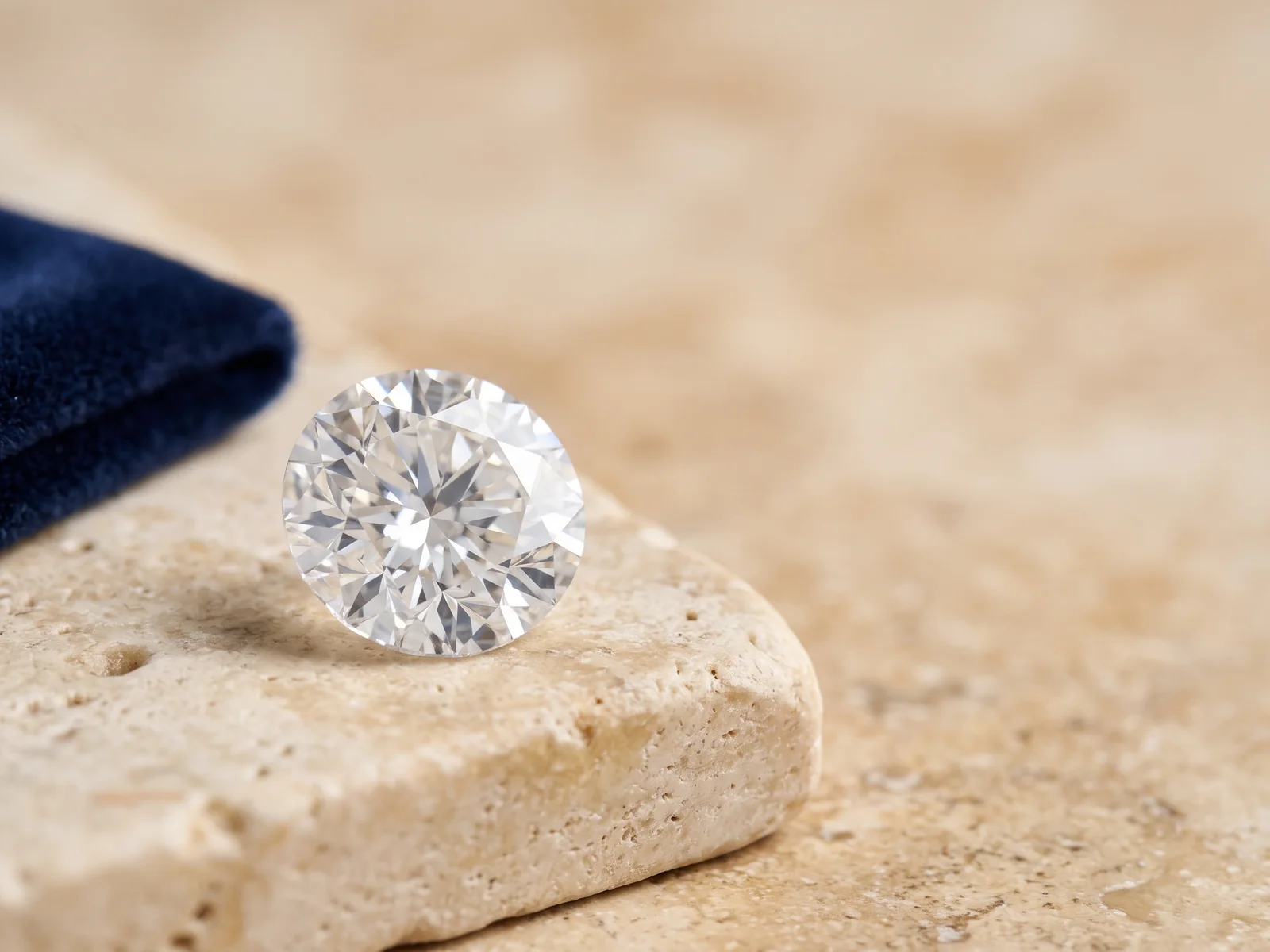
 Reviewed by Raj Sood, Graduate Gemologist (GIA), AJP (GIA)Master jeweller and Graduate Gemologist (GIA) · reviewed 4 November 2026
Quick answer
Graining in diamonds is a growth or strain feature: faint lines, haze or colourless reflections caused by irregular crystal growth or plastic deformation. Most graining is harmless to durability and invisible to the eye. It only matters when it lowers clarity to SI or below, creates visible haze or reaches the surface as grain lines that resist polish.
What is graining in diamonds?
Graining is the gemmologist's word for irregularities in a diamond's crystal structure. A diamond is carbon atoms locked in a repeating cubic lattice. Where that lattice grew unevenly, or was bent and squeezed after it formed, the change shows up as faint lines, bands, a soft haze or a colourless reflection that flashes as the stone moves. Nothing foreign is trapped inside. Graining is the diamond itself, slightly out of step with the crystal around it.
Grading labs treat graining as a clarity characteristic, one of the features they weigh when they assign a clarity grade. Clarity is the C that our guide to colour, cut, clarity and carat explains in full. Internal graining sits inside the stone and counts as an inclusion. Surface graining reaches the polished facets and counts as a blemish (a feature confined to the surface).
Graining is common. Under a 10× loupe, the standard grading magnification, many natural diamonds show at least a trace of it, and it is one of the least worrying things you can find in a stone. Our wider diamond education hub covers the other inclusion types, and any unfamiliar word on this page is defined in the GemTrove jewellery glossary.
How does graining form in natural and lab-grown diamonds?
Natural diamonds crystallise roughly 150–200 km below the surface, under enormous pressure and at temperatures of around 900–1,300 °C. They can spend a very long time down there before an eruption carries them up. That long, violent history is where most graining comes from. There are three main causes:
- Irregular growth: different zones of the crystal grow at different speeds or take in different amounts of nitrogen. The boundaries between those zones can show as straight lines or faint colour bands.
- Plastic deformation: after growth, pressure and movement in the mantle bend the lattice along its octahedral planes, much as a deck of cards slides when you push it. This leaves sets of parallel lines, often called deformation lines or glide planes.
- Twinning: part of the crystal changes direction along a twin plane. Graining often runs along that plane, and it is closely related to the twinning wisps that form where twin planes trap tiny crystals.
Plastic deformation also explains most natural brown and pink diamonds. The colour sits in thin parallel bands that follow the deformation, which gemmologists call coloured graining. Pink diamonds from Western Australia's Argyle mine, which closed in 2020, are well known for their pink grain lines. When brown type IIa diamonds (a rare, nitrogen-poor type) are treated with high pressure and high temperature (HPHT) to lighten their colour, the brown can fade but the graining and strain usually remain. Any such treatment must be disclosed on the report.
Lab-grown diamonds are real diamond, grown in a laboratory rather than mined. They can show growth features too. HPHT lab-grown diamonds grow in distinct sectors that sometimes show as faint banding, while CVD (chemical vapour deposition) diamonds grow layer by layer on a seed plate and can show fine striations or strain running in the growth direction. In most well-grown laboratory-grown stones these features are hard to see at 10×, but labs use them, with fluorescence imaging and a polariscope (a viewer with crossed polarising filters that reveals strain), to help confirm whether a diamond is natural or lab-grown.
What types of graining do grading labs describe?
Graders describe graining by how it looks, not just by what caused it. Four internal types and one surface type cover almost everything you will see:
| Type | What it looks like | Inside or surface | Usual effect |
|---|---|---|---|
| Colourless (transparent) graining | Faint lines or ripples, like heat shimmer, seen only at certain angles | Inside | Rarely affects appearance; can set the grade in VVS–VS stones |
| Whitish graining | Milky lines, bands or a soft haze | Inside | In strong amounts lowers transparency and can make a stone look hazy |
| Coloured graining | Brown, pink or yellowish bands or lines | Inside | Can shape the colour impression; common in natural brown and pink diamonds |
| Reflective graining | A flat plane that flashes like a mirror as the stone tilts | Inside | Can be mistaken for a feather at first glance; usually harmless |
| Surface graining | Fine lines on the facets that run across facet junctions | Surface | A blemish; affects the polish grade only when prominent |
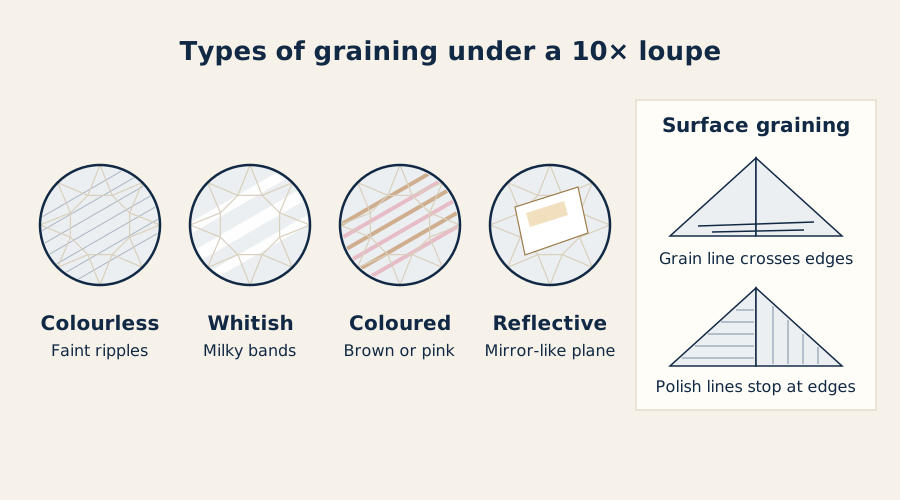
Surface graining appears where a grain boundary meets a facet. The two sides of the boundary have slightly different crystal orientations, so they polish at different rates and the polishing wheel leaves a fine step or line. It is part of the diamond, so polishing cannot remove it. Our page on how polish grades from Excellent to Poor are set covers how graders weigh it.
A related polishing feature is lizard skin, a wavy, textured patch left when a facet is polished too close to the diamond's natural grain direction. See our guide to burn marks, lizard skin and other polishing marks for how these differ.
Where does graining show on a diamond grading report?
A full grading report includes a plot diagram, a map of the diamond's crown (top) and pavilion (bottom) with symbols showing each clarity characteristic. Inclusions are drawn in red and blemishes in green. Graining is the odd one out, because it is often spread through the stone and hard to draw as a single symbol.
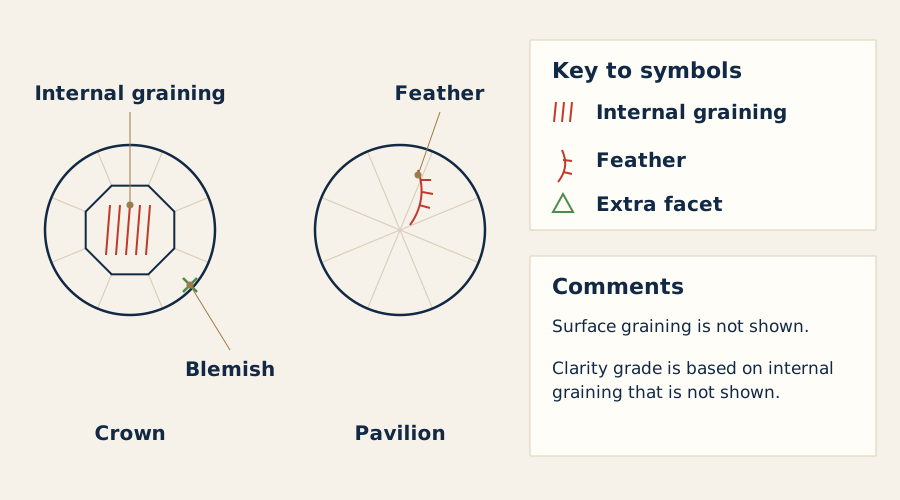
Here is what to look for:
- Key to symbols: if internal graining appears here, it was significant enough to draw on the plot, often as a series of red lines.
- Comments: "Internal graining is not shown": graining is present but was left off the plot. It may or may not influence the grade.
- Comments: "Surface graining is not shown": grain lines reach the facets but were judged minor.
- Comments: "Clarity grade is based on internal graining that is not shown": the most important wording. Graining is the main reason for the grade, so look at the stone itself before you decide.
Smaller-format reports for diamonds under about 2 carats sometimes have no plot at all, so the comments are your only clue. GIA and IGI both note graining on natural and laboratory-grown diamond reports, and the report will always state whether the stone is natural or lab-grown.
Not sure which one is right?
Send us the stones you are looking at and our gemologist will tell you which to choose and why.
Does graining in diamonds affect the clarity grade?
It can. Graders consider five things for every characteristic: size, number, position, nature and relief (how much it stands out from the surrounding diamond). Graining usually has low relief, because it is the same material as the rest of the stone, so a fair amount of it can be present before the grade drops. The table shows the typical pattern:
| Clarity grade | What graining typically looks like at that grade |
|---|---|
| FL (Flawless) | No surface graining at 10×; only faint colourless internal graining that does not affect transparency may be permitted |
| IF (Internally Flawless) | Only faint colourless internal graining may be permitted, plus very slight surface graining |
| VVS1–VVS2 | Faint colourless internal graining is a common grade-setting feature |
| VS1–VS2 | More noticeable lines or light whitish bands, seen with effort at 10× |
| SI1–SI2 | Strong whitish or reflective graining easily seen at 10×; may soften transparency |
| I1–I3 | Heavy graining causing haze visible without magnification |
Position matters. Graining under the table (the large top facet) is easier to see than graining near the girdle (the thin outer edge). Graining is also directional: it can be obvious with the stone tilted one way and disappear when you turn it a few degrees, which is why two graders can see the same stone slightly differently.
Is a diamond with graining eye-clean?
In most cases, yes. An eye-clean diamond is one with no clarity characteristics you can see without magnification, face-up, at a normal viewing distance of about 25–30 cm. Colourless graining almost never shows at that distance, and reflective graining rarely does, even in SI grades, so a VS or SI stone graded down for graining often looks as clean as a VVS. Our guide to finding eye-clean diamonds explains how to judge this grade by grade.
The exception is whitish graining. In strong amounts it scatters light and gives the diamond a soft, slightly milky look, with less contrast between bright and dark facets. It can resemble the oily look a small minority of stones with very strong blue fluorescence under ultraviolet light show in sunlight. A hazy diamond can still have an Excellent cut grade, so if the report says the clarity grade is based on graining that is not shown, see the stone or a sharp video in daylight before you commit.
For brightness, cut matters far more than a trace of graining. A well-proportioned stone returns enough light to overwhelm faint internal lines; our comparison of Excellent, Very Good and Good cut grades shows the difference that makes.
Is graining in diamonds a durability risk?
For everyday wear, the risk is low. Graining is not a crack and is not open to the surface. Diamond is 10 on the Mohs hardness scale, with a refractive index of about 2.42, and a grained diamond keeps both. That puts graining in a different category from a feather (an internal fracture), from bearding, the fine hair-like fractures along the girdle, or from etch channels, natural tunnels that reach the surface, all of which can matter for durability.
Where graining does matter is at the bench. Heavily grained or strained areas, which cutters call knots or hard spots, resist the polishing wheel, so recutting a chipped stone or repolishing a scratched facet can take longer and may not finish perfectly. Some jewellers also check strongly strained stones under a polariscope before heavy setting work or a repair involving heat, as a precaution.
- Everyday wear: no special care beyond normal diamond care.
- Cleaning: ultrasonic cleaning is generally fine for diamonds with graining alone; avoid it if the stone also has surface-reaching feathers.
- Setting and repairs: tell your jeweller the report mentions graining, so they can plan claw work and any repolishing.
How is graining different from twinning wisps, feathers and polish lines?
Graining is often confused with other features at 10×. This table sets out the differences:
| Feature | What it is | Inside or surface | Durability risk |
|---|---|---|---|
| Graining | Irregular or deformed crystal structure | Either | Low |
| Twinning wisp | Pinpoints, clouds and graining along a twin plane | Inside | Low |
| Feather | An internal fracture or crack | Inside, may reach surface | Low to high, depending on size and position |
| Polish lines | Fine parallel marks from polishing that stop at facet edges | Surface | None |
| Laser drill hole | A treatment channel drilled to reach a dark inclusion | Reaches surface | Low; must be disclosed |
| Pit | A tiny surface cavity | Surface | Very low |
The quickest test is the facet edge. Polish lines stay within one facet; surface grain lines run straight across facet junctions because they follow the crystal, not the wheel. Inside the stone, a feather has visible depth and catches light at its edges, while reflective graining is flat and featureless. Laser channels look like fine white tubes leading to the surface; see how laser drilling works and how it is disclosed. Small surface cavities and stray facets are covered in our page on pits and extra facets that affect polish and symmetry.
Related guideTwinning Wisps in DiamondsShould you buy a diamond with graining?
Often it is a sensible choice. A VS2 or SI1 diamond graded down for colourless graining usually looks no different face-up from a stone two grades higher, and the lower clarity grade costs less. That saving can go towards carat weight, colour or a better cut, which is exactly the trade-off weighed in choosing between a bigger diamond and a better grade.
Be more careful with whitish graining that causes haze, with coloured graining in a stone sold as near-colourless, and with any stone whose grade is based on graining you cannot inspect. If face-up size is the goal, the cut and setting tricks in ways to make a diamond look bigger do more than chasing a higher clarity grade.
Both natural and lab-grown diamonds can carry graining comments, and lab-grown diamonds cost much less than natural diamonds of the same grades. If you are comparing a solitaire with a cluster or multi-stone ring, check the weight terms too; our explainer on ct, ctw and tcw carat weight terms shows how to read them.
Browse natural and lab-grown diamonds
How to check a diamond for graining: step by step
- Read the report comments. Look for "Internal graining is not shown", "Surface graining is not shown" or "Clarity grade is based on internal graining".
- Check the key to symbols. If graining is drawn on the plot, note where it sits, especially under the table.
- View the stone at 10× and rotate it. Tilt it slowly through several angles; graining appears and disappears with direction.
- Check face-up at 25–30 cm in daylight. Judge whether it is eye-clean and whether the stone looks crisp or slightly hazy, using the checks in our eye-clean checklist by clarity grade.
- Look along the facet edges. Lines that cross from one facet to the next are surface graining, not polish lines.
- Ask about strain for strongly grained stones. A polariscope view shows how much strain is present before setting or repair work.
Free consultation
Talk to a gemologist
Compare stones in person or online with Raj Sood, Graduate Gemologist (GIA), AJP (GIA).
Book a consultationShop this shape
FAQ
Common questions
What is graining in a diamond?
Graining is an irregularity in the diamond's crystal structure, caused by uneven growth or by the crystal being bent under pressure. It shows as faint lines, haze or reflections and is part of the diamond itself, not a trapped mineral.
Is diamond graining bad?
Usually not. Most graining is invisible to the eye and does not weaken the stone in normal wear. Strong whitish graining that makes a stone look hazy is the main type to avoid.
What does "internal graining is not shown" mean on a report?
It means the grader found internal graining but did not draw it on the plot diagram. If the comment says the clarity grade is based on that graining, inspect the stone or a clear video before deciding.
Does graining affect diamond clarity?
It can. Faint graining is a common reason a stone grades VVS rather than IF, and stronger whitish or reflective graining can push a stone to VS or SI.
Can lab-grown diamonds have graining?
Yes. Laboratory-grown diamonds can show growth banding or strain from the HPHT or CVD process, although it is often hard to see at 10×. The report will state that the diamond is lab-grown.
Can graining be polished out?
No. Graining is part of the crystal, so polishing cannot remove it, and surface grain lines usually remain after repolishing. Grained areas can also make repolishing slower.

Ask a gemologist
Not sure which diamond to choose?
Raj Sood is a Graduate Gemologist (GIA) and master jeweller. Bring the stones you are considering, or send the reports, and he will tell you honestly which one is better and why.
Keep learning
Related guides
 Diamond 4Cs & GradingTwinning Wisps in DiamondsDiamond 4Cs & GradingEye Clean DiamondsDiamond 4Cs & GradingDiamond Polish Grades ExplainedDiamond 4Cs & GradingEtch Channels in DiamondsDiamond 4Cs & GradingDiamond 4Cs
 Diamond 4Cs & GradingDiamond EducationDiamond 4Cs & GradingFluorescence
 Diamond 4Cs & GradingExcellent vs Very Good vs Good Cut Diamonds
Explore more
More guides on this topic
Education