
Gemstones
Australian Opal Fields: Lightning Ridge, Coober Pedy and Queensland Boulder
Most types of precious opal have a home town, and the Australian opal fields are the reason. Knowing where an opal was mined tells you what to expect from its body tone, structure and price.
 Reviewed by Raj Sood, Graduate Gemologist (GIA), AJP (GIA)Master jeweller and Graduate Gemologist (GIA) · reviewed 4 November 2026
Quick answer
Australia's main opal fields sit along the Great Artesian Basin. Lightning Ridge in New South Wales is known for black opal, Coober Pedy and Andamooka in South Australia for white and crystal opal, and western Queensland, around Winton, Quilpie and Yowah, for boulder opal set in ironstone. Each field's geology shapes the opal's body tone and character.
Where are the Australian opal fields?
Australia's precious opal comes from a broad arc of outback country across three states, all sitting on the rocks of the Great Artesian Basin. The fields are small towns and mining leases scattered over hundreds of kilometres, but they fall into three groups, each with its own signature stone.
- New South Wales: Lightning Ridge and the nearby Grawin and Glengarry fields, home of Lightning Ridge black opal. White Cliffs, further west, was the first commercial field.
- South Australia: Coober Pedy, Andamooka, Mintabie and Lambina, the main source of white or light opal and much of the world's crystal opal.
- Queensland: a long belt from around Winton down through Opalton, Quilpie, Yowah and Koroit, where boulder opal forms inside ironstone.
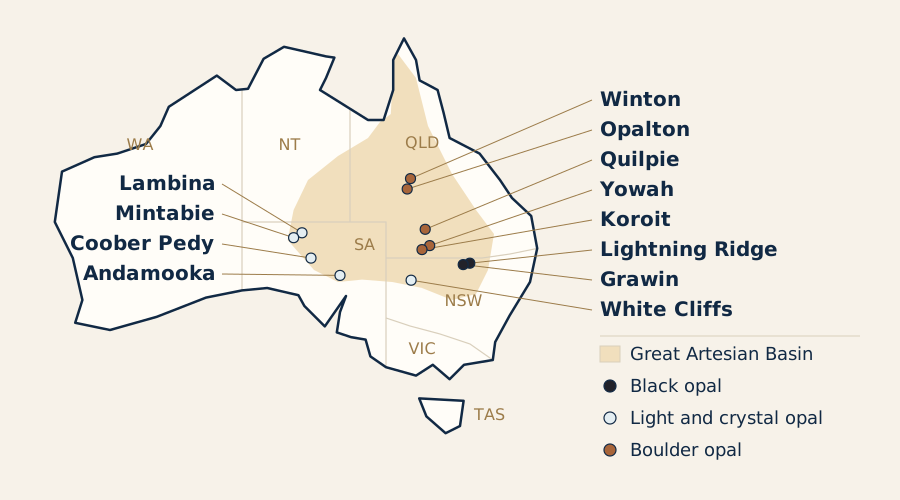
Opal is a gem where origin really does change what you are looking at. A black opal and a white opal can share the same chemistry, yet they come from different ground, are cut differently and are priced on different scales. If you are new to coloured stones, our wider gemstone guides are a good place to start.
How did opal form in the Great Artesian Basin?
Precious opal is hydrated amorphous silica, written SiO2·nH2O. Amorphous means it has no crystal structure, unlike quartz, which is the same silica arranged in a crystal lattice. Australian sedimentary opal usually holds roughly 6–10% water locked inside it. Our guide to the chemistry of opal and other gemstones compares it with diamond, sapphire and emerald.
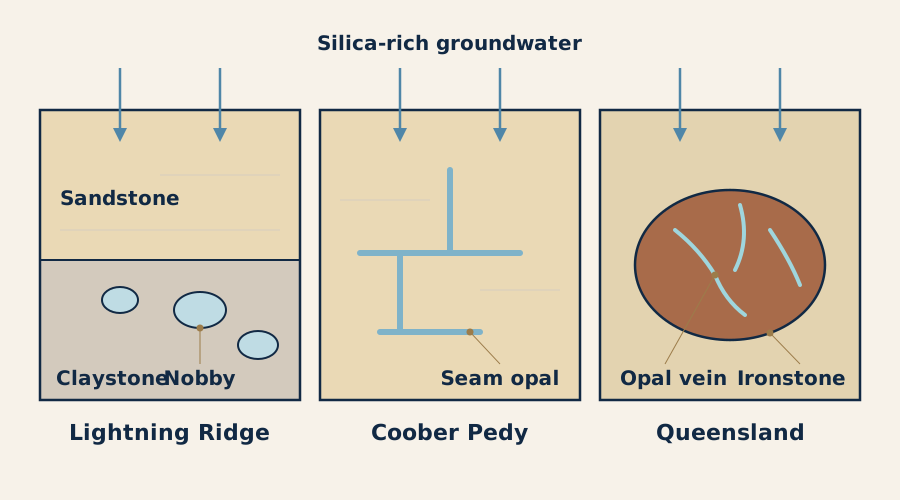
Around 100–120 million years ago, much of inland Australia lay under a shallow inland sea. It left layers of sandstone and claystone behind. Over a very long time, weathering released silica from those rocks, and silica-rich groundwater seeped down into cracks, voids, fossil shells and the cores of ironstone nodules. As the water slowly drained away, the silica settled out as tiny spheres.
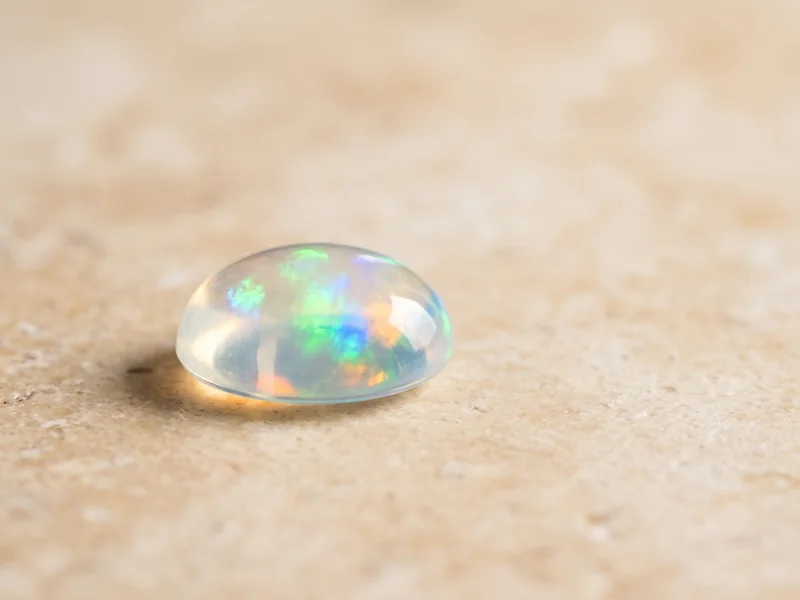
Play-of-colour, the flashes that move as you tilt an opal, happens when those spheres are all the same size and stacked in neat rows. Light is diffracted by the regular gaps between them, much like a diffraction grating. Spheres of roughly 150–300 nanometres produce colour; the larger the spheres, the further the colour moves towards red. That is why red play-of-colour is the rarest. Where the spheres are jumbled, you get potch: common opal with no play-of-colour. Terms like these are explained in our jewellery glossary.
What makes Lightning Ridge black opal special?
Lightning Ridge in north-western New South Wales is the field most people think of first, because it is the main source of black opal. Black opal was first sold commercially from the Ridge in the early 1900s, and it is still found in very few places in the world in meaningful amounts.
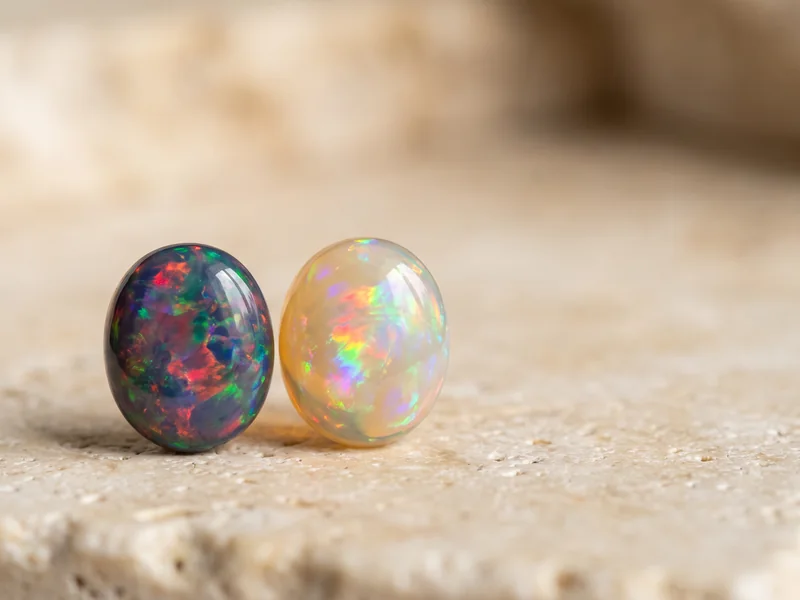
The opal here forms mostly as nobbies: rounded nodules found in a claystone layer below the sandstone, often a few metres to around 20 metres down. Many nobbies have a dark potch base, and when a cutter leaves a thin layer of that dark potch behind the bright colour bar, the colour glows against it like a lamp in a dark room.
Opal body tone is the background darkness of the stone, graded on a scale from N1 (black) to N9 (white). True black opal sits at about N1–N4; dark or semi-black is roughly N5–N6. Lightning Ridge also produces light and crystal opal, so not every Ridge stone is black. Our guide to how black opal is graded covers body tone, brightness and pattern in detail.
Because of this, Lightning Ridge stones carry the highest prices of any Australian opal. As a rough guide, top-grade black opal with bright red play-of-colour can sell for several thousand to well over AUD 10,000 per carat, while dark opal with patchy or dull colour costs a small fraction of that.
What opal comes from Coober Pedy and South Australia?
Opal was found at Coober Pedy in 1915, and the town grew into the largest opal field in the world by area and output. Many residents still live in dugouts, homes cut into the hillsides to escape the summer heat.
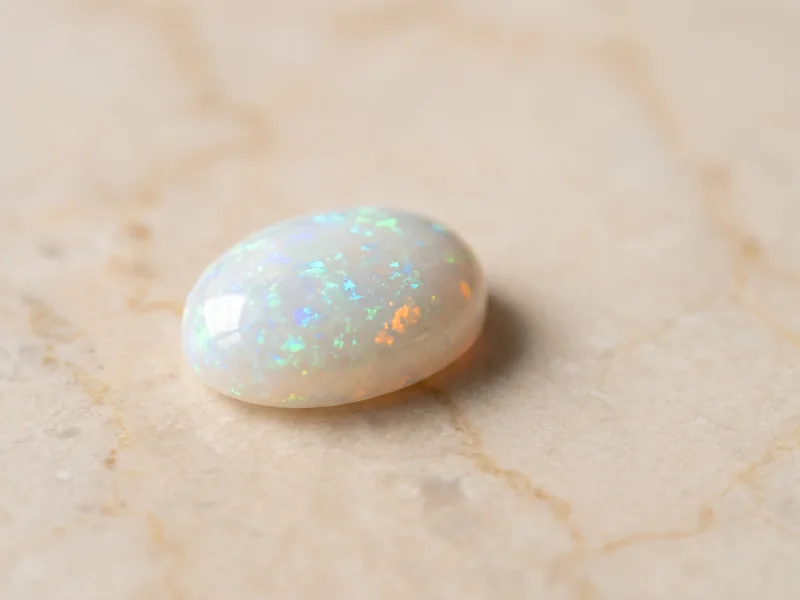
South Australian opal is mostly seam opal: thin, flat veins in sandstone and claystone rather than rounded nobbies. Most of it has a light body tone (around N7–N9), which is the classic milky light opal that most Australians picture. The field also yields clear, glassy stones, and crystal opal from Coober Pedy can show play-of-colour that seems to float inside the stone.
- Coober Pedy: white, milky and crystal opal, plus the thin seams used to make doublets and triplets.
- Andamooka: found in 1930; known for high-quality crystal and white opal, and for matrix opal, where opal fills the pores of the host rock. Andamooka matrix is often treated with a sugar-and-acid process to darken the background, which must always be disclosed.
- Mintabie and Lambina: smaller fields that have produced some darker and semi-black opal, closer in look to Lightning Ridge stones.
Light opal is the most affordable precious opal, and it is the traditional October birthstone. As a rough guide, good commercial white opal often sells from tens to a few hundred AUD per carat; bright, clean crystal opal costs considerably more.
Not sure which one is right?
Send us the stones you are looking at and our gemologist will tell you which to choose and why.
What is Queensland boulder opal?
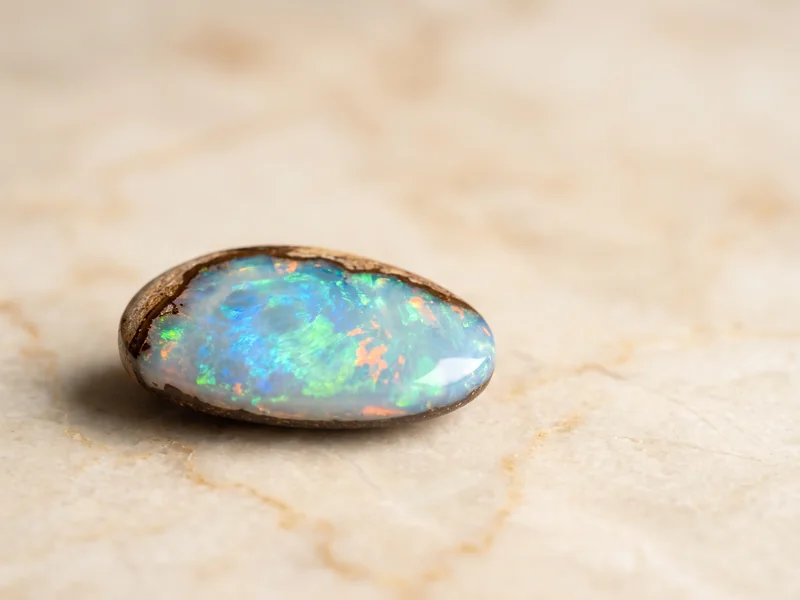
Western Queensland produces boulder opal, which forms in cracks and cavities inside ironstone boulders and concretions. The opal veins are usually thin, so cutters leave the natural brown ironstone on the back. The result is a solid, natural stone in two materials: bright opal on the face and ironstone behind it, sometimes with ironstone streaks across the surface.
Because the ironstone backing is dark, boulder opal often has a body tone similar to black opal and can show very strong colour, but it costs less carat for carat because the ironstone adds weight. It is also cut to follow the vein, so shapes are often freeform and the surface can undulate. Our full boulder opal guide goes deeper into grading.
- Winton and Opalton: boulder opal in larger ironstone boulders; Opalton was among the early Queensland fields of the late 1800s.
- Quilpie and Koroit: boulder opal, including pieces with broad colour bars and pictorial patterns.
- Yowah: known for Yowah nuts, small ironstone nodules, often walnut-sized or smaller, with a kernel of opal inside. Yowah also produces boulder matrix, where the opal is spread through the ironstone as a fine web.
Boulder opal is usually stable and tough for its type, because the ironstone supports the thin opal layer. Prices vary widely by piece, from roughly a few hundred to several thousand AUD for fine stones.
What about White Cliffs and Australia's other gem fields?
White Cliffs, in far-western New South Wales, became Australia's first commercial opal field in the 1890s. It is known for light opal and for unusual opalised fossils and "pineapples": clusters of crystal-shaped opal that replaced an earlier mineral. Opalised shells, bones and wood also turn up at Lightning Ridge and Coober Pedy, because opal can fill the space left by a fossil.
Opal is not Australia's only gem story. The Australian sapphire fields of Inverell and Anakie sit in old volcanic country rather than sedimentary basins, and they also produce natural zircon alongside the sapphire. In central Queensland and Western Australia, nickel-bearing rocks yield chrysoprase, sometimes called Australian jade, although it is not true jade.
How do the Australian opal fields compare?
| Lightning Ridge (NSW) | Coober Pedy and Andamooka (SA) | Western Queensland | |
|---|---|---|---|
| Signature opal | Black and dark opal | White, light and crystal opal | Boulder opal and matrix |
| Typical body tone | N1–N6, plus some light | N7–N9 | Dark (from ironstone backing) |
| How it occurs | Nobbies in claystone | Thin seams in sandstone and claystone | Veins and kernels in ironstone |
| How it is cut | Solid stones, often cabochons | Solid stones; thin seams used for doublets and triplets | Solid with natural ironstone back, often freeform |
| Relative price | Highest | Most affordable to mid-range | Mid to high, depending on colour |
| Common treatments to ask about | Rare; check for doublets | Doublets, triplets; sugar-acid on Andamooka matrix | Usually untreated; check for added backing |
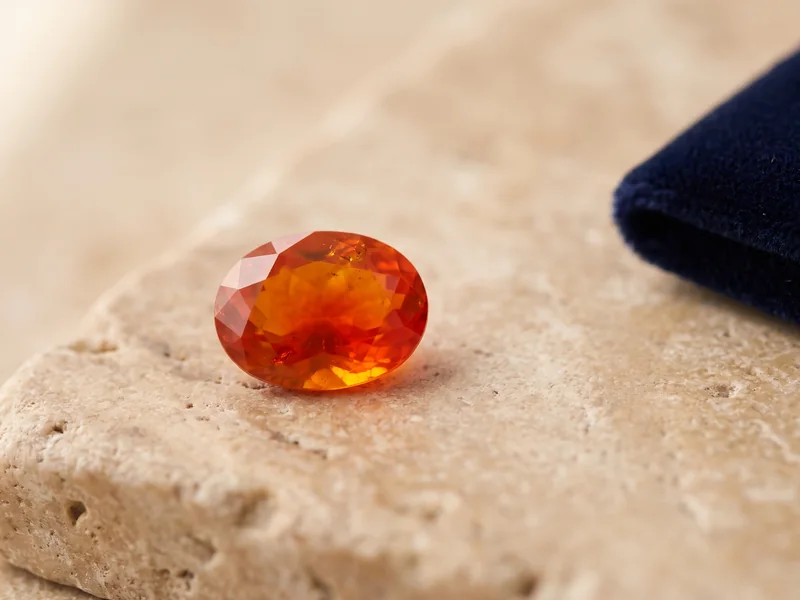
Fire opal is a different story. True Mexican-style fire opal is transparent orange to red body colour, mostly from volcanic rocks in Mexico, and is not a product of these fields. In Australian trade, "fire" simply means play-of-colour.
| Australian sedimentary opal | Ethiopian (Welo) opal | |
|---|---|---|
| Geology | Sedimentary basins | Volcanic rock |
| Water behaviour | Generally stable; low porosity | Often hydrophane: absorbs water and can turn clear temporarily |
| Typical body tone | Full range, from black to white | Mostly white to crystal; dark stones are often treated |
| Price | Higher for comparable colour | Usually lower |
Can you tell which field an opal came from?
Sometimes, by an experienced eye, but there is no lab test that reliably proves field of origin for opal. Body tone, the way the stone sits on its potch or ironstone, its shape and its pattern all give strong hints, and a dealer who buys from the fields will usually know. Treat origin as part of the seller's description, and ask for it in writing.
What matters more than the field is whether the opal is solid, assembled or synthetic:
- Solid opal: one piece of natural opal, which can include its natural ironstone or potch backing.
- Doublet: a thin slice of natural opal glued to a dark backing, such as black potch, ironstone or glass, to imitate black opal.
- Triplet: a doublet with a clear dome of quartz or glass on top to protect the thin opal.
- Lab-created opal: synthetic opal grown in a laboratory since the 1970s. It often shows a regular "chicken-wire" or snakeskin pattern under magnification, and it must always be sold as lab-created or synthetic.
Doublets and triplets are honest products when they are disclosed, and they cost far less than solid opal. Look at the stone side-on: a straight glue line between two materials is the giveaway.
Browse natural gemstones in our stock
Is Australian opal good for everyday jewellery?
Opal is softer than most ring stones, at 5.5–6.5 on the Mohs scale, compared with 9 for sapphire and 10 for diamond. Everyday dust contains quartz at about 7, so an opal's polish will dull over years of daily wear and may need re-polishing. Opal also dislikes knocks, sudden temperature changes and harsh chemicals.
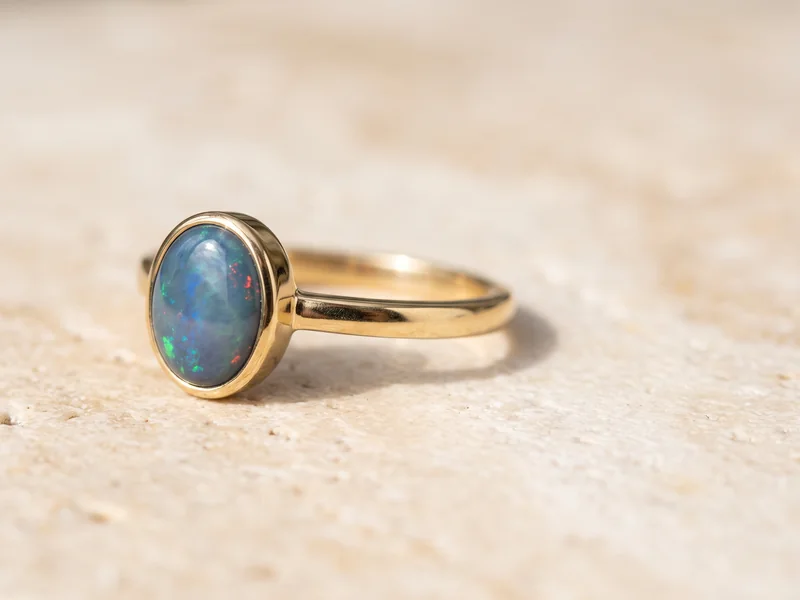
Pendants and earrings are the easiest way to wear it. In a ring, a bezel (a rim of metal around the edge) protects opal much better than claws. Solid opal handles water fine, but doublets and triplets should be kept out of soaking water, because the glue can lift and cloud. Our guide to opal engagement ring wear and care covers settings and cleaning, and if you want an Australian stone that copes with heavier wear, consider an Australian sapphire engagement ring.
Crazing, a network of fine surface cracks caused by water loss, is uncommon in Australian sedimentary opal but worth checking for with a 10× loupe before you buy.
How to choose an Australian opal: step by step
- Choose the type first. Decide between black (Lightning Ridge), light or crystal (South Australia) and boulder (Queensland), since each is priced on its own scale.
- Ask what it is. Confirm solid, doublet, triplet or lab-created opal, plus the field of origin and any treatment, in writing.
- Judge the colour. Check body tone, brightness and which colours appear; red is rarest, then orange, green and blue.
- Look at the pattern and the face. Even colour across the face and an attractive pattern add value; dead spots and large potch areas reduce it.
- Check the side and the surface. Use a loupe for glue lines, cracks or crazing, and look at the ironstone on boulder opal.
- Plan a protective setting. A bezel or partial bezel for rings, and clear care habits for everyday wear.
Free consultation
Talk to a gemologist
Compare stones in person or online with Raj Sood, Graduate Gemologist (GIA), AJP (GIA).
Book a consultationShop this shape
FAQ
Common questions
Where does most Australian opal come from?
By volume, South Australia's fields, led by Coober Pedy and Andamooka, have produced most of Australia's opal, mostly light and crystal opal. Lightning Ridge in NSW produces less but is the main source of black opal, and western Queensland produces boulder opal.
Why is Lightning Ridge black opal so expensive?
Its dark body tone makes play-of-colour appear brighter, and black opal is found in commercial amounts in very few places. Fine stones with bright red colour are especially rare.
Is boulder opal real opal?
Yes. Boulder opal is solid natural opal that formed inside ironstone, and the ironstone left on the back is part of the natural stone, not an added backing.
What are Yowah nuts?
Yowah nuts are small ironstone nodules from the Yowah field in Queensland with a kernel or web of opal inside. They are usually cut in half to show the opal.
Is Australian opal better than Ethiopian opal?
They are different rather than better or worse. Australian sedimentary opal is generally stable and spans black to white body tones, while Ethiopian opal is volcanic, often absorbs water and usually costs less.
Can you visit the Australian opal fields?
Yes. Lightning Ridge, Coober Pedy, Andamooka and Winton all welcome visitors, with mine tours, galleries and designated fossicking areas, though rules vary by state and field.
Terms in this guide

Ask a gemologist
Not sure which diamond to choose?
Raj Sood is a Graduate Gemologist (GIA) and master jeweller. Bring the stones you are considering, or send the reports, and he will tell you honestly which one is better and why.
Keep learning
Related guides
Explore more
More guides on this topic
Education