
Gemstones
Tanzanite: The Complete Gemstone Guide
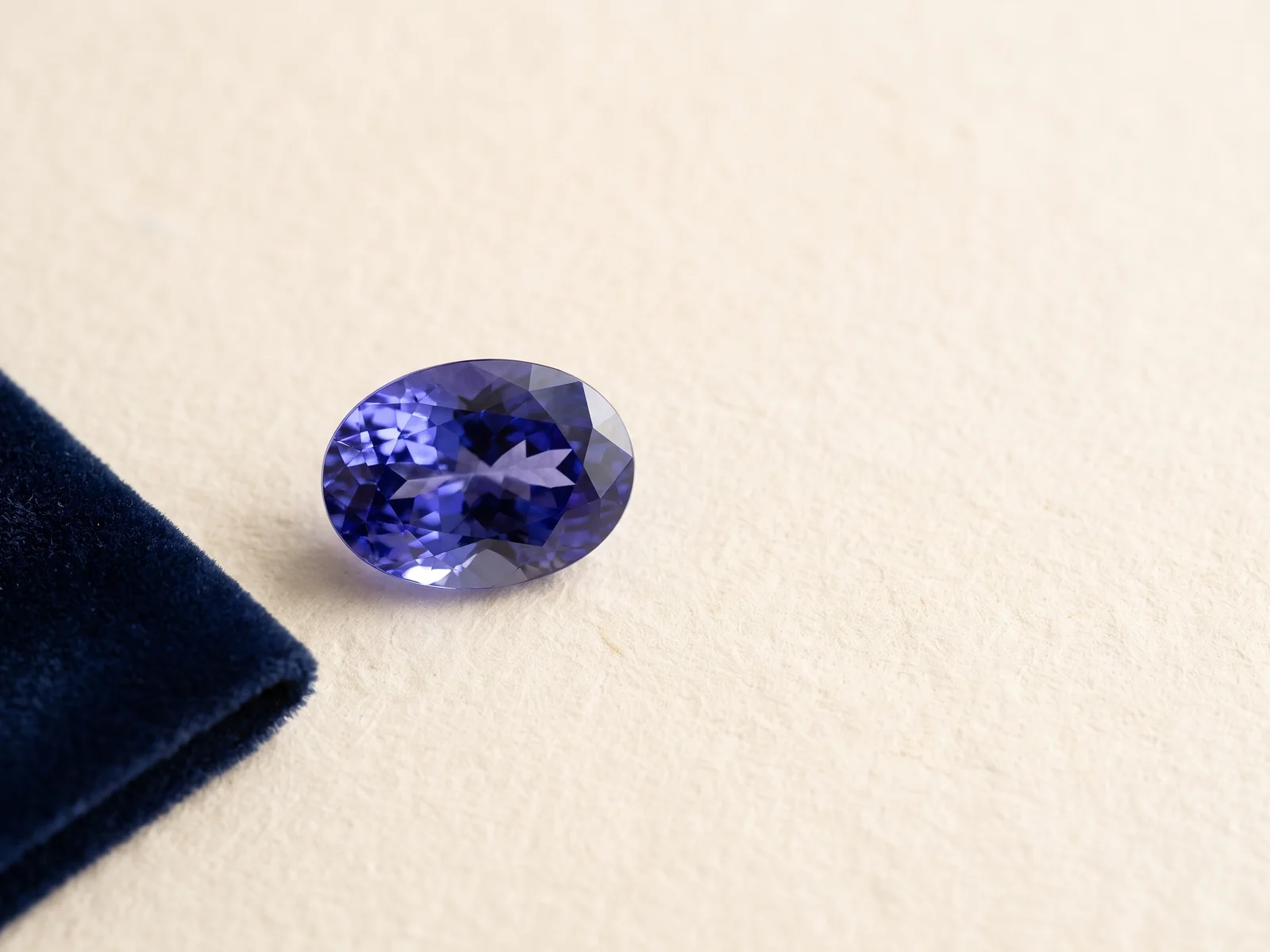
Tanzanite shifts between blue and violet as you turn it, and it comes from one small area of northern Tanzania. It is also softer than it looks, so how you choose, set and care for it matters more than with most blue gems.
 Reviewed by Raj Sood, Graduate Gemologist (GIA), AJP (GIA)Master jeweller and Graduate Gemologist (GIA) · reviewed 4 November 2026
Quick answer
Tanzanite is the blue-to-violet variety of the mineral zoisite, mined commercially only in the Merelani Hills of northern Tanzania. Almost all stones are heat treated to remove brownish tones. It rates 6–7 on the Mohs scale with one perfect cleavage, so it suits pendants, earrings and carefully set rings better than hard daily wear.
What is tanzanite?
Tanzanite is the blue-to-violet gem variety of zoisite, a calcium aluminium silicate mineral with the formula Ca2Al3(SiO4)(Si2O7)O(OH). Its colour comes from traces of vanadium in the crystal. Zoisite also forms in green, pink (called thulite) and brown, but only the blue-violet material is sold as tanzanite.
It is one of the youngest of the well-known coloured gemstones. Gem-quality crystals were found in the Merelani Hills of Tanzania in 1967, and the name was given in 1968 by Tiffany & Co., who introduced it to the wider market. In 2002 it was added to the modern birthstone list, so it now sits alongside zircon and turquoise as one of the December birthstones.
Here are the properties a gemmologist uses to describe it. If any term is new, our jewellery glossary explains it in plain English.
| Property | Tanzanite |
|---|---|
| Mineral | Zoisite (blue-violet variety) |
| Crystal system | Orthorhombic |
| Mohs hardness | 6–7 |
| Toughness | Fair to poor |
| Cleavage | Perfect in one direction |
| Refractive index | about 1.691–1.700 |
| Birefringence | about 0.008–0.013 |
| Specific gravity | about 3.35 |
| Pleochroism | Strong; three colours in untreated rough |
What colour is tanzanite, and why does it change?
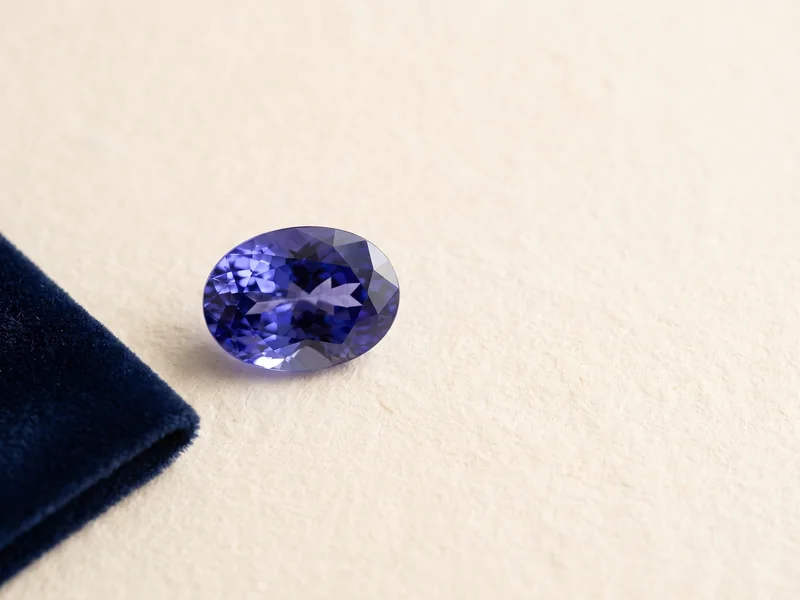
Tanzanite ranges from pale lavender through violetish blue to a deep, saturated blue-violet. What makes it unusual is pleochroism: the crystal shows different colours when you look along different directions. Untreated rough is trichroic, showing blue, violet and a brownish-yellow or bronze colour. After heating, the bronze direction turns violet, leaving a stone that flashes blue and violet as it moves.
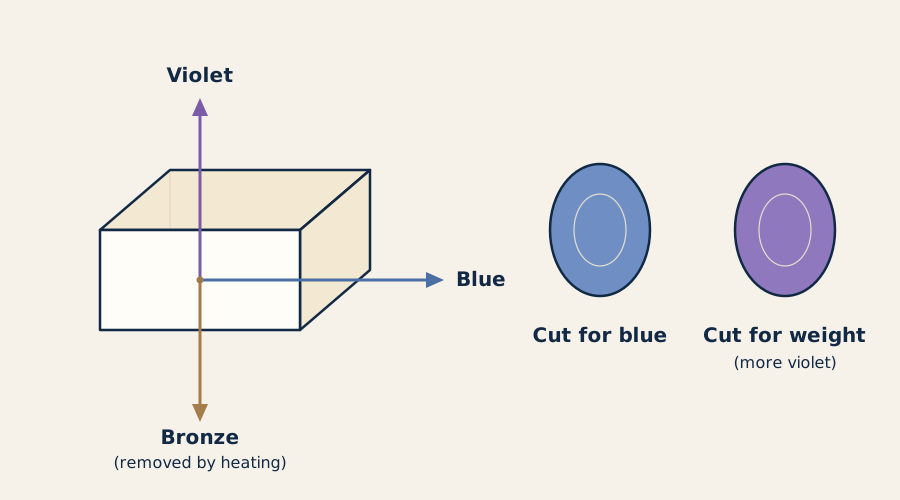
Because of this, the cutter decides the face-up colour. Orienting the table to look down the blue direction gives a bluer stone, often at the cost of more weight lost from the rough. Orienting for weight usually gives a more violet stone. Neither is wrong; it is a trade-off between colour and carat.
Lighting changes it too. In daylight or cool white LED, tanzanite looks bluer. Under warm indoor light it leans violet, sometimes with purple-red flashes. Size matters as well: colour deepens as stones get larger, so stones under about 1 carat are often paler, while 3 carat and up can be intensely saturated.
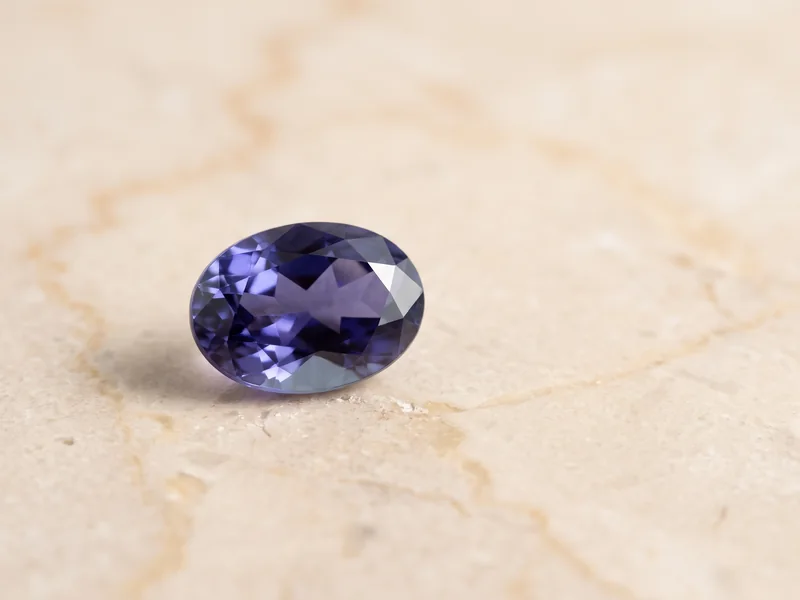
Other gems share this colour-shifting habit. Iolite is strongly pleochroic in violet-blue and grey, and pink kunzite also shows deeper colour along one direction. If you want blue without the shift, opaque lapis lazuli gives a steady royal blue.
Where is tanzanite mined?
All commercial tanzanite comes from the Merelani Hills in the Manyara Region of northern Tanzania, in the plains below Mount Kilimanjaro. The mining area is small, often described as only a few square kilometres, and is divided into blocks worked by both large operators and small-scale miners. In 2018 the Tanzanian government built a perimeter wall around the area to control the trade.
A single source means supply goes up and down with that one area's output, and the deposit is finite. Small finds of blue zoisite have been reported elsewhere, but none has produced tanzanite commercially. If a seller claims a tanzanite came from somewhere other than Tanzania, ask what evidence supports it.
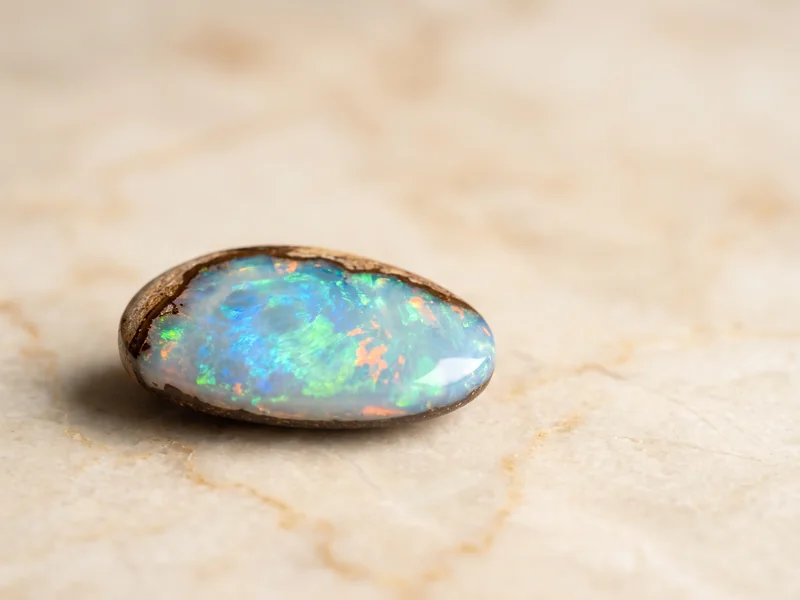
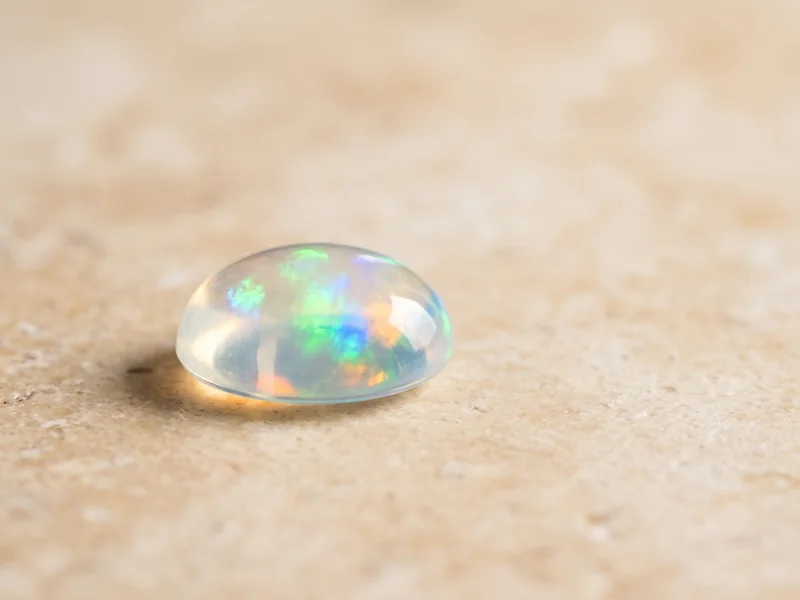
Tanzanite is not found in Australia. If an Australian origin matters to you, the gems with a real local story are sapphire from Queensland and New South Wales, and opal: dark-backed Queensland boulder opal and the transparent crystal opal from fields such as Lightning Ridge and Coober Pedy.
Is tanzanite heat treated?
Almost always. Most tanzanite rough comes out of the ground with a brownish or greenish-yellow component. Heating it to roughly 400–600°C removes that colour and leaves the blue and violet. The change is permanent and stable, it does not fade, and in most cases a lab cannot tell whether a particular stone was heated. The trade treats heated tanzanite as the norm, and you should assume any stone you see has been heated unless it carries specific evidence otherwise.
Some crystals near the surface were heated naturally by geological processes and come out blue, but proving a stone is unheated is rarely possible, so unheated claims deserve caution.
The treatment to watch for is coating. Since the late 2000s, some pale tanzanite has been given a thin surface coating, often containing cobalt, to deepen the colour. Unlike heating, a coating can scratch or wear off with cleaning and everyday contact. Under magnification it can show iridescence, patchy colour along facet edges or scratches that reveal paler stone underneath. Our A to Z of gemstone treatments explains heating, coating and what sellers must disclose.
Not sure which one is right?
Send us the stones you are looking at and our gemologist will tell you which to choose and why.
How hard is tanzanite? Hardness and toughness for rings
Two separate things decide how a gem copes with wear. Hardness (the Mohs scale) is resistance to scratching. Toughness is resistance to chipping and breaking. Tanzanite is middling on the first and weak on the second.
At 6–7 on the Mohs scale, tanzanite is about as hard as or slightly softer than quartz, which is 7. Ordinary household dust contains quartz grains, so over years of wear the facet edges of a tanzanite ring gradually round off and the surface dulls. Its perfect cleavage in one direction means a sharp knock at the wrong angle can split the stone cleanly. It is also sensitive to sudden temperature changes, which can crack it.
| Gemstone | Mohs hardness | Toughness | Cleavage | Daily-wear ring? |
|---|---|---|---|---|
| Diamond | 10 | Good | Perfect, four directions | Yes |
| Moissanite | 9.25 | Good to excellent | None | Yes |
| Sapphire | 9 | Excellent | None | Yes |
| Chrysoberyl | 8.5 | Excellent | Poor to none | Yes |
| Iolite | 7–7.5 | Fair | Distinct, one direction | With care |
| Jadeite jade | 6.5–7 | Exceptional | None (granular) | Yes, if well set |
| Tanzanite | 6–7 | Fair to poor | Perfect, one direction | With a protective setting and care |
| Sunstone | 6–6.5 | Fair | Perfect, two directions | With care |
| Kunzite | 6–7 | Poor | Perfect, two directions | Occasional wear |
| Opal | 5.5–6.5 | Poor to fair | None | With care |
| Turquoise | 5–6 | Fair to good | None | With care |
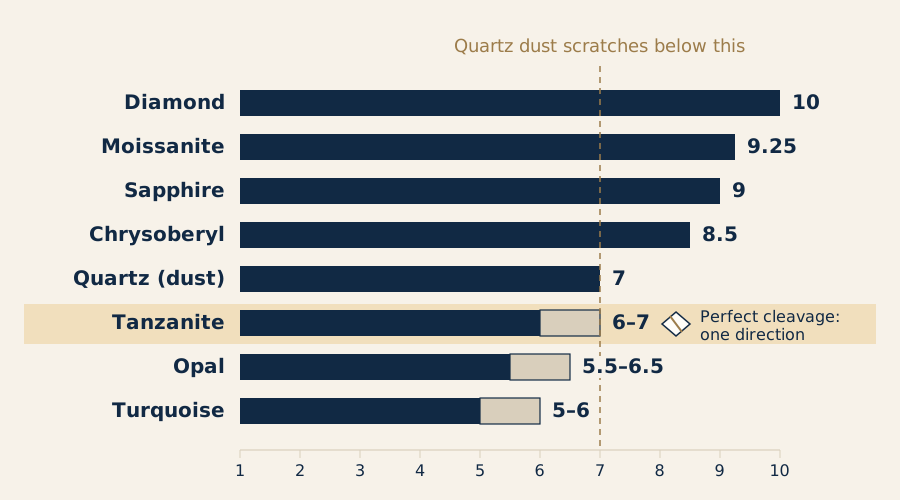
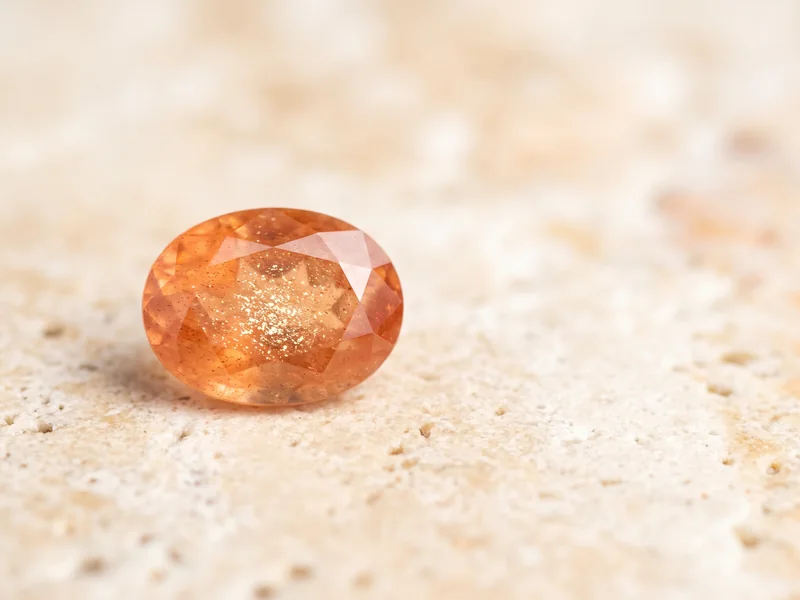
For comparison, chrysoberyl and cat's-eye combines high hardness with excellent toughness, and jadeite and nephrite are similar in hardness to tanzanite but far tougher because of their interlocking crystal structure. Softer stones such as turquoise, Mexican fire opal and feldspar sunstone need similar care to tanzanite.
Is tanzanite good for an engagement ring?
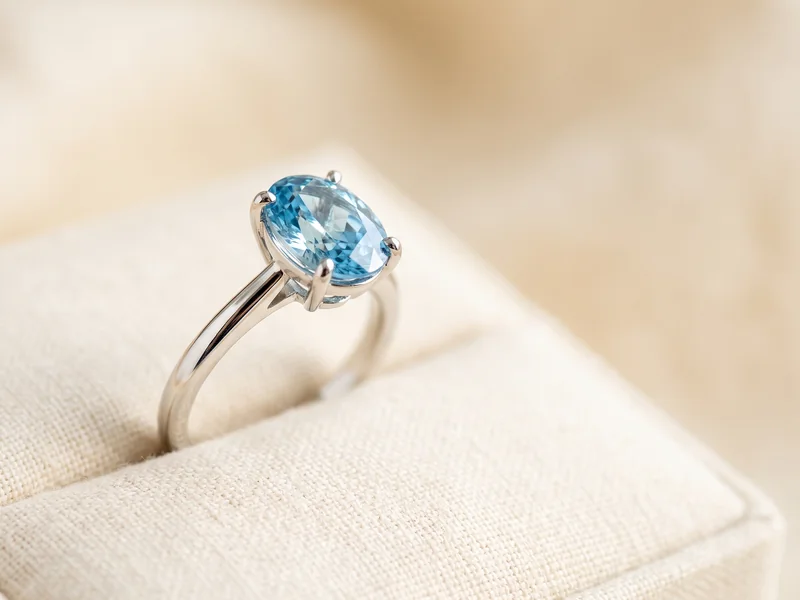
It can be, if you go in with clear eyes. Tanzanite is well suited to pendants, earrings and dress rings worn now and then, where knocks are rare. As an engagement ring worn every day, it needs a setting designed around its weaknesses and an owner happy to take it off for rough jobs. Expect the facets to need a re-polish every several years.
- Bezel or half-bezel: a rim of metal around the girdle protects the edge from knocks. This is the most protective choice.
- Halo: small diamonds around the tanzanite act as a bumper and also suit its colour.
- Lower profile: a stone set closer to the finger catches on less.
- Rounded shapes: ovals, cushions and rounds have no exposed points. Pears, marquises and trillions need a V-claw or bezel on each point.
- Metal colour: platinum and white gold emphasise the blue; yellow and rose gold warm the stone towards violet.
Our guide to tanzanite rings and everyday durability looks at real wear in more detail. If you want the colour but daily durability is non-negotiable, a blue sapphire or a lab-created coloured moissanite are much harder choices.
Related guideTanzanite Rings: Beauty vs Everyday DurabilityHow do gemmologists identify tanzanite?
At the bench, tanzanite is identified by a combination of tests rather than colour alone. A refractometer reads a refractive index of about 1.691–1.700 with low birefringence. A dichroscope, which splits light into two views, shows strong blue and violet. Specific gravity comes in around 3.35, heavier than many lookalikes. Under a loupe, a clean stone with no visible doubling of the back facets fits tanzanite.
The most common imitation is lab-created forsterite, sometimes misleadingly sold as synthetic tanzanite. It is a different mineral, and its high birefringence makes the back facet edges look doubled under 10× magnification, which gives it away quickly. Coloured glass and lab-created spinel are singly refractive and show no pleochroism. Coated stones are checked under magnification, as described in our notes on how coatings are spotted.
| Stone | Refractive index | Birefringence | Pleochroism | Quick giveaway |
|---|---|---|---|---|
| Tanzanite | 1.691–1.700 | 0.008–0.013 | Strong blue/violet | No obvious facet doubling |
| Lab-created forsterite | 1.635–1.670 | about 0.035 | Moderate | Clear doubling of back facets |
| Iolite | 1.54–1.55 | about 0.008–0.012 | Strong violet/grey-yellow | Lower RI, lighter in the hand |
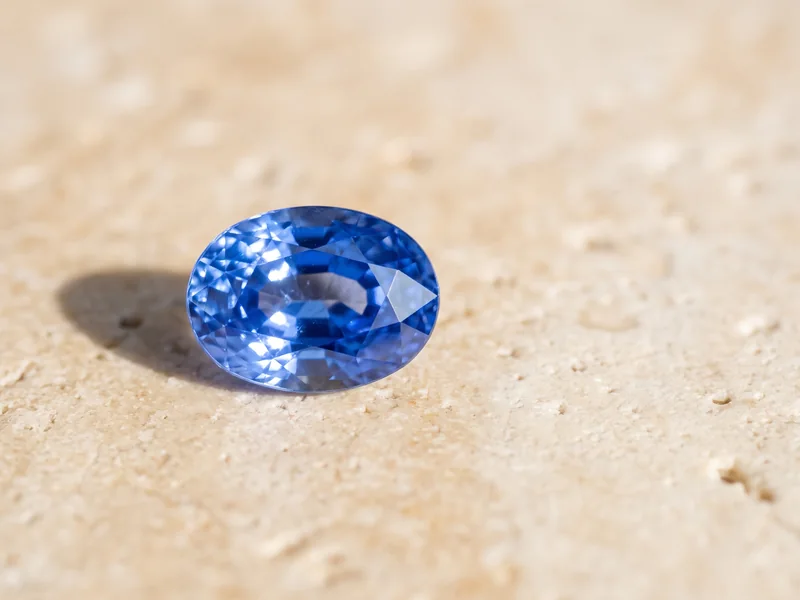
| Blue sapphire | 1.76–1.77 | about 0.008 | Weak to moderate | Higher RI, Mohs 9 |
| Glass or lab-created spinel | Single reading | None | None | Singly refractive, may show bubbles |
Iolite, the lower-priced violet-blue lookalike, is the natural stone most often confused with pale tanzanite, and a refractometer separates them in seconds. For larger stones, an independent lab report confirming identity is worth having.
What affects tanzanite price per carat?
Colour drives value more than anything else. Deep, saturated stones are priced well above pale ones, and the market has traditionally paid more for a strong blue-dominant colour with violet flashes. Because colour deepens with size, price per carat climbs steeply as stones get bigger.
- Colour: depth of saturation first, then the balance of blue and violet. Trade grades such as AAA are not standardised between sellers, so compare the stone, not the label.
- Size: stones over about 3 carats with full colour are noticeably rarer.
- Clarity: tanzanite is usually expected to be eye-clean. Visible inclusions lower the price sharply.
- Cut: shallow stones cut to save weight show a window, a pale, see-through patch in the centre. A well-cut stone holds colour across its face.
- Treatment: heating is standard and priced in; a coated stone should cost far less and be disclosed.
| Typical quality | Size | Approx. AUD per carat |
|---|---|---|
| Pale lavender | Under 1 ct | about $100–$300 |
| Medium violet-blue | 1–3 ct | about $300–$800 |
| Deep, saturated blue-violet | 1–5 ct | about $700–$1,500 |
| Exceptional saturation | 5 ct and over | about $1,200–$2,500+ |
These are broad guides; prices move with supply from Merelani and with the individual stone. Tanzanite is a natural gem (heated, as nearly all are), and imitations such as lab-created forsterite sell for a small fraction of these figures.
Browse natural gemstones in our stock
How do you clean and care for tanzanite?
Tanzanite care is mostly about avoiding heat, vibration and knocks.
- Clean gently: warm water, a drop of mild dishwashing liquid and a soft toothbrush, then rinse and dry with a soft cloth.
- No ultrasonic or steam cleaners: vibration can open the cleavage, and steam brings the thermal shock it is sensitive to.
- Avoid sudden temperature changes: do not go from hot dishwater to cold water, or leave it near a heater or in a hot car.
- Keep chemicals away: tanzanite can be attacked by hydrochloric and hydrofluoric acids, and household cleaners can damage a coating.
- Take it off for the gym, gardening, sport and heavy housework.
- Store it separately in a soft pouch, away from diamonds and sapphires that will scratch it.
- Have the claws checked about once a year, and the facets re-polished when they look dull.
How to choose a tanzanite: step by step
- Decide how it will be worn. Daily ring, occasional ring, pendant or earrings; this decides how much protection the setting needs.
- Judge colour in two lights. Look in daylight and under warm light, and choose the saturation you like in both.
- Check the cut. Tilt the stone and look for a pale window in the centre; a well-cut stone stays coloured across its face.
- Look for eye-clean clarity. No inclusions visible at normal viewing distance, especially near the girdle or corners.
- Ask about treatment. Heating is expected; confirm in writing that the stone is not coated.
- Confirm identity. For larger stones, ask for an independent lab report to rule out forsterite and other imitations.
- Plan the setting. Choose a bezel, halo or secure claws, and a shape without exposed points if it will be worn every day.
Free consultation
Talk to a gemologist
Compare stones in person or online with Raj Sood, Graduate Gemologist (GIA), AJP (GIA).
Book a consultationShop this shape
FAQ
Common questions
Is tanzanite rarer than diamond?
Tanzanite comes from a single small area in Tanzania, so geographically it is far more limited than diamond. It is still readily available in jewellery, though, and rarity alone does not set its price.
Is tanzanite good for an everyday engagement ring?
It can work with a bezel or halo setting and careful wear, but at 6–7 on the Mohs scale with perfect cleavage it will scratch and chip more easily than sapphire or diamond. Many people choose it for dress rings, pendants and earrings instead.
Does tanzanite change colour?
It shows blue and violet depending on the viewing angle, and it looks bluer in daylight and more violet under warm indoor light. This is a natural property called pleochroism, not a treatment.
Is all tanzanite heat treated?
Nearly all of it. Heating removes brownish tones and is permanent and accepted in the trade; coating is a different, less durable treatment that should always be disclosed.
Can I clean tanzanite in an ultrasonic cleaner?
No. Ultrasonic and steam cleaners can crack tanzanite along its cleavage. Use warm soapy water and a soft brush instead.
Is there lab-grown tanzanite?
Lab-grown tanzanite is not an established product in the jewellery market. Stones sold as synthetic tanzanite are usually lab-created forsterite or glass, which are different materials.
Terms in this guide

Ask a gemologist
Not sure which diamond to choose?
Raj Sood is a Graduate Gemologist (GIA) and master jeweller. Bring the stones you are considering, or send the reports, and he will tell you honestly which one is better and why.
Keep learning
Related guides
Explore more
More guides on this topic
Education