
- Education
- Diamond 4Cs & Grading
- Fancy Shape Diamond Cut Quality: How to Judge It Without a GIA Cut Grade
Diamond 4Cs & Grading
Fancy Shape Diamond Cut Quality: How to Judge It Without a GIA Cut Grade
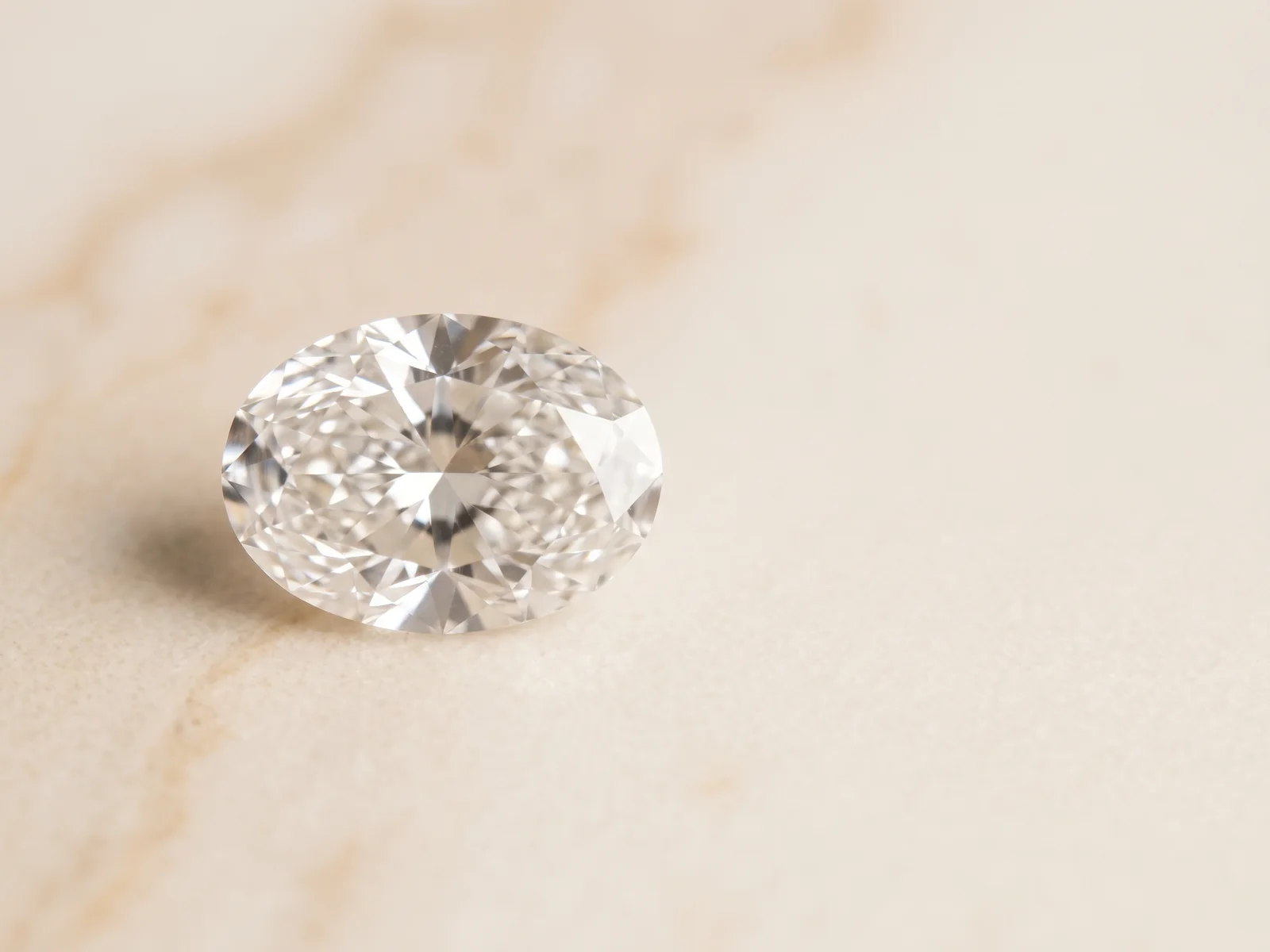
GIA grades the cut of round diamonds but not of ovals, pears, emeralds and other fancy shapes. That leaves you to judge fancy shape diamond cut quality yourself, and cut often changes the look more than colour or clarity do.
 Reviewed by Raj Sood, Graduate Gemologist (GIA), AJP (GIA)Master jeweller and Graduate Gemologist (GIA) · reviewed 4 November 2026
Quick answer
GIA only gives an overall cut grade to round brilliant diamonds. For fancy shape diamond cut quality you judge it yourself: check the report's polish and symmetry grades (Excellent or Very Good), the depth and table percentages for that shape, the length-to-width ratio, girdle and culet, then watch a video for bow-ties, windows and dark areas.
Why is there no GIA cut grade for fancy shape diamonds?
GIA (the Gemological Institute of America) gives an overall cut grade to standard round brilliant diamonds in the D-to-Z colour range, on a five-step scale from Excellent to Poor. Cut is the one part of the four Cs of diamond grading that measures human craftsmanship rather than what nature supplied. For every other outline, known as a fancy shape, the GIA report has no cut grade at all.
The reason is practical. The round brilliant has one well-studied facet pattern, so GIA could model a huge range of proportion combinations and match them to how trained observers rated three things: brightness (white light returned to your eye), fire (flashes of spectral colour) and scintillation (the sparkle and pattern of light and dark as the stone moves). Fancy shapes vary too much for that. An oval at a 1.35 ratio and one at 1.55 need different proportions, cutters use different facet counts, and step cuts such as emeralds are designed to look quite different from brilliants. That is why no single proportion chart suits every fancy shape.
So when a fancy shape is described as 'excellent cut', ask what that means. It might be a seller's own description, a cut grade from a different lab's system, or simply that polish and symmetry are both Excellent. Our explainer on how GIA cut grades work on round diamonds and the difference between ideal and excellent cut labels will help you decode the wording. Any unfamiliar term is defined in the GemTrove jewellery glossary.
What does a GIA report say about a fancy shape's cut?
A GIA Diamond Grading Report for a fancy shape still gives you most of the raw information about the cut. It just does not roll it up into one grade. These are the lines to read:
| Report field | What it tells you | What to look for |
|---|---|---|
| Shape and cutting style | For example 'Oval Modified Brilliant' or 'Emerald Cut' | Confirms brilliant (kite and triangle facets) or step (long parallel facets) style |
| Measurements | Length × width × depth in millimetres | Divide length by width for the ratio; compare width with other stones of similar weight |
| Depth % | Total depth divided by average width | Inside the usual range for that shape (see the proportions table below) |
| Table % | Width of the table (top flat facet) divided by average width | Inside the usual range for that shape |
| Girdle | Thickness range of the outer edge, e.g. Thin to Medium | Avoid Extremely Thin (chip risk) and Very Thick to Extremely Thick (hidden weight) |
| Culet | Size of the tiny facet at the base: None, Very Small, Small and so on | None or Very Small; a large culet can show as a dark dot face-up |
| Polish | Excellent, Very Good, Good, Fair or Poor | Excellent or Very Good |
| Symmetry | Excellent, Very Good, Good, Fair or Poor | Excellent or Very Good |
| Proportions diagram | A profile sketch showing the percentages | Crown and pavilion angles are usually not given for fancy shapes |
Smaller natural stones are often sold with a GIA Diamond Dossier, which carries the same grades and proportions but no plotting diagram; see how a Dossier differs from a full grading report. For a field-by-field walk-through, read our guide to reading every line of a GIA report, and always check the report number against GIA's online database before relying on the numbers.
How much do polish and symmetry grades change the look?
Polish grades the smoothness of the facet surfaces after cutting. Graders look for polish lines, tiny drag lines, burn marks from overheating on the wheel and similar surface marks. Symmetry grades the precision of the cut: whether facets meet neatly at points, whether the table and culet sit centred, whether facets are the right shape and whether the outline is even. Both are judged at 10× magnification.
| Grade | Polish: what you might notice | Symmetry: what you might notice |
|---|---|---|
| Excellent | Little or nothing, even under a loupe | Facets meet neatly; outline balanced |
| Very Good | Minor marks only under 10× | Small deviations under 10×; not visible face-up |
| Good | Marks visible under 10×, rarely to the eye | Some misalignment; an off-centre table or uneven outline can show in larger stones |
| Fair / Poor | Surfaces can look slightly dull or hazy | Lopsided outline or a visibly uneven facet pattern |
To the naked eye, Excellent and Very Good look the same. A double Excellent stone (Excellent polish and Excellent symmetry) tells you the cutter worked carefully, which is a good sign. What it does not tell you is whether the diamond is bright. A deep, dark oval with a heavy bow-tie can still be double Excellent, because neither grade measures light performance.
Outline matters most in shapes with a mirror line: pears, hearts, marquises and ovals. The symmetry grade includes the outline, but only coarsely. Check by eye that both shoulders of a pear match, that an oval is not flatter on one side and that a marquise's points line up along its length.
How do you judge fancy shape diamond cut quality from the numbers?
Use depth and table as a filter, not a verdict. The ranges below are common trade guidelines for well-cut stones. Plenty of attractive diamonds sit just outside them, and some inside them still disappoint, so always finish with your eyes.
| Shape | Depth % | Table % | Typical length-to-width ratio |
|---|---|---|---|
| Oval | 58–63 | 53–63 | 1.30–1.50 |
| Pear | 58–64 | 53–63 | 1.45–1.75 |
| Marquise | 58–64 | 53–63 | 1.85–2.10 |
| Heart | 56–62 | 53–63 | 0.90–1.10 |
| Cushion (brilliant) | 61–68 | 58–68 | 1.00–1.10 square, longer if preferred |
| Princess | 64–75 | 63–72 | 1.00–1.05 |
| Radiant | 61–67 | 61–69 | 1.00–1.05 square or 1.20–1.35 rectangle |
| Emerald | 61–69 | 61–69 | 1.30–1.50 |
| Asscher | 60–68 | 60–68 | 1.00–1.05 |
Notice that square shapes run much deeper than ovals and pears. A princess cut has a steep, pyramid-like pavilion (the lower half of the stone), so a depth around 70% is normal; our guide explains why princess cuts sit deeper than other shapes. The same 70% on an oval would usually mean a heavy, dark stone.
- Too deep for the shape: more weight hidden below the girdle, a smaller face-up size and often a darker centre.
- Too shallow: a wide spread but a risk of a window, a washed-out see-through patch in the middle.
- Very Thick to Extremely Thick girdle: weight you pay for but cannot see.
- Extremely Thin girdle, especially at points: more exposed to chipping.
- Ratio outside your preference: not a quality fault, but it changes the look a great deal, so decide your range first.
Not sure which one is right?
Send us the stones you are looking at and our gemologist will tell you which to choose and why.
What do bow-ties, windows and dark areas look like in a fancy shape?
Most elongated brilliant shapes show some bow-tie effect: a dark band across the middle, shaped like a bow-tie, where light leaks out of the pavilion rather than returning to your eye. It is most common in ovals, pears and marquises. A faint bow-tie that flickers as the stone moves adds contrast and is perfectly normal. A dark band that stays put in every position is a cutting problem.
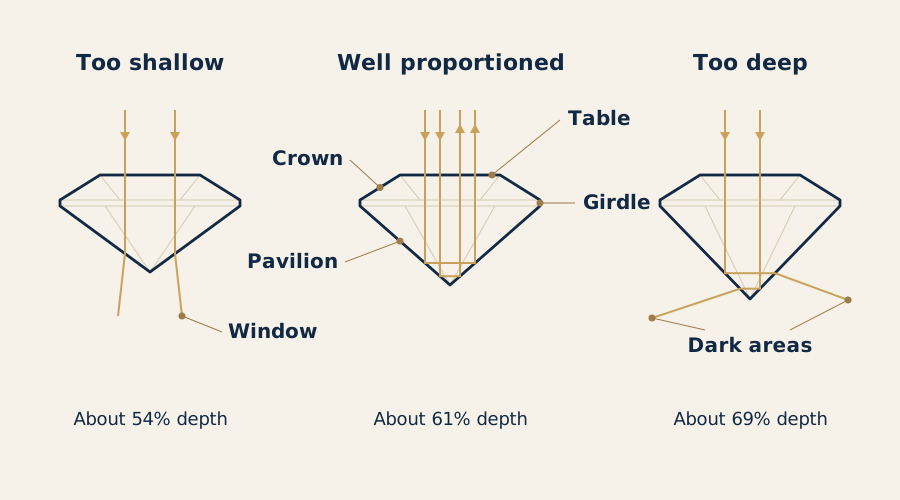
- Window: a glassy, see-through patch in the centre, usually from a pavilion that is too shallow. You can often read text through it.
- Extinction: dark areas that do not return light, often at the ends of a pear or marquise or across a deep oval.
- Bow-tie: a specific pattern of extinction across the belly of elongated brilliants.
- Hall of mirrors: the broad, flashing reflections of step cuts such as emeralds, which are meant to look like this rather than sparkle like a brilliant.
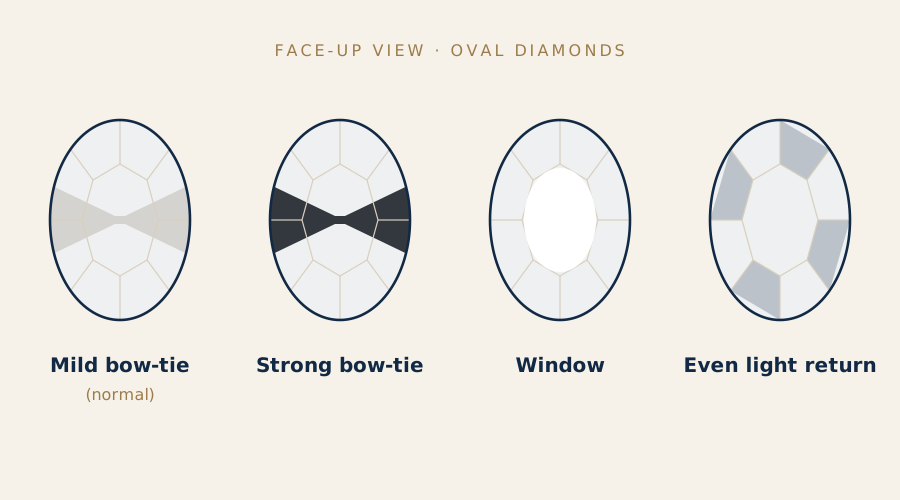
Photos are kind to diamonds, because studio lighting and a single angle can hide a bow-tie. A 360° video under neutral light is much more honest. Some sellers also supply ASET or Ideal Scope images, which use coloured filters to map where light returns: strong, even colour across the stone is good, while clear or white patches show light leaking out.
Does cut change how big a fancy shape diamond looks?
Yes, and this is where cut quality touches your budget most directly. Face-up spread is the size you see from above, measured as the length and width in millimetres. Two diamonds of the same carat weight can differ noticeably in spread, because a deeper stone or a thicker girdle holds more weight where you cannot see it.
As a rough example, a 1.00 ct oval cut at about 61% depth might measure around 7.7 × 5.7 mm, while the same weight cut at about 68% depth could be closer to 7.4 × 5.5 mm. That is the difference between a stone that looks like a one-carat and one that looks a little under. Cutters sometimes keep extra depth deliberately so a stone stays just over a weight threshold such as 1.00 ct, where prices step up.
The fix is simple: compare the millimetre measurements, not only the carat weight. Line up three or four stones of similar weight and look at their widths side by side.
Related guideFancy-Shape Diamonds: Why There Is No Single Perfect Proportion ChartIs cut quality different in lab-grown fancy shape diamonds?
Lab-grown diamonds are real diamond with the same hardness (10 on the Mohs scale) and refractive index (about 2.42) as natural diamonds, so cut affects them in exactly the same way. Because lab-grown rough costs far less, cutters have less reason to keep every point of weight, and many laboratory-grown fancy shapes are cut for appearance. That is a tendency, not a rule: some CVD crystals grow as flat plates, which can push a cutter towards shallower stones. Our guide to what to check in lab-grown cut quality goes further.
Grading reports also differ. Many lab-grown diamonds come with IGI reports, and GIA has changed how it describes laboratory-grown stones; see GIA's premium and standard lab-grown assessments. Whatever the lab, a fancy shape's report still gives you polish, symmetry and proportions to work from.
Coloured diamonds are a special case. Fancy colour diamonds, natural or lab-grown, are often cut deeper or with radiant-style faceting to intensify colour, so the usual depth ranges do not apply and colour, not brightness, is the priority. Read more in our guide to laboratory-grown pink, blue and yellow diamonds.
How is cut judged in step cuts and unusual shapes?
Step cuts such as emeralds and asschers have long, parallel facets and a large table, so they show less sparkle and more broad flashes. They also reveal cutting faults and inclusions more readily. With a step cut, check for a window in the centre, even step spacing on both sides and corners cut evenly enough that the outline looks square, not twisted.
Shapes with sharp corners need extra attention to the girdle. A triangular or trillion cut has three thin corners that should not be Extremely Thin. Antique and specialty styles follow their own logic: a rose cut has a domed top and a flat base with no pavilion at all, so the brilliant depth ranges are meaningless (see how rose cuts differ from brilliant cuts). The many-faceted Portuguese cut and the cut-cornered square Flanders cut are judged mostly by eye, on symmetry of pattern and how evenly they light up.
Is better fancy shape diamond cut quality worth paying for?
Pay for proportions and appearance; do not pay extra to move polish or symmetry from Very Good to Excellent. The price gap between those two grades is usually small, and you will not see the difference. The gap that matters is between a well-proportioned stone and a heavy or windowed one of the same weight, colour and clarity: the well-cut stone may cost a little more per carat but faces up larger and brighter.
| 1 ct oval, G–H colour, VS clarity | Approximate price range (AUD) | What you get |
|---|---|---|
| Lab-grown, well proportioned | about $1,000–$3,000 | Even light, full spread, much lower cost |
| Natural, well proportioned | about $7,000–$14,000 | Rarer origin, even light, full spread |
| Natural, deep or heavy-bellied | usually somewhat less per carat | Smaller face-up size, often a stronger bow-tie |
These are broad ranges only and they move with the market. Lab-grown diamonds cost much less than natural ones of the same grades and look identical to the eye. Natural diamonds are rarer; neither should be thought of as an investment.
Browse natural diamonds graded by GIA
How do you check a fancy shape's cut before you buy? Step by step
- Verify the report. Look up the number on the lab's website and confirm the shape, weight and whether the stone is natural or lab-grown.
- Check polish and symmetry. Both should be Excellent or Very Good; then move on.
- Compare depth and table with the usual range for that shape, not with round diamond numbers.
- Work out the ratio by dividing length by width, and keep to the range you like.
- Read the girdle and culet. Avoid Extremely Thin or Extremely Thick girdles and large culets.
- Compare spread in millimetres against other stones of similar weight.
- Watch a 360° video for a fixed dark bow-tie, a window or dead ends, and check the outline is balanced.
Free consultation
Talk to a gemologist
Compare stones in person or online with Raj Sood, Graduate Gemologist (GIA), AJP (GIA).
Book a consultationShop this shape
FAQ
Common questions
Why doesn't GIA give a cut grade for oval or pear diamonds?
GIA's cut grade is built on research into the round brilliant's single facet pattern. Fancy shapes vary too much in ratio, faceting and style for one set of proportions to apply, so GIA grades only their polish and symmetry.
Is a double Excellent fancy shape diamond well cut?
Not necessarily. Excellent polish and symmetry show careful craftsmanship, but they do not measure brightness, so a double Excellent stone can still be too deep or show a strong bow-tie.
Is Very Good polish and symmetry good enough?
Yes. Very Good and Excellent look the same to the eye; the differences are only visible under 10× magnification.
What depth percentage is good for an oval diamond?
Many well-cut ovals sit at about 58–63% depth with a 53–63% table. Deeper stones tend to look smaller and darker, shallower ones can show a window.
Can I tell cut quality from photos?
Only partly. Still photos can hide a bow-tie or a window, so ask for a 360° video under neutral light and compare the millimetre measurements.
Do lab-grown fancy shapes get cut grades?
Some labs describe cut on lab-grown reports, but for most fancy shapes you still judge cut from polish, symmetry, proportions and how the stone looks, just as with natural diamonds.

Ask a gemologist
Not sure which diamond to choose?
Raj Sood is a Graduate Gemologist (GIA) and master jeweller. Bring the stones you are considering, or send the reports, and he will tell you honestly which one is better and why.
Keep learning
Related guides
 Diamond 4Cs & GradingDiamond Cut Grade
 Diamond ShapesFancy-Shape Diamonds: Why There Is No Single Perfect Proportion Chart
 Certificates & ValuationsHow to Read a GIA Diamond Report
 Lab-Grown DiamondsLab-Grown Diamond Cut QualityDiamond 4Cs & GradingDiamond 4Cs
 Diamond 4Cs & GradingIdeal Cut vs Excellent Cut Diamonds
 Lab-Grown DiamondsLab-Grown Fancy Colour Diamonds
 Certificates & ValuationsGIA Diamond Dossier vs Diamond Grading Report
Explore more
More guides on this topic
Education