
- Education
- Fancy Colour Diamonds
- What Drives Fancy Colour Diamond Prices? Colour, Intensity, Rarity and Origin
Fancy Colour Diamonds
What Drives Fancy Colour Diamond Prices? Colour, Intensity, Rarity and Origin
Two fancy colour diamonds of the same size can differ in price by a factor of a hundred or more. Fancy colour diamond prices follow their own rules, and knowing them helps you read a grading report and judge what you are actually paying for.
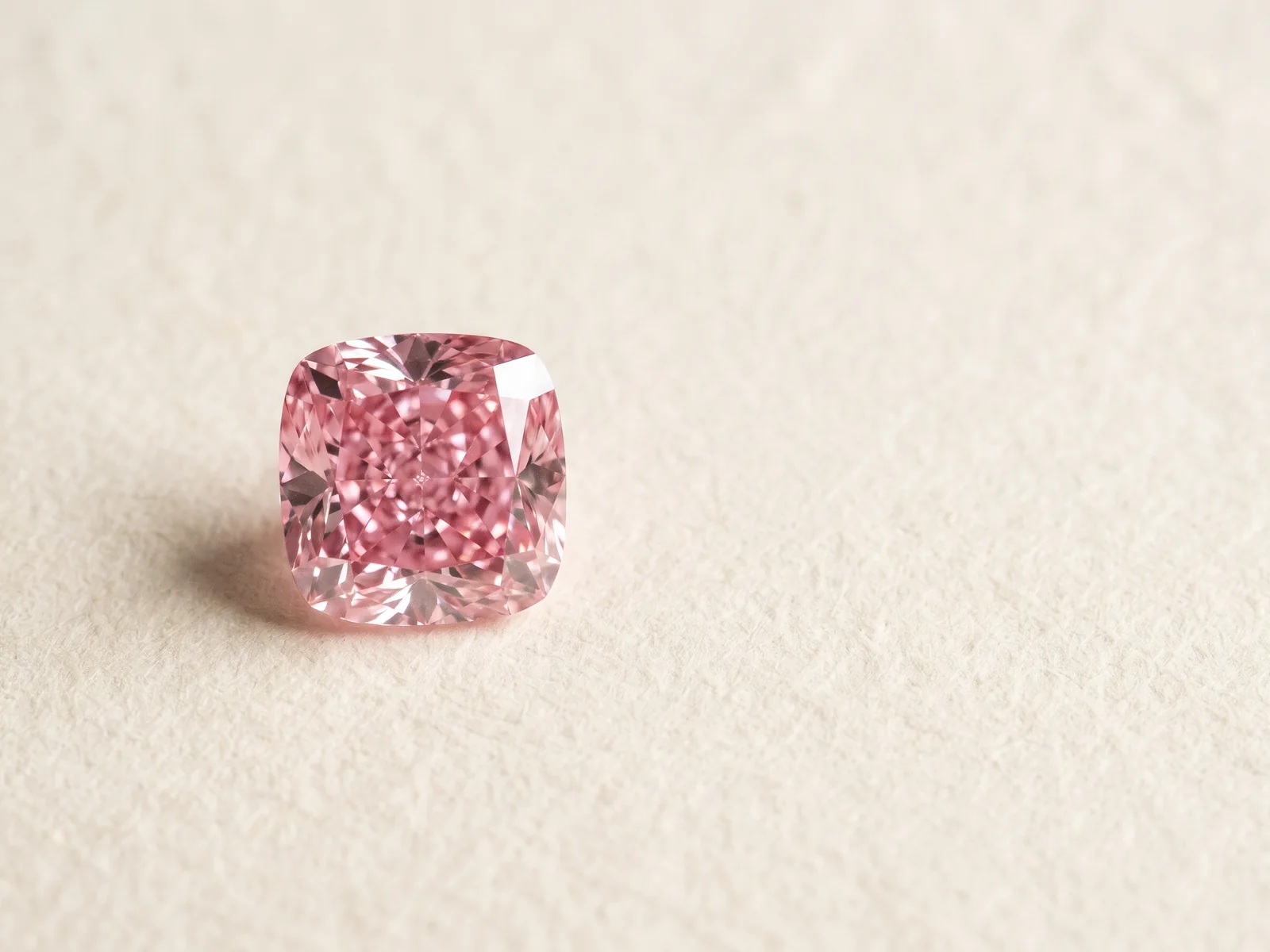
 Reviewed by Raj Sood, Graduate Gemologist (GIA), AJP (GIA)Master jeweller and Graduate Gemologist (GIA) · reviewed 4 November 2026
Quick answer
Fancy colour diamond prices are driven by hue and rarity, then intensity grade, then origin. Red, blue, green and pink are far rarer than yellow or brown, and each step up the GIA scale towards Fancy Vivid adds to the price. A natural, untreated colour costs many times more than a treated or lab-grown diamond of the same colour.
What drives fancy colour diamond prices?
A fancy colour diamond is a natural or laboratory-grown diamond whose colour is strong enough, or unusual enough, to sit outside the normal D-to-Z scale used for white diamonds. Yellow, brown, pink, blue, green, orange, purple, red, grey and black all qualify. Our complete guide to fancy colour diamonds introduces each colour; this page focuses on why they cost what they cost.
With a white diamond, value comes from the absence of colour, plus cut and clarity. With a fancy colour diamond the logic flips: colour carries most of the value, and clarity matters far less. In rough order of importance, the price depends on:
- Hue: the colour itself. Red, blue, green and pink sit at the top; yellow and brown at the bottom.
- Intensity: how strong and saturated the colour is, from Faint to Fancy Vivid.
- Origin: whether the colour is natural and untreated, natural but treated, or the diamond is lab-grown.
- Purity of colour: whether a secondary colour (a modifier) helps or hurts, for example purplish pink versus brownish pink.
- Carat weight: large fancy colours are much rarer than small ones, so price per carat climbs steeply with size.
- Cut and shape: how well the cutter concentrated the colour face-up.
- Clarity: usually the least important, as long as inclusions do not affect durability or look.
Any unfamiliar word on this page, from hue to saturation, is also defined in our plain-English jewellery glossary.
What causes colour in a diamond, and why are some colours rarer?
Pure diamond is just carbon atoms locked in a tight crystal lattice, and it is colourless. Colour appears when something interrupts that lattice: a trace element such as nitrogen or boron, a distortion of the crystal, or natural radiation. How often each of those things happens in the earth is what sets rarity, and rarity is the foundation of price.
| Colour | Main cause | Diamond type | Relative rarity (natural) |
|---|---|---|---|
| Yellow ('canary') | Nitrogen atoms in the lattice, which absorb blue light | Type Ia or Ib | The most common fancy colour |
| Brown, champagne, cognac | Plastic deformation (the crystal was bent under heat and pressure) | Usually Type Ia | Common |
| Orange | Nitrogen-related colour centres | Type Ia or Ib | Rare |
| Pink and red | Plastic deformation; the exact mechanism is still studied | Type Ia or IIa | Very rare; red is the rarest of all |
| Blue | Boron atoms in the lattice | Type IIb | Very rare |
| Green | Natural radiation over millions of years | Various | Rare; often only a green 'skin' |
| Violet and purple | Linked to hydrogen and deformation | Various | Very rare |
| Grey | Hydrogen or boron | Various | Uncommon |
| Black | Dense dark inclusions such as graphite | Various | Natural black uncommon; most on sale are treated |
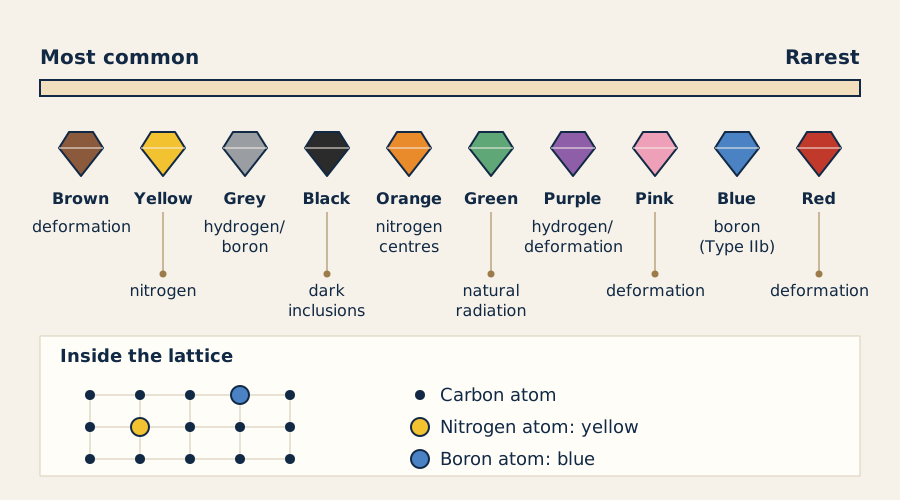
Diamond type is a scientific classification based on nitrogen and boron content. About 98% of natural diamonds are Type Ia. Type IIb diamonds, which contain boron and can be blue, are a tiny fraction of production, which is one reason natural blues are so costly. A gemmological lab can test a stone's type, and that test is a key part of deciding whether its colour is natural.
Some colours are easy to confuse with something cheaper. Salt-and-pepper diamonds, for example, are grey-white stones full of black and white inclusions. They are popular and affordable, but their look comes from inclusions rather than body colour, so they are priced on character rather than on the fancy colour scale.
How do intensity grades from Faint to Fancy Vivid change the price?
GIA describes fancy colour using three things: hue (the colour), tone (how light or dark it is) and saturation (how strong or pure it is). These are combined into one of nine intensity grades. Our guide to how labs grade fancy colour diamonds explains the viewing conditions and colour comparison stones used.
| GIA grade | What you see | Typical effect on price |
|---|---|---|
| Faint, Very Light, Light | A hint of colour; for yellow and brown these fall within the D-to-Z range | Low premium; for rarer hues still valuable |
| Fancy Light | Clear but soft colour | Entry point for most fancy colours |
| Fancy | Moderate, even colour | A clear step up from Fancy Light |
| Fancy Intense | Strong, rich colour | Often well above Fancy |
| Fancy Vivid | Strongest saturation at medium tone | The top price tier for most hues |
| Fancy Deep | Strong colour at a darker tone | Usually below Vivid; prized in some blues and pinks |
| Fancy Dark | Dark tone, lower saturation | Usually lower than Fancy Deep |
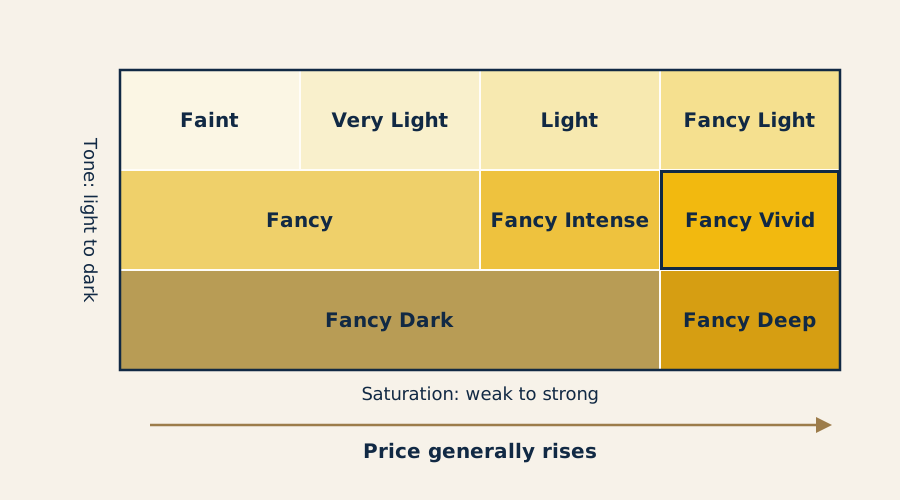
The jump between grades is not small. For natural yellows, a Fancy Intense stone often costs noticeably more than a Fancy, and a Fancy Vivid can cost two to three times a Fancy Intense of the same size. For pinks and blues the gaps are wider again. The full ladder is set out in our step-by-step intensity scale from Faint to Vivid, and the top grade gets its own page on what earns a Fancy Vivid grade.
It helps to see where white diamonds end and fancy yellows begin. On the D-to-Z colour grading scale, a colourless E grade or F colour diamond is valued because it shows almost nothing. By the time you reach an H colour stone, an I colour diamond or a J colour diamond with its gentle warmth, the tint is visible and the price falls. Keep going past Z and the colour becomes the point again: a yellow stronger than Z is graded Fancy Light Yellow, and the price starts to rise.
Why do hue and modifiers matter so much to a coloured diamond's price?
Most fancy colour diamonds are not a single pure colour. The grade names the main hue last and any secondary colour, called a modifier, before it. A Fancy Intense purplish pink is mainly pink with a purple influence; a Fancy Intense pinkish purple is mainly purple. The order of words changes the stone, and usually the price.
- Modifiers that usually add value: purplish in pink, orangy in yellow (for some buyers), greenish in blue when the result is a clean, bright colour.
- Modifiers that usually reduce value: brownish and greyish in almost any hue, because they dull the colour.
- Pure colours: a 'Fancy Vivid Pink' or 'Fancy Vivid Blue' with no modifier commands the highest premium of its hue.
Two diamonds with the same intensity can therefore sit a long way apart on price. A Fancy brownish pink may cost a fraction of a Fancy pink, and a greyish blue less than a pure blue. Our page on how modifiers and overtones shift colour and value lists the common combinations and how the market treats each one.
Not sure which one is right?
Send us the stones you are looking at and our gemologist will tell you which to choose and why.
Why are Argyle pink diamonds so expensive?
Australia has a special place in the fancy colour story. The Argyle mine in the east Kimberley region of Western Australia, operated by Rio Tinto, produced diamonds from the mid-1980s until it closed in November 2020. Most of its output by volume was brown, but it is famous for producing about 90% of the world's pink diamonds, along with a small number of reds, violets and blues.
Even at Argyle, pinks were a tiny fraction of one per cent of production. The most important stones were sold each year through the invitation-only Argyle Pink Diamonds Tender. Argyle also used its own colour language: a number for intensity (with 1 the most intense) and letters for hue, such as P for pink, PP for purplish pink, PR for pink rose and PC for pink champagne. For browns, Argyle promoted a champagne-to-cognac scale running from C1 (lightest) to C7 (darkest), which is why Australians often say 'champagne diamond'.
- Fixed supply: with the mine closed, no new Argyle rough is being produced, so the number of genuine Argyle pinks is finite.
- Paperwork: certified Argyle pinks usually carry an Argyle certificate and a laser-inscribed number on the girdle (the thin edge of the stone). Check that the inscription matches the certificate.
- Small sizes: most Argyle pinks are under 0.50 carat; a pink over 1 carat is exceptional.
- A note on value: prices for Argyle pinks have risen over the years, but past prices are no guide to future resale. A coloured diamond is something to wear and enjoy, not a financial product.
Argyle champagne and cognac diamonds sit at the opposite end of the market: natural, Australian and attractive, but far more plentiful, which keeps them affordable.
How do natural, treated and lab-grown fancy colour diamond prices compare?
Origin is the single biggest price switch after hue. The same pink can be natural, a natural diamond with treated colour, or a lab-grown diamond. To the eye they can look alike, which is why an independent report matters. On a GIA coloured diamond report, look for the colour origin line. Here is how it reads in practice:
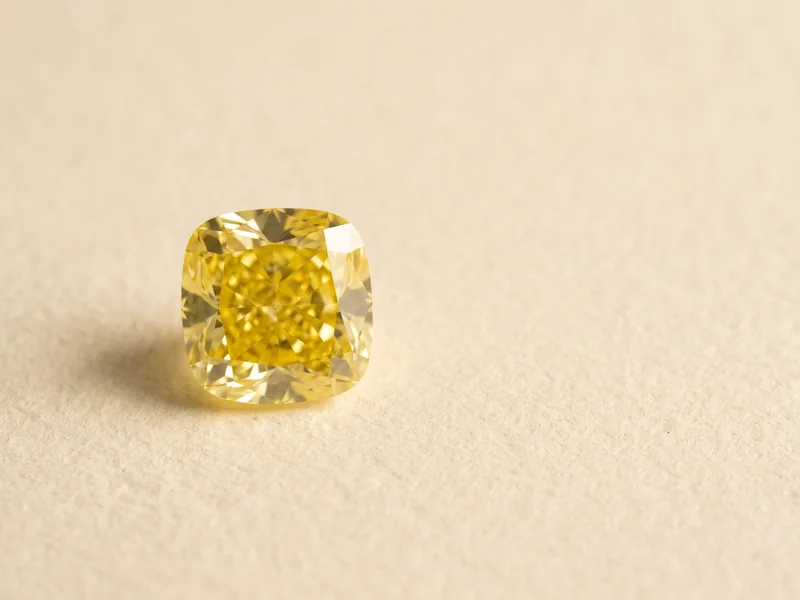
- 'Fancy Intense Yellow' with colour origin 'Natural': a mined diamond whose colour formed in the earth, untreated. This is the top price tier for that hue and grade.
- 'Fancy Deep Blue' with colour origin 'Treated': a natural diamond whose colour was created or changed by a lab process such as irradiation or HPHT (high pressure, high temperature) treatment. The comments section often names the process. It is real diamond, priced at a small fraction of a natural blue.
- Colour origin 'Undetermined': the lab could not confirm whether the colour is natural. The market usually prices this cautiously, closer to a treated stone.
- A GIA laboratory-grown diamond report: a separate report type for lab-grown stones. It states the diamond is laboratory-grown, notes the growth method (CVD or HPHT) and any post-growth treatment, and the girdle is usually laser-inscribed to say so.
| Natural colour | Natural, treated colour | Lab-grown | |
|---|---|---|---|
| What it is | Mined diamond, colour formed in the earth | Mined diamond, colour created or improved after mining | Real diamond grown in a laboratory |
| How colour is made | Nitrogen, boron, deformation, radiation | Irradiation, annealing, HPHT or (rarely) coatings | Added during growth (nitrogen, boron) or by post-growth treatment |
| Report wording | Colour origin: Natural | Colour origin: Treated, with process noted | Laboratory-grown, with any treatment noted |
| Hardness | 10 on the Mohs scale | 10 (coatings are not permanent) | 10 on the Mohs scale |
| Repair note | Normal care | Some treated colours can change under a jeweller's torch | Treated lab colours may also be heat-sensitive |
| Approx. price, 1 ct pink, Fancy | Tens of thousands to several hundred thousand AUD | About $3,000–$15,000 AUD | About $1,000–$5,000 AUD |
Lab-grown fancy colours are physically and chemically diamond, with the same hardness and a refractive index of about 2.42, but they are produced to order, so they cost far less and are easy to find in larger sizes and brighter grades. Blue lab-grown diamonds get their colour from boron added during growth; many lab pinks are coloured after growth. Our guide to laboratory-grown fancy colour diamonds covers each colour, and the forces behind lab-grown diamond pricing explains why those prices keep moving.
Shop fancy colour diamonds: natural and lab-grown
How do cut, carat and clarity affect fancy colour diamond prices?
Carat weight matters more for fancy colours than for white diamonds. Colour also looks stronger in a larger stone, because light travels further through it. A 0.20 carat pink can look paler than a 1 carat pink of the same body colour, and large natural pinks and blues are so rare that price per carat can multiply between half a carat and one carat.
Cut works differently, too. With white diamonds, the round brilliant is cut for maximum brightness and carries the highest price per carat. With fancy colours, cutters usually choose shapes that concentrate colour, such as the radiant, cushion, oval and pear, because more facets reflecting light back through the stone deepen the face-up colour. A rough crystal that would grade Fancy as a round might reach Fancy Intense as a radiant, which is why so few fancy colour diamonds are rounds.
GIA does not give an overall cut grade to these shapes, so you judge cut by eye: even colour across the face, no large washed-out window in the centre and a pleasing outline. Our guide to judging cut quality in fancy shapes without a GIA cut grade walks through the checks, and why fancy shapes have no single ideal proportion chart explains why numbers alone are not enough.
Clarity usually comes last. SI (slightly included) clarity is common and widely accepted in natural fancy colours, and strong colour tends to hide small inclusions. The exceptions are large feathers (internal cracks) near the edge, which affect durability, and dark inclusions in a light-coloured stone, which can be visible. Fluorescence (a glow under ultraviolet light) is noted on reports; strong blue fluorescence in a yellow can slightly mute its colour in daylight.
Which settings and metals suit fancy colour diamonds?
The metal around a coloured diamond reflects into it and changes how strong the colour looks. A sensible setting can make a Fancy stone look closer to Fancy Intense; the wrong one can wash it out.
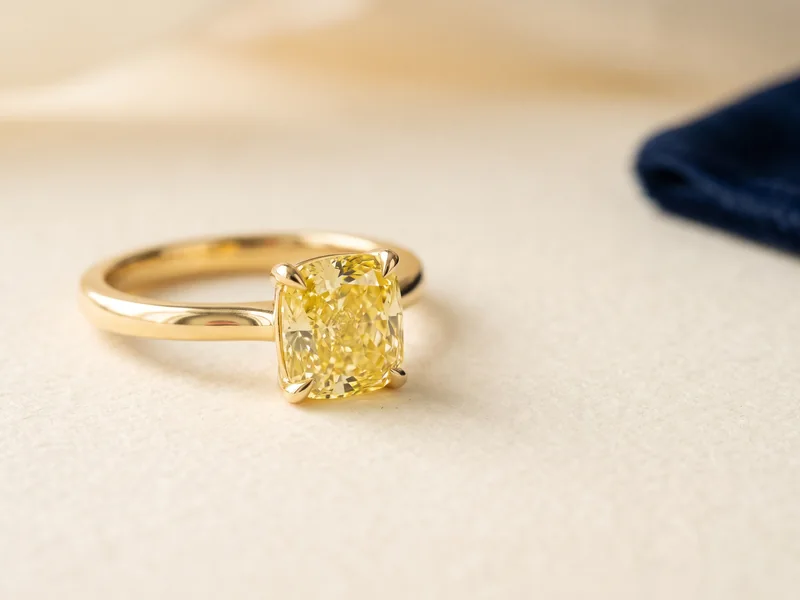
- Yellow diamonds: yellow gold claws or a yellow gold cup under the stone deepen the colour, even on a white gold or platinum band.
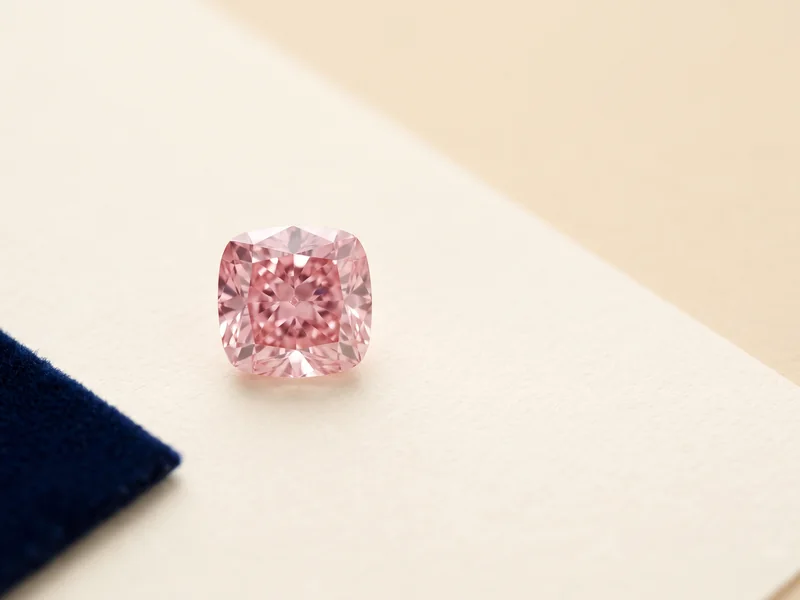
- Pink diamonds: rose gold warms and supports pink; white gold or platinum keeps a cooler, purer look. Avoid yellow gold claws on pale pinks, which can push them towards peach.
- Blue and green diamonds: white gold or platinum keeps the colour clean.
- Champagne and cognac: rose and yellow gold suit their warmth.
- Black diamonds: white gold for contrast, or yellow and rose gold for a softer look; bezel or claw settings both work.
- Halos: a halo of white diamonds frames the colour and makes a small centre look larger; a halo of matching coloured diamonds lifts the overall colour.
If your coloured diamond has treated colour, tell your jeweller before any resizing or repair, because heat from a torch can change some treatments. This is one of the reasons the report should travel with the ring.
Related guideFancy Coloured Diamond Engagement RingsHow do you compare fancy colour diamonds before you buy?
Because so many factors move the price, compare stones in the same order the market prices them:
- Confirm the origin first. Check the report for colour origin (natural, treated or undetermined) or a laboratory-grown report. Compare natural with natural and lab-grown with lab-grown.
- Read the full colour grade. Note the intensity and the main hue (the last word), then any modifiers, especially brownish or greyish.
- Look at the stone in more than one light. Daylight, cool white and warm indoor light all show colour differently.
- Check colour evenness. Look face-up for patches or a pale centre, and watch a 360° video if you are viewing online.
- Compare size in millimetres. Deep-cut coloured stones can carry hidden weight; a shallower stone of the same carat can look larger.
- Plan the metal. Decide whether yellow, rose or white metal will support the colour, and look at real fancy coloured engagement ring designs before committing to a stone.
Free consultation
Talk to a gemologist
Compare stones in person or online with Raj Sood, Graduate Gemologist (GIA), AJP (GIA).
Book a consultationShop this shape
FAQ
Common questions
What is the rarest and most expensive diamond colour?
Natural red is the rarest, followed by blue, green and pink. Natural reds are so scarce that only a handful of significant stones are known, and most are graded simply 'Fancy Red'.
Why are yellow diamonds cheaper than pink diamonds?
Yellow comes from nitrogen, the most common trace element in diamond, so natural yellows are far more plentiful. Pink comes from a rare distortion of the crystal, and most of the world's supply came from one mine, Argyle, which closed in 2020.
Are treated colour diamonds real diamonds?
Yes. A treated colour diamond is a natural diamond whose colour was created or improved after mining, by irradiation, annealing or HPHT. It must be disclosed, it costs much less than a natural-colour stone, and some treatments can be affected by heat during repairs.
How can I tell if a coloured diamond's colour is natural?
Not by eye. Ask for an independent report from a lab such as GIA, which states the colour origin as natural, treated or undetermined, or issues a separate report for laboratory-grown diamonds.
Are lab-grown fancy colour diamonds worth considering?
They are real diamond with the same hardness and sparkle, and they cost a small fraction of natural fancy colours, especially in pink and blue. They suit people who want strong colour in a larger size; natural colours suit people who value rarity and earth origin.
How much does a natural yellow diamond cost in Australia?
Very roughly, a 1 carat natural Fancy Yellow is often in the range of about AUD $5,000–$15,000, with Fancy Intense and Fancy Vivid stones costing more. Prices vary with shape, modifiers and clarity, so treat this as a broad guide only.

Ask a gemologist
Not sure which diamond to choose?
Raj Sood is a Graduate Gemologist (GIA) and master jeweller. Bring the stones you are considering, or send the reports, and he will tell you honestly which one is better and why.
Keep learning
Related guides
 Fancy Colour DiamondsHow Fancy Colour Diamonds Are Graded
 Fancy Colour DiamondsFancy Colour Intensity Scale: Faint to Vivid
 Lab-Grown DiamondsLab-Grown Fancy Colour DiamondsFancy Colour DiamondsFancy Colour Modifiers and OvertonesFancy Colour DiamondsFancy Colour Diamonds Guide
 Fancy Colour DiamondsFancy Coloured Diamond Engagement RingsFancy Colour DiamondsWhat Is a Fancy Vivid Diamond?
 Lab-Grown DiamondsWhat Actually Drives Lab-Grown Diamond Prices?
Explore more
More guides on this topic
Education