
Gemstones
Gemstone Cuts Explained: Cabochon, Faceted and Carved Stones
Gemstone cuts decide whether a stone sparkles, glows or shows a star, and they affect its durability and price too. Here is how the three cut families work, and which gems suit each one.
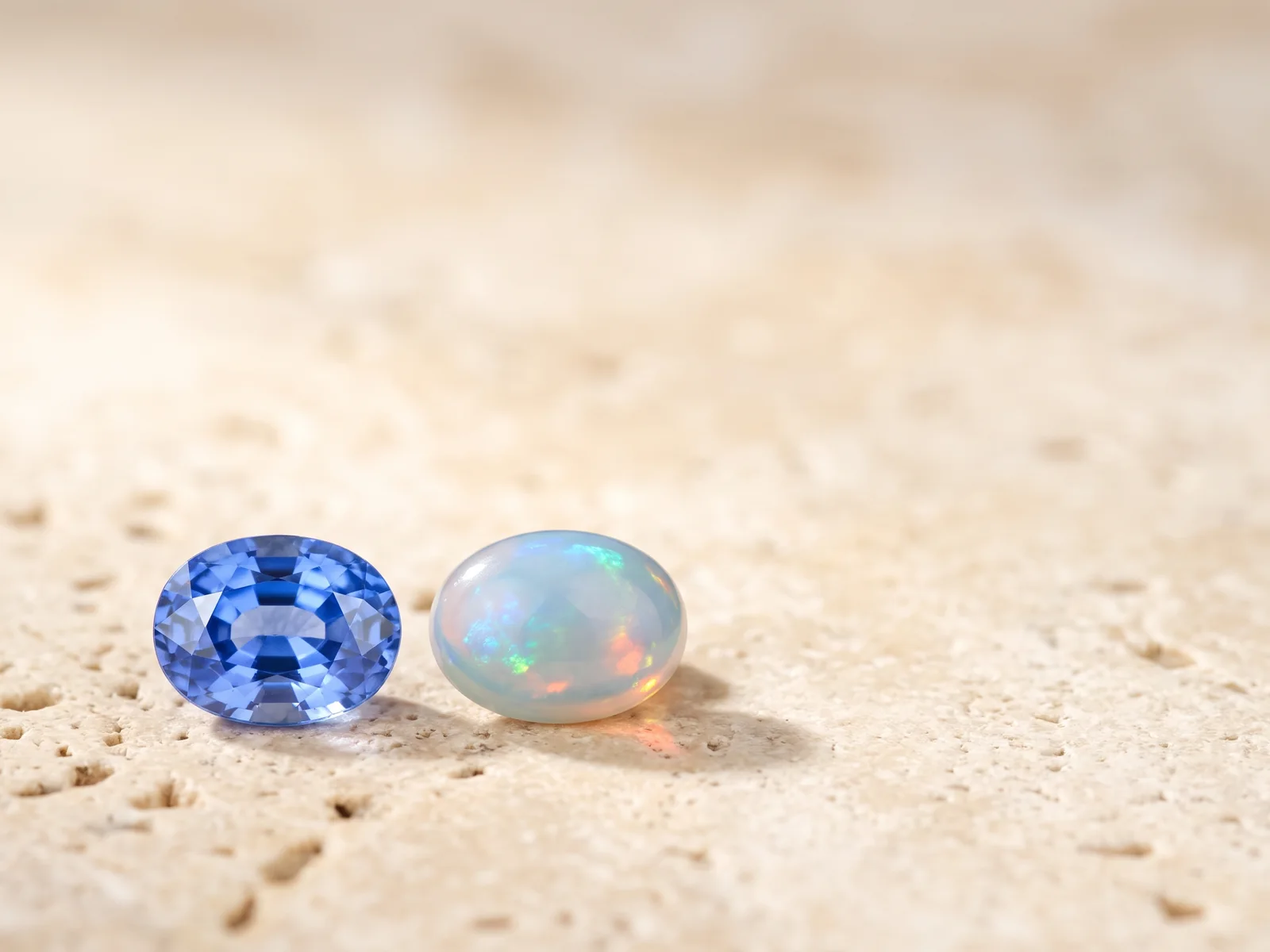
 Reviewed by Raj Sood, Graduate Gemologist (GIA), AJP (GIA)Master jeweller and Graduate Gemologist (GIA) · reviewed 4 November 2026
Quick answer
Gemstone cuts fall into three families. Faceted stones have flat, polished facets that return light as sparkle and suit transparent gems like sapphire. Cabochons are smooth domes that show colour, translucency and effects such as stars and cat's eyes, ideal for opal and turquoise. Carved stones are sculpted into shapes, cameos or intaglios.
What are gemstone cuts?
A cut is the finished form a cutter gives a rough gem crystal. For diamonds, “cut” usually means a shape such as round or oval. For coloured stones, it starts one step earlier: is the stone faceted (covered in flat, polished planes), cabochon (a smooth, polished dome with no facets) or carved (sculpted into a design)? Shape comes after that choice.
The cutter's decision depends on the rough. Transparent, fairly clean material is usually faceted, because facets turn light into brightness and sparkle. Translucent or opaque material, or rough full of inclusions (internal features), is usually cut as a cabochon, which shows off colour and texture instead. Tough, fine-grained material such as jade is often carved, because it can hold fine detail without breaking.
Coloured gems are also cut with weight in mind far more than diamonds. Rough is priced by the carat, so cutters in places like Sri Lanka and Thailand often keep extra weight in the base of a stone rather than cutting to ideal proportions. That is why two sapphires of the same carat weight can look very different in size and brightness. Our overview of coloured gemstones, birthstones and custom jewellery covers the main gem species, and any unfamiliar term here is explained in our plain-English jewellery glossary.
What is a faceted gemstone cut?
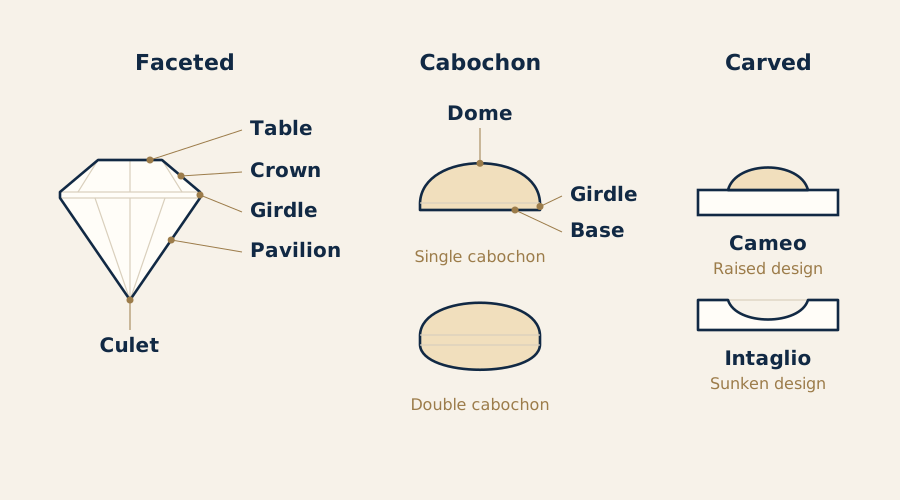
A faceted gemstone has two main parts. The crown is the top section, with a large flat table facet in the middle. The pavilion is the lower section, which acts like a set of angled mirrors. The girdle is the thin edge between them, where the setting grips the stone.
Facets work because of refractive index (RI), a measure of how strongly a material bends light. When light inside a stone hits a pavilion facet at a steep enough angle, it reflects back up instead of leaking out. The angle where that switch happens is the critical angle. Diamond, with an RI of about 2.42, has a critical angle of about 24.4°, so it is very forgiving. Sapphire (RI about 1.76) sits near 34.6°, and quartz (RI about 1.54) near 40.4°, so quartz needs a deeper pavilion to stay bright. Measuring RI is also one of the first tests in how gemmologists identify a gemstone scientifically.
| Faceting style | Facet pattern | What it shows best | Common in |
|---|---|---|---|
| Brilliant | Triangular and kite-shaped facets radiating from the centre | Sparkle; hides small inclusions | Round sapphire, spinel, garnet |
| Step | Long, parallel facets in rows, like stairs | Colour, clarity and crisp lines | Emerald, aquamarine, tourmaline |
| Mixed | Brilliant-style crown over a step-cut pavilion, or the reverse | Colour with good weight retention | Most oval and cushion sapphires and rubies |
| Rose | Flat base under a domed crown of triangular facets | Soft glow with a low profile | Antique jewellery, garnet |
| Checkerboard | Crown of small square facets, often over a faceted pavilion or flat base | Surface glitter rather than depth | Quartz, topaz, peridot |
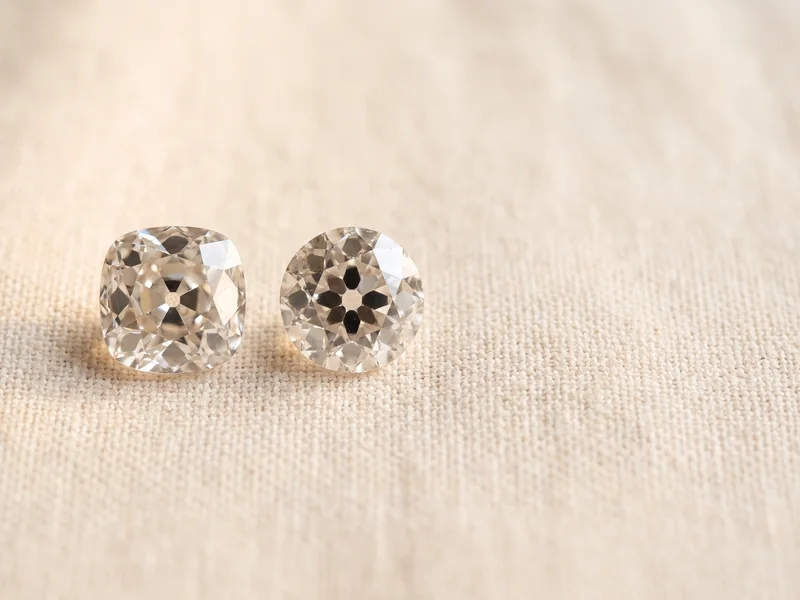
The mixed cut gemstone is the everyday workhorse of coloured stones: a brilliant crown for sparkle and a step pavilion that keeps weight. The difference between the two main styles is set out in our guide to step cuts and brilliant cuts compared. The rose cut dates back to the 1500s and is covered in our page on Old Mine, Old European and rose cuts.
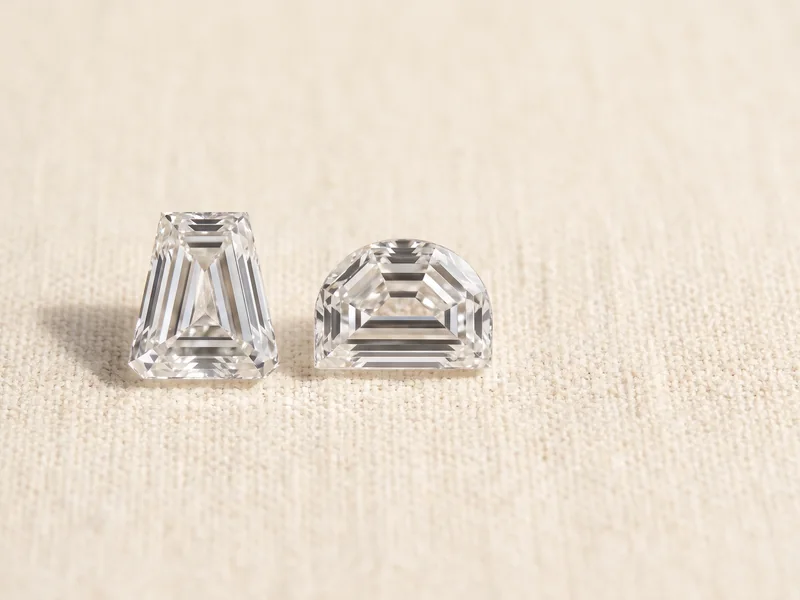
Shapes used for diamonds work for coloured gems too. Ovals, pears and marquise shapes are popular for sapphire because they suit elongated rough; see oval, pear, marquise and moval outlines. Hexagons, kites and shields appear in modern designs, as in our guide to geometric shapes such as shield, kite and hexagon, while small trapezoids and baguettes in coloured stones make tidy accents, much like the trapezoid, half moon and bullet side stones used beside diamonds.
Two faults are worth knowing. A window is a washed-out, see-through patch in the centre, caused by a pavilion that is too shallow. Extinction is dark areas where light is lost. A little extinction gives contrast; large dead zones mean poor proportions.
What is a cabochon cut and why are some gems cut that way?
A cabochon cut (often shortened to “cab”) has a smooth, polished, rounded top and usually a flat or gently curved base. The word comes from an old French word for head. It is the oldest way of finishing a gem, and it remains the right choice for many stones.
- Single cabochon: domed top, flat back. The most common form, used for opal, turquoise and chalcedony.
- Double cabochon: domed on both sides. Common for moonstone and star stones, where the lower dome helps focus the effect.
- Hollow cabochon: hollowed out underneath to lighten very dark stones such as almandine garnet.
- Buff top cut: a cabochon crown over a faceted pavilion, giving a soft surface with sparkle beneath. Used in Art Deco jewellery and modern men's rings.
Cutters choose a cabochon for four main reasons. The material is opaque or translucent, so facets would add nothing. The stone shows an optical effect that only a dome can display. The rough contains too many inclusions to look good faceted, as with much emerald and ruby. Or the material is soft or brittle, and a rounded surface with no sharp edges resists chipping better.
Australia has a long cabochon tradition through opal. Black opal from Lightning Ridge in New South Wales and white opal from Coober Pedy in South Australia are cut as cabochons to display play-of-colour (flashes of spectral colour). Queensland boulder opal is often cut freeform to follow the ironstone it formed in. Opal is also made into doublets and triplets, thin slices of opal backed with dark material and, in a triplet, capped with clear quartz or glass; these should always be disclosed.
Related guideGemstone Durability for Everyday RingsHow do cabochons show star and cat's eye effects?
Some gems contain fine needle-like inclusions, which gemmologists call silk. When the needles are parallel and the stone is cut as a dome in the right direction, light reflects off them as a sharp band. This is called a phenomenon, and it is the main reason a fine cabochon can be worth more than a faceted stone of the same species.
- Chatoyancy (cat's eye): one set of parallel needles or fibres gives a single bright line across the dome. The classic cat's eye gemstone is chrysoberyl; tourmaline, quartz and apatite can also show it.
- Asterism (star): two or three sets of needles crossing at angles give a four- or six-rayed star. In sapphire and ruby, rutile (titanium oxide) needles usually create six rays; rare stones show twelve.
- Adularescence: a soft bluish-white glow that floats across moonstone as it moves.
- Labradorescence: flashes of blue, green and gold in labradorite.
- Play-of-colour: the shifting rainbow patches in precious opal, caused by tiny silica spheres diffracting light.
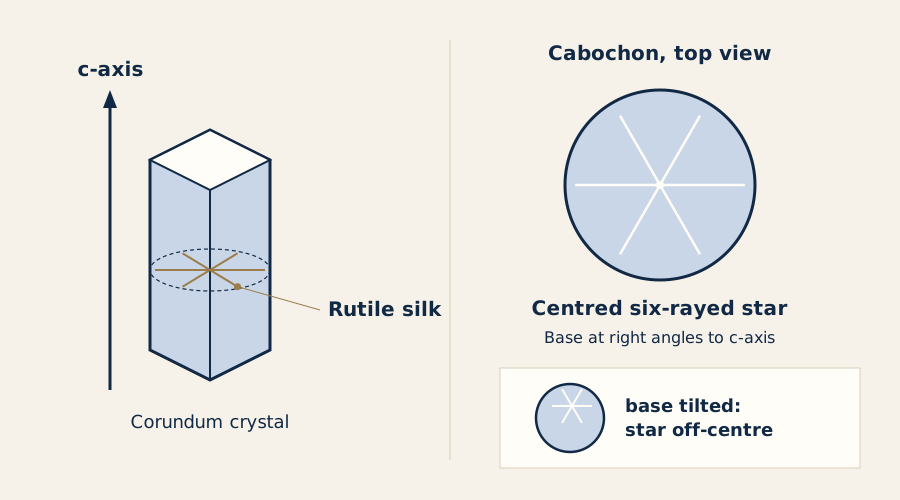
Orientation is everything. In a star sapphire cabochon, the cutter must place the base at right angles to the crystal's main axis (the c-axis) so the three sets of needles lie flat under the dome. A slightly tilted base puts the star off-centre. A dome that is too flat gives a weak, spread-out star, and one that is too high makes the stone look bulky. Our sapphire guide, from colour to origin covers the species in depth.
Silk also tells gemmologists about a stone's history. Intact, unaltered needles suggest the stone has not been heated strongly, and their character can help a laboratory decide where the stone came from; see how laboratories determine gemstone origin.
Not sure which one is right?
Send us the stones you are looking at and our gemologist will tell you which to choose and why.
What are carved gemstones?
Carved gemstones are shaped beyond simple domes and facets into flowers, leaves, animals, faces or abstract forms. Carving rewards material that is tough (resistant to breaking) rather than just hard (resistant to scratching), which is why jade has been carved for thousands of years.
- Cameo: a design carved in raised relief, standing up from the background. Often cut from shell or from banded agate, onyx or sardonyx so the figure and background are different colours.
- Intaglio: the reverse of a cameo, with the design cut down into the surface. Intaglios were used as seals pressed into wax, and still appear in signet rings.
- Relief and figural carving: leaves, flowers and animals in jade, tourmaline, aquamarine, coral and quartz. Carved ruby, sapphire and emerald leaves were a signature of 1920s Art Deco jewellery.
- Fantasy cut: a modern style that combines carved grooves on the back with facets or a polished front, so the cuts reflect through the stone. Popular for quartz, tourmaline and beryl.
The difference between a cameo and intaglio matters when you wear one. A cameo's raised details can wear down over years in a ring, so cameos are more common in brooches and pendants. An intaglio's details are protected below the surface, which is why seal rings use intaglios.
Carving usually costs more in labour than faceting the same stone, and it can hide inclusions in the cut-away areas. Check the thinnest parts of a carving, such as leaf tips or undercut edges, for small cracks before you buy.
Cabochon vs faceted vs carved: how do the gemstone cuts compare?
| Faceted | Cabochon | Carved | |
|---|---|---|---|
| Surface | Flat polished facets | Smooth polished dome | Sculpted design or relief |
| What it shows | Brightness, sparkle, fire | Colour, translucency, phenomena | Form, detail, colour banding |
| Typical rough | Transparent, fairly clean | Translucent, opaque or included | Tough, fine-grained or banded |
| Example gems | Sapphire, spinel, aquamarine, garnet | Opal, turquoise, moonstone, star sapphire | Jade, agate, tourmaline, shell |
| Weight kept from rough | Often 20–40% | Often higher | Varies widely |
| Main wear risk | Chipped facet edges and points | Scratched dome on softer stones | Broken fine details |
| Usual setting | Claws, bezel, channel | Bezel or collet | Bezel, frame or drilled mount |
The same species can be cut all three ways. Corundum, the mineral behind sapphire and ruby, is faceted when transparent, cut as a star cabochon when it holds oriented silk, and occasionally carved. Emerald is a good example of matching the cut to the rough: clean material becomes the step-cut “emerald cut”, with cut corners that protect a stone prone to fractures, while heavily included emerald is often cut as cabochons or carved beads. Our guide to the emerald, its inclusions and its care goes further.
For the cabochon vs faceted choice in a ring, it often comes down to taste. Faceted stones look lively in any light. Cabochons look calm and rich, and they have a smooth top with no edges to catch.
Are cabochons more durable than faceted stones?
Shape for shape, yes. A dome has no sharp facet junctions or thin points, so it spreads a knock better than a faceted stone. But cut is only part of the story: the material matters more. The Mohs scale ranks scratch resistance from 1 (talc) to 10 (diamond). Everyday dust contains quartz at Mohs 7, so anything softer slowly loses its polish. That is why many softer gems are traditionally cut as cabochons.
| Gem | Mohs hardness | Usual cut | Everyday ring? |
|---|---|---|---|
| Diamond | 10 | Faceted | Yes |
| Sapphire and ruby | 9 | Faceted or star cabochon | Yes |
| Spinel | 8 | Faceted | Yes |
| Emerald | 7.5–8 (brittle) | Step cut or cabochon | With a protective setting |
| Tourmaline | 7–7.5 | Faceted or carved | Yes, with some care |
| Jadeite | 6.5–7 (very tough) | Cabochon or carved | Yes |
| Moonstone | 6–6.5 | Cabochon | Occasional wear |
| Opal | 5.5–6.5 | Cabochon | With a protective bezel |
| Turquoise | 5–6 | Cabochon | Occasional wear |
| Malachite | 3.5–4 | Cabochon or carved | Pendants and earrings |
Our full Mohs hardness guide by gemstone lists many more stones, and the advice on cleaning differs a lot between them: turquoise is porous and opal contains water, so both dislike chemicals and ultrasonic cleaners, for instance. See how to clean and store each gemstone before you wash a cabochon.
Cabochons are usually held in a bezel, a continuous rim of metal pushed over the edge of the dome, because claws can slip off a smooth curve. Cabochons are often cut to calibrated sizes such as 8 × 6 mm or 10 × 8 mm ovals; freeform and carved stones need a mount built around them.
How does the cut affect a gemstone's price and quality?
Within one species, facet-grade rough (clean and transparent) usually costs far more per carat than cabochon-grade rough. So a faceted sapphire generally costs more than a cabochon sapphire of similar size. The big exception is phenomenal stones: a natural star sapphire with a sharp, centred, six-rayed star and good colour can cost more than an ordinary faceted stone.
As a very broad guide, a 1 carat natural blue sapphire with good colour, faceted, might be roughly AUD $800–$4,000, while natural star sapphires of 2–3 carats range from roughly AUD $500 to $5,000 or more, depending on the star, colour and translucency. Treatments, origin and the grading report all move these numbers, and prices change with the market.
Quality checks differ by cut. For faceted stones, look at colour, brightness, windows and symmetry. For cabochons, look at the evenness of the dome, the polish, how centred and sharp any star or eye is, and how much weight sits in the base. For carvings, judge the crispness of detail and the finish inside grooves.
Lab-created stones are cut in all the same ways. Lab-created (synthetic) star sapphires and rubies have been made since the 1940s and often show stars that are unnaturally sharp on very clean, evenly coloured bodies. They are real corundum, grown in a laboratory, and cost a small fraction of natural stones; they must always be sold as lab-created. Our page on lab-created and other man-made gemstones explains the methods. If you are weighing up colour for an engagement ring, see engagement rings with colour and personal meaning.
Browse natural gemstones
How do you choose between gemstone cuts? Step by step
- Start with the stone. Transparent gems usually look their best faceted; translucent, opaque or phenomenal gems suit a cabochon; tough, banded or fine-grained material suits carving.
- Match it to how you will wear it. For an everyday ring, choose Mohs 7 or harder, or a softer stone cut as a cabochon in a protective bezel.
- Check a faceted stone in motion. Tilt it and look for a see-through window in the centre or large dark areas that stay put.
- Check a cabochon from the side. The dome should be even and well polished, any star or eye centred and sharp, and the base not excessively thick.
- Check a carving up close. Details should be crisp, with no cracks at thin tips or undercut edges.
- Read the report. Confirm whether the stone is natural or lab-created, and whether it has been treated (heated, oiled, filled or dyed).
- Plan the setting. Decide on claws, bezel or a custom mount before you commit, so the cut and the setting work together.
Free consultation
Talk to a gemologist
Compare stones in person or online with Raj Sood, Graduate Gemologist (GIA), AJP (GIA).
Book a consultationShop this shape
FAQ
Common questions
What is the difference between a cabochon and a faceted gemstone?
A faceted gemstone has flat polished planes that reflect light as sparkle, while a cabochon has a smooth polished dome with no facets. Faceting suits transparent stones; cabochons suit translucent or opaque stones and those with stars or cat's eyes.
Are cabochon gemstones less valuable?
Not always. Cabochon-grade material is usually cheaper than facet-grade material of the same gem, but fine opals and star sapphires with sharp, centred stars can be very valuable.
Why are opals cut as cabochons?
Opal's play-of-colour shows best across a smooth curved surface, and opal is relatively soft at Mohs 5.5–6.5. A dome displays the colour and has no sharp edges to chip.
What is the difference between a cameo and an intaglio?
A cameo is carved in raised relief, so the design stands up from the background. An intaglio is carved into the surface, which is why intaglios were used as wax seals in signet rings.
Can a cabochon be recut into a faceted stone?
Sometimes, if the material is transparent and clean enough, but there will be a significant weight loss. Most cabochon rough was cut that way because it would not look good faceted.
Are star sapphires natural?
Both exist. Natural star sapphires get their star from rutile needles; lab-created star sapphires have been made since the 1940s and must be disclosed as lab-created or synthetic.
Terms in this guide

Ask a gemologist
Not sure which diamond to choose?
Raj Sood is a Graduate Gemologist (GIA) and master jeweller. Bring the stones you are considering, or send the reports, and he will tell you honestly which one is better and why.
Keep learning
Related guides
 Diamond ShapesStep Cuts vs Brilliant Cuts Explained
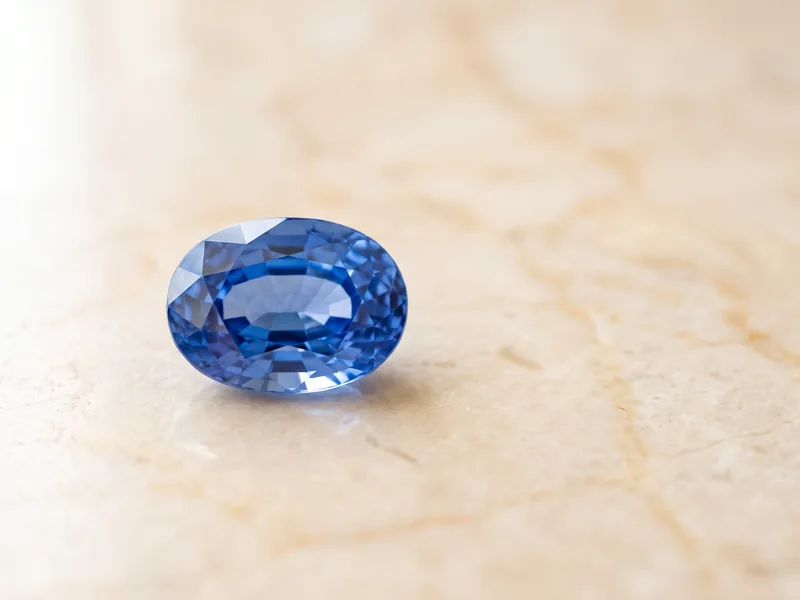 GemstonesGemstone Hardness Guide
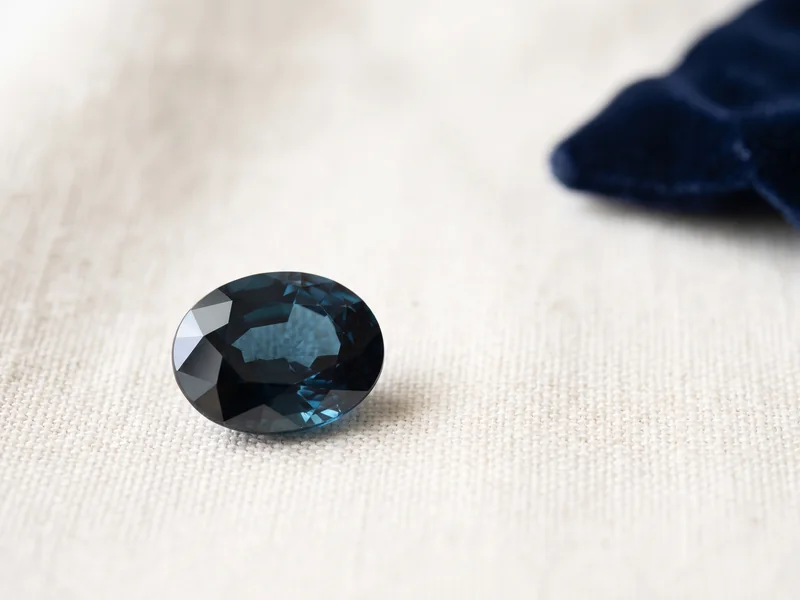 GemstonesSapphire Gemstones
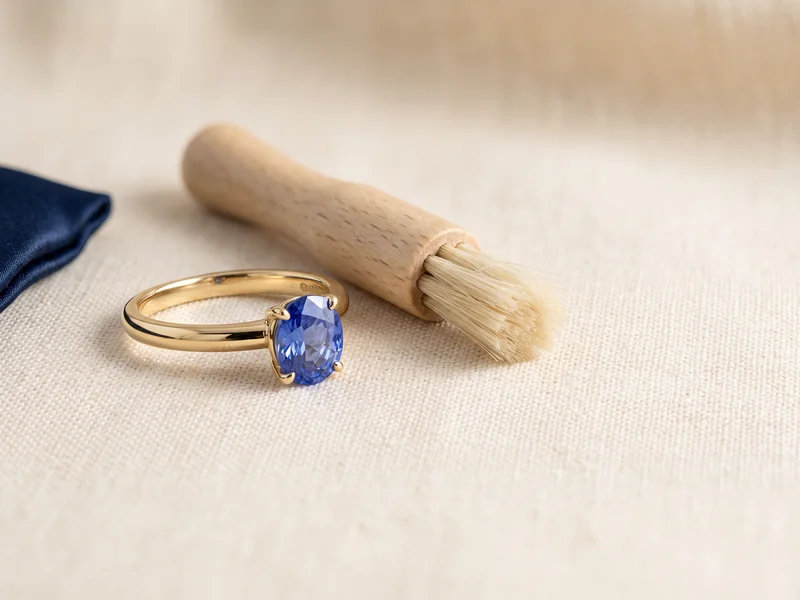 GemstonesGemstone Care by StoneGemstonesGemstones | Coloured Gemstones, Birthstones and Custom Jewellery
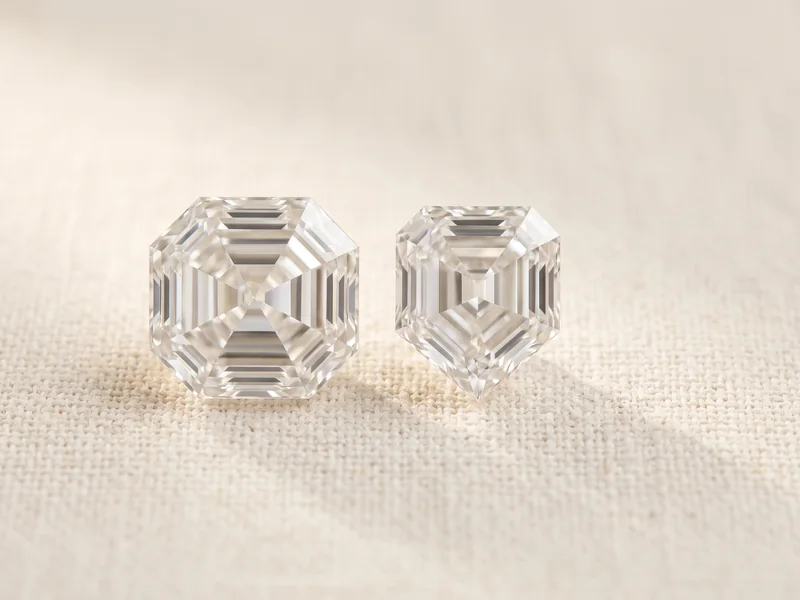 Diamond ShapesGeometric Diamond Cuts: Shield, Kite, Hexagon, Pentagon and More
 Diamond ShapesAntique Diamond Cuts: Old Mine, Old European and Rose
 Diamond ShapesSide Stone Diamond Cuts: Trapezoid, Half Moon, Bullet, Baguette, Trilliant
Explore more
More guides on this topic
Education