
- Education
- Diamond Shapes
- Asscher Cut Diamond Clarity Guide: Which Grade Looks Eye-Clean?
Diamond shapes
Asscher Cut Diamond Clarity Guide: Which Grade Looks Eye-Clean?
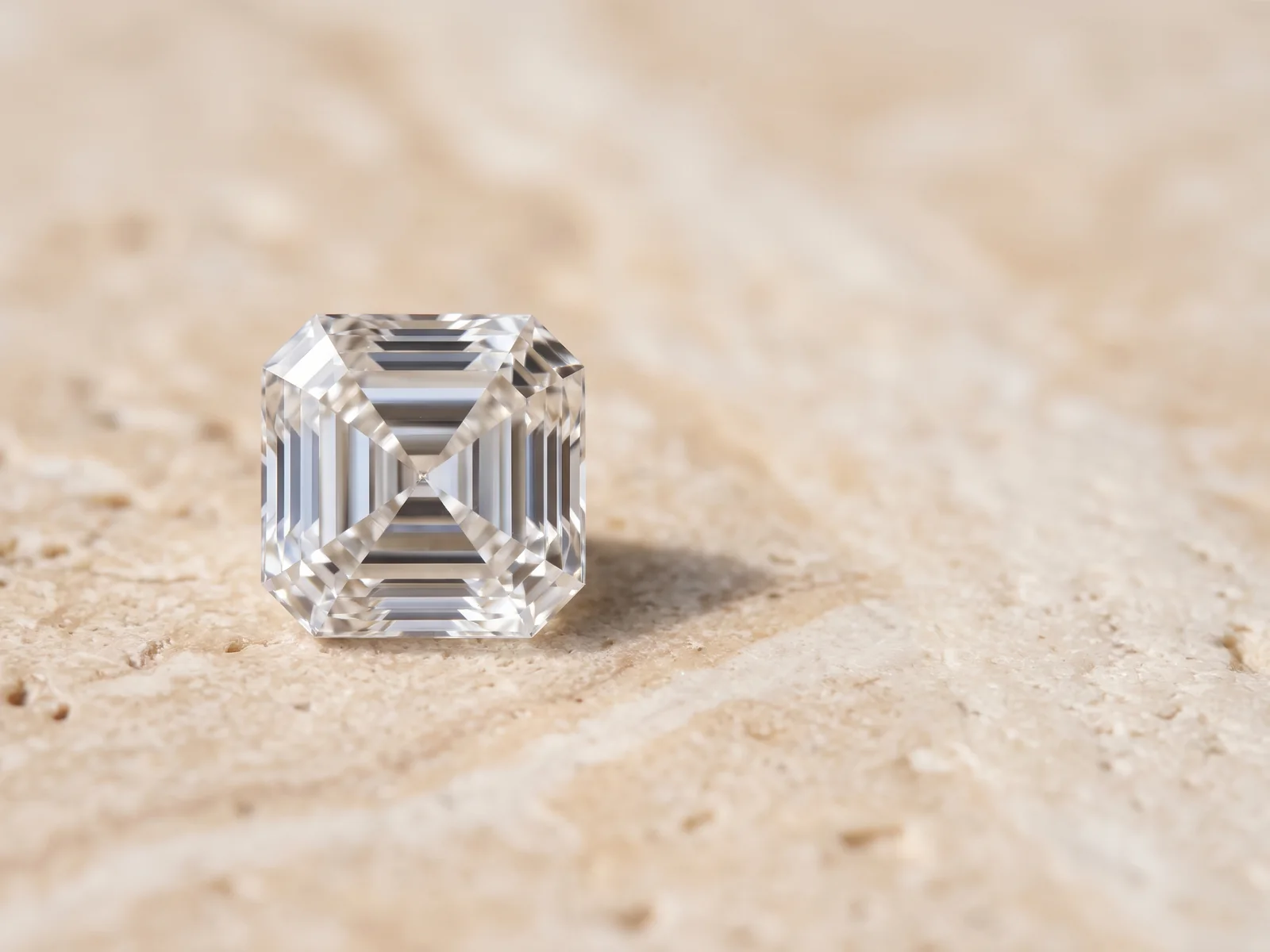
An Asscher has a clear, open face, which also shows more of what is inside the stone. Getting Asscher cut diamond clarity right decides whether the stone looks clean on the hand, and how much you spend to get there.
 Reviewed by Raj Sood, Graduate Gemologist (GIA), AJP (GIA)Master jeweller and Graduate Gemologist (GIA) · reviewed 4 November 2026
Quick answer
Asscher cut diamond clarity matters more than in round brilliants, because the large table and parallel step facets show inclusions clearly. For most Asschers up to about 1.5 carats, VS2 is the usual eye-clean starting point. Above 1.5 carats, VS1 is safer. SI1 works only when a stone is checked individually and its inclusions sit near the corners.
What does clarity mean for an Asscher cut diamond?
Clarity describes how free a diamond is of inclusions (features inside the stone) and blemishes (marks on the surface). Graders look at the diamond under 10× magnification and judge the size, number, position, nature and colour of those features. The result is one of 11 grades on the GIA scale, from Flawless (FL) down to Included (I3).
An Asscher is a square step cut with cut corners, so it looks like an octagon face-up. Instead of the small triangular and kite-shaped facets of a brilliant, it has long, flat facets arranged in steps that run parallel to the edges. The original was designed by the Asscher brothers in Amsterdam in 1902, and most Asschers today have about 58 facets. Our full Asscher cut diamond guide covers its history, proportions and look, and the Asscher belongs to the step cut family alongside emerald and baguette cuts. It is also one of the 34 diamond cuts we explain in detail.
Clarity is graded the same way on every shape, so a VS2 Asscher and a VS2 round have the same grade on paper. What changes is how visible those inclusions are once the diamond is cut. That is the whole point of this guide. Any term here you have not met before is explained in our plain-English jewellery glossary.
| Grade | Meaning | What you see at 10× |
|---|---|---|
| FL | Flawless | No inclusions or blemishes |
| IF | Internally Flawless | No inclusions; minor surface blemishes only |
| VVS1–VVS2 | Very, Very Slightly Included | Inclusions very difficult to see, even for a skilled grader |
| VS1–VS2 | Very Slightly Included | Minor inclusions, difficult to somewhat easy to see |
| SI1–SI2 | Slightly Included | Noticeable inclusions at 10× |
| I1–I3 | Included | Obvious inclusions, often visible without magnification |
Why do Asscher cuts show inclusions more than brilliant cuts?
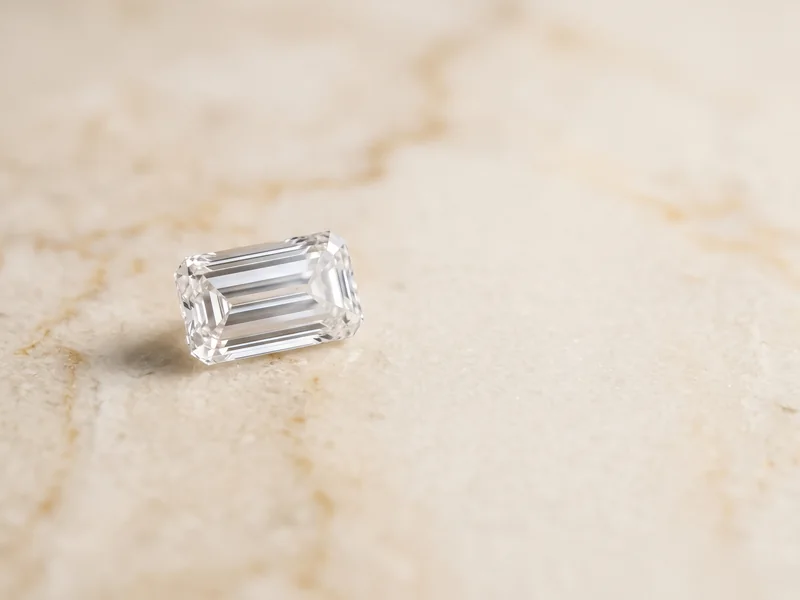
A brilliant cut breaks light into many small, bright flashes. Those flashes act like camouflage: a small crystal or feather sitting among them is hard for your eye to pick out. An Asscher works differently. Its broad facets reflect light in larger, calmer panels, and its table (the flat top facet) is often 60–70% of the width. Looking into an Asscher is a bit like looking into a still pool, which is why people call the effect a hall of mirrors.
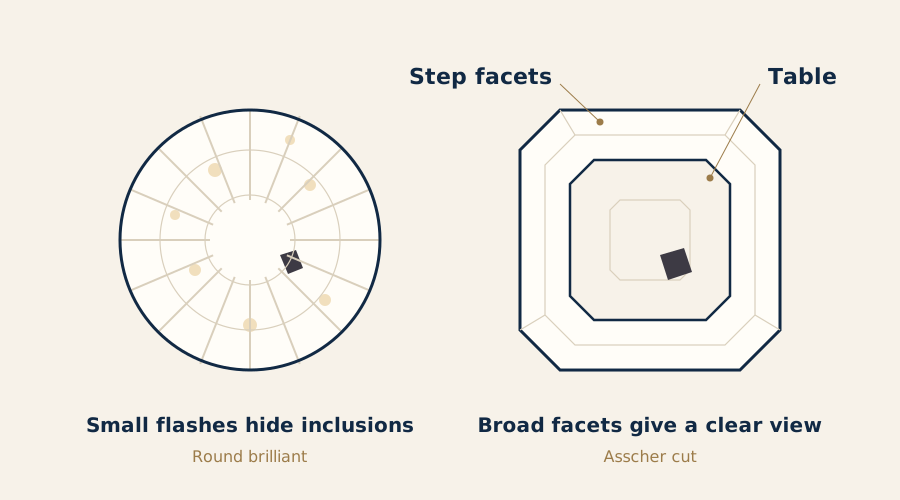
That clarity of view is part of the Asscher's appeal. The concentric squares you see through the table, known as the windmill pattern seen through the table, only look crisp when nothing interrupts them. A dark crystal under the table, or a white feather crossing a step, breaks the pattern and draws the eye straight to it.
Step cuts also show reflections of inclusions less than brilliants do. In a round, one crystal can reflect off several facets and look like a cluster of inclusions. In an Asscher, you usually see the inclusion once, clearly, where it actually sits. That is useful, because what you see on a photo is close to what you will see on the hand. For a wider look at how faceting style differs across diamond shapes, our shapes overview compares brilliant, step and mixed cuts.
What clarity grade should you choose for an Asscher cut diamond?
The aim for most people is an eye-clean diamond, meaning you cannot see any inclusion without magnification from a normal viewing distance of about 25–30 cm. Paying for a higher grade than that buys you rarity on paper, not a different look on the hand. Here is how each grade usually behaves in an Asscher:
| Clarity | How it usually looks in an Asscher | Gemmologist view |
|---|---|---|
| FL–IF | Clean at any magnification | Rare and priced accordingly; no visual gain over VVS |
| VVS1–VVS2 | Clean to the eye in every size | A comfortable choice for large stones over 2 ct |
| VS1 | Eye-clean in almost all sizes | The safer choice from about 1.5 ct upwards |
| VS2 | Eye-clean in most stones up to about 1.5 ct | The usual sweet spot for value and look |
| SI1 | Sometimes eye-clean; inclusions often visible under the table | Only after checking the individual stone |
| SI2 | Usually shows inclusions in a step cut | Rarely recommended for Asschers |
| I1–I3 | Visible inclusions; may affect durability | Not recommended |
Compared with a round brilliant, you generally need to go about one grade higher in an Asscher to get the same clean look. An SI1 round can often look clean; in an Asscher, VS2 is the more reliable equivalent. The same thinking applies to the longer emerald cut, which has an even bigger table; our page on how emerald and Asscher cuts compare covers the differences in shape and transparency.
Remember that two stones with the same grade can look quite different. A VS2 with a tiny white pinpoint near a corner looks cleaner than a VS2 with a small dark crystal under the table. The grade is a starting point; the position and colour of the inclusion finish the story.
Does Asscher size change the clarity you need?
Yes. As an Asscher gets larger, its table gets wider and its inclusions get larger too, because a bigger stone can hold a bigger crystal and still earn the same grade. More face-up area also means more room for your eye to wander, so larger Asschers need a little more clarity to stay clean.
| Carat weight | Typical face-up size | Suggested clarity for an eye-clean look |
|---|---|---|
| 0.50 ct | about 4.5 × 4.5 mm | SI1 (checked) or VS2 |
| 0.75 ct | about 5.0 × 5.0 mm | VS2 |
| 1.00 ct | about 5.5 × 5.5 mm | VS2 |
| 1.50 ct | about 6.3 × 6.3 mm | VS2 (checked) or VS1 |
| 2.00 ct | about 6.9 × 6.9 mm | VS1 |
| 3.00 ct | about 7.9 × 7.9 mm | VS1 or VVS2 |
These sizes are typical for an Asscher with a ratio close to 1.00 and a depth of about 63–68%. Asschers are often cut quite deep, so they can face up smaller than a round of the same weight; our comparison of which shapes look biggest for their carat weight sets out the pattern. Check the millimetre measurements on the report as well as the carat weight; our guide to Asscher proportions, depth and table size goes through the numbers that shape the look.
Small Asschers, under about 0.30 carat, are more forgiving. In accent stones and side stones an SI clarity is common, because the eye reads them as part of a pattern rather than studying each one. The same applies to the baguettes, carrés and other step cuts often used as side stones.
Not sure which one is right?
Send us the stones you are looking at and our gemologist will tell you which to choose and why.
Which inclusions matter most in an Asscher diamond?
Not every inclusion is equal. In an Asscher, the type and position of an inclusion matter more than the grade alone. The most common types:
- Crystals: small minerals trapped inside the diamond. Dark or coloured crystals, such as graphite or garnet, are the most visible in a step cut; clear or white crystals blend in better.
- Feathers: small internal breaks that look white or transparent. Usually harmless, but a feather reaching the surface near a corner can weaken the stone.
- Clouds: groups of tiny pinpoints. A light cloud is invisible; a dense cloud can make an Asscher look slightly hazy and dull the windmill pattern.
- Pinpoints: single tiny crystals, usually only visible under magnification.
- Twinning wisps: thin, wispy lines formed where the crystal structure changed direction as it grew. They can show as faint streaks across the steps.
- Naturals and indented naturals: small areas of the original rough surface left on or near the girdle (the outer edge).
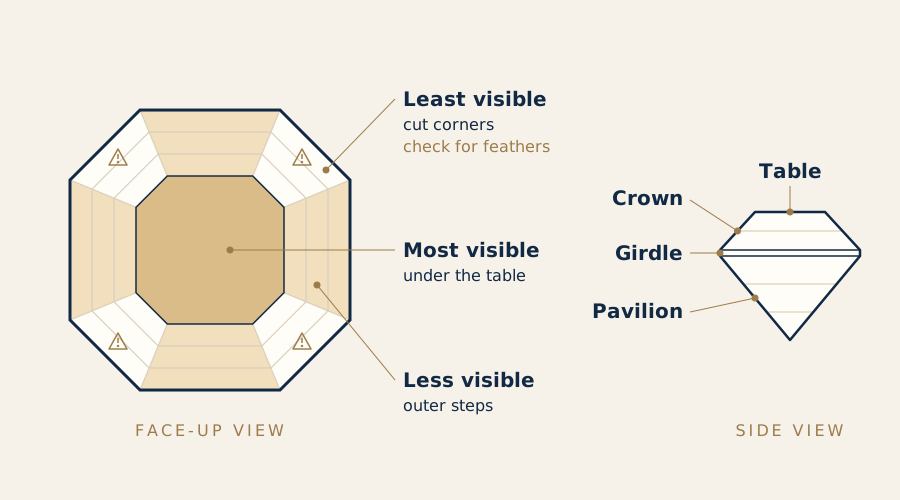
Position is the other half of the picture. An inclusion directly under the table is the most visible, because you look straight at it. Inclusions near the cut corners or close to the girdle are harder to see and can sometimes be covered by claws. But the corners are also where an Asscher is thinnest, so a feather that reaches the surface there is a durability concern as well as a visual one. Our guide to settings that cover and protect an Asscher's corners explains how claws and bezels help.
How do you read the clarity plot on an Asscher grading report?
A grading report from a lab such as GIA or IGI includes a clarity plot: a diagram of the stone, face-up and face-down, with each inclusion marked. On GIA reports, internal features are usually drawn in red and surface blemishes in green, with a key listing each type. The report also names the clarity characteristics, listing the main ones first.
- Look at position first. A mark in the middle of the table matters more than one at a corner or the girdle.
- Read the comments. Notes such as "clouds are not shown" or "additional pinpoints are not shown" tell you about features too small or scattered to plot.
- Check for treatments. Laser drilling (a tiny tunnel burnt to reach a dark inclusion) or fracture filling (a glass-like filler in a feather) must be disclosed. Fracture-filled diamonds are not graded by GIA.
- Compare plot to photos. The plot tells you where to look; a photo or video tells you whether you can actually see it.
A plot cannot show colour or contrast, so a large white feather and a small black crystal can look similar on paper. That is why video matters so much with step cuts. If any term on the report is new to you, our definitions of feathers, clouds and twinning wisps are a quick reference.
Related guideAsscher vs Square Radiant DiamondsIs clarity different in lab-grown Asscher diamonds, and what do they cost?
Laboratory-grown diamonds are real diamond, with the same hardness (10 on the Mohs scale) and refractive index (about 2.42) as natural diamond. They are graded on the same clarity scale, and the report states clearly that the stone is lab-grown. Their inclusions look a little different from natural ones:
- HPHT lab-grown (grown under high pressure and high temperature) can contain small metallic inclusions left by the growth process. These look dark and can show clearly under an Asscher's table.
- CVD lab-grown (grown from carbon-rich gas, layer by layer) can show dark pinpoints of graphite or faint growth lines.
- Natural diamonds carry crystals, feathers, clouds and twinning wisps formed deep in the earth over millions of years.
Because lab-grown diamonds cost much less, high clarity grades such as VVS are easy to find in lab-grown Asschers without a large price jump. With natural Asschers, each step up in clarity adds noticeably to the price, which is why choosing a well-placed VS2 rather than a VVS can make a real difference to your budget.
| 1 ct Asscher, G colour | Approximate price range (AUD) |
|---|---|
| Lab-grown, VS2 | about $800–$2,500 |
| Lab-grown, VVS2 | about $1,000–$3,000 |
| Natural, VS2 | about $6,000–$12,000 |
| Natural, VVS2 | about $8,000–$15,000 |
These are broad ranges only; prices move with the market, the exact grades and how well the stone is cut. Asschers usually cost less per carat than rounds of the same weight, colour and clarity; our page on how prices differ between diamond shapes shows where the Asscher sits. Live stock, with real measurements and 360° video, is the most reliable way to compare.
Shop Asscher cut diamonds: natural and lab-grown
Do other square shapes and settings need the same clarity?
How much clarity you need depends on how the shape handles light. Here is how the Asscher compares with the shapes people most often weigh it against:
| Asscher | Emerald | Princess | Square radiant | Cushion | |
|---|---|---|---|---|---|
| Facet style | Step cut | Step cut | Brilliant | Brilliant (mixed) | Brilliant |
| How well it hides inclusions | Low | Lowest | Good | Very good | Good |
| Usual eye-clean grade (about 1 ct) | VS2 | VS1–VS2 | SI1 | SI1–SI2 | SI1 |
| Vulnerable points | Four cut corners (fairly protected) | Four cut corners | Four sharp corners | Four cut corners | None |
If you love the square look but want more freedom on clarity, the brilliant-cut alternatives are worth comparing: see our princess vs Asscher comparison, the square radiant as a more forgiving alternative and Asscher against the softer cushion cut. To see every diamond shape side by side, start with our shapes overview.
The setting also changes what shows. Four claws placed over the cut corners can cover small inclusions there and protect the thinnest part of the stone. A bezel (a thin metal rim around the edge) hides the girdle completely. A halo frames the Asscher with small stones, which adds sparkle around it but does nothing to hide inclusions under the table. Our page on bezel, claw and halo options for Asscher rings shows each style.
How do you check an Asscher cut diamond's clarity? Step by step
- Read the report. Confirm the clarity grade, the measurements and whether the diamond is natural or lab-grown, and note any treatment such as laser drilling.
- Study the plot. Find where each inclusion sits. Favour stones whose main inclusions are near the corners or girdle rather than under the table.
- Watch a 360° video. Look straight through the table as the stone turns. Dark crystals and dense clouds are the features to watch for.
- Check the windmill. Make sure inclusions do not break up the concentric squares; our guide to checking the windmill for evenness shows what a crisp pattern looks like.
- Look at actual size. View a photo at true size on screen, or the stone in person at arm's length, to judge whether it is truly eye-clean.
- Check the corners. Make sure no feather reaches the surface at a cut corner, and plan a setting that protects them.
Follow those six checks and you will usually find that a carefully chosen VS2 Asscher looks as clean as a stone graded two or three steps higher, with the money left over for size, colour or the setting.
Free consultation
Talk to a gemologist
Compare stones in person or online with Raj Sood, Graduate Gemologist (GIA), AJP (GIA).
Book a consultationFAQ
Common questions
What clarity is eye-clean for an Asscher cut diamond?
For most Asschers up to about 1.5 carats, VS2 is usually eye-clean. Above that, VS1 is safer, and SI1 only works when you have checked the individual stone.
Is SI1 clarity okay for an Asscher diamond?
Sometimes, but it needs checking stone by stone. Step cuts show inclusions clearly, so an SI1 Asscher is only a good choice if its inclusions are small, light in colour and sit near the corners rather than under the table.
Do Asscher cuts need higher clarity than round diamonds?
Generally yes, by about one grade. A round brilliant's sparkle hides inclusions, while an Asscher's large table and step facets give a clear view into the stone.
Is VVS clarity worth it in an Asscher?
For most stones under 2 carats, a well-chosen VS2 or VS1 looks the same to the eye. VVS makes more sense in very large Asschers, or in lab-grown stones where the price difference is small.
Do lab-grown Asscher diamonds have inclusions?
They can. Lab-grown diamonds may show metallic inclusions, dark pinpoints or growth lines, and they are graded on the same clarity scale as natural diamonds.
Which is more forgiving on clarity, Asscher or emerald cut?
The Asscher is slightly more forgiving, because its table is smaller and its deeper pavilion adds more reflections. Both are step cuts, though, so both need more clarity than brilliant shapes.
Terms in this guide

Ask a gemologist
Not sure which diamond to choose?
Raj Sood is a Graduate Gemologist (GIA) and master jeweller. Bring the stones you are considering, or send the reports, and he will tell you honestly which one is better and why.
Keep learning
Related guides
 Diamond ShapesAsscher Cut Diamonds
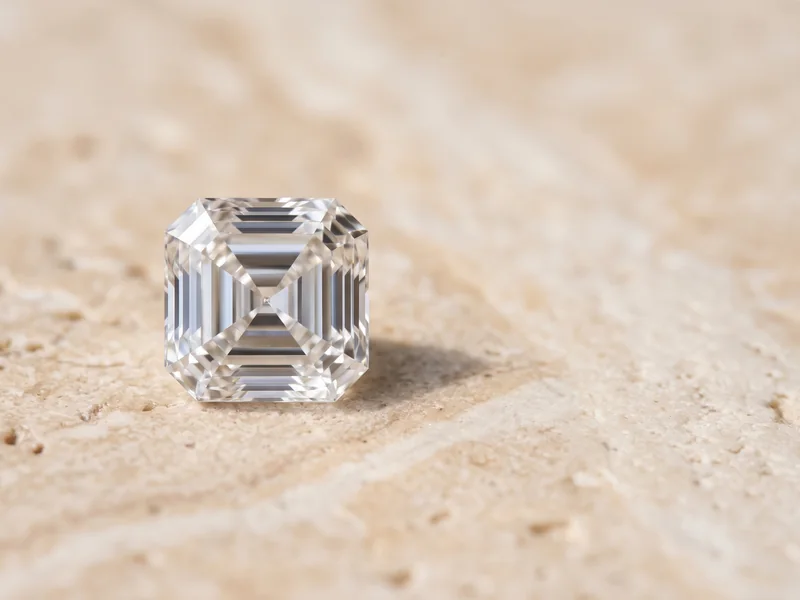 Diamond ShapesAsscher-Cut Diamond Windmill Pattern
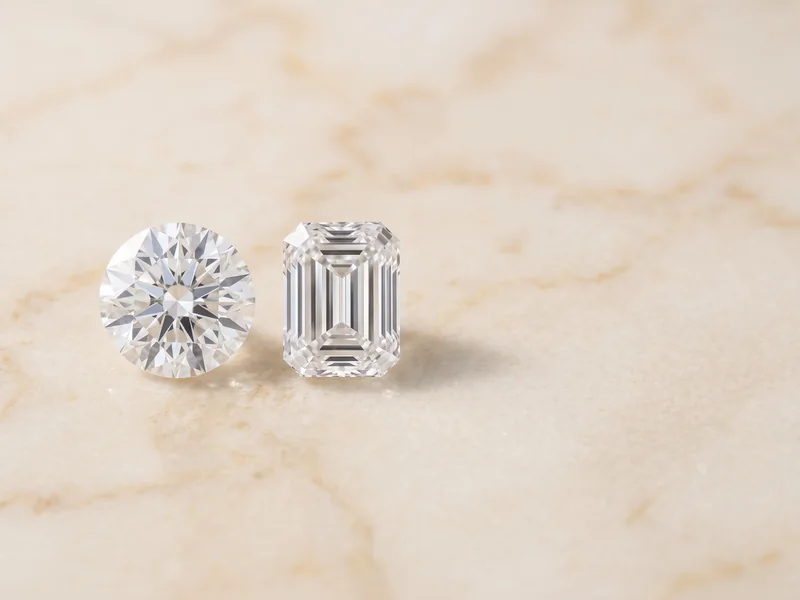 Diamond ShapesEmerald vs Asscher Cut Diamonds
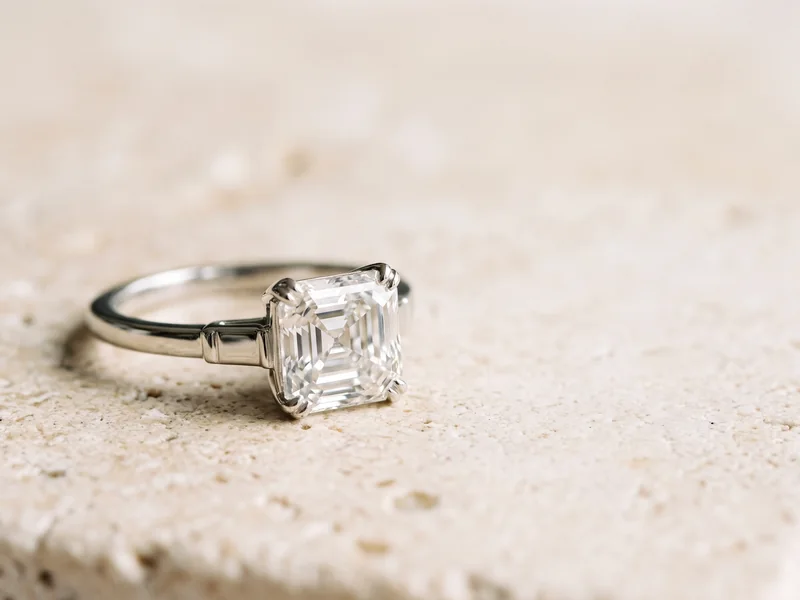 Engagement Rings & SettingsBest Settings for Asscher DiamondsDiamond ShapesUnderstanding Diamond Shapes
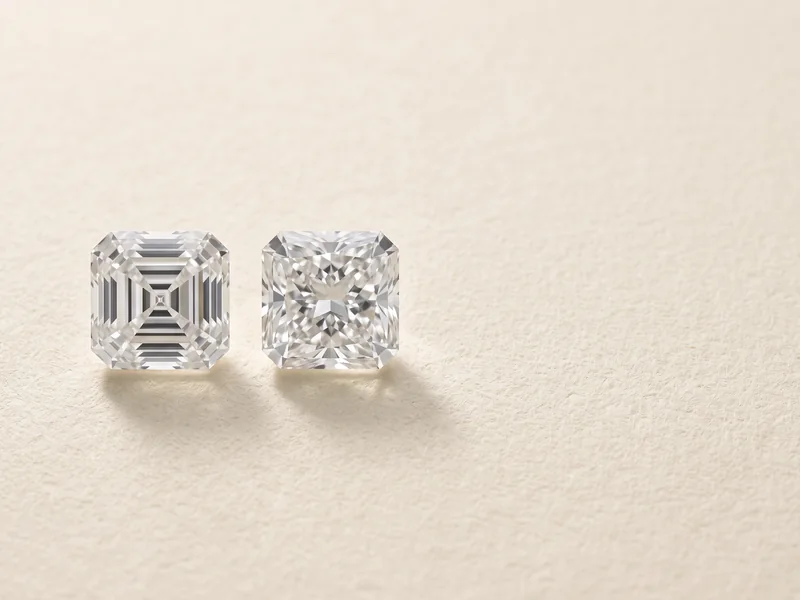 Diamond ShapesPrincess vs Asscher Cut DiamondsDiamond ShapesAsscher vs Cushion Cut Diamonds
 Diamond ShapesStep Cut Diamonds: Emerald, Asscher, Baguette, Carré and More
Explore more
More guides on this topic
Education