
Gemstones
July Birthstone Ruby: History, Colours, Durability and Ring Settings
The July birthstone ruby is one of the few coloured gems tough enough for a ring worn every day. Here is what makes a ruby red, how most rubies are treated, where they come from and how to set one so it lasts.
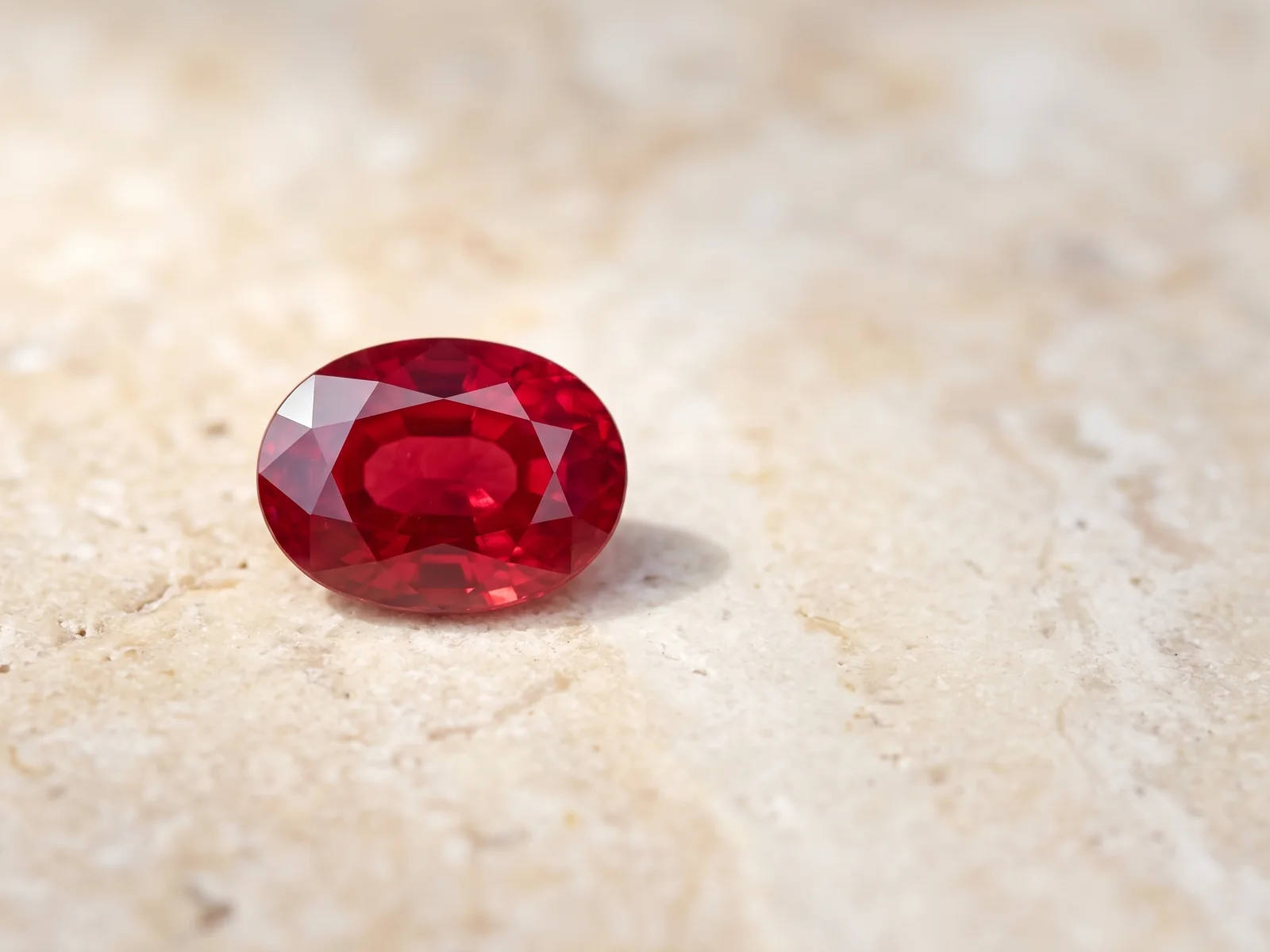
 Reviewed by Raj Sood, Graduate Gemologist (GIA), AJP (GIA)Master jeweller and Graduate Gemologist (GIA) · reviewed 4 November 2026
Quick answer
Ruby is the July birthstone. It is red corundum, coloured by chromium, and rates 9 on the Mohs scale, second only to diamond, so it suits everyday rings. Most rubies are heat-treated, which is stable and accepted. Look for a strong, even red, an eye-clean stone, a report stating any treatment and a protective claw or bezel setting.
Why is ruby the July birthstone?
Ruby is the birthstone for July on the modern list used by jewellers in Australia, the UK and the US. A ruby is the red variety of the mineral corundum, which is crystalline aluminium oxide (Al2O3). Pure corundum is colourless. A trace of chromium, usually well under 1% of the crystal, takes the place of some aluminium and turns it red. Every other colour of corundum is sold as sapphire, which is why our September birthstone guide to sapphire reads almost like a sister page to this one.
The modern birthstone list was standardised in 1912 by the American National Association of Jewelers, and ruby has held July ever since. Some older traditional and mystical lists give July to carnelian or onyx instead, but when people say July birthstone colour, they mean ruby red. Ruby is one of the four classic precious gems, alongside diamond, sapphire and emerald, which take April's diamond, September and the May birthstone, emerald. It is also the traditional gem for a 40th wedding anniversary.
For every month's stone and how each one is worn, see our birthstone jewellery overview. For all the coloured gems we work with, start at the coloured gemstones hub.
What is the history and meaning of the ruby birthstone?
The name comes from the Latin ruber, meaning red. In Sanskrit ruby was called ratnaraj, 'king of precious stones', and it has been traded out of South and South-East Asia for well over two thousand years. The Mogok valley in Burma (now Myanmar) became the classic source, and Sri Lanka supplied lighter, pinker stones. The ruby birthstone meaning people quote today, passion, courage and protection, comes from that long tradition of red as the colour of blood and life.
Until modern gem testing, many red stones were simply called ruby. The 'Black Prince's Ruby' in the British Imperial State Crown is actually a red spinel, a different mineral that was only separated from ruby scientifically in the late 1700s. Red garnets were confused with ruby too, and garnet, the January birthstone, is still sometimes mistaken for it today.
In 1902 the French chemist Auguste Verneuil announced the flame-fusion process, which made lab-created ruby (also called synthetic ruby) cheap and plentiful. Lab-created rubies have the same chemistry, hardness and optical properties as natural ruby, and they are used in watch movements and lasers as well as jewellery. They must always be sold as lab-created or synthetic, never simply as ruby.
What colours do rubies come in?
Ruby ranges from purplish red through pure red to orangey red, in tones from medium to quite dark. The most valued colour is a pure to slightly purplish red of strong saturation (intensity), traded as pigeon's blood. A pigeon's blood ruby is a trade description, not a formal grade: some labs print it on reports to their own defined standard, others do not use it at all.
Chromium also makes ruby fluoresce, glowing red under ultraviolet light, including the UV in daylight, so many rubies seem lit from within. Rubies from marble-hosted deposits, such as Myanmar, tend to be low in iron and fluoresce strongly. Iron-rich rubies from basalt-related deposits, such as parts of Thailand and Cambodia, fluoresce less and can look darker or slightly brownish.
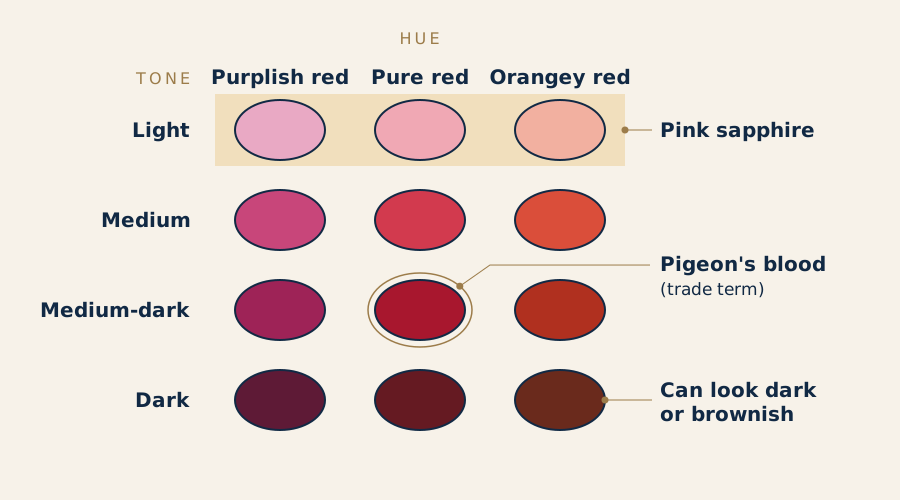
| Colour description | What it means | Notes |
|---|---|---|
| Pigeon's blood | Pure to slightly purplish red, strong saturation, strong fluorescence | Trade term; most associated with Myanmar, also found in Mozambique |
| Purplish red | Red with a cool purple secondary hue | Common and attractive; slightly lower value than pure red |
| Orangey red | Red with a warm orange secondary hue | Can look lively in yellow gold |
| Dark or brownish red | Low brightness, often iron-rich | Lower value; can look black in dim light |
| Light pinkish red | Light tone, lower saturation | Usually sold as pink sapphire in Australia |
Where does ruby end and pink sapphire begin? There is no fixed line. In Australia, the US and most of Europe, corundum generally needs a medium to dark tone of red to be called ruby; lighter stones are pink sapphire. Some Asian markets call lighter stones ruby. Ruby is also pleochroic, meaning it shows slightly different colours when viewed from different directions, so a skilled cutter orients the rough for the richest red face-up. Our guide to judging ruby colour, clarity and cut goes through each factor grade by grade.
Where do rubies come from, and are there Australian rubies?
Today Mozambique, around Montepuez, supplies a large share of the world's rubies, many of them bright and clean enough for fine jewellery. Other sources include Myanmar, Thailand and Cambodia (mostly historic), Sri Lanka, Madagascar, Tanzania, Kenya, Afghanistan, Vietnam and Greenland. Origin is an opinion given by a gem lab after testing, not something you can see by eye. It can change the price a great deal, but it does not change the stone's hardness or how it wears.
Australia is famous for sapphire rather than ruby. Red corundum turns up only occasionally among the sapphires of the New England fields in New South Wales and the central Queensland fields, and small, mostly translucent to opaque rubies are known from the Harts Range in the Northern Territory. An Australian ruby large and clean enough to facet for a ring is rare. If Australian origin matters to you, ask about an Australian sapphire, including the blue-green-yellow parti sapphires these fields are known for, or ask for a ruby with documented origin from elsewhere.
Translucent ruby is usually cut as a cabochon, a smooth domed stone with no facets. When it contains fine needles of the mineral rutile, a cabochon can show a six-rayed star that glides across the dome as it moves; see how star rubies and star sapphires form.
Not sure which one is right?
Send us the stones you are looking at and our gemologist will tell you which to choose and why.
Is the July birthstone ruby tough enough for an everyday ring?
Yes. Ruby is 9 on the Mohs scale, so only diamond among common gems will scratch it, and household dust (mostly quartz, at 7) cannot. Corundum has no true cleavage (a plane along which a crystal splits cleanly), so its toughness, its resistance to chipping and breaking, is very good. That combination is why ruby engagement ring durability is rarely a worry, and why rubies set generations ago are often still sharp-edged.
The weak points are not the mineral itself but what is inside it. Large surface-reaching fractures, and especially glass-filled fractures, lower a ruby's toughness. A well-chosen heated or unheated ruby with no open fractures is as practical as a sapphire. Here is how it compares with other birthstones for a ring worn daily:
| Birthstone | Month | Mohs hardness | For an everyday ring |
|---|---|---|---|
| Diamond | April | 10 | Excellent |
| Ruby | July | 9 | Excellent |
| Sapphire | September | 9 | Excellent |
| Aquamarine | March | 7.5–8 | Good, with a protective setting |
| Emerald | May | 7.5–8 | Fair; brittle and often fracture-filled |
| Garnet | January | 6.5–7.5 | Fair; scratches and wears over years |
| Amethyst | February | 7 | Fair; better for occasional wear |
So ruby sits right beside sapphire and diamond, well ahead of aquamarine for March or February's amethyst. Our guide to choosing a birthstone engagement ring that lasts ranks every month in detail.
Are rubies treated, and what about lab-created ruby?
Most rubies on the market have been treated in some way. Treatment is not a problem in itself; what matters is that it is disclosed and that you know how stable it is. A grading report from a lab such as GIA, SSEF, Gübelin or GRS states what the lab detects.
| Treatment | What it does | Stable? | Effect on value |
|---|---|---|---|
| None (unheated) | Colour and clarity as mined | Yes | Highest, for the same quality |
| Heating | Improves colour, dissolves fine silk (needles) | Yes, permanent | Widely accepted; standard in the trade |
| Heating with flux (minor residue) | Heals small fractures with a glassy residue | Generally yes | Slightly below plain heating |
| Lead-glass filling | Fills large fractures in low-grade ruby with high-lead glass | No; damaged by heat, acids, ultrasonic | Very low; sold as composite or glass-filled ruby |
| Oiling or dyeing | Hides fractures, adds colour | No | Very low |
A heat treated ruby is the everyday standard and is perfectly suited to a ring. A lead-glass filled ruby is a different product: so much glass can be present that it is sold as a composite. It is fine as a fashion piece but not for a ring you plan to wear for decades or have resized. A low price on a large, very clean-looking red stone is the usual giveaway; our page on spotting treatments and checking a ruby report shows what to look for.
Lab-created ruby is real corundum grown in a laboratory by flame fusion, flux growth or hydrothermal methods. It has the same hardness of 9 and the same refractive index as natural ruby, often with better clarity, and costs a fraction of the price. Flame-fusion stones can show curved growth lines under magnification; flux-grown stones look more like natural ruby and cost more. Whichever you choose, the paperwork should state clearly whether it is natural or lab-created.
What is the best setting for a ruby ring?
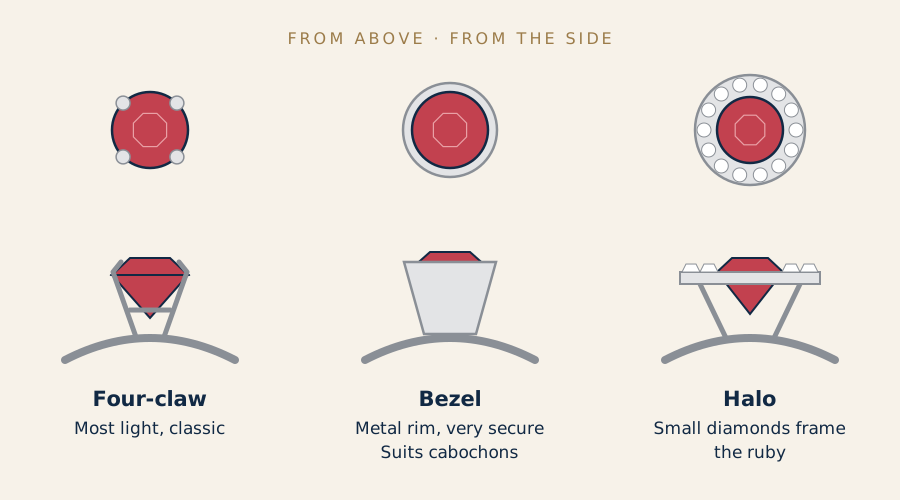
Because ruby is hard and tough, almost any setting works. The best setting for a ruby ring depends on how you wear it and the look you want:
- Four or six claws: let in the most light, which helps a darker ruby stay bright. Six claws add security for stones over about 1 carat.
- Bezel setting: a rim of metal around the whole edge. Very secure for active hands and a good match for cabochons and star rubies.
- Halo: a ring of small diamonds around the ruby. White diamonds frame the red and make the centre look larger.
- Three-stone: a ruby between two diamonds, or a diamond between two rubies, a common choice for anniversaries.
- Bands and eternity rings: small calibrated rubies (cut to exact millimetre sizes) channel-set or claw-set around a band.
- Pendants and studs: simple ways to wear the July birthstone without the knocks a ring takes.
Metal colour changes how the red reads. Yellow and rose gold warm it up and suit orangey reds. Platinum and white gold give a cooler, crisper contrast that flatters purplish reds and pure reds. Silver is too soft to hold a valuable ruby securely in a daily ring.
For design ideas and how a red centre stone works as an engagement ring, see our guide to ruby engagement ring designs. If you are weighing ruby against a diamond centre, our ruby versus diamond comparison sets out hardness, brilliance and price side by side, and choosing between a ruby and a sapphire ring covers the closest alternative.
Related guideRuby vs Sapphire Engagement RingsHow much does a July birthstone ruby cost?
Ruby prices vary more than almost any other gem, because colour, clarity, treatment and origin all pull hard on value. Fine rubies over about 1 carat are much rarer than diamonds of the same size, and price per carat rises steeply with size. Ruby price in Australia also follows exchange rates, since nearly all stones are imported.
| Type of ruby (about 1 ct) | Approximate price range (AUD) |
|---|---|
| Lab-created (flame fusion) | about $50–$300 |
| Lab-created (flux-grown) | about $200–$1,000 |
| Lead-glass filled (composite) | about $20–$200 |
| Natural, heated, commercial quality | about $500–$2,500 |
| Natural, heated, fine colour, eye-clean | about $3,000–$10,000 |
| Natural, unheated, fine colour with origin report | about $10,000–$50,000 or more |
These are broad ranges only and change with the market and the exact stone. Within natural rubies, colour drives price most, then clarity, treatment, size and origin. Some inclusions are expected; a completely clean natural ruby is exceptional. Our page on loose ruby gemstones in Melbourne explains what is typically available.
Shop natural gemstones
How do you clean and care for ruby jewellery?
For an untreated or heated ruby with no open fractures, warm water, a little mild dishwashing liquid and a soft toothbrush are all you need. Rinse well and dry with a lint-free cloth. Ultrasonic and steam cleaning are usually safe for these stones, but skip them for any ruby that is glass-filled, fracture-filled, oiled or has visible surface-reaching cracks.
- Take rings off for gardening, gym work and heavy lifting; ruby resists scratches but the claws and metal still wear.
- Store ruby pieces apart from diamonds, which can scratch ruby, and from softer gems, which ruby can scratch.
- Have claws checked about once a year; a loose claw is the most common reason any centre stone is lost.
- Tell your jeweller about any treatment before a resize or repair, so heat from the torch is managed correctly.
If any of these terms are new, our jewellery terms explained in plain English covers claws, bezels, cabochons and treatments.
How do you choose a July birthstone ruby? Step by step
- Decide how it will be worn. An everyday ring needs a stone without open fractures and a secure claw or bezel setting; a pendant gives more freedom.
- Judge colour first. Look for a strong red with an even spread and few dark or washed-out areas, in daylight and under indoor light.
- Check clarity by eye. Aim for a stone that looks clean at normal viewing distance, and ask whether any fractures reach the surface.
- Read the report. Confirm natural or lab-created, the treatment (none, heated or glass-filled) and, for valuable stones, the origin opinion.
- Compare millimetre size. Ruby is denser than diamond, so a 1 ct ruby looks smaller than a 1 ct diamond; compare measurements, not just carat weight.
- Match the metal and setting. Choose yellow or rose gold for warmth, platinum or white gold for contrast, and a setting that protects the edges.
Free consultation
Talk to a gemologist
Compare stones in person or online with Raj Sood, Graduate Gemologist (GIA), AJP (GIA).
Book a consultationShop this shape
FAQ
Common questions
What is the birthstone for July?
Ruby is the modern birthstone for July. Some older traditional lists also mention carnelian or onyx, but ruby is the stone most people mean.
Is ruby good for an everyday ring?
Yes. At 9 on the Mohs scale with very good toughness, ruby is one of the most practical coloured gems for daily wear, provided it has no large glass-filled fractures.
Are heat-treated rubies real rubies?
Yes. Heating is a long-standing, permanent treatment applied to natural rubies to improve colour and clarity. It should be disclosed, and unheated stones of the same quality cost more.
What is a pigeon's blood ruby?
It is a trade term for a pure to slightly purplish red ruby with strong saturation and strong fluorescence. It is not a universal grade, and labs that use it apply their own criteria.
Are lab-created rubies real?
A lab-created ruby is real corundum with the same chemistry and hardness as a natural ruby, but it was grown in a laboratory. It costs much less and must always be described as lab-created or synthetic.
Are there rubies in Australia?
Yes, but they are uncommon. Occasional red corundum is found in the New South Wales and Queensland sapphire fields, and small rubies are known from the Northern Territory's Harts Range, though facet-grade Australian rubies are rare.

Ask a gemologist
Not sure which diamond to choose?
Raj Sood is a Graduate Gemologist (GIA) and master jeweller. Bring the stones you are considering, or send the reports, and he will tell you honestly which one is better and why.
Keep learning
Related guides
 GemstonesHow to Judge Ruby QualityGemstonesRuby Engagement RingsGemstonesRuby Gemstones Melbourne
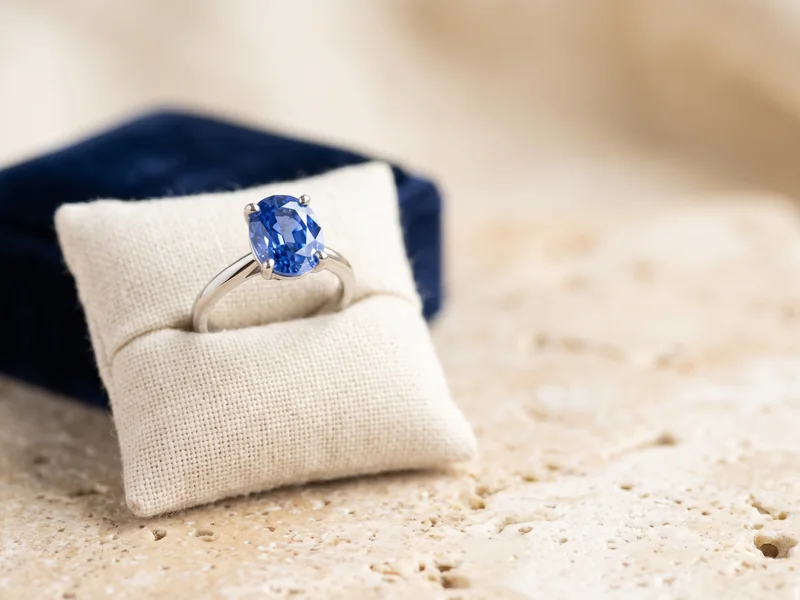 GemstonesBirthstone Engagement Rings: Choosing for DurabilityGemstonesGemstones | Coloured Gemstones, Birthstones and Custom Jewellery
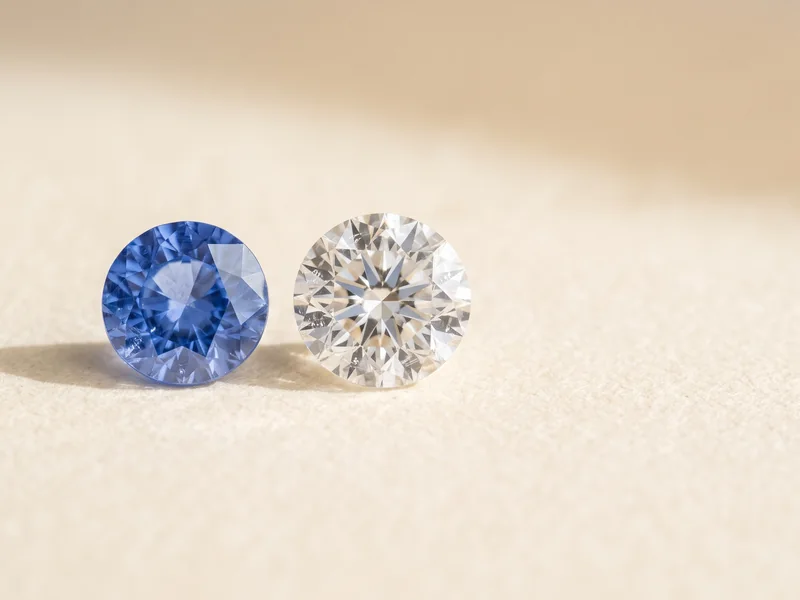 GemstonesRuby vs Diamond
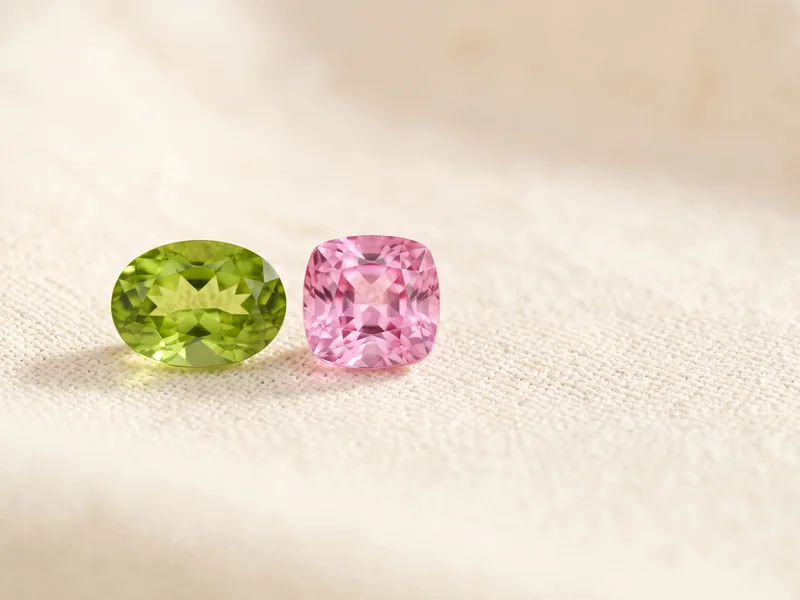 GemstonesRuby vs Sapphire Engagement Rings
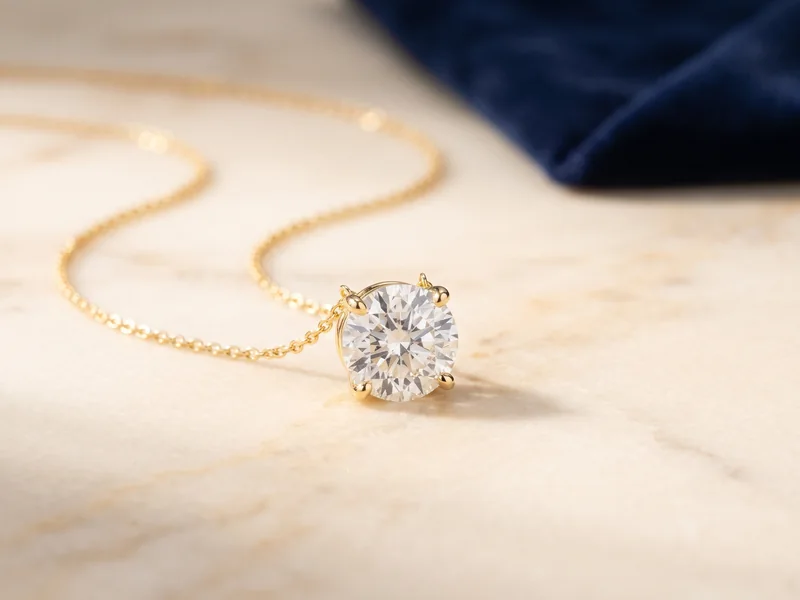 GemstonesBirthstone Jewellery Melbourne
Explore more
More guides on this topic
Education