
Gemstones
April Birthstone Diamond: History, Colours, Durability and Settings
If you were born in April, your birthstone is diamond: the hardest of all twelve monthly stones and the easiest to wear every day. This April birthstone diamond guide covers its history, colours, Australian sources, durability, settings and prices.
 Reviewed by Raj Sood, Graduate Gemologist (GIA), AJP (GIA)Master jeweller and Graduate Gemologist (GIA) · reviewed 4 November 2026
Quick answer
The April birthstone is diamond, crystallised carbon and the hardest natural material at 10 on the Mohs scale. It comes colourless or in fancy colours such as yellow, pink and blue, and is available natural or lab-grown. Its hardness makes it the most practical birthstone for an everyday ring, set in claws or a bezel.
What is the April birthstone?
The April birthstone is diamond, the only birthstone made of a single element: carbon, packed into a tight cubic crystal lattice. That structure is why diamond rates 10 on the Mohs scale (a 1–10 ranking of scratch resistance), has a refractive index of about 2.42 (a measure of how strongly it bends light) and shows a dispersion of about 0.044, which splits white light into the flashes of spectral colour often called fire. Diamond sits within our wider guide to coloured gemstones and birthstones, and it is the hardest of the twelve monthly stones by a wide margin.
Modern lists used in Australia, the United States and the United Kingdom all give diamond for April. Some traditional British lists add rock crystal (colourless quartz, Mohs 7) as an April birthstone alternative, and people who want a clear stone at a lower price sometimes choose white sapphire. Neither is a diamond, and both should always be sold under their own names.
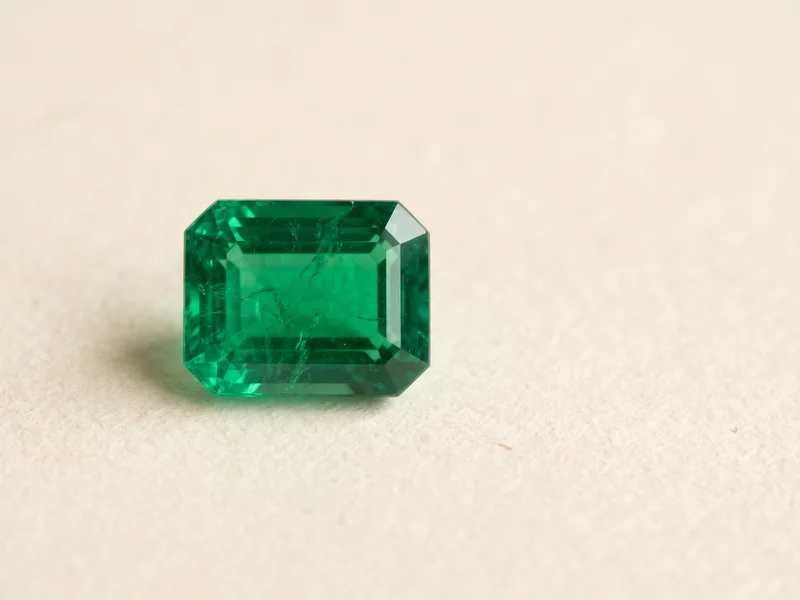
April sits between aquamarine, the pale blue March birthstone and emerald, the green stone for May. If you are planning a piece that brings several family members' months together, our page on birthstone jewellery ideas for every month shows how the stones work side by side.
Why is diamond the birthstone for April?
The idea of a stone for each month grew out of older traditions that linked twelve gems to the breastplate of the high priest described in the Book of Exodus, and later to the months and the signs of the zodiac. For centuries, different cultures used different lists. The modern list most people follow was adopted in 1912 by the American National Retail Jewelers Association (now Jewelers of America), and it named diamond for April. Britain's National Association of Goldsmiths published its own list in 1937, again with diamond for April.
Diamond's own history is far older than the list. India was the only known source for roughly two thousand years, with stones recovered from river gravels from at least the 4th century BCE. The Sanskrit word vajra meant both diamond and thunderbolt, and the English word comes from the Greek adamas, meaning unconquerable. Brazil became the main source after deposits were found in the 1720s, and South Africa took over after the finds of the late 1860s and the Kimberley pipes of 1871.
The first well-documented diamond engagement ring was given by Archduke Maximilian of Austria to Mary of Burgundy in 1477. Over the centuries diamond came to stand for strength, clarity and lasting commitment, and that is usually given as the April birthstone meaning today. The list itself has not stood still since 1912: June's trio of pearl, moonstone and alexandrite shows how months have gained extra stones, while garnet, the stone that opens the year in January has kept its place from the start.
What colours does the April birthstone diamond come in?
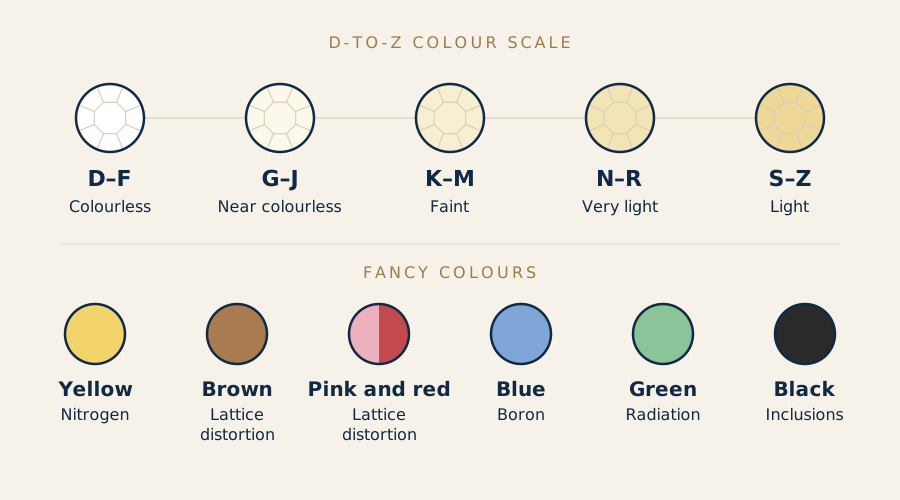
Most people picture a colourless diamond, and that is what the standard D-to-Z colour scale grades. D is completely colourless, and each letter further down the alphabet shows a little more yellow or brown, mostly from traces of nitrogen in the crystal. When the colour is strong enough, or a colour other than yellow or brown is present, the stone is graded as a fancy colour diamond instead. So the April birthstone colour is usually given as clear or white, but diamond actually comes in almost every colour.
| Colour | Main cause | How often you see it |
|---|---|---|
| Colourless to light yellow (D–Z) | Little or some nitrogen | Most common; graded on the D-to-Z scale |
| Fancy yellow | Nitrogen in larger amounts | The most common fancy colour |
| Brown (champagne, cognac) | Distortion of the crystal lattice | Common; Argyle produced large volumes |
| Pink and red | Lattice distortion deep in the earth | Very rare; red is the rarest of all |
| Blue | Traces of boron | Very rare in nature |
| Green | Natural radiation over long periods | Rare; colour is often only near the surface |
| Black | Dense inclusions such as graphite | Often treated to deepen the colour |
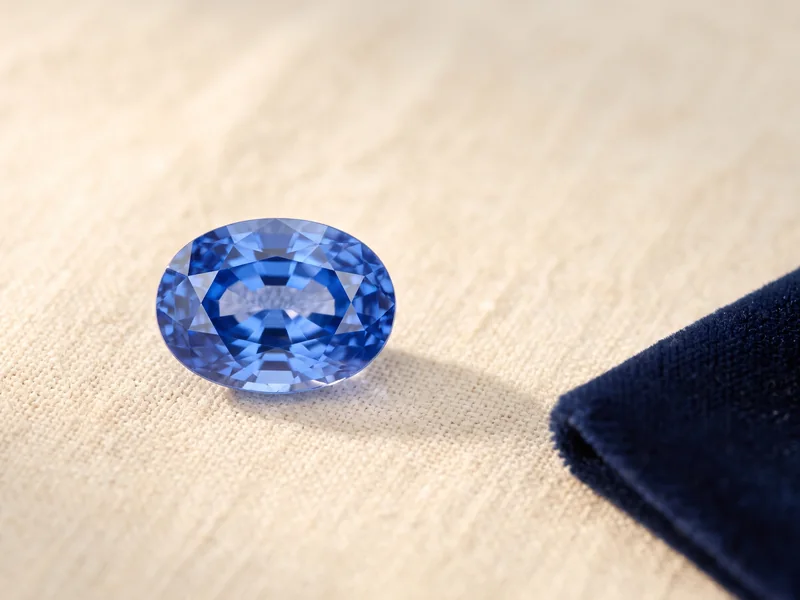
Fancy colours are graded for intensity, from Faint, Very Light and Light through Fancy Light, Fancy, Fancy Intense and Fancy Vivid, with Fancy Deep and Fancy Dark for darker stones. Many coloured diamonds on the market, natural and lab-grown, have had their colour created or improved by treatments such as irradiation or HPHT (high-pressure, high-temperature) processing. Treatment must be disclosed, and a report from GIA or a similar lab will state it. If any of these terms are new, our plain-English jewellery glossary explains them. If you love colour but not the price of a fancy diamond, sapphire, the September birthstone comes in pink, yellow and blue and rates 9 on the Mohs scale.
Are there Australian April birthstone diamonds?
Yes, and Australia has an unusual place in diamond history. The Argyle mine in the East Kimberley region of Western Australia was discovered in 1979 and mined from the mid-1980s. At its peak it was the world's largest diamond producer by volume. Most of its output was brown, which the trade marketed as champagne and cognac diamonds, but Argyle is best known for its pinks: it supplied the large majority of the world's pink diamonds, often quoted at around 90%, until it closed in November 2020.
Other Australian sources include the Ellendale mine, also in the Kimberley, known for fancy yellow diamonds until it closed in 2015, and smaller historical finds in the river gravels of northern New South Wales. With Argyle closed, documented Argyle pinks are now scarce. They are usually sold with origin paperwork, and many carry a microscopic laser inscription on the girdle (the thin outer edge of the stone). Argyle browns and small white diamonds still turn up in the trade more often.
If Australian origin matters to you, ask for evidence rather than a verbal assurance: origin documents, a girdle inscription, or a report that notes the source. Diamond is not the only Australian birthstone story, either; opal, one of October's two birthstones, is our national gemstone, and most of the world's precious opal is mined here.
Not sure which one is right?
Send us the stones you are looking at and our gemologist will tell you which to choose and why.
Is diamond durable enough for an everyday ring?
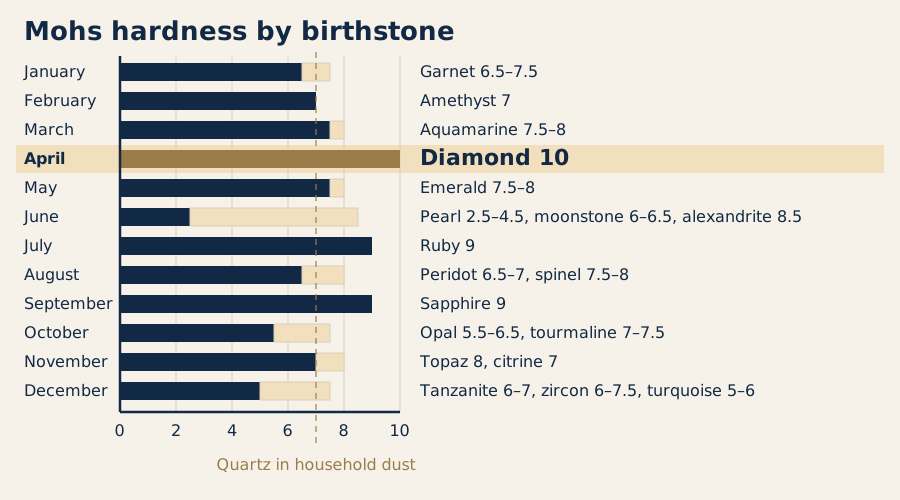
Yes. Diamond is the most scratch-resistant gem there is: at 10 on the Mohs scale, only another diamond can scratch it. The Mohs scale is also uneven. The step from sapphire at 9 to diamond at 10 is far larger than the step from 8 to 9, and on absolute hardness tests diamond measures several times harder than sapphire. A diamond worn daily for decades keeps its crisp facet edges and polish, while softer stones slowly round off and dull, because everyday dust contains quartz (Mohs 7).
Hardness is not the whole story. Toughness is a stone's resistance to chipping and breaking, and diamond has perfect cleavage in four directions: flat planes along which the crystal can split if it is hit hard at the wrong angle. A sharp knock on a thin girdle, or on the point of a pear or marquise, can chip a diamond. That is why the setting matters even for the hardest birthstone.
| Month | Birthstone | Mohs hardness | Everyday ring? |
|---|---|---|---|
| January | Garnet | 6.5–7.5 | Yes, with a protective setting |
| February | Amethyst | 7 | Yes, expect wear over years |
| March | Aquamarine | 7.5–8 | Good |
| April | Diamond | 10 | Excellent |
| May | Emerald | 7.5–8 | Protective setting; often included and brittle |
| June | Pearl / moonstone / alexandrite | 2.5–4.5 / 6–6.5 / 8.5 | Pearl and moonstone need care; alexandrite good |
| July | Ruby | 9 | Excellent |
| August | Peridot / spinel | 6.5–7 / 7.5–8 | Peridot with care; spinel good |
| September | Sapphire | 9 | Excellent |
| October | Opal / tourmaline | 5.5–6.5 / 7–7.5 | Opal with care; tourmaline fair |
| November | Topaz / citrine | 8 / 7 | Topaz good, though it can cleave; citrine fair |
| December | Tanzanite / zircon / turquoise | 6–7 / 6–7.5 / 5–6 | Best in pendants and earrings |
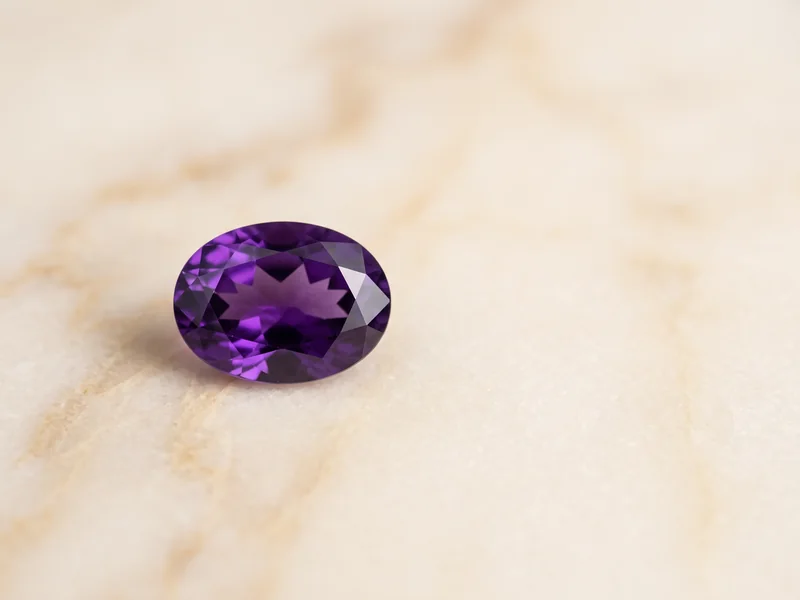
For comparison, February's purple amethyst sits at 7, which is fine for pendants and earrings but shows wear on a daily ring over the years. Ruby, the July stone, and sapphire are both corundum at 9, the next most durable after diamond. August's peridot and spinel differ a lot, with spinel a sound ring stone and peridot softer, and November's topaz and citrine split the same way. December's tanzanite, zircon and turquoise all need gentler wear. Even within one gem family the numbers vary: hessonite, the warm orange-brown garnet, rates about 7–7.5.
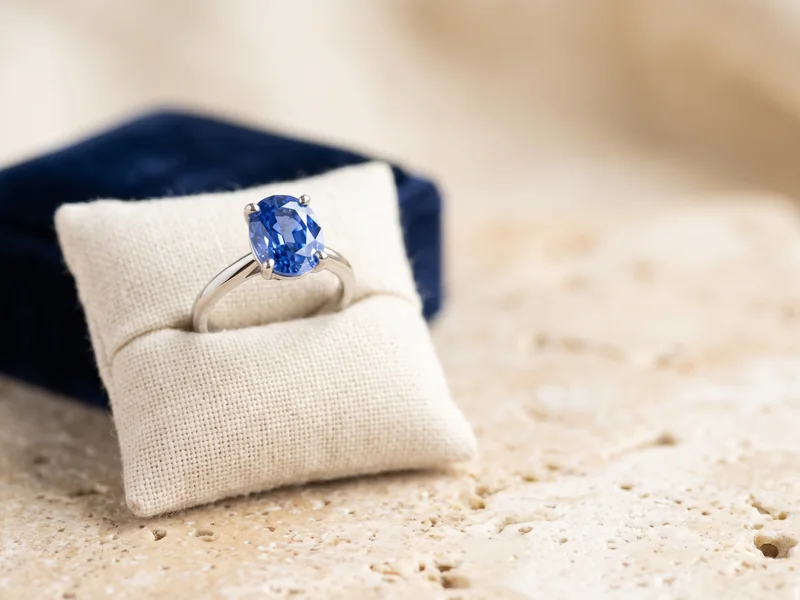
Related guideBirthstone Engagement Rings: Choosing for DurabilityNatural or lab-grown April birthstone: what is the difference?
Natural diamonds formed roughly 150–200 km below the surface, mostly between one and three and a half billion years ago, and were carried up by volcanic eruptions through kimberlite or, at Argyle, lamproite pipes. Lab-grown diamonds (also called laboratory-grown) are grown above ground in weeks, either by HPHT, which recreates the pressure and heat of the earth, or by CVD (chemical vapour deposition), which builds diamond up layer by layer from a carbon-rich gas.
Both are real diamond, with the same carbon structure, the same hardness of 10 and the same refractive index of 2.42. You cannot tell them apart by eye; a gem lab needs specialised equipment. Reputable lab-grown stones are reported as lab-grown and usually carry a girdle inscription saying so. A simulant is different: it only imitates diamond and has different properties.
| Material | What it is | Mohs | Refractive index | How it looks |
|---|---|---|---|---|
| Natural diamond | Carbon formed deep in the earth | 10 | 2.42 | Bright white and coloured flashes |
| Lab-grown diamond | Carbon grown by HPHT or CVD | 10 | 2.42 | Identical to natural by eye |
| Moissanite | Lab-created silicon carbide | 9.25 | 2.65–2.69 | More fiery, with doubled facet edges |
| Cubic zirconia | Synthetic zirconium oxide | 8–8.5 | about 2.15 | Bright at first, scratches and clouds over time |
| White sapphire | Natural or lab-created corundum | 9 | 1.76–1.77 | Clear but much less sparkle |
For a birthstone, natural and lab-grown diamond are both genuine April stones. Lab-grown costs much less and makes larger sizes affordable; natural carries geological rarity and, for some people, an origin story such as an Australian mine. Choose the one that feels right to you rather than treating either as an investment, since resale values for both are usually well below retail. If you want to compare diamond with other natural stones, our natural gemstone education hub covers each one.
Browse natural gemstones
Which settings suit April birthstone diamond jewellery?
Because diamond shrugs off scratches, it suits almost any piece, including the rings and bracelets that take the most knocks. The main choice is how much metal protects the edge. Common ideas for an April birthstone ring or piece of jewellery:
- Solitaire pendant: a single diamond of about 0.10–0.50 carat in four or six claws or a bezel; a classic first piece for an April birthday.
- Studs: claw studs show the most light, while bezel studs (a thin rim of metal around the stone) are snag-free and suit children and sleeping in.
- Birthstone ring: a small diamond flush-set or bezel-set into a band sits low and is very hard to damage, ideal for daily wear.
- Eternity and half-eternity bands: a row of diamonds around the band; half-eternity is easier to resize later.
- Family or mothers' rings: diamond sits beside other months' stones; set the softer stones in bezels and let the diamond take claws.
- Engagement rings: for April-born partners, the birthstone and the traditional engagement stone are the same, so a diamond solitaire does both jobs.
If the diamond will sit in an engagement ring, our guide to choosing a birthstone engagement ring that lasts compares how each month's stone handles daily wear. For pieces that combine several months, see our ideas for family and mothers' birthstone rings, where layout and setting style keep softer stones safe beside the diamond.
How much does an April birthstone diamond cost in Australia?
Price depends on the four Cs (carat, colour, clarity and cut), on whether the diamond is natural or lab-grown, and on the setting. Small diamonds used in birthstone pendants, studs and bands are far more affordable than engagement-size stones, and the price per carat rises steeply as size increases.
| Round diamond, G–H colour | Natural (approx. AUD) | Lab-grown (approx. AUD) |
|---|---|---|
| 0.10 ct, SI clarity | $200–$600 | $80–$250 |
| 0.25 ct, SI clarity | $600–$1,500 | $200–$500 |
| 0.50 ct, VS–SI clarity | $2,000–$4,500 | $400–$1,200 |
| 1.00 ct, VS clarity | $7,000–$15,000 | $1,000–$3,000 |
These are broad ranges for loose stones only; prices move with the market and with exact grades, and the setting and metal are extra. Fancy colours sit outside this table entirely: fancy yellow and brown diamonds can cost less than a colourless stone of the same size, while natural pinks, especially documented Argyle pinks, cost many times more per carat. For stones of about 0.30 carat and above, ask for an independent grading report from a lab such as GIA or IGI.
How do you clean and care for diamond jewellery?
Diamond attracts grease, so a ring worn every day soon looks dull under hand cream and soap film. Soak it in warm water with a drop of mild dishwashing liquid, scrub gently behind the stone with a soft toothbrush, rinse and dry with a lint-free cloth. Most untreated diamonds are safe in an ultrasonic cleaner, but fracture-filled or heavily included stones, and pieces that also hold softer birthstones, should be cleaned by hand.
Store diamond pieces apart from other jewellery, because a diamond will scratch gold, platinum and every other gemstone it rubs against. Have the claws checked every six to twelve months; worn or lifted claws, not the diamond itself, are the usual reason stones are lost.
How do you choose an April birthstone diamond? Step by step
- Decide natural or lab-grown. Both are real diamond; lab-grown costs much less, natural offers rarity and, sometimes, a documented origin.
- Pick the piece. Think about how it will be worn: a daily ring needs more protection than a pendant or earrings.
- Set colour and clarity for the metal. G–H colour suits white gold or platinum; I–J can look white in yellow or rose gold. Aim for eye-clean, usually VS2–SI1.
- Check the paperwork. For stones of about 0.30 carat and up, ask for a GIA or IGI report stating natural or lab-grown and any treatment.
- Ask about origin if it matters. For an Australian diamond, look for origin documents or a girdle inscription.
- Choose the setting for your lifestyle. Bezel or flush settings for active wearers and children; claws for maximum sparkle.
- Plan the care. Clean regularly and book a claw check every six to twelve months.
Free consultation
Talk to a gemologist
Compare stones in person or online with Raj Sood, Graduate Gemologist (GIA), AJP (GIA).
Book a consultationShop this shape
FAQ
Common questions
What is the April birthstone?
Diamond is the April birthstone on modern Australian, American and British lists. Some traditional British lists also give rock crystal (clear quartz) as an alternative.
What colour is the April birthstone?
The April birthstone colour is usually given as clear or white, because most diamonds are colourless to near-colourless. Diamonds also come in fancy colours such as yellow, brown, pink and blue.
Is a lab-grown diamond a real April birthstone?
Yes. A lab-grown diamond is real diamond with the same hardness and optical properties as a natural one, so it is a genuine April birthstone. It should always be described and reported as lab-grown.
What are cheaper alternatives to a diamond for April?
Lab-grown diamond is the closest match at a lower price. Other options are white sapphire, rock crystal or lab-created moissanite, each sold under its own name and with different sparkle and hardness.
Can a diamond chip or break?
Yes. Diamond is very hard but has cleavage planes, so a sharp knock on a thin edge or point can chip it. A bezel, flush setting or well-made claws reduces the risk.
What does the April birthstone mean?
Diamond's name comes from the Greek adamas, meaning unconquerable, and it has long stood for strength, clarity and lasting commitment. These meanings are tradition, not a property of the stone.

Ask a gemologist
Not sure which diamond to choose?
Raj Sood is a Graduate Gemologist (GIA) and master jeweller. Bring the stones you are considering, or send the reports, and he will tell you honestly which one is better and why.
Keep learning
Related guides
 GemstonesBirthstone Jewellery Melbourne
 GemstonesBirthstone Engagement Rings: Choosing for DurabilityGemstonesGemstones | Coloured Gemstones, Birthstones and Custom Jewellery
 GemstonesMay Birthstone: Emerald
 GemstonesFebruary Birthstone: Amethyst
 GemstonesSeptember Birthstone: Sapphire
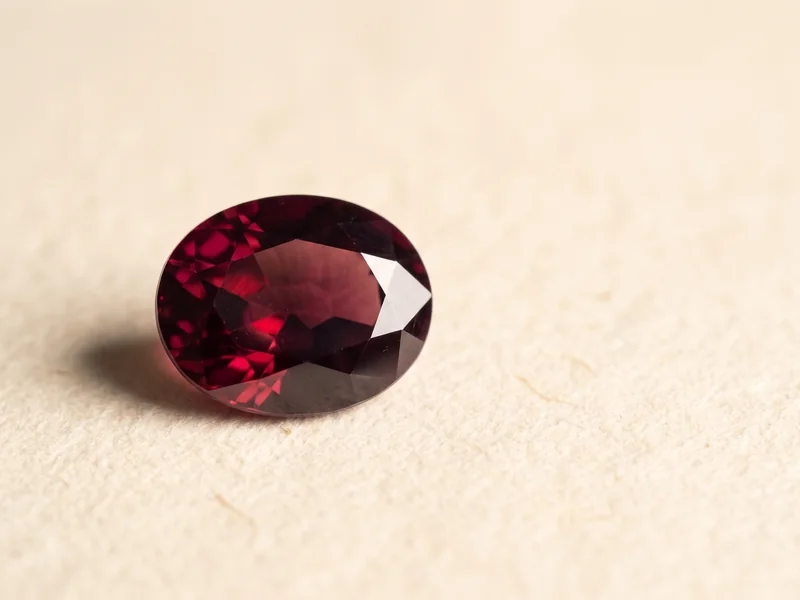 GemstonesJanuary Birthstone: Garnet
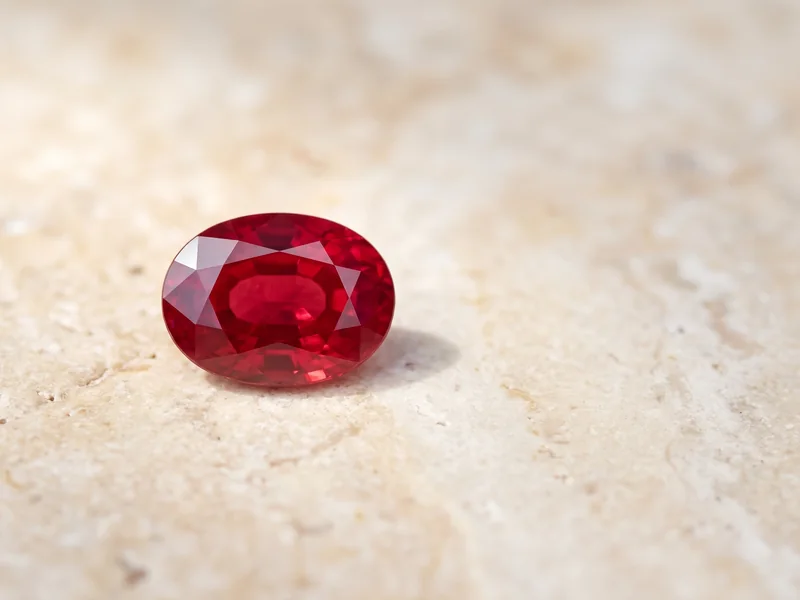 GemstonesJuly Birthstone: Ruby
Explore more
More guides on this topic
Education