
Gemstones
Kunzite Gemstone Guide: Colour, Hardness, Treatments and Care
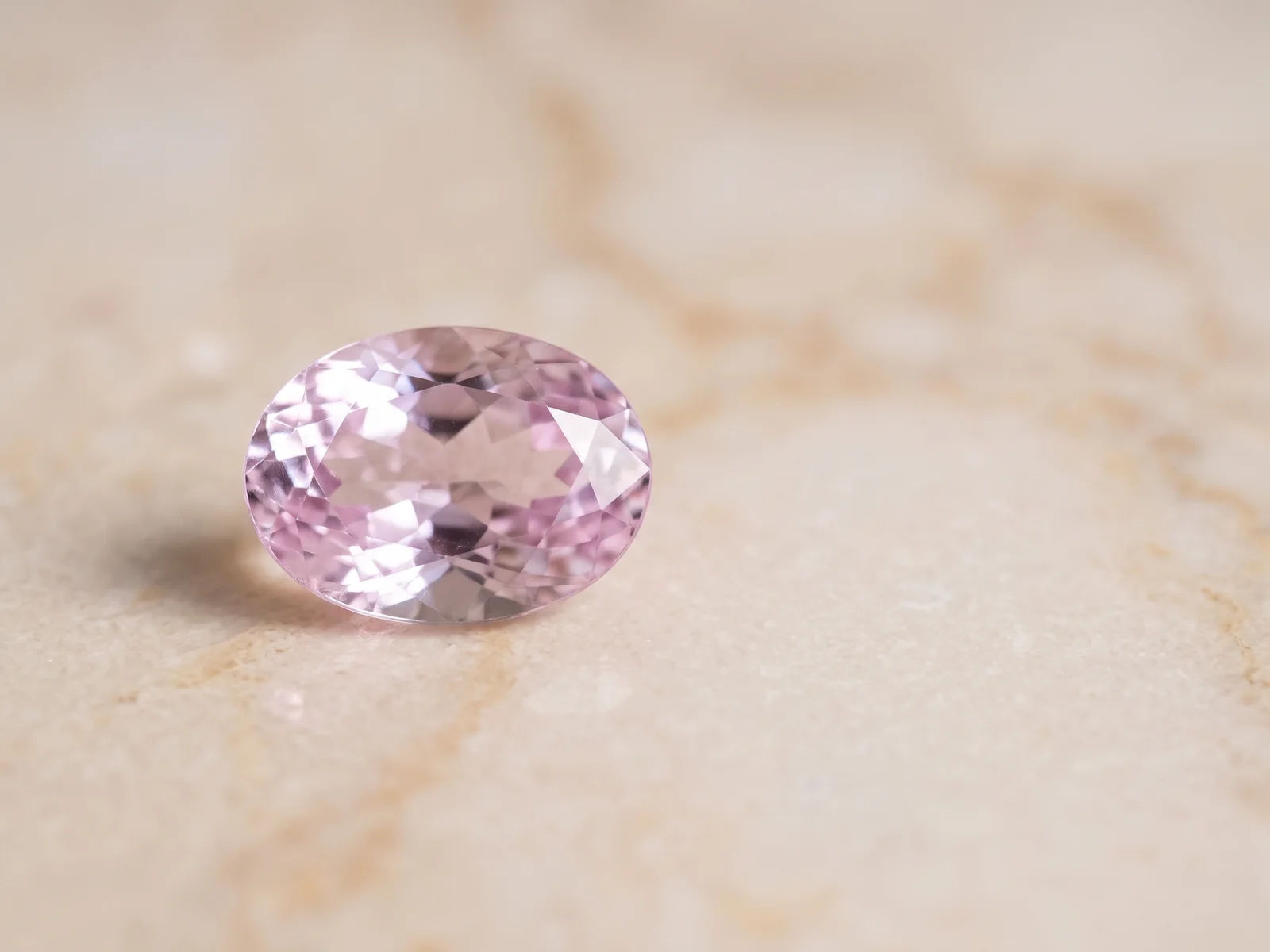
Kunzite gives you soft pink to violet colour in large, clean sizes for a modest price. It also has two quirks, fading and easy splitting, that you need to understand before you choose one for a ring.
 Reviewed by Raj Sood, Graduate Gemologist (GIA), AJP (GIA)Master jeweller and Graduate Gemologist (GIA) · reviewed 4 November 2026
Quick answer
Kunzite is the pink to violet variety of the mineral spodumene, coloured by manganese. It rates 6.5–7 on the Mohs scale but has two directions of perfect cleavage, so it can split from a sharp knock. Many stones fade slowly in strong light. It suits pendants, earrings and occasional-wear rings in protective settings better than daily-wear engagement rings.
What is kunzite?
Kunzite is the pink, lilac and violet variety of spodumene, a lithium aluminium silicate mineral (LiAlSi2O6). Its colour comes from traces of manganese in the crystal. The same mineral in green is called hiddenite, and in yellow it is sometimes sold as triphane. Most spodumene in the world is not gem quality at all: it is mined by the tonne as lithium ore for batteries.
The gem was named in 1903 after George Frederick Kunz, the gemmologist at Tiffany & Co. who described the pink material found near Pala in California. It is a relatively young gem in the trade, which is one reason it is less familiar than sapphire or topaz. You will find it alongside other pink and purple stones in our coloured gemstones guide.
Three properties shape almost everything about kunzite. It is moderately hard, at 6.5–7 on the Mohs scale (a 1–10 scratch-resistance scale where diamond is 10). It has strong pleochroism, meaning it shows different colours when viewed along different directions in the crystal. And it has perfect cleavage, a tendency to split cleanly along flat planes in its atomic structure. Any unfamiliar term here is also defined in our jewellery glossary.
On the plus side, kunzite forms large, clean crystals. Faceted stones of 10 carats or more are common, and many are eye-clean (no inclusions you can see without magnification), which is unusual for a coloured gem at this price.
What colours does kunzite come in?
Kunzite ranges from very pale pink through soft rose to lilac and a fairly saturated violet-pink. Gem professionals describe colour in three parts: hue (the basic colour), tone (how light or dark) and saturation (how strong or pure). Our explainer on how hue, tone and saturation are graded covers the system in detail.
- Hue: pink to purplish pink to violet. Stones with a slight violet tint are usually the most sought after.
- Tone: mostly light to medium. Truly dark kunzite is rare.
- Saturation: often weak in small stones. Colour deepens with size and depth, so a 1 carat kunzite is often pale while a 15 carat stone of the same rough can look clearly pink.
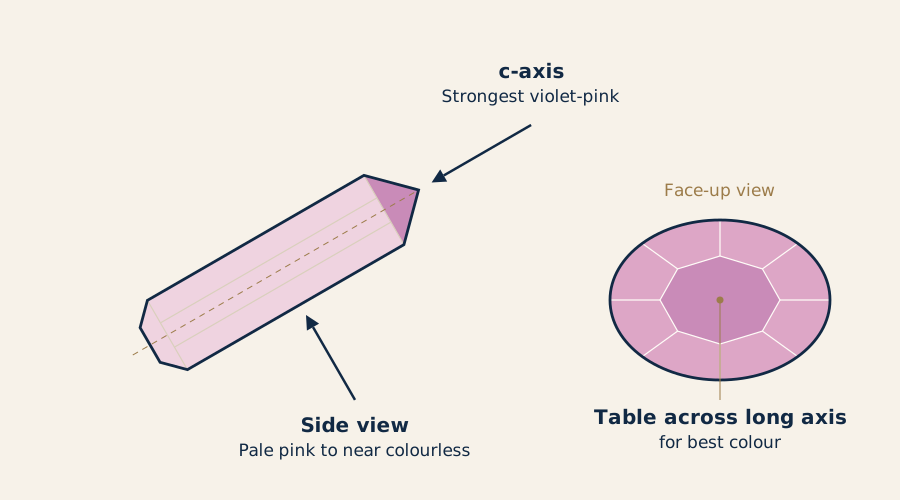
Pleochroism is the key to kunzite colour. Looking down the long axis of the crystal (the c-axis), you usually see the strongest pink or violet. From the sides, the colour is paler, and in some directions close to colourless. A skilled cutter orients the rough so the table (the large top facet) sits across that long axis, giving the deepest face-up colour. A badly oriented stone can look washed out even if the rough was good.
Because its pinks are soft rather than vivid, kunzite is often compared with morganite and pink sapphire. Our morganite vs pink sapphire comparison shows how those two differ, and kunzite sits between them: usually more lilac than peachy morganite, and much paler than most pink sapphire. For a milky, translucent pink instead of a transparent one, look at rose quartz, a softer translucent pink.
Does kunzite fade in sunlight?
Yes, many kunzites do. Long exposure to strong light, especially sunlight and its ultraviolet component, and to heat can slowly weaken the pink colour. This is why kunzite is sometimes called an evening stone. How fast it happens varies a lot from stone to stone and is not predictable by eye. Some stones show little change over years of normal wear; others pale noticeably after long periods in a sunny window or under hot display lights.
Ordinary indoor wear and the occasional day outside are not usually a problem. The risks are prolonged, repeated exposure: leaving a ring on a sunny windowsill, wearing it every day at the beach, or storing it in a lit display cabinet. The colour change is generally permanent once it has happened, and re-treating a faded stone is possible in some cases but not something to rely on.
Colour created or intensified by treatment (see the next section) can be less stable than untreated colour, which is one more reason to ask about treatment history when you buy.
Is kunzite treated?
Often, yes. A large share of kunzite on the market is thought to have been treated, and the treatment usually cannot be proven either way with standard testing. The common methods are:
- Heating: low-temperature heating can remove brownish or greenish tones and leave a cleaner pink.
- Irradiation: exposure to gamma rays or an electron beam can deepen pink or turn stones green. Irradiation is very often followed by gentle heating to stabilise or adjust the colour.
- Fillings: uncommon in kunzite, but surface-reaching cracks can be filled with oil or resin, as in many gems.
Irradiated gems are not radioactive by the time they reach the market when the process is done properly and checked. The colour can, however, be less stable than natural colour, and green irradiated spodumene in particular is known to fade quickly in light. Irradiation is also how some other gems get their colour, including much commercial smoky quartz, whose colour also comes from radiation.
Any treatment should be disclosed by the seller. For a wider view, see our full A to Z of gemstone treatments, and for how fillings in cracks are made and detected, how glass and fracture filling work.
Not sure which one is right?
Send us the stones you are looking at and our gemologist will tell you which to choose and why.
How hard is kunzite, and is it tough enough for a ring?
Hardness and toughness are different things. Hardness is resistance to scratching. Toughness is resistance to chipping, cracking and splitting. Kunzite scores reasonably on hardness: at 6.5–7 it is roughly as hard as quartz, so everyday dust (which contains quartz) can slowly dull its facet edges but will not gouge it. Its weak point is toughness.
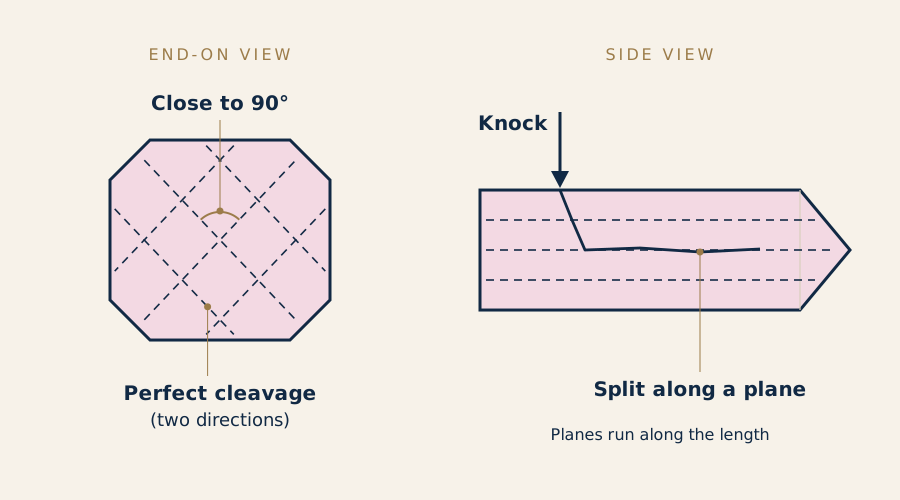
Kunzite has two directions of perfect cleavage, at close to 90° to each other, running along the length of the crystal. A sharp knock in the wrong direction, a sudden temperature change or pressure during setting can split it cleanly. Cutters have to work around those planes, and facet edges and corners are prone to small chips.
| Gem | Mohs hardness | Toughness | Everyday ring wear |
|---|---|---|---|
| Diamond | 10 | Good (has cleavage, but very hard) | Excellent |
| Sapphire | 9 | Excellent, no cleavage | Excellent |
| Spinel | 8 | Good | Very good |
| Morganite | 7.5–8 | Fair to good | Good with care |
| Rose quartz | 7 | Fair to good | Occasional wear |
| Kunzite | 6.5–7 | Poor: two perfect cleavages | Occasional wear, protective setting |
| Tanzanite | 6–7 | Fair, one cleavage direction | Occasional wear, protective setting |
| Amber | 2–2.5 | Poor, scratches easily | Pendants and earrings |
Kunzite sits with tanzanite as a gem that is lovely in a ring but needs the wearer's cooperation. Our page on tanzanite and the other December birthstones explains the same trade-off for that stone, and emerald vs diamond for everyday wear shows how another fragile favourite compares with the hardest gem. At the very soft end, amber, at only Mohs 2–2.5 is a good reminder that pendants forgive almost anything.
Where is kunzite found?
Gem kunzite forms in pegmatites, coarse-grained igneous rocks rich in lithium and other rare elements, often alongside tourmaline and beryl. The main sources are:
| Source | What it is known for |
|---|---|
| Afghanistan (Nuristan and Laghman provinces) | Large crystals and some of the strongest pink to violet colour |
| Pakistan | Material from northern pegmatite regions, often paired with Afghan output |
| Brazil (Minas Gerais) | A major long-term source; often lighter pink |
| United States (Pala, California) | Where kunzite was first described; historic mines, limited production today |
| Madagascar | Pegmatite gems including kunzite, often in good sizes |
| Australia (Western Australia) | Huge spodumene deposits such as Greenbushes and Pilgangoora, mined as lithium ore; gem-quality kunzite is not a commercial Australian product |
Origin has much less effect on kunzite value than it does on ruby or sapphire. Colour, size, clarity and cut matter far more, and most kunzite is sold without any origin report. If you want to understand why origin matters so much for other gems, our page on famous gem origins from Ceylon to Mozambique explains the background.
Australia's place in the spodumene story is industrial rather than ornamental. Western Australia is one of the world's largest lithium producers, and nearly all of that lithium comes from spodumene, but the crystals are opaque and grey-white, not gem kunzite. For home-grown coloured gems, Australia is better known for sapphire; see Australia's sapphire fields at Inverell and Anakie.
How do gemmologists identify kunzite and tell it from imitations?
Pale pink stones look alike to the eye, so identification relies on measurements. Kunzite has a refractive index (RI, a measure of how much the stone bends light) of about 1.660–1.676, with double refraction of about 0.014–0.016. Its specific gravity (density compared with water) is about 3.15–3.21. Under a dichroscope, a small tool that splits light into two directions, it shows strong violet and pale pink to near colourless. Many kunzites glow orange-pink under longwave ultraviolet light.
| Pink gem | Mohs | Refractive index | Key clues |
|---|---|---|---|
| Kunzite | 6.5–7 | 1.66–1.68 | Strong pleochroism; cleavage cracks; fine tube-like inclusions along the length |
| Morganite (beryl) | 7.5–8 | 1.57–1.60 | Peachy pink; weaker pleochroism; lower density |
| Pink sapphire (natural or lab-created) | 9 | 1.76–1.77 | Higher RI and lustre; lab-created stones show curved growth lines or gas bubbles |
| Pink topaz (usually treated) | 8 | 1.61–1.64 | One perfect cleavage; often coated or heated colour |
| Rose quartz | 7 | 1.54–1.55 | Usually translucent and milky |
| Pink glass | 5–6 | about 1.50–1.70 | Singly refractive; round gas bubbles and swirl marks |
Under magnification, natural kunzite often shows fine tubes or etch features running parallel to its length, and sometimes small cleavage cracks. Pink glass shows round bubbles and swirls, while lab-created pink sapphire or spinel can be sold under misleading names. Our guide to the difference between natural, synthetic and simulant gems explains how each is defined, and how glass and CZ imitate other stones covers the most common lookalikes. Lab-created spodumene exists but is rarely seen in the jewellery trade.
Related guideMorganite vs Pink SapphireWhat affects kunzite price in Australia?
Kunzite is one of the more affordable transparent pink gems, partly because large clean crystals are not rare. Four things move the price most:
- Colour: the biggest factor. A saturated violet-pink is worth several times a pale pink of the same size.
- Size: colour improves with size, so larger stones are more valuable per carat, though the jump is gentler than for sapphire.
- Clarity: buyers expect kunzite to be eye-clean. Visible cleavage cracks lower value and raise the risk of splitting.
- Cut: correct orientation for colour, good symmetry and clean facet edges. Deeper cuts hold more colour but add weight.
| Kunzite quality (faceted) | Approximate price range per carat (AUD) |
|---|---|
| Pale pink, small (under 3 ct) | about $30–$100 |
| Medium pink, eye-clean, 3–10 ct | about $80–$250 |
| Strong violet-pink, eye-clean, 10 ct+ | about $200–$600 |
These are broad retail ranges only and move with the market, the dealer and the exact stone. Most kunzite is faceted in ovals, cushions, pears and step cuts such as the emerald cut, which suits the long crystal shape. Lower grades are also cut as cabochons (smooth domed stones) or carved. Our guide to faceted, cabochon and carved cuts explains why the cut style changes both the look and the price.
Shop natural gemstones
Is kunzite good for an engagement ring?
For a ring worn every day, kunzite is a risky choice. Its cleavage means a single hard knock on a doorframe or bench can split it, and daily sun exposure may fade it. For a ring worn on special occasions, or for pendants and earrings, it works well and gives you a large, bright pink stone for the money.
If you do choose a kunzite ring, the setting matters more than usual:
- Bezel or half-bezel: a rim of metal around the edge protects corners and the girdle (the outer edge) from knocks.
- Halo: a ring of small stones shields the kunzite's edge and frames its soft colour.
- Lower profile: a stone that sits closer to the finger is knocked less often.
- Avoid tension settings: constant pressure across the stone is a poor match for perfect cleavage.
- Claws with care: four to six claws are fine if set gently by a jeweller who knows the stone.
White gold and platinum keep pale pink looking cool and lilac; rose gold warms it and can make a light stone read pinker. Take it off for the gym, gardening, cleaning and the beach, and treat it as you would an opal or tanzanite ring.
How do you care for kunzite jewellery?
Kunzite care is simple, but it is mostly about what not to do. Follow these steps:
- Take it off for hard work. Remove rings before sport, gardening, housework or lifting.
- Clean gently. Use warm water, a drop of mild dishwashing liquid and a soft toothbrush, then rinse and pat dry.
- Skip machines. Never use an ultrasonic cleaner or steam cleaner; vibration and heat can open cleavage cracks.
- Avoid temperature shock. Do not move it from hot to cold water, and keep it away from saunas and hot cars.
- Store it in the dark. Keep it in a soft pouch or lined box, away from sunny windows and lit cabinets, and apart from harder gems that can scratch it.
- Check the setting. Have claws or bezels checked every 6–12 months, and always tell your jeweller it is kunzite before any repair.
Free consultation
Talk to a gemologist
Compare stones in person or online with Raj Sood, Graduate Gemologist (GIA), AJP (GIA).
Book a consultationShop this shape
FAQ
Common questions
Is kunzite a real gemstone?
Yes. Kunzite is a natural gem variety of the mineral spodumene, coloured pink to violet by manganese. Pink glass and lab-created pink sapphire can imitate it, so ask for an identification if you are unsure.
Does kunzite lose its colour?
Many kunzites fade slowly with long exposure to strong sunlight or heat. Normal indoor wear is usually fine, but store it away from direct light.
Can you wear kunzite every day?
It is not ideal for daily wear in a ring because its two perfect cleavages make it prone to splitting. Pendants, earrings and occasional-wear rings in a bezel or halo are safer choices.
Is kunzite expensive?
Not compared with most pink gems. Pale stones can cost under AUD $100 per carat, while large, strongly coloured violet-pink stones cost more, roughly into the hundreds of dollars per carat.
What is the difference between kunzite and morganite?
Kunzite is spodumene and usually lilac to violet-pink; morganite is beryl and usually peachy pink. Morganite is harder (7.5–8) and has no cleavage problem, so it is more forgiving in a ring.
Is kunzite found in Australia?
Western Australia has some of the world's largest spodumene deposits, but they are mined as lithium ore. Gem-quality kunzite is mostly sourced from Afghanistan, Pakistan, Brazil, Madagascar and the United States.

Ask a gemologist
Not sure which diamond to choose?
Raj Sood is a Graduate Gemologist (GIA) and master jeweller. Bring the stones you are considering, or send the reports, and he will tell you honestly which one is better and why.
Keep learning
Related guides
 GemstonesGemstone Treatments A to Z
 GemstonesMorganite vs Pink Sapphire
 GemstonesNatural vs Synthetic vs Simulant Gemstones
 GemstonesGemstone Colour Grading: Hue, Tone, SaturationGemstonesGemstones | Coloured Gemstones, Birthstones and Custom Jewellery
 GemstonesGemstone Origins: Ceylon, Burma, Kashmir, Madagascar, Mozambique
 GemstonesDiamond Simulants: CZ, YAG, GGG and GlassGemstonesGemstone Cuts: Cabochon, Faceted and Carved
Explore more
More guides on this topic
Education