
Gemstones
September Birthstone: Sapphire Colours, History, Durability and Ring Settings
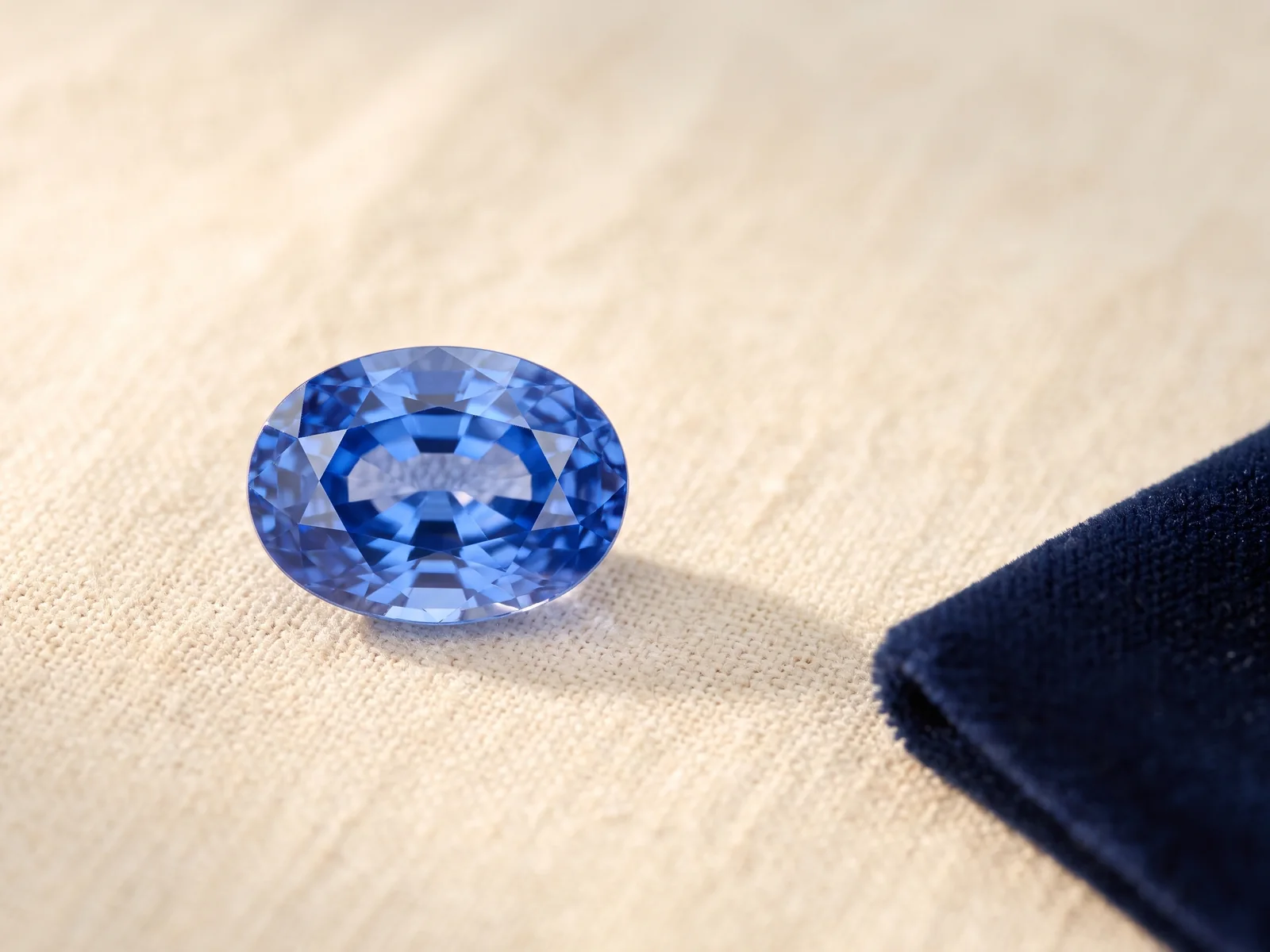
The September birthstone is sapphire: hard-wearing, found in almost every colour and mined right here in Australia. Here is its history, its colours, how it holds up in an everyday ring and which settings suit it.
 Reviewed by Raj Sood, Graduate Gemologist (GIA), AJP (GIA)Master jeweller and Graduate Gemologist (GIA) · reviewed 4 November 2026
Quick answer
Sapphire is the September birthstone. It is corundum, rated 9 on the Mohs scale, so it is one of the few birthstones tough enough for an everyday ring. Blue is the classic colour, but sapphire also comes in pink, yellow, green, teal, purple, orange and colourless, and Australia produces deep blue, green and parti sapphires.
What is the September birthstone?
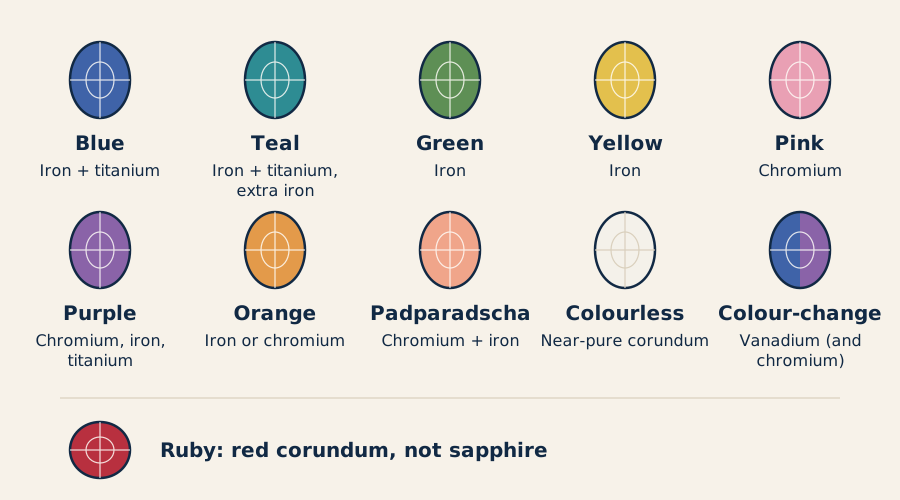
The September birthstone is sapphire, a variety of the mineral corundum (crystallised aluminium oxide, Al2O3). Pure corundum is colourless. Tiny amounts of other elements, called trace elements, give it colour: iron and titanium together make blue, chromium makes pink, and iron on its own makes yellow and green. Red corundum is called ruby, which is July's stone; every other colour of corundum is sapphire. Our in-depth sapphire gemstone guide covers the mineral side in more detail.
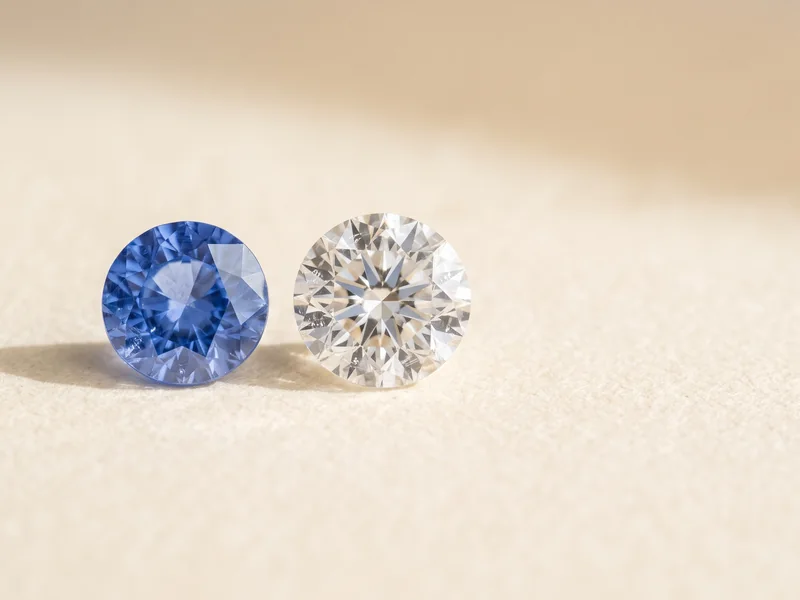
Sapphire rates 9 on the Mohs scale, a 1-to-10 ranking of scratch resistance on which diamond sits at 10. It has a refractive index (a measure of how strongly a stone bends light) of about 1.76–1.78, and a specific gravity (density compared with water) of about 4.00. Diamond's specific gravity is 3.52, so sapphire is denser, which means a 1 carat sapphire looks smaller than a 1 carat diamond. A 1 carat oval sapphire is typically around 7 × 5 mm, while a 1 carat oval diamond is closer to 7.5 × 5.5 mm.
Sapphire also shows pleochroism: it can look a slightly different colour depending on the direction you view it from, for example violet-blue one way and greenish-blue another. A good cutter orients the rough so the more attractive colour faces up. Sapphire sits alongside dozens of other coloured stones in our overview of coloured gemstones and birthstones, and if a word here is new, the plain-English jewellery glossary explains it.
Why is sapphire the September birthstone?
Sapphire has been prized for well over two thousand years. The name comes through Latin from the Greek sappheiros, although many historians think the ancient Greeks used that word for lapis lazuli, the opaque blue stone, rather than what we now call sapphire. In medieval Europe, sapphires were set in bishops' rings and royal regalia and were linked with wisdom, truth and faithfulness. That traditional sapphire birthstone meaning is one reason blue sapphire has long been chosen for engagement rings.
The modern list of monthly birthstones was drawn up in 1912 by the American National Association of Jewelers (now Jewelers of America), which named sapphire for September. Older traditional lists sometimes gave September to other stones, and lapis lazuli is the September birthstone alternative you will see most often. Today sapphire is the standard September stone almost everywhere, including Australia. It is also commonly given for a 45th wedding anniversary.
The best-known sapphire ring of modern times is the engagement ring given to Lady Diana Spencer in 1981: an oval blue Sri Lankan sapphire of about 12 carats surrounded by 14 diamonds, now worn by the Princess of Wales. It made the sapphire-and-diamond cluster a classic look, and it still shapes what many people picture when they think of a September birthstone ring.
Each month has its own stone and its own strengths. You can compare September with April's birthstone, the diamond, the May birthstone, emerald and amethyst for February babies, or see how each month's stone is used in birthstone rings, pendants and earrings.
What colours does the September birthstone come in?
Blue is the traditional September birthstone colour, but sapphire comes in almost every colour except red (which is ruby). Any sapphire that is not blue is called a fancy sapphire. The table sets out the main colours and what causes them.
| Colour | Main cause | What to know |
|---|---|---|
| Blue | Iron and titanium | The classic. Most people prefer a medium to medium-dark, saturated blue; very dark stones can look inky |
| Teal (blue-green) | Iron and titanium, with extra iron | Often Australian or from Montana; can look bluer from one angle and greener from another |
| Green | Iron | Usually muted, from olive to forest green; common in Australian deposits |
| Yellow | Iron | Lemon to golden; often heat-treated to strengthen colour |
| Pink | Chromium | Pale pink to hot pink; very strong pinks shade towards ruby |
| Purple or violet | Chromium with iron and titanium | Often from Sri Lanka and Madagascar |
| Orange | Iron or chromium | Check the report for beryllium diffusion, a common treatment for this colour |
| Padparadscha | Chromium and iron | A rare pinkish-orange; the name comes from the Sinhalese word for lotus flower |
| Colourless (white) | Near-pure corundum | Less sparkle than diamond and shows a film of grease quickly |
| Colour-change | Vanadium (and chromium) | Blue in daylight, purple under warm indoor light |
Two other effects are worth knowing. Parti sapphires show two or more colours in separate zones, often blue, green and yellow in the one stone, and Australia is one of the main sources. Star sapphires contain fine needles of the mineral rutile (called silk) that reflect light as a six-rayed star when the stone is cut as a smooth dome, known as a cabochon.
Each colour has its own page: green sapphire, purple and violet sapphire, orange sapphire and the rare pinkish-orange padparadscha. Teal has become one of the most requested colours for engagement rings; see teal sapphire engagement ring ideas for examples.
Where do Australian sapphires come from?
Australia is a significant sapphire producer, and an Australian sapphire is a natural fit for a September birthstone ring. Most stones come from two areas that both sit on old volcanic basalt: the New England fields of northern New South Wales, around Inverell and Glen Innes, and the Central Queensland gemfields around Anakie, Rubyvale and the town of Sapphire. Sapphires were found in Central Queensland in the 1870s, and in the 1970s and 1980s Australia supplied a large share of the world's sapphire, much of it cut overseas and sold without its origin.
Australian sapphires formed in iron-rich conditions, which shapes how they look:
- Blue: deep navy to very dark blue. Heat treatment is often used to lighten them.
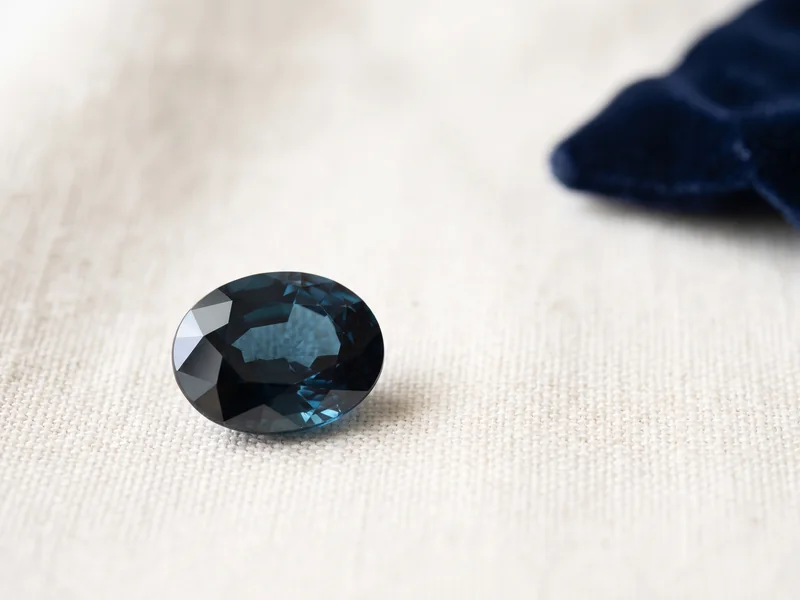
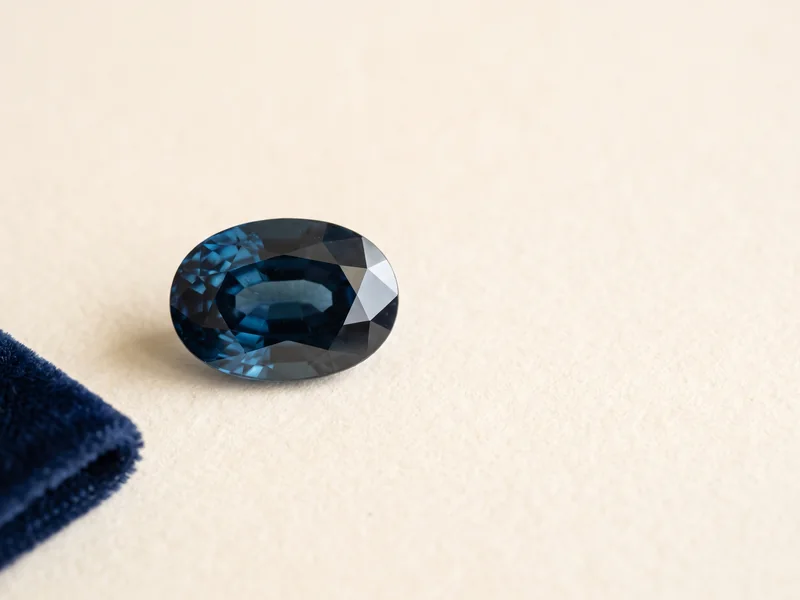
- Teal and green: blue-green, forest green and olive tones are a strength of Australian deposits.
- Yellow and gold: found especially in the Queensland fields.
- Parti: blue, green and yellow zones in one stone, each one different.
- Black star sapphire: dark cabochons with a six-rayed star, a Central Queensland speciality.
If origin matters to you, ask for it in writing, along with whether the stone has been heated. Origin is usually based on the supply chain; a laboratory can give an origin opinion on its report but cannot always be certain. For design ideas, see engagement rings set with sapphires mined in Australia.
Not sure which one is right?
Send us the stones you are looking at and our gemologist will tell you which to choose and why.
Is sapphire durable enough for an everyday ring?
Yes. Sapphire is one of the few birthstones that handles daily wear in a ring. At 9 on the Mohs scale, only diamond is harder, so everyday dust (which contains quartz, about 7) will not scratch it. Hardness is only half the story, though. Toughness is resistance to chipping and breaking. Sapphire has no true cleavage (a plane along which a crystal splits cleanly), so its toughness is rated good. Some stones show parting, a weaker plane caused by crystal twinning, and a hard knock on a thin edge or corner can still chip any gem.
| Month | Birthstone | Mohs hardness | Everyday ring? |
|---|---|---|---|
| January | Garnet | 6.5–7.5 | With care and a protective setting |
| February | Amethyst | 7 | With care; facet edges wear over time |
| March | Aquamarine | 7.5–8 | Yes, with some care |
| April | Diamond | 10 | Yes |
| May | Emerald | 7.5–8 | With care; often has fractures |
| June | Pearl | 2.5–4.5 | Occasional wear only |
| July | Ruby | 9 | Yes |
| September | Sapphire | 9 | Yes |
| October | Opal | 5.5–6.5 | Occasional wear; protective setting |
| December | Tanzanite | 6–7 | With care |
Compared with diamond, sapphire shows a little rounding on its facet edges after many years of wear, and it returns less white sparkle; it gives colour instead. Our comparison of diamond versus sapphire for an engagement ring weighs the two side by side, and our guide to which birthstones last in an engagement ring ranks every month.
Related guideBirthstone Engagement Rings: Choosing for DurabilityCare is simple: warm soapy water and a soft toothbrush. Untreated and heat-treated sapphires are generally safe in ultrasonic and steam cleaners, but glass-filled or fracture-filled stones are not. Heat from a jeweller's torch can damage treated stones, so mention any treatment when a ring goes in for resizing or repair.
Natural, treated or lab-created sapphire: what is the difference?
You will meet four kinds of sapphire, and the grading report or invoice should say which one you are looking at:
- Natural, unheated: mined and cut with no treatment. The rarest and most expensive at a given colour.
- Natural, heat-treated: mined, then heated to improve colour and clarity. This is the majority of sapphires sold, the result is stable, and it is accepted in the trade as long as it is disclosed.
- Natural, with other treatments: beryllium diffusion (used for orange, yellow and padparadscha-like colours), surface diffusion, and glass or fracture filling. Filled stones are less durable and cost much less.
- Lab-created (synthetic) sapphire: grown in a laboratory, with the same chemistry as natural sapphire.
Lab-created sapphire has the same hardness and refractive index as natural sapphire. It has been made since the early 1900s by flame fusion (the Verneuil process), and today also by flux growth and the Czochralski crystal-pulling method. Under magnification, flame-fusion stones can show curved growth lines and gas bubbles, which a gemmologist uses to identify them. A lab-created sapphire is a genuine corundum crystal, not an imitation, but it must always be described as lab-created or synthetic, and it costs a small fraction of a natural stone.
For any natural sapphire of real value, ask for an independent laboratory report that states whether the stone is natural or lab-created and whether heat or any other treatment was detected. Treatment matters more to the price than almost anything except colour.
Browse natural gemstones, including sapphires
How much does a September birthstone ring cost in Australia?
Sapphire prices vary more than diamond prices because there is no single grading system that everyone uses. The figures below are broad, approximate ranges for a loose 1 carat stone of good, eye-clean quality, before the setting. Treat them as a starting point for conversation, not a quote.
| 1 ct sapphire (loose) | Approximate price range (AUD) |
|---|---|
| Lab-created blue | about $50–$400 |
| Natural Australian teal, green or parti, heated | about $400–$2,000 |
| Natural Australian blue, heated | about $500–$2,500 |
| Natural blue, heated (Sri Lanka, Madagascar) | about $1,500–$6,000 |
| Natural blue, unheated, fine colour | about $4,000–$15,000+ |
| Natural padparadscha | about $5,000–$25,000+ |
What moves the price, roughly in order:
- Colour: a saturated, even colour that is neither too light nor too dark costs the most.
- Treatment: unheated stones cost noticeably more than heated stones of the same look; filled stones cost far less.
- Clarity: most sapphires have some inclusions (internal features). Aim for a stone that looks clean to the eye.
- Cut: watch for windowing, a washed-out patch in the centre where light passes straight through a pavilion that is too shallow.
- Size: price per carat climbs steeply above about 2 carats for fine colour.
- Origin: Kashmir, Myanmar (Burma) and Sri Lanka origins attract a premium; Australian stones are usually more affordable for their size.
A finished September birthstone ring with a 1 carat natural heated sapphire in 18ct gold commonly lands somewhere between a few thousand dollars and the low tens of thousands, depending on the stone, the metal and any diamonds.
Which settings suit a sapphire ring?
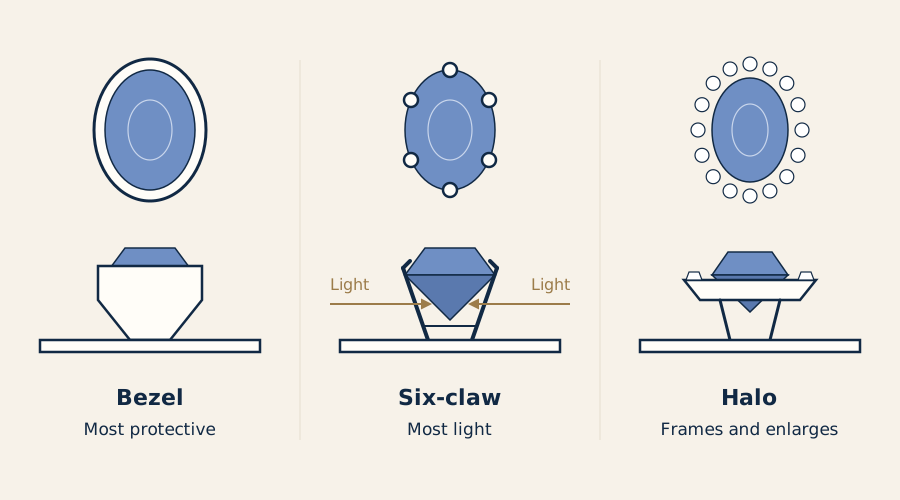
Because sapphire is hard and tough, it suits almost any ring style. The choice comes down to how you live and how much colour you want to show:
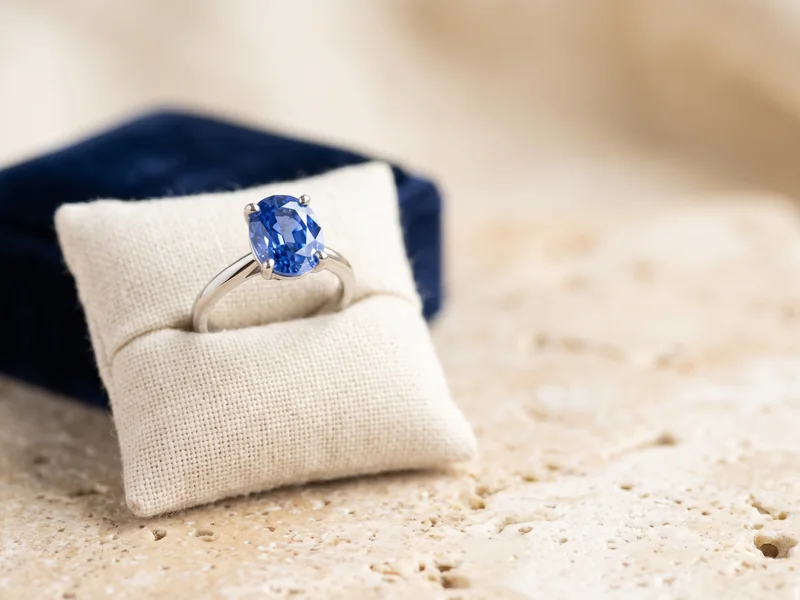
- Bezel: a thin rim of metal around the stone. The most protective option for active hands, and a clean modern look.
- Four or six claws: lets in the most light, which helps darker Australian blues. Six claws give extra security.
- Halo: a ring of small diamonds that frames the sapphire, as in the 1981 royal ring, and makes the centre look larger.
- Three-stone: a sapphire between two diamonds, or a diamond between two sapphires.
- East-west or toi et moi: an oval or pear set sideways, or two stones side by side.
- Sapphire bands: channel-set or claw-set sapphires in a wedding or eternity band, a durable choice because of their hardness.
Metal colour changes how a sapphire reads. Platinum and white gold keep blues and teals crisp. Yellow gold flatters yellow, orange and padparadscha stones and softens a dark blue. Rose gold pairs well with pink and peach tones. For finished examples, browse our sapphire engagement ring designs.
How do you choose a September birthstone ring? Step by step
- Choose the colour first. Blue is traditional, but teal, green, pink, yellow and parti are all September stones.
- Decide natural or lab-created. Both are corundum; natural is rarer, lab-created costs far less. Make sure the paperwork says which.
- Ask about treatment. Heated, unheated, diffused or filled. Get it in writing, with a laboratory report for valuable stones.
- Check the colour in several lights. Daylight, shop light and warm indoor light. Dark stones can go inky; light stones can look washed out.
- Look for windowing. Tilt the stone; a see-through patch in the centre means the cut is leaking light.
- Compare millimetres, not just carats. Sapphire is dense, so it looks smaller than a diamond of the same weight.
- Match setting to lifestyle. A bezel for active hands, claws to let light into darker stones, and a metal colour that suits the sapphire.
Free consultation
Talk to a gemologist
Compare stones in person or online with Raj Sood, Graduate Gemologist (GIA), AJP (GIA).
Book a consultationShop this shape
FAQ
Common questions
What colour is the September birthstone?
Blue is the traditional colour, because sapphire is best known as a blue stone. Sapphire also comes in pink, yellow, green, teal, purple, orange and colourless, and all of them count as the September birthstone.
Is sapphire good for an everyday engagement ring?
Yes. At 9 on the Mohs scale with good toughness and no cleavage, sapphire is one of the few birthstones suited to daily wear. A bezel or six-claw setting adds extra protection.
What is the alternative September birthstone?
Some older traditional lists give lapis lazuli for September. The modern list, used in Australia, names sapphire.
Is a lab-created sapphire a real sapphire?
It is real corundum with the same hardness and refractive index as natural sapphire, but it was grown in a laboratory. It must always be sold as lab-created or synthetic, and it costs much less than a natural stone.
Are Australian sapphires good quality?
Australian deposits produce fine stones alongside commercial ones, just like any source. They are known for deep blues, teals, greens, yellows and parti sapphires, and they are usually more affordable than stones of similar size from Sri Lanka or Myanmar.
Does heat treatment lower a sapphire's value?
A heated sapphire costs less than an unheated stone of the same appearance, but heating is stable, widely accepted and used on most sapphires sold. What matters is that it is disclosed.

Ask a gemologist
Not sure which diamond to choose?
Raj Sood is a Graduate Gemologist (GIA) and master jeweller. Bring the stones you are considering, or send the reports, and he will tell you honestly which one is better and why.
Keep learning
Related guides
 GemstonesSapphire Gemstones
 GemstonesAustralian Sapphire Engagement Rings
 GemstonesBirthstone Jewellery Melbourne
 GemstonesSapphire Engagement Rings in MelbourneGemstonesGemstones | Coloured Gemstones, Birthstones and Custom Jewellery
 GemstonesDiamond vs Sapphire Engagement Rings
 GemstonesApril Birthstone: DiamondGemstonesBirthstone Engagement Rings: Choosing for Durability
Explore more
More guides on this topic
Education