
Gemstones
Moonstone Guide: Colours, Sheen, Hardness, Value and Care
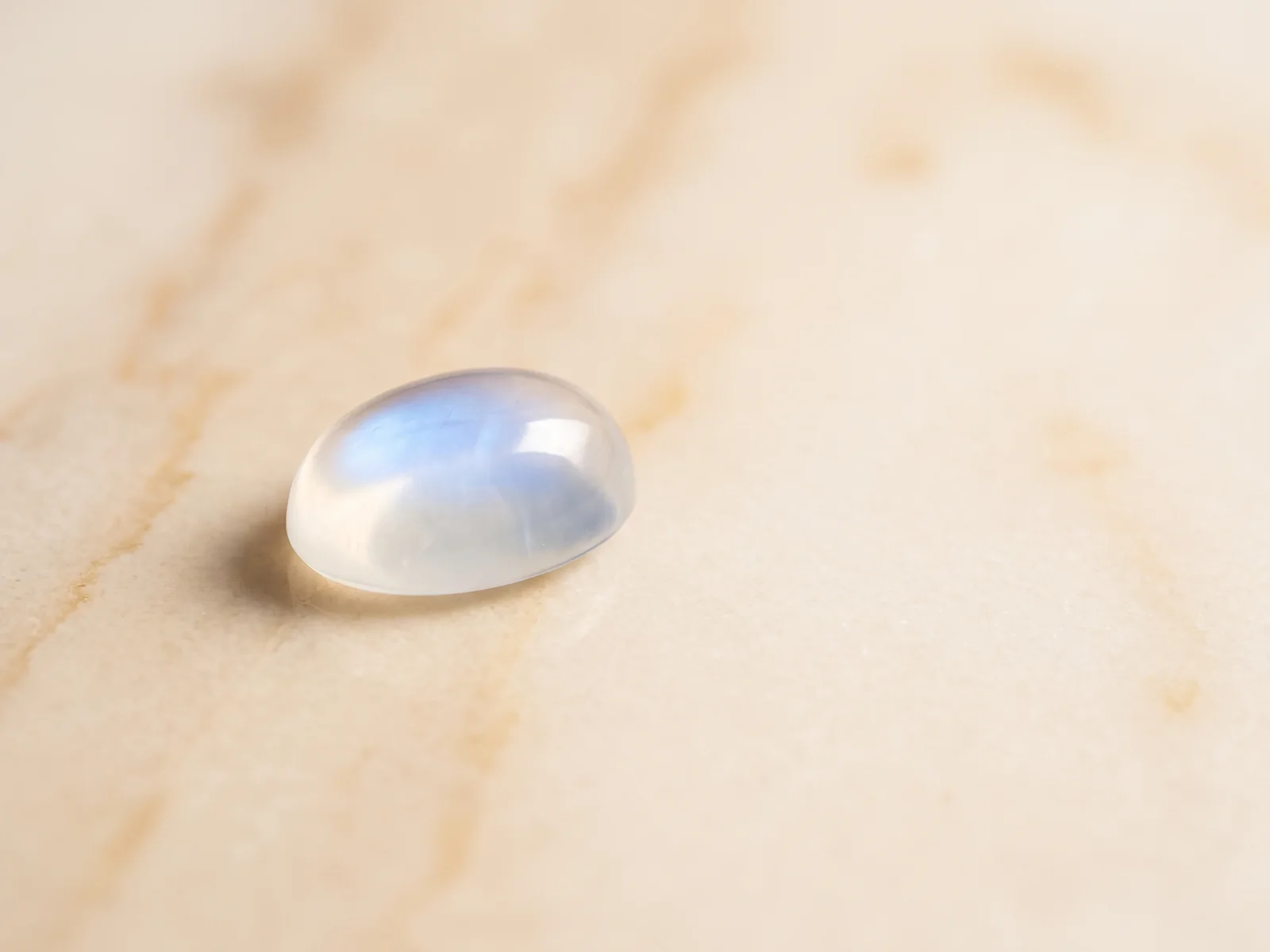
Moonstone is loved for its soft floating glow, but it is softer and more fragile than most ring stones. Here is what moonstone is, what makes one valuable and how to wear it so it lasts.
 Reviewed by Raj Sood, Graduate Gemologist (GIA), AJP (GIA)Master jeweller and Graduate Gemologist (GIA) · reviewed 4 November 2026
Quick answer
Moonstone is a feldspar gem prized for adularescence, a soft bluish or white glow that floats across the stone as it moves. It rates 6–6.5 on the Mohs scale and has easy cleavage, so it suits pendants, earrings and carefully set rings more than hard daily wear. Value depends on transparency, sheen colour and freedom from cracks.
What is moonstone?
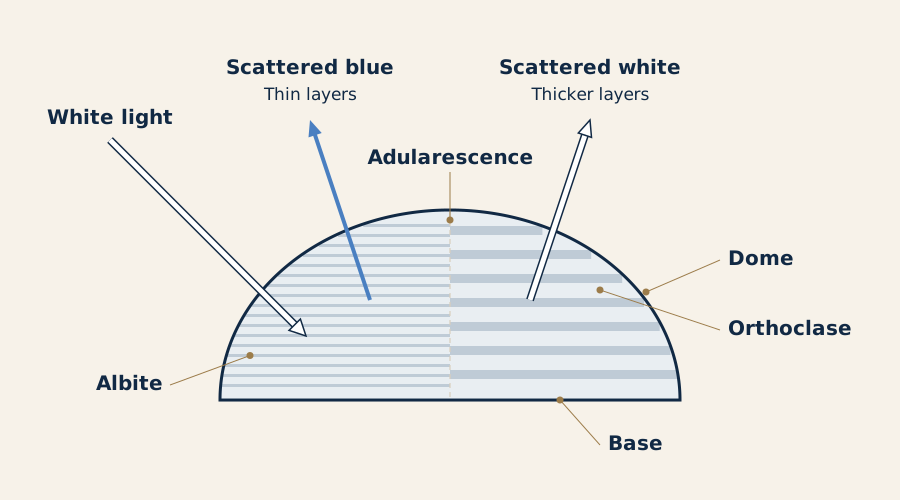
Moonstone is a gem variety of feldspar, the most common mineral group in the Earth's crust. Classic moonstone is mostly orthoclase (a potassium feldspar) with extremely thin layers of albite (a sodium feldspar) running through it. Those layers form as the hot mineral cools slowly and the two feldspars separate, a little like oil and vinegar settling out of a salad dressing. It is one of the many stones covered in our guide to coloured gemstones and birthstones.
Those stacked layers create moonstone's defining effect, adularescence: a soft, milky glow that seems to sit just under the surface and roll across the stone as you tilt it. Light entering the stone is scattered by the layers. Very thin layers scatter mostly blue light, giving the prized blue sheen; thicker layers scatter all colours together, giving a whiter, softer glow. The name comes from adularia, an old name for this feldspar taken from the Adula mountains in Switzerland.
On the gemmologist's bench, classic moonstone has a refractive index (how strongly it bends light) of about 1.518–1.526, a specific gravity (density compared with water) of about 2.56–2.59 and a hardness of 6–6.5 on the Mohs scale. Those numbers are much lower than diamond or sapphire, which is why moonstone has a gentle glow rather than sparkle. It is also a traditional June stone, sharing the month with two very different gems in our page on June's three birthstones. Any unfamiliar term here is explained in our jewellery glossary.
What colours does moonstone come in?
Moonstone has two colours to think about: the body colour (the colour of the stone itself) and the sheen colour (the colour of the floating glow). The most sought-after combination is a nearly colourless, transparent body with a blue sheen. When gemmologists describe body colour they use the same language as for other coloured stones, which you can learn in our explainer on hue, tone and saturation.
| Type | Body colour | Sheen | Typical sources |
|---|---|---|---|
| Blue moonstone (blue-sheen) | Colourless to near-colourless, transparent | Blue, sometimes intense | Sri Lanka, Myanmar |
| White moonstone | Colourless to milky white | White to silvery | Sri Lanka, India |
| Peach and grey moonstone | Peach, tan, grey, brown | White to silvery | India |
| Rainbow moonstone (labradorite) | White to colourless | Blue with flashes of other colours | India, Madagascar |
| Cat's-eye moonstone | Grey, white, brown | A single bright line | India, Sri Lanka |
| Star moonstone | Grey to brown | Usually a four-rayed star | India |
Rainbow moonstone needs a note. Mineralogically it is a white variety of labradorite, a plagioclase feldspar, not orthoclase. Its sheen comes from a related layering effect and often shows several colours at once. The trade name is widely accepted, but a laboratory report may call it labradorite, and its refractive index sits a little higher, at about 1.56–1.57. Dark spots and needle-like inclusions are common in rainbow moonstone and are part of its character.
Cat's-eye and star moonstones are cut from material with fine needle-like inclusions lined up inside. Cut as a dome, those needles reflect light into a sharp line or a star, an effect called chatoyancy (for the cat's-eye) or asterism (for the star).
Related guideJune Birthstone: Pearl, Moonstone and AlexandriteIs moonstone hard enough for a ring?
Moonstone hardness is 6–6.5 on the Mohs scale. Ordinary household dust contains quartz, which is 7, so everyday wiping and knocks slowly wear the surface of a moonstone. Over a few years of daily wear, a moonstone ring usually shows a softened, slightly dull dome and small nicks on the edge.
The bigger issue is toughness, meaning resistance to chipping and breaking. Moonstone has two directions of perfect cleavage (planes where the crystal splits cleanly) at close to right angles. A sharp knock on a door frame or gym weight can split a moonstone along one of those planes. Many moonstones also contain small stress cracks called centipede inclusions, because they look like a tiny insect with legs; they are a useful identification feature but also mark weaker spots.
| Gem | Mohs hardness | Toughness | Ring suitability |
|---|---|---|---|
| Diamond | 10 | Good (has cleavage) | Everyday wear |
| Sapphire | 9 | Excellent | Everyday wear |
| Morganite | 7.5–8 | Good | Everyday with some care |
| Smoky and rose quartz | 7 | Good | Everyday with some care |
| Chrysoprase | 6.5–7 | Good (no cleavage) | Everyday with some care |
| Moonstone | 6–6.5 | Poor (two cleavages) | Occasional wear, protective setting |
| Opal | 5.5–6.5 | Fair to poor | Occasional wear |
| Pearl | 2.5–4.5 | Fair to good | Occasional wear |
| Amber | 2–2.5 | Poor | Pendants and occasional rings |
So is moonstone good for an engagement ring? It can be, if you accept that it will need gentle wear and probably a re-polish or even replacement at some point. If you want a soft, light-coloured stone that copes better with daily life, compare it with milky pink rose quartz, smoky quartz, a tougher brown-grey option or the much harder stones in our morganite vs pink sapphire comparison. At the softer end, amber, an organic gem is gentler again and best kept for pendants.
Is moonstone treated, and how can you tell real moonstone from fake?
Most moonstone is untreated. The exceptions are uncommon: surface coatings that intensify the sheen, dye in cracked lower-grade material, and dark backings or assembled stones in some older jewellery. Any treatment should be disclosed when you buy. Our A to Z of gemstone treatments explains each of these and how they affect care.
Lab-created moonstone is not produced commercially. What you will meet instead are imitations (simulants), which look similar but are a different material: milky or opalescent glass (sometimes sold as "opalite"), older heat-treated synthetic spinel, and milky chalcedony. The distinctions between natural, lab-created and look-alike stones are set out in our page on natural, synthetic and simulant gems.
- Sheen depth: in moonstone the glow floats under the surface and moves as one soft patch. In glass the effect often looks painted on or stays fixed in place.
- Inclusions: centipede-like stress cracks and small crystals point to moonstone. Round gas bubbles and swirl marks point to glass, the same clues used in spotting glass and other simulants.
- Refractive index: a spot reading of about 1.52–1.53 on a refractometer fits orthoclase moonstone; about 1.56–1.57 fits rainbow moonstone. Synthetic spinel reads about 1.72, well clear of both.
- Specific gravity: about 2.56–2.59 for moonstone, about 2.70 for rainbow moonstone, and about 3.6 for synthetic spinel.
- Temperature: moonstone feels cool for a moment on the lips; plastic imitations feel warm.
For clarity, gemmologists group coloured stones into clarity types I, II and III depending on how often they grow free of inclusions. With fine blue moonstone the aim is a body that looks clean and clear to the eye, because cracks and cloudy patches block the sheen as well as weakening the stone.
Not sure which one is right?
Send us the stones you are looking at and our gemologist will tell you which to choose and why.
Where does moonstone come from?
Sri Lanka is the classic source of fine blue moonstone, especially the Meetiyagoda area in the south-west, where stones are dug from weathered deposits. Sri Lanka and its old name, Ceylon, appear again and again in the gem trade, as you will see in our page on classic gem origins from Ceylon to Mozambique.
- Sri Lanka: transparent stones with blue or white sheen; the finest blue-sheen material.
- India: large volumes of peach, grey, brown and white moonstone, plus most rainbow moonstone and cat's-eye and star stones.
- Myanmar (Burma): some fine blue-sheen moonstone.
- Madagascar and Tanzania: mainly commercial grades and rainbow moonstone.
- Brazil, Mexico, Norway and the USA: smaller occurrences, mostly collector or commercial material.
Australia is not known as a commercial moonstone source. Feldspars are common here, but gem-quality adularescent material has not been mined in meaningful quantity. If you want an Australian-mined stone, look instead at Australia's sapphire fields at Inverell and Anakie or the apple-green chrysoprase from Queensland and Western Australia.
Unlike sapphire, moonstone origin is rarely stated on a report and moves the price far less than appearance does. A clear Sri Lankan stone with strong blue sheen is valued for how it looks, not just where it came from.
What affects moonstone value and price in Australia?
Moonstone prices range from a few dollars per carat to several hundred, and the gap is almost all about how the sheen looks. In order of importance:
- Sheen colour: blue is valued most, then white and silver.
- Transparency: a clear, glassy body lets the sheen float freely; milky or cloudy bodies cost much less.
- Sheen strength and position: a bright sheen that sits in the centre of the dome when viewed face-up, and moves smoothly, is the goal.
- Clarity: few visible cracks, centipede inclusions or cloudy patches.
- Cut and orientation: the layers must lie parallel to the base, and the dome must be high enough to gather the sheen in the centre.
- Size: fine blue-sheen stones above about 5 carats are scarce and rise in price per carat.
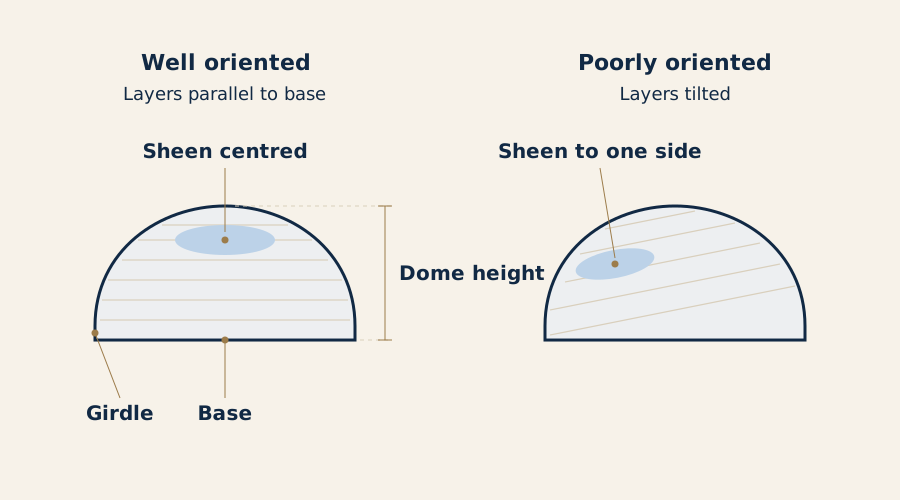
Because the effect sits inside the stone, moonstone is almost always cut as a cabochon, a smooth domed shape without facets. Faceted moonstone exists but shows the sheen less clearly. See our guide to cabochon, faceted and carved cuts for how each style handles light.
| Moonstone type and quality | Approximate price per carat (AUD, loose) |
|---|---|
| Commercial white, grey or peach, translucent | about $5–$40 |
| Rainbow moonstone, good sheen | about $10–$80 |
| Cat's-eye or star moonstone | about $10–$60 |
| Fine transparent blue-sheen, 1–5 ct | about $100–$800 |
These are broad ranges only, and they move with the market and individual stones. The setting and metal usually cost more than the moonstone itself, so a finished moonstone ring's price is driven mostly by the design and the gold or platinum.
Browse natural gemstones
What is the best setting for a moonstone ring?
Because moonstone is soft and cleaves easily, the right moonstone ring setting does most of the work in keeping it safe. The aim is to cover the edge and keep the dome from taking direct knocks.
- Bezel setting: a continuous rim of metal around the stone. It protects the girdle (the outer edge) where chips start, and suits the rounded cabochon shape.
- Low profile: a stone sitting close to the finger is knocked less often than one raised high.
- Moderate dome: a very tall cabochon shows sheen well but takes more hits; a medium dome is a good balance for rings.
- Claws with care: four or six claws work for occasional rings and pendants, but the setter must avoid pressure on cleavage planes.
- Pendants and earrings: the safest homes for moonstone, because they are rarely knocked.
Moonstone's cool, pale glow suits white gold, platinum and silver, while yellow gold warms peach and grey stones. Whichever metal you choose, plan to take the ring off for gardening, the gym, cleaning and heavy work.
How do you clean and care for moonstone?
Moonstone care is simple, but a few common cleaning methods can crack it.
- Clean gently: warm water, a drop of mild dishwashing liquid and a soft toothbrush, then rinse and dry with a soft cloth.
- No ultrasonic or steam cleaners: vibration and heat can open cleavage planes and existing cracks.
- Avoid heat and sudden temperature changes: for example, moving from a hot oven to cold water.
- Keep chemicals away: chlorine, cleaning products and perfume can dull the surface and damage any coating.
- Store separately: harder gems such as diamond and sapphire will scratch moonstone in a jewellery box.
- Check the setting: have claws or bezels checked about once a year, and ask about a re-polish if the dome looks dull.
A worn moonstone can usually be re-polished to restore its surface, removing a fraction of a millimetre from the dome. Deep chips may need the stone recut or replaced.
How to choose a moonstone: step by step
- Decide how you will wear it. Pendant and earrings suit any moonstone; a ring needs a protective setting and a stone free of edge cracks.
- Choose the type. Blue-sheen, white, peach, grey or rainbow moonstone; confirm whether rainbow material is described as labradorite.
- Look at the body. Clearer is better; check under daylight-type light for cloudiness and cracks.
- Rock the stone. Tilt it slowly and watch the sheen move; it should be bright, centred face-up and roll smoothly.
- Check for cleavage and centipedes. Look side-on with a light for flat flashes, especially near the edge.
- Ask about treatment and identity. Confirm the stone is natural moonstone, untreated or disclosed, and not glass or a synthetic imitation.
- Plan the setting and care. Choose a bezel or low setting for rings, and keep cleaning to warm soapy water.
Free consultation
Talk to a gemologist
Compare stones in person or online with Raj Sood, Graduate Gemologist (GIA), AJP (GIA).
Book a consultationShop this shape
FAQ
Common questions
Is moonstone a real gemstone?
Yes. Moonstone is a natural variety of feldspar, mostly orthoclase with thin albite layers. Glass and synthetic spinel imitations exist, so check that a stone is described as natural moonstone.
Can you wear a moonstone ring every day?
You can, but expect wear. At 6–6.5 on the Mohs scale with two cleavage directions, moonstone scratches and can chip, so a bezel or low setting and taking it off for hard work help a lot.
Is rainbow moonstone real moonstone?
Rainbow moonstone is a white labradorite, a related feldspar, rather than orthoclase moonstone. The trade name is widely used and accepted, but some reports call it labradorite.
What is the most valuable colour of moonstone?
A transparent, nearly colourless body with a strong blue sheen, traditionally from Sri Lanka, is valued most. White, peach and grey moonstones cost considerably less.
How do you clean moonstone?
Use warm water, mild dishwashing liquid and a soft brush, then rinse and dry. Avoid ultrasonic and steam cleaners, heat and household chemicals.
Is moonstone expensive?
Most moonstone is affordable, from roughly $5 to $80 per carat in Australia. Fine transparent blue-sheen stones can reach several hundred dollars per carat.

Ask a gemologist
Not sure which diamond to choose?
Raj Sood is a Graduate Gemologist (GIA) and master jeweller. Bring the stones you are considering, or send the reports, and he will tell you honestly which one is better and why.
Keep learning
Related guides
 GemstonesJune Birthstone: Pearl, Moonstone and Alexandrite
 GemstonesGemstone Cuts: Cabochon, Faceted and Carved
 GemstonesGemstone Treatments A to Z
 GemstonesNatural vs Synthetic vs Simulant GemstonesGemstonesGemstones | Coloured Gemstones, Birthstones and Custom Jewellery
 GemstonesGemstone Origins: Ceylon, Burma, Kashmir, Madagascar, Mozambique
 GemstonesDiamond Simulants: CZ, YAG, GGG and Glass
 GemstonesGemstone Colour Grading: Hue, Tone, Saturation
Explore more
More guides on this topic
Education