
- Education
- Buying Knowledge & Custom Process
- Choosing an Engagement Ring Together: A Practical Australian Guide
Buying knowledge & custom process
Choosing an Engagement Ring Together: A Practical Australian Guide
Many couples now shop for the engagement ring as a team. Here is how choosing an engagement ring together works in practice, from keeping some surprise to the GST, Tourist Refund Scheme and insurance rules most guides skip.
 Reviewed by Raj Sood, Graduate Gemologist (GIA), AJP (GIA)Master jeweller and Graduate Gemologist (GIA) · reviewed 4 November 2026
Quick answer
Choosing an engagement ring together works well for many couples: the wearer gets a ring that fits their hand, lifestyle and taste, and you agree a budget openly. You can still keep a surprise by shopping together for style and size, then letting one partner pick the final stone, ring or proposal date.
Should couples be choosing an engagement ring together?
There is no rule that says the engagement ring has to be a surprise. The picture of one partner choosing a ring alone and producing it on bended knee is a tradition, not a requirement, and plenty of Australian couples now treat the ring as a shared decision, much like choosing where to live. The person wearing it will have it on their hand every day for decades, so it makes sense that they have a say.
Shopping together does not mean losing the romance. Many couples land somewhere in the middle: they agree the essentials together, then one partner handles the final choice or the timing of the proposal. If you are starting from scratch, our complete engagement ring buying guide covers shapes, metals and the 4Cs (cut, colour, clarity and carat weight) before you get into the detail here.
Four practical reasons couples choose together:
- Taste is personal. Someone who has never liked a classic solitaire may want a bezel, a coloured stone or an asymmetric design. Our page on engagement ring ideas for people who dislike traditional styles shows how wide the options are.
- Lifestyle matters. A nurse, chef, tradie or rock climber usually needs a lower, more protected setting than someone who works at a desk. See how daily life should shape the ring design.
- Size has to be right. A ring that is too loose can slip off in cold water; one that is too tight will sit in a drawer.
- Money is often shared. When savings are pooled, the budget is a joint decision anyway.
What are the pros and cons of a surprise ring versus choosing together?
Each approach trades surprise against certainty. The table sets out the three common ways couples handle it.
| Full surprise | Chosen together | Hybrid: shortlist together, one picks | |
|---|---|---|---|
| Ring suits the wearer's taste | A gamble unless you know their style well | Very likely | Very likely |
| Ring size accuracy | Often a guess; may need resizing | Measured properly | Measured properly |
| Surprise at the proposal | Complete | The question and timing only | The final ring, plus the moment |
| Budget | Decided by one person | Agreed openly | Agreed openly, ceiling shared |
| Risk of remaking the ring | Highest | Lowest | Low |
| Time needed | Shortest | Longer: more appointments | Longer: more appointments |
There is also a legal reason to get the wearer's input early. Under Australian Consumer Law, a jeweller does not have to give a refund if you simply change your mind, and a ring made to order is usually not returnable. Consumer guarantees still apply if something is faulty, but "it's not quite their style" is not a fault. Resizing is often possible, though a redesign usually means paying for new work.
Related guideShould You Choose a Custom Engagement Ring or a Ready-Made Ring?How can you keep the proposal a surprise if you shop together?
Choosing together still leaves plenty of room for surprise. These are the hybrid approaches couples use most:
- Shortlist together, pick alone. You both look at three or four designs, then one partner chooses the final ring without saying which.
- Choose the setting together, keep the stone secret. The wearer picks the style and metal; the proposer chooses the diamond or gemstone and its size.
- Propose with the loose diamond. Some people propose with the centre stone in a box, then design the setting together afterwards.
- Propose with a stand-in ring. A simple placeholder ring, or a family ring, is used on the day and the real ring is designed as a couple.
- Choose together, keep the date secret. The ring is no surprise, but when and where you ask still is.
Whichever route you take, work backwards from the proposal date. Custom work, resizing and engraving all take time, so our guide to when to order the ring before a proposal sets out realistic lead times.
What should you decide together, and what can one person choose?
Not every decision needs both of you. The ones that affect comfort and daily wear belong to the wearer; the ones that are mostly about the moment can sit with the proposer.
| Decision | Why it matters | Usually decided by |
|---|---|---|
| Ring size | Comfort and security on the finger | The wearer (measured, not guessed) |
| Metal and colour | Platinum, white, yellow or rose gold must suit skin tone and other jewellery | The wearer |
| Band width | Changes how large the stone looks and how the ring feels | The wearer |
| Setting height and style | High claws catch on gloves and knits; bezels are lower and safer | Together, based on lifestyle |
| Natural or lab-grown | Changes the budget and size options a great deal | Together |
| Budget ceiling | Sets every other choice | Together |
| Exact centre stone | Carat, colour and clarity within the agreed range | Either; often the proposer |
| Wedding band fit | The band has to sit comfortably beside the engagement ring | Together, at the design stage |
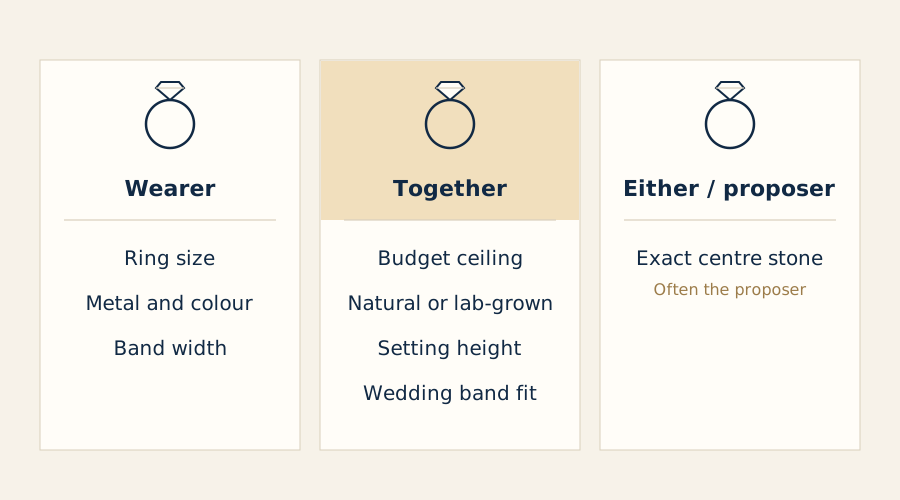
Ring size is where surprise rings most often go wrong. Australia uses letter sizes, the same system as the UK, while the US uses numbers and much of Europe uses the inside circumference in millimetres. Our chart of Australian ring sizes against US, UK and EU sizes helps if you have a size from an overseas ring. For a partner with larger hands, or for a men's engagement ring, the men's ring sizing guide covers the wider range. Most rings can be resized up or down by about one or two sizes, but full eternity bands and some patterned bands cannot be resized easily.
Band width is worth trying on in person: a 1.8 mm band makes a centre stone look larger, while a 2.5–3 mm band feels sturdier. Our page on choosing an engagement ring band width explains the trade-offs. Think about the wedding band now too. A curved or contoured band may be needed to sit flush, which is why some couples design the engagement ring and wedding band as a set, and others weigh up whether their two wedding bands should match.
Not sure which one is right?
Send us the stones you are looking at and our gemologist will tell you which to choose and why.
How do couples agree on an engagement ring budget?
Talking about money is the part many couples put off, but it is the conversation that makes everything else easier. Old advertising rules about spending a set number of months' salary were marketing, not advice. A sensible budget is one you can pay without debt you regret, and it should include the setting, any resizing, insurance and, if you want them, wedding bands. Our guide to setting an engagement ring budget works through it in more detail.
The biggest single lever is whether the centre diamond is natural or lab-grown. Natural diamonds formed deep in the earth, most of them between one and three billion years ago, and are rarer. Lab-grown diamonds (also called laboratory-grown) are real diamond, with the same hardness (10 on the Mohs scale) and refractive index (about 2.42), grown in a laboratory over weeks. They cost much less, so the same budget buys a larger stone. Neither should be bought as a financial investment; choose on what matters to you both.
| Centre stone (round, G–H, VS) | Approximate price range (AUD) |
|---|---|
| 1 ct lab-grown | about $1,000–$3,000 |
| 1 ct natural | about $7,000–$15,000 |
| 2 ct lab-grown | about $2,000–$6,000 |
| 2 ct natural | about $20,000–$45,000 |
| 18ct gold solitaire setting | about $1,500–$4,000 on top of the stone |
These are broad ranges only; prices move with the market and the exact grades. If lab-grown suits you both, our size guides for a 1 carat lab-grown diamond, a 2 carat lab-grown stone and going up to 3 carats lab-grown show what changes at each size, from face-up millimetres to how high the setting sits.
Browse natural and lab-grown diamonds
How does the custom design process work for a couple?
A custom ring suits couples well because there are natural points to involve both people. The process usually runs like this: a first conversation, a shortlist of stones, a CAD render (a computer-aided design model showing the ring from every angle), changes, then making and finishing. Total time is commonly about 4–8 weeks, longer if the stone has to be sourced.
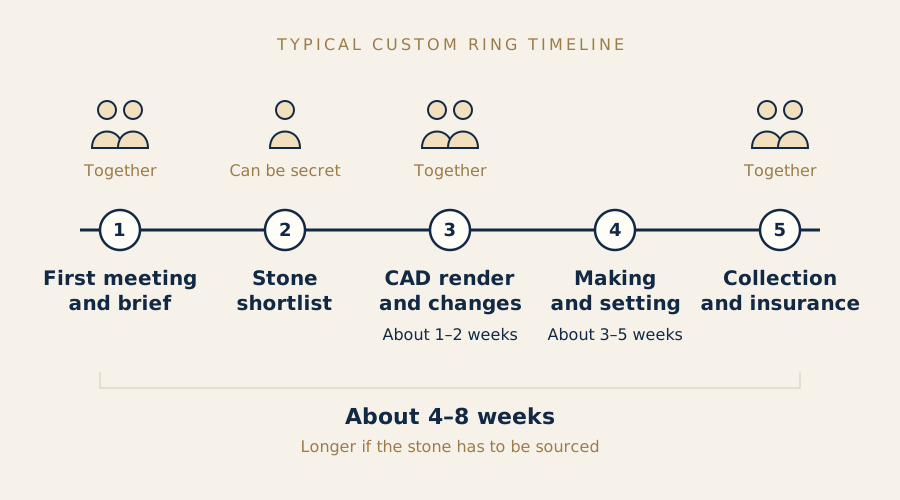
Start by writing down what you both want. Our guide to writing a clear engagement ring design brief gives a simple template: shape, metal, band width, setting height, what you dislike and the budget. Keep it to one shared page so nothing gets lost between appointments.
When it comes to stones, it is easy to get stuck comparing hundreds of near-identical diamonds. Agree on a range together, then use our method for building a short list of diamonds without drowning in filters. If you are viewing stones online, learn what to watch for in a 360-degree diamond video, such as a dark bow-tie or an inclusion near the edge.
The CAD stage is the best moment for the wearer to give feedback, because changes cost little before the metal is cast. Our page on reading an engagement ring CAD render explains claw thickness, band width and setting height on screen, so you both know what you are approving.
How do GST and the Tourist Refund Scheme apply to an engagement ring?
Prices for jewellery in Australia include GST (goods and services tax) at 10%, so GST makes up one-eleventh of the price you pay. Two rules decide whether you can get it back or have to pay it again: the Tourist Refund Scheme for things bought here, and the passenger allowance for things bought overseas.
The Tourist Refund Scheme (TRS) lets travellers claim back GST on goods bought in Australia and taken overseas. In plain terms:
- You must spend at least $300 (including GST) with one business, shown on one or more tax invoices from the same ABN.
- The purchase must be made within 60 days before you leave Australia.
- You must carry the ring with you, worn or in hand luggage, and show it with the original tax invoice.
- Claims are made at the TRS facility in the international departure area, and you need to allow time before your flight closes.
The catch for Australian residents is coming home. If you claim the TRS and then bring the ring back, it counts towards your passenger concession (the duty-free allowance, $900 per adult for general goods), and you must declare it on arrival. If it is over the allowance, GST is normally payable again, so the TRS mainly helps overseas visitors, or Australians moving abroad.
| Situation | What usually happens |
|---|---|
| Overseas visitor buys a ring in Melbourne and flies home with it | Can claim the GST back through the TRS if the conditions are met |
| Australian couple buys here, claims the TRS, returns with the ring | Must declare it on return; GST is usually payable again if over the $900 allowance |
| Australian couple buys a ring overseas and brings it home | Declare it if over $900; GST, and possibly customs duty, apply to the full value, not just the excess |
| Jeweller ships the ring direct to an overseas address | Usually sold without Australian GST as an export; the destination country may charge its own import tax |
Buying overseas brings other practical questions: who resizes the ring if it does not fit, how warranty repairs work across borders, and whether the grading report is from a recognised lab such as GIA or IGI. Check the current rules with the Australian Border Force and the ATO before you travel, as limits and processes can change.
Should you insure an engagement ring before the proposal?
Yes. The weeks between buying the ring and proposing are often the riskiest: it is hidden in a sock drawer, carried in a jacket pocket or packed in luggage for an overseas proposal. Arrange cover from the day you take it home.
- Check your contents policy. Many home and contents policies cap unspecified jewellery at a set amount per item, often somewhere around $1,000–$2,500, unless you list the ring separately.
- Specify the ring. Listing it as a specified item, with portable valuables cover for outside the home, means it is covered when worn or travelling.
- Get an insurance valuation. A written valuation from a qualified valuer describes the stone, metal and replacement cost. Keep the tax invoice, grading report and clear photos with it.
- Agreed value or replacement. Some policies pay an agreed figure; others replace the ring through their own suppliers. Ask which applies.
- Update after the proposal. If the buyer insured it on their own policy, check the wearer is covered once it is on their hand, especially if you live apart.
Lab-grown diamonds are worth insuring too, but their replacement cost has been falling, so review the valuation every couple of years rather than paying a premium on an outdated figure. Our guide to insuring a lab-grown diamond ring covers what to tell your insurer.
How do you go about choosing an engagement ring together, step by step?
- Agree the approach. Full surprise, fully together or a hybrid, and what part stays secret.
- Set the budget ceiling. Include the setting, resizing, insurance and wedding bands.
- Get the wearer measured. Use a proper ring sizer, ideally at the end of the day when fingers are slightly larger.
- Try on shapes and band widths. Spend an appointment trying styles before looking at individual stones.
- Decide natural or lab-grown. Compare a few stones of each at your budget and size.
- Write a shared brief. One page covering shape, metal, setting height, wedding band fit and dislikes.
- Approve the CAD render together. Or hand this step to one partner if the final design is the surprise.
- Insure it from day one. Arrange a valuation and specified-item cover before the proposal, and check the TRS and customs rules if you are travelling.
If any of the terms above are new to you, our plain-English jewellery glossary explains them in a line or two each.
Free consultation
Talk to a gemologist
Compare stones in person or online with Raj Sood, Graduate Gemologist (GIA), AJP (GIA).
Book a consultationShop this shape
FAQ
Common questions
Is it bad luck or unromantic to choose an engagement ring together?
No. It is simply a choice about how you share the decision. Many couples keep the romance by keeping the proposal date, place or final stone a surprise.
How do I find out my partner's ring size secretly?
Borrow a ring they wear on the same finger and have it measured, or ask a close friend to help. If you are unsure, choose a ring that can be resized after the proposal, and avoid full eternity bands.
Can I get a refund if my partner doesn't like the ring?
Australian Consumer Law does not require a refund for a change of mind, and custom-made rings are usually not returnable. Ask about the jeweller's own policy before you buy, or involve your partner in the key choices first.
Can Australians use the Tourist Refund Scheme on an engagement ring?
Yes, if you spend $300 or more with one business within 60 days of leaving and carry the ring with you. If you bring it back to Australia, you must declare it, and GST is usually payable again if you are over your $900 allowance.
Do I have to pay GST on a ring bought overseas?
If the ring is worth more than your $900 passenger allowance, you must declare it and GST, plus any customs duty, is calculated on the full value. Check the current Australian Border Force rules before you travel.
When should we insure the engagement ring?
From the day you take it home, before the proposal. Specify it on your contents policy with cover outside the home, and keep the valuation, invoice and grading report together.

Ask a gemologist
Not sure which diamond to choose?
Raj Sood is a Graduate Gemologist (GIA) and master jeweller. Bring the stones you are considering, or send the reports, and he will tell you honestly which one is better and why.
Keep learning
Related guides
 Buying Knowledge & Custom ProcessPlanning a Proposal: When Should You Order the Engagement Ring?
 Buying Knowledge & Custom ProcessHow Much Should You Spend on an Engagement Ring?
 Lab-Grown DiamondsShould a Lab-Grown Diamond Be Insured?
 Engagement Rings & SettingsWhat Engagement Ring Band Width Should You Choose?
 Wedding Bands & EternityShould You Design the Engagement Ring and Wedding Band Together?
 Buying Knowledge & Custom ProcessShould You Choose a Custom Engagement Ring or a Ready-Made Ring?Engagement Rings & SettingsHow to Choose an Engagement Ring When You Dislike Traditional Styles
Explore more
More guides on this topic
Education