
- Education
- Engagement Rings & Settings
- Men's Engagement Ring Guide: Settings, Stones, Metals and Fit
Engagement Rings & Settings
Men's Engagement Ring Guide: Settings, Stones, Metals and Fit
A men's engagement ring usually gets harder wear than almost any other ring, through tools, gym bars and steering wheels. Here is how each style is built, how it holds up over the years and which stones, metals and widths suit it.
 Reviewed by Raj Sood, Graduate Gemologist (GIA), AJP (GIA)Master jeweller and Graduate Gemologist (GIA) · reviewed 4 November 2026
Quick answer
A men's engagement ring is usually a 5–8 mm band in platinum or gold with a low-set stone, most often a diamond of 0.10–0.50 carat in a flush or bezel setting. Those settings keep the stone below or level with the metal, so it copes with daily knocks. Choose a Mohs 9–10 stone and a comfort-fit profile.
What is a men's engagement ring?
A men's engagement ring is simply an engagement ring designed for, or chosen by, a man. It is worn from the proposal until the wedding, and many men then keep wearing it, either alone or stacked with a wedding band. There is no fixed rule about what it must look like. Some are plain gold bands, some carry a single diamond, and some have a row of small stones or a coloured gemstone.
What sets most men's rings apart from a typical women's solitaire is build, not gender. Men's rings tend to be wider (5–8 mm rather than 2–3 mm), heavier and lower, with the stone set into the band rather than raised above it. The same construction choices covered in our overview of engagement ring setting styles apply here, but the balance shifts towards security and comfort.
A men's engagement ring sits in a wider family of rings with similar looks but different meanings. A ring given as a commitment before an engagement is a promise ring (see what a promise ring means and when to give one), and a ring worn purely as a personal piece is often a right-hand ring, explained in our guide to the history and meaning of right-hand rings. If you are still deciding how a ring fits with a watch, a signet or cufflinks, our page on the main types of men's jewellery covers the rest of the jewellery box.
Some of the terms below, such as girdle, bezel and comfort fit, are explained as we go, and every one is also in our A–Z jewellery glossary.
Which settings suit a men's engagement ring?
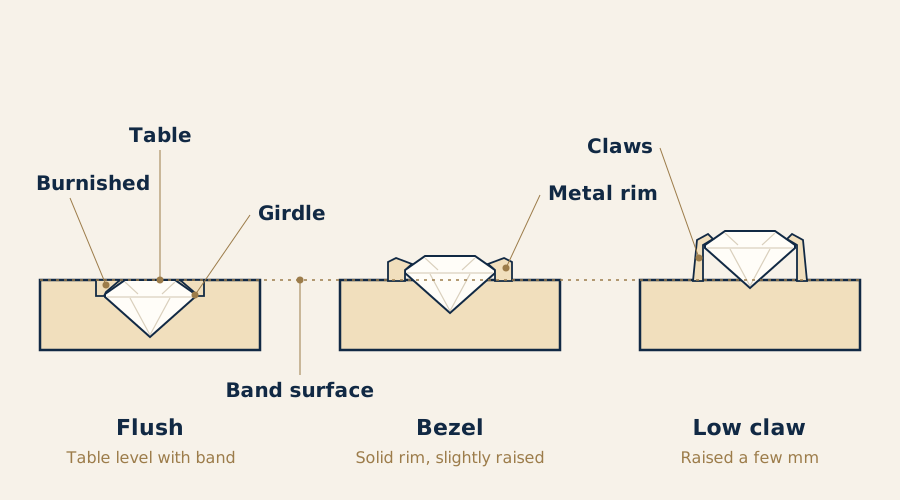
The setting is the metal work that holds the stone. For a ring worn on a working hand, the most important question is how far the stone sits above the band. The higher it sits, the more light it catches and the more knocks it takes. These are the settings we see most often on men's rings:
- Flush setting (also called gypsy or burnish setting): a hole is drilled into the band, the stone drops in so its table (the flat top facet) sits level with the metal, and the jeweller pushes and polishes metal over the girdle (the stone's outer edge). Nothing sticks out, so it is very hard to catch.
- Bezel setting: a solid rim of metal wraps the whole girdle. It can sit slightly raised or almost level with the band. Very secure, and it protects the edge of the stone from chips.
- Channel setting: a row of stones held between two walls of metal. Common for a line of small diamonds across the top of a band.
- Low claw setting: four or six claws hold the stone, but the setting is kept low and close to the finger. It shows the most diamond, but claws wear and can bend.
- Tension-style setting: the stone appears to be held only by pressure between two ends of the band. True tension settings need a very rigid metal and precise sizing; many modern versions are tension-style designs with a hidden seat for security.
| Setting | Stone height | Security | Shows the stone | Upkeep over years |
|---|---|---|---|---|
| Flush | Level with band | Very high | Less (only the table shows) | Low; occasional repolish |
| Bezel | Level to slightly raised | Very high | Moderate | Low; rim can dent |
| Channel | Level with band | High | Moderate, a row of stones | Check walls for wear |
| Low claw | Raised a few mm | Moderate | Most | Claws re-tipped every few years |
| Tension-style | Level to slightly raised | Moderate to high | High from the side | Needs exact sizing; cannot be resized much |
Plenty of men choose a classic single stone; our guide to single-stone solitaire rings covers the women's versions of that style, and the same proportions can be scaled up. For a closer look at the rim-style option, see how bezel settings are made and worn. Raised styles, such as cathedral settings with arched shoulders, are less common on men's rings because the height catches on gloves and pockets. Off-centre designs work well, though: an asymmetrical ring with an offset stone can look modern in a wide band.
How do men's engagement ring settings hold up over the years?
This is where a repair bench sees what a showroom does not. Most of the damage we see on men's rings comes from the same handful of causes: lifting, gripping and banging the hand against hard surfaces. The patterns are predictable.
- Claws wear flat on the side facing the palm, then bend or snap. A claw-set ring worn daily typically needs claws checked every 12 months and re-tipped (built back up with new metal) every few years.
- Flush settings rarely lose a stone. The metal around the stone can wear down over a decade or more, and the band can show scratches, but the stone stays protected.
- Bezels can dent if the ring is hit on an edge. A jeweller can usually reshape a small dent; a heavily flattened bezel may need rebuilding.
- Band shanks (the part under the finger) thin out over many years of wear, especially in softer gold. A shank under about 1.2 mm thick is worth rebuilding before it cracks.
- Rhodium plating on white gold wears away, usually within one to three years for a men's ring, letting the slightly warm colour of the gold show through. It can be replated.
If your work involves tools, machinery or electrical equipment, read our guide to choosing a band for hands-on jobs before you settle on a design. It covers the safety side too: any metal ring can catch on machinery, and some workplaces ask that rings are removed. Fine, open metalwork, such as filigree rings with lace-like detail, is lovely but traps grime and can bend under hard use, so it suits a lighter-wearing hand.
Which diamonds and gemstones suit a men's engagement ring?
A men's ring sees knocks from every angle, so hardness matters. The Mohs scale ranks how well a material resists scratching, from talc at 1 to diamond at 10. Household dust contains quartz at about 7, so any stone below 7 will slowly lose its polish. For daily wear, aim for 9 or above. Hardness is not the same as toughness (resistance to chipping), which is another reason a protective setting helps.
| Stone | Mohs hardness | Everyday wear | Notes |
|---|---|---|---|
| Diamond (natural or lab-grown) | 10 | Excellent | Refractive index about 2.42; can still chip on a hard knock to the edge |
| Black diamond | 10 | Good | Usually natural diamond treated for colour, or lab-grown; often heavily included, so prefer a bezel or flush setting |
| Moissanite (lab-created) | 9.25 | Excellent | Shows more coloured flashes than diamond |
| Sapphire (natural or lab-created) | 9 | Excellent | Blue, black, grey, green and other colours |
| Ruby (natural or lab-created) | 9 | Excellent | Red variety of corundum, same hardness as sapphire |
| Spinel | 8 | Good | Tough for its hardness; good in a protected setting |
| Emerald | 7.5–8 | Fair | Often included and brittle; best in a bezel and not for heavy work |
Shape matters as much as stone. Round brilliants are the easiest to flush set, because the even girdle sits neatly in a drilled seat and has no corners to chip. Square and rectangular shapes such as princess, emerald, asscher and baguette cuts suit the clean lines of a wide band, but their corners are the weak points; set them with metal covering the corners, either in a bezel or with corner claws. Hexagon and kite shapes are popular on modern men's rings and need the same corner protection.
Size: a 0.10–0.25 carat diamond (about 3.0–4.1 mm across for a round) reads as a subtle accent in a 6 mm band. A 0.50 carat round is about 5.1 mm and gives a clearly visible centre. A 1 carat round, about 6.4 mm, nearly fills the width of a 7 mm band and is usually set in a bezel or low claws rather than flush.
Old cuts can also suit men's rings. The geometric step cuts of the Art Deco era's engagement rings sit well in a strong band, and the chunky, rounded old mine and old European cuts found in Edwardian and Victorian rings can be reset into a modern men's design.
Not sure which one is right?
Send us the stones you are looking at and our gemologist will tell you which to choose and why.
What metal is best for a men's engagement ring?
There is no single right metal, but each behaves differently on the hand over years. Because men's bands are wide and heavy, the metal is a large share of the cost and the feel.
| Metal | Colour | Weight on the hand | How it wears | Resizing |
|---|---|---|---|---|
| Platinum (950) | Naturally white | Heaviest | Scratches move metal rather than remove it; develops a soft matte patina | Yes |
| 18ct white gold (75% gold) | White, usually rhodium plated | Heavy | Plating wears; needs replating every 1–3 years | Yes |
| 18ct yellow or rose gold | Rich yellow or pink | Heavy | Scratches show but polish out; colour does not wear off | Yes |
| 9ct gold (37.5% gold) | Paler yellow, rose or white | Lighter | Harder than 18ct but less rich in colour | Yes |
| Palladium | Naturally white, slightly grey | Light | Similar look to platinum, lighter | Yes, with experience |
| Titanium or tungsten carbide | Grey to dark grey | Light (titanium) or very heavy (tungsten) | Tungsten is very scratch-resistant but can crack if dropped on tiles | Generally no |
For a ring with a diamond or gemstone, platinum and gold are the practical choices, because they can be resized, repaired and reset. Alternative metals such as tungsten carbide cannot be cut and soldered like gold, so if your finger size changes or the stone loosens, the ring usually has to be replaced.
How wide should a men's engagement ring be, and how should it fit?
Most men's engagement rings are 5–8 mm wide. As a rough guide, 5–6 mm suits slimmer fingers or a man who has not worn rings before, 6–7 mm is the middle ground, and 8 mm or more suits larger hands and bold designs. Our comparison of typical band widths for women and men shows the full range side by side.
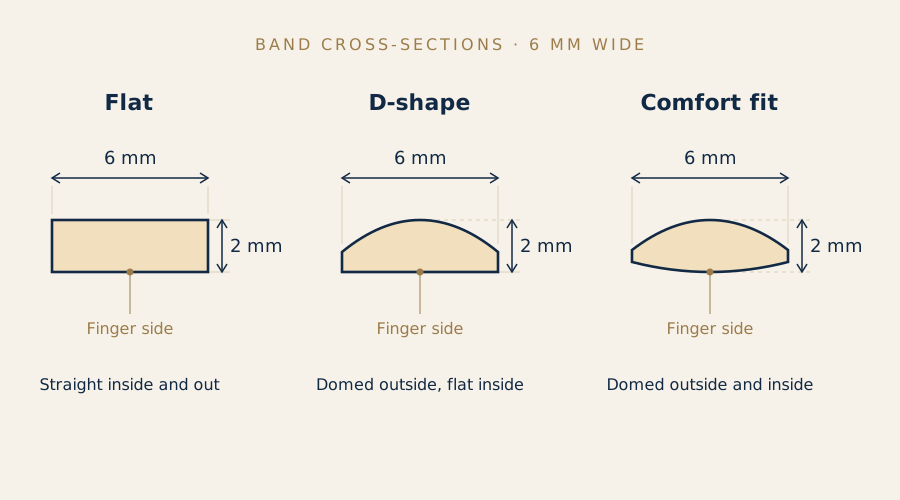
Profile is the shape of the band in cross-section, and it changes the feel more than most people expect.
- Flat: straight inside and out. Crisp look, but the edges can feel sharp on a wide band.
- Court or comfort fit: the inside is gently domed so the ring slides over the knuckle and sits without pressing. Most men's bands over 5 mm are made this way.
- D-shape: domed outside, flat inside. A traditional look; heavier rings in this shape can feel snug.
- Bevelled edge: flat top with angled edges, which frames a flush-set stone neatly.
Wider bands fit tighter. An 8 mm band covers more of the finger than a 2 mm band, so you often need about half a size larger. Australian ring sizes run on a letter scale, and most men fall roughly between R and Z. Our step-by-step men's ring sizing guide explains how to measure at the end of the day, when fingers are largest, and how knuckle size affects the fit.
How much does a men's engagement ring cost in Australia?
The two biggest drivers of price are the metal weight (a 7 mm band in platinum can weigh two to three times as much as a slim women's band) and the stone. Natural and laboratory-grown diamonds look the same to the eye and are both real diamond with the same hardness and refractive index. Lab-grown diamonds are grown in a laboratory rather than mined; they cost much less, so many men choose a larger lab-grown stone. Natural diamonds are rarer, and a grading report from a recognised lab will state which you have.
| Ring | Approximate price range (AUD) |
|---|---|
| Plain 6 mm 18ct gold band, no stone | about $1,500–$3,500 |
| 6 mm 18ct gold, 0.25 ct lab-grown diamond, flush set | about $2,000–$4,500 |
| 6 mm 18ct gold, 0.25 ct natural diamond, flush set | about $3,000–$6,000 |
| 7 mm platinum, 0.50 ct natural diamond, bezel set | about $6,000–$12,000 |
These are broad ranges only. Gold and platinum prices move daily, and the exact colour, clarity and cut of the stone shift the price a long way within each band. A coloured stone such as a sapphire can cost less or more than a diamond depending on its origin, colour and whether it is natural or lab-created.
Create your ring: choose a setting and stone
Do men wear a wedding band with an engagement ring?
There is no single custom. Some men wear their engagement ring alone and swap it for a wedding band at the ceremony. Some wear both, stacked on the same finger. Others move the engagement ring to the right hand after the wedding. If you plan to stack, design the two together: a flush-set engagement ring with straight sides sits cleanly against a plain band of the same width and metal, while a raised bezel needs a band with a slight curve or a gap.
Matching metals matters for wear as well as looks. Platinum and gold worn together rub against each other, and the harder metal slowly wears the softer one, so most people stack the same metal. Our complete guide to men's wedding bands covers finishes such as brushed, hammered and high polish, and how each ages.
Related guideMen’s Wedding Band GuideHow to choose a men's engagement ring, step by step
- Look at his hands and work. Note the jobs, sports and habits that will knock the ring, and whether he already wears a watch or other rings.
- Choose the setting height. Flush or bezel for hands-on wear; low claws only if he is happy to have them checked each year.
- Pick a stone of Mohs 9 or above. Diamond, lab-grown diamond, moissanite, sapphire or ruby, and confirm on the report whether it is natural, lab-grown or lab-created.
- Match shape to setting. Rounds flush set easily; square and hexagon shapes need their corners covered.
- Decide metal and width. Platinum or gold if you want it resizable; 5–8 mm wide with a comfort-fit inside.
- Get the size right. Measure at the end of the day and allow about half a size up for bands over 6 mm.
- Plan the wedding band. If he will stack, design both rings together in the same metal.
Free consultation
Talk to a gemologist
Compare stones in person or online with Raj Sood, Graduate Gemologist (GIA), AJP (GIA).
Book a consultationShop this shape
FAQ
Common questions
Do men wear engagement rings?
Yes, some men do. There is no rule about style; many choose a wide band with a low-set diamond, while others wear a plain band until the wedding.
What is the most practical setting for a men's engagement ring?
A flush or bezel setting suits most men, because the stone sits level with or close to the metal and is hard to catch or knock out. Claw settings show more of the stone but need regular checks.
How big should the diamond be in a men's engagement ring?
Most men choose 0.10–0.50 carat, which is about 3.0–5.1 mm across for a round. Larger stones of around 1 carat suit a bezel or low claw setting in a wider band.
Can a men's engagement ring be resized?
Platinum and gold rings can usually be resized by about one or two sizes, though a ring with stones all the way around is harder to adjust. Tungsten carbide and most titanium rings generally cannot be resized.
Is a lab-grown diamond suitable for a men's engagement ring?
Yes. A lab-grown diamond is real diamond, with the same hardness of 10 on the Mohs scale, and it costs much less than a natural diamond of the same size. The grading report will state that it is laboratory-grown.
Which finger does a man wear an engagement ring on?
In Australia most men wear it on the fourth finger of the left hand, the same as a wedding band. Some prefer the right hand, especially if they are left-handed or work with their hands.

Ask a gemologist
Not sure which diamond to choose?
Raj Sood is a Graduate Gemologist (GIA) and master jeweller. Bring the stones you are considering, or send the reports, and he will tell you honestly which one is better and why.
Keep learning
Related guides
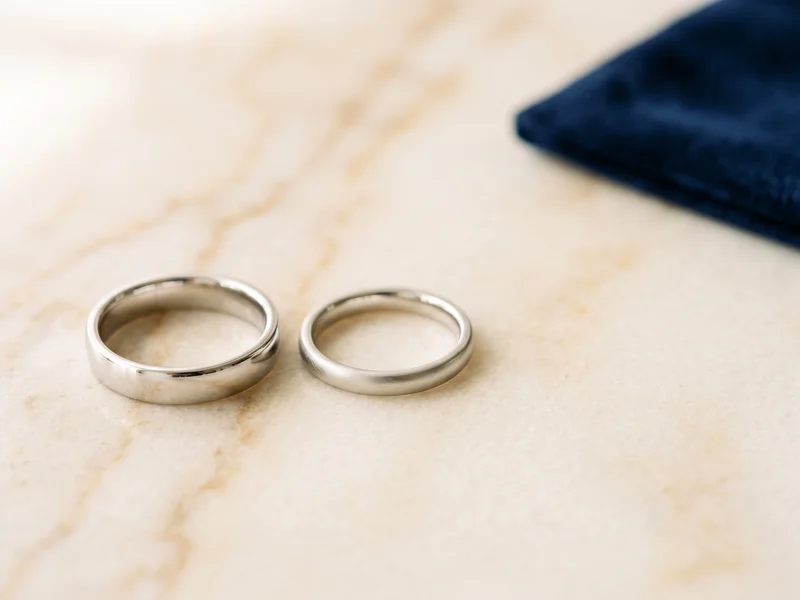
 Wedding Bands & EternityMen’s Wedding Band Guide
 Buying Knowledge & Custom ProcessMen's Ring Size Guide
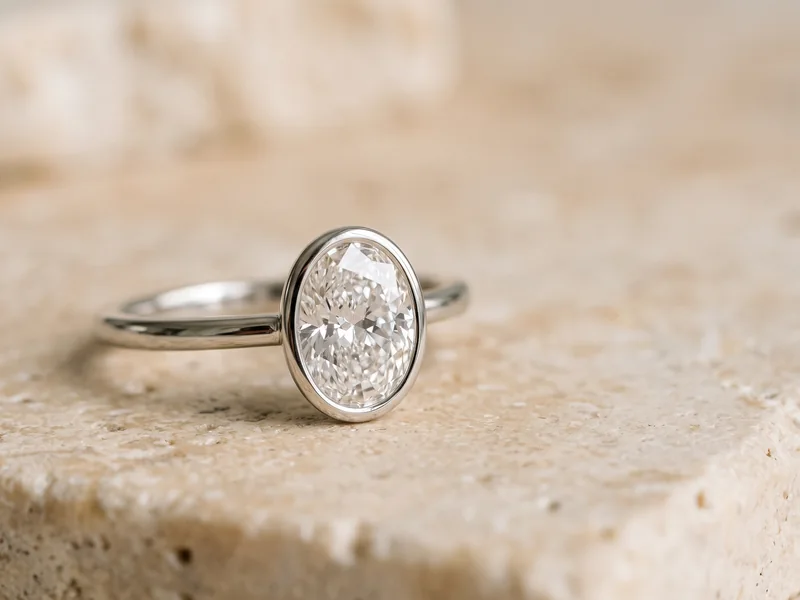 Engagement Rings & SettingsBezel Set Engagement RingsWedding Bands & EternityHow to Choose a Men’s Wedding Band for Hands-On WorkEngagement Rings & SettingsEngagement Ring Setting Styles GuideWedding Bands & EternityWomen's vs Men's Wedding Band Widths
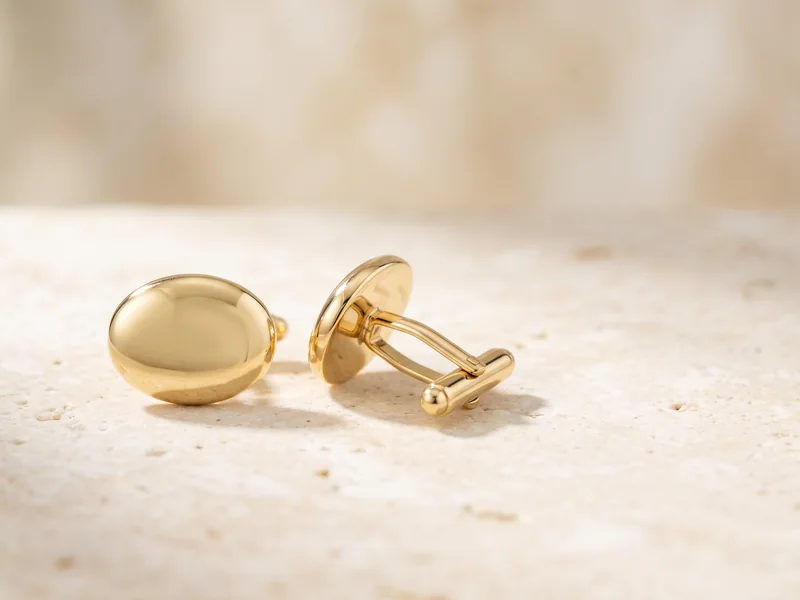 Jewellery TypesCufflinks and Men's Jewellery Types
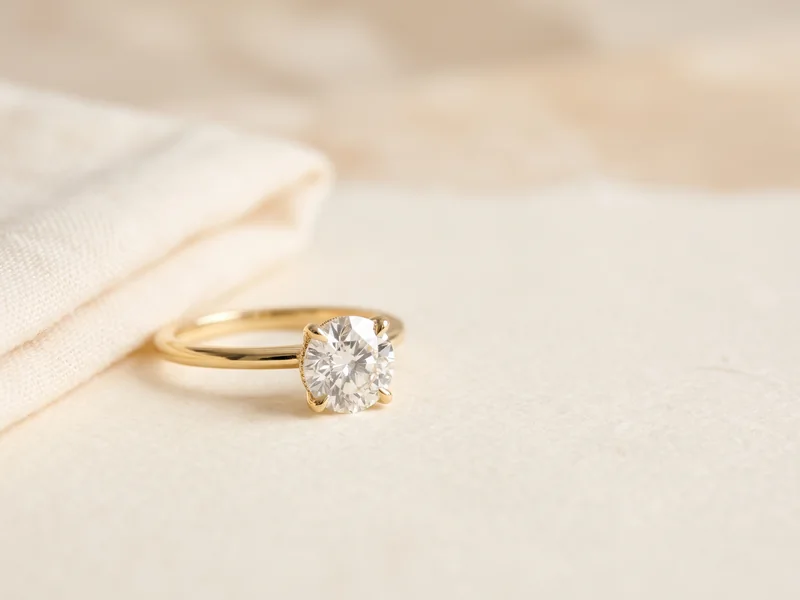 Engagement Rings & SettingsPromise Rings Explained
Explore more
More guides on this topic
Education