
Gemstones
Spinel Gemstone: The Complete Guide
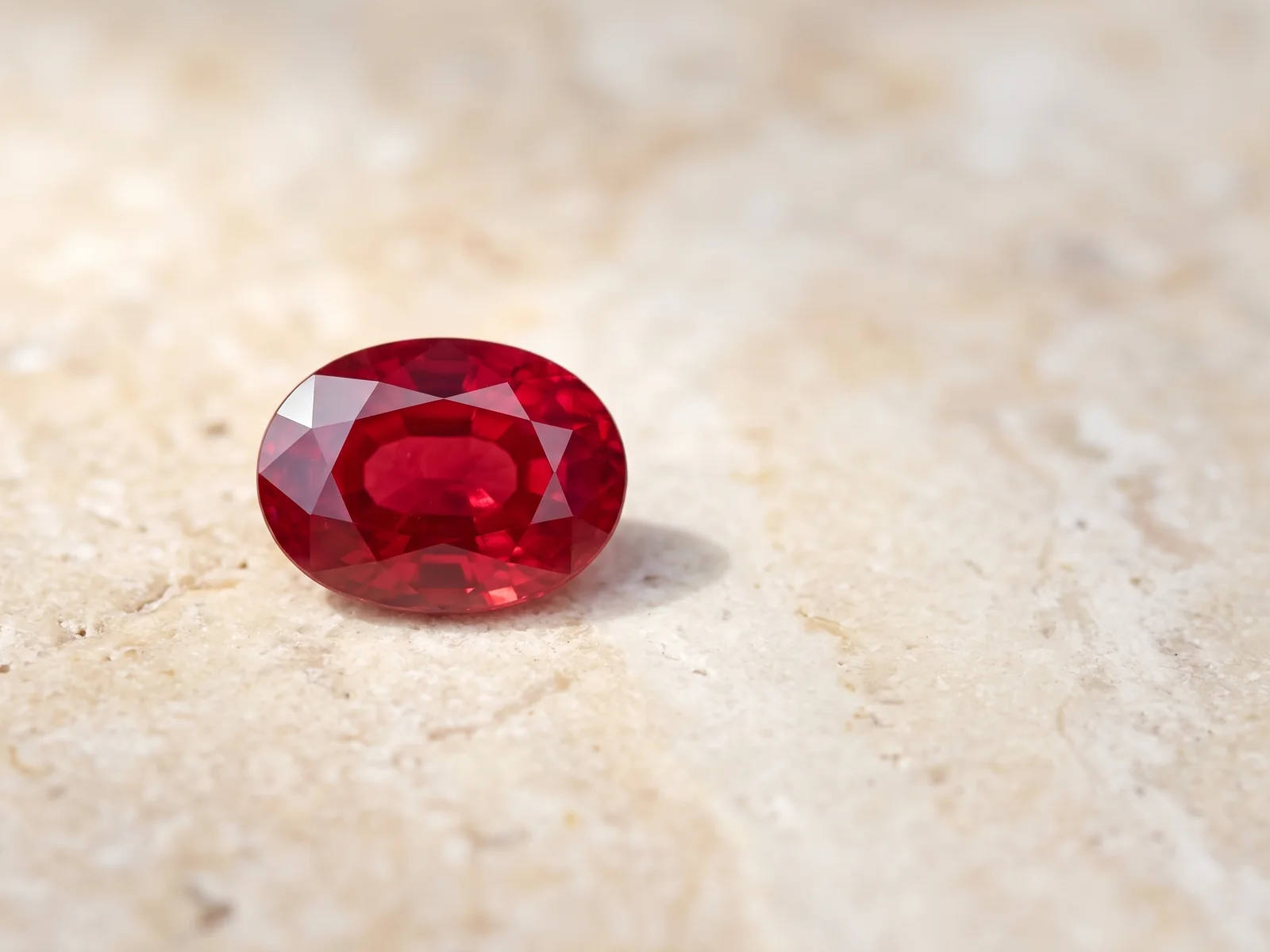
For centuries the spinel gemstone was mistaken for ruby. Today it is one of the most rewarding gems for a ring: hard, bright, usually untreated and found in more colours than most people realise.
 Reviewed by Raj Sood, Graduate Gemologist (GIA), AJP (GIA)Master jeweller and Graduate Gemologist (GIA) · reviewed 4 November 2026
Quick answer
Spinel is a natural gemstone made of magnesium aluminium oxide, found in red, pink, orange, purple, blue, grey and black. It is 8 on the Mohs scale with good toughness and no cleavage, so it suits everyday rings. Most spinel is untreated; colour, clarity and size drive value.
What is a spinel gemstone?
Spinel is a natural mineral made of magnesium aluminium oxide (MgAl2O4). It forms in marble and other rocks that have been changed by heat and pressure, and it is often found in the same gravels as ruby and sapphire. That shared home is why, for most of history, red spinel was simply called ruby.
Gemologists separate the two by their optics. Spinel is singly refractive: light passes through it along one path, so it shows the same colour from every direction. Its refractive index (how strongly it bends light) sits around 1.71–1.72, lower than ruby and sapphire at about 1.76–1.77. Ruby and sapphire are also doubly refractive, splitting light into two paths, and often show slightly different shades as you turn them. A trained gemologist with a refractometer or polariscope can tell them apart quickly; our guide to the instruments gemologists use shows how each tool works.
Some of the most famous 'rubies' in history are spinel, including the large red stone known as the Black Prince's Ruby in the British Imperial State Crown. Spinel only gained its own name once mineralogy could separate it, and it has been building its own reputation since. If any of the terms here are new, our plain-English jewellery glossary explains them.
What colours does spinel come in?
Spinel has one of the widest colour ranges of any gem. Small amounts of chromium, iron and cobalt in the crystal create the colour, and each source tends to produce its own palette.
| Colour | What causes it | What to know |
|---|---|---|
| Red | Chromium | The classic colour; vivid, pure reds are the most sought after |
| Pink and hot pink | Chromium | Bright, neon-like pinks are highly prized |
| Orange to orange-red | Chromium with iron | Warm and less common than red |
| Purple and lavender | Iron and chromium | Often good value for the size |
| Blue | Iron, or cobalt for the most intense blues | Cobalt blue spinel is rare and highly valued |
| Grey and steel blue | Iron | Subtle, modern tones that have become popular |
| Black | Iron-rich spinel | Opaque; used in men's rings and as accent stones |
Because spinel is singly refractive, its colour looks even from every angle, which makes it straightforward to cut for brightness. Compare that with tanzanite, a strongly pleochroic gem, which shows blue, violet and other tones depending on how you hold it. Pleochroism simply means a gem shows different colours in different directions.
Is a spinel gemstone hard enough for an engagement ring?
Yes. Durability depends on two things: hardness (resistance to scratching, measured on the Mohs scale from 1 to 10) and toughness (resistance to chipping and breaking). Spinel scores well on both, and it has no cleavage, meaning no flat plane along which it tends to split. That combination puts it just below ruby and sapphire for a ring worn every day.
| Gemstone | Mohs hardness | Toughness | Everyday ring? |
|---|---|---|---|
| Diamond | 10 | Good (has cleavage) | Yes |
| Sapphire and ruby | 9 | Excellent | Yes |
| Spinel | 8 | Good | Yes |
| Aquamarine and morganite | 7.5–8 | Good | Yes, with some care |
| Emerald | 7.5–8 | Poor to fair | Protective setting needed |
| Tanzanite | 6–7 | Fair to poor | Occasional wear or a protective setting |
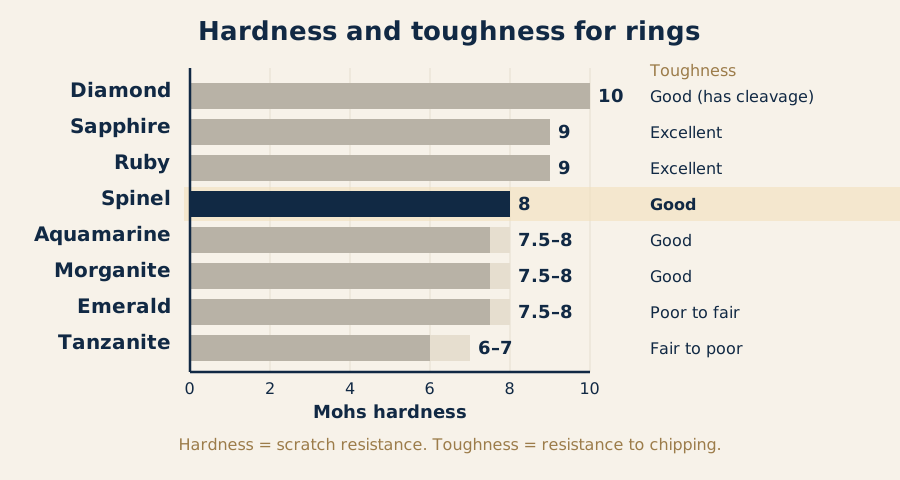
Household dust contains quartz, which is 7 on the Mohs scale, so any gem softer than 7 slowly dulls with wear. Spinel is harder than that, so a polished spinel keeps its shine well. It can still be scratched by harder gems such as diamond and sapphire, so store it separately, and any stone can chip from a hard knock on the edge. A setting that covers the girdle (the outer edge) helps on a ring you wear every day.
For comparison, emerald is close in hardness but far less tough, which is why emerald engagement rings need a protective setting; our emerald vs diamond comparison shows the gap clearly. Aquamarine engagement rings are a similar everyday option in the blue range.
Is spinel treated?
Most spinel on the market is untreated, which is one of its biggest attractions. Many coloured gems are routinely heated or filled to improve colour or clarity; spinel usually reaches the market just cut and polished. Heat treatment of spinel does exist, and specialist laboratories can usually detect it, so it should be disclosed. Our guide to heated and unheated gemstones explains why disclosure matters and how it affects price.
The bigger issue is identity, not treatment. Lab-created spinel has been made for more than a century and is inexpensive to produce, and it is often used to imitate other gems, including aquamarine and blue topaz. Lab-created spinel must always be described as lab-created or synthetic. Clarity treatments such as glass filling and fracture filling are uncommon in spinel, but an independent report is the safest way to confirm a stone is natural and unenhanced.
An inclusion is any small crystal, fracture or feature trapped inside a gem as it formed. In spinel, those little octahedral crystals are one of the most useful clues that a stone grew in the earth rather than in a laboratory.
Not sure which one is right?
Send us the stones you are looking at and our gemologist will tell you which to choose and why.
Where does spinel come from?
Gem spinel comes mostly from Asia and East Africa. Each source has a reputation for certain colours, though origin on its own tells you nothing certain about an individual stone's quality.
- Myanmar (Burma): the Mogok region is known for vivid reds and pinks.
- Sri Lanka: a long-standing source of pastel pinks, purples, greys and blues.
- Tanzania: the Mahenge area produced bright pink to red spinel.
- Vietnam: pinks, purples and some cobalt-coloured blues.
- Tajikistan: the historical source of many large red and pink spinels once called 'balas rubies'.
- Madagascar and Afghanistan: a range of colours from smaller deposits.
Australia is better known for sapphire than spinel. Dark spinel does turn up in some eastern Australian gem gravels alongside sapphire, but most gem spinel set in jewellery here is imported. If an Australian-mined gem matters to you, read about the sapphire fields of Inverell and Anakie or our guide to Australian opal fields.
What makes a spinel gemstone valuable?
Spinel value rests on the same broad factors as other coloured gems, in roughly this order:
- Colour: the most important factor. Pure, saturated reds, hot pinks and cobalt blues sit at the top; greys and lavenders are usually more affordable.
- Clarity: spinel is often quite clean, so visible inclusions reduce value more than they would in an emerald.
- Cut: a well-proportioned cut with no window (a pale, see-through patch in the centre) makes the colour look brighter.
- Size: fine spinel over a few carats is scarce, and price per carat rises with size.
- Treatment and origin: an untreated stone with a report from a recognised laboratory gives you certainty about what you have.
Prices vary widely with colour, so we don't quote a typical figure. As a general rule, spinel costs less than a ruby or sapphire of similar colour and quality, which is part of its appeal, but the finest reds and cobalt blues are no longer a bargain. Treat any spinel as something to wear and enjoy rather than a financial asset.
Spinel vs ruby, sapphire and other gemstones: how do they compare?
| Spinel | Ruby | Sapphire | Tanzanite | |
|---|---|---|---|---|
| Mineral | Spinel | Corundum | Corundum | Zoisite |
| Mohs hardness | 8 | 9 | 9 | 6–7 |
| Optics | Singly refractive | Doubly refractive | Doubly refractive | Doubly refractive, strongly pleochroic |
| Usually treated? | No | Usually heated | Usually heated | Almost always heated |
| Colour range | Very wide | Red only | Every colour except red | Blue to violet |
If you love red, spinel vs ruby comes down to hardness and treatment: ruby is harder, but spinel is more often untreated. For warmer colours, our yellow sapphire guide is a useful comparison. Spinel also sits alongside colour-change alexandrite and soft pink morganite as a coloured centre stone. Read more about spinel as an engagement ring centre stone, or browse our hub of coloured gemstones and birthstones to see them all.
Natural spinel at GemTrove
We usually hold only a handful of spinels in our natural gemstone stock at any time, and we can often source other colours and sizes through our gem suppliers. Every stone is checked by our gemologist before it is offered, and we describe treatment and identity clearly.
Browse natural gemstones in our stock
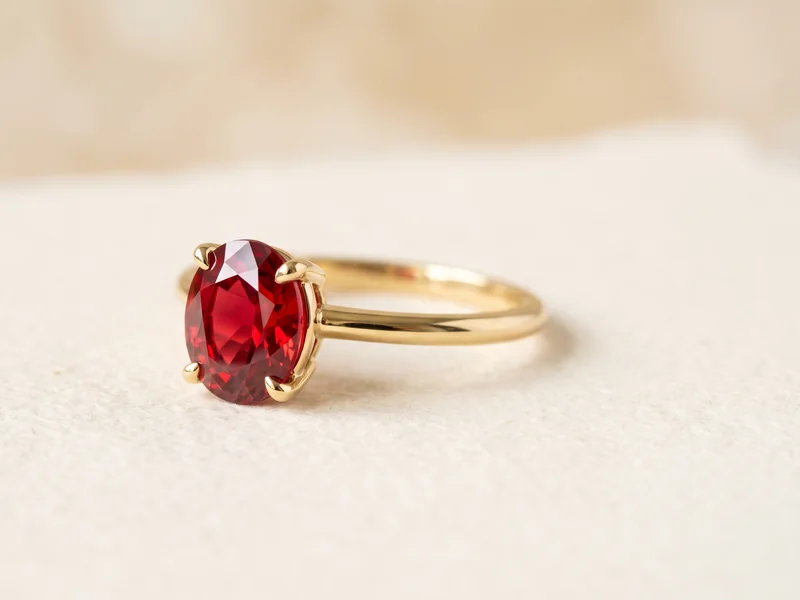
Spinel suits claw, bezel and halo settings. For red and pink spinel, yellow or rose gold warms the colour; for blue, grey and lavender, white gold or platinum keeps it cool. A bezel gives the most edge protection for daily wear. Spinel is also a lovely gift for August: see our spinel August birthstone guide.
How to choose and care for a spinel: step by step
- Pick the colour first. Look at stones in daylight and indoor light; that is where spinel's value and personality sit.
- Check it face-up. Look for even colour without a pale window or dark patch in the centre.
- Ask about identity and treatment. Confirm the stone is natural and whether it is heated, ideally with an independent report.
- Check for eye-visible inclusions. Spinel is often clean, so a visible inclusion should be reflected in the price.
- Choose a protective setting. For daily wear, claws with a solid gallery or a bezel protect the edges.
- Clean it simply. Warm water, mild soap and a soft brush. Ultrasonic cleaning is usually fine for untreated, inclusion-free spinel, but ask your jeweller first, and avoid it for stones with fractures or fillings.
- Store it separately. Keep it away from diamonds and sapphires, which can scratch it, and have the claws checked about once a year.
Free consultation
Talk to a gemologist
Compare stones in person or online with Raj Sood, Graduate Gemologist (GIA), AJP (GIA).
Book a consultationShop this shape
FAQ
Common questions
Is spinel a real gemstone or a fake ruby?
Spinel is a real natural gemstone with its own mineral identity. It was historically mistaken for ruby, but it is a different mineral, not an imitation. Lab-created spinel also exists and must be disclosed as lab-created.
Is spinel hard enough for an engagement ring?
Yes. At 8 on the Mohs scale with good toughness and no cleavage, spinel handles daily wear well. A setting that protects the edges is still a good idea.
Is spinel more expensive than ruby?
Usually not. A spinel generally costs less than a ruby of similar colour and quality, although the finest red and cobalt blue spinels can be expensive.
Is spinel treated?
Most spinel is untreated. Heat treatment exists but is less common than in ruby and sapphire, and it should always be disclosed.
What colour spinel is most valuable?
Vivid, pure red, hot pink and cobalt blue are generally the most sought after. Grey, lavender and purple spinels are often more affordable for their size.
Is spinel the birthstone for August?
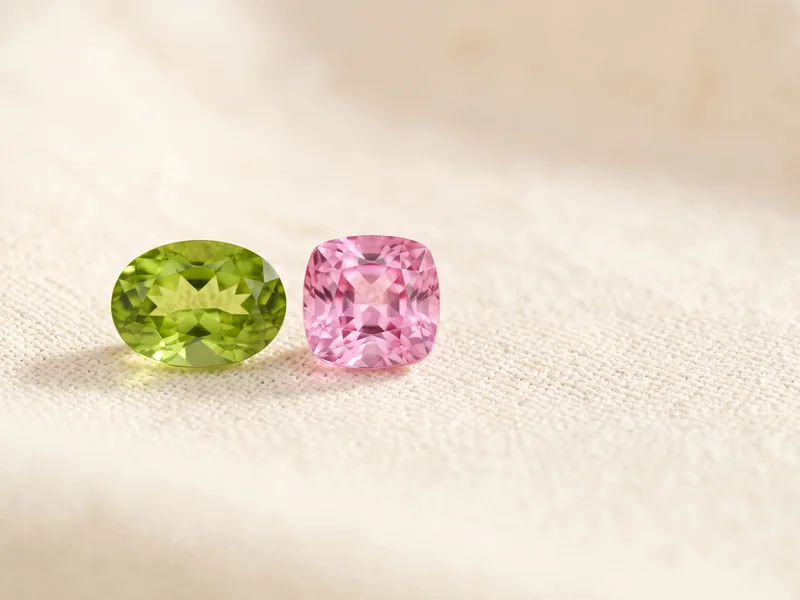
Yes. Spinel was added as an August birthstone alongside peridot in 2016.

Ask a gemologist
Not sure which diamond to choose?
Raj Sood is a Graduate Gemologist (GIA) and master jeweller. Bring the stones you are considering, or send the reports, and he will tell you honestly which one is better and why.
Keep learning
Related guides
 GemstonesSpinel Engagement Rings: An Underrated Gemstone
 GemstonesAugust Birthstone: Peridot and Spinel
 GemstonesHeated vs Unheated Gemstones
 GemstonesTanzaniteGemstonesGemstones | Coloured Gemstones, Birthstones and Custom Jewellery
 GemstonesEmerald vs Diamond
 GemstonesAustralian Sapphire Fields: Inverell, Anakie and the Lava Plains
 GemstonesAustralian Opal Fields: Lightning Ridge, Coober Pedy and Queensland Boulder
Explore more
More guides on this topic
Education