
Gemstones
Yellow Sapphire Guide: Colour, Treatments, Origins and Value
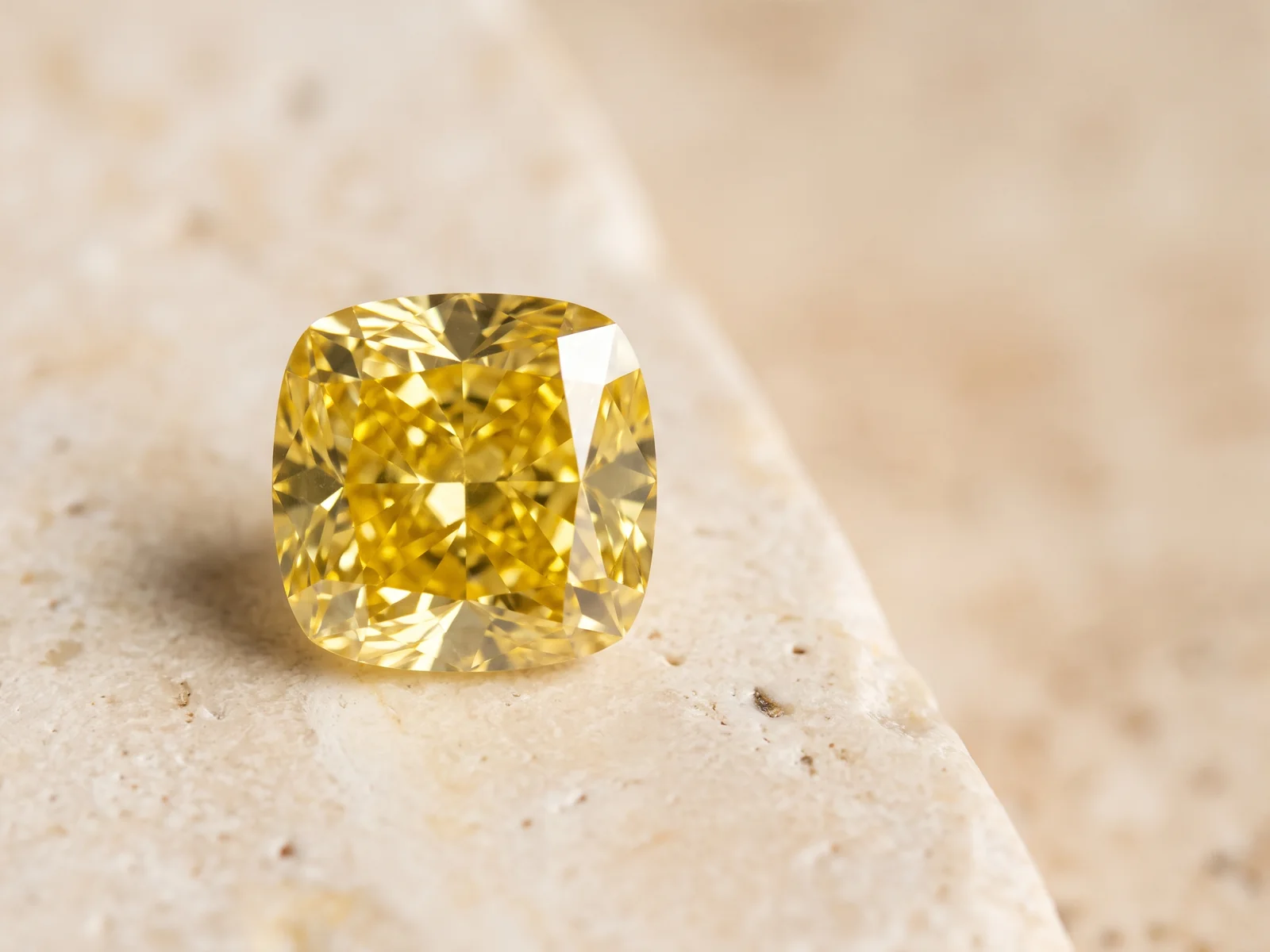
A yellow sapphire gives you the warmth of a yellow diamond in one of the toughest gems used in jewellery, at a much lower price. Colour, treatment and origin decide what it is worth, so here is what to check before you choose one.
 Reviewed by Raj Sood, Graduate Gemologist (GIA), AJP (GIA)Master jeweller and Graduate Gemologist (GIA) · reviewed 4 November 2026
Quick answer
A yellow sapphire is the yellow variety of corundum, the same mineral as blue sapphire and ruby. It rates 9 on the Mohs scale with excellent toughness, so it suits everyday rings. Most are heated to improve colour, which is stable and accepted if disclosed. Value rests on a pure, saturated canary colour, treatment, clarity, cut and size.
What is a yellow sapphire?
A yellow sapphire is corundum, which is crystalline aluminium oxide (Al2O3), coloured yellow by traces of iron and by tiny defects in the crystal called colour centres. Corundum is one mineral in many colours: red corundum is called ruby, and every other colour is called sapphire, with the colour named in front. A yellow sapphire is therefore every bit as much a sapphire as a blue one. Our main sapphire gemstone guide covers the whole family, from blue through to the rarer fancy colours.
In the lab, yellow sapphire has a refractive index (how strongly it bends light) of about 1.762–1.770, a birefringence (the gap between its two refractive indices) of 0.008–0.010 and a specific gravity (density compared with water) of about 4.00. That density means a sapphire is smaller than a diamond of the same weight: a 1 carat round yellow sapphire measures roughly 6.0 mm across, while a 1 carat round diamond, at a specific gravity of 3.52, is about 6.4–6.5 mm.
Natural yellow sapphires are mined in several countries, including Australia. Lab-created yellow sapphire, grown since the early twentieth century by a fast process called flame fusion, has the same chemistry and hardness but is far cheaper and must always be sold as lab-created or synthetic. If you are comparing yellow sapphire with other colourful options, browse the full range of coloured gemstones, and any unfamiliar term here is explained in our plain-English jewellery glossary.
What colours does yellow sapphire come in?
Yellow sapphire runs from a pale lemon to a deep golden yellow. Gemmologists describe colour in three parts: hue (the colour itself), tone (how light or dark it is) and saturation (how strong or pure it is). The most sought-after yellow sapphires are a pure, medium-toned, strongly saturated yellow, often called canary in the trade. Pale stones, and stones with a brown or green secondary colour, cost less.
| Colour description | What you see | Typical origins | Value |
|---|---|---|---|
| Pale lemon | Light, clean yellow; can look washed out in small sizes | Sri Lanka, Madagascar | Moderate |
| Canary (vivid yellow) | Pure, saturated, medium tone | Sri Lanka, Madagascar, Tanzania | Highest |
| Golden yellow | Yellow with an orange tint | Sri Lanka, Tanzania, Thailand | High |
| Greenish yellow | Yellow with a green secondary colour | Australia, Thailand, Nigeria | Lower |
| Brownish yellow | Muted, darker tone | Various basalt fields | Lowest |
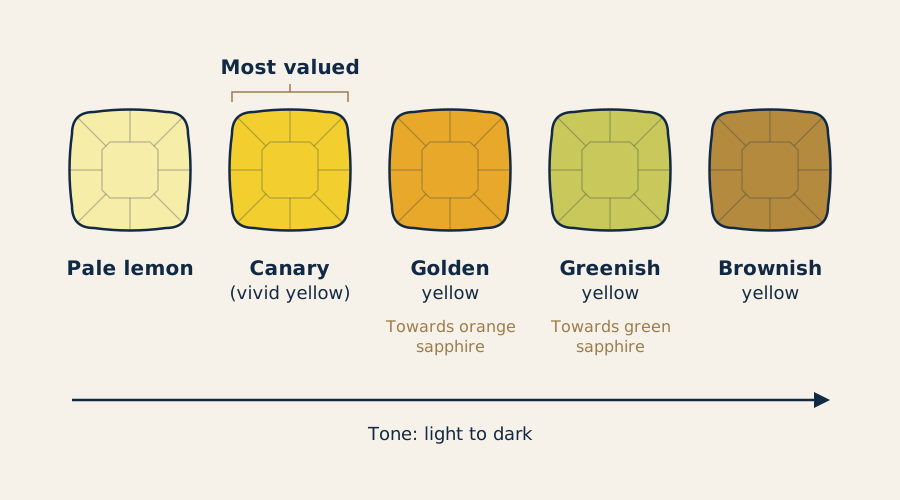
There is no fixed line where one colour ends and the next begins. As the orange grows stronger, a golden stone moves towards the warmer shades of orange sapphire, and a pinkish-orange stone may be graded as the pink-orange padparadscha, which is priced quite differently. At the other end, iron-rich stones with a strong green tint can cross into greenish stones sold as green sapphire. Yellow sapphire has weak pleochroism (different colours seen from different directions), so cutters have more freedom to orient the stone for weight than they do with blue sapphire.
How hard and tough is yellow sapphire for a ring?
Two different properties matter for a ring. Hardness is resistance to scratching, measured on the Mohs scale from 1 to 10. Toughness is resistance to chipping and breaking. Sapphire scores well on both: at 9 on the Mohs scale, only diamond among natural gems scratches it, and because it has no true cleavage (a plane along which a crystal splits easily), it resists knocks better than most gems. Corundum can show parting, a weakness along twinning planes, but it is uncommon in faceted yellow sapphire.
| Yellow gem | Mohs hardness | Toughness | Everyday ring? |
|---|---|---|---|
| Yellow diamond | 10 | Good (cleavage in four directions) | Yes |
| Yellow sapphire | 9 | Excellent (no cleavage) | Yes |
| Chrysoberyl | 8.5 | Excellent | Yes |
| Yellow topaz | 8 | Poor (perfect cleavage) | With a protective setting |
| Heliodor (yellow beryl) | 7.5–8 | Good | Occasional wear |
| Yellow tourmaline | 7–7.5 | Fair | Occasional wear |
| Citrine (quartz) | 7 | Good | Occasional wear; scratches show with time |
Household dust contains quartz at about 7 on the Mohs scale, so any gem softer than that gradually dulls in a ring. Yellow sapphire sits comfortably above it, which is why its facet edges stay crisp for decades. For a side-by-side look at daily wear, see how diamond and sapphire compare for daily wear, and for a softer alternative, read why emerald needs more care than sapphire.
Are yellow sapphires heat treated?
Most yellow sapphires on the market have been heated. Heating at roughly 1,000–1,800 °C can strengthen yellow colour and dissolve fine silk (needle-like rutile inclusions) that makes a stone hazy. The result is permanent and widely accepted, provided it is disclosed. Unheated stones with fine colour are rarer and command a clear premium, helped by strong demand in Vedic astrology, where yellow sapphire (pukhraj) is traditionally expected to be untreated.
| Treatment | What it does | Stable? | How it is detected |
|---|---|---|---|
| Heating | Deepens yellow, improves clarity | Yes, permanent | Altered inclusions under the microscope, such as melted crystals and discoid fractures |
| Beryllium diffusion | Beryllium driven into the crystal at very high temperature creates strong yellow or orange | Yes | Advanced lab chemistry such as LA-ICP-MS; often not visible with a loupe |
| Irradiation | Turns pale stones yellow to orange | No, fades in light within hours to days | Fade test in strong light |
| Lab-created | Not a treatment: grown entirely in a lab | Yes | Curved growth lines and gas bubbles; lab report |
Beryllium diffusion appeared in the early 2000s and can turn pale or unattractive corundum into a bright yellow or orange that may run through the whole stone. It is a legitimate treatment when disclosed, but a beryllium-treated stone is worth a small fraction of a heated or unheated one. Because it usually needs specialist equipment to detect, a report from a recognised laboratory is worth having for any yellow sapphire of meaningful value.
Not sure which one is right?
Send us the stones you are looking at and our gemologist will tell you which to choose and why.
Where do yellow sapphires come from, including Australia?
Yellow sapphire comes from two broad kinds of deposit. Metamorphic deposits, such as those in Sri Lanka and Madagascar, tend to produce low-iron stones with bright, clean yellows. Basaltic deposits, formed in volcanic regions such as eastern Australia and Thailand, produce iron-rich stones that lean golden, greenish or darker.
- Sri Lanka: the traditional source of fine canary and golden yellow, often in larger sizes.
- Madagascar: a major source since the late 1990s, with bright yellows similar to Sri Lankan stones.
- Tanzania: the Umba and Songea areas produce yellow to golden and orange sapphires.
- Thailand: basalt-hosted yellows, and the centre of the world's sapphire heating trade at Chanthaburi.
- Australia: Central Queensland (Anakie, Rubyvale, Sapphire) and the New England region of New South Wales (around Inverell and Glen Innes).
Australian yellow sapphire is typically golden, lemon-green or greenish yellow, with a richer, earthier look than Sri Lankan stones. Clean, pure yellows are mined but are not common. Australian fields are better known for blues, teals and the multicoloured stones described in our page on parti sapphires that mix yellow, green and blue, along with teal sapphire rings. If origin matters to you, see our guide to rings set with Australian-mined sapphire. Origin can be suggested by inclusions and trace elements, but a laboratory origin opinion is an expert judgement, not a certainty.
How can you tell if a yellow sapphire is real?
Yellow is a colour many materials share, so identification matters. Common lookalikes include citrine, yellow topaz, yellow glass, cubic zirconia and lab-created yellow sapphire. A gemmologist works through a few standard tests:
- Refractometer: corundum reads about 1.762–1.770. Citrine reads about 1.54–1.55, topaz about 1.61–1.63, and cubic zirconia is above the instrument's range.
- Spectroscope: iron-rich Australian and Thai yellows show absorption lines around 450, 460 and 470 nm; low-iron Sri Lankan yellows show little or nothing.
- Ultraviolet light: many Sri Lankan yellows glow orange to apricot under long-wave UV, while iron-rich stones are usually inert.
- Microscope: natural stones show straight, angular growth zoning, silk, fingerprints and small crystals. Flame-fusion lab-created stones show curved striae (curved growth lines) and round gas bubbles.
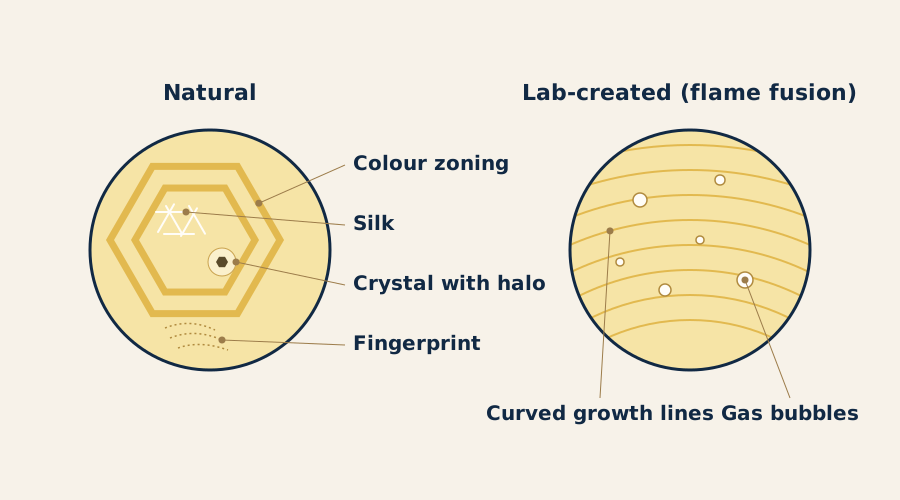
Natural and lab-created yellow sapphire share the same refractive index and hardness, so the microscope and the lab report do most of the work in telling them apart. Modern flux-grown and hydrothermal lab-created stones can look much cleaner than flame fusion and may need advanced lab testing. The same toolkit is used on colour-change sapphires and the other fancy colours.
What affects the price of a yellow sapphire in Australia?
Colour is the main driver, followed closely by treatment. In order of influence:
- Colour: a pure, saturated mid-tone yellow is worth the most; pale, brownish or greenish stones less.
- Treatment: unheated stones with fine colour carry a premium over heated; beryllium-diffused stones are priced far lower.
- Carat: yellow sapphire is relatively plentiful in larger sizes, so price per carat climbs less steeply than for blue sapphire or ruby.
- Clarity: yellow sapphires are usually expected to be eye-clean (no inclusions visible at normal viewing distance).
- Cut: a well-proportioned stone avoids windowing, a washed-out see-through patch in the centre caused by a shallow pavilion.
- Origin and report: Sri Lankan origin and a recognised lab report can add value.
| About 1 ct yellow sapphire | Approximate price range (AUD) |
|---|---|
| Lab-created | about $50–$300 |
| Beryllium-diffused, natural | about $100–$500 |
| Heated, natural, good colour | about $400–$1,500 |
| Unheated, natural, fine canary | about $1,000–$4,000 |
| Unheated, natural, 3 ct and above | about $1,500–$6,000 per carat |
These are broad ranges only and move with the market, the exact colour and the size. Yellow sits below blue sapphire and well below padparadscha in price for similar quality, and in a similar band to other fancy colours such as purple sapphire.
Browse natural gemstones
Yellow sapphire vs yellow diamond: what is the difference?
| Yellow sapphire | Natural yellow diamond | Lab-grown yellow diamond | |
|---|---|---|---|
| Mineral | Corundum | Diamond (carbon) | Diamond (carbon), laboratory-grown |
| Mohs hardness | 9 | 10 | 10 |
| Toughness | Excellent | Good | Good |
| Refractive index | 1.76–1.77 | about 2.42 | about 2.42 |
| Look | Deep, saturated colour, softer sparkle | Strong fire and brilliance | Strong fire and brilliance |
| Colour cause | Iron and colour centres | Nitrogen | Nitrogen, often enhanced after growth |
| About 1 ct (AUD) | about $400–$4,000 | about $4,000–$15,000+ | about $800–$3,000 |
The two look different side by side. Diamond's high refractive index gives it strong fire (flashes of rainbow colour) and a bright, sparkly face, while yellow sapphire shows a deeper, more saturated body colour with a gentler sparkle. Natural fancy yellow diamonds are graded on their own scale from Fancy Light to Fancy Vivid, and our yellow and canary diamond guide explains those grades. Lab-grown yellow diamonds are real diamond, grown in a laboratory, and sit between the two on price.
Related guideYellow and Canary DiamondsIs yellow sapphire good for an engagement ring?
Yes. With a Mohs hardness of 9 and excellent toughness, a yellow sapphire engagement ring will handle everyday wear well, as long as the claws are checked from time to time. The main design choices are the metal and the setting:
- Yellow gold: deepens and warms the yellow; it suits golden and canary stones.
- White gold or platinum: keeps the yellow crisp and clean, and can make a pale lemon stone look brighter by contrast.
- Rose gold: pushes the colour towards golden-orange.
- Halo: a ring of small white diamonds makes the yellow look more saturated and the stone look larger.
- Settings: four or six claws suit rounds and cushions; a bezel (a metal rim) is secure for active hands.
For design ideas across all sapphire colours, see sapphire engagement ring designs. If you are still choosing a colour, our teal vs blue sapphire comparison shows how other sapphire colours wear in a ring.
How do you choose and care for a yellow sapphire? Step by step
- Confirm what it is. The report or invoice should say natural or lab-created yellow sapphire, and state the treatment: unheated, heated or beryllium-diffused.
- Judge the colour in daylight. Look for a pure, saturated yellow without strong brown or green, and compare it in white and yellow metal.
- Check for windowing. Tilt the stone; a pale, see-through patch in the centre means a shallow cut.
- Check clarity by eye. Aim for an eye-clean stone at arm's length.
- Compare measurements, not just carats. Sapphire is denser than diamond, so check the millimetre size face-up.
- Clean it simply. Warm water, mild detergent and a soft brush. Ultrasonic cleaners are usually fine for unheated and heated stones without fractures; avoid them if a stone has surface-reaching fractures or fillers.
- Store and check. Keep it apart from other jewellery, since it can scratch softer gems and diamond can scratch it, and have the claws checked every 6–12 months.
Free consultation
Talk to a gemologist
Compare stones in person or online with Raj Sood, Graduate Gemologist (GIA), AJP (GIA).
Book a consultationShop this shape
FAQ
Common questions
Is yellow sapphire a real sapphire?
Yes. Yellow sapphire is corundum, the same mineral as blue sapphire and ruby, coloured yellow by traces of iron and colour centres. Only red corundum is called ruby; every other colour is sapphire.
Is a heated yellow sapphire worth less?
A heated stone usually costs less than an unheated stone of the same colour, but heating is stable, permanent and widely accepted when disclosed. Beryllium-diffused stones are priced much lower than either.
Is yellow sapphire cheaper than yellow diamond?
Usually much cheaper. A good 1 carat heated yellow sapphire is generally a fraction of the price of a natural fancy yellow diamond, and also tends to cost less than a lab-grown yellow diamond.
Does Australia produce yellow sapphires?
Yes. Central Queensland and the New England region of New South Wales produce yellow sapphires, typically golden or greenish yellow, as well as parti sapphires that combine yellow with green and blue.
How can I tell a yellow sapphire from citrine?
A gemmologist can separate them quickly with a refractometer: sapphire reads about 1.76–1.77 and citrine about 1.54–1.55. Sapphire also feels heavier for its size and resists scratches far better.
Can you wear a yellow sapphire ring every day?
Yes. At 9 on the Mohs scale with excellent toughness, yellow sapphire is one of the most practical coloured gems for daily wear. Have the claws checked every 6–12 months.

Ask a gemologist
Not sure which diamond to choose?
Raj Sood is a Graduate Gemologist (GIA) and master jeweller. Bring the stones you are considering, or send the reports, and he will tell you honestly which one is better and why.
Keep learning
Related guides
 GemstonesSapphire Gemstones
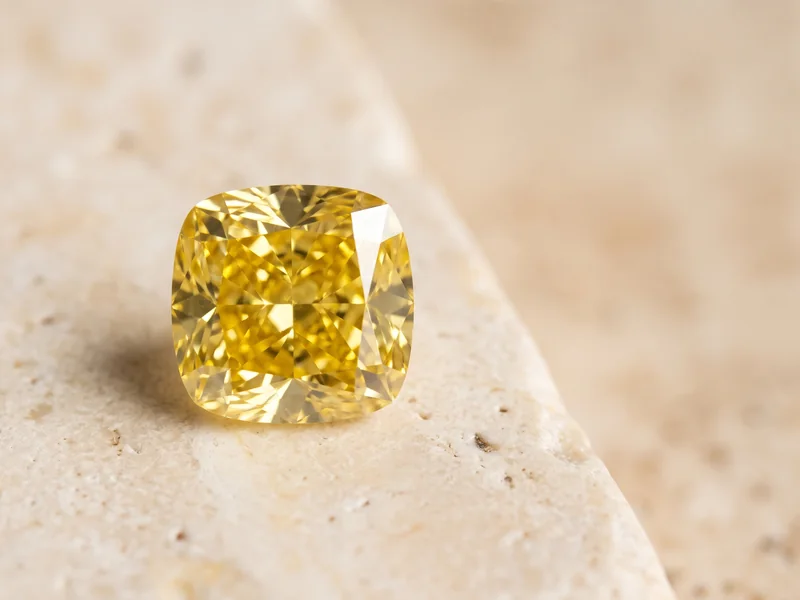 Fancy Colour DiamondsYellow and Canary Diamonds
 GemstonesAustralian Sapphire Engagement Rings
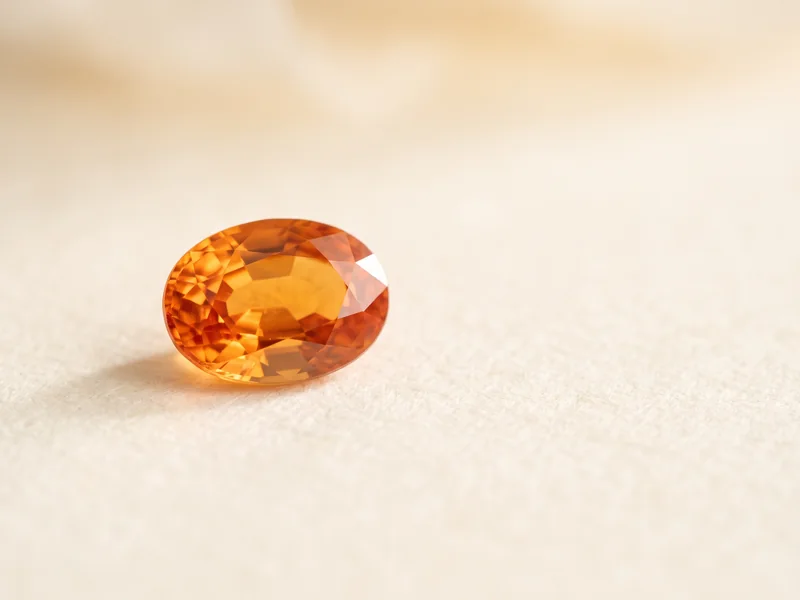 GemstonesOrange SapphireGemstonesGemstones | Coloured Gemstones, Birthstones and Custom Jewellery
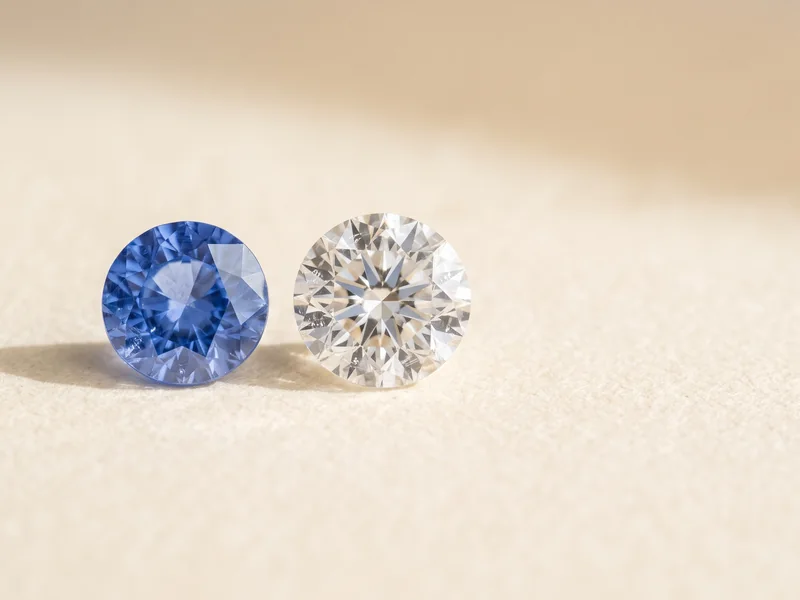 GemstonesDiamond vs Sapphire Engagement Rings
 GemstonesSapphire Engagement Rings in Melbourne
 GemstonesGreen Sapphire
Explore more
More guides on this topic
Education