
- Education
- Buying Knowledge & Custom Process
- Tourist Refund Scheme on Jewellery Explained: Claiming the GST Back in Australia
Buying Knowledge & Custom Process
Tourist Refund Scheme on Jewellery Explained: Claiming the GST Back in Australia
If you are flying out of Australia with a new ring or loose diamond, the Tourist Refund Scheme can return the GST on jewellery you carry with you. Here is how it works, what trips people up, and how insurance fits around it.
 Reviewed by Raj Sood, Graduate Gemologist (GIA), AJP (GIA)Master jeweller and Graduate Gemologist (GIA) · reviewed 4 November 2026
Quick answer
The Tourist Refund Scheme (TRS) lets overseas visitors and Australian residents claim back the GST on jewellery they take out of Australia. Spend at least AUD $300 with one business within 60 days of departure, carry or wear the piece on board, and lodge the tax invoice at the airport TRS facility at least 30 minutes before departure.
What is the Tourist Refund Scheme and does it cover jewellery?
The Tourist Refund Scheme (TRS) is run by the Australian Border Force (ABF) with the Australian Taxation Office. It refunds the GST (Goods and Services Tax, the 10% tax added to most goods sold in Australia) on goods you buy here and take out of the country with you. It also refunds wine equalisation tax on wine, which does not matter for jewellery.
Jewellery suits the scheme well because it is valuable, small and easy to carry on board. The TRS covers finished pieces such as engagement rings, wedding bands, pendants and earrings, and it covers loose diamonds and gemstones, whether natural or lab-grown, as long as you buy them from an Australian business registered for GST and the purchase meets the rules below.
What it does not cover is services. A repair, a resize, engraving or an insurance valuation billed on its own is a service rather than goods you export, so the GST on it cannot be claimed. Gift cards and vouchers are also excluded.
If you are still deciding what to buy, our complete engagement ring buying guide and our guide to choosing a diamond cover the stone and the setting. This page is about the tax side once you have chosen. Any unfamiliar term here is explained in our plain-English jewellery glossary.
Who can claim a tourist refund on jewellery?
Despite the name, the scheme is not only for tourists. The person claiming must be the traveller leaving Australia with the goods. In practice that means:
- Overseas visitors: tourists, students and temporary workers flying or sailing out of Australia can claim.
- Australian residents: can claim on goods they take overseas, but must declare them when they come back (see the section on residents below).
- Not eligible: operating aircrew and ship's crew on the journey they are working.
- Not eligible: anyone who is not actually departing with the goods, such as a friend who buys a ring and posts it to you.
For purchases of AUD $1,000 or more, the tax invoice must show the traveller's name. That matters for jewellery, because a ring bought by a parent or partner in their own name may not be claimable by the person who flies out with it. If you are shopping for the ring as a couple, decide before you pay whose name goes on the invoice, and make it the person who will carry the ring through the airport.
Who pays for the ring is a personal decision, and families do it many different ways. Our page on who traditionally pays and other ring etiquette covers the customs; for the TRS, the only thing that counts is the name on the invoice and the passport at the counter.
What are the Tourist Refund Scheme rules for jewellery purchases?
Every claim is checked against the same set of conditions. Here is how each one applies to jewellery.
| Rule | What it means | Jewellery example |
|---|---|---|
| Minimum spend | At least AUD $300 including GST from one business (one ABN). Several invoices from that business can be added together. | A $180 pendant and $150 earrings from the same jeweller total $330, so they qualify together. |
| Timing | Bought within 60 days before you leave Australia. | A ring paid for and invoiced 10 weeks before your flight does not qualify. |
| Tax invoice | A paper or electronic tax invoice, with your name if the total is $1,000 or more. | Ask for the name exactly as it appears on your passport. |
| Carry it | The goods must go with you as hand luggage or be worn on board. | A ring on your finger or in your carry-on bag counts; one in a checked suitcase does not. |
| Show it | The TRS officer can ask to see the goods as well as the invoice. | Keep the ring box or pouch where you can reach it. |
| Lodge in time | At airports, at least 30 minutes before scheduled departure. | Allow for queues at the TRS facility after security. |
| Goods only | Services are not refunded. | GST on a resize or valuation invoiced separately cannot be claimed. |
A tax invoice is more than a receipt. For a TRS claim it should show:
- the words "tax invoice"
- the seller's name and ABN (Australian Business Number)
- the date it was issued
- a description of each item, the quantity and the price
- the GST amount, or a statement that the total price includes GST
- your name, if the total is AUD $1,000 or more
The description matters for jewellery. An invoice should say what the piece actually is, for example "18ct white gold solitaire ring with 1.02 ct laboratory-grown diamond, IGI report number…". A clear description helps the TRS officer match the invoice to the ring in your hand, and it helps your insurer later.
Buying online from an Australian jeweller can still work under the tourist refund scheme rules, as long as you receive a proper tax invoice and carry the piece out of Australia yourself. Our online versus in-store comparison covers the other differences, from viewing the stone to collecting it.
How much do you get back from the Tourist Refund Scheme on jewellery?
A common mistake is to expect 10% of the price back. Australian prices already include GST, so the refund is one-eleventh of the GST-inclusive price, which equals 10% of the price before GST. On a $5,500 ring, the GST is $500, not $550.
| Price paid (AUD, incl. GST) | GST refunded | Effective price after refund |
|---|---|---|
| $300 | $27.27 | $272.73 |
| $1,100 | $100 | $1,000 |
| $2,750 | $250 | $2,500 |
| $5,500 | $500 | $5,000 |
| $11,000 | $1,000 | $10,000 |
| $22,000 | $2,000 | $20,000 |
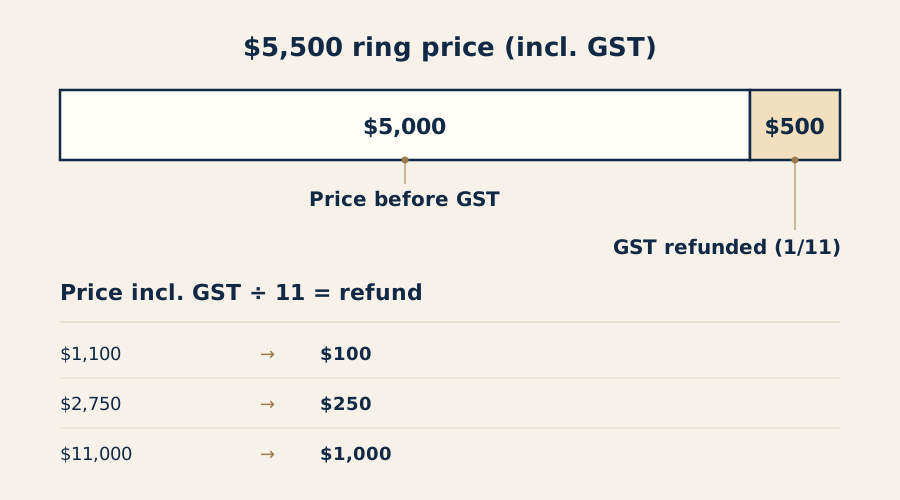
The ABF does not charge a fee to process a claim. The refund is calculated in Australian dollars, so if it goes to an overseas card, the amount you see depends on the exchange rate and any fees your bank charges on the day it lands. Refunds are not instant; expect to wait several weeks after you leave.
Because the money comes back later, plan your budget around the full price you pay at the counter. Our guide to setting a realistic ring budget works through the numbers, and our page on where the three-month salary rule came from explains why a fixed formula rarely fits.
Not sure which one is right?
Send us the stones you are looking at and our gemologist will tell you which to choose and why.
Can Australian residents claim the TRS on an engagement ring?
Yes, but it is rarely a saving if the ring is coming home again. An Australian resident can claim the GST on jewellery taken overseas. When you return, any goods you claimed a TRS refund on and bring back must be declared on arrival. They count towards your duty-free concession, currently AUD $900 of general goods for adults and $450 for travellers under 18.
A ring worth more than the concession will usually mean paying GST again, and possibly duty, when you come back through customs. So the refund you received at the airport is mostly or entirely handed back. Failing to declare goods you claimed under the TRS can lead to penalties on top of the tax owed.
Where it genuinely helps residents is when the jewellery stays overseas: a gift for a relative abroad, or a ring for a partner who lives in another country. If you are planning to propose on holiday and want to keep it simple, some people travel with a placeholder proposal ring instead of the final ring and choose the real one together afterwards.
Is it better to claim the TRS or have jewellery shipped overseas?
There is a second way for overseas buyers to avoid Australian GST. When an Australian business sends goods directly to an address outside Australia, the sale can be GST-free as an export, so no GST is charged in the first place. You do not need to claim anything, but you do not carry the piece home yourself.
| TRS claim | Jeweller ships overseas (GST-free export) | Kept in Australia | |
|---|---|---|---|
| GST at purchase | Paid, then refunded later | Usually not charged, if the export rules are met | Paid |
| Who carries it | You, on board | An insured courier | Not applicable |
| Refund timing | Several weeks after you leave | None needed | None |
| Import taxes at home | May apply when you arrive | May apply on delivery | Not applicable |
| Suits | Visitors flying out within 60 days | Visitors already home, or pieces finishing after you leave | Residents keeping the jewellery here |
| Main risks | Missed deadline, wrong invoice, checked bag | Shipping time and courier value limits | None for GST |
Either way, your own country may charge import tax or duty on jewellery you bring in. Many countries have a personal allowance well below the value of an engagement ring, and you are expected to declare anything above it. Check your home customs rules before you buy, so the Australian refund and your home tax are both part of your sums.
The TRS treats natural and lab-grown diamonds the same way: both are goods and both can be claimed. The invoice and grading report should state clearly whether the diamond is natural or laboratory-grown, which also helps when you declare it at home. If you are weighing prices against what you would pay at home, comparing two diamonds properly means matching the grading lab, carat, colour, clarity and cut, not just the price tag.
Browse natural and lab-grown diamonds
How does the TRS work with custom and made-to-order rings?
Custom work is where the 60-day window most often causes trouble. A made-to-order ring usually takes several weeks from design approval to collection, and a fully handmade piece can take longer. Our step-by-step ring timeline shows how long each stage typically runs.
The 60 days are counted from the purchase date on the tax invoice. If you paid a deposit months before you fly, talk to the jeweller early about how the final tax invoice will be issued, and confirm with the ABF how your payments will be treated before you rely on a refund. If the ring will not be finished before you leave, a direct export to your home address may be the simpler route.
- Tell the jeweller your departure date at the first appointment, so the schedule is planned around it.
- Build in a buffer of a week or two for final adjustments, because a rushed finish helps no one.
- Confirm the ring size before you leave; a resize after departure means shipping the ring back. Our ring size converter translates Australian sizes into US, UK and European ones.
- Decide early between ready-made and custom: a ready-made ring fits a short trip far more easily. See custom or ready-made: the trade-offs.
How the ring is made affects the timeline too. A design modelled on screen first moves differently from one built entirely at the bench, as explained in handmade versus CAD-designed rings, and a cast band follows a different process from a hand-fabricated one, covered in how casting and hand fabrication differ.
How should you insure jewellery bought in Australia for travel?
Insurance and the TRS are separate, but the trip home is the moment the two meet. Arrange cover from the day you collect the piece, not the day you land. A few points matter most for travellers:
- Overseas visitors: Australian home contents and jewellery policies are generally designed for people living here, so cover usually needs to come from an insurer in your home country. Ask before you travel whether they can cover a new item from the date of purchase.
- Travel insurance: many policies have low limits for each valuable item and may exclude jewellery left unattended or packed in checked luggage. Read the valuables section before you rely on it.
- Replacement value: an insurance valuation records what it would cost to replace the piece. The TRS refund does not change that figure, so give your insurer both the tax invoice and a valuation.
- Documents: keep copies of the invoice, valuation and diamond grading report separate from the jewellery, plus clear photos of the piece.
Our guide to how jewellery insurance works in Australia explains agreed value, replacement value and what insurers usually ask for.
Related guideHow Jewellery Insurance Works in AustraliaWhat are the most common TRS mistakes with jewellery?
Most problems are about paperwork and timing rather than the jewellery itself. Check this list before your trip:
- Leaving it to the last minute: claims close 30 minutes before departure, and queues at the TRS facility can be long.
- Packing the ring in a checked bag: it must be carried or worn so it can be shown if asked.
- The wrong name on the invoice: for $1,000 or more, the traveller's name must be on it.
- Buying too early: a purchase more than 60 days before departure is outside the window.
- Splitting across businesses: $200 at one jeweller and $200 at another do not combine; the $300 minimum is per business.
- Claiming a service: a resize, repair or valuation on its own is not goods.
- Forgetting home customs: residents must declare claimed goods when they return, and visitors may owe tax at home.
How do you claim a tourist refund on jewellery at the airport? Step by step
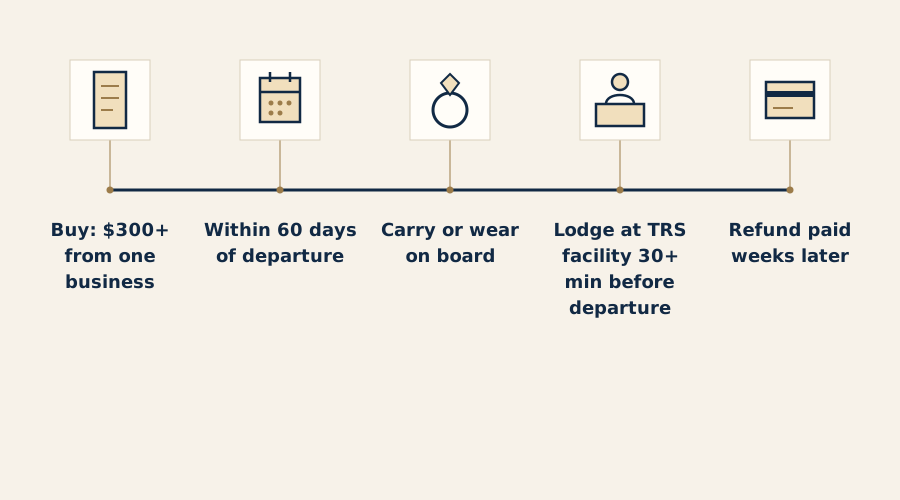
- Before you pay, tell the jeweller you plan to claim under the TRS and ask for a tax invoice with your name as on your passport, the seller's ABN, a full description and the GST amount.
- Check the dates. Make sure the invoice date falls within 60 days of your departure, and keep the paper invoice or emailed PDF safe.
- Prepare your claim in advance if you like, using the ABF's TRS app, which creates a QR code to speed things up at the counter.
- Pack it in your hand luggage or wear it. Keep the box or pouch easy to reach.
- Clear immigration and security, then find the TRS facility in the international departures area.
- Present your passport, boarding pass, tax invoice and the jewellery at least 30 minutes before your scheduled departure.
- Choose how to be paid, such as to a card or an Australian bank account, and keep any claim confirmation.
- At home, declare the jewellery if your customs rules require it, and confirm your insurance is in place.
Free consultation
Talk to a gemologist
Compare stones in person or online with Raj Sood, Graduate Gemologist (GIA), AJP (GIA).
Book a consultationShop this shape
FAQ
Common questions
Can I claim the GST back on an engagement ring when I leave Australia?
Yes, if you spent at least AUD $300 with one business within 60 days of departure, have a valid tax invoice, and carry or wear the ring on board. You lodge the claim at the TRS facility at the airport at least 30 minutes before departure.
How much GST refund do I get on jewellery?
You get back one-eleventh of the GST-inclusive price. For example, a $5,500 ring returns $500 and an $11,000 ring returns $1,000.
Can I wear the jewellery in Australia before I leave?
Yes. Jewellery can be worn before departure, and wearing it on board counts as carrying it. You must still be able to show it, with the invoice, if the TRS officer asks.
Can Australian residents use the Tourist Refund Scheme?
Yes, but if you bring the jewellery back you must declare it, and it counts towards your duty-free concession. Above that limit, GST and possibly duty are payable, so the refund is often handed back.
Does the TRS cover lab-grown diamonds?
Yes. Lab-grown and natural diamonds are both goods under the scheme. The invoice should clearly describe the stone as laboratory-grown or natural.
Can I claim the TRS on a ring repair or resize?
Usually not. A repair, resize or valuation billed on its own is a service, and the TRS only refunds GST on goods you take out of Australia.

Ask a gemologist
Not sure which diamond to choose?
Raj Sood is a Graduate Gemologist (GIA) and master jeweller. Bring the stones you are considering, or send the reports, and he will tell you honestly which one is better and why.
Keep learning
Related guides
 Buying Knowledge & Custom ProcessHow Jewellery Insurance Works in AustraliaBuying Knowledge & Custom ProcessEngagement Ring Buying Guide
 Buying Knowledge & Custom ProcessBuying an Engagement Ring Online vs In-Store
 Buying Knowledge & Custom ProcessEngagement Ring Timeline: How Long Each Step Takes
 Buying Knowledge & Custom ProcessCast vs Hand-Fabricated Jewellery
 Buying Knowledge & Custom ProcessEngagement Ring EtiquetteBuying Knowledge & Custom ProcessThe Three-Month Salary Rule
 Buying Knowledge & Custom ProcessRing Size Converter (Tool)
Explore more
More guides on this topic
Education