
- Education
- Buying Knowledge & Custom Process
- How to Write a Clear Engagement Ring Design Brief
Buying Knowledge & Custom Process
How to Write a Clear Engagement Ring Design Brief
A clear engagement ring design brief saves weeks of back-and-forth and prevents expensive surprises. Here is what to put in it, from budget and stone to ring size, CAD approval, insurance and the Tourist Refund Scheme.
 Reviewed by Raj Sood, Graduate Gemologist (GIA), AJP (GIA)Master jeweller and Graduate Gemologist (GIA) · reviewed 4 November 2026
Quick answer
An engagement ring design brief is a one-page summary you give a jeweller before any drawing starts. Include your budget range, centre stone (natural or lab-grown, shape, size), metal, setting style, ring size, lifestyle, deadline and photos of rings you like and dislike. Add insurance and Tourist Refund Scheme plans so the paperwork is right.
What is an engagement ring design brief?
A design brief is a short written summary of the ring you want, handed to the jeweller before any sketching or CAD (computer-aided design, the 3D modelling software jewellers use) begins. It turns "something simple but special" into decisions a designer can act on: a budget range, a stone, a metal, a ring size and a date. If you are still comparing styles, start with our complete engagement ring buying guide and come back once you have a direction.
A good brief does three jobs. It keeps the design inside your budget, because the jeweller knows the ceiling before sourcing a stone. It cuts the number of revision rounds, which shortens the timeline. And it creates a written record of what was agreed, which protects both you and the jeweller if a detail is later remembered differently. Most briefs fit on one page plus a handful of reference photos.
You do not need the technical vocabulary. "I want the diamond to sit low so it doesn't catch on gloves" is a perfectly good instruction; the jeweller translates it into a setting height in millimetres. If a word on a quote or drawing is unfamiliar, our plain-English jewellery glossary defines it.
What should an engagement ring design brief include?
These nine items cover almost every custom engagement ring. If you cannot answer one yet, write "undecided" rather than leaving it out, so the jeweller knows to raise it with you.
| Item | What to write | Example |
|---|---|---|
| Budget | A total range, including the stone and setting | AUD 6,000–8,000 all in |
| Centre stone | Natural or lab-grown, shape, size (carat or mm), colour and clarity range | Lab-grown oval, about 1.5 ct, F–G, VS |
| Metal | Metal and purity, and the colour of the claws | 18ct yellow gold band, white gold claws |
| Setting and profile | Claws, bezel, halo; high or low set | Four claws, low profile |
| Band and side stones | Band width, plain or pavé, engraving | 2 mm plain band, date engraved inside |
| Ring size | Australian letter size, and how you found it | Size M, measured from a ring she wears |
| Lifestyle | Work, sport, hobbies, gloves | Nurse; washes hands often, wears gloves |
| Deadline | The date you need it in hand, not the proposal date | Collect by 1 November |
| Paperwork | Valuation for insurance, TRS claim, overseas shipping | Insurance valuation; leaving Australia in March |
Reference photos do a lot of work. Five to ten images are plenty; more than that and the brief starts to contradict itself. For each photo, add one line on what you like about it, because a jeweller cannot tell whether you saved a picture for the band, the halo or the colour of the gold. Photos of rings you don't like are just as useful.
How much should you budget for a custom engagement ring in Australia?
Give a total range, not a single figure, and say whether it includes the centre stone. A range lets the jeweller show you trade-offs, such as a slightly smaller diamond in exchange for platinum. Ignore old formulas; we explain why the three-month salary rule is out of date and what to use instead. A sensible budget is one you can pay without strain.
As a rough guide, the setting (everything except the centre stone) usually falls into these approximate AUD ranges, depending on the metal, the weight of the ring and how many small diamonds it carries:
- Plain solitaire in 18ct gold: about AUD 1,500–3,500.
- Solitaire in platinum: usually more than the same design in 18ct gold, because platinum is denser and harder to work.
- Halo or pavé band: about AUD 3,000–6,500, driven mainly by the number and quality of the small diamonds.
- Complex hand-finished designs: priced individually after the first CAD.
The shape of the centre stone also moves the budget, because rounds usually cost more per carat than fancy shapes of the same grade; our page on how shape changes the price per carat sets out the pattern. Be clear about your priorities too. Write down which matters more if the budget is tight: stone size, stone quality or metal. And keep expectations realistic about value later on; our guide to what diamonds are worth on resale explains why a ring is something to wear and enjoy rather than a store of money.
How do you describe the centre stone in your brief?
Start with the biggest decision: natural or lab-grown diamond. Both are real diamond, 10 on the Mohs hardness scale with a refractive index of about 2.42, and they look the same to the eye. Natural diamonds formed underground over millions of years and are rarer; lab-grown diamonds are grown in a laboratory and cost much less for the same size and grade. Saying which you want, or that you want to see both, changes the whole quote.
Then give the shape, a size and a grade range. If you are unsure of the shape, our overview of every diamond shape helps you narrow it down. Size is easier to discuss in millimetres than carats, because two 1 carat diamonds can face up at different sizes depending on how deeply they are cut; a well-cut 1 ct round is about 6.4 mm across, and our comparison of which shapes face up largest for their weight shows how much this varies. For colour and clarity, a range (say G–H, VS2–SI1 eye-clean) lets the jeweller find the stone that looks right rather than one that only ticks a box. Our page on how the 4Cs work in practice explains each grade.
- Report: ask for an independent grading report, such as GIA or IGI, and say so in the brief.
- Your own stone: if you are supplying a family diamond, note it, and have it checked for chips before the setting is designed around it.
- Coloured gemstones: sapphire (Mohs 9) is durable for daily wear; lab-created sapphire must be described as lab-created, and moissanite (about 9.25) is a different mineral, not diamond.
Before approving a stone, learn the basics of reading a diamond grading report, so you can confirm the measurements, grades and whether it is natural or lab-grown.
Browse natural and lab-grown diamonds, or start a custom ring
Not sure which one is right?
Send us the stones you are looking at and our gemologist will tell you which to choose and why.
Which metal and setting should you ask for?
The metal sets the colour, weight and upkeep of the ring. In Australia the common choices are 18ct yellow, white or rose gold, 9ct gold (harder wearing but paler in colour) and 950 platinum. White gold is usually plated with rhodium, a bright white metal, which wears off over time and is typically replated every one to two years; platinum is naturally white and heavier on the hand. Many people pair a yellow or rose band with white claws, which makes a colourless diamond look whiter.
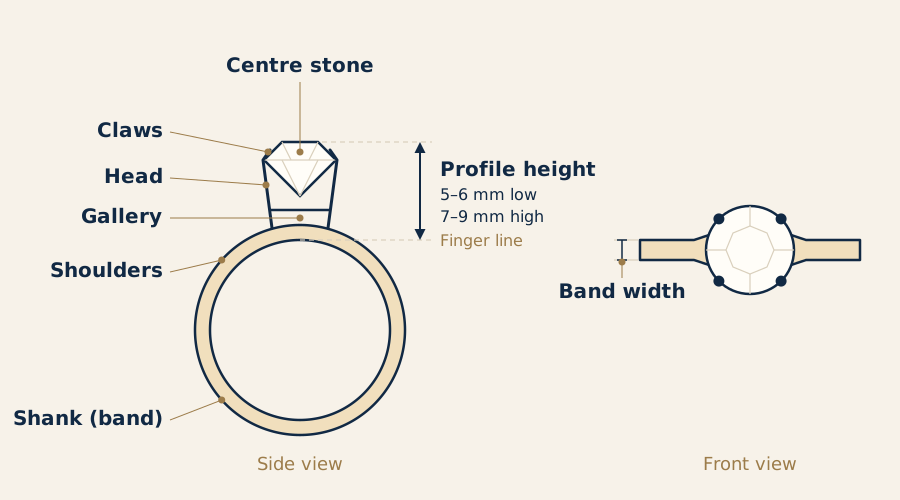
Describe your day, not just your taste. A profile height (how far the stone sits above the finger) of about 5–6 mm suits gloves and busy hands, while 7–9 mm shows more of the stone but catches more often. Bezel settings, a thin rim of metal around the stone, protect the edge better than claws. Our guide on matching the design to work, sport and daily wear goes further, including lower-profile settings for active hands.
If a wedding band will sit beside the ring, mention it now. A band that needs to sit flush affects the height of the setting and the shape of the gallery, and it is far easier to plan for at the start than to fix afterwards.
How do you find out ring size without asking?
Australia uses letter sizes (A to Z, with half sizes), the same system as the UK. The most reliable surprise method is to borrow a ring the person already wears on the same finger and have it measured on a ring stick, then put it back. Tracing the inside of the ring on paper or pressing it into soap also works. Note in your brief how you found the size, because it tells the jeweller how much confidence to place in it.
- Wrong-finger rings are not a reliable guide: the left ring finger is often a different size from the right.
- Wider bands fit tighter, so a 4 mm band may need a quarter to half size larger than a 2 mm one.
- Resizing: a plain solitaire can usually go up or down one or two sizes; full eternity bands and some pavé designs can barely be resized at all.
If secrecy matters, ask the jeweller to design a band that is easy to resize after the proposal. For questions about who chooses, involving family, or proposing without a ring, see our page on etiquette around surprise proposals and ring choice.
How does CAD engagement ring design approval work?
Once the brief is agreed and a stone is chosen, the jeweller builds the ring in CAD and sends renders (realistic images) from several angles. You review, ask for changes and approve. Many jewellers also 3D-print a resin model so you can see the real size on the hand. Our explainer on how CAD renders and 3D-printed models are used covers the technology.
At the CAD stage, check the things renders exaggerate. Renders are often shown large and close up, so ask for the key measurements in writing: band width at the base, setting height, claw thickness and the face-up size of the stone. Compare them with your brief. For a full checklist, read our guide to approving a CAD design with confidence.
Related guideBuying an Engagement Ring Online vs In-StoreHow long does a custom engagement ring take?
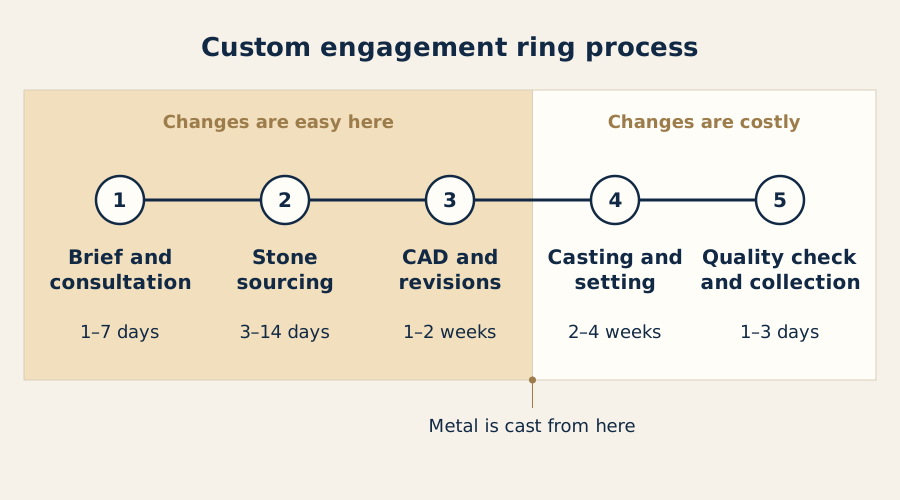
Allow about four to eight weeks from an agreed brief to collection, longer if a particular stone has to be sourced or the design is unusual. The deadline in your brief should be the date you need the ring in your hand, with at least a week of buffer before the proposal.
| Stage | What happens | Typical time |
|---|---|---|
| Brief and consultation | Budget, stone and style agreed in writing | 1–7 days |
| Stone sourcing | Options shown with reports; you choose | 3–14 days |
| CAD and revisions | Renders, changes, sign-off | 1–2 weeks |
| Casting and setting | Metal cast, stone set, polished | 2–4 weeks |
| Quality check and collection | Fit, finish, valuation and paperwork | 1–3 days |
Expect a deposit before work starts; many jewellers ask for a portion when the stone is reserved or the CAD is approved, and the balance on collection. Ask for the deposit terms, the refund position if you cancel, and what is included (resizing, a valuation, a first rhodium replate) in writing. Whether you deal with a jeweller in person or remotely also shapes the process; we weigh up the pros and cons of buying online versus in a store.
Engagement ring insurance and the Tourist Refund Scheme: what should Australians know?
Two pieces of paperwork are worth planning in the brief, because they affect how the invoice and valuation are written.
Insurance. Most home and contents policies cover jewellery only up to a modest limit per item unless it is listed separately. For an engagement ring you will usually need an insurance valuation: a written replacement value with a full description of the metal, stone and report number, ideally from a registered valuer. Ask for it in the brief so it is ready at collection, and arrange cover before the proposal, not after.
| Cover type | How it works | Watch for |
|---|---|---|
| Contents, unspecified | Ring covered within general contents | Low per-item limits; often not covered away from home |
| Contents, specified item | Ring listed by value on your policy | Need a valuation; check overseas and loss cover |
| Standalone jewellery policy | Separate policy just for jewellery | Excess, replacement terms, valuation updates |
Read the product disclosure statement for whether the insurer replaces the ring through its own suppliers or pays cash, and update the valuation every two to three years.
Tourist Refund Scheme (TRS). If you are leaving Australia, you may be able to claim back the GST (one-eleventh of the GST-inclusive price) on a ring when you depart. The main conditions:
- You spend at least AUD 300 (including GST) with one business that has an ABN.
- The purchase is made within 60 days before you leave, with a tax invoice in your name.
- You wear the ring or carry it in your hand luggage and show it, with the invoice, at the TRS facility at the airport or seaport.
- Australian residents can also claim, but may have to declare the ring and pay GST if they bring it back above the duty-free allowance.
Custom work makes timing tricky, because a deposit may be paid months before collection. Note your departure date in the brief so the jeweller can issue the invoice correctly. Our page on the full rules of the Tourist Refund Scheme on jewellery explains the detail, including claiming GST back at the airport and what changes if the ring is shipped overseas instead, where your own country's import taxes may apply.
How to write your engagement ring design brief: step by step
- Set a total budget range. Decide whether it includes the centre stone and what you would trade off first.
- Choose natural or lab-grown. Then add shape, size in mm or carats and a colour and clarity range.
- Gather 5–10 photos. Write one line on each: what you like, or what you don't.
- Describe daily life. Work, sport, gloves and hand-washing guide the profile height and setting.
- Confirm the ring size. Note how you measured it and whether the band must be easy to resize.
- Pick the metal. Band and claw colour, and whether a wedding band will sit beside it.
- Set the deadline. The date you need it in hand, with a week of buffer.
- List the paperwork. Insurance valuation, grading report, TRS claim or overseas shipping.
- Send it and ask for written confirmation. Then review the CAD against your brief before approving.
If you would like a refresher on the style options first, our page on choosing ring styles before you brief a jeweller is a good companion to this checklist.
Free consultation
Talk to a gemologist
Compare stones in person or online with Raj Sood, Graduate Gemologist (GIA), AJP (GIA).
Book a consultationShop this shape
FAQ
Common questions
How long should an engagement ring design brief be?
One page is enough for most rings, plus five to ten reference photos with a line of notes on each. Clarity matters more than length.
Do I need to know diamond grades before I brief a jeweller?
No. A range such as "near-colourless, eye-clean" is fine, and the jeweller can show you stones that fit. Knowing the basics of the 4Cs helps you compare options.
Can I change the design after approving the CAD?
Small changes are sometimes possible before casting, but once the metal is cast, changes usually mean recasting at extra cost. Check every measurement before you sign off.
Should I include a lab-grown or natural preference in the brief?
Yes. It changes the price, the stone options and the size you can reach, so state your preference or ask to see both. The grading report should always state whether the diamond is natural or lab-grown.
Is my engagement ring covered by home contents insurance?
Often only up to a low per-item limit unless you list it as a specified item. Ask your insurer and arrange cover, with a valuation, before the proposal.
Can I claim the Tourist Refund Scheme on a custom engagement ring?
Possibly, if you spend at least AUD 300 with one business within 60 days of leaving and carry or wear the ring when you depart. Tell your jeweller your travel date early so the tax invoice is issued correctly.

Ask a gemologist
Not sure which diamond to choose?
Raj Sood is a Graduate Gemologist (GIA) and master jeweller. Bring the stones you are considering, or send the reports, and he will tell you honestly which one is better and why.
Keep learning
Related guides
 Buying Knowledge & Custom ProcessHow CAD Is Used in Custom Engagement Ring Design
 Engagement Rings & SettingsHow Lifestyle Should Influence Engagement Ring DesignBuying Knowledge & Custom ProcessEngagement Ring Buying Guide
 Buying Knowledge & Custom ProcessTourist Refund Scheme on Jewellery Explained
 Buying Knowledge & Custom ProcessDiamond Resale Value Explained
 Buying Knowledge & Custom ProcessEngagement Ring EtiquetteBuying Knowledge & Custom ProcessThe Three-Month Salary RuleBuying Knowledge & Custom ProcessBuying an Engagement Ring Online vs In-Store
Explore more
More guides on this topic
Education