
- Education
- Engagement Rings & Settings
- How to Choose an Engagement Ring Band Width: 1.5 mm to 4 mm Explained
Engagement Rings & Settings
How to Choose an Engagement Ring Band Width: 1.5 mm to 4 mm Explained
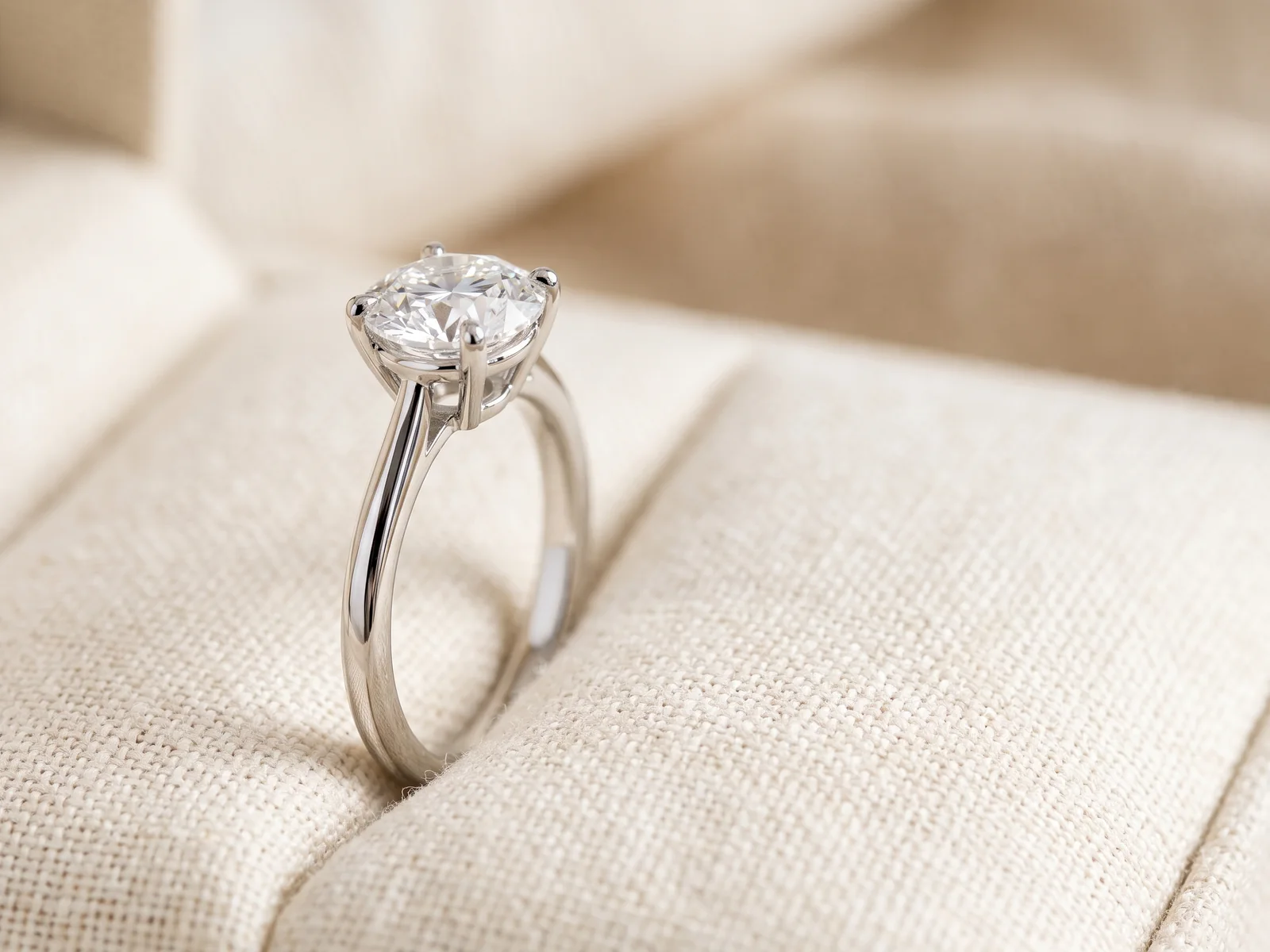
Band width is the part of how to choose an engagement ring that most people leave until last. It still changes how big the diamond looks, how the ring feels and how well it lasts. Here is what each millimetre does.
 Reviewed by Raj Sood, Graduate Gemologist (GIA), AJP (GIA)Master jeweller and Graduate Gemologist (GIA) · reviewed 4 November 2026
Quick answer
Most people choose an engagement ring band between 1.8 and 2.5 mm wide. Below about 1.8 mm the diamond looks larger, but the band is harder to resize and wears thin sooner. At 3 mm or more it feels sturdy and suits larger hands, but a small centre stone can look smaller. Match width to finger, stone and wedding band.
What does engagement ring band width mean?
Band width is how wide the ring's band (the shank) is when you look down at the top of your finger, measured in millimetres. It is usually quoted at the back of the ring, the part that sits under your palm, because many bands change width as they rise towards the diamond. Thickness, sometimes called depth, is the other measurement. It tells you how far the metal stands out from your skin. Every unfamiliar term on this page is defined in our plain-English jewellery glossary.
Most engagement rings made in Australia today have bands between about 1.8 mm and 2.5 mm wide, with a thickness of roughly 1.5–1.8 mm. That range balances three things: how large the centre stone looks, how comfortable the ring feels next to a wedding band, and how much metal is there to survive decades of daily wear. For a measurement-by-measurement look, see our page on band widths from 1.8 mm to 4 mm.
Width and thickness work together. A band can look delicate from above but still be strong if it is deep enough. That is why jewellers talk about the cross-section, the shape you would see if you cut through the band, rather than width alone. The common cross-sections are:
- Flat: square edges, modern look, can feel sharper on the finger.
- D-shape: rounded outside, flat inside; the traditional profile.
- Comfort fit (court): rounded inside and out, so it slides over the knuckle easily.
- Knife-edge: the top rises to a ridge, so the band looks finer than it is.
What engagement ring band widths are available?
Engagement bands are made from about 1.2 mm up to 4 mm or more. Here is how each range looks and how it holds up over the years, based on what jewellers see when rings come back for sizing and repair.
| Width | How it looks | Suits | Long-term wear |
|---|---|---|---|
| 1.2–1.5 mm | Very fine, almost a thread of metal | Petite hands, minimalist solitaires | Highest risk of bending and thinning; often limits resizing |
| 1.6–1.9 mm | Fine and delicate; the stone stands out | Most solitaires from 0.50 ct up | Fine for daily wear if about 1.5 mm thick or more |
| 2.0–2.4 mm | Balanced, the classic modern band | Almost any hand and stone size | Robust; resizes easily |
| 2.5–2.9 mm | Noticeably solid | Larger stones, longer or wider fingers, pavé bands | Very durable; feels substantial beside a wedding band |
| 3.0–4.0 mm+ | Bold, closer to a wedding band | Larger fingers, vintage styles, stones 1.50 ct+ | Very durable, but can feel tight and look heavy with a small stone |
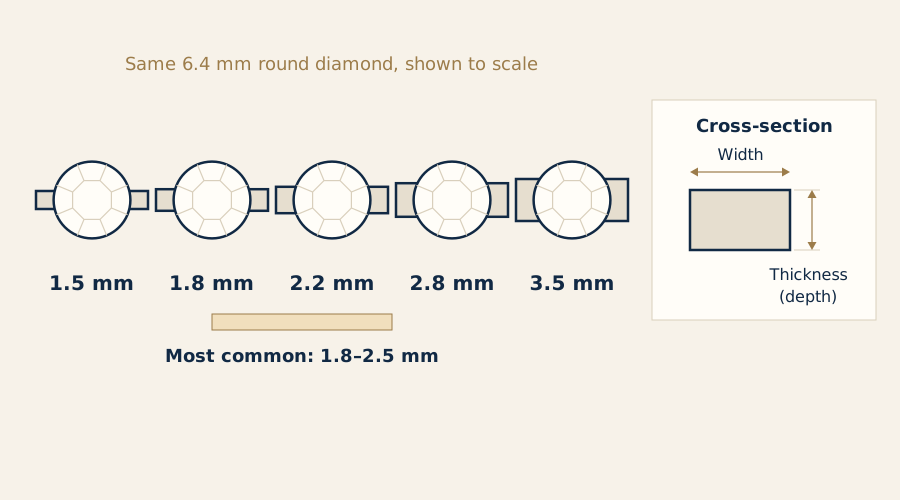
These are ranges, not hard edges. A 1.8 mm band in platinum feels and lasts differently to a 1.8 mm band in 9ct gold. A pavé band, one set with a row of small diamonds held by tiny beads of metal, needs at least about 2 mm simply to hold the stones securely, and more for larger accent diamonds.
Related guideEngagement Ring Band Widths: 1.8 to 4 mmDo wide engagement ring bands make diamonds look smaller?
Yes, a little, and it comes down to proportion. Your eye judges the centre stone against the metal beside it. A round diamond of 1 carat measures about 6.4 mm across. On a 1.8 mm band the stone is roughly three and a half times the band's width, so it reads as large. Put the same stone on a 3.5 mm band and the ratio drops below two to one, and the diamond looks more modest, even though nothing about it has changed.
| Round diamond | Approx. diameter | Fine (stone looks larger) | Balanced | Bold (stone looks smaller) |
|---|---|---|---|---|
| 0.25 ct | about 4.1 mm | 1.5–1.7 mm | 1.8–2.0 mm | 2.5 mm+ |
| 0.50 ct | about 5.1 mm | 1.6–1.8 mm | 2.0–2.3 mm | 2.8 mm+ |
| 0.75 ct | about 5.8 mm | 1.7–1.9 mm | 2.0–2.5 mm | 3.0 mm+ |
| 1.00 ct | about 6.4 mm | 1.8–2.0 mm | 2.2–2.6 mm | 3.2 mm+ |
| 1.50 ct | about 7.3 mm | 1.8–2.2 mm | 2.4–2.8 mm | 3.5 mm+ |
| 2.00 ct | about 8.1 mm | 2.0–2.3 mm | 2.5–3.0 mm | 4.0 mm+ |
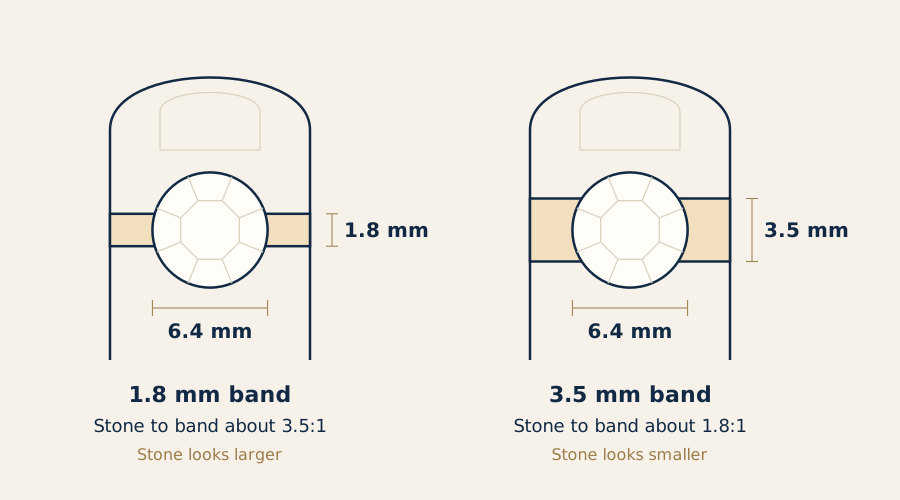
A useful rule of thumb: a band about a third of the stone's diameter, or a little more for small stones, looks balanced to most people. Go finer if you want the diamond to dominate; go wider if you prefer a solid, heirloom feel. Fancy shapes follow the same logic using the stone's width, so a 1 ct oval (about 7.7 × 5.7 mm) behaves more like a 0.75 ct round on the same band.
The setting shifts the balance too. A halo of small diamonds adds roughly 1.5–2 mm to the visible width of the centre, so a halo ring carries a wider band without the stone looking swamped. Band width does not change a diamond's brightness or sparkle, only how large it seems against your finger. If apparent size matters most, narrowing the band towards the stone costs far less than going up in carat weight.
How to choose an engagement ring band width for your hand?
Your hands matter as much as the stone. On a slim finger in Australian size H or J, a 2 mm band already covers a fair share of the finger and a 3 mm band can look heavy. On a size P or Q finger, the same 2 mm band looks fine-boned, and many people move to 2.3–2.8 mm so the ring holds its own. Longer fingers carry width more easily than short ones because there is more length between the knuckle and the hand.
- Short or slim fingers: 1.6–2.0 mm keeps the hand looking long; a tapered band helps further.
- Long fingers: almost any width works; 2.0–2.5 mm is a comfortable middle.
- Wider or larger fingers: 2.3–3.0 mm looks in proportion; very fine bands can look lost and tend to roll.
- Prominent knuckles: the ring must pass the knuckle, so it may spin; a slightly wider comfort-fit band or small sizing beads inside help it sit upright.
Width also changes fit. A wider band touches more skin, so it feels tighter than a narrow band of the same size. As a rough guide, bands over about 4 mm are often made a quarter to half a size larger, though most engagement rings are narrow enough that this does not apply. A comfort-fit inside slides over the knuckle more easily and makes a wider band feel narrower. Fingers swell on hot Melbourne afternoons and shrink on cold mornings, so check sizes at the end of the day.
If your partner already wears rings, a ring they wear on the same finger is the most reliable guide to both size and the width they like. If you are working to a proposal date, our guide on when to order the engagement ring explains where sizing fits in the timeline.
Not sure which one is right?
Send us the stones you are looking at and our gemologist will tell you which to choose and why.
How thin is too thin for an engagement ring band?
This is where the repair bench has firm opinions. A large share of engagement ring repairs involve the band, not the diamond: it has thinned, cracked or bent. Metal wears where it rubs, mainly the underside of the band against your palm, the steering wheel, gym equipment and the wedding band beside it. Over 15–25 years of daily wear, a gold band can lose a noticeable part of its thickness at the back.
- Below about 1.5 mm wide: the band can be squeezed out of round (into an egg shape), which also loosens the claws holding the diamond.
- Below about 1.2 mm thick: worn backs can crack, often near an old solder join from resizing.
- Fine pavé bands: the small beads holding each diamond wear down, and accent stones can come loose within years rather than decades.
- Fine bands worn with a wedding band: the two rings grind against each other, so each wears faster than it would alone.
Metal choice changes how quickly wear happens. Platinum is dense and tough: when it is scratched, most of the metal is pushed aside rather than lost, so a platinum band keeps its thickness longer, though it develops a soft, satin-like patina. Gold wears away gradually, and the lost metal does not come back. A worn band can be rebuilt by re-shanking, which replaces the bottom section, but it is simpler to start with enough metal.
Think about resizing too. Most plain bands can be sized up or down by one or two sizes, but very fine, tapered, twisted and pavé bands are harder, and full eternity bands usually cannot be resized at all. Our guide to designing a ring with future resizing in mind explains what to plan for now. If you garden, lift weights or work with your hands, read how daily life should shape the ring's design before you settle on a fine band.
Which band styles change how wide an engagement ring looks?
Width is not always one number. The band's profile, seen from above and from the side, changes how wide it looks and where the metal sits.
- Tapered: wider at the back and narrowing towards the stone, for example 2.4 mm tapering to 1.6 mm. The diamond looks larger while the back stays strong; see how a tapered band frames the centre stone.
- Reverse taper: narrow at the back and widening towards the stone, so the head looks bold and well supported. Our page on reverse taper bands and their trade-offs covers how they wear.
- Knife-edge: the top rises to a ridge, so it looks finer than its true width from above while keeping metal for strength. More in knife-edge band profiles explained.
- Twisted: two or more strands wound together; they read wider than a plain band of the same width and need care where the strands cross. See twisted and rope-style bands.
- Pavé or channel-set: small diamonds along the band add sparkle and visual width; allow at least 2 mm.
- Split shank: the band divides in two as it nears the stone, adding width at the top without bulk underneath.
The head, the part that holds the diamond, changes the picture too. Our guide to solitaire, halo, pavé and bezel settings shows how each sits on the band. And if none of the classic shapes feel right, choosing a ring when traditional styles don't appeal looks at wider, sculptural and asymmetric bands.
What wedding band width goes with an engagement ring?
Most people wear the engagement ring and wedding band together on the same finger, so treat the two widths as one stack. A 2 mm engagement ring with a 2 mm wedding band gives 4 mm combined, which feels light. A 2.5 mm engagement ring with a 3 mm band makes 5.5 mm, closer to a single wide ring. Above about 6 mm combined, some people find the stack feels stiff when they bend the finger.
| Engagement band | Wedding band | Combined | Effect |
|---|---|---|---|
| 1.8 mm | 1.8 mm (matching) | 3.6 mm | Delicate; the rings read as a pair |
| 2.0 mm | 2.0–2.5 mm | 4.0–4.5 mm | Balanced; the most common pairing |
| 2.0 mm | 3.0–4.0 mm | 5.0–6.0 mm | The wedding band leads; the engagement ring sits as the accent |
| 2.5–3.0 mm | 2.0–3.0 mm | 4.5–6.0 mm | Solid stack for larger hands and stones |
Height matters as much as width. If the diamond sits low, its claws or basket can stop a straight wedding band from sitting flush, leaving a gap. Our page on how setting height affects wedding band fit explains when you need a contoured or notched band. Partners often choose very different widths for their own wedding bands; typical women's and men's band widths sets out the usual ranges, and for tradies, mechanics and anyone hands-on there is picking a men's band that survives physical work.
Does the metal change the engagement ring band width you need?
Yes. Softer or less dense metals need a little more width and thickness to last the same time. These are general guides; your jeweller can advise on a specific design.
| Metal | Hardness and wear | Suggested minimum width | Notes |
|---|---|---|---|
| Platinum (950) | Dense; metal moves rather than wears away | about 1.6 mm | Heaviest option; naturally white; develops a patina |
| 18ct white gold | Hard alloy, usually rhodium plated | about 1.6–1.8 mm | Plating wears and is usually redone every 1–3 years |
| 18ct yellow or rose gold | Softer than most white gold alloys | about 1.8 mm | Rose gold's copper makes it slightly harder than yellow |
| 9ct gold | Hard but less dense; can be more brittle | about 1.8–2.0 mm | 37.5% gold; lower cost |
18ct gold is 75% pure gold, alloyed with other metals for strength and colour; 9ct is 37.5% gold. Platinum jewellery is usually 95% platinum and is roughly 35–40% heavier than 18ct gold in the same design, so even a 2.5 mm platinum band feels substantial. Pure gold is only about 2.5–3 on the Mohs hardness scale, which is why the alloy matters so much for a ring worn every day.
If you are designing the ring rather than choosing a ready-made setting, ask to see a CAD render (a 3D computer model) with the exact width and thickness marked, then compare it with a finished ring of similar width on the hand. Renders are enlarged on screen and can make a fine band look sturdier than it will feel.
Explore ring settings or create your ring
How to choose an engagement ring band: step by step
- Start with the stone. Note its width in millimetres (the diameter for a round) and aim for a band about a third of that (a little more for small stones) for a balanced look.
- Look at the hand. Slim or short fingers suit about 1.6–2.0 mm; larger fingers suit about 2.3–3.0 mm.
- Check thickness, not just width. Ask for the depth at the back of the band; about 1.5 mm or more suits daily wear.
- Choose the profile. Plain, tapered, knife-edge, twisted or pavé each change how wide the band looks.
- Plan the wedding band. Add the two widths together, keep the total comfortable and check the setting height allows a flush fit.
- Match the metal to your life. Hands-on work and regular gym sessions favour platinum or a slightly wider, thicker gold band.
- Try widths on. Wear sample bands of about 1.8, 2.2 and 2.8 mm for a few minutes each, at the end of the day, before you decide.
Once the width is settled, the rest of the design usually falls into place quickly: the head, the claws and the metal colour all follow from how much band you want under the stone.
Free consultation
Talk to a gemologist
Compare stones in person or online with Raj Sood, Graduate Gemologist (GIA), AJP (GIA).
Book a consultationShop this shape
FAQ
Common questions
What is the most popular engagement ring band width?
Between about 1.8 mm and 2.5 mm, with 2 mm the most common single width. It suits most hands, holds a centre stone securely and pairs easily with a wedding band.
Is a 1.5 mm engagement ring band too thin?
Not always, but it is near the lower limit for daily wear. It should be at least about 1.5 mm thick, ideally in a durable metal such as platinum, and it may be harder to resize later.
Do wide bands make a diamond look smaller?
Yes, slightly. The eye compares the stone with the band, so a 1 ct round looks smaller on a 3.5 mm band than on a 1.8 mm band, although its size and brightness are unchanged.
What band width suits a 1 carat diamond?
A 1 ct round is about 6.4 mm across, and a band of roughly 1.8–2.6 mm looks balanced to most people. Choose the fine end to emphasise the stone or go wider for a sturdier look.
Should my engagement ring and wedding band be the same width?
Not necessarily. Matching widths look like a set, while a slightly wider wedding band lets the engagement ring sit as the accent; keep the combined width comfortable, usually under about 6 mm.
Can you change the band width of an engagement ring later?
A jeweller can replace the lower part of the band with a wider or thicker section, called re-shanking. Changing the width right up to the setting usually means remaking the ring, so it is simpler to choose well at the start.

Ask a gemologist
Not sure which diamond to choose?
Raj Sood is a Graduate Gemologist (GIA) and master jeweller. Bring the stones you are considering, or send the reports, and he will tell you honestly which one is better and why.
Keep learning
Related guides
 Engagement Rings & SettingsEngagement Ring Band Widths: 1.8 to 4 mmEngagement Rings & SettingsTapered BandsEngagement Rings & SettingsSetting Height and Wedding Band Fit
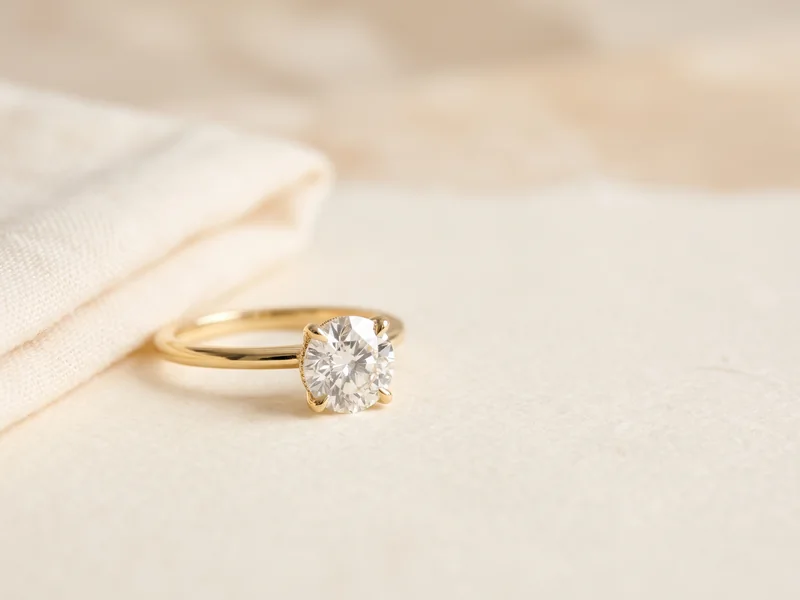 Care, Repairs & RemodellingShould Your Engagement Ring Be Designed for Future Resizing?Engagement Rings & SettingsEngagement Ring Setting Styles Guide
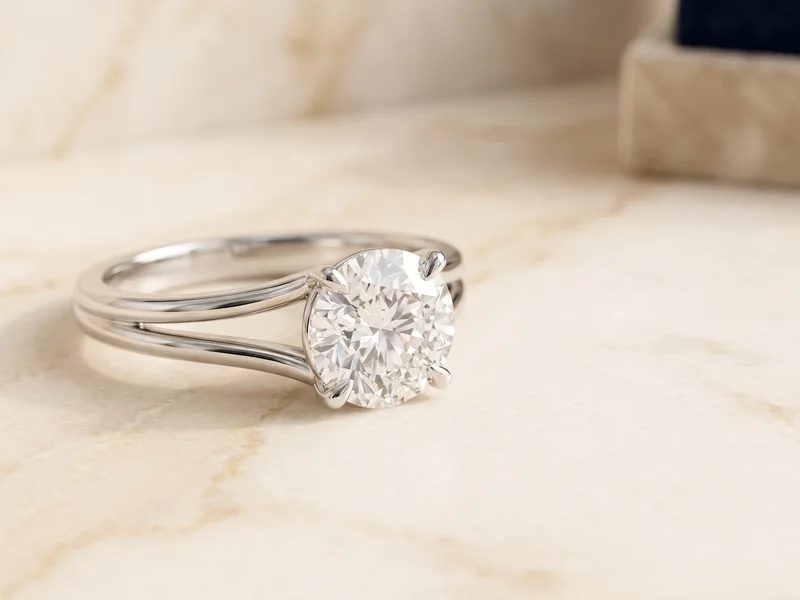 Engagement Rings & SettingsTwisted Bands
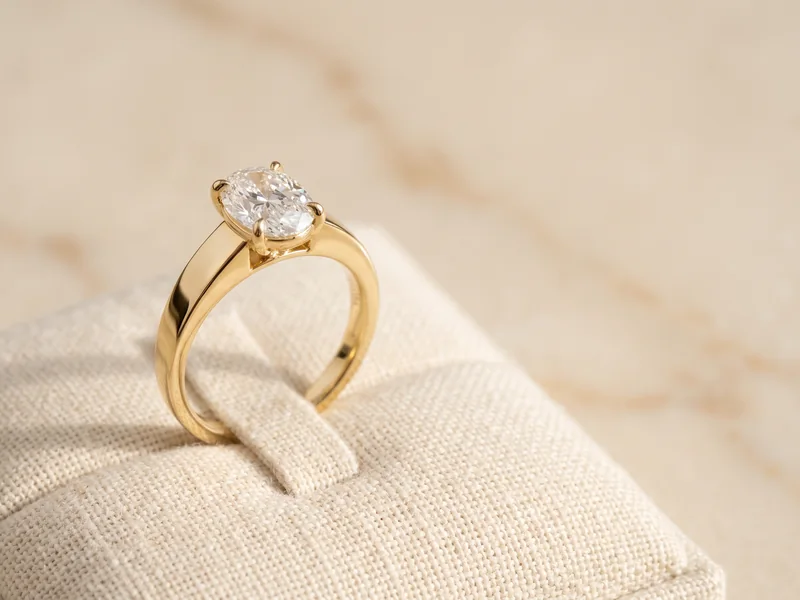 Engagement Rings & SettingsReverse Taper BandsEngagement Rings & SettingsKnife-Edge Bands
Explore more
More guides on this topic
Education