
Gemstones
March Birthstone: Aquamarine Guide to Colour, Durability and Rings
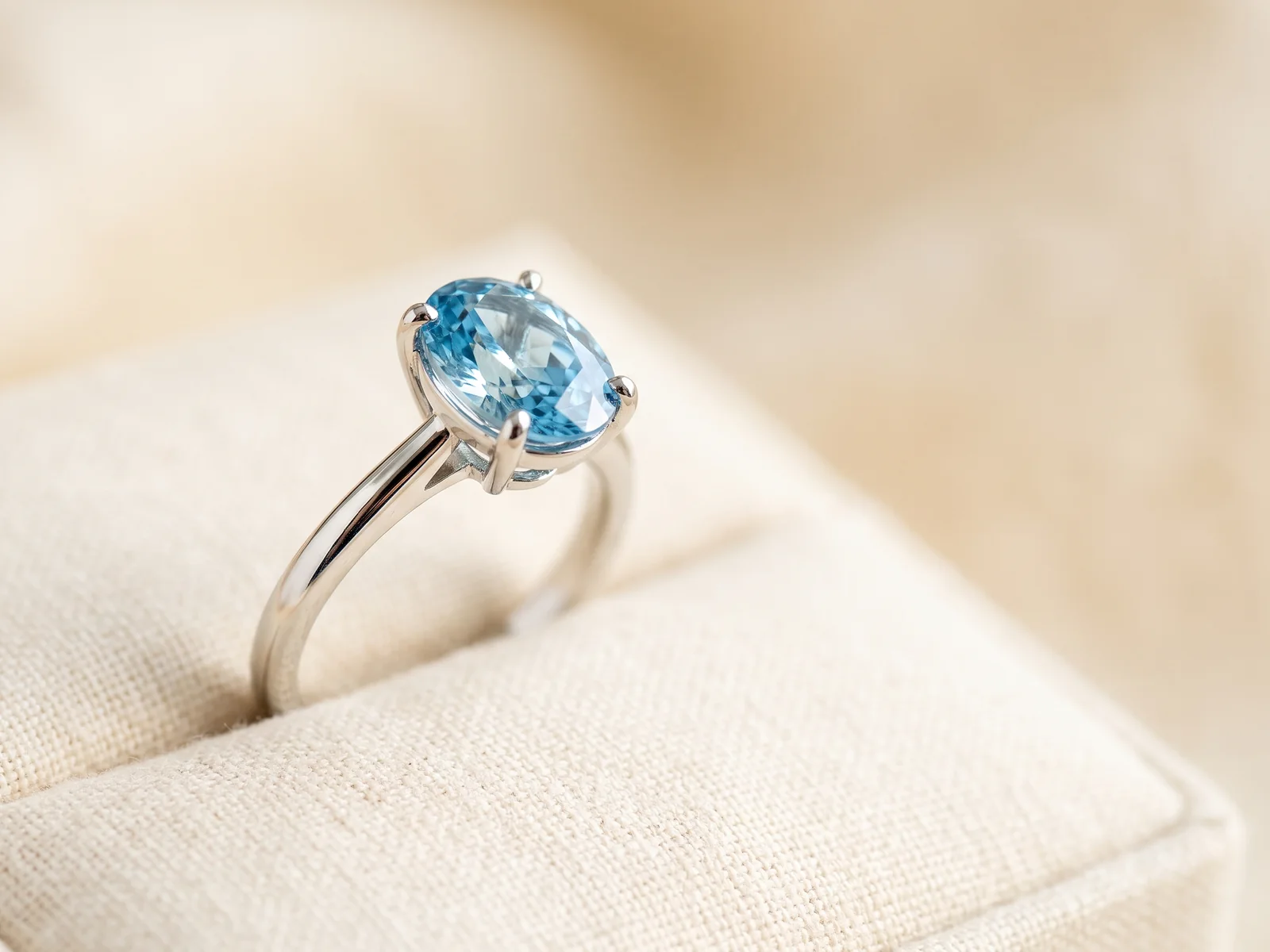
The March birthstone is one of the few birthstones tough enough for a ring you wear every day. Here is what aquamarine is, which colours matter, how it holds up and how to set it so it lasts.
 Reviewed by Raj Sood, Graduate Gemologist (GIA), AJP (GIA)Master jeweller and Graduate Gemologist (GIA) · reviewed 4 November 2026
Quick answer
The March birthstone is aquamarine, a pale to deep blue variety of beryl, the same mineral family as emerald. It rates 7.5–8 on the Mohs scale with no strong cleavage, so it suits everyday rings if set protectively. Bloodstone is the traditional alternative. Deeper, purer blue costs more; most stones are heat-treated.
What is the March birthstone?
The modern March birthstone is aquamarine, with bloodstone listed as the traditional alternative. Aquamarine is the blue to greenish-blue variety of the mineral beryl, a beryllium aluminium silicate (Be3Al2Si6O18). Beryl comes in several colours, each with its own name: green beryl coloured by chromium or vanadium is emerald, pink is morganite, yellow is heliodor and colourless is goshenite. If you know emerald, May's birthstone and aquamarine's green cousin, you already know aquamarine's family.
The blue comes from small amounts of iron in the crystal. Aquamarine has a refractive index (how strongly it bends light) of about 1.57–1.58, much lower than diamond's 2.42, so it shows a calm, glassy brightness rather than strong sparkle. Its specific gravity (density) is about 2.68–2.74, lighter than most gems, which means an aquamarine looks larger than a sapphire or diamond of the same carat weight.
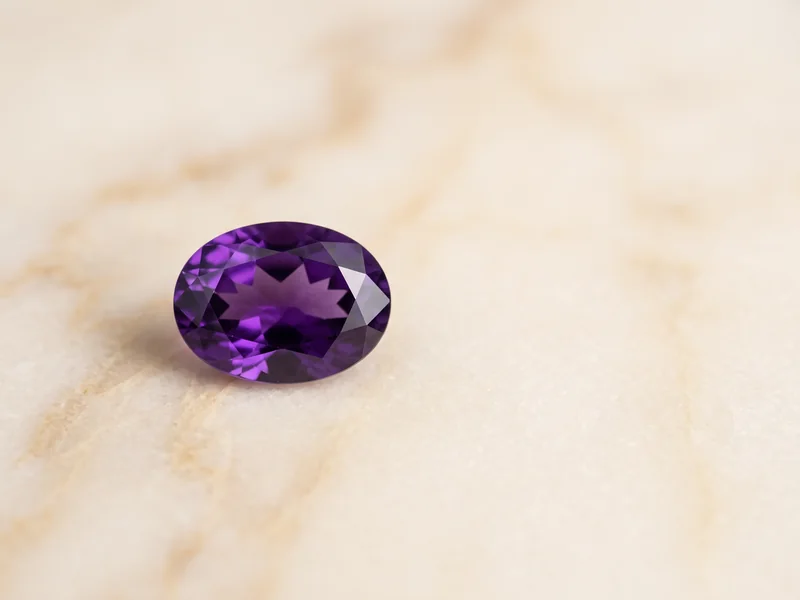
Aquamarine sits in the birthstone calendar between February's purple amethyst and April's diamond. For how it fits among all coloured stones, see our guide to coloured gemstones and birthstones, and any unfamiliar word on this page is explained in our plain-English jewellery glossary.
What is the history of the March birthstone?
The name comes from the Latin "aqua marina", meaning "water of the sea". Many cultures linked the stone with the sea, and old European lore tells of sailors carrying aquamarine as a charm for calm water and safe passage. These are stories rather than facts, but they explain why the stone has long been tied to travel, calm and clear thinking.
The birthstone lists most people use today trace back to a list adopted by the American National Association of Jewelers in 1912, which named aquamarine and bloodstone for March. Earlier traditional lists gave March to bloodstone alone, which is why both still appear. Britain and other countries have published similar lists, and aquamarine is the March stone on nearly all of them.
Aquamarine also grows in very large, clean crystals. The best-known example is the Dom Pedro, a carved obelisk of about 10,363 carats cut from a Brazilian crystal, now held at the Smithsonian in Washington. Large clean rough is one reason aquamarine is so often seen in bigger cocktail rings and pendants, and why it is a popular choice for birthstone jewellery made in Melbourne.
Most commercial aquamarine today comes from Brazil, with other important sources in Nigeria, Madagascar, Mozambique, Zambia and Pakistan. Australia has smaller finds, including the Harts Range in the Northern Territory and parts of the New England region of New South Wales. Australian aquamarine turns up mostly as specimen and small-parcel material rather than steady commercial supply, so ask about origin if an Australian stone matters to you. Our January garnet page covers another birthstone with genuine Australian sources.
What colours does aquamarine come in?
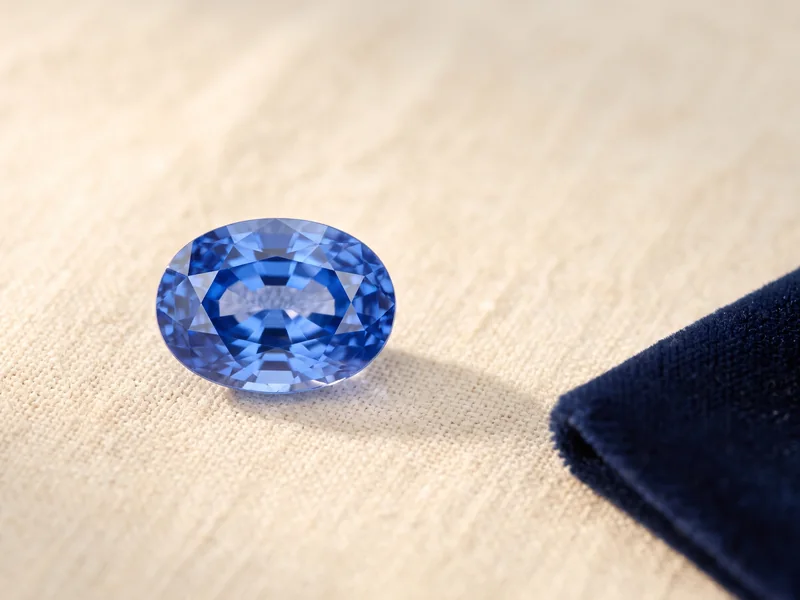
Aquamarine runs from almost colourless with a hint of blue, through sky blue, to a deep, slightly inky blue. Many stones have a faint green or grey undertone. In general, the purer and more saturated (stronger) the blue, the higher the value. Pale stones are still lovely, especially in larger sizes, but they can look almost clear in a small setting.
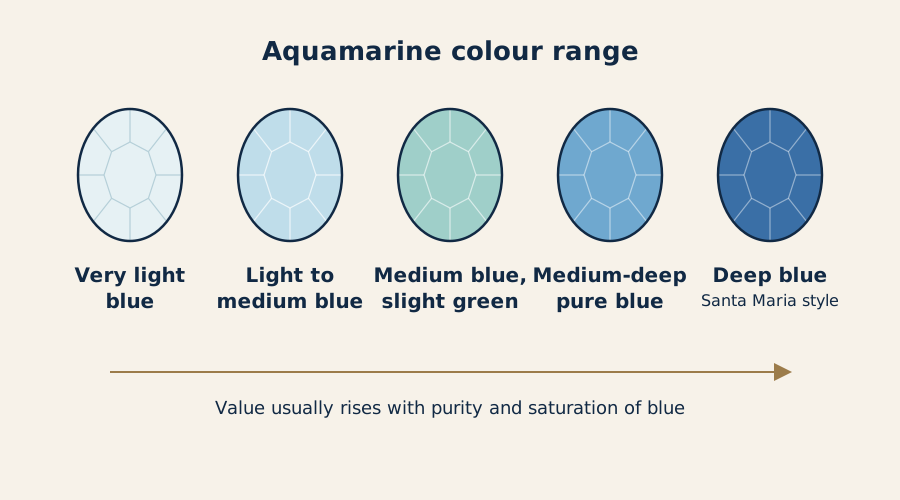
| Colour | How it looks | Approximate price per carat (AUD) |
|---|---|---|
| Very light blue | Clear water with a blue tint; can look colourless when small | about $40–$150 |
| Light to medium blue | Sky blue, the most common commercial colour | about $150–$400 |
| Medium blue, slight green | Seaside blue-green; preferred by some for its softness | about $100–$350 |
| Medium-deep pure blue | Strong, even blue with no grey | about $400–$1,000 |
| Deep blue ("Santa Maria" style) | Saturated, intense blue, rare in larger sizes | about $800–$2,000+ |
Santa Maria is a trade name taken from the Santa Maria de Itabira mine in Brazil, now used loosely for any deep, saturated aquamarine. It describes a colour, not proof of origin, so treat it as a description only. A related trade term, Espírito Santo, is used for slightly lighter stones of good colour.
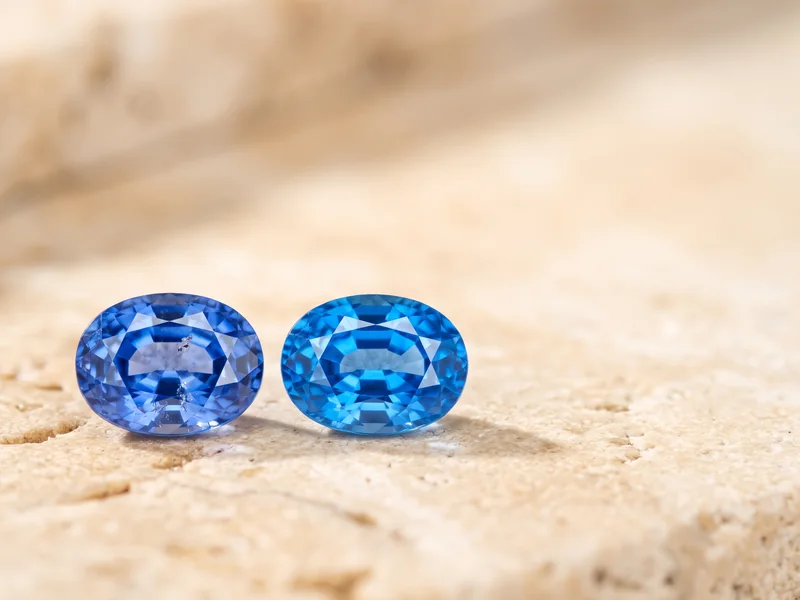
Aquamarine is pleochroic: it shows different colours when viewed from different directions, usually a stronger blue along one axis and a paler, almost colourless blue along another. Good cutters orient the stone so the strongest blue faces up. Light-blue stones are often confused with blue topaz, which is usually a brighter, more electric blue; our page on how aquamarine compares with blue topaz sets out how to tell them apart. If you love a violet-blue rather than a sea blue, look at tanzanite and blue zircon for December.
Is aquamarine durable enough for an everyday ring?
Yes, with sensible setting. Durability has three parts: hardness (resistance to scratching, measured on the Mohs scale of 1 to 10), toughness (resistance to chipping and breaking) and stability (resistance to heat, light and chemicals). Aquamarine scores well on all three. At 7.5–8 it is harder than household dust (which contains quartz at about 7), so it keeps its polish far better than softer stones.
Unlike its cousin emerald, aquamarine usually forms with few inclusions (internal features) and fractures, and its cleavage is indistinct, meaning it has no strong tendency to split along a flat plane. That makes it much tougher in practice than an emerald of the same hardness. Its colour is stable in normal light and wear.
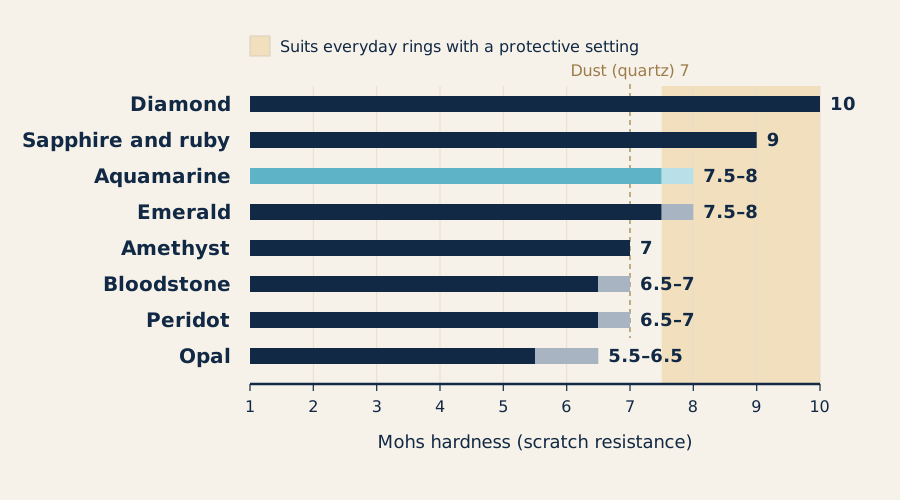
| Birthstone | Mohs hardness | Everyday ring? |
|---|---|---|
| Diamond (April) | 10 | Yes, the hardest |
| Sapphire and ruby (September, July) | 9 | Yes, very durable |
| Aquamarine (March) | 7.5–8 | Yes, with a protective setting |
| Emerald (May) | 7.5–8 | With care; often included and brittle |
| Amethyst (February) | 7 | Yes, but scratches over years |
| Bloodstone (March) | 6.5–7 | Better for occasional wear |
| Peridot (August) | 6.5–7 | With care |
| Opal (October) | 5.5–6.5 | Occasional wear, protective setting |
Aquamarine will still scratch against anything harder, and a sharp knock on a corner can chip it. If you want the very toughest stone for a daily engagement ring, September's sapphire or July's ruby at 9 are a step up. Compared with softer October opal, aquamarine is far more forgiving. Our guide to choosing a birthstone engagement ring that lasts ranks all twelve months side by side.
Related guideAquamarine Engagement RingsNot sure which one is right?
Send us the stones you are looking at and our gemologist will tell you which to choose and why.
Is aquamarine treated, and are there lab-created aquamarines?
Most aquamarine on the market has been heat-treated. Gentle heating, commonly around 375–450°C, removes a yellow component in the colour, turning greenish stones a purer blue. The result is permanent, stable and almost impossible to detect, and it is accepted across the trade. Untreated stones with a natural pure blue exist but are hard to prove, so most sellers describe aquamarine as "usually heated". Irradiation is used occasionally; ask if it matters to you.
There is also a dark-blue beryl known as Maxixe, first found in Brazil, whose colour fades when exposed to light. It is rare and not true aquamarine, but it is one reason to buy from someone who can test the stone.
Lab-created aquamarine (synthetic beryl grown by the hydrothermal method) does exist, but it is uncommon because natural aquamarine is plentiful and affordable. Far more often you will see imitations: blue glass, lab-created spinel or blue topaz described loosely as "aqua". Blue topaz is a real natural gem, usually irradiated and heated to get its colour; see topaz, November's stone for more. A gemmologist can separate them quickly by refractive index and specific gravity.
- Natural aquamarine: RI about 1.57–1.58, SG about 2.68–2.74, soft sea-blue.
- Blue topaz: RI about 1.61–1.63, SG about 3.53, usually a brighter blue.
- Lab-created spinel: RI about 1.73, single colour from every angle.
- Glass: RI often around 1.50–1.70, may show bubbles and soft, worn facet edges.
What is bloodstone, the other March birthstone?
Bloodstone is the traditional March birthstone. It is a dark green chalcedony (a fine-grained form of quartz) with red to orange spots of iron oxide, sometimes called heliotrope. It is opaque, so it is cut as cabochons (smooth domed stones), beads, signet ring faces and carvings rather than faceted gems.
At about 6.5–7 on the Mohs scale, bloodstone is softer than aquamarine but quite tough, because its tiny interlocking crystals resist chipping. It suits signet rings, cufflinks and pendants, and costs much less than aquamarine, usually tens rather than hundreds of dollars per stone. For another green birthstone with more sparkle, see peridot and spinel for August.
| Aquamarine | Bloodstone | Blue topaz | |
|---|---|---|---|
| Mineral | Beryl | Chalcedony (quartz) | Topaz |
| Colour | Pale to deep sea blue | Dark green with red spots | Sky, Swiss or London blue |
| Transparency | Transparent | Opaque | Transparent |
| Mohs hardness | 7.5–8 | 6.5–7 | 8 |
| Cleavage | Indistinct | None | Perfect, one direction |
| Typical cut | Faceted: emerald, oval, round | Cabochon, signet, carving | Faceted |
| Price per carat | Moderate | Low | Low |
Which settings suit an aquamarine ring?
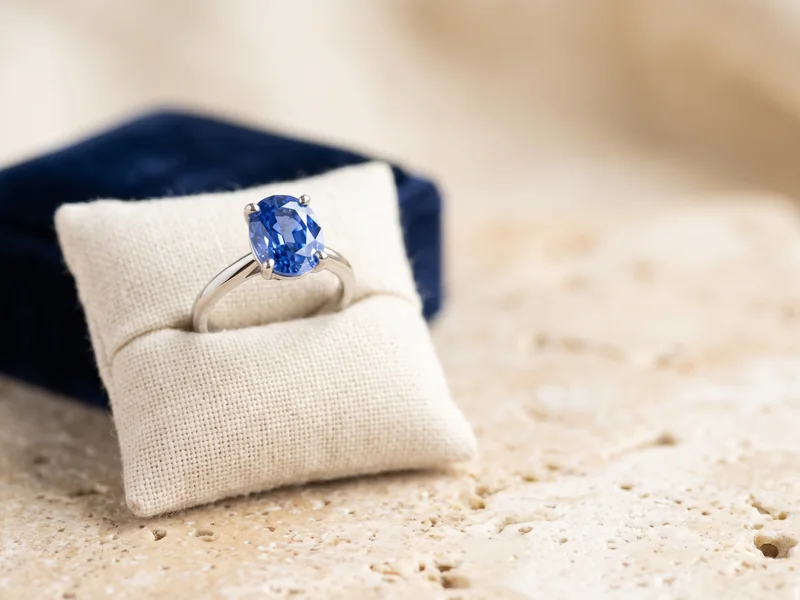
Aquamarine is most often cut as an emerald cut (a rectangle with cut corners and step facets), oval, cushion or round. Because its light return is quieter than diamond's, step cuts like the emerald cut show off its clear, watery colour particularly well, while ovals and cushions give more brightness. Larger sizes work well: a 1 ct oval aquamarine measures roughly 8 × 6 mm, slightly larger than a typical 1 ct diamond oval because aquamarine is less dense.
- Four or six claws: let in the most light, which matters for paler stones. Choose sturdy claws and have them checked yearly.
- Bezel or half-bezel: a rim of metal around the edge. The most protective option for an everyday ring, and it guards the corners of an emerald cut.
- Halo: a ring of small diamonds frames the stone and adds sparkle that aquamarine lacks on its own.
- Three-stone: an aquamarine centre with diamond or white sapphire sides.
- Pendants and earrings: very low risk of knocks, so even large, pale stones work well.
Metal colour changes how aquamarine looks. White gold and platinum keep the blue cool and clean. Yellow gold warms it and can make a slightly greenish stone look greener. Rose gold gives a soft contrast many people like. Because pale aquamarine picks up colour from what is behind it, a closed back or a metal basket can tint the stone; open galleries keep it brighter. Our page on aquamarine engagement ring designs shows these options in detail.
How much does aquamarine cost in Australia?
Aquamarine is priced per carat, and the price per carat rises with both colour and size, because large stones of strong colour are rarer. The biggest factor is colour, followed by clarity (most aquamarine is eye-clean, so visible inclusions reduce value noticeably), cut quality and size.
| Natural aquamarine, eye-clean | Approximate price range (AUD) |
|---|---|
| 0.50 ct, light blue | about $50–$150 |
| 1 ct, medium blue | about $200–$600 |
| 2 ct, medium blue | about $500–$1,600 |
| 3 ct, medium-deep blue | about $1,200–$4,000 |
| Deep "Santa Maria" style, 2 ct+ | about $2,000–$6,000+ |
These are broad ranges for loose stones only; prices move with the market and with the exact colour. The finished ring adds the cost of metal, any diamonds and the making. Aquamarine generally costs more than blue topaz of a similar look and far less than a fine sapphire. Because aquamarine is overwhelmingly natural, the lab-grown versus natural question that matters so much for diamonds rarely applies here; just make sure the stone is identified as natural aquamarine and that treatment is disclosed.
Shop natural gemstones
How do you choose and care for aquamarine? Step by step
- Confirm what it is. Ask for the stone to be identified as natural aquamarine, with any heat treatment disclosed.
- Judge the colour in daylight. Look for an even, pure blue with little grey; compare face-up and side-on.
- Check it is eye-clean. At normal viewing distance you should see no inclusions.
- Look at the cut. The stone should be evenly bright across the face, without a large washed-out window in the centre.
- Compare millimetres, not just carats. Aquamarine faces up larger than denser gems of the same weight.
- Choose a protective setting. A bezel, half-bezel or sturdy claws for a ring worn daily.
- Care for it simply. Clean with warm soapy water and a soft brush, take it off for the gym and gardening, avoid sudden temperature changes and have the claws checked once a year.
Free consultation
Talk to a gemologist
Compare stones in person or online with Raj Sood, Graduate Gemologist (GIA), AJP (GIA).
Book a consultationShop this shape
FAQ
Common questions
What is the March birthstone?
Aquamarine is the modern March birthstone, with bloodstone as the traditional alternative. Aquamarine is a blue variety of beryl; bloodstone is a green chalcedony with red spots.
What colour is the March birthstone?
Aquamarine ranges from very pale blue to deep blue, often with a slight green or grey undertone. The purer and more saturated the blue, the more it usually costs.
Is aquamarine good for an engagement ring?
Yes. At 7.5–8 on the Mohs scale with indistinct cleavage, aquamarine handles everyday wear well in a protective setting such as a bezel or sturdy claws. It will show light scratches over many years, and sapphire or diamond are harder if you are especially hard on your hands.
Is aquamarine expensive?
Not usually. Commercial light to medium blue stones are often about AUD $150–$600 per carat, while rare deep blue stones can cost several times more.
How can you tell aquamarine from blue topaz?
Blue topaz is usually a brighter, more electric blue and is heavier for its size, while aquamarine is softer sea-blue and shows two tones from different angles. A gemmologist can confirm it in minutes by measuring refractive index.
Can you clean aquamarine in an ultrasonic cleaner?
Clean, eye-clean aquamarine is usually safe in an ultrasonic, but stones with fractures or liquid inclusions are not. Warm soapy water and a soft brush is always safe.

Ask a gemologist
Not sure which diamond to choose?
Raj Sood is a Graduate Gemologist (GIA) and master jeweller. Bring the stones you are considering, or send the reports, and he will tell you honestly which one is better and why.
Keep learning
Related guides
 GemstonesAquamarine Engagement Rings
 GemstonesAquamarine vs Blue Topaz
 GemstonesBirthstone Engagement Rings: Choosing for Durability
 GemstonesBirthstone Jewellery MelbourneGemstonesGemstones | Coloured Gemstones, Birthstones and Custom Jewellery
 GemstonesApril Birthstone: Diamond
 GemstonesFebruary Birthstone: Amethyst
 GemstonesSeptember Birthstone: Sapphire
Explore more
More guides on this topic
Education