
- Education
- Engagement Rings & Settings
- Art Deco Engagement Rings: History, Anatomy, Cuts and Settings
Engagement Rings & Settings
Art Deco Engagement Rings: History, Anatomy, Cuts and Settings
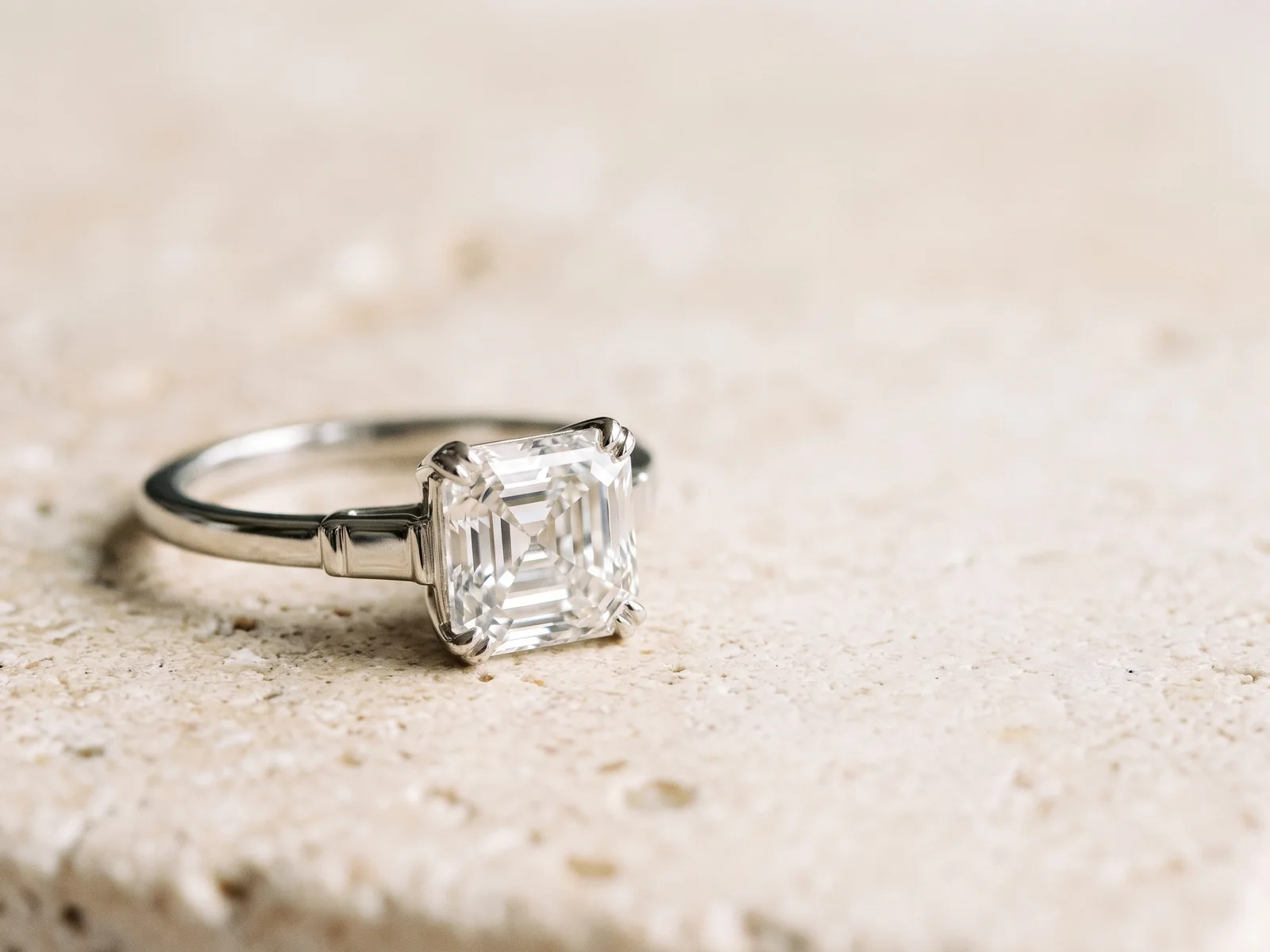
Art deco engagement rings are built on geometry, platinum and fine handwork from the 1920s and 30s. Here is how to read one, from the gallery to the milgrain, and how to choose between an antique, a reproduction and a new ring made to order.
 Reviewed by Raj Sood, Graduate Gemologist (GIA), AJP (GIA)Master jeweller and Graduate Gemologist (GIA) · reviewed 4 November 2026
Quick answer
Art deco engagement rings follow the geometric style of roughly 1920–1939: symmetrical lines, octagonal or stepped outlines, milgrain edges, pierced filigree galleries and step-cut or Old European cut diamonds, often with calibré-cut coloured accents. Originals are usually platinum. You can choose an antique, an era-style reproduction or a new ring made to order with period details.
What are art deco engagement rings?
Art deco engagement rings are rings made in, or designed after, the Art Deco style that shaped jewellery from about 1920 to 1939. Earlier Edwardian rings were soft and lacy, with garlands and bows. Deco rings are built on geometry instead: straight lines, stepped outlines, octagons, hexagons and strict symmetry. The look is crisp and architectural, usually white metal and white diamonds, often set off by a line of blue, red, green or black stones.
The term is used for three quite different things, and it helps to know which one you are looking at:
- Antique originals: rings actually made in the period, so now roughly 85 to 105 years old. Each has its own wear, repairs and history.
- Reproductions and Deco-style rings: made from later decades onwards, often cast from moulds of older designs. They look the part but are newer and usually more uniform.
- New rings made to order: designed today with period details such as milgrain and filigree, but with modern settings, metal and a centre stone of your choice.
Deco is a design language rather than one setting type, so it borrows from many of the main engagement ring setting styles, from halos to bezels to three-stone rings. If you are early in your research, our engagement ring education hub puts the style in context, and every workshop term on this page is explained in our plain-English jewellery glossary.
Where did the Art Deco ring style come from?
The name comes from the 1925 Paris exhibition, the Exposition Internationale des Arts Décoratifs et Industriels Modernes. The short label "Art Deco" only became common decades later, in the 1960s; people at the time simply called it modern. Designers drew on Cubist painting, machine-age engineering, skyscrapers, and Egyptian motifs that became fashionable after Tutankhamun's tomb was opened in 1922.
Two technical changes made the style possible. First, platinum. It is strong enough that a few fine claws or beads hold a stone securely, so jewellers could pierce the metal into lace-like openwork without the ring falling apart. Platinum melts at about 1,768 °C, and it was the spread of high-temperature gas torches in the late 1800s and early 1900s that made it practical to work at the bench. Second, diamond cutting. Step cuts suited the straight-edged look, and the Asscher cut (a square step cut with cropped corners) had been introduced in 1902.
| Era | Approximate dates | Typical look | Usual metal |
|---|---|---|---|
| Edwardian | about 1901–1915 | Lacy, garlands, bows, very fine milgrain | Platinum, or platinum over gold |
| Art Deco | about 1920–1939 | Geometric, symmetrical, step cuts, coloured accents | Platinum; some white gold |
| Retro | about 1939–1950 | Bold, curved, chunky | Yellow and rose gold |
| Mid-century | about 1950–1965 | Simpler shapes, raised centre stones | White and yellow gold, platinum |
The end of the period was shaped by war. During the Second World War platinum was restricted for military use in the United States and elsewhere, so late-1930s and 1940s rings are more often white or yellow gold. After the war, the plain single-stone solitaire ring became the default engagement ring, and the busy geometric Deco look faded until its revival from the 1970s onwards.
What are the parts of an art deco engagement ring?
Deco rings pack a lot of detail into a small space, and each part has a name. Knowing them makes it much easier to compare rings, read a description or brief a jeweller.
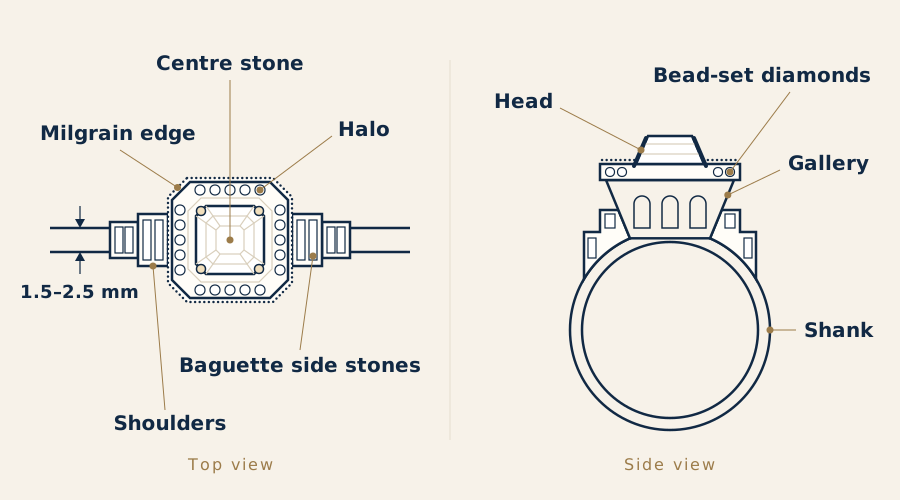
- Head: the part that holds the centre stone. In Deco rings it is often a square, octagonal or hexagonal plate, or a raised box with four to eight claws.
- Halo or cluster: a frame of small diamonds around the centre, frequently octagonal rather than round.
- Shoulders: where the band meets the head. Deco shoulders often step down in tiers, set with baguettes (small rectangular step-cut stones) or engraved with geometric patterns.
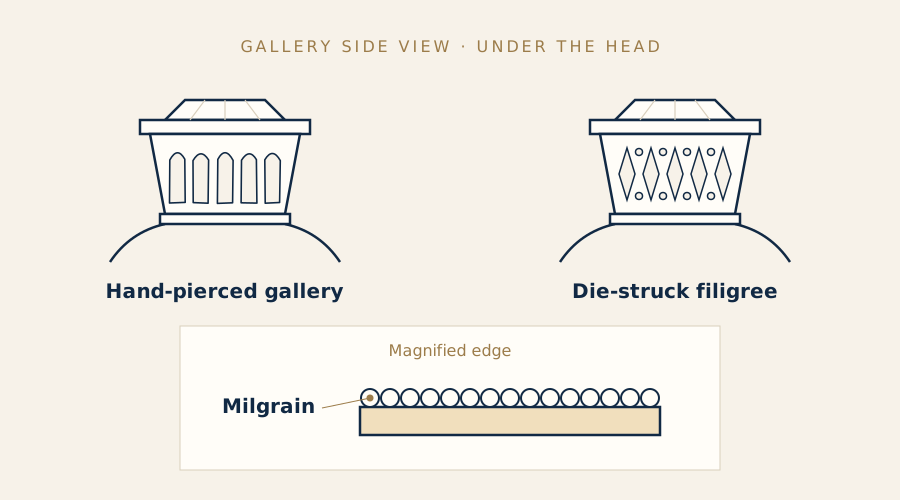
- Gallery: the side profile under the head. In Deco rings it is usually pierced into windows, arches or filigree (fine openwork metal).
- Milgrain: a row of tiny metal beads pressed along an edge with a knurled wheel. It softens the line and catches light.
- Bead or grain setting: tiny diamonds held by small beads of metal raised from the surface with a graver, rather than by claws.
- Shank: the band itself. Antique shanks are often slim, around 1.5–2.5 mm wide, and may have worn thinner underneath.
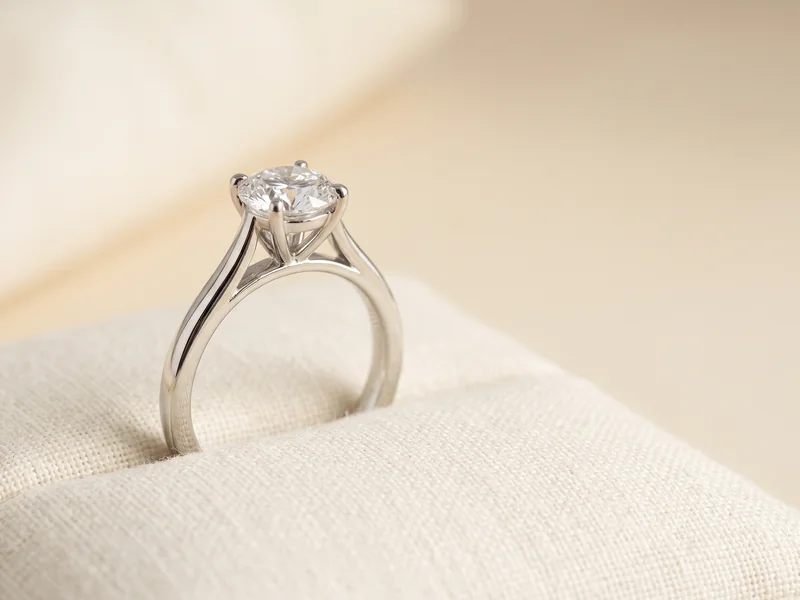
The head is where Deco differs most from modern rings. Many modern rings use one of the heads compared in our guide to how basket, trellis and peg heads differ; a Deco head is usually lower and flatter, sitting close to the finger. Some new Deco-style rings lift the centre stone higher on cathedral shoulders that arch up to the head, which adds presence but moves away from the period profile.
Which diamond cuts suit art deco engagement rings?
The centre stone decides how period-accurate a ring feels. Diamond is 10 on the Mohs hardness scale, with a refractive index (how strongly it bends light) of about 2.42, but the way it is cut changes the whole character. Deco jewellers used the cuts below:
| Cut | What it looks like | Period-accurate? | Worth knowing |
|---|---|---|---|
| Old European cut | Round, small table, high crown, open culet; broad flashes of light | Yes, the most common Deco centre | Often warmer in colour than modern stones |
| Old Mine cut | Cushion outline, chunky facets | Yes, more in early pieces | Each stone is unique in shape |
| Transitional cut | Between Old European and modern round | Yes, late 1920s–1940s | Brighter than Old European, still soft |
| Asscher cut | Square step cut, cropped corners, hall-of-mirrors look | Yes | Ratio about 1.00–1.05; shows clarity |
| Emerald cut | Rectangular step cut with cropped corners | Yes | Ratio about 1.30–1.50; shows clarity |
| Baguette and calibré | Small rectangles and custom-cut shapes in lines | Yes, as side stones | Calibré stones are cut to fit a set space |
| Single cut | Tiny round with about 17 facets | Yes, as halo and bead-set stones | Gentle sparkle, typical of antique melee |
| Modern round brilliant | 57–58 facets, high brilliance | No, but common in reproductions | Looks brighter and more uniform |
Step cuts (rows of long, flat facets parallel to the edges) are the most Deco of all, so an art deco emerald cut engagement ring is a natural choice. Step cuts show clarity more openly than brilliant cuts, so most people choose VS2 or better for an Asscher or emerald cut. Original Old European diamonds often sit around I to L in colour, which looks soft and warm in platinum. A modern centre stone can be cut in these older styles too, and an elongated emerald cut can even be turned sideways, which our guide to setting an elongated stone sideways covers.
A lab-grown art deco engagement ring is simply a new ring with a laboratory-grown diamond in the centre. Lab-grown diamond is real diamond with the same hardness and refractive index, and it is now available in Old European, Asscher and emerald cuts. An antique original will contain natural diamonds, though its coloured accents may be synthetic (see the antique section below).
Not sure which one is right?
Send us the stones you are looking at and our gemologist will tell you which to choose and why.
Which art deco ring settings and styles are most common?
Most art deco ring settings fall into a handful of recognisable layouts. Many combine two or three of them in one ring.
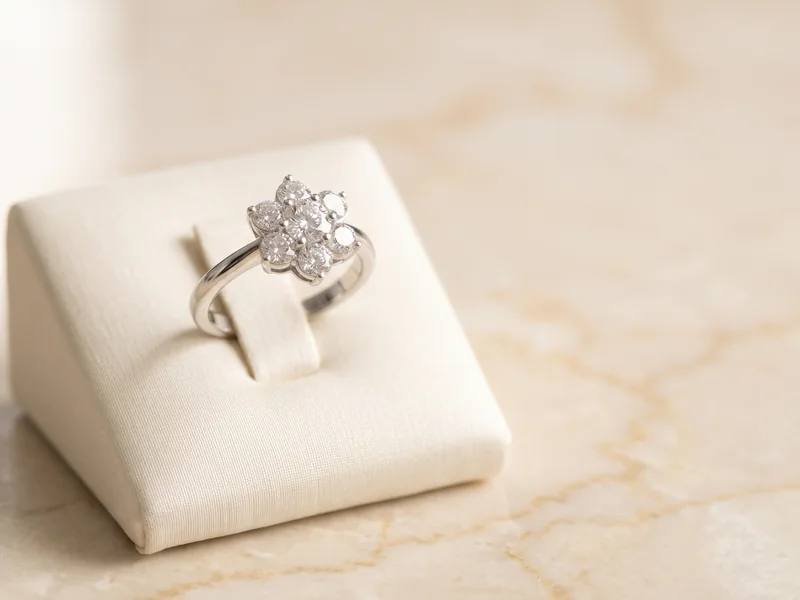
- Halo and cluster: the centre surrounded by an octagonal or square frame of single-cut diamonds. An art deco halo engagement ring is the layout most people picture; it echoes cluster rings built from many small diamonds.
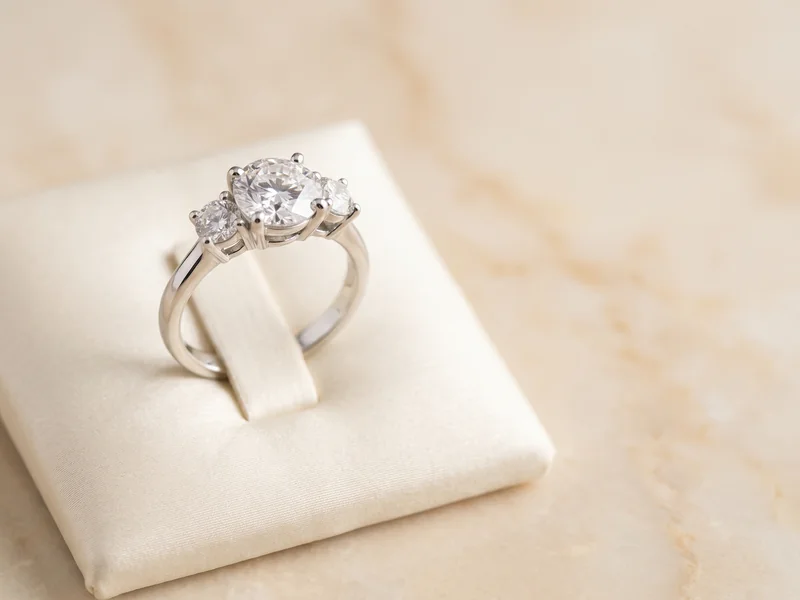
- Three-stone: a centre diamond flanked by two smaller stones, often baguettes or trapezoids, part of the wider family of three-stone engagement designs.
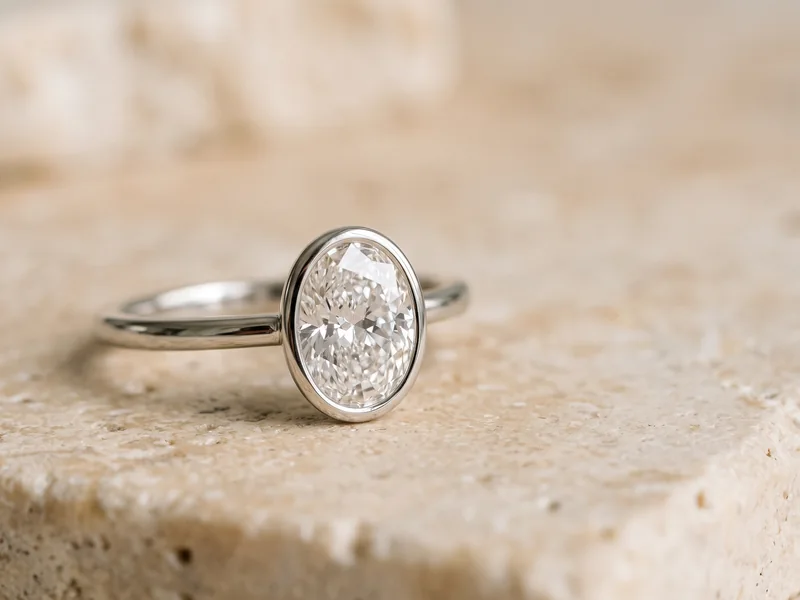
- Collet and bezel: the centre held in a rim of metal, edged with milgrain. Our guide to a full bezel, a metal rim around the stone explains the pros and cons.
- Plaque or panel: a wide flat top, often rectangular or lozenge-shaped, covered in bead-set diamonds, sometimes with no single large centre stone.
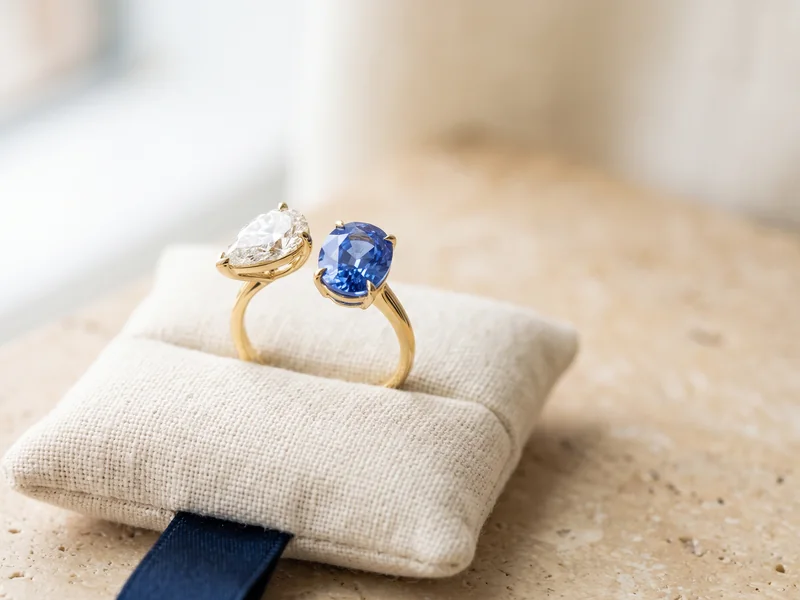
- Toi et moi: two stones side by side. Pairs of diamonds, or a diamond with a sapphire, appear in the period; see two-stone toi et moi rings.
- Crossover: shoulders that sweep past each other, an idea shared with bypass bands that wrap past each other.
Strict symmetry is part of the Deco rulebook, so period rings almost never lean to one side. New designers sometimes break that rule on purpose and borrow Deco detail for deliberately asymmetrical designs, or open up the band into a split shank that divides near the head. At the far end of the spectrum, tension and suspended settings hold a stone with almost no visible metal, the opposite of Deco's detailed metalwork.
Related guideCluster Engagement RingsWhich metal suits an art deco engagement ring?
Platinum is the period-accurate choice. In Australia most platinum jewellery today is 950 (95% platinum), while many older American rings are 90% platinum with 10% iridium. Platinum is dense, about 21.4 grams per cubic centimetre, so a platinum art deco ring feels noticeably heavier than the same ring in gold. It stays white without plating and develops a soft grey patina with wear, which suits antique styling. Its weakness is that fine milgrain and beads gradually flatten over years of daily wear.
18ct white gold is 75% gold alloyed with whiter metals, and is usually rhodium-plated for a bright white finish. The plating wears through, often within one to three years depending on how the ring is worn, and needs re-plating. White gold was introduced in the 1910s, so some late Deco rings are made of it. Two-tone rings, with a platinum top over a yellow gold shank, were also common: the white top flattered the diamonds while the gold made the band cheaper and warmer against the skin.
Yellow and rose gold are not typical of the period, but they work well in a modern ring that uses Deco shapes, and they make a warmer-coloured centre stone look whiter. Fine milgrain and filigree are easiest to keep crisp in platinum, so if you want a lot of detail on a ring you will wear every day, that is worth weighing up.
How can you tell an antique art deco ring from a reproduction?
An honest seller should describe any ring as antique, vintage, reproduction or new. If you are weighing up an antique vs reproduction art deco ring, these are the details a gemmologist checks under a loupe (a 10× magnifier):
| Feature | Antique original (about 1920–1939) | Reproduction or new Deco-style |
|---|---|---|
| Centre stone | Old European, Old Mine or transitional cut, often replaced over time | Usually modern round, emerald or Asscher cut |
| Small diamonds | Single cuts or rose cuts, slightly uneven | Full-cut brilliants, very uniform |
| Filigree | Hand-pierced, or die-struck with crisp sharp detail | Usually cast, with softer, rounder edges |
| Milgrain | Worn and softened in places | Even and sharp all round |
| Marks | PLAT, IRIDPLAT, 18ct, or a dated British hallmark | Modern maker's and fineness marks, or none |
| Coloured accents | Often synthetic sapphire or ruby, onyx, or glass | Natural or lab-created stones, or cubic zirconia |
| Wear | Thinned shank, flattened beads, old repairs | Little or none |
Coloured accents surprise many buyers. Synthetic ruby and sapphire were made by the Verneuil flame-fusion process from the early 1900s, and they were cheap enough to cut into the many tiny calibré stones that Deco designs needed. Under magnification, flame-fusion synthetics show curved growth lines, while natural corundum shows straight or angular growth. A synthetic accent is not a fault in an antique ring, but it should be described accurately as synthetic.
Also watch for married rings, where an old head has been fitted to a new shank, or an original centre stone has been swapped for a modern one. Neither is a problem if it is disclosed, but it changes what you are paying for. Ask for a written description that lists the metal, every stone type and any known replacements.
Are antique art deco engagement rings practical for everyday wear?
Yes, with sensible checks. The diamonds are tough enough for daily life; the risk is in the metal and the softer accents. Claws and beads that have held a stone for 90 years are often worn thin, and a slim shank may have worn to well under 1 mm on the underside. Onyx (dyed chalcedony) is only about 6.5–7 on the Mohs scale, and emerald, at 7.5–8, is brittle, so accents of either are more easily chipped than sapphire at 9 or diamond at 10.
- Have it checked every 6 to 12 months, especially the claws on the centre stone.
- Take it off for the gym, gardening and heavy lifting; pierced galleries can catch and bend.
- Avoid ultrasonic cleaners for rings with emeralds, onyx, glass or any stone that feels loose. Warm water, mild soap and a soft brush are safer.
- Resize with care. Pierced shanks and filigree can distort; many rings can go up or down about one to two sizes, but continuous patterns may limit that.
A wedding band also needs thought, because Deco heads are often wide and low. Contoured bands are common, and a slim band with diamonds in flush or gypsy settings for a low profile sits close without catching the milgrain edges. When an antique is too fragile to wear daily, many owners have it remade: the original stones reset in a new mount drawn from the old design.
How much do art deco engagement rings cost in Australia?
Art deco ring price in Australia depends first on whether you buy an antique or a new ring, and then on the centre stone. The ranges below are broad guides only; condition, provenance and the exact diamond grades move prices a long way.
| Type of ring | Approximate price range (AUD) |
|---|---|
| Antique original, centre under 0.50 ct | about $2,500–$8,000 |
| Antique original, 1 ct Old European centre | about $10,000–$30,000 |
| New Deco-style setting only, 18ct gold or platinum | about $2,000–$6,000 |
| New setting with a 1 ct lab-grown centre, G–H VS | about $3,000–$8,000 |
| New setting with a 1 ct natural centre, G–H VS | about $9,000–$20,000 |
Lab-grown diamonds cost much less than natural diamonds of the same size and grade, and they make larger Asscher or emerald cut centres more affordable. Natural diamonds are rarer, and natural Old European cut stones are no longer cut in quantity, so a well-preserved antique stone carries its own premium. Platinum settings usually cost more than 18ct gold because of the metal's density and the extra bench time it takes to finish milgrain and piercing. Neither natural nor antique rings should be bought on the expectation that they will rise in value; choose the ring you want to wear.
Explore ring settings and create your own art deco ring
How do you choose an art deco engagement ring? Step by step
- Decide antique, reproduction or new. Antiques carry history and wear; new rings give you choice of stone, metal and size.
- Pick the centre cut. Asscher, emerald or Old European for period accuracy; a modern round if you want maximum sparkle.
- Choose the layout. Halo, three-stone, bezel, plaque or toi et moi, keeping the outline symmetrical for a true Deco look.
- Check the metalwork. Look at the gallery, milgrain and beads under a loupe, and confirm the metal type and marks.
- Ask what every stone is. Natural or lab-grown diamond, and natural, synthetic or imitation coloured accents, in writing.
- Plan the band and the upkeep. Confirm a wedding band will sit beside it, how far it can be resized and when it should next be checked.
Free consultation
Talk to a gemologist
Compare stones in person or online with Raj Sood, Graduate Gemologist (GIA), AJP (GIA).
Book a consultationShop this shape
FAQ
Common questions
What makes a ring art deco?
Geometry and symmetry: stepped or octagonal outlines, milgrain edges, pierced galleries, step-cut or Old European cut diamonds and often calibré-cut coloured accents. Original pieces date from about 1920 to 1939 and are usually platinum.
Are art deco engagement rings always platinum?
Most originals are platinum or platinum-topped gold, though some late pieces are white gold. New Deco-style rings are made in platinum, white gold, yellow gold or rose gold.
Can an antique art deco ring be resized?
Usually, but with care. Many can move about one to two sizes; continuous filigree, engraving or stones all the way around the band can limit resizing, so have a jeweller inspect it first.
Can I have a lab-grown diamond in an art deco engagement ring?
Yes. A new Deco-style ring can hold a lab-grown diamond cut as an Asscher, emerald or Old European cut. An original antique ring will have natural diamonds, unless a stone has been replaced.
Are the sapphires in antique art deco rings real?
Often they are synthetic sapphires, which were widely used for calibré accents from the early 1900s. They are real corundum made in a laboratory, and a gemmologist can identify them under magnification.
What wedding band goes with an art deco engagement ring?
A contoured band, or a slim band with milgrain or flush-set diamonds, usually sits most comfortably beside a wide, low Deco head. Try the two rings together before deciding.

Ask a gemologist
Not sure which diamond to choose?
Raj Sood is a Graduate Gemologist (GIA) and master jeweller. Bring the stones you are considering, or send the reports, and he will tell you honestly which one is better and why.
Keep learning
Related guides
 Engagement Rings & SettingsCluster Engagement Rings
 Engagement Rings & SettingsBezel Set Engagement Rings
 Engagement Rings & SettingsThree-Stone Engagement Rings
 Engagement Rings & SettingsAsymmetrical Engagement Rings
 Engagement Rings & SettingsSolitaire Engagement Rings
 Engagement Rings & SettingsCathedral Engagement RingsEngagement Rings & SettingsEngagement Rings & Education
Explore more
More guides on this topic
Education