
- Education
- Engagement Rings & Settings
- Bypass Engagement Ring Guide: Construction, Security, Stones and Band Fit
Engagement Rings & Settings
Bypass Engagement Ring Guide: Construction, Security, Stones and Band Fit
A bypass engagement ring wraps the band around the centre stone instead of meeting beneath it, which gives the ring movement and a softer look. Here is how the setting is built, how secure it is, which stones suit it and how it wears over the years.
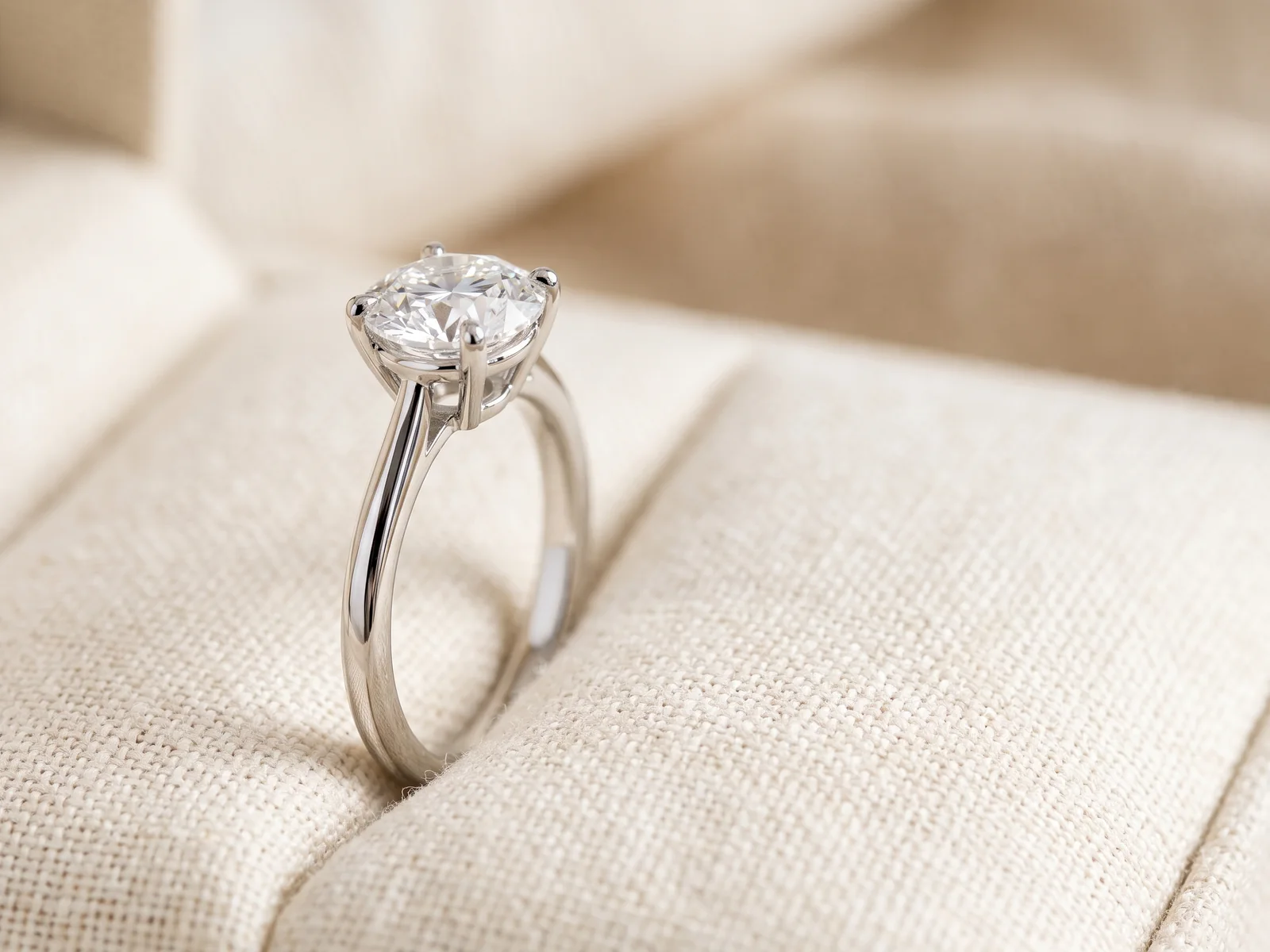
 Reviewed by Raj Sood, Graduate Gemologist (GIA), AJP (GIA)Master jeweller and Graduate Gemologist (GIA) · reviewed 4 November 2026
Quick answer
A bypass engagement ring has a band whose two ends don't meet under the stone but slide past each other, curving around the centre diamond from opposite sides. It suits rounds, ovals and pears from about 0.50 carat, needs well-anchored claws or a bezel, and usually pairs with a contoured or curved wedding band.
What is a bypass engagement ring?
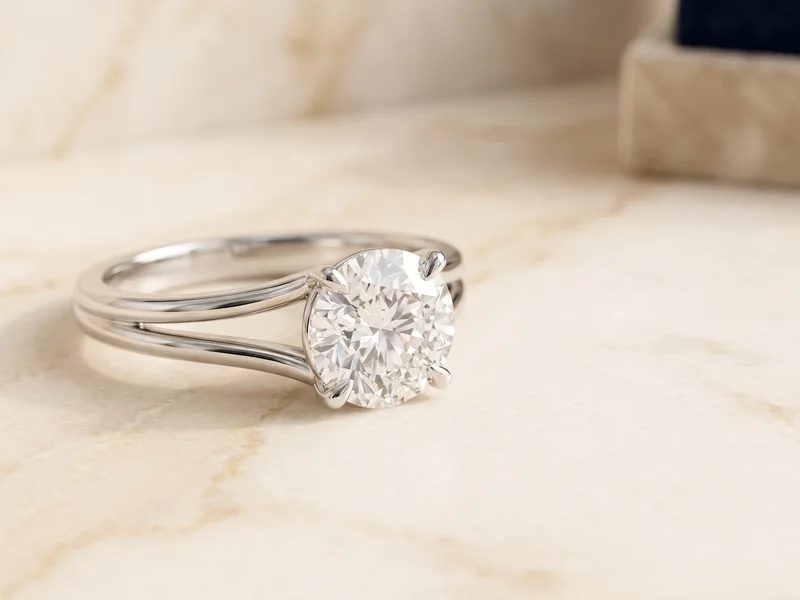
A bypass engagement ring is a ring where the two ends of the shank (the band that goes around your finger) don't join in a straight line beneath the centre stone. Instead they pass by each other: one end rises on one side of the stone and the other end on the opposite side, so the band seems to wrap or swirl around the diamond. Seen from above, the metal forms a soft S-curve or a gentle diagonal through the setting.
You will also see it called a crossover engagement ring, a swirl ring or a wrap ring. Jewellers don't all use these names the same way, but the idea is consistent: the band is open at the top and the stone sits in, or is held by, the space where the two ends overlap. Crossover rings have appeared in jewellery for well over a century, and the two-stone toi et moi (French for 'you and me'), with one stone on each end of the band, is one of the oldest forms.
The bypass sits within the wider family of settings covered in our guide to engagement ring setting styles. Because the two sides of a bypass are rarely mirror images, it also overlaps with asymmetrical engagement ring designs. If any term on this page is new to you, our glossary of jewellery terms explains it in plain English.
How is a bypass ring setting built?
Every bypass ring setting has the same basic parts. How they are proportioned decides whether the ring feels light and flowing or heavy and awkward, and whether it will still be sound in twenty years.
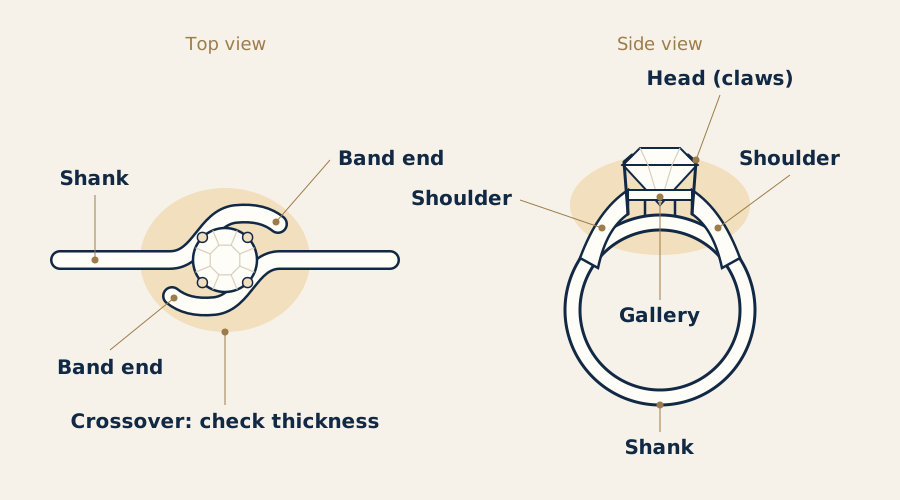
- Shank: the band itself. In a bypass it is usually 1.8–2.5 mm wide at the back of the finger.
- Shoulders: the parts of the band either side of the stone. In a bypass they rise at different points, one ahead of the stone and one behind it.
- Band ends (terminals): the two ends that curve past each other. They can be plain, tapered, set with small diamonds or finished with a second stone.
- Head: the claws or bezel (a thin rim of metal around the stone) that actually hold the centre stone.
- Gallery: the metalwork under the stone, visible from the side, which joins the head to the band.
There are two main ways to build it. In a head-in-the-gap design, a separate claw or bezel head sits between the two ends and is joined to both, so the stone is held by a conventional head and the bypass ends are mostly decorative. In a shank-held design, the ends themselves do the holding: each end splits into claws, or curves into a half-bezel that grips one side of the stone. Shank-held designs look lighter and more fluid, but the joints are under more strain and the metalwork needs to be thicker to compensate.
The choice of head matters as much as the band. Our comparison of basket, trellis and peg head settings explains how each type of head is attached and how easily it can be retipped later. In a bypass, the side profile is unusually visible because the band sweeps up past the stone, so it is worth looking at decorative under-gallery work such as hidden halos or small engraved bridges.
What styles of bypass engagement ring are there?
The bypass is a framework rather than a single design, and it combines well with other setting ideas:
- Classic solitaire bypass: one centre stone with plain, polished ends sweeping past it. Clean and understated.
- Pavé bypass: small diamonds, usually 1–1.5 mm, set along one or both ends so the sparkle follows the curve.
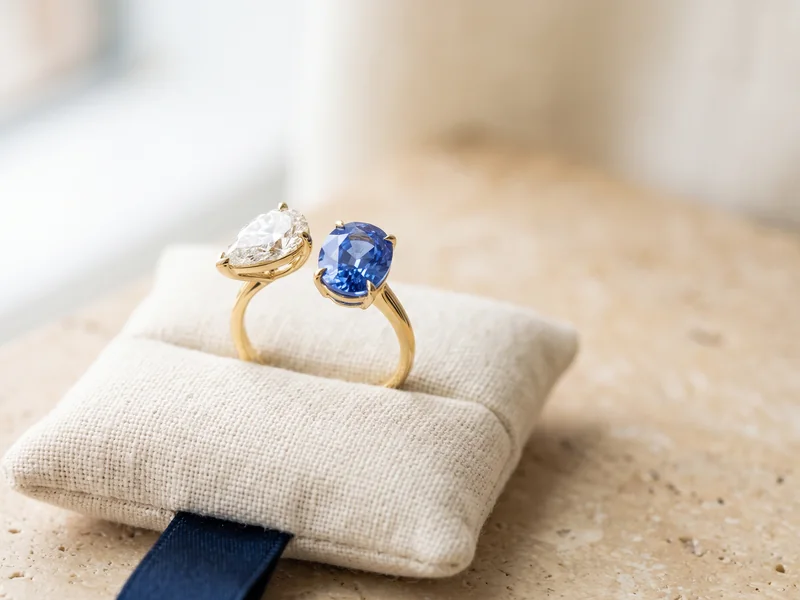
- Toi et moi bypass: two stones, one on each end, often of different shapes or colours, such as a pear with a round or a diamond with a sapphire.
- Bypass with accent stones: smaller diamonds set where the ends meet the head. This sits close to the side-stone engagement ring family, and a three-stone version echoes classic three-stone rings but on a diagonal.
- Cluster-end bypass: each end finishes in a small group of stones, a look shared with cluster engagement rings.
- East-west bypass: an oval, emerald or marquise set sideways across the finger, so the curve of the band and the length of the stone run in the same direction. See our page on stones set sideways across the finger.
- Tension-look bypass: the ends appear to squeeze the stone between them. A true tension setting holds the stone by spring pressure alone; most tension-look bypass rings hide small claws or a partial bezel to do the real work.
Is a bypass engagement ring secure for everyday wear?
Yes, when it is well made. The main thing to understand is where a bypass is weaker than a straight solitaire. In a straight band, the head sits on top of a continuous ring of metal. In a bypass, the head is attached to two ends coming from different directions, so the crossover zone carries the knocks and the twisting forces of daily wear.
- Metal at the crossover: for daily wear, look for at least about 1.5–1.8 mm of thickness where the ends join the head. Very fine, wiry ends look delicate in photos but bend over time.
- Claws: four claws is standard for a round; six spreads the load and keeps the stone in if one claw is damaged. Each claw tip should be at least about 0.9–1.0 mm across when new.
- Bezel or half-bezel: wraps more of the girdle (the outer edge of the stone) and is the most protective option for active hands.
- Exposed ends: raised terminals can catch on knitwear, hair and gloves. Rounded, low-profile ends catch less.
The metal also changes how a bypass wears. This table is a general guide to the alloys used for engagement rings in Australia.
| Metal | Fine metal content | How it behaves in a bypass |
|---|---|---|
| Platinum 950 | 95% platinum | Dense and heavy; scratches move metal rather than lose it, so claws and ends stay solid for longer |
| 18ct white gold | 75% gold | Firm and holds claws well; usually rhodium plated, which wears and needs replating |
| 18ct yellow or rose gold | 75% gold | Warm colour with no plating to wear off; rose gold is a little harder than yellow |
| 9ct gold | 37.5% gold | Lower cost; can be less forgiving in thin sections, so keep the crossover generous |
Not sure which one is right?
Send us the stones you are looking at and our gemologist will tell you which to choose and why.
Which diamond shapes suit a bypass engagement ring?
Curved outlines suit the bypass naturally because the sweep of the band echoes the stone. Shapes with corners can work too, but the contrast is stronger and the corners need careful protection.
| Shape | How it suits a bypass | What to watch |
|---|---|---|
| Round | Very well; the curve flows around it from any angle | Smaller rounds under 0.50 ct can get lost between the ends |
| Oval | Very well, set north-south or east-west | Bow-tie (a dark band across the middle) in poorly cut ovals |
| Pear | Very well; the point can follow the direction of the swirl | Protect the point with a V-claw |
| Marquise | Well, especially set slightly on an angle | Two points to protect |
| Cushion | Well; softened corners blend with the curves | Check claws sit on the corners |
| Emerald or Asscher | Possible; gives a deliberate contrast of lines and curves | Cut corners need claws placed squarely |
| Princess | Possible but less common | Sharp corners are among the most exposed of any shape |
| Heart | Works in a romantic swirl design | Lobes, cleft and point all need care |
For pears, marquises and other pointed stones, the band end should never run straight at the point without a claw covering it. Our guide to placing claws on pointed diamond shapes shows where the claws should sit. Size matters too: from about 0.50 to 2 carats the stone and the band ends stay in proportion. Much larger stones can make a bypass look top-heavy unless the ends are widened.
Diamond (10 on the Mohs hardness scale, refractive index about 2.42) is the obvious choice. Sapphire and ruby (both 9) and moissanite (about 9.25) also handle daily wear well, as do lab-created sapphires, which have the same hardness as natural ones. Softer or more brittle stones, such as opal (about 5.5–6.5) and emerald (7.5–8, often with fractures), are better kept for occasional wear or a protective bezel, because the open design of a bypass leaves more of the stone's edge exposed.
Can you wear a wedding band with a bypass engagement ring?
You can, but a straight wedding band rarely sits flush. The ends of a bypass curve out past the stone, often one towards the hand and one towards the fingertip, so a straight band touches the engagement ring at one point and leaves a gap beside it. Some people like that gap; others want the two rings to lock together.
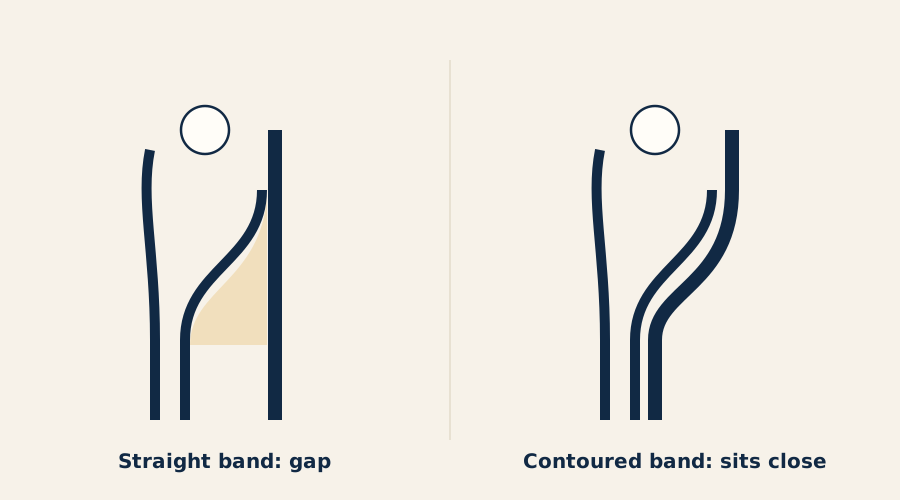
- Contoured band: shaped to follow the curve of the bypass end. Usually made to order for the specific engagement ring.
- Notched band: a small dip that lets the head or one end nest into it.
- Matching swirl band: a second bypass-style band that mirrors the first, so the pair forms one design.
- Spaced stack: a straight band worn deliberately with a gap, or on the other hand.
Head height affects this as much as the curve. If the gallery sits high enough, a straight band can slide partly under the head; our page on how setting height affects wedding band fit explains the measurements. For a straight-ish partner with texture, twisted wedding bands repeat the movement of a bypass well. A knife-edge band with its sharp central ridge reads slimmer beside a busy engagement ring, while a band that widens towards the top can balance a bypass with a larger centre stone.
How does a bypass ring wear over the years?
From the repair bench, the same few things come back in bypass rings again and again. None of them are reasons to avoid the style, but they are worth knowing before you choose a design.
- Thinning at the back of the shank: the palm side of any ring wears with use. In a bypass the band is often slimmer to keep it elegant, so it reaches a worn state sooner.
- Claw wear: claw tips wear down over about 10–20 years of daily wear, faster on hands that work. Retipping (adding new metal to the tip) is routine.
- Stress at the crossover joints: knocks to one end twist the head slightly. Over years this can loosen the stone, which is why the joints need checking.
- Plating wear: rhodium on white gold usually wears through in roughly 12–24 months, showing a warmer tone first on the ends that touch other rings.
- Resizing limits: stretching or shrinking a bypass changes the gap between the ends. Most can go up or down about one to two sizes; pavé along the shank limits this further.
A yearly check of the claws, the crossover joints and the back of the shank catches most problems early. Clean it gently with warm water, mild detergent and a soft brush, paying attention to the space under the bypass ends where soap and lotion collect.
Related guideSplit Shank Engagement RingsHow does a bypass compare with split shank, twisted and solitaire rings?
| Bypass | Split shank | Twisted band | Classic solitaire | |
|---|---|---|---|---|
| Band shape | Two ends pass each other at the stone | Band divides into two near the head | Strands twist along the band | Single straight band |
| Look | Flowing, asymmetric movement | Wide, open and symmetrical | Textured, rope-like | Simple, centre stone first |
| Security | Good with solid joints | Good; load spread over two arms | Good; check pavé if set | Very good; simplest structure |
| Wedding band fit | Usually contoured or custom | Straight bands often fit | Straight bands often fit | Straight bands usually fit |
| Resizing | About 1–2 sizes | Moderate | Limited if pavé set | Easiest |
| Snag risk | Moderate (raised ends) | Low to moderate | Low | Low |
A bypass and a split shank both open up the band near the stone, but in opposite ways: the bypass shifts the two sides out of line, while a split shank band that forks either side of the head keeps them symmetrical. If you want movement without a custom wedding band, a twisted or split shank is easier to pair. If you want the ring itself to be the statement, the bypass gives more character from the same centre stone.
How much does a bypass engagement ring cost?
The setting itself usually costs a little more than a plain solitaire because the band is shaped by hand or designed in CAD, and the crossover joints take more finishing. Pavé, a second stone or a custom contoured wedding band all add to the total. The centre stone is still the biggest cost.
| Ring | Approximate price range (AUD) |
|---|---|
| Bypass setting only, 18ct gold, plain ends | about $1,800–$4,000 |
| Bypass setting only, platinum, plain ends | about $2,500–$5,500 |
| Complete ring, 1 ct lab-grown round, G–H VS | about $3,500–$8,000 |
| Complete ring, 1 ct natural round, G–H VS | about $10,000–$25,000 |
These are broad ranges only and move with metal prices and the exact stone grades. Lab-grown diamonds are real diamond grown in a laboratory rather than mined; they look the same as natural diamonds, cost much less and should be identified as laboratory-grown on their grading report. Natural diamonds are rarer and priced accordingly. Both suit a bypass equally well. For the wider picture of styles, metals and stones, start at our engagement rings and education hub.
Explore ring settings and create your ring
How do you choose a bypass engagement ring? Step by step
- Choose the centre stone first. Decide shape and size; rounds, ovals and pears from about 0.50 carat suit a bypass most easily.
- Pick head or shank-held. A separate head is easier to retip later; shank-held looks lighter but needs thicker metal.
- Check the crossover side-on. Look for solid joints of about 1.5 mm or more where the ends meet the head.
- Protect points and corners. Make sure every point or corner has a claw or bezel over it.
- Choose the metal. Platinum or 18ct gold for thin, curved ends; think about plating upkeep with white gold.
- Plan the wedding band now. Decide whether you want a contoured band, a matching swirl or a deliberate gap.
- Try it on. Check the ends don't catch on clothing and that the ring sits straight on your finger.
Free consultation
Talk to a gemologist
Compare stones in person or online with Raj Sood, Graduate Gemologist (GIA), AJP (GIA).
Book a consultationShop this shape
FAQ
Common questions
Are bypass engagement rings secure?
Yes, if the joints where the band ends meet the head are solid and the stone is held by sturdy claws or a bezel. Very fine, wiry ends are the weak point, so check the crossover side-on before you choose.
What wedding band goes with a bypass engagement ring?
A contoured or curved band shaped to follow the bypass usually sits closest. A matching swirl band or a straight band worn with a small gap are also common choices.
What is the difference between a bypass and a crossover ring?
They are mostly two names for the same idea: a band whose ends pass each other at the stone rather than meeting in a straight line. Some jewellers use crossover for designs where the ends visibly overlap.
Can a bypass engagement ring be resized?
Usually by about one to two sizes, because changing the size also changes the gap between the ends. Pavé along the band limits resizing further, so get the size right at the start.
Which diamond shape looks good in a bypass setting?
Round, oval and pear shapes suit it most naturally because their curves echo the band. Marquise, cushion and emerald cuts work too, as long as every point or corner is protected.
What is a toi et moi bypass ring?
It is a bypass ring with one stone on each end of the band, sitting side by side. The name is French for 'you and me', and the two stones are often different shapes or colours.
Terms in this guide

Ask a gemologist
Not sure which diamond to choose?
Raj Sood is a Graduate Gemologist (GIA) and master jeweller. Bring the stones you are considering, or send the reports, and he will tell you honestly which one is better and why.
Keep learning
Related guides
 Engagement Rings & SettingsSplit Shank Engagement Rings
 Engagement Rings & SettingsAsymmetrical Engagement Rings
 Engagement Rings & SettingsSetting Height and Wedding Band FitEngagement Rings & SettingsEngagement Ring Setting Styles GuideEngagement Rings & SettingsEngagement Rings & Education
 Engagement Rings & SettingsThree-Stone Engagement RingsEngagement Rings & SettingsSide-Stone Engagement Rings
 Engagement Rings & SettingsCluster Engagement Rings
Explore more
More guides on this topic
Education