
- Education
- Engagement Rings & Settings
- Engagement Rings: A Complete Australian Guide to Settings, Metals and Stones
Engagement Rings & Settings
Engagement Rings: A Complete Australian Guide to Settings, Metals and Stones
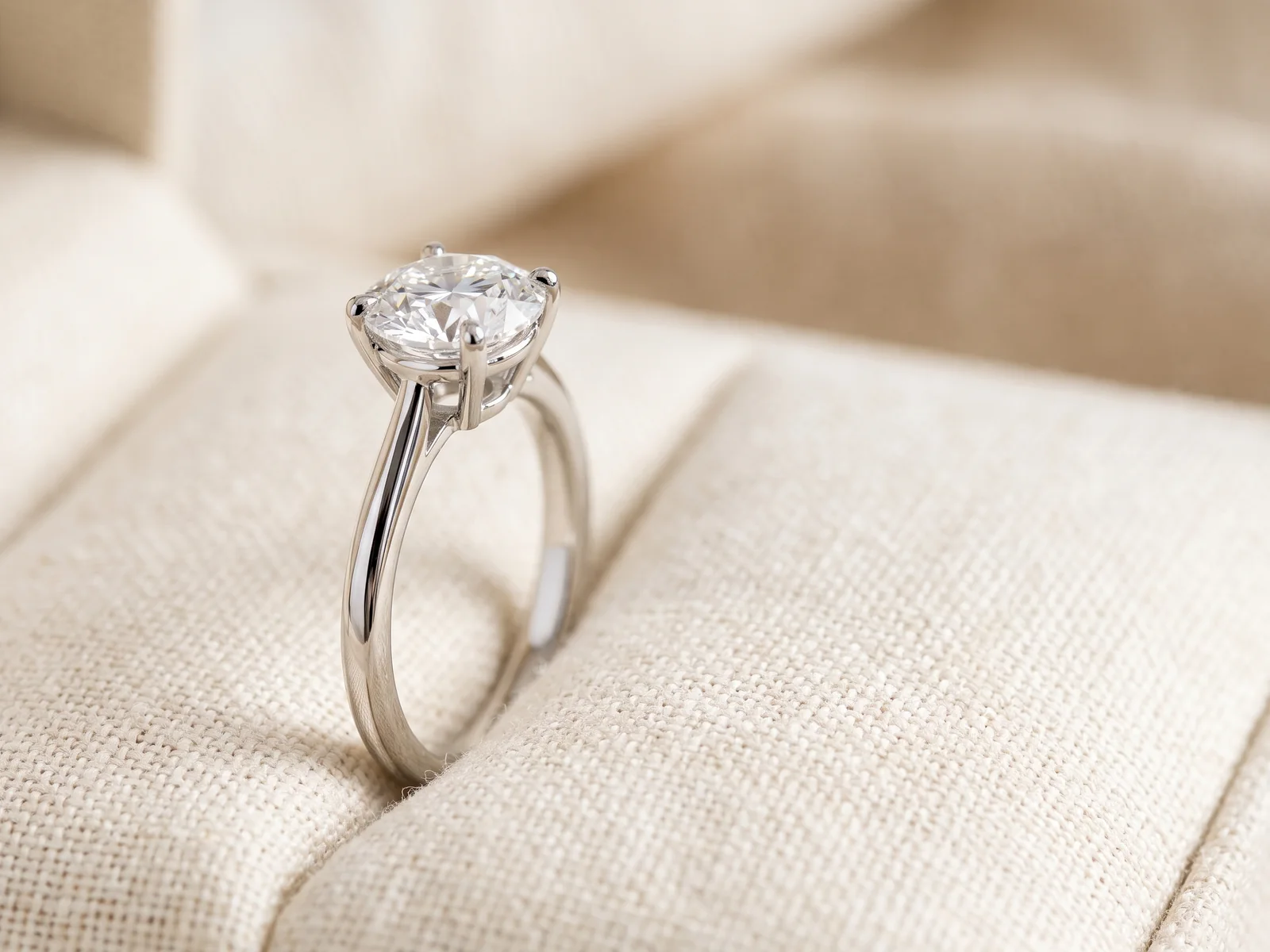
Engagement rings are worn every day for decades, so the choices you make now decide how the ring looks, feels and holds up. This guide covers the setting, metal and centre stone, and how each one wears over the years.
 Reviewed by Raj Sood, Graduate Gemologist (GIA), AJP (GIA)Master jeweller and Graduate Gemologist (GIA) · reviewed 4 November 2026
Quick answer
Engagement rings come down to three choices: the setting (how the centre stone is held, such as claws, bezel or halo), the metal (platinum or 9ct–18ct gold) and the centre stone (natural or lab-grown diamond, or a hard gem like sapphire). Choose a secure setting, a band of at least 1.8 mm, and claw checks every 6–12 months.
What are the parts of an engagement ring?
Every engagement ring, however simple or ornate, is built from the same few parts. Knowing their names makes it much easier to compare designs and to understand what a jeweller is telling you. Our page on every part of a ring, from claw to shank goes into each one in detail; here is the short version.
- Centre stone: the main gem, usually a diamond, set at the top of the ring.
- Head: the structure that holds the centre stone. It might be a set of claws (also called prongs, small metal posts folded over the stone's edge) or a bezel (a thin rim of metal that wraps right around the stone).
- Gallery: the side profile under the centre stone, seen when you look at the ring from the side. It can be plain, open, or decorated with scrollwork.
- Shoulders: the parts of the band either side of the head. They may be plain, set with small diamonds, or tapered.
- Shank: the band itself, the part that goes around the finger. Its width and thickness decide how comfortable and durable the ring is.
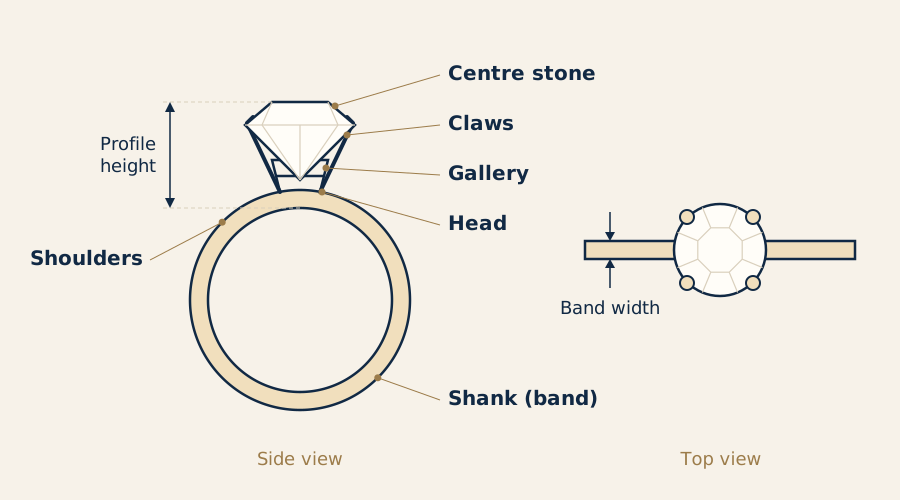
A few other terms come up often. Profile is how high the centre stone sits above the finger: a low-profile ring catches less on clothing and gloves, while a high-profile ring lets more light reach the stone from the side and leaves room for a straight wedding band underneath. Melee are the small diamonds, usually under about 0.18 carat, used in halos and shoulders. If a word in a ring description is new to you, look it up in our A–Z jewellery glossary.
Why do people give engagement rings?
Rings as a sign of a promise to marry go back at least to ancient Rome, where betrothal rings were often made of iron or gold. One of the earliest recorded diamond engagement rings was given by Archduke Maximilian of Austria to Mary of Burgundy in 1477. The modern habit of a diamond solitaire became widespread in the 20th century, helped along by diamond advertising from the 1930s onward. If you enjoy the background, read about the long history of the engagement ring and how wedding rings developed alongside them.
Today there is no single rule. Some couples choose a ring together, some propose with a ring and resize or remake it later, and some choose a coloured gem, a vintage piece or a family stone reset in a new design. Not every ring given in a relationship is an engagement ring, either: see what a promise ring means and how it differs if you are not quite at the proposal stage.
The old idea that you should spend two or three months' salary also came from advertising, not from tradition. The right budget is the one that suits you; the sections below explain where the money goes so you can decide what matters most.
What engagement ring setting styles are there?
The setting is the design of the head and band, and it changes the look of the ring more than anything else apart from the stone. Here are the main engagement ring styles, with how each one wears. Our full guide to engagement ring setting styles has photos and CAD renders of each.
| Setting | What it is | Security | Snags on clothing | Maintenance |
|---|---|---|---|---|
| Solitaire (4 claws) | One centre stone held by four claws | Good | Some | Check claws yearly |
| Solitaire (6 claws) | Six claws; extra grip on rounds | Very good | Some | Check claws yearly |
| Bezel | Metal rim around the whole stone | Excellent | Very little | Low |
| Halo | Ring of small diamonds around the centre | Good (centre); small stones need checks | Some | Check melee claws |
| Hidden halo | Small diamonds set under the centre stone | Good | Some | Check melee claws |
| Three-stone | Centre with a stone either side | Good | Some | Check all claws |
| Pavé band | Small diamonds set across the band | Good | Little | Melee can loosen over years |
| Tension | Stone held by pressure of the band | Varies | Little | Cannot easily be resized |
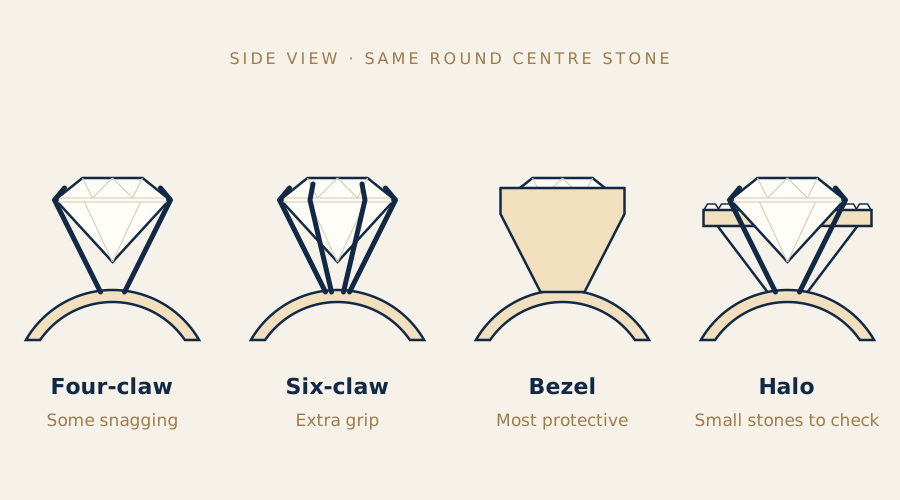
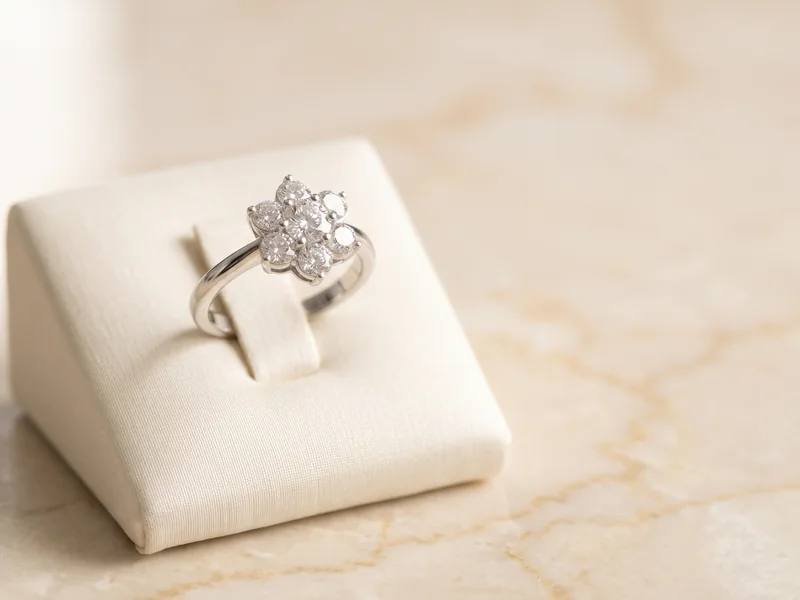
A halo makes the centre stone look larger, because the small diamonds blend with it from a distance. Halo engagement rings work with most shapes, and double halo designs add a second ring of diamonds for even more spread. If you prefer a clean solitaire look from the top but a flash of sparkle from the side, consider the hidden halo, set under the stone.
For something less symmetrical, asymmetrical and toi et moi designs use two stones of different shapes, or set the centre stone off to one side. They are personal and modern, but plan the wedding band early, because uneven shapes can leave a gap against a straight band.
Related guideHalo vs Hidden Halo Engagement RingsAre vintage engagement rings right for you?
Vintage engagement rings, and new rings made in a vintage style, suit people who like detail and character. The main periods have distinct looks:
- Victorian (about 1837–1901): yellow and rose gold, cluster settings, old mine cut diamonds and coloured gems.
- Edwardian (about 1901–1915): platinum lace-like work, milgrain (tiny metal beads along the edges) and delicate open galleries.
- Art Deco (about 1920–1935): geometric shapes, calibré-cut coloured stones, step cuts and strong symmetry.
Our guides to Edwardian and Victorian ring styles and to Art Deco engagement rings from the 1920s and 30s show what to look for in each era. Many vintage designs use filigree metalwork, fine openwork patterns cut or cast into the gallery and shoulders.
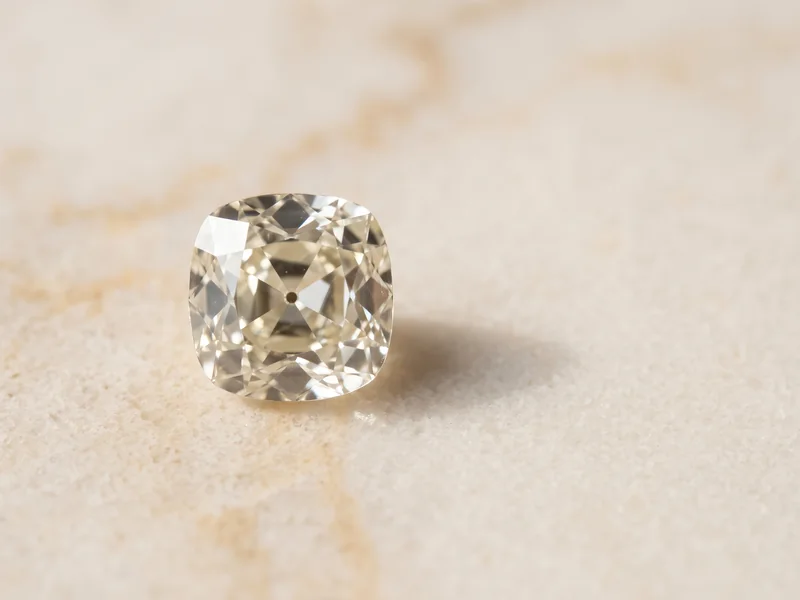
Genuine antique rings need a careful look before purchase. Claws may be worn thin, the shank may have been resized several times, and older stones such as old mine and old European cuts have tall crowns and small tables that need a suitable head. Our page on settings that suit an old mine cut diamond covers how to reset an older stone without losing its character. Fine filigree also softens with wear over many years, so a vintage-style ring made new in a slightly heavier gauge can be the practical choice for everyday wear.
Not sure which one is right?
Send us the stones you are looking at and our gemologist will tell you which to choose and why.
How do engagement ring settings wear over the years?
This is the part most ring guides skip, and it is what we see every week at the repair bench. An engagement ring is worn daily, often for 30 years or more. Metal moves and wears with that use, so it helps to know what to expect.
- Claws: the tips wear down and can bend after knocks. Most rings need their claws checked every 6–12 months, and many need re-tipping (adding new metal to worn claw tips) somewhere between about 5 and 15 years, depending on wear.
- Thin bands: a shank under about 1.8 mm wide or 1.3 mm thick can wear thin at the base and bend out of round. A slightly heavier band lasts much longer.
- Pavé and halos: the small claws holding melee are tiny, so a stone can work loose after a hard knock. Check them at the same time as the main claws.
- Bezels: very durable. The rim may need gentle tightening after decades but rarely loses a stone.
- White gold: most white gold is plated with rhodium (a bright white metal from the platinum family). The plating wears, often within 1–2 years on the underside of the band, and can be re-done.
- Platinum: develops a soft grey sheen called patina. Scratches move metal around rather than removing much of it, so platinum claws tend to hold their shape well.
How you live matters too. Gym work, gardening, nursing and trades are hard on high claws, so a bezel, a low profile or a six-claw head is often a better fit. Halo and hidden halo rings both need their small stones checked; see how a halo and a hidden halo compare in daily wear for the practical differences.
Which metal suits engagement rings best?
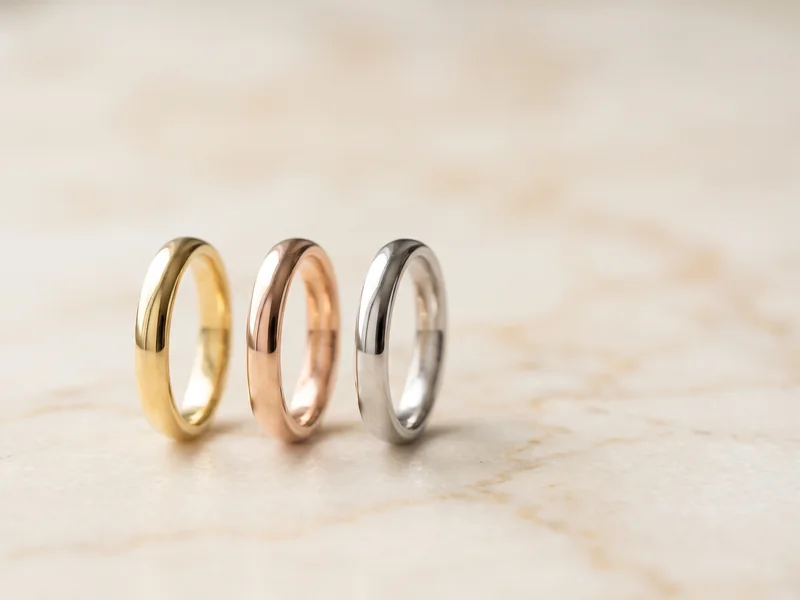
The metal decides colour, weight, durability and upkeep. In Australia gold is sold as 9ct (37.5% gold), 14ct (58.5%) and 18ct (75%), with the rest made up of alloys such as silver, copper, zinc or palladium that give colour and strength. Platinum rings are usually 950 platinum, meaning 95% pure.
| Metal | Colour | Feel | Upkeep | Notes |
|---|---|---|---|---|
| Platinum 950 | Naturally white | Heavy, dense | Polish when wanted; patina forms | Holds claws well; costs more |
| 18ct white gold | White when rhodium plated | Solid | Re-plate every 1–2 years | Warm tone shows as plating wears |
| 18ct yellow gold | Rich yellow | Solid | Polish occasionally | Makes I–J colour diamonds look whiter |
| 18ct rose gold | Pink, from copper | Solid | Polish occasionally | Colour deepens slightly over time |
| 9ct and 14ct gold | Paler tones | Slightly harder | Similar to 18ct | Less gold, lower cost; less common for heads |
A popular approach is a platinum head on a gold band: the platinum claws hold the centre stone securely and stay white, while the band is in the colour you love. Whatever you choose, match the metal of the wedding band to the engagement ring if you can, because harder metals slowly wear softer ones where they rub together.
GemTrove has designed and made rings in Melbourne since 2008, and the family has been in the jewellery trade since 1984. For custom engagement rings, we show a CAD render (a 3D computer model) first, so you can see the profile, claw positions and band width before anything is made.
Which centre stone suits an engagement ring?
Diamond is still the most common centre stone because it is the hardest natural material (10 on the Mohs scale) and has a refractive index of about 2.42, which gives strong sparkle. You can choose a natural diamond, mined from the earth, or a lab-grown diamond, which is real diamond grown in a laboratory with the same hardness and optical properties. Lab-grown diamond engagement rings cost much less for the same size and grades. Our diamond education hub covering cut, colour, clarity and carat explains how to compare either kind.
| Stone | Mohs hardness | Refractive index (approx.) | Everyday wear |
|---|---|---|---|
| Natural diamond | 10 | 2.42 | Excellent |
| Lab-grown diamond | 10 | 2.42 | Excellent |
| Moissanite (lab-created) | 9.25 | 2.65–2.69 | Very good |
| Sapphire (natural or lab-created) | 9 | 1.76–1.77 | Very good |
| Ruby (natural or lab-created) | 9 | 1.76–1.77 | Very good |
| Morganite | 7.5–8 | 1.57–1.59 | Good with a protective setting |
| Emerald | 7.5–8 | 1.57–1.58 | Needs care; often included and brittle |
Hardness is only part of the story. Toughness, a stone's resistance to chipping, matters too. Emeralds usually contain many inclusions (internal features) and can crack from a knock, so they suit a bezel or a well-protected claw setting. Sapphires and rubies are both hard and tough, which makes them a practical coloured choice. Every centre stone of any size should come with an independent report stating whether it is natural, lab-grown or lab-created, and whether it has been treated.
How much do engagement rings cost in Australia?
Price depends far more on the centre stone than the setting. The figures below are broad, approximate ranges only; real prices move with the market, the exact grades and the design.
| Ring (18ct gold solitaire) | Approximate price range (AUD) |
|---|---|
| Setting only, simple solitaire | about $1,500–$3,500 |
| 1 ct lab-grown diamond, G–H, VS | about $2,500–$6,000 |
| 1 ct natural diamond, G–H, VS | about $8,000–$20,000 |
| 1 ct natural blue sapphire | about $3,000–$10,000 |
| Halo or pavé design | add about $800–$3,000 to the setting |
Platinum usually adds to the setting cost because it is denser and harder to work. To make a budget go further, look at carat weights just under the round numbers (0.90 rather than 1.00 carat, for example), consider G–H colour in white metal or I–J in yellow gold, and aim for an eye-clean clarity (no inclusions visible without magnification) rather than the top grades. These figures cover the ring only; resizing, engraving and later maintenance are separate.
Create your ring: browse engagement ring settings
How do you choose an engagement ring? Step by step
- Set a budget. Decide on a range you are comfortable with, then split it between the centre stone and the setting.
- Find the ring size. Australian ring sizes run in letters (with half sizes). Borrow a ring worn on the same finger, or get a free sizing, and note that fingers swell in warm weather.
- Choose the setting style. Match it to daily life: bezel or low six-claw for active hands, halo or high claws for more sparkle.
- Pick the metal. Platinum, white, yellow or rose gold, ideally the same as the future wedding band.
- Choose the centre stone. Natural or lab-grown diamond, or a hard coloured gem, with an independent report.
- Check the CAD render. Look at the side profile, claw positions and band width (aim for at least 1.8 mm) before the ring is made.
- Plan the upkeep. Book a claw check every 6–12 months and keep the report and receipt somewhere safe for insurance.
Free consultation
Talk to a gemologist
Compare stones in person or online with Raj Sood, Graduate Gemologist (GIA), AJP (GIA).
Book a consultationShop this shape
FAQ
Common questions
What is the most popular engagement ring setting?
The claw-set solitaire is still the most common, usually with four or six claws. Halo and hidden halo designs are also widely chosen because they add sparkle and make the centre stone look larger.
Is platinum or white gold better for an engagement ring?
Both work well. Platinum is naturally white, heavier and holds claws well, while white gold is lighter and costs less but needs rhodium re-plating every one to two years to stay bright white.
Are lab-grown diamond engagement rings real diamonds?
Yes. Lab-grown diamonds are real diamond, with the same hardness and sparkle as natural diamonds, grown in a laboratory instead of mined. They cost much less for the same size and grades, and the report will state that they are lab-grown.
How often should an engagement ring be checked?
Every 6 to 12 months is a sensible routine. A jeweller checks the claws, small stones and band thickness, and can re-tip worn claws before a stone is at risk.
Can an engagement ring be resized?
Most plain and solitaire bands can be resized by about one or two sizes. Full pavé, eternity and tension settings are harder or impossible to resize, so it is worth getting the size right first.
How much should I spend on an engagement ring?
There is no rule; the salary formulas came from advertising. Set a budget you are comfortable with, then decide whether size, grades or the setting matter most to you.
Terms in this guide

Ask a gemologist
Not sure which diamond to choose?
Raj Sood is a Graduate Gemologist (GIA) and master jeweller. Bring the stones you are considering, or send the reports, and he will tell you honestly which one is better and why.
Keep learning
Related guides
 Engagement Rings & SettingsEngagement Ring Anatomy
 Engagement Rings & SettingsHalo Engagement Rings
 Diamond 4Cs & GradingDiamond Education
 Engagement Rings & SettingsBest Settings for Old Mine Diamonds
 Engagement Rings & SettingsHistory of Engagement Rings
 Engagement Rings & SettingsHistory of Wedding Rings
 Engagement Rings & SettingsPromise Rings Explained
Explore more
More guides on this topic
Education