
- Education
- Engagement Rings & Settings
- East West Engagement Ring Guide: How Sideways Settings Are Built, Worn and Paired
Engagement Rings & Settings
East West Engagement Ring Guide: How Sideways Settings Are Built, Worn and Paired
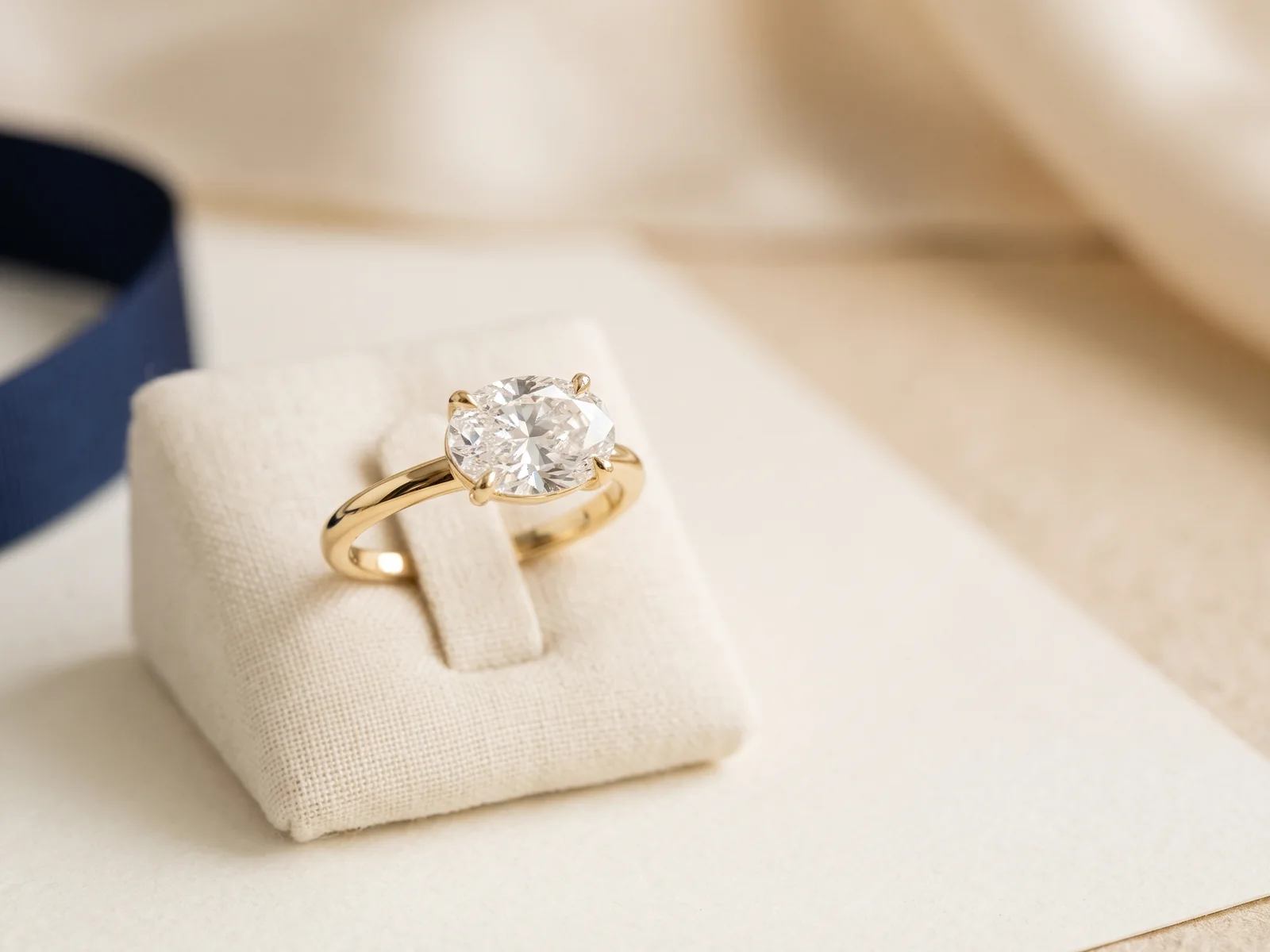
Turning a stone sideways changes how a ring looks, wears and pairs with a wedding band. This east west engagement ring guide covers how the setting is built, which shapes and gemstones suit it, how secure it is and what wears first over the years.
 Reviewed by Raj Sood, Graduate Gemologist (GIA), AJP (GIA)Master jeweller and Graduate Gemologist (GIA) · reviewed 4 November 2026
Quick answer
An east west engagement ring sets an elongated stone, such as an oval, emerald cut, pear or marquise, horizontally across the finger instead of pointing along it. The look is modern and understated. Choose a ratio of about 1.35 or more, four or six claws or a bezel, and check your wedding band sits flush beside it.
What is an east west engagement ring?
An east-west engagement ring (also written east west) is a ring where an elongated centre stone is set horizontally, so its long axis runs across the finger, parallel to the band. The usual arrangement, called north-south, points the stone along the finger towards the fingernail. The setting is the same family of claws or bezels you already know; it is simply turned 90°.
The idea is not new. Horizontal stones appear in Georgian and Victorian rings, and sideways step cuts were common in the geometric designs of the early twentieth century. If you are interested in where these styles came from, our page on how engagement ring styles have changed over the centuries traces the thread. What has changed recently is demand: more people now ask for a sideways oval or emerald cut as their main ring, not just as a fashion piece.
East-west is a head orientation, not a separate setting type. You can have an east-west solitaire, an east-west bezel, an east-west halo or an east-west three-stone. To see how it sits alongside every other style, start with our full guide to engagement ring setting styles. Any term on this page you have not met before is explained in our jewellery glossary of setting terms.
How is an east-west setting built?
Every engagement ring has a head (the part that holds the stone), a gallery (the open metalwork under the stone) and a shank (the band itself). Our guide to the parts of an engagement ring, from head to shank labels each one. In an east-west ring, the head is made or rotated so the stone's long side lines up with the shank.
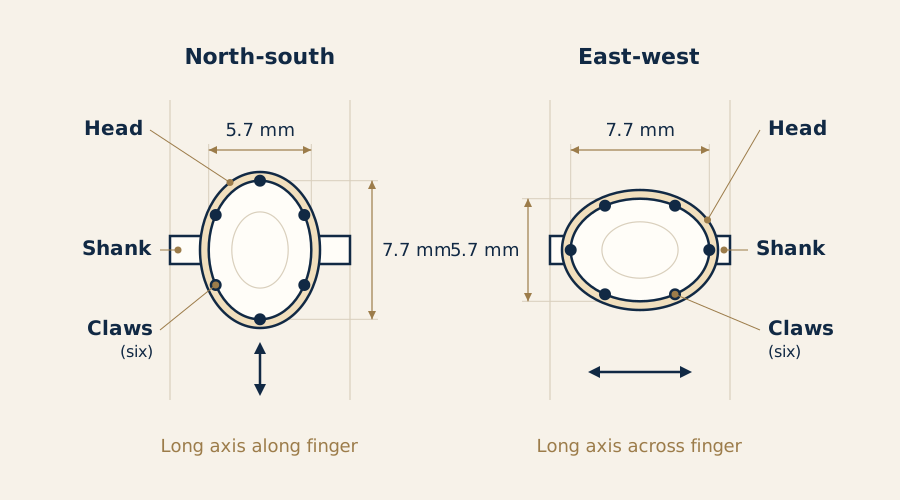
That sounds simple, but it changes the engineering. In a north-south ring, the stone's narrow width sits across the shank, so the head only needs to be a little wider than the band. In an east-west ring, the full length of the stone spans across the top of the finger. A 1 carat oval of about 7.7 × 5.7 mm now presents its 7.7 mm side across the hand, so the head must be wider and the claws or bezel wall sit at the sides, where they meet neighbouring fingers.
- Claws: four claws at the corners or six claws (two on each long side plus one at each end) are most common. Six spreads the load and keeps the stone secure if one claw wears.
- V-claws: any point, such as the tip of a pear or both ends of a marquise, needs a V-shaped claw wrapping it. In east-west settings those points face the neighbouring fingers.
- Bezel: a thin rim of metal around the whole girdle (the stone's outer edge). It is the most protective option for a sideways stone.
- Gallery and shoulders: the shank usually splits or flares into the head so the wider stone looks supported rather than balanced on a thin wire.
With computer-aided design (CAD), the jeweller models the head around the exact measurements of your stone, then checks the claw positions, metal thickness and height before anything is cast. For an east-west ring that matters, because a head copied from a north-south design and simply turned can leave the stone too high or the claws too thin at the sides.
Which diamond shapes suit an east west engagement ring?
The effect depends on the stone being clearly longer than it is wide. The length-to-width ratio is the stone's length divided by its width, taken from the grading report. A round (1.00) looks the same either way, so it gains nothing from being turned. From about 1.35 upwards the sideways line is obvious.
| Shape | Typical ratio | How it reads east-west | Setting notes |
|---|---|---|---|
| Oval | 1.30–1.50 | Soft, modern and the most popular choice | Four or six claws, or a bezel |
| Emerald cut | 1.30–1.50 | Clean, architectural; strong Art Deco feel | Four corner claws or double claws; bezel protects the cut corners |
| Elongated cushion | 1.15–1.30 | Subtle; can look nearly square | Choose 1.25+ so the turn shows |
| Radiant (elongated) | 1.20–1.40 | Bright and geometric | Corner claws protect the trimmed corners |
| Pear | 1.45–1.75 | Asymmetric, point facing sideways | V-claw on the point is essential |
| Marquise | 1.85–2.10 | Dramatic, spans the most finger | Two V-claws; most exposed points |
| Baguette or step-cut bar | 2.00+ | Minimal and very low | Bezel or channel-style head |
Step cuts such as the emerald cut have long parallel facets that show clarity more than brilliant cuts do, so an eye-clean stone (no inclusions visible without magnification) matters more. A sideways emerald cut is a natural fit with geometric metalwork; our page on Art Deco engagement rings of the 1920s and 30s shows how designers used horizontal step cuts then.
Coloured gemstones suit the style too. Sapphire and ruby (both corundum, 9 on the Mohs hardness scale) are tough enough for daily wear. Emerald (7.5–8) and morganite (7.5–8) are softer and an emerald usually contains natural fissures, so a bezel or protective claws are wise in an east-west head where the sides take knocks. Lab-created sapphires and rubies have the same hardness as natural ones. Diamond, natural or lab-grown, is 10 on the Mohs scale and the hardest option.
How does an east-west ring look on the hand?
A north-south oval makes the finger look longer and slimmer because it points along it. Turned east-west, the same stone draws the eye across the hand, so it looks wider and more horizontal. A typical adult ring finger is roughly 16–19 mm across, so a 1 carat oval spans roughly 40–50% of the finger width sideways, compared with covering about 7.7 mm of its length when set north-south.
| North-south | East-west | |
|---|---|---|
| Stone direction | Along the finger | Across the finger |
| Visual effect | Lengthens the finger | Widens and shortens the line |
| Points (pear, marquise) | Face the nail and knuckle | Face the neighbouring fingers |
| Profile | Can sit higher to clear the band | Often designed lower and flatter |
| Wedding band fit | Stone's length overhangs the band | Stone's width overhangs less |
| Looks most like | A traditional solitaire | A modern or vintage-inspired design |
East-west rings suit short fingers less predictably than north-south rings, and they suit long, slender fingers very well. The best test is trying both orientations on the finger you will wear it on; our page on which finger an engagement ring is traditionally worn on covers the custom in Australia and elsewhere.
Because the look is understated, east-west designs are also popular outside engagement. Many people choose them as right-hand rings and how they differ from engagement rings, or as a smaller stone that signals what a promise ring means before an engagement.
Not sure which one is right?
Send us the stones you are looking at and our gemologist will tell you which to choose and why.
Are east west engagement rings secure?
Yes, when they are built properly. A well-made east-west ring is as secure as any claw or bezel setting. The difference is where the wear happens. In a north-south ring, the claws at the top and bottom of the stone take most knocks. In an east-west ring, the claws or bezel on the sides rub against the fingers either side, and the stone's ends are the first thing to meet a door frame or bench edge.
- Side claws thin first. From the repair bench, the claws facing the middle and little fingers wear faster on east-west rings, often visibly within a few years of daily wear.
- Points take the hits. A pear or marquise tip facing sideways is more exposed than one facing the nail, which is why a V-claw is not optional.
- Emerald-cut corners are a chipping risk; corner claws or a bezel protect them.
- Low heads help. A lower stone has less leverage on the claws when it is knocked, so it is less likely to loosen.
A bezel is the most protective choice for a sideways stone, especially a pear, marquise or emerald. It hides a little more of the outline and lets in slightly less light from the sides, but for an active wearer it is a sensible trade.
Will a wedding band sit flush with an east west engagement ring?
Often more easily than with a north-south ring. The stone's short side now runs along the finger, so less of it overhangs the band. A 1 carat oval set east-west extends only about 5.7 mm along the finger, rather than 7.7 mm, which leaves more room for a straight wedding band to sit beside it.
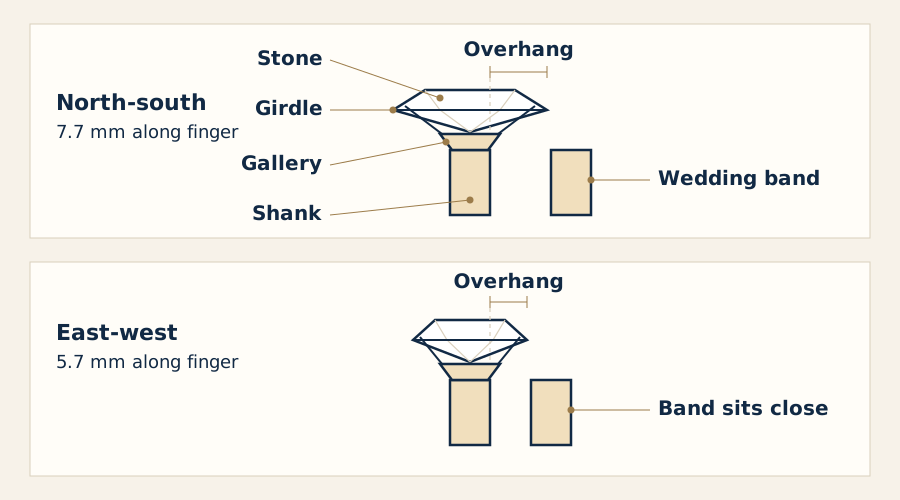
Flush fit still depends on height. If the gallery or the stone's girdle sits below the top of the wedding band, there will be a gap or the band will push against the head. Our guide on how setting height affects wedding band fit explains the measurements to check. Band style also changes the look:
- Straight, thin bands: 1.8–2.5 mm keeps attention on the stone; see our page on band widths from 1.8 to 4 mm.
- Tapered: tapered bands that narrow towards the head make a wide east-west stone look larger.
- Reverse taper: reverse taper band styles widen near the head and suit a bezel-set stone.
- Twisted: twisted band designs soften a geometric emerald cut.
- Knife-edge: knife-edge bands with a peaked profile look fine from above while keeping strength.
East-west rings also pair well with stacks, because the horizontal stone echoes the line of the bands. The tradition of wearing the wedding band closest to the heart is covered in our history of the wedding ring.
Related guideSetting Height and Wedding Band FitCan you add a halo or side stones to an east-west ring?
Yes. A halo (a ring of small diamonds around the centre) frames a sideways stone and protects its edge, though it makes the head wider still, so it suits slimmer stones or longer fingers. If you like the framed look, compare double halo designs, which add a second row and suit a smaller centre stone.
- East-west three-stone: the side stones can be set east-west to match the centre or north-south for contrast. Check the total width does not crowd the neighbouring fingers.
- Pavé shoulders: small diamonds along the band lead into the head; they need checking for loose stones every year.
- Hidden halo: a row of small diamonds under the girdle adds sparkle from the side without widening the top.
- Toi et moi: two stones side by side, often one set east-west, a personal and asymmetric style.
How do you care for an east-west engagement ring?
Care is the same as any fine ring, with extra attention to the sides. Soak it in warm water with a drop of dishwashing liquid, brush gently under the stone with a soft toothbrush, rinse and dry. Oil and lotion collect in the gallery and dull the stone's sparkle quickly.
- Have the claws and any small stones checked about once a year.
- Expect side claws on a daily-wear ring to need re-tipping roughly every 5–10 years, depending on metal and how hard you are on your hands.
- Take the ring off for the gym, gardening and heavy cleaning, when the sideways stone is most likely to be knocked.
- Avoid ultrasonic cleaning for emeralds and any treated or fissured gemstone; diamonds and sapphires usually handle it.
Platinum wears mainly by moving rather than losing metal, so worn claws can often be rebuilt; 18ct gold claws lose a little metal over time and are re-tipped. White gold is usually rhodium-plated and may need re-plating every year or two to stay bright white.
How much does an east west engagement ring cost in Australia?
An east-west setting usually costs about the same as the same style set north-south. A custom head, extra claws or a bezel can add a little. Most of the total is the centre stone, and the biggest decision there is natural or lab-grown. Lab-grown diamonds are real diamond, grown in a laboratory rather than mined, and they cost much less than natural diamonds of the same size and grade. Both should come with an independent grading report.
| Item | Approximate price range (AUD) |
|---|---|
| East-west solitaire setting, 18ct gold | about $1,500–$3,500 |
| East-west solitaire setting, platinum | about $2,500–$5,000 |
| 1 ct lab-grown oval, G–H, VS | about $800–$2,500 |
| 1 ct natural oval, G–H, VS | about $6,000–$14,000 |
These are broad ranges only; prices move with the market, the metal price and the exact grades. Ovals and emerald cuts usually cost less per carat than rounds of the same weight, colour and clarity, which is one reason they are popular for east-west rings.
Create your ring: east-west settings and stones
How do you choose an east-west engagement ring? Step by step
- Pick an elongated shape. Oval, emerald, pear, marquise or an elongated radiant; skip rounds and squares.
- Check the ratio. Divide length by width on the report; aim for about 1.35 or more so the sideways line shows.
- Measure the span. Compare the stone's length in millimetres with your finger width, and try it on beside your neighbouring fingers.
- Choose the protection. Six claws or a bezel for daily wear, and a V-claw on every point.
- Set the height. Keep the head as low as the stone allows, and confirm your wedding band will sit flush.
- Confirm the stone. Read the report for shape, measurements, grades and whether it is natural or lab-grown.
- Plan the upkeep. Book a yearly claw check, with extra attention to the side claws.
Free consultation
Talk to a gemologist
Compare stones in person or online with Raj Sood, Graduate Gemologist (GIA), AJP (GIA).
Book a consultationShop this shape
FAQ
Common questions
What does east-west mean in an engagement ring?
It means the centre stone is set horizontally, with its long side running across the finger. The usual north-south setting points the stone along the finger instead.
Which stone shape is most popular for an east-west ring?
The oval is the most common, followed by the emerald cut. Pear and marquise shapes also work but need V-claws because their points face the neighbouring fingers.
Are east west engagement rings secure for everyday wear?
Yes, if the head is built for the stone and kept low. The side claws wear faster than on a north-south ring, so have them checked about once a year.
Does a wedding band sit flush with an east-west ring?
Often more easily than with a north-south ring, because less of the stone overhangs the band. Flush fit still depends on the setting height, so check the gallery clears the band.
Can I turn my existing engagement ring east-west?
Often, by replacing the head with one made for your stone's measurements. A jeweller will check the shank, claws and stone condition first.
Does an east-west setting make a diamond look bigger?
It does not change the stone's face-up size, but it spans more of the finger width, so it can look broader. A north-south stone looks longer instead.

Ask a gemologist
Not sure which diamond to choose?
Raj Sood is a Graduate Gemologist (GIA) and master jeweller. Bring the stones you are considering, or send the reports, and he will tell you honestly which one is better and why.
Keep learning
Related guides
 Engagement Rings & SettingsSetting Height and Wedding Band FitEngagement Rings & SettingsEngagement Ring AnatomyEngagement Rings & SettingsTapered Bands
 Engagement Rings & SettingsReverse Taper Bands
 Engagement Rings & SettingsTwisted BandsEngagement Rings & SettingsKnife-Edge BandsEngagement Rings & SettingsEngagement Ring Band Widths: 1.8 to 4 mm
Explore more
More guides on this topic
Education