
- Education
- Engagement Rings & Settings
- Cluster Engagement Rings: How They Are Built, Which Stones Suit and How They Wear
Engagement Rings & Settings
Cluster Engagement Rings: How They Are Built, Which Stones Suit and How They Wear
Cluster engagement rings group many small stones into one bold shape, which makes them generous on the hand and a little more demanding to look after. Here is how a cluster is built, which stones and shapes suit it, and how it wears over the years.
 Reviewed by Raj Sood, Graduate Gemologist (GIA), AJP (GIA)Master jeweller and Graduate Gemologist (GIA) · reviewed 4 November 2026
Quick answer
A cluster engagement ring groups several smaller stones closely together so they read as one larger shape, often a flower around a centre stone. Clusters give a big face-up look for the budget and suit diamonds, sapphires and rubies. The trade-off is more claws: have them checked every 6–12 months and clean the ring weekly.
What are cluster engagement rings?
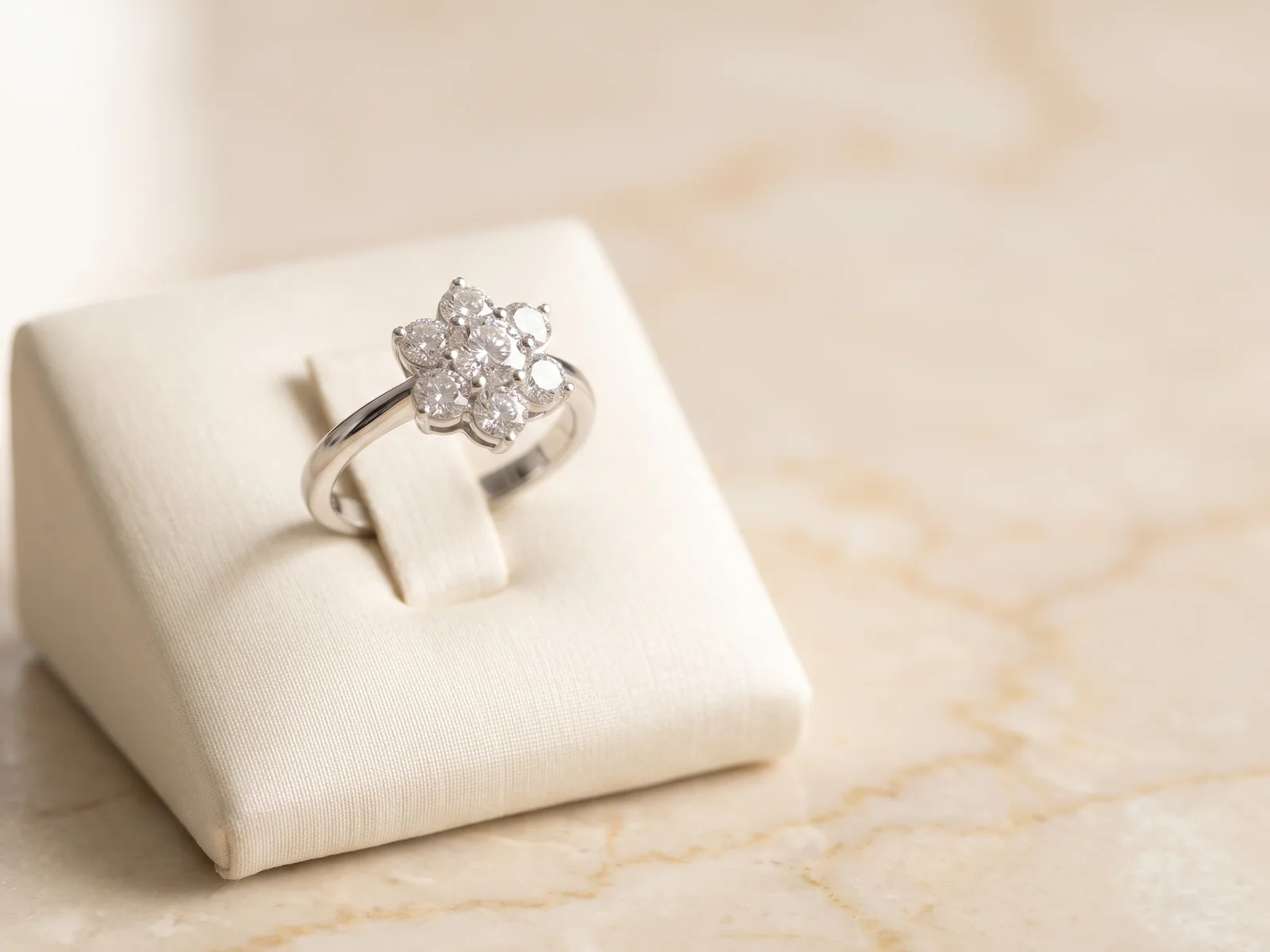
A cluster ring is a ring where several stones are set close together in one head, so from a little distance they read as a single, larger shape. A cluster engagement ring usually takes one of two forms: a centre stone ringed by slightly smaller stones, or a group of similar-sized stones with no single dominant one. Where a classic single-stone solitaire relies on one diamond to carry the look, a cluster builds its presence from many.
Clusters are an old idea. Georgian and Victorian jewellers set rose-cut and old mine cut diamonds in tight clusters, often in closed-back settings of silver over gold, and Edwardian makers refined them in platinum with millegrain, a row of tiny metal beads along the edges. You can trace that lineage through Victorian and Edwardian ring designs and in the many vintage-inspired engagement rings with old-world detail made today. In the 1920s and 1930s the cluster turned geometric, mixing rounds with baguettes and small calibré-cut coloured stones; our page on the geometric clusters of the Art Deco era covers that period.
The best-known modern example is the oval sapphire and diamond cluster given to Diana, Princess of Wales, in 1981 and now worn by Catherine, Princess of Wales. It is the reason so many people picture a blue centre ringed with white diamonds when they hear the words sapphire cluster engagement ring.
Several technical words come up below. Each is explained the first time, and all of them are in our glossary of jewellery terms if you want to look one up later.
How is a diamond cluster ring made?
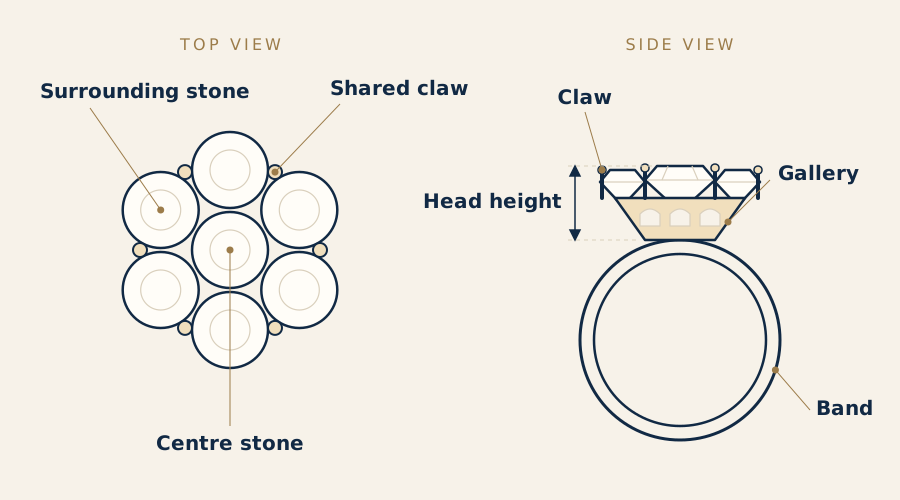
Every cluster sits on a gallery, the metal framework under the stones that lifts them off the finger and joins the head to the band. Each stone sits in its own seat, a small hole or ledge cut into the gallery, and is held in place by claws (also called prongs), the thin metal tips folded over the edge of the stone.
Most clusters use shared claws, where one claw tip grips the edges of two neighbouring stones at once. Sharing lets the stones sit closer together and shows less metal, which is what makes a good diamond cluster ring look like one continuous sparkle. The trade-off is that one worn claw can loosen two stones, not one. A seven-stone daisy cluster can easily have 12 or more claw tips holding it together.
Clusters also follow simple geometry. Six round stones fit exactly around one centre of the same diameter, which is why the classic daisy has seven stones. Add a second row of twelve and you get nineteen; a third row of eighteen makes thirty-seven. When the centre is bigger than its neighbours, more stones are needed to go around it: a 5 mm centre (about 0.50 carat) takes roughly ten surrounding stones of 2 mm, less a little room for the claws.
Because so many stones have to sit level and evenly spaced, clusters reward careful design. We draw them in CAD (computer-aided design) first, so you can see a render of the head from the top and from the side, check how high it sits and see how a wedding band will meet it before any metal is cast. The finished ring is then hand-set and polished at the bench.
Metal choice matters more in a cluster than in a solitaire, because there are so many small claws. Platinum (usually 950, meaning 95% platinum) is dense and tends to push aside rather than wear away, so its claws hold up well. 18ct gold (75% gold) is a little harder but loses metal slowly with wear. 18ct white gold is usually plated with rhodium, a bright white metal, which wears through over time and needs re-plating to keep its colour.
What cluster ring styles are there?
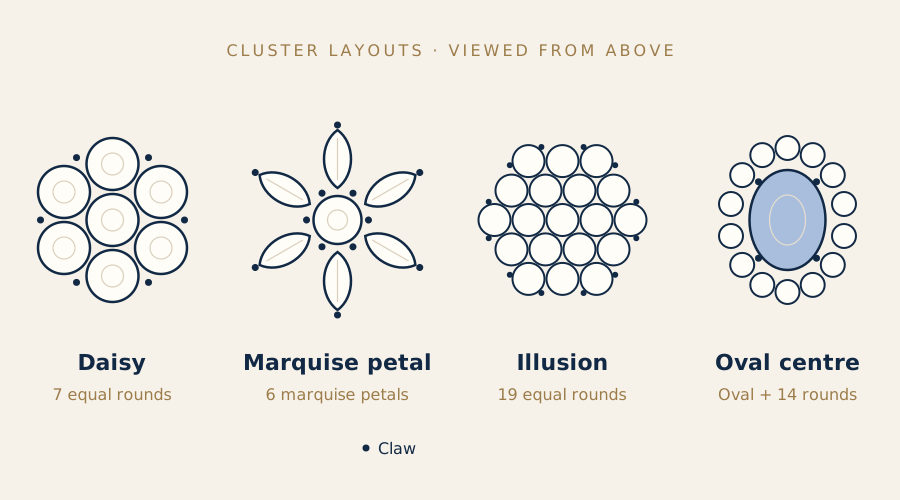
Within the broad cluster family there are several distinct layouts. Each one changes the outline, the amount of metal you see and how the ring catches on clothing.
| Style | Layout | Look | Typical stones |
|---|---|---|---|
| Daisy or flower cluster | Round centre with 6–8 round petals | Soft, floral, vintage | Round brilliants throughout |
| Marquise or pear petal | Round centre ringed by marquise or pear petals | Starburst or snowflake outline | Marquise, pear and round |
| Illusion (pie) cluster | 7, 19 or 37 equal stones packed together | Reads as one larger round from a distance | Small round diamonds |
| Oval or cushion cluster | Larger centre with a ring of rounds | Classic, Diana-style | Sapphire, ruby, emerald or diamond centre |
| Geometric (Art Deco) | Squares, steps and lines | Architectural and crisp | Baguette, carré and round |
| Free-form or scatter | Mixed sizes and shapes, no fixed pattern | Organic and modern | Mixed shapes, often coloured |
The flower cluster engagement ring is the one most people picture first. With all seven stones the same size, it reads as a single round about three times the width of each stone. The marquise-petal version is spikier and more dramatic, but marquise and pear tips are thin and exposed, so each needs its own claw.
Free-form clusters, where stones of different shapes and sizes are scattered across the head, sit close to asymmetrical and free-form ring designs. At the other end of the scale, many vintage-style clusters add fine filigree metalwork through the gallery and shoulders, which lets light in under the stones and gives the side view a lacy pattern.
Cluster vs halo engagement ring: what is the difference?
Clusters and halos are often confused because both surround a centre with smaller stones. The difference is scale and setting. In a halo, the centre stone clearly dominates and is framed by a continuous row of much smaller stones, often 1–1.5 mm, set in tiny beads or micro-claws. In a cluster, the surrounding stones are larger relative to the centre, often 2–3.5 mm, each held by its own or shared claws, so you see individual stones rather than a smooth frame.
There are also hybrids. Hidden halo settings tuck a row of small diamonds under the centre so it is only visible from the side, while three-stone engagement rings spread the stones along the finger instead of grouping them around a centre.
| Cluster | Halo | Solitaire | Three-stone | |
|---|---|---|---|---|
| Look | Many stones read as one shape | Centre framed by tiny stones | One stone, clean lines | Centre with a stone each side |
| Face-up size for budget | Large | Large | Smallest | Medium |
| Claws to maintain | Many, often shared | Many, very small | 4–6 | 10–18 |
| Snag risk | Moderate to high if domed | Moderate | Low to moderate | Moderate |
| Wedding band fit | Often needs a contoured band | Often needs a contoured band | Usually sits flush | Depends on height |
| Era it suits | Georgian to modern | 1920s and modern | Any | Any |
If you are still deciding between these families, it helps to see them side by side. Our overview of every engagement ring setting style compares claws, bezels, halos and more in one place.
Related guideEngagement Ring Setting Styles GuideNot sure which one is right?
Send us the stones you are looking at and our gemologist will tell you which to choose and why.
Which stones and shapes suit a cluster engagement ring?
Diamond is the natural choice for a cluster. It is 10 on the Mohs scale (a 1–10 scale of scratch resistance), with a refractive index of about 2.42, so even small stones throw back strong sparkle. Surrounding diamonds are usually round brilliants because they are easy to match in size, colour and cut. For a white look, a centre of G–H colour with surrounding stones of G–J is common; what matters most is that the small stones match each other, because one yellower stone stands out in a ring of seven.
A lab-grown diamond cluster ring uses laboratory-grown diamonds, which are real diamond with the same hardness and refractive index as natural, grown in a laboratory rather than mined. They cost much less, which makes larger centres and bigger surrounding stones affordable. Some rings mix a natural or lab-grown centre with surrounding stones of the other type; the origin of every stone should be stated clearly on the paperwork.
| Gem | Mohs hardness | Suits a cluster for daily wear? |
|---|---|---|
| Diamond (natural or lab-grown) | 10 | Yes, the most durable choice |
| Moissanite (lab-created) | 9.25 | Yes, very hard and bright |
| Sapphire (natural or lab-created) | 9 | Yes, the classic coloured centre |
| Ruby (natural or lab-created) | 9 | Yes, same mineral as sapphire |
| Spinel | 8 | Yes, with reasonable care |
| Aquamarine and morganite | 7.5–8 | Yes, but scratches show over time |
| Emerald | 7.5–8, brittle | With care; it is often oil-treated and can chip |
| Tanzanite | 6–6.5 | Better for occasional wear |
| Opal | 5.5–6.5 | Occasional wear, ideally in a rubover rim |
For the centre, a round gives the classic daisy, while an oval cluster engagement ring lengthens the finger and suits a coloured stone. Cushions give a softer square, pears point along the finger, and emerald cuts pair naturally with baguette surrounds in a Deco layout. Thin points on marquise, pear and princess shapes need claws that cover them.
A sapphire cluster engagement ring with a natural sapphire centre will usually have a heat-treated stone, a common and stable treatment that should be disclosed. Lab-created sapphires and rubies are chemically the same as natural ones and cost far less; they should always be described as lab-created or synthetic.
Are cluster engagement rings secure for everyday wear?
A well-made cluster is perfectly wearable every day. It does, though, have more places where things can go wrong than a solitaire, simply because there are more stones and claws. From the repair side of the bench, these are the changes clusters typically show over the years:
- Worn claw tips: the claws on the outer edge take every knock and slowly flatten, especially on a domed cluster worn by someone who works with their hands.
- Loose small stones: a sharp knock can lift a shared claw and loosen two stones at once. Small stones are lost far more often than centre stones.
- Snagging: raised claws catch on knitwear, hair and gloves, which slowly pulls them open.
- Thinning band: a heavy head on a slim band of about 1.5 mm can wear thin underneath after many years.
- Plating wear: rhodium on white gold wears through on the claws first, showing a faint warm tone.
Several design choices make a cluster more secure. A lower head, around 5–6 mm off the finger rather than 7–8 mm, takes fewer knocks. An outer rim of metal, like the rubover edge in a bezel-set design, protects the edge stones completely. Claws in platinum, or slightly heavier claws in gold, last longer. And cathedral shoulders that arch up to the head support a larger cluster and spread the load into the band.
How do you clean and look after a cluster ring?
Clusters collect dirt faster than most rings, because hand cream, soap and skin oil build up in the gallery and between the stones. A dull cluster is almost always a dirty cluster, not a damaged one. A simple routine keeps it bright:
- Weekly: soak for 10–20 minutes in warm water with a drop of mild dishwashing liquid, then brush gently under the head with a soft toothbrush. Rinse in a bowl, not over an open sink, and pat dry with a lint-free cloth.
- Avoid: chlorine pools, bleach and harsh cleaners, which can attack gold alloys and some gemstones.
- Take it off: for the gym, gardening, moving furniture and anything that grips hard.
- Ultrasonic cleaners: only after a professional check, because the vibration can shake out a loose stone. Never for emeralds, opals or fracture-filled stones.
- Every 6–12 months: a professional check of every claw under magnification, plus a steam clean.
- Every 1–2 years for white gold: re-plating with rhodium, depending on wear.
- Every few years: re-tipping worn claws, which adds new metal to the tips before they fail.
Storing the ring in its own soft pouch or compartment also matters. Diamond will scratch other jewellery, and the claws of a cluster can catch on chains if everything is kept in one box.
What wedding band fits a cluster engagement ring?
Band fit is the question most people forget to ask. A cluster head is often 8–12 mm wide, and its gallery may reach down to the band, so a straight wedding band can leave a gap or sit at an angle. Before you choose, look at the ring from the side and see where the lowest point of the head sits. Options to consider:
- Straight band: works if the gallery sits high enough for the band to slide underneath.
- Contoured or curved band: follows the outline of the cluster and sits flush against it.
- Notched band: a small cut-out that takes the lowest part of the head.
- Fitted pair: the engagement ring and wedding band designed together in CAD, so they lock into each other.
The shape of the engagement ring's band changes the picture too. Split shank bands that divide near the head give a large cluster a wider base, while bypass rings that wrap around the centre can turn a cluster into a flowing, off-centre design. If you want sparkle along the shoulders, side-stone ring designs add small diamonds that lead the eye up to the cluster. For every other setting and stone question, start at our engagement ring education hub.
Keep the wedding band in proportion. With a cluster head, a band of about 2–2.5 mm usually looks balanced, and a slightly thicker engagement band, around 2–2.5 mm rather than 1.5 mm, supports the weight of the head over decades of wear.
How much do cluster engagement rings cost in Australia?
Clusters give more face-up size for the money than a solitaire. Diamond price per carat climbs steeply with size, so seven 0.06 ct diamonds (about 0.42 ct in total) cost far less than one 1.5 ct round, yet together they can measure about the same 7.5 mm across. A solitaire still has more depth and fire from one large stone, and that is a personal trade-off rather than a right or wrong choice.
Prices for cluster engagement rings in Australia depend on the centre stone above all, then on the total weight of the surrounding stones, the metal and how much hand work the head needs. The ranges below are broad guides only.
| Cluster ring (18ct gold or platinum) | Approximate price range (AUD) |
|---|---|
| Natural diamond daisy cluster, about 0.40–0.60 ct total | about $2,500–$5,500 |
| Natural diamond, 0.50 ct centre plus about 0.30 ct surround | about $4,000–$8,000 |
| Natural diamond, 1 ct centre plus about 0.40 ct surround | about $9,000–$20,000 |
| Lab-grown diamond, 1 ct centre plus about 0.40 ct surround | about $2,500–$5,500 |
| Natural sapphire centre (about 1 ct) with diamond surround | about $3,000–$8,000 |
Lab-grown diamonds cost much less than natural diamonds of the same size and grade, so they are often chosen when someone wants a bigger centre or a larger surround. Natural diamonds are rarer. Neither should be thought of as an investment; choose the one that suits your taste and budget, and ask for a grading report on any centre stone of about 0.30 carat and above.
Design a cluster ring: create your ring or browse ring settings
How to choose a cluster engagement ring: step by step
- Pick the layout. Decide between a daisy, petal, illusion, oval-centre, geometric or free-form cluster.
- Choose the centre stone. Diamond, lab-grown diamond or a hard gem such as sapphire or ruby (Mohs 9 or above) for everyday wear.
- Match the surrounding stones. Ask for the size in millimetres and the colour range, and check that they look even beside each other.
- Check the side view. Look at the head height (about 5–6 mm is practical), the gallery and whether a wedding band will sit against it.
- Look at the claws. Count them, check they cover any thin points and ask whether they are shared.
- Choose the metal. Platinum or 18ct gold, with a band of at least 2 mm to support the head.
- See a CAD render. Review the top and side views before casting, and confirm the origin of every stone is stated in writing.
- Plan the upkeep. Book a claw check every 6–12 months and clean the ring at home weekly.
Free consultation
Talk to a gemologist
Compare stones in person or online with Raj Sood, Graduate Gemologist (GIA), AJP (GIA).
Book a consultationShop this shape
FAQ
Common questions
What is the difference between a cluster and a halo engagement ring?
In a halo, a dominant centre stone is framed by a continuous row of tiny stones, usually 1–1.5 mm. In a cluster, the surrounding stones are larger relative to the centre and individually claw-set, so the whole group reads as one shape.
Are cluster engagement rings a good choice for everyday wear?
Yes, if they are well made and looked after. Choose a lower head, hard stones and solid claws, and have the claws checked every 6–12 months, because clusters have more small stones that can work loose.
Do diamond cluster rings look bigger than solitaires?
For the same budget, usually yes. Seven 2.5 mm diamonds in a daisy measure about 7.5 mm across, close to the face-up width of a 1.5 ct round, while costing much less.
Can you get a lab-grown diamond cluster ring?
Yes. Lab-grown diamonds are real diamond and are widely used for both centre and surrounding stones. They cost much less than natural diamonds, and the paperwork should state they are lab-grown.
What wedding band goes with a cluster engagement ring?
A contoured, curved or notched band usually sits flush against a wide cluster head. A straight band works only if the gallery sits high enough for the band to slide underneath.
How do I clean a cluster ring at home?
Soak it in warm water with a drop of mild dishwashing liquid, brush gently under the head with a soft toothbrush, rinse in a bowl and pat dry. Avoid ultrasonic cleaners unless a jeweller has checked the claws first.

Ask a gemologist
Not sure which diamond to choose?
Raj Sood is a Graduate Gemologist (GIA) and master jeweller. Bring the stones you are considering, or send the reports, and he will tell you honestly which one is better and why.
Keep learning
Related guides
 Engagement Rings & SettingsVintage-Inspired Engagement Rings with Old-World Detail and Custom Character
 Engagement Rings & SettingsHidden Halo Engagement Rings
 Engagement Rings & SettingsThree-Stone Engagement Rings
 Engagement Rings & SettingsArt Deco Engagement RingsEngagement Rings & SettingsEdwardian and Victorian Engagement RingsEngagement Rings & SettingsFiligree Engagement Rings
 Engagement Rings & SettingsAsymmetrical Engagement Rings
Explore more
More guides on this topic
Education