
- Education
- Engagement Rings & Settings
- Asymmetrical Engagement Rings: Styles, History, Anatomy and Fit
Engagement Rings & Settings
Asymmetrical Engagement Rings: Styles, History, Anatomy and Fit
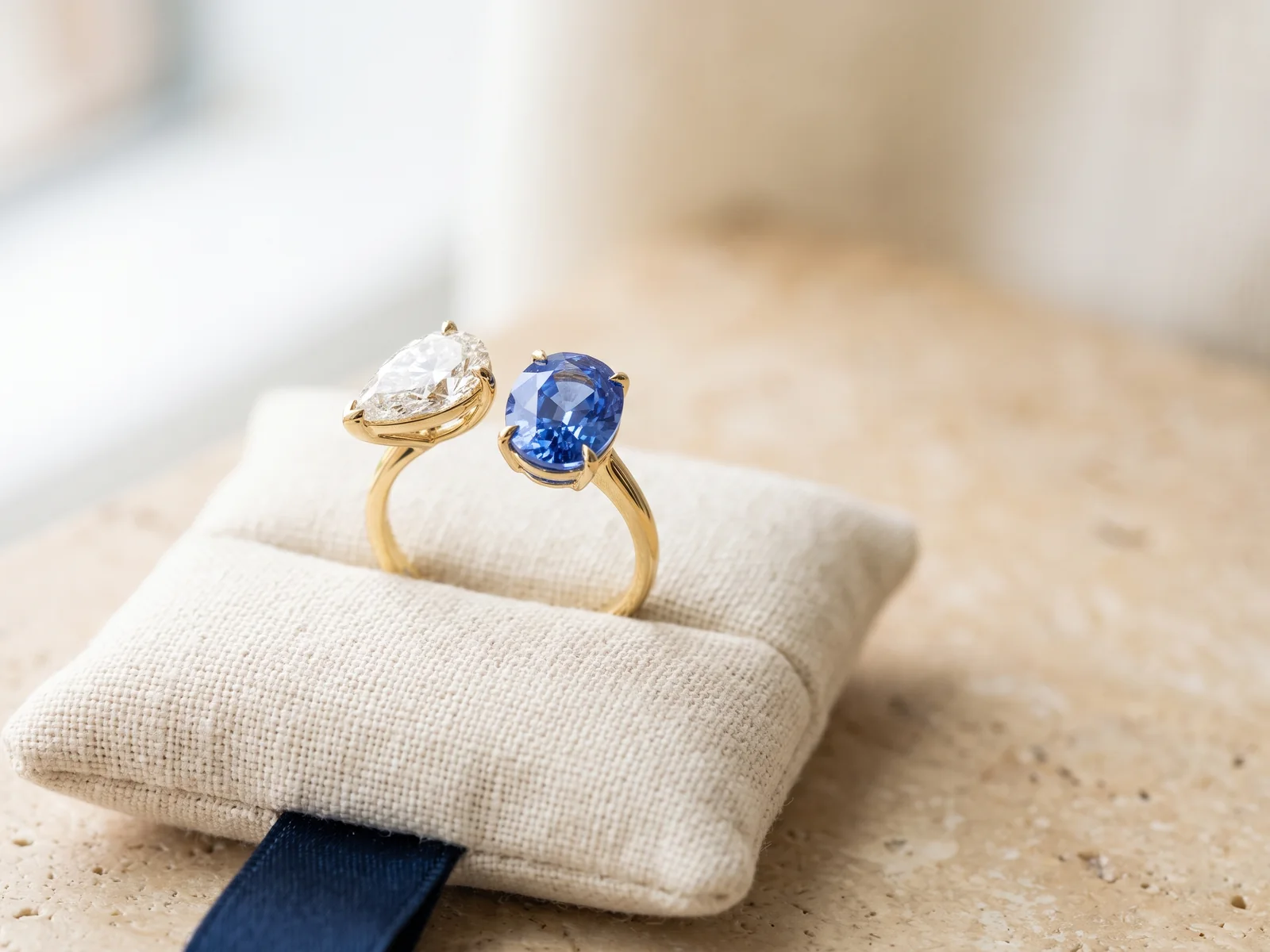
Asymmetrical engagement rings deliberately break the mirror image of a classic ring, and that freedom comes with real engineering choices. Here is how each style is built, where it came from, and what keeps it comfortable and secure for decades of wear.
 Reviewed by Raj Sood, Graduate Gemologist (GIA), AJP (GIA)Master jeweller and Graduate Gemologist (GIA) · reviewed 4 November 2026
Quick answer
Asymmetrical engagement rings are designs where the left and right sides of the ring deliberately differ: two stones side by side (toi et moi), bypass arms that wrap past each other, off-centre clusters or open cuffs. They date back to the late 1700s. Choose a heavier shank to stop spinning, protect exposed points, and plan a contoured wedding band.
What are asymmetrical engagement rings?
Asymmetrical engagement rings are rings where the design on one side of the centre line does not mirror the other. In a classic ring, if you fold the top view down the middle, both halves match. In an asymmetrical ring they do not: one side might carry a second stone, a sweep of small diamonds, an arm that curls past the centre stone, or nothing at all. Our full guide to engagement ring setting styles shows where this family sits alongside the more traditional layouts.
The appeal is movement. A classic solitaire engagement ring is calm and centred; an asymmetrical design leads the eye across the finger, often on a diagonal. That makes these rings feel personal, and many of them are made to order rather than picked off a tray. The trade-off is that the weight, the claws and the wedding band all have to be planned more carefully, because the ring no longer balances itself.
A few terms come up constantly. The shank is the band that goes around the finger. The head is the part that holds the stone, usually claws or a bezel (a rim of metal around the edge). The gallery is the metalwork under the stone, seen from the side. If you meet a word below you have not seen before, our plain-English jewellery glossary explains it.
Asymmetry is not only for engagement rings. The same designs work as promise rings given before an engagement, as rings worn on the right hand for a milestone, and in heavier, more architectural forms as engagement rings for men. In Australia an engagement ring is traditionally worn on the left ring finger, but there is no rule, and some people wear a toi et moi on the right hand precisely because it reads as a statement ring.
Which styles of asymmetrical engagement rings are there?
Most asymmetrical designs fall into six groups. Many rings combine two of them, for example a bypass shank carrying a toi et moi pair.
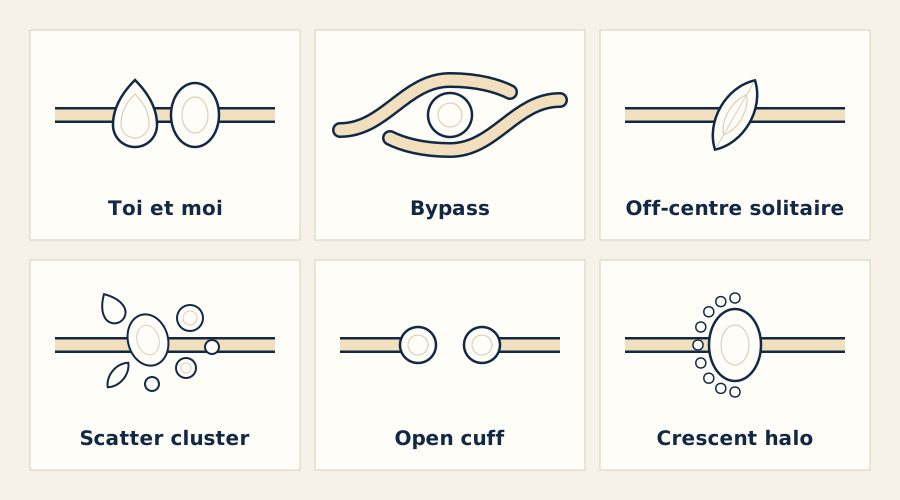
| Style | What it looks like | Main era | Wedding band | Everyday wear notes |
|---|---|---|---|---|
| Toi et moi | Two stones side by side, often different shapes or gems | Late 1700s onwards; strong revival since about 2020 | Usually contoured or custom-fitted | Two heads to check; softer second gems need care |
| Bypass | Shank ends pass each other, stone sits between or on one arm | Victorian crossovers; popular again in the 1940s–50s | Curved band or gap left visible | Arm tips can catch on knitwear |
| Off-centre or tilted solitaire | One stone set at an angle or shifted to one side | Modern | Straight band can sit flush if the stone is low | Watch the exposed corner or point |
| Scatter cluster | Small stones of varied size and shape, arranged freely | Georgian and Victorian clusters; modern scatter designs | Custom-fitted band | Many small claws; check them yearly |
| Open cuff | Shank does not close; stones sit on the open ends | Mid-century; modern minimalist | Often worn alone or with a thin band | Limited resizing; can spread if squeezed |
| Crescent or partial halo | Small diamonds hug only part of the centre stone | Modern | Contoured band | Halo side adds protection to that edge |
The toi et moi (French for "you and me") is the best known. Two stones of roughly equal weight sit side by side, often a pear with an oval, or a diamond with a coloured gem. A bypass engagement ring has a shank that splits and slides past itself, so the two ends overlap rather than meeting at the stone. An off-centre engagement ring keeps one stone but tilts it, commonly a pear or marquise set diagonally.
Partial halos are a useful middle ground. Where full halo designs ring the whole stone, a crescent halo frames one side and leaves the other open. If you are weighing up framing options, our comparison of halo and hidden halo explains how each changes the look from the top and the side. For an exposed point on a tilted stone, a half-bezel is one of the most secure choices; see bezel settings that wrap the edge in metal.
Where did asymmetrical rings come from?
Asymmetry in rings is older than most people expect. The ring usually cited is the one Napoleon Bonaparte gave Joséphine in 1796: a toi et moi with a pear shaped diamond and a pear shaped sapphire, each about a carat, set on a thin gold band. It sold at auction in 2013 and is still the reference point for the style. Our longer history of engagement rings puts it in context with the posy and gimmel rings that came before.
The Victorian era (1837–1901) loved sentiment and nature, so crossover and serpent rings, two-stone rings and loose clusters were common. Edwardian jewellers (roughly 1901–1915) worked in platinum, which let them make very fine, lace-like settings, and some of those designs drift off-centre with leaves and garlands. You can see how these periods compare in our guide to Victorian and Edwardian ring styles.
Art Deco (about 1920–1935) is mostly associated with strict symmetry, but the period also produced asymmetric geometric rings with stepped shoulders and offset baguettes. The geometric Art Deco engagement rings page shows both sides of that era. The 1940s and 1950s, sometimes called the Retro period, brought chunky rose and yellow gold bypass rings with ribbon-like shanks.
When old rings come into the workshop for remodelling, the era usually shows in the details: Victorian clusters are often set in silver-topped gold, Edwardian pieces have thin knife-edge shanks and millegrain (tiny beaded edging), and Retro bypass rings tend to have thick, hollow-looking curves. If you want a modern ring with an antique feel, fine filigree metalwork in the gallery is a period-accurate way to soften an asymmetric layout.
How is an asymmetrical ring built? Asymmetrical ring anatomy explained
An asymmetrical ring has the same basic parts as any engagement ring, plus a few that only appear when the design is off-centre. Our page on the parts of an engagement ring, labelled covers the standard pieces; here is what changes.
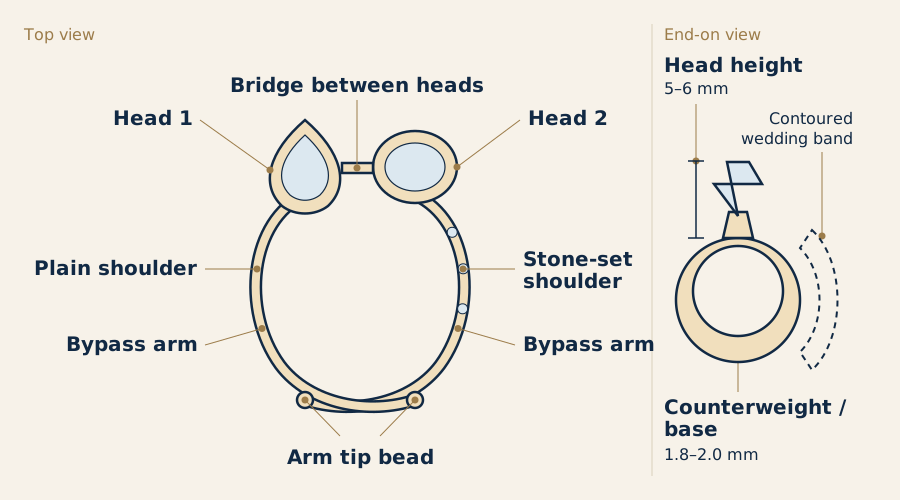
- Bypass arms: the two ends of the shank that curve past each other. Their tips are the most exposed metal on the ring and are usually finished with a small bead or a bezel.
- Offset head or heads: in a toi et moi there are two heads, often of different heights, so the stones sit at the same level despite different depths.
- Bridge: the small piece of metal that joins two heads and stops them flexing apart.
- Base or counterweight: the bottom of the shank, often made a little thicker to pull the centre of gravity down so the ring sits upright.
- Shoulders: the parts of the shank either side of the head. In asymmetrical rings each shoulder may be a different shape, one plain and one set with stones.
- Gallery: the side profile under the stones, which can be open, filigreed or a low basket.
Shoulders can also rise. Some asymmetric designs borrow cathedral shoulders that arch up to the head on one side only, giving a ring that looks different from the left and the right. That is attractive but means a straight wedding band will touch one side and not the other.
Related guideEngagement Ring AnatomyNot sure which one is right?
Send us the stones you are looking at and our gemologist will tell you which to choose and why.
Which stones and shapes suit an asymmetric setting?
Elongated shapes do the most work in asymmetrical rings because they have direction. A pear, marquise or oval set on a diagonal immediately looks intentional. Our guide to settings for pear, marquise and oval diamonds explains how to protect their points. Popular toi et moi pairings are pear and oval, pear and pear (points facing opposite ways), emerald cut and pear, and round with a coloured gem.
For a two stone engagement ring, aim for stones whose face-up size (how big they look from above) is close, not just their carat weight. A 0.70 carat pear is about 7.7 × 5.0 mm, while a 0.70 carat round is about 5.7 mm across, so matched carat weights can look unbalanced. Many designers deliberately use one stone a little larger, perhaps 1.0 and 0.7 carat, so the asymmetry reads as a choice rather than a mismatch.
Hardness matters because both stones face daily knocks. Hardness is measured on the Mohs scale, where higher means more scratch-resistant.
| Gem | Mohs hardness | Suits daily wear in a toi et moi? |
|---|---|---|
| Diamond (natural or lab-grown) | 10 | Yes |
| Moissanite | 9.25 | Yes |
| Sapphire or ruby (natural or lab-created) | 9 | Yes |
| Emerald | 7.5–8 | With care; brittle and often fracture-filled, a bezel helps |
| Morganite or aquamarine | 7.5–8 | With care; scratches and dulls over time |
| Pearl | 2.5–4.5 | Not ideal for an everyday ring; better for occasional wear |
Lab-grown diamonds are real diamond, grown in a laboratory rather than mined, with the same hardness and refractive index of about 2.42 as natural diamond. They cost much less, which is one reason two-stone designs have become easier to afford. Natural and lab-grown stones can be mixed in one ring, as long as each is clearly disclosed to the buyer. Lab-created sapphires are the same mineral as natural sapphire and equally durable.
Will an asymmetrical ring spin or sit unevenly?
It can, and this is the most common problem we hear about with off-centre rings. Any ring with weight concentrated on top tends to roll towards the side of the finger. Put more of that weight on one side, as a toi et moi or tilted solitaire does, and it rolls in that direction. The fix is engineering, not tighter sizing.
- A heavier base: a shank around 1.8–2.0 mm thick and 2.0–2.5 mm wide at the bottom pulls the centre of gravity down.
- A lower head: keeping the stones about 5–6 mm above the finger rather than 7 mm or more reduces the lever effect.
- A flatter inside profile: a slightly squared or European-style shank grips the finger better than a fully rounded one.
- Sizing beads: two small metal bumps inside the band help a ring stay upright on knuckles that are wider than the base of the finger.
- Counterweighting: a little extra metal on the lighter side of the shank can level a lopsided design.
Durability needs the same attention. The tips of bypass arms and the exposed corner of a tilted stone take more knocks than a centred head, so a bead, a bezel or a protective claw at that point is worth the small change in look. Open cuff rings should be at least about 1.8 mm thick in 18 carat gold or platinum so they do not spread when squeezed. Check all claws every 6–12 months; clusters have many small claws, and one that lifts is easy to miss.
What wedding band suits asymmetrical engagement rings?
This is the question to answer before the engagement ring is made, not after. Because the two sides differ, a straight band often touches one side of the ring and leaves a gap on the other. Some people like that gap as part of the look; others want the two rings to sit as one.
| Band option | How it fits | Good for |
|---|---|---|
| Straight band | Leaves a gap beside the higher or wider side | Open cuffs, low tilted solitaires, people who like a stacked gap |
| Contoured band | Curves around one stone or the halo | Toi et moi and crescent halo designs |
| Custom-fitted band | Made from the engagement ring's CAD file to follow every curve | Scatter clusters and bypass rings |
| Mirror bypass band | A second bypass that interlocks with the first | A matched set with a strong diagonal line |
| Notched band | A small cut-out where the stone or claw sits | Rings with one protruding claw or bezel |
A custom-fitted band is usually the cleanest answer for an asymmetric cluster, but it ties the two rings together for life: resizing one usually means resizing both, and a remodel later may need a new band. Ask for both rings to be designed together so the shank widths match, typically within about 0.2 mm, and so they wear evenly against each other.
How much do asymmetrical engagement rings cost in Australia?
Asymmetrical settings usually cost more than a plain solitaire setting because they need more design time, more metal and, in toi et moi and cluster rings, more heads and more setting work. The stones are priced separately and usually make up most of the total. The ranges below are broad guides for the setting only, in 18 carat gold, with small diamonds included where the style has them.
| Setting style (18 carat gold, setting only) | Approximate price range (AUD) |
|---|---|
| Off-centre or tilted solitaire | about $1,500–$3,000 |
| Bypass setting | about $1,800–$3,500 |
| Toi et moi, two claw heads | about $2,200–$4,500 |
| Crescent or partial halo | about $2,500–$5,000 |
| Scatter cluster, 5–15 small diamonds | about $3,000–$7,000 |
| Platinum instead of gold | adds about $500–$1,500 |
For the stones, a 1 carat lab-grown round diamond in good colour and clarity is roughly $1,000–$3,000, while a natural diamond of the same weight and grades is roughly $6,000–$15,000. In a toi et moi, two 0.70 carat stones usually cost less than one 1.40 carat stone of the same grades, because price per carat rises steeply with size. Prices move with the market, so treat every figure here as a starting point.
Create your ring: browse ring settings
How do you design an asymmetrical engagement ring? Step by step
- Pick the layout. Decide between toi et moi, bypass, tilted solitaire, cluster, cuff or partial halo, using the styles table above.
- Choose the stones together. Compare face-up millimetre sizes, not just carat weights, and confirm on each report whether the stone is natural or lab-grown.
- Check hardness. For daily wear, keep both stones at about Mohs 9 or above, or plan a bezel for softer gems.
- Review the CAD model. Look at the top, side and end-on views, check head height (about 5–6 mm) and base thickness (about 1.8–2.0 mm).
- Design the wedding band now. Decide on a straight, contoured or custom-fitted band so both rings are built to suit each other.
- Protect the exposed points. Confirm beads, bezels or V-claws on bypass tips and any point facing outwards.
- Plan for sizing. Ask how much the ring can be resized later; cuffs and full clusters usually allow less than a plain shank.
A well-planned asymmetrical ring wears as comfortably as any solitaire. The difference is that the decisions a symmetrical ring makes for you, such as where the weight sits and how the band fits, have to be made on purpose. Make them at the CAD stage and the ring will sit straight, stay secure and pair with its band for decades.
Free consultation
Talk to a gemologist
Compare stones in person or online with Raj Sood, Graduate Gemologist (GIA), AJP (GIA).
Book a consultationShop this shape
FAQ
Common questions
What is a toi et moi engagement ring?
A toi et moi, French for "you and me", is a ring with two stones set side by side, often in different shapes or gems. Napoleon's 1796 ring for Joséphine, a pear diamond beside a pear sapphire, is the best-known early example.
Do asymmetrical engagement rings spin on the finger?
They can if the weight sits high and to one side. A thicker base, a lower head, a slightly squared inside profile or sizing beads all help the ring stay upright.
Can you wear a straight wedding band with an asymmetrical engagement ring?
Yes, but it will usually leave a gap on one side. For a flush fit most people choose a contoured or custom-fitted band designed alongside the engagement ring.
Can an asymmetrical ring be resized?
Usually, but less freely than a plain band. Open cuffs and full clusters may only allow a small adjustment, and a custom-fitted wedding band may need resizing at the same time.
Which finger do you wear an asymmetrical engagement ring on?
In Australia engagement rings are traditionally worn on the left ring finger. There is no rule, though, and many people wear toi et moi and bypass designs on the right hand as well.
Are toi et moi rings made with lab-grown diamonds?
Yes. Lab-grown diamonds are real diamond and cost much less than natural, which makes two-stone designs easier to afford. Each stone's report should state whether it is natural or lab-grown.
Terms in this guide

Ask a gemologist
Not sure which diamond to choose?
Raj Sood is a Graduate Gemologist (GIA) and master jeweller. Bring the stones you are considering, or send the reports, and he will tell you honestly which one is better and why.
Keep learning
Related guides
 Engagement Rings & SettingsEngagement Ring Anatomy
 Engagement Rings & SettingsHistory of Engagement Rings
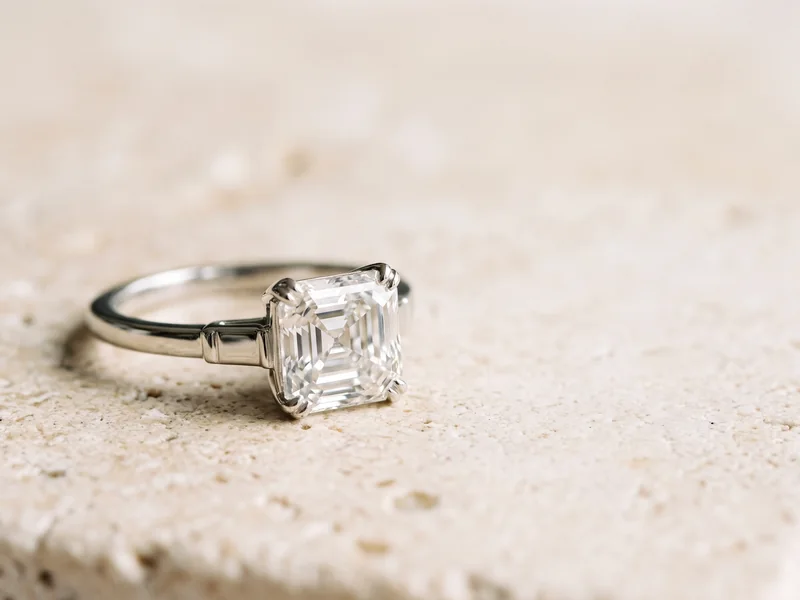 Engagement Rings & SettingsArt Deco Engagement Rings
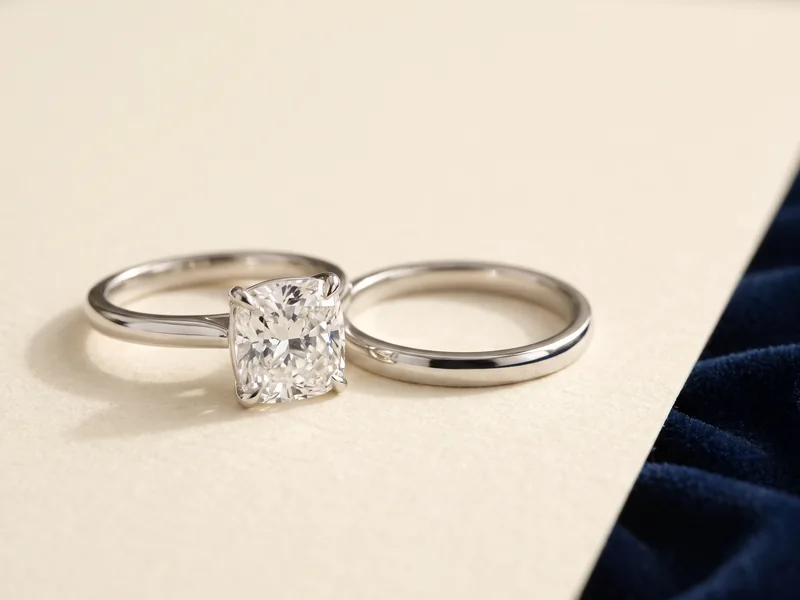 Engagement Rings & SettingsMen's Engagement Rings
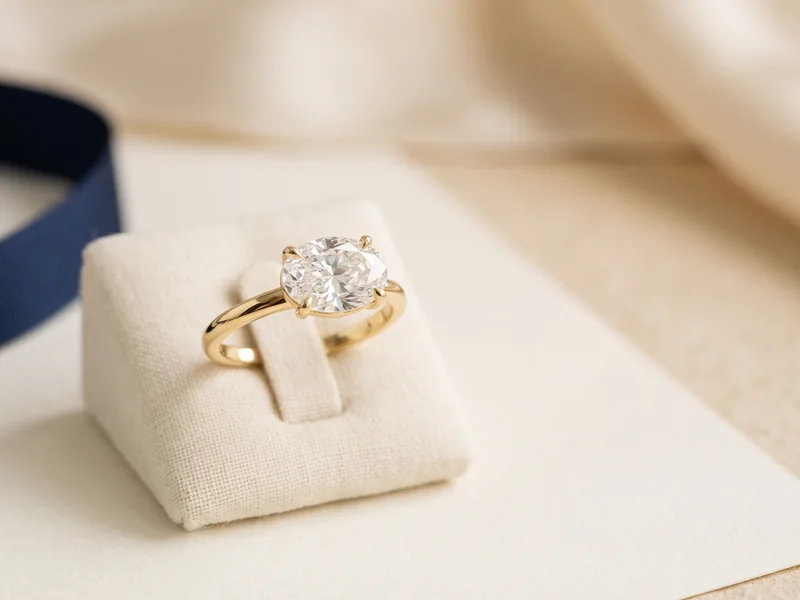 Engagement Rings & SettingsBest Settings for Elongated Diamond Shapes
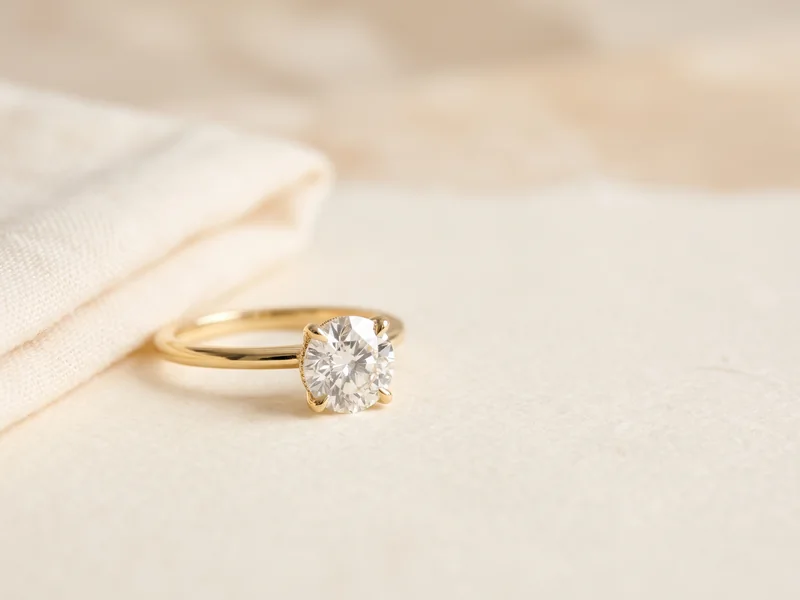 Engagement Rings & SettingsPromise Rings Explained
 Engagement Rings & SettingsRight-Hand Rings Explained
Explore more
More guides on this topic
Education