
Gemstones
Padparadscha Sapphire Guide: Colour, Treatments, Origins and Value
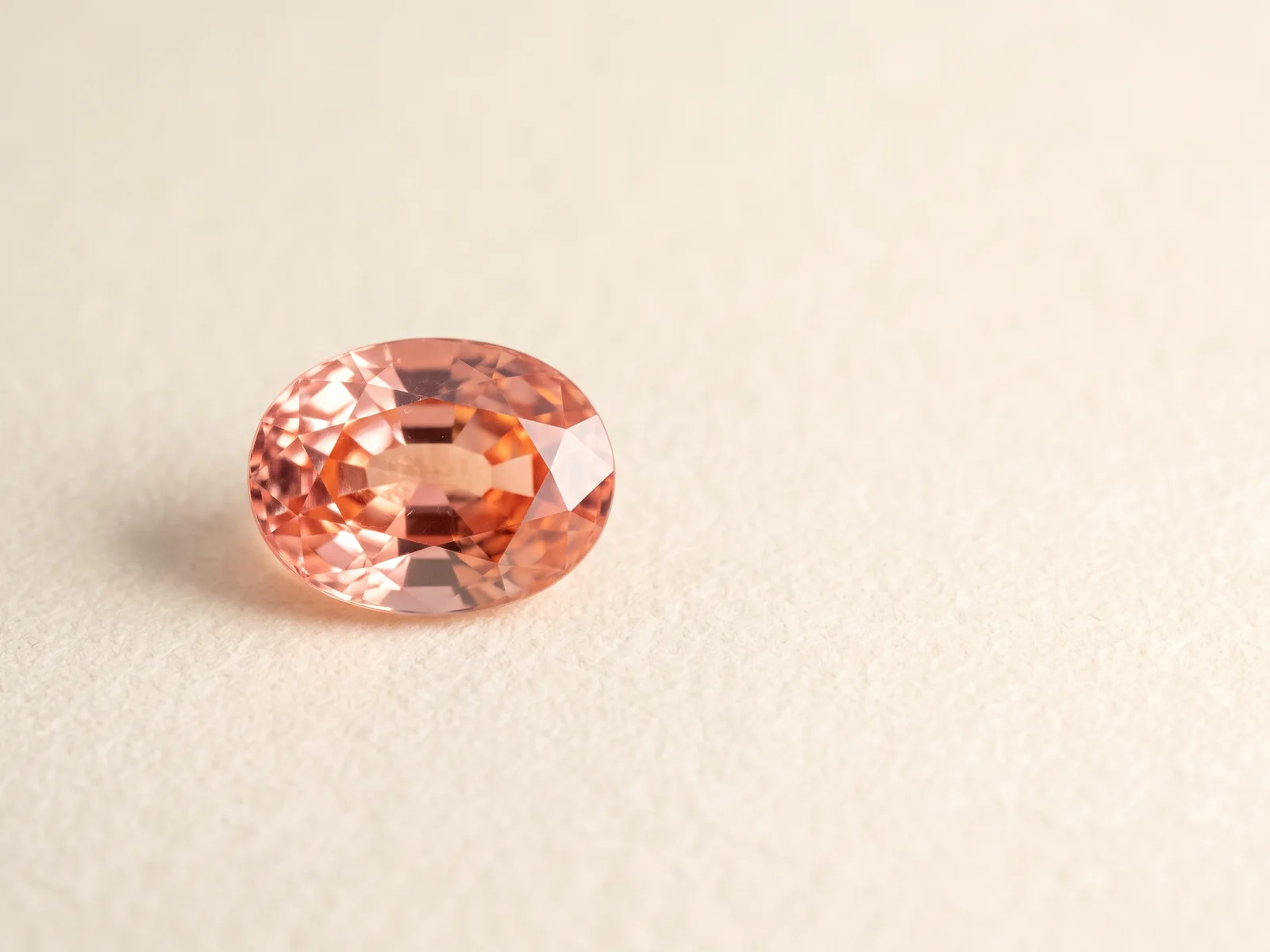
The padparadscha sapphire is the rarest named colour of sapphire, and the one where the label on the report matters most. Here is how to judge its colour, spot treatments and decide whether it suits a ring you will wear every day.
 Reviewed by Raj Sood, Graduate Gemologist (GIA), AJP (GIA)Master jeweller and Graduate Gemologist (GIA) · reviewed 4 November 2026
Quick answer
A padparadscha sapphire is a corundum showing a delicate blend of pink and orange, in light to medium tones, named after the Sinhalese word for lotus blossom. It is 9 on the Mohs scale with excellent toughness, so it suits an everyday ring. Value depends on colour balance, treatment (unheated, heated or beryllium-diffused), origin and size.
What is a padparadscha sapphire?
A padparadscha sapphire is a variety of corundum, the mineral made of aluminium oxide (Al2O3). Pure corundum is colourless; tiny amounts of other elements give it colour. Red corundum is called ruby and every other colour is called sapphire. Where the line between a deep pink sapphire and a ruby falls is explained in our ruby and sapphire comparison.
Padparadscha (pronounced pad-pah-RAD-shah) is the only sapphire colour with its own trade name. The word comes from Sinhalese, the main language of Sri Lanka, and is usually linked to the colour of the lotus blossom. What makes a stone a padparadscha is not one exact shade but a balance of pink and orange together, neither colour overwhelming the other. Our main sapphire gemstone guide covers the whole corundum family, and our coloured gemstone overview puts sapphire alongside every other gem we work with.
Because the name adds value, it is also the most argued-over label in coloured stones. Different gem laboratories draw the boundary slightly differently, and a stone one lab calls padparadscha another may describe as orangey pink sapphire. That is why the report, and the lab behind it, matter so much for this gem.
What colour is a padparadscha sapphire?
The classic description is a pinkish orange to orangey pink, with a light to medium tone (how light or dark the colour is) and moderate to strong saturation (how intense it is). Think of a tropical sunset or a salmon-coloured rose rather than a bright tangerine or a hot pink. Stones that are too dark, too brown or too saturated usually fall outside the name.
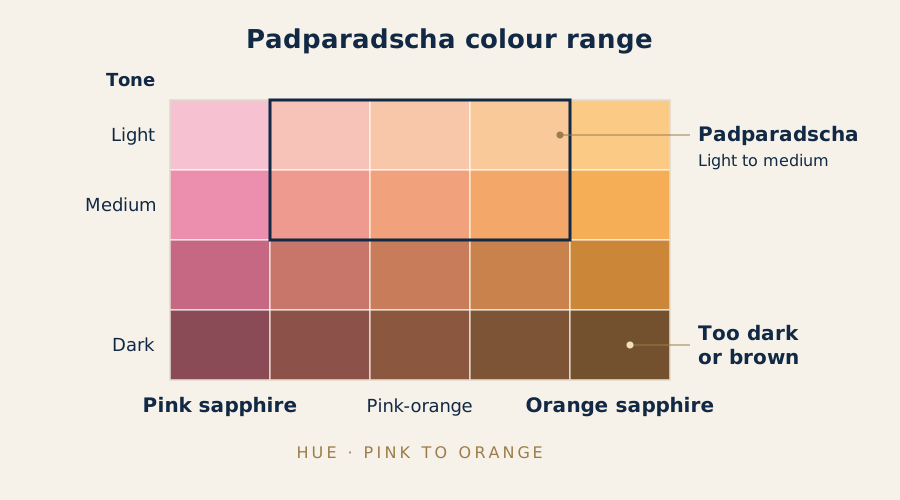
| Colour seen | Usually called | Why |
|---|---|---|
| Pure pink, no orange | Pink sapphire | The orange component is missing |
| Pink with a clear orange glow | Padparadscha | Both colours balanced |
| Orange with a soft pink glow | Padparadscha | Both colours balanced |
| Strong pure orange | Orange sapphire | The pink component is missing |
| Dark, brownish orange-pink | Orangey pink or pinkish orange sapphire | Too dark or too brown for the name |
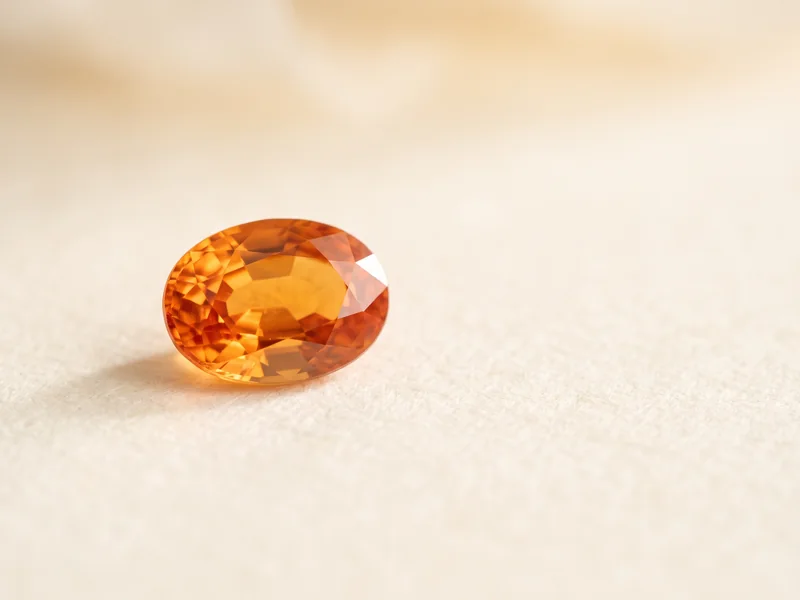
If you love the warmth but want something bolder and easier to find, a pure orange sapphire with a saturated tangerine colour is a common alternative. Sapphire comes in almost every colour, from sunny yellow sapphire to violet and purple sapphire and leafy green sapphire, so the padparadscha is one point on a very wide spectrum.
Lighting shifts how a padparadscha reads. Warm indoor light pushes it towards orange; cool daylight brings out the pink. That is normal and different from a true colour-change sapphire, which moves between distinct colours such as blue and purple.
How hard and tough is a padparadscha sapphire?
Two separate properties decide whether a gem survives daily wear. Hardness is resistance to scratching, measured on the Mohs scale from 1 to 10. Toughness is resistance to chipping and breaking. Corundum scores well on both: 9 on the Mohs scale, beaten only by diamond among natural gems, and excellent toughness because it has no cleavage (a plane along which a crystal splits easily). It can show parting, a weaker plane caused by twinning, but this is uncommon in faceted stones.
| Gem | Mohs hardness | Toughness | Everyday ring? |
|---|---|---|---|
| Diamond | 10 | Good (has cleavage) | Yes |
| Moissanite | 9.25 | Excellent | Yes |
| Sapphire, including padparadscha | 9 | Excellent | Yes |
| Spinel | 8 | Good | Yes, with care |
| Morganite | 7.5–8 | Good | With a protective setting |
| Topaz | 8 | Poor (strong cleavage) | With care |
| Emerald | 7.5–8 | Poor to fair | Protective setting, gentle wear |
For comparison, the dust in everyday air contains quartz at about 7 on the Mohs scale, which slowly dulls softer gems. A sapphire resists it. If you are choosing between green and padparadscha-coloured stones, our emerald versus sapphire durability guide covers why emerald needs more care.
For the gemmologist, corundum's key identification figures are a refractive index of about 1.762–1.770, birefringence of about 0.008–0.009, a specific gravity near 4.00 and a uniaxial, doubly refractive optic character. These separate it quickly from look-alikes such as glass, morganite or spinel, which is singly refractive.
Are padparadscha sapphires treated?
Most sapphires on the market have been treated in some way, and padparadscha is no exception. Treatment is not wrong, but it must be disclosed, and it changes value considerably. The three categories you will see:
- Unheated: the colour is entirely natural. These are the rarest and most valued padparadschas.
- Heated: the stone has been heated to improve colour or clarity, a long-accepted, stable treatment. Heated stones usually cost noticeably less than unheated stones of similar appearance.
- Beryllium diffusion: the stone is heated with beryllium, which diffuses into the crystal and adds orange. Emerged widely in the early 2000s and turned large amounts of pink sapphire padparadscha-coloured. It must be disclosed and is priced far lower.
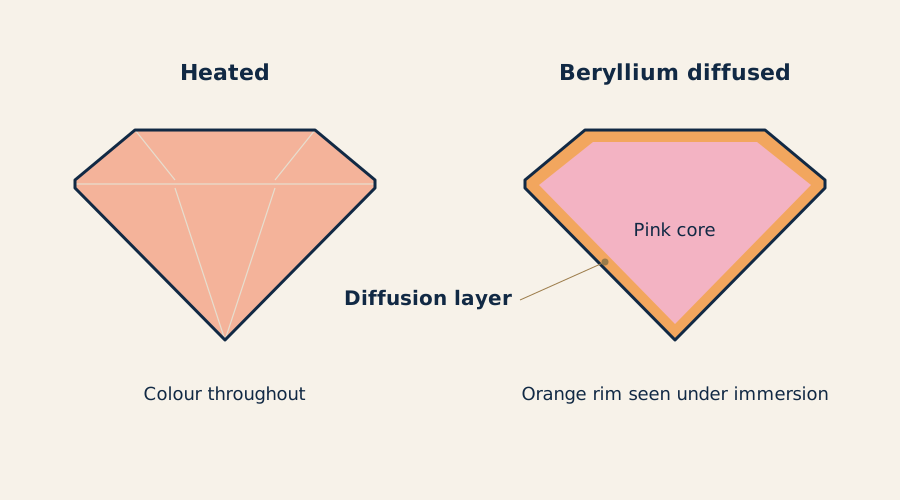
Beryllium is a light element and hard to detect with standard tools. Labs use immersion (looking at the stone in a liquid to see colour zones near the surface) and chemical analysis such as LA-ICP-MS or LIBS. Many laboratories will not use the padparadscha name for beryllium-treated stones at all, while some will describe the colour but state the treatment clearly.
Some padparadschas, particularly certain Madagascan stones, have shown unstable colour: part of the orange can fade after exposure to light, and in some cases return after gentle heating or ultraviolet exposure. Several labs now run a fade test before naming a stone padparadscha. Ask whether the report mentions it.
Finally, lab-created padparadscha sapphire exists. It is real corundum grown in a laboratory by methods such as flame fusion or the Czochralski pull method, with the same hardness and refractive index, at a small fraction of the price. It must always be sold as lab-created or synthetic sapphire, and a lab can separate it from natural by its curved growth lines, gas bubbles or chemistry.
Not sure which one is right?
Send us the stones you are looking at and our gemologist will tell you which to choose and why.
Where do padparadscha sapphires come from?
Sri Lanka is the traditional source, and many in the trade still think of Sri Lankan stones as the classic padparadscha colour: soft, lighter-toned and glowing. Madagascar has become a major source since the late 1990s, often producing stones with more pink. Tanzania, including the Umba Valley, and Vietnam also produce pinkish-orange corundum.
| Origin | Typical character | Gemmologist notes |
|---|---|---|
| Sri Lanka | Lighter, delicate pink-orange | Fine silk, zircon crystals with stress halos, fingerprint inclusions |
| Madagascar | Often pinker, sometimes deeper | Some stones tested for fading colour |
| Tanzania (Umba) | Often more orange or brownish | Usually heated |
| Australia | Very rarely padparadscha-coloured | Known for blue, green, yellow, teal and parti stones |
Australia's sapphire fields in New England, New South Wales, and central Queensland around Anakie are known for deep blues, greens, yellows and the two-tone stones described in our guide to parti sapphire rings. True padparadscha colours are very rare in Australian rough. If you want an Australian-origin stone with warmth, our page on engagement rings set with Australian sapphire covers what is realistically available, and teal sapphire rings are a distinctly Australian look.
Origin affects price, but it is not visible to the eye. It can only be stated by a laboratory that offers origin reports, and even then it is an expert opinion based on inclusions and trace-element chemistry.
What affects padparadscha sapphire value and price in Australia?
Value comes from the same factors as other coloured gems, but colour dominates. In rough order of importance:
- Colour balance: an even pink-orange blend in a light to medium tone, with no brown or grey.
- Treatment: unheated, then heated, then beryllium-diffused, each step a large drop in price.
- Report and lab: a recognised lab naming the stone padparadscha adds significantly to value.
- Size: fine stones over 2 carats are scarce, so price per carat climbs with size.
- Clarity and cut: eye-clean stones with even, lively faceting and no large window (a pale see-through patch in the centre).
- Origin: Sri Lankan origin often carries a premium.
| About 1 ct, eye-clean, good colour | Approximate price range (AUD) |
|---|---|
| Lab-created padparadscha sapphire | about $100–$600 |
| Beryllium-diffused natural | about $300–$1,500 |
| Heated natural, lab-named padparadscha | about $2,500–$8,000 |
| Unheated natural, lab-named padparadscha | about $6,000–$20,000+ |
These are broad ranges only. Prices vary widely with colour quality and change with the market. Natural gems are not sold here as investments; the price reflects rarity and beauty, not a promise of future value.
Padparadscha vs pink sapphire, orange sapphire and morganite: what is the difference?
| Padparadscha | Pink sapphire | Orange sapphire | Morganite | |
|---|---|---|---|---|
| Mineral | Corundum | Corundum | Corundum | Beryl |
| Colour | Pink-orange blend | Pink | Orange | Peach to pink |
| Mohs hardness | 9 | 9 | 9 | 7.5–8 |
| Refractive index | 1.762–1.770 | 1.762–1.770 | 1.762–1.770 | about 1.57–1.60 |
| Relative price | Highest of the three sapphires | Moderate | Moderate | Lower |
| Everyday ring | Excellent | Excellent | Excellent | Good with a protective setting |
Morganite is the most common look-alike in peach tones and is much more affordable, but it is softer and less brilliant because of its lower refractive index. A pink or orange sapphire gives the same durability as a padparadscha at a lower price, simply without the balanced blend. For how any coloured sapphire stacks up against a diamond centre, see our diamond or sapphire engagement ring guide.
Related guideOrange SapphireIs a padparadscha sapphire good for an engagement ring?
Yes. Its hardness and toughness make a padparadscha sapphire engagement ring practical for daily wear, provided the setting suits the stone. Because its charm lies in a soft, light colour, setting choices matter more than with a deep blue sapphire.
- Metal colour: rose and yellow gold echo the orange; white gold and platinum bring out the pink. Hold the stone against both before deciding.
- Claws: four or six claws let in the most light, which keeps a light-toned stone glowing.
- Bezel: very secure, but a thick bezel can make a pale stone look darker at the edge.
- Halo: white diamonds around the stone sharpen the colour; a rose gold halo warms it.
- Shape: ovals and cushions are most common, because cutters keep the shape that saves the most of this rare rough.
Our sapphire engagement ring guide covers settings for every colour of corundum, and if you are weighing a soft warm stone against a deeper blue-green, the teal versus blue sapphire comparison shows how tone changes the look on the hand.
How do you care for a padparadscha sapphire?
Day to day, a padparadscha needs the same care as any sapphire. Clean it with warm water, a drop of mild dish soap and a soft toothbrush, then rinse and dry. Untreated and heated stones are safe in an ultrasonic cleaner, but avoid ultrasonic and steam cleaning if the stone has filled fractures or you are unsure of its treatment.
Keep it away from very hard knocks, which can still chip any gem, and store it apart from diamonds, which can scratch sapphire. If your stone passed a colour-stability test, there is no special care needed; if it was not, avoid leaving it in strong direct sunlight for long periods. Have the claws checked once a year. Words such as parting, silk and bezel are all explained in our glossary of jewellery and gem terms.
How do you choose a padparadscha sapphire? Step by step
- Ask for a report. It should come from a recognised laboratory and state natural or lab-created, treatment, and whether the colour qualifies as padparadscha.
- Check the treatment line. Unheated, heated or beryllium-diffused makes a large difference to price.
- Ask about colour stability. Find out whether the stone was fade-tested, especially for Madagascan stones.
- Judge the colour yourself. Look for pink and orange together, light to medium tone, no brown or grey.
- Look for a window. Tilt the stone; a pale see-through centre means light is leaking out.
- Plan the setting and metal. Hold the stone against rose, yellow and white metal before you choose.
Browse natural gemstones
Free consultation
Talk to a gemologist
Compare stones in person or online with Raj Sood, Graduate Gemologist (GIA), AJP (GIA).
Book a consultationShop this shape
FAQ
Common questions
Why are padparadscha sapphires so expensive?
The balanced pink-orange colour is rare in natural corundum, especially in unheated stones over 1 carat. Demand is high and the name itself adds value when a lab confirms it.
Is padparadscha rarer than blue sapphire?
Yes. Fine natural padparadschas are found far less often than fine blue sapphires, which is reflected in their price per carat.
Can a padparadscha sapphire be lab-grown?
Yes. Lab-created padparadscha sapphire is real corundum grown in a laboratory and costs a small fraction of natural. It must be sold as lab-created or synthetic, and a gem lab can identify it.
What is the difference between padparadscha and pink sapphire?
A pink sapphire is pink only, while a padparadscha shows both pink and orange together. Both are corundum with the same hardness of 9.
Do padparadscha sapphires fade?
Most do not, but some stones, notably certain Madagascan material, have shown part of their orange fading after strong light exposure. Many labs now test for this before using the padparadscha name.
Are Australian padparadscha sapphires available?
Very rarely. Australian sapphire fields mainly produce blue, green, yellow, teal and parti stones, and true padparadscha colours are uncommon in Australian rough.

Ask a gemologist
Not sure which diamond to choose?
Raj Sood is a Graduate Gemologist (GIA) and master jeweller. Bring the stones you are considering, or send the reports, and he will tell you honestly which one is better and why.
Keep learning
Related guides
 GemstonesOrange Sapphire
 GemstonesSapphire Gemstones
 GemstonesSapphire Engagement Rings in Melbourne
 GemstonesRuby vs Sapphire Engagement RingsGemstonesGemstones | Coloured Gemstones, Birthstones and Custom Jewellery
 GemstonesDiamond vs Sapphire Engagement Rings
 GemstonesAustralian Sapphire Engagement Rings
 GemstonesGreen Sapphire
Explore more
More guides on this topic
Education