
- Education
- Engagement Rings & Settings
- Elongated Diamond Settings: Which Setting Suits Each Shape
Engagement Rings & Settings
Elongated Diamond Settings: Which Setting Suits Each Shape
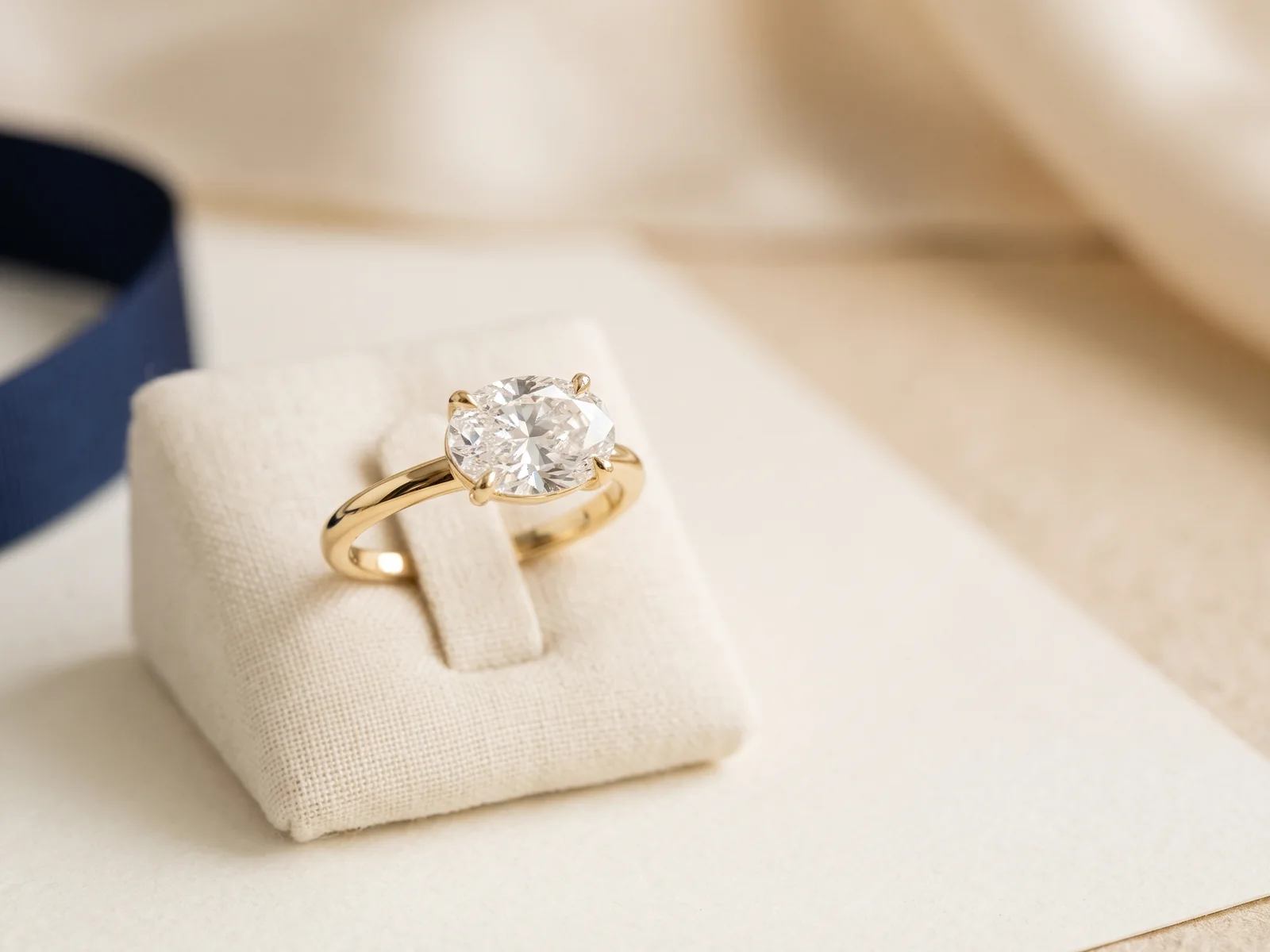
An oval, pear, marquise or elongated emerald behaves very differently in a ring from a round. This guide to elongated diamond settings shows where the claws go, when a halo helps, and which bands sit beside each shape.
 Reviewed by Raj Sood, Graduate Gemologist (GIA), AJP (GIA)Master jeweller and Graduate Gemologist (GIA) · reviewed 4 November 2026
Quick answer
The best setting for an elongated diamond depends on its ends. Pears and marquises need V-claws or bezels to protect their points; ovals suit four or six claws placed on the diagonals; elongated emerald, radiant and cushion cuts need corner claws or V-claws. A thin band, low profile and optional halo keep proportions balanced.
What are elongated diamond shapes and why do settings matter?
An elongated diamond is any shape that is clearly longer than it is wide. The usual measure is the length-to-width ratio: divide the length on the grading report by the width. A round is 1.00. Ovals usually sit around 1.30–1.50, pears 1.45–1.75 and marquises 1.85–2.10, while elongated cushion, radiant and emerald cuts stretch a familiar square or rectangle to roughly 1.15–1.60. Our guide to the full family of elongated diamond cuts covers each shape in detail.
Settings matter more for these shapes than for a round, for three reasons. First, many elongated cuts have points or corners, which are the thinnest parts of the stone. Diamond is 10 on the Mohs hardness scale, but hardness is resistance to scratching, not to knocks. A thin point can chip along a cleavage plane (a direction in which the crystal splits more easily) if it takes a hard hit on a doorframe or bench.
Second, a long stone has a direction. The setting has to hold it dead straight along the finger, because a slight lean that you would never notice on a round looks crooked on a marquise. Third, the setting changes how long the stone looks. A heavy halo or a wide band can make a slim oval read as stubby, while well-placed claws and a fine band make the same stone look longer.
If a term here is new, our jewellery glossary of setting terms explains it, and our overview of engagement ring setting styles covers every style from solitaire to bezel. This page focuses on how those styles work with elongated shapes specifically.
How many claws does an elongated diamond need, and where should they go?
A claw (called a prong in the United States) is a small post of metal bent over the edge of the stone to hold it in place. On an elongated diamond, where the claws sit matters as much as how many there are. The rule of thumb is simple: every point or sharp corner gets covered, and the rest of the claws are spaced so the stone cannot rock.
| Shape | Usual claw count | Where the claws go | Why |
|---|---|---|---|
| Oval | 4 or 6 | Four on the diagonals, or six spaced evenly around the outline | Leaves the ends open so the full length shows; six adds security |
| Pear | 3 or 5 | A V-claw on the point, plus two or four around the rounded end | The point is the most exposed edge |
| Marquise | 4 or 6 | A V-claw on each point, plus two or four along the sides | Both tips are thin and exposed |
| Moval | 4 or 6 | V-claws or tab claws on the ends, plus side claws | Its ends are softer than a marquise's but still taper |
| Elongated cushion | 4 (single or double) | On the four rounded corners | Corners take the knocks |
| Elongated radiant or emerald | 4 | On the four cut corners, often as flat or tab claws | The bevelled corners reduce chipping; claws finish the job |
| Heart | 3 or 5 | A V-claw on the point, one on each lobe | Protects the point and the lobes |
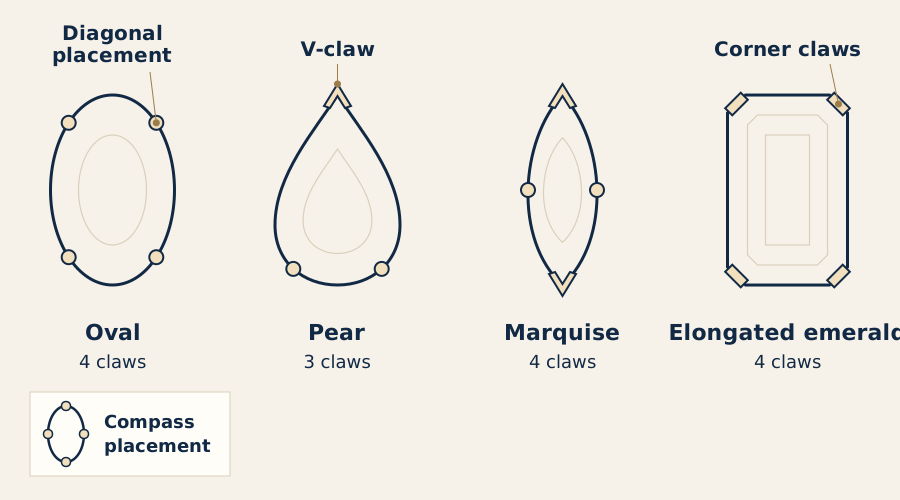
A V-claw is a claw folded into a V shape that wraps around a point, so a knock hits metal before it hits diamond. Ovals have no points, so they are usually held by four or six round claws. With four claws there are two placements. The common one puts them on the diagonals, at the shoulders of the oval, leaving both ends clear so the stone reads as long as possible. Compass placement puts a claw at north, south, east and west instead; it covers the ends, looks more unusual, and suits people who want a slightly different look.
For a 1 carat stone, claws are usually about 1.0–1.4 mm across at the tip. Finer claws look delicate but wear down sooner; heavier claws are more secure but cover more of the outline. Double claws (two thin claws side by side at each position) are a good middle ground on ovals and cushions: if one wears or bends, the other still holds. The principle is the same as how claws are placed on a round diamond, with extra attention to points, and it follows the same logic as corner protection on princess cuts.
What are the best settings for elongated diamond shapes, shape by shape?
Here is how the main setting styles suit each elongated diamond. None of these is the only right answer; the aim is to protect the weak spots and keep the shape reading clearly.
| Shape | Typical ratio | Fragile areas | Settings that suit | Watch for |
|---|---|---|---|---|
| Oval | 1.30–1.50 | None | 4 or 6 claws, halo, hidden halo, east-west | Bow-tie (dark band across the middle); a setting cannot fix it |
| Pear | 1.45–1.75 | The point | 3 or 5 claws with V-claw, half-bezel, halo | Point must face the fingertip and sit straight |
| Marquise | 1.85–2.10 | Both points | 6 claws with two V-claws, bezel ends, east-west | Both points line up exactly with the band |
| Moval | about 1.50–1.90 | Tapered ends | V-claws or tab claws, bezel ends | Claws should not flatten the outline |
| Elongated cushion | 1.15–1.50 | Corners (mild) | 4 double claws, cushion-shaped halo | Halo can push the ratio towards square |
| Elongated radiant | 1.20–1.50 | Cut corners | 4 tab claws, bezel, halo | Claws should sit on the bevels, not the long sides |
| Elongated emerald | 1.40–1.60+ | Cut corners | 4 corner claws, bezel, east-west | Step cuts show every inclusion and tilt |
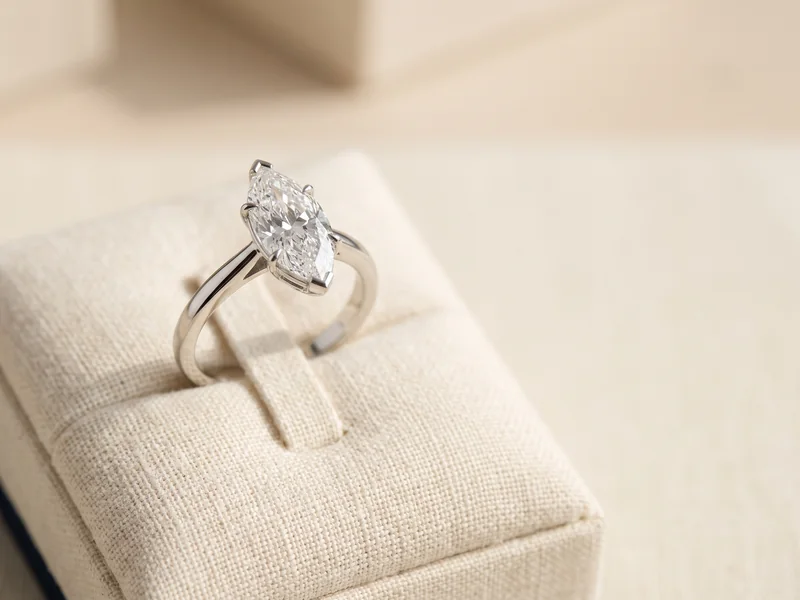
Pears and marquises are the shapes where the setting does the most work. A pear is normally set with the point towards the fingertip, held by a V-claw and two or four claws around the round end; our page on setting ideas for pear diamonds goes through each option. A marquise needs both points protected, usually with two V-claws and two or four side claws, or with bezel caps on each end. See marquise settings with two V-claws for side-by-side examples.
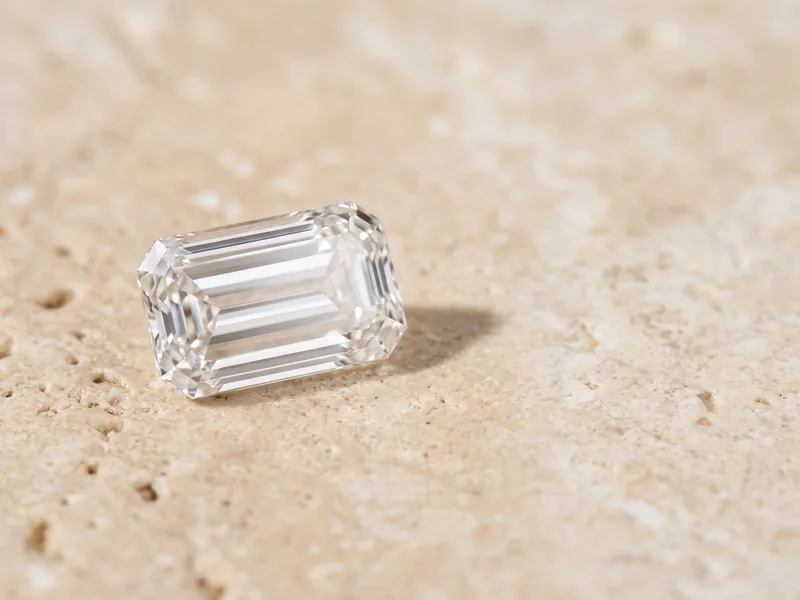
Step-cut and cut-corner shapes are more forgiving at the edges, because the corners are already trimmed. An elongated emerald has long parallel step facets that act like a window, so it suits clean, low settings that do not distract; our elongated emerald cut guide explains the ratios people prefer. Radiants have the same outline but brilliant faceting, so they hide inclusions better and suit halos well; read what makes an elongated radiant different before choosing between the two.
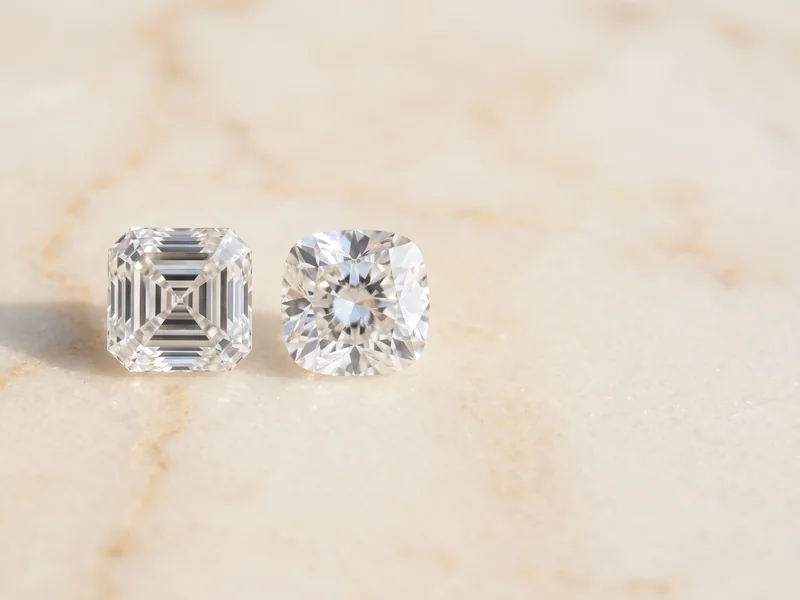
Cushions sit between the two families, with rounded corners and pillowy sides. Four double claws on the corners are the classic choice. Our page on elongated cushion cuts explained covers the ratios, and square versus elongated cushion shows how the same setting looks on each. Hearts are not usually counted as elongated, but they share the problem of an exposed point, so the same V-claw logic applies; see settings that protect a heart's point.
Related guideElongated Diamond Cuts: Oval, Pear, Marquise, Moval and MoreShould you put a halo around an elongated diamond?
A halo is a ring of small diamonds, usually about 1.0–1.5 mm each, set around the centre stone. It makes the centre look larger, frames the outline and shields the edges, including the points of a pear or marquise. It also adds sparkle at the edge where an elongated stone can look a little dark.
The catch is that a halo adds the same amount of width to the sides as length to the ends, so it pulls the ratio towards 1.00. Take a typical 1 carat oval of about 8.0 × 5.6 mm, a ratio of 1.43. A halo that adds 1.2 mm all round makes the outline about 10.4 × 8.0 mm, a ratio of 1.30. The ring looks bigger, but noticeably less slim. If you love a long look, start with a slightly longer stone or choose a thinner halo.
- Classic halo: follows the outline of the centre stone. Best for size and protection.
- Hidden halo: a row of small diamonds under the centre stone, seen from the side. Keeps the face-up ratio exactly as the stone was cut.
- Contrast halo: a round or cushion-shaped halo around an oval or pear. A deliberate design choice, but it softens the elongated outline.
- No halo: a solitaire shows the true shape and ratio and is easiest to pair with a band.
Halos are common on ovals and elongated cushions, which can look similar once framed; our oval or elongated cushion comparison helps if you are deciding between them. For cushion-specific halo shapes, see halo and claw options for cushion diamonds.
Not sure which one is right?
Send us the stones you are looking at and our gemologist will tell you which to choose and why.
Is a bezel or east-west setting good for an elongated diamond?
A bezel is a thin rim of metal that wraps the whole edge of the stone. It is the most secure setting for any shape, and for a marquise or pear it removes the worry about points entirely. It hides a little of the outline, often a fraction of a millimetre around the edge, and lets in slightly less light from the side. A half-bezel or bezel caps on just the ends of a marquise keep most of the protection while showing more of the stone.
Bezels suit step cuts particularly well, because their clean lines match the stone's own geometry; the same thinking appears in our step-cut settings for Asscher diamonds. If you work with your hands, garden, lift weights or nurse, a bezel or low claw setting is worth serious thought, and our page on low, secure settings for active hands covers this in depth.
An east-west setting turns the stone sideways, so its length runs across the finger instead of along it. It sits lower visually, has a modern look, and suits ovals, marquises and emerald cuts. The trade-off is that the ends now point towards your neighbouring fingers, which is where knocks happen, so V-claws or bezel ends matter even more. An east-west stone also makes the finger look wider rather than longer.
Which metal and profile suit an elongated diamond ring?
The profile is how the ring looks from the side: how high the stone sits and what holds it up. Elongated stones are long, so a tall setting puts a lot of edge in the way of everyday knocks. Many people choose a lower head, with the stone sitting roughly 5–7 mm above the finger, as a balance between light reaching the stone and practicality.
- Cathedral: the shoulders rise up to meet the stone in arches. Elegant, and leaves room for a straight band underneath.
- Basket: the claws are joined by a wire rail around the stone. Strong and easy to clean.
- Rail or gallery: a single wire running under the long sides. Keeps a long stone from flexing in its claws and looks tidy side-on.
- Low set: the stone sits close to the band. Practical, but a straight wedding band may not sit flush.
Metal choice affects colour and wear. Platinum is dense and its claws tend to move rather than wear away, so they can be re-tipped less often. 18 carat white gold is usually plated with rhodium (a bright white metal) that wears and needs replating every year or two. Yellow and rose gold warm the look of the diamond, so a slightly warmer colour grade is less noticeable. For a V-claw or bezel, many jewellers use platinum or white gold even on a yellow gold band, so the metal against the stone looks white.
Which wedding band suits an elongated engagement ring?
An elongated engagement ring changes what sits comfortably beside it. Long stones overhang the band at both ends, and points can catch or press against a straight band. The width of the band also changes how long the centre stone looks: a fine band of about 1.8–2.5 mm makes a 1 carat oval look longer, while a band of 3 mm or more makes it look shorter and more solid.
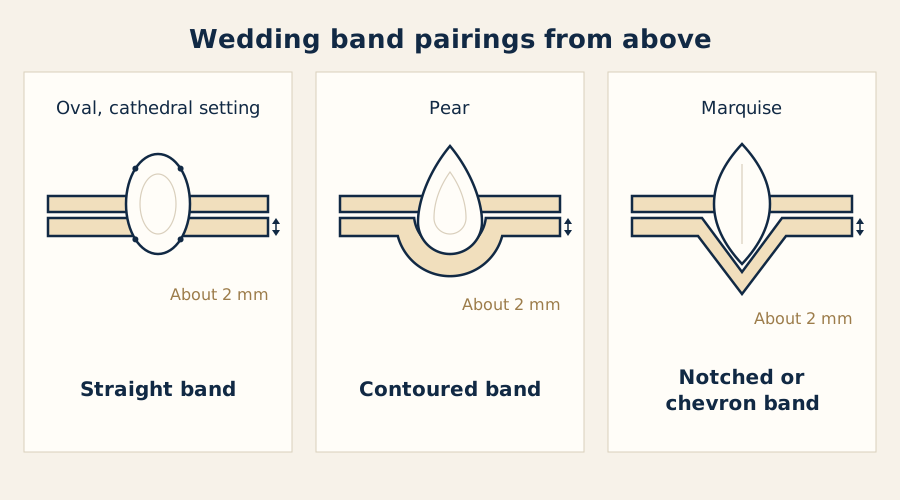
- Oval or elongated cushion: a straight band can sit flush if the setting is a cathedral or has a raised gallery. On a low setting, a slightly curved band works better.
- Pear: a contoured band (one shaped to follow the outline) curves around the round end or the point.
- Marquise: a contoured or notched band, or a deliberate small gap. A chevron band that dips into a V suits the shape well.
- Elongated emerald or radiant: a straight band with small claws or channel-set stones keeps the clean lines.
- East-west stones: usually leave room for a straight band either side, because the stone sits across the finger.
If you are not sure yet, have the engagement ring made so a straight band can sit flush. That keeps the most options open later. A contoured band can always be made to match an existing ring.
How much does an elongated diamond setting cost in Australia?
The setting is priced separately from the stone. What moves the price most is the metal, the weight of metal, the number and quality of side or halo diamonds, and how much hand work the design needs. These are broad ranges only, for the setting without the centre diamond.
| Setting style (without centre stone) | 18 carat gold, approx. AUD | Platinum, approx. AUD |
|---|---|---|
| Plain solitaire, 4 or 6 claws | about $1,200–$2,500 | about $1,800–$3,500 |
| Solitaire with V-claws or bezel ends | about $1,400–$2,800 | about $2,000–$3,800 |
| Full bezel | about $1,400–$3,000 | about $2,000–$4,000 |
| Hidden halo | about $1,800–$3,500 | about $2,500–$4,500 |
| Classic halo | about $2,200–$4,500 | about $3,000–$5,500 |
| Matching contoured band | about $800–$2,500 | about $1,200–$3,500 |
Centre stones come in two kinds. Natural diamonds are mined and formed deep in the earth, most of them more than a billion years ago; lab-grown diamonds are real diamond grown in a laboratory, with the same hardness and refractive index (about 2.42). Lab-grown diamonds cost much less than natural diamonds of the same size and grade. Every setting style on this page works the same way with either, and both should come with an independent grading report that states whether the stone is natural or laboratory-grown.
Create your ring: choose a setting for your elongated diamond
How do you choose a setting for an elongated diamond? Step by step
- Know your shape and ratio. Divide length by width on the report. A slim stone may not need a halo; a shorter one can look longer with a fine band.
- Find the weak spots. Points on pears, marquises and movals; corners on cushions, radiants and emeralds. Each needs a V-claw, corner claw or bezel.
- Choose the claw count and placement. Four or six for ovals, three or five for pears, four or six for marquises, four on the corners for cut-corner shapes.
- Decide on a halo. Work out how much it will shift the ratio, or choose a hidden halo to keep the true outline.
- Pick a profile for your life. Lower and bezel-set if your hands are busy; cathedral if you want a straight band to sit flush.
- Plan the wedding band now. Straight, contoured or notched, and about 1.8–2.5 mm if you want the stone to look long.
- Check it straight-on. Look at a render or the finished ring from above and confirm the stone runs exactly in line with the band.
Free consultation
Talk to a gemologist
Compare stones in person or online with Raj Sood, Graduate Gemologist (GIA), AJP (GIA).
Book a consultationShop this shape
FAQ
Common questions
What is the best setting for an oval diamond?
Most ovals suit four or six claws, with four placed on the diagonals so both ends stay open. A halo makes the stone look larger, and a hidden halo adds sparkle without changing the face-up ratio.
Do pear and marquise diamonds need V-claws?
Yes, in almost every case. Their points are the thinnest parts of the stone, and a V-claw or bezel end takes the knocks the point would otherwise take.
Does a halo make an elongated diamond look shorter?
Slightly. A halo adds the same width all round, so a 1.43 ratio oval can look closer to 1.30 once framed. Choosing a longer stone or a thinner halo offsets this.
Is an east-west setting practical for everyday wear?
It can be, but the ends of the stone point towards your other fingers, so protect any points with V-claws or bezel ends. A low profile also helps.
Will a straight wedding band sit flush with an oval engagement ring?
Only if the setting is raised enough, such as a cathedral or a setting with a raised gallery. On a low setting, a slightly curved or contoured band usually fits better.
Are bezel settings good for elongated diamonds?
They are the most secure option and suit marquises, pears and step cuts well. They hide a little of the outline, so some people choose bezel caps on just the ends.

Ask a gemologist
Not sure which diamond to choose?
Raj Sood is a Graduate Gemologist (GIA) and master jeweller. Bring the stones you are considering, or send the reports, and he will tell you honestly which one is better and why.
Keep learning
Related guides
 Engagement Rings & SettingsBest Settings for Pear Diamonds
 Engagement Rings & SettingsBest Settings for Marquise Diamonds
 Diamond ShapesElongated Diamond Cuts: Oval, Pear, Marquise, Moval and MoreEngagement Rings & SettingsEngagement Ring Setting Styles Guide
 Diamond ShapesElongated Emerald Cut Diamonds
 Diamond ShapesElongated Cushion Cut Diamonds
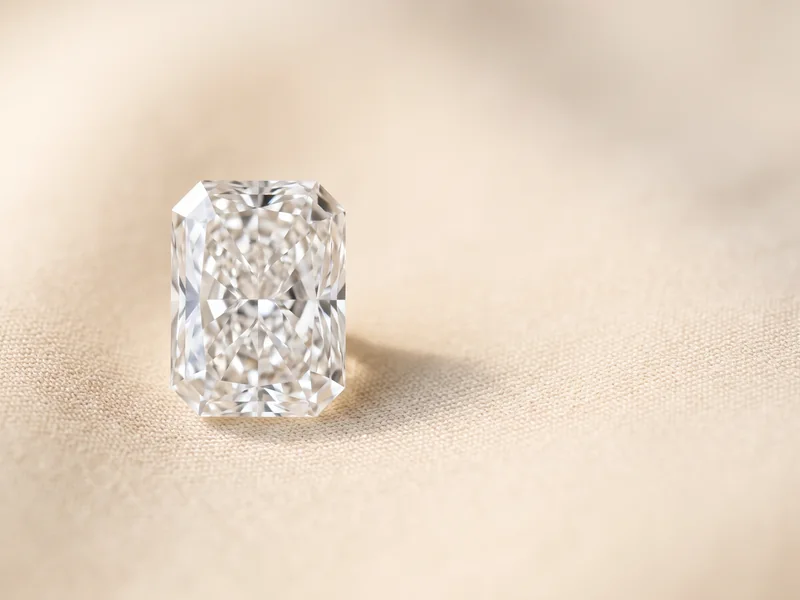 Diamond ShapesElongated Radiant Cut Diamonds
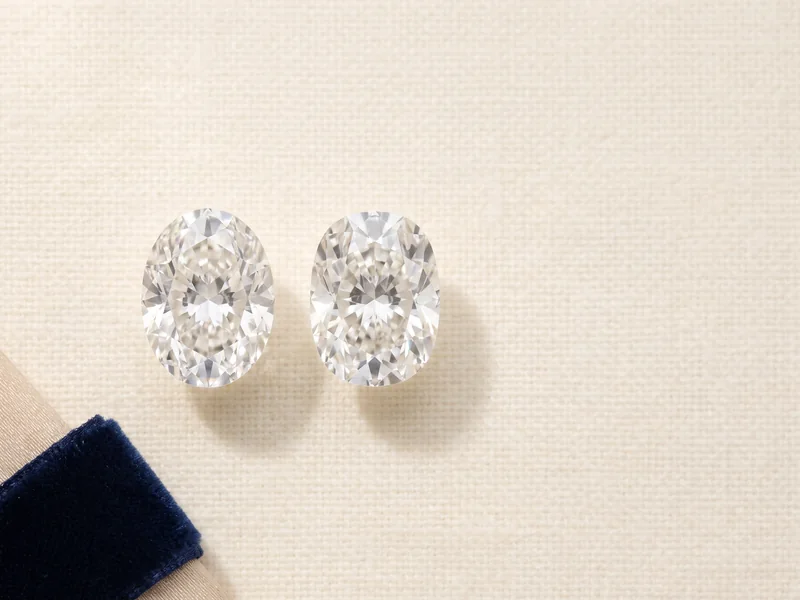 Diamond ShapesOval vs Elongated Cushion Diamonds
Explore more
More guides on this topic
Education