
- Education
- Engagement Rings & Settings
- Marquise Diamond Settings: Claws, Halos, Bezels and Band Pairing
Engagement rings & settings
Marquise Diamond Settings: Claws, Halos, Bezels and Band Pairing
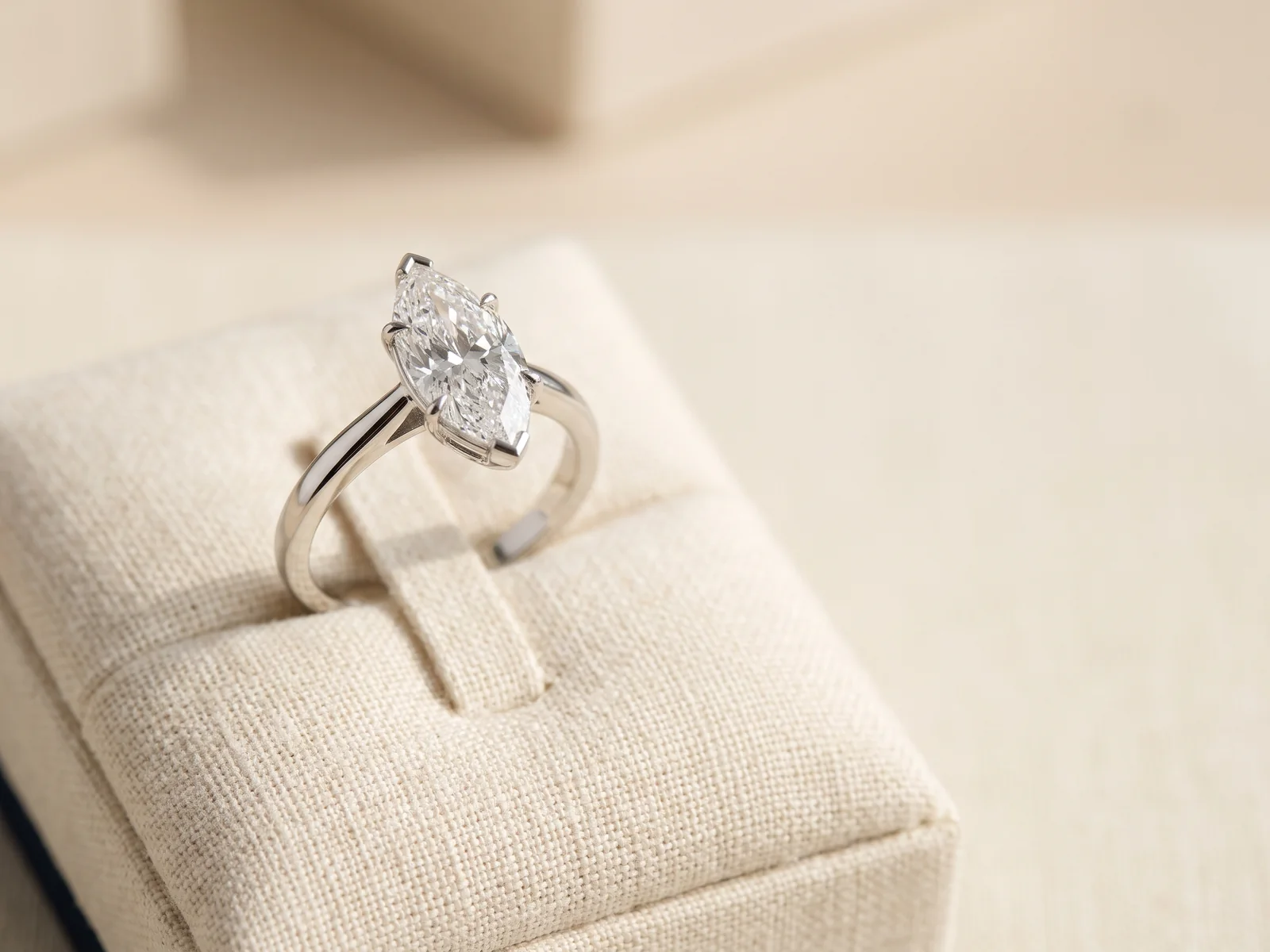
A marquise has two fine points and a long outline, so the setting does more work here than with almost any other shape. This guide compares marquise diamond settings by how well they protect the tips, show off the length and sit beside a wedding band.
 Reviewed by Raj Sood, Graduate Gemologist (GIA), AJP (GIA)Master jeweller and Graduate Gemologist (GIA) · reviewed 4 November 2026
Quick answer
The most reliable marquise diamond settings cover both points: a V-tip claw at each end with two or four side claws, or a full or half bezel. A halo adds protection and apparent size. Set the stone north-south for the classic look or east-west for a modern one, and pair it with a contoured or notched band.
Why does a marquise diamond need a special setting?
A marquise is a long, boat-shaped modified brilliant cut. That means it uses brilliant-style triangular and kite-shaped facets, usually 56 to 58 of them, arranged around an outline with two curved sides that meet in a sharp point at each end. Most people choose a length-to-width ratio between about 1.85 and 2.10, so a 1 carat marquise measures roughly 12 × 6 mm. For grading, history and how the shape is cut, start with our complete guide to marquise cut diamonds.
Diamond is 10 on the Mohs hardness scale, the hardest natural material, but hardness only means it resists scratching. Toughness, its resistance to chipping and breaking, is a different property. Diamond has cleavage planes, directions along which it can split if a thin edge takes a sharp knock. A round has no thin edges to speak of. A marquise has two, and they are the first part of the stone to meet a door frame, a benchtop or a car door.
So a marquise setting has four jobs, in roughly this order:
- Protect both points. Metal should cover or closely guard each tip.
- Hold the stone dead straight. Because the stone is long and narrow, a tilt of even a few degrees is obvious on the hand.
- Show the length. The outline is the whole appeal, so the setting should hide as little of it as it safely can.
- Sit well with a wedding band. The points and the claws that guard them can clash with a straight band.
If the setting vocabulary is new, our overview of engagement ring setting styles explains claws, bezels, halos and galleries in general, and every term on this page is defined in the GemTrove jewellery glossary. For the durability side in more depth, see how to keep marquise points from chipping.
Where should the claws go on a marquise diamond?
Claws (also called prongs) are the small metal posts that grip the stone. On a marquise, where they sit matters more than how many there are. The key piece is the V-tip, sometimes called a V-claw or chevron claw: a V-shaped claw that wraps around the point, covering both sides and the very tip. With a V-tip at each end, the two most fragile spots are physically shielded.
| Claw layout | What it does | Suits |
|---|---|---|
| 2 V-tips + 2 side claws | Points covered; one claw at the middle of each side holds the width | Most marquise solitaires up to about 1.5 ct |
| 2 V-tips + 4 side claws (six-claw) | Points covered; two claws per side spread the grip | Larger stones, active wearers, the classic choice |
| 6 round claws (a pair either side of each point plus one on each side) | Points flanked but not covered | A lighter look; less protection at the tips |
| 4 round claws at the shoulders | Points fully exposed | Not recommended for an everyday ring |
| Double claws at each point | Two small claws close to the tip | Vintage-style designs; check the tip sits between them |
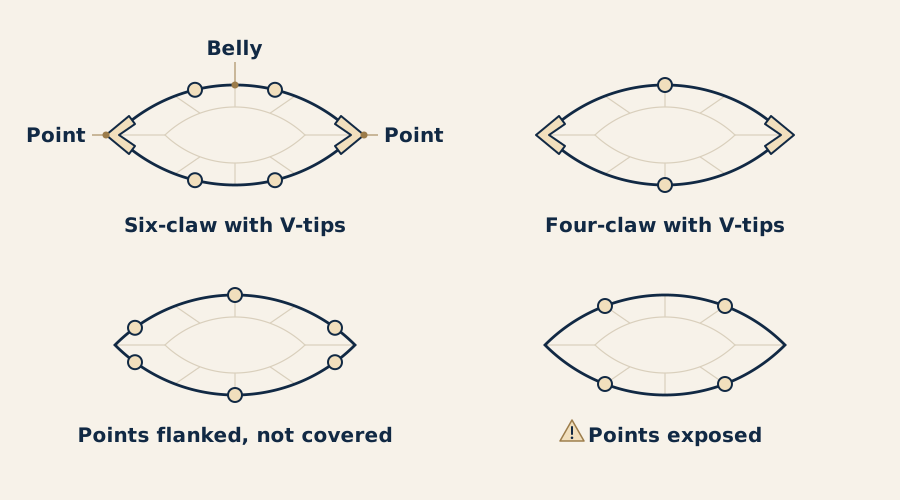
Side claws are usually placed at or near the widest part of the stone, called the belly, where they hold it most firmly. On a stone with a ratio above about 2.0, the sides are long enough that a second pair of claws stops the stone rocking. V-tips are typically 0.4–0.8 mm thicker at the very point than a round claw, so they show slightly as a small metal triangle at each end. Most people find that frames the shape; if you prefer a minimal look, ask for fine V-tips that are polished to follow the curve of the stone.
Claws also affect how straight the stone looks. If one side's claws sit closer to the point than the other's, the eye reads the whole stone as leaning. The same applies to the stone itself: lopsided wings or points that do not line up show up quickly once set. Our page on checking a marquise for even wings and aligned points shows what to look for before you choose a stone.
What are the best marquise diamond settings?
There is no single best setting for a marquise diamond; it depends on how you live, how much metal you like to see and what band you plan to wear beside it. Here are the main marquise engagement ring settings side by side.
| Setting | Point protection | Shows outline | Everyday wear | Look |
|---|---|---|---|---|
| Six-claw solitaire with V-tips | Very good | Almost all of it | Very good | Classic, open |
| Full bezel | Excellent | Slightly less (rim covers the edge) | Excellent | Modern, smooth |
| Half-bezel (metal at the points only) | Excellent | Most of it | Very good | Modern, airy sides |
| Halo | Very good | Framed and enlarged | Good (small stones need checks) | Brighter, larger |
| Three-stone | Good with V-tips | All of it | Good | Traditional, balanced |
| Toi et moi | Depends on design | All of it | Fair to good | Asymmetric, fashion-led |
| East-west solitaire | Good with V-tips or bezel | All of it, sideways | Good | Contemporary |
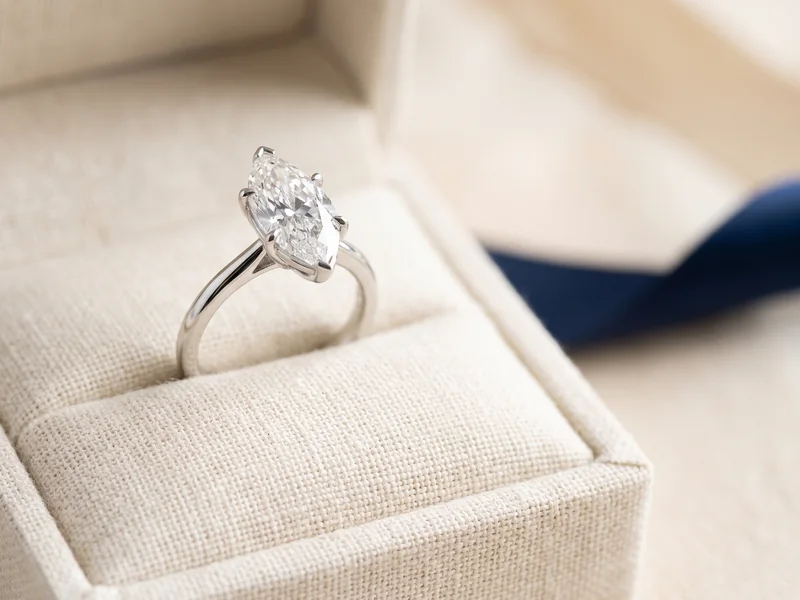
Six-claw solitaire. The most common marquise setting, and for good reason: two V-tips protect the points, four side claws hold the stone firmly, and almost the whole outline stays visible. It lets the most light into the sides of the stone.
Full or half bezel. A bezel is a thin rim of metal that runs around the edge of the stone. A marquise bezel setting is the most protective option, because no edge is exposed at all. The trade-off is that the rim hides a sliver of the outline and makes the stone look a touch smaller, roughly 0.5 mm less on each side. A half-bezel wraps only the two points and leaves the long sides open, which keeps most of the light and outline while still guarding the tips.
Three-stone. A marquise centre with a smaller stone either side. Tapered baguettes, pears pointing outward or small rounds all work. The side stones sit beside the centre's long sides and shield it from side knocks, but the points still need V-tips.
Toi et moi. French for 'you and me', this places two stones side by side, often a marquise with a pear or a round. A toi et moi marquise ring is popular and personal, but the stones are often set at angles, so check that each point is covered by a V-tip or bezel rather than left proud.
Related guideProtecting Marquise Diamond PointsIf you are comparing shapes before settling on a marquise, it helps to see how the advice changes for stones with no points at all; our guide to settings that suit round brilliants is a useful baseline.
Should a marquise diamond have a halo?
A halo is a ring of small diamonds, called melee, set closely around the centre stone. On a marquise halo engagement ring, the melee are usually about 1.0–1.5 mm across and follow the outline all the way to each point, so the halo adds about 2–3 mm to the overall length and width.
- Looks larger: the outline reads bigger from a distance, which suits smaller marquises under about 0.70 ct.
- Protects the edge: the halo takes knocks before the centre stone does, including at the points.
- Frames the shape: a clean, even halo exaggerates the marquise's length and sharp ends.
- More upkeep: dozens of tiny claws need checking every 6–12 months, and lost melee are more likely than a lost centre.
- Harder to pair: a halo widens the head, so a straight band may leave a gap.
A halo should follow the marquise exactly. If the halo's points are blunt or rounded, the stone underneath looks like an oval with a frame, and you lose the point of choosing a marquise. Ask to see the halo's tips up close in a render or photo before you commit.
Halos work differently on other shapes. A cushion's soft corners take a halo naturally, which is why our cushion setting guide leans towards them, while a heart's cleft makes the halo's shape trickier, as shown in our heart diamond setting comparisons.
Not sure which one is right?
Send us the stones you are looking at and our gemologist will tell you which to choose and why.
Should a marquise be set north-south or east-west?
North-south means the points run along the finger, towards the fingertip and the hand. This is the traditional orientation, and it makes the finger look longer and slimmer. East-west turns the stone 90° so the points run across the finger. An east west marquise ring looks contemporary, sits lower and catches less on gloves and jumpers, because the points are tucked towards the sides of the finger rather than standing out at the front and back. A third option, diagonal or tilted, angles the stone at about 30–45°, often in toi et moi designs.
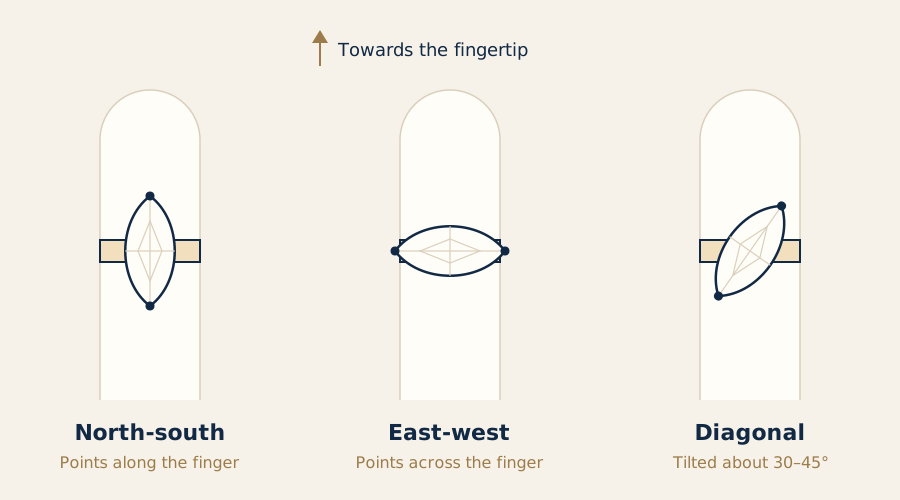
East-west has one catch: a long marquise set sideways can overhang a narrow finger. A 1 carat stone at about 12 mm long, for example, spans most of the width of a typical ladies' finger. A slightly shorter ratio, around 1.75–1.90, often suits east-west better. Our page on choosing the right marquise ratio shows how much length each ratio adds.
If you like the length but want softer ends, the moval sits between a marquise and an oval; see how a marquise and a moval differ in shape and setting.
Which marquise diamond settings suit active hands?
If you work with your hands, garden, train at the gym or care for small children, the setting matters more than the stone. For active wear, the most protective marquise diamond settings are a full bezel, a half-bezel or a low six-claw setting with heavy V-tips. Avoid exposed round claws at the points and very tall settings.
Height makes a real difference. A low-profile head that sits the girdle (the stone's outer edge) about 5–6 mm above the finger is far less likely to take a knock than a high cathedral setting at 7–8 mm or more. An east-west orientation also helps, because the points sit along the sides of the finger instead of at the front. Our guide to engagement ring settings for busy, hands-on lives compares the options across every shape.
Metal choice matters too. Platinum is dense and tends to move rather than wear away when knocked, so claws keep their bulk for longer. 18ct gold claws wear a little faster and should be checked and re-tipped when they thin. Many yellow and rose gold marquise rings use a white gold or platinum head, so the claws are tougher and the stone looks whiter. Whatever the metal, a yearly check of the V-tips is the simplest way of stopping small tip damage before it spreads.
What wedding band suits a marquise engagement ring?
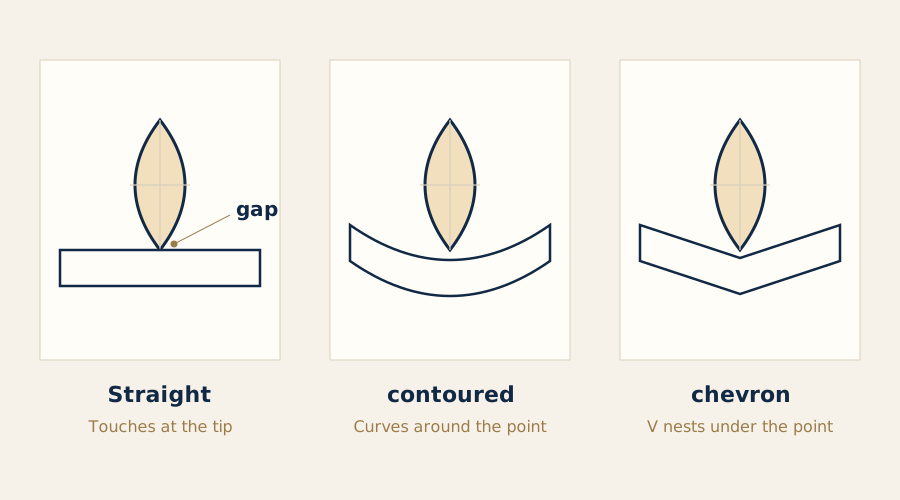
On a north-south marquise, the V-tips point straight at whatever band sits beside the ring. On a low setting, a straight band will often touch the V-tip and leave a gap along the rest of its length. Higher settings let a straight band slide underneath. A halo widens the head and makes the gap larger.
| Band type | How it sits beside a marquise | Notes |
|---|---|---|
| Straight, plain | Touches at the V-tip; may leave a small gap | Works on higher settings or east-west stones |
| Contoured (curved) | Curves around the point and sits close | The most common pairing for a low marquise |
| Chevron or V-shaped | The V nests under the point | Strong, deliberate look; often stacked |
| Notched | Small cut-out lets the band sit flush | Subtle; needs to be made to match |
| Diamond eternity or half-eternity | Sits beside a high setting | Check that claws do not rub the band's stones |
Plan the band at the same time as the engagement ring if you can, so the head height and shape are designed together. For the full range of options, including stacking two bands, read our guide to choosing a wedding band for a marquise ring.
How do marquise settings compare with pear, princess and Asscher settings?
Every shape's setting starts from the same question: where is the stone thinnest and most exposed? A marquise has two points; a pear has one; a princess has four sharp corners. That drives where the claws go.
| Shape | Fragile areas | Usual claw plan |
|---|---|---|
| Marquise | Two points | 2 V-tips + 2 or 4 side claws, or a bezel |
| Pear | One point | 1 V-tip + 2 to 4 claws around the rounded end |
| Heart | Point and cleft | 1 V-tip + 2 to 4 claws, one near each lobe |
| Princess | Four sharp corners | 4 V-claws, one on each corner |
| Asscher | Four cut corners | 4 claws or double claws; corners less exposed |
| Round | None | 4 or 6 round claws |
The pear is the marquise's closest cousin, and its setting advice is a simpler version of this page, with one point to protect instead of two; see setting a pear shaped diamond and our marquise vs pear comparison. Square shapes swap points for corners: our princess cut setting guide covers V-claws on all four corners, while settings that suit Asscher cuts deal with a step cut, where facets are long and flat and show every detail of the claw work.
How much does a marquise engagement ring setting cost in Australia?
The setting and the stone are priced separately. The ranges below are broad guides for a ring made in Australia; the final figure depends on metal weight, finger size, the number of small diamonds and how much hand finishing is involved.
| Item | Approximate price range (AUD) |
|---|---|
| 18ct gold six-claw solitaire setting | about $1,200–$3,000 |
| Platinum six-claw solitaire setting | about $2,000–$4,500 |
| 18ct gold bezel or half-bezel setting | about $1,500–$3,500 |
| 18ct gold halo setting | about $2,500–$5,500 |
| 1 ct marquise, G–H, VS, lab-grown | about $900–$2,500 |
| 1 ct marquise, G–H, VS, natural | about $5,000–$12,000 |
Marquise diamonds are cut from both natural and laboratory-grown diamond. Lab-grown diamonds are real diamond, with the same hardness and refractive index (about 2.42), grown in a laboratory rather than mined; they cost much less than natural stones of the same grades. Natural marquises are rarer. Both should come with an independent grading report from a lab such as GIA or IGI, and both need exactly the same protection at the points. A marquise also usually costs less per carat than a round of the same grades.
Shop marquise diamonds and ring settings
How do you choose a setting for a marquise diamond? Step by step
- Check the stone first. Confirm the ratio, symmetry and whether it is natural or lab-grown on the report, and look for inclusions near either point.
- Decide on point protection. Choose V-tips, a half-bezel or a full bezel; avoid exposed round claws at the tips for an everyday ring.
- Choose the orientation. North-south for a classic, finger-lengthening look; east-west or diagonal for something more modern.
- Pick the height. Lower for active hands; higher if you want a straight band to sit underneath.
- Decide on a halo. Worth it for smaller stones or extra protection; skip it for a clean, minimal outline.
- Plan the wedding band now. Match a contoured, chevron or notched band to the head before the ring is made.
- Review a CAD render. A computer-aided design (CAD) model shows claw placement and band fit before any metal is cast.
- Book a yearly check. Have the V-tips and side claws inspected every 12 months, sooner after a hard knock.
Free consultation
Talk to a gemologist
Compare stones in person or online with Raj Sood, Graduate Gemologist (GIA), AJP (GIA).
Book a consultationFAQ
Common questions
What is the most secure setting for a marquise diamond?
A full bezel is the most secure, because metal surrounds the whole edge, including both points. A half-bezel or a six-claw setting with V-tips at each end is nearly as protective and shows more of the stone.
How many claws does a marquise diamond need?
Usually six: a V-tip at each point and two claws along each side. Smaller stones can be held with two V-tips and one claw on each side.
Does a halo make a marquise look bigger?
Yes. A halo of 1.0–1.5 mm diamonds adds roughly 2–3 mm to the outline, so the stone reads larger from a distance. It also shields the edge, but the small claws need regular checks.
Can a marquise ring sit flush with a wedding band?
Often not with a straight band, because the V-tip at the point touches it first and leaves a gap. A contoured, chevron or notched band usually sits flush, or a higher setting lets a straight band slide underneath.
Are marquise diamonds good for everyday wear?
Yes, if the points are protected. With V-tips or a bezel and a yearly claw check, a marquise is fine for daily wear; exposed points are the main risk.
Is an east-west marquise ring practical?
Yes. It sits lower and the points face the sides of the finger, so it catches less. Check that a long stone does not overhang a narrow finger; a ratio of about 1.75–1.90 often suits east-west best.

Ask a gemologist
Not sure which diamond to choose?
Raj Sood is a Graduate Gemologist (GIA) and master jeweller. Bring the stones you are considering, or send the reports, and he will tell you honestly which one is better and why.
Keep learning
Related guides
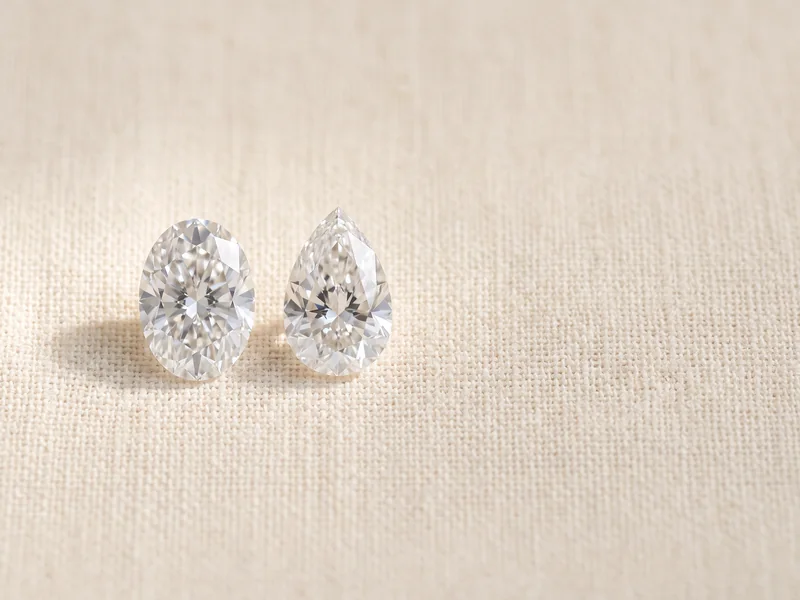 Wedding Bands & EternityBest Wedding Band for Marquise Engagement RingsDiamond ShapesProtecting Marquise Diamond Points
 Diamond ShapesMarquise Cut Diamonds MelbourneDiamond ShapesMarquise Diamond Length-to-Width RatioEngagement Rings & SettingsEngagement Ring Setting Styles GuideDiamond ShapesMarquise vs Pear DiamondsDiamond ShapesMarquise vs Moval DiamondsDiamond ShapesHow to Judge Marquise Diamond Symmetry
Explore more
More guides on this topic
Education