
Gemstones
Smoky Quartz Guide: Colour, Treatments, Value and Care
Smoky quartz is one of the most affordable ways to wear a large, clean gem in earthy brown tones. Here is what a gemologist checks: where the colour comes from, whether it has been treated, how it compares with smoky topaz and brown diamond, and how to set and care for it.
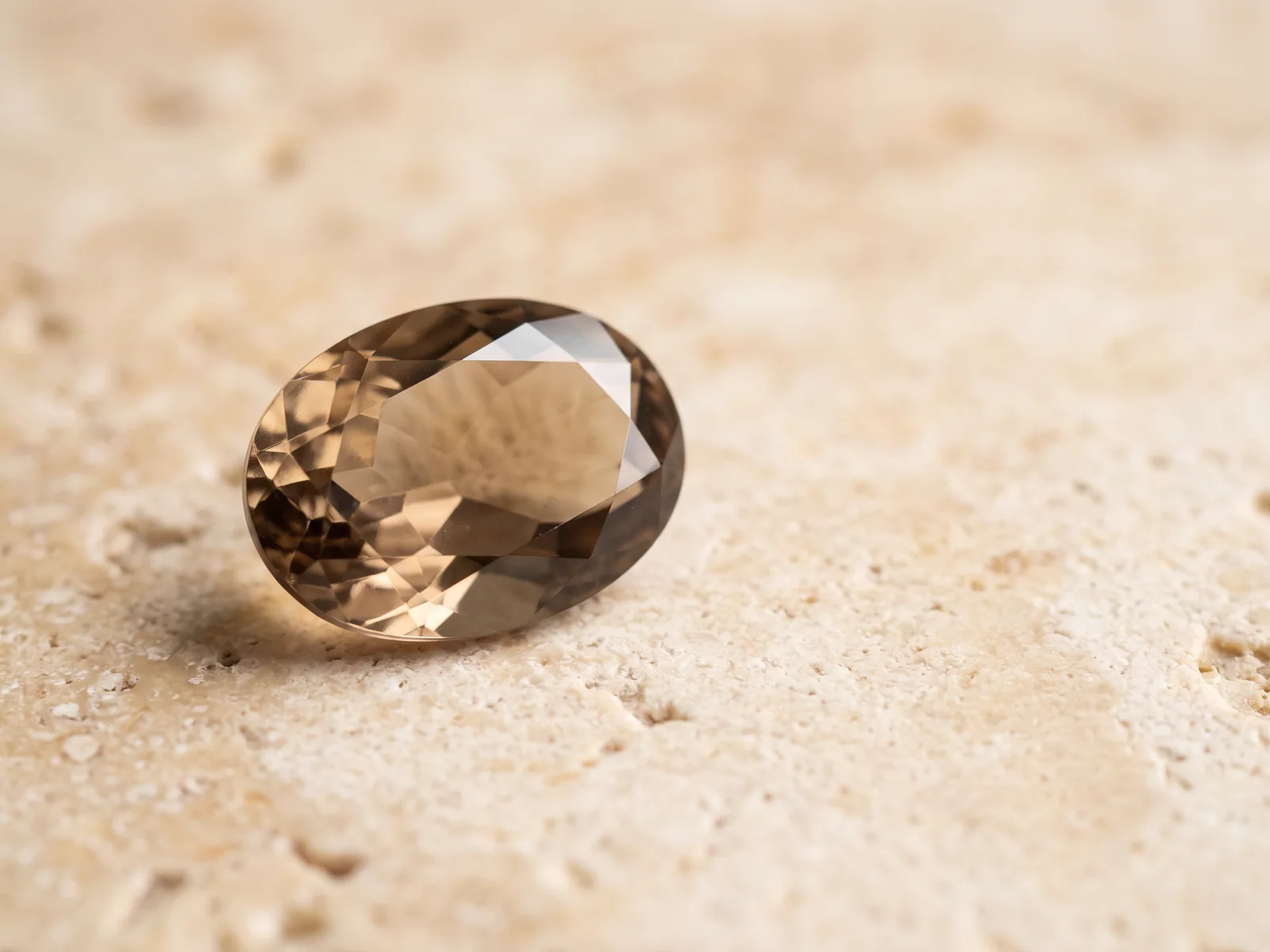
 Reviewed by Raj Sood, Graduate Gemologist (GIA), AJP (GIA)Master jeweller and Graduate Gemologist (GIA) · reviewed 4 November 2026
Quick answer
Smoky quartz is a brown to near-black variety of quartz (silicon dioxide) coloured by natural radiation acting on traces of aluminium. It rates 7 on the Mohs scale, so it suits pendants, earrings and carefully set rings. Much commercial smoky quartz is irradiated, and that colour is stable. Most loose stones cost about AUD $20–$200.
What is smoky quartz?
Smoky quartz is the brown to grey-black variety of quartz, the same mineral as amethyst, citrine and rose quartz, its soft pink relative. Chemically it is silicon dioxide (SiO2), one of the commonest minerals in the Earth's crust. What makes a particular crystal smoky is not a different recipe but a tiny defect in its atomic structure, which we explain in the next section.
Because quartz is so abundant and grows in big, clear crystals, smoky quartz is available in large clean pieces, sometimes crystals weighing many kilograms. That is why a faceted smoky quartz of 20 carats or more can cost less than a modest dinner out, something that is impossible with sapphire or diamond. It sits alongside other affordable, characterful stones in our coloured gemstones overview.
| Property | Smoky quartz |
|---|---|
| Chemical composition | SiO2 (silicon dioxide) |
| Crystal system | Trigonal; crystals are six-sided prisms |
| Mohs hardness | 7 |
| Refractive index | 1.544–1.553 |
| Birefringence | 0.009 (doubly refractive) |
| Specific gravity | about 2.65 |
| Pleochroism | Weak, brown to reddish brown |
| Cleavage | None; breaks with a curved (conchoidal) fracture |
| Heat sensitivity | Colour can fade with strong heat |
In plain terms, a Mohs hardness of 7 means the stone resists most everyday scratches, though household dust contains quartz of the same hardness, so polished surfaces slowly wear over time. The refractive index (how strongly a stone bends light) is modest, so smoky quartz shows a soft, glowing brightness rather than diamond-like fire. It has no cleavage (a natural plane of weakness), so it is less likely to split from a knock than topaz. Any unfamiliar word here is also defined in our glossary of jewellery terms.
What gives smoky quartz its colour?
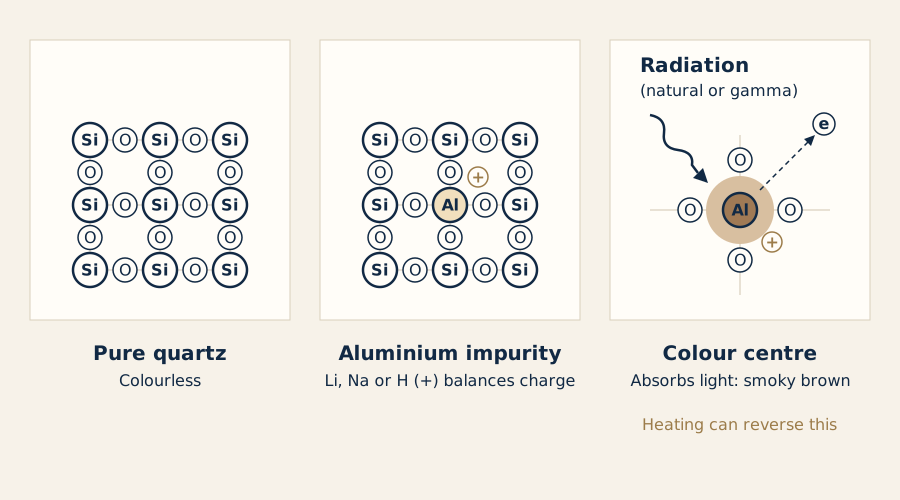
Pure quartz is colourless. In smoky quartz, a small number of aluminium atoms have taken the place of silicon atoms as the crystal grew, with tiny ions such as lithium, sodium or hydrogen sitting nearby to balance the electrical charge. On its own, that does nothing to the colour.
The colour appears when the crystal is exposed to radiation. Smoky quartz usually grows in granite and pegmatite (a very coarse-grained granite), rocks that contain low levels of naturally radioactive elements. Over millions of years that radiation knocks an electron away from near each aluminium site, leaving what gemologists call a colour centre: a defect that absorbs part of the light passing through and makes the stone look brown. More aluminium and more radiation generally mean a darker stone.
The colour range runs from pale champagne and tea tones, through mid whisky brown and dark chocolate, to morion, the name for smoky quartz so dark it looks black and nearly opaque. Cairngorm is the traditional Scottish name for smoky to yellowish-brown quartz from the Cairngorm Mountains, long set in brooches, kilt pins and the hilts of Highland daggers.
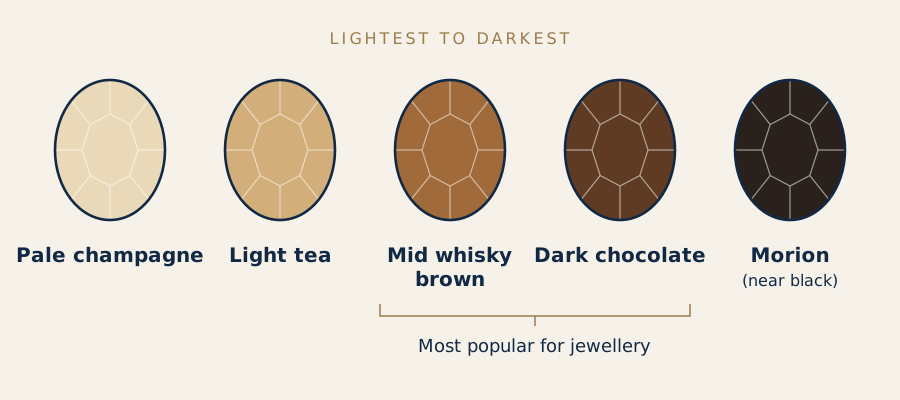
For jewellery, most buyers favour a transparent, medium to medium-dark brown with a warm rather than grey cast. Very dark stones can look black indoors, while very pale stones can look washed out next to gold. Natural crystals often show colour zoning, bands or patches of stronger and weaker colour, and sometimes phantoms, ghostly outlines of an earlier crystal face trapped inside. A good cutter orients the stone so that zoning blends in when you look at it face-up.
Is smoky quartz natural or irradiated?
Both exist, and they usually cannot be told apart with standard gem testing. A large share of the smoky quartz sold today is irradiated smoky quartz: colourless quartz containing aluminium is exposed to gamma rays (commonly from a cobalt-60 source) in an industrial facility. That does in hours what the granite did over geological time, creating the same colour centre. Gamma irradiation does not leave the stone radioactive, and the resulting colour is stable in normal wear and daylight.
Because the treatment is common and permanent, irradiated smoky quartz costs about the same as untreated material. Disclosure is still expected, and a reputable seller should tell you if a stone is known or likely to be irradiated. The wider picture of how gems are heated, irradiated, oiled and filled is set out in our guide to irradiation, heating and other gem treatments.
The colour centre is also undone by heat. Roughly between 200 and 400 °C, depending on the stone, smoky quartz starts to fade towards colourless or a pale yellow. Some yellow quartz on the market began life as smoky quartz and was heated. Quartz can also crack if heated or cooled suddenly (thermal shock), so the stone needs protecting during any jewellery work that uses a torch.
Lab-created quartz is a separate matter. Synthetic quartz is grown hydrothermally (in hot, pressurised water) in enormous volumes for electronics, and lab-created smoky quartz is made too. It is the same material as natural quartz and must be sold as lab-created or synthetic. Glass imitations also turn up, especially in costume jewellery: glass is singly refractive, often shows round gas bubbles or swirl marks under magnification, and warms quickly in the hand. Our page on how glass and other imitations are identified covers the same tests.
Where is smoky quartz found, and is there Australian smoky quartz?
Smoky quartz forms wherever granite and pegmatite host aluminium-bearing quartz, so it is found on every continent. Well-known sources include Brazil (much of the commercial cutting material), Madagascar, the Swiss and French Alps (famous for crystals collected from open rock clefts), the Pikes Peak area of the Rocky Mountains in the United States (where it grows alongside blue-green amazonite) and Scotland. Smoky quartz is also the official state gem of New Hampshire in the United States.
Unlike sapphire or ruby, the origin of a smoky quartz rarely changes its price much; colour, clarity and cut matter far more. For the gems where origin does carry weight, see our explainer on why Ceylon, Burma and Kashmir origins affect value.
Australian smoky quartz is real but mostly a collector's and fossicker's stone rather than a commercial jewellery supply. Because it grows in granite country, it has been reported from granite and tin-bearing districts in several states, including the New England region of New South Wales, Tasmania and parts of Western Australia and Queensland. Fossickers working the gravels and granite around the New England sapphire fields near Inverell and Glen Innes sometimes find quartz crystals among the heavier stones. Fossicking rules and licences differ by state, so check with the relevant state authority before you dig.
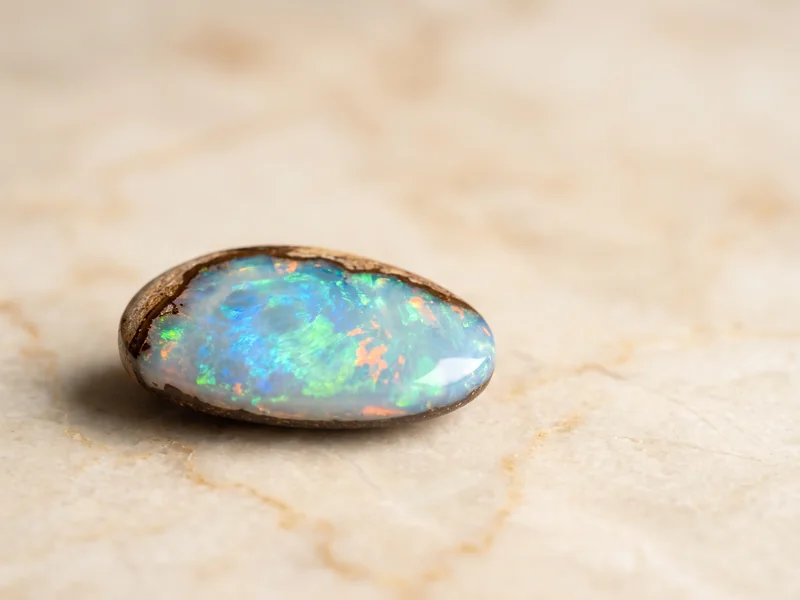
If you have found a crystal yourself, a gemologist can confirm it is quartz with a refractometer reading of about 1.54–1.55 and tell you whether it is clean enough to facet. For Australia's best-known home-grown gems, start with our guide to Queensland boulder opal and how it forms.
Not sure which one is right?
Send us the stones you are looking at and our gemologist will tell you which to choose and why.
How do you judge smoky quartz quality?
Smoky quartz has no official grading scale the way diamonds do, but gemologists look at the same four factors:
- Colour: transparent, even, medium to medium-dark brown with warmth. Grey or muddy tones and obvious zoning lower the value.
- Clarity: GIA places smoky quartz in its Type I group of gems, which are usually eye-clean (no inclusions visible without magnification). Expect a faceted stone to look clean; visible cracks or cloudiness are a reason to keep looking.
- Cut: with a refractive index around 1.55, a shallow or badly angled stone shows a window, a see-through patch in the centre where light leaks out. Look for even brightness across the face.
- Size: because big clean rough is plentiful, price per carat rises only gently with size, unlike diamond or sapphire.
Inclusions can also be the point. Rutilated smoky quartz contains golden or reddish needles of the mineral rutile, and tourmalinated quartz holds black needles of tourmaline. These are usually cut as cabochons (smooth domed stones) or flat-topped shapes that show off the needles, and well-patterned pieces command a premium over plain stones of the same size.
Since the material is inexpensive, cutters can afford to cut for beauty rather than weight. That is why smoky quartz is a favourite for precision and fantasy cuts, checkerboard tops and large emerald or cushion shapes with crisp, even facets. A well-cut 10 × 8 mm smoky quartz will look noticeably livelier than a native-cut stone (cut quickly at the mine to save weight) of the same size.
Smoky quartz vs smoky topaz, citrine and brown diamond: how do they differ?
Smoky topaz is a misleading trade name. A stone sold as smoky topaz is almost always smoky quartz, and the name borrows the reputation of a different, harder gem. Genuine brown topaz does exist, but it is a separate mineral with different properties. If a label says smoky topaz, ask whether the stone is actually quartz or topaz.
| Stone | Mohs | Refractive index | Typical look | Relative price |
|---|---|---|---|---|
| Smoky quartz | 7 | 1.544–1.553 | Brown to near-black, soft glow | Low |
| Citrine (quartz) | 7 | 1.544–1.553 | Yellow to orange-brown | Low |
| Brown topaz | 8 | 1.61–1.64 | Brown, brighter than quartz | Low to moderate |
| Brown tourmaline (dravite) | 7–7.5 | 1.62–1.64 | Brown with strong two-tone pleochroism | Moderate |
| Andalusite | 7–7.5 | 1.63–1.64 | Brown with green and orange flashes | Moderate |
| Brown or champagne diamond, natural or lab-grown | 10 | about 2.42 | Brown with strong sparkle and fire | High |
The practical differences: brown diamond, whether natural or lab-grown, is far harder and brighter, and costs many times more. Brown topaz is a little harder and shinier than quartz. Smoky quartz wins on the size and clarity you get for your money. Citrine is the same mineral in a yellow colour, so the two wear identically.
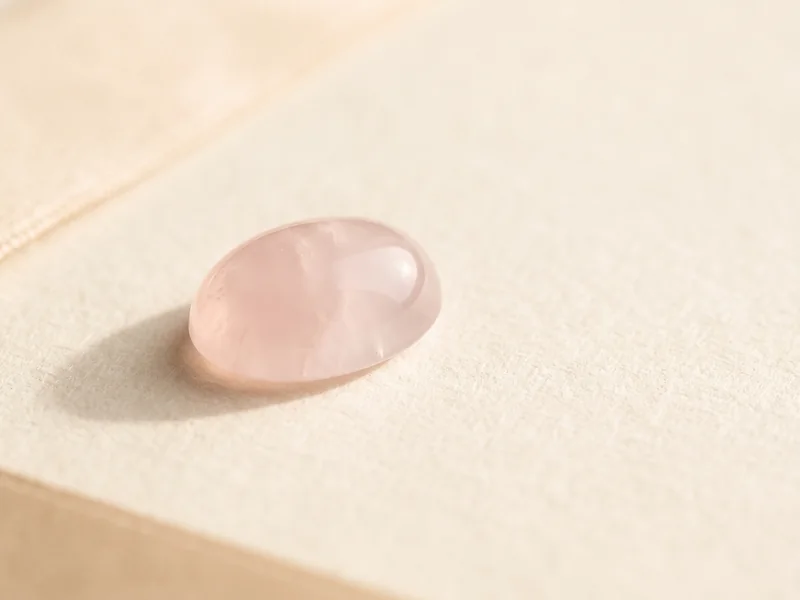
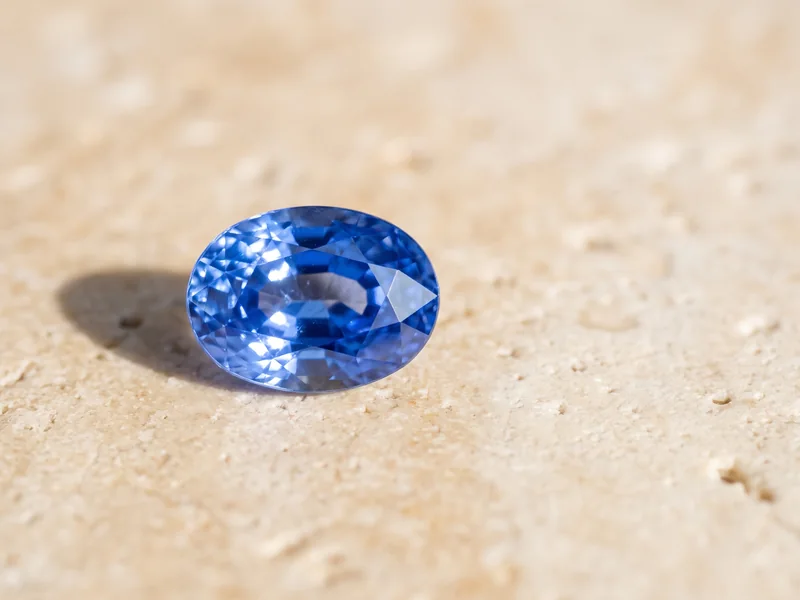
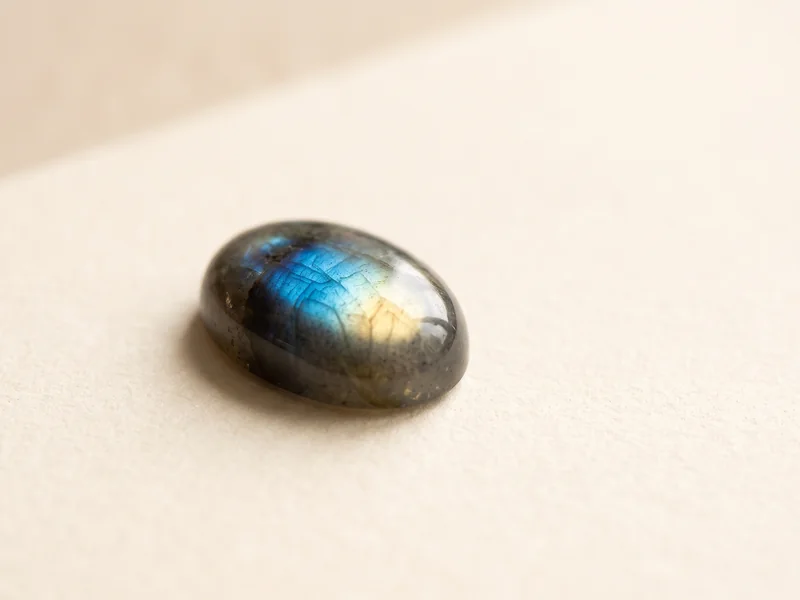
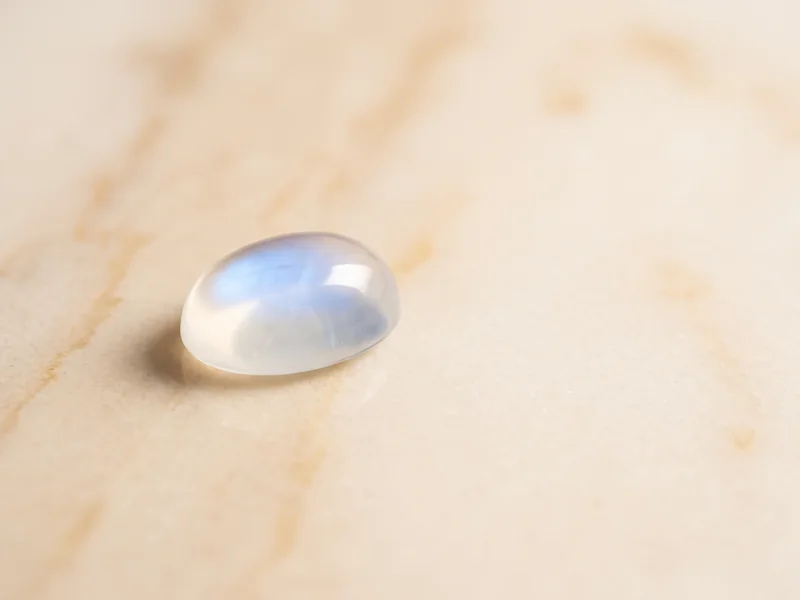
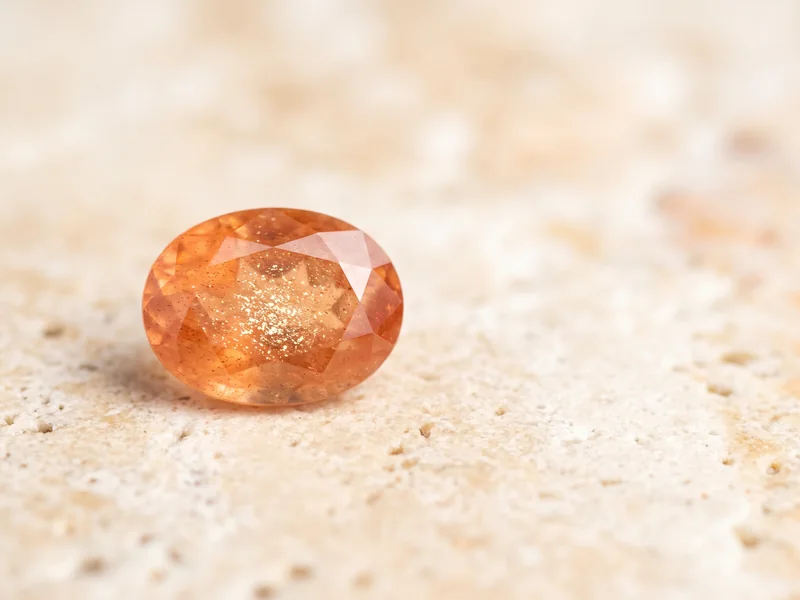
Related guideRose QuartzIf you like smoky quartz for its quiet, earthy look, a few other stones are worth a look. Labradorite and its grey-blue flash and moonstone with its soft floating sheen are both feldspars, softer at about 6–6.5. Glittering orange sunstone brings warmth with sparkle from within. For something cooler, violet-blue iolite is similarly priced, and if you need more toughness for daily wear, honey-toned chrysoberyl and cat's-eye rates 8.5 on the Mohs scale.
Is smoky quartz good for a ring or everyday wear?
At 7 on the Mohs scale, smoky quartz is harder than many popular ornamental stones, such as turquoise at about 5–6 and lapis lazuli at about 5–5.5. It is not as tough as jadeite and nephrite jade, which resist breakage well thanks to their tightly interlocking crystal structures, but it has no cleavage and handles knocks reasonably. Its colour is also stable in daylight, unlike kunzite, which can fade in strong light.
For a smoky quartz ring worn every day, expect the facet edges to soften and pick up fine scratches over several years, because household grit is about the same hardness. The good news is that quartz repolishes easily and cheaply. As a smoky quartz engagement ring, it works if you accept that wear, choose a protective setting and take the ring off for gardening, gym work and cleaning.
- Bezel or half-bezel: a rim of metal around the edge, the most protective option for a ring worn daily.
- Four or six claws: let more light in and suit large stones; check the claws every year or two.
- Halo: small white diamonds, natural or lab-grown, around the smoky quartz frame the colour and shield the girdle (the outer edge).
- Metal colour: yellow and rose gold bring out the warmth; white gold, platinum and silver make a cool, modern contrast that suits darker stones.
- Pendants and earrings: take little wear, so they suit very large or fantasy-cut stones.
Because the stone itself is inexpensive, the metal, setting and labour usually make up most of the cost of a smoky quartz piece. That is worth knowing when you compare a mass-produced ring with a custom one.
How much does smoky quartz cost in Australia?
Smoky quartz is one of the more affordable transparent gems. The figures below are broad approximate ranges for loose faceted stones in Australian retail; prices vary with colour, cut quality and the seller.
| Loose smoky quartz | Approximate price range (AUD) |
|---|---|
| Small calibrated stone, e.g. 6 × 4 mm oval | about $10–$40 |
| Medium stone, e.g. 10 × 8 mm (about 2–3 ct) | about $20–$80 |
| Large stone, about 15–30 ct, commercial cut | about $50–$200 |
| Precision or designer cut, any size | about $100–$500+ |
| Rutilated smoky quartz, well-patterned | about $50–$300+ |
What moves the price most is cut quality and colour, not weight. A clean, warm, medium brown stone cut to precise angles costs several times more than a dull, windowed one of the same size. Irradiated and untreated stones are usually priced similarly, though some collectors pay more for documented natural colour from a known locality. Finished jewellery adds the cost of metal and labour, so a gold ring set with smoky quartz typically costs far more than the stone alone.
Browse natural gemstones, including smoky quartz when available
How do you choose and care for smoky quartz? Step by step
- Ask what it is. Confirm the stone is quartz, not glass, and that any label saying smoky topaz means smoky quartz. Ask whether it is natural, irradiated or lab-created.
- Judge the colour in daylight and indoors. Make sure a dark stone does not turn black under warm indoor light, and a pale one still shows colour against your skin.
- Check for a window. Tilt the stone face-up; a see-through centre means poor cutting.
- Look for cracks and zoning. A faceted stone should be eye-clean, and any colour banding should not be obvious face-up.
- Match the setting to the wear. Choose a bezel or sturdy claws for a ring, and plan to remove it for heavy work.
- Clean gently. Use warm water, mild dishwashing liquid and a soft brush. Avoid steam cleaners, and skip the ultrasonic if the stone has fractures.
- Protect it from heat. Keep it away from torches, hot ovens and sudden temperature changes, and ask for the stone to be removed before any repair.
Free consultation
Talk to a gemologist
Compare stones in person or online with Raj Sood, Graduate Gemologist (GIA), AJP (GIA).
Book a consultationShop this shape
FAQ
Common questions
Is smoky quartz natural?
Smoky quartz occurs naturally, but much of it on the market is colourless quartz that has been irradiated to create the same brown colour. The two usually cannot be separated by standard testing, and the treated colour is stable.
Is irradiated smoky quartz safe to wear?
Yes. Gamma irradiation does not make the stone radioactive, and the treated stone is chemically the same as natural smoky quartz.
What is the difference between smoky quartz and smoky topaz?
Smoky topaz is a misleading trade name that is almost always used for smoky quartz. Genuine brown topaz is a different, slightly harder mineral with a higher refractive index.
Is smoky quartz hard enough for an engagement ring?
At 7 on the Mohs scale it can be worn in a ring, but facet edges will show wear over years of daily use. A bezel setting and taking it off for heavy work help, and quartz repolishes easily.
Can smoky quartz fade?
Its colour is stable in normal daylight and wear. Strong heat, roughly 200–400 °C, can fade it, which is why the stone should be removed before any torch repair.
What is morion?
Morion is the name for very dark smoky quartz that looks black and almost opaque. It is the same mineral, just with a much higher concentration of colour centres.

Ask a gemologist
Not sure which diamond to choose?
Raj Sood is a Graduate Gemologist (GIA) and master jeweller. Bring the stones you are considering, or send the reports, and he will tell you honestly which one is better and why.
Keep learning
Related guides
Explore more
More guides on this topic
Education