
Gemstones
December Birthstone Guide: Tanzanite, Zircon and Turquoise
December is one of the few months with three birthstones, and the three could hardly be more different. Here is how tanzanite, zircon and turquoise compare on colour, history and wear, so you can choose a December birthstone that suits the way you live.
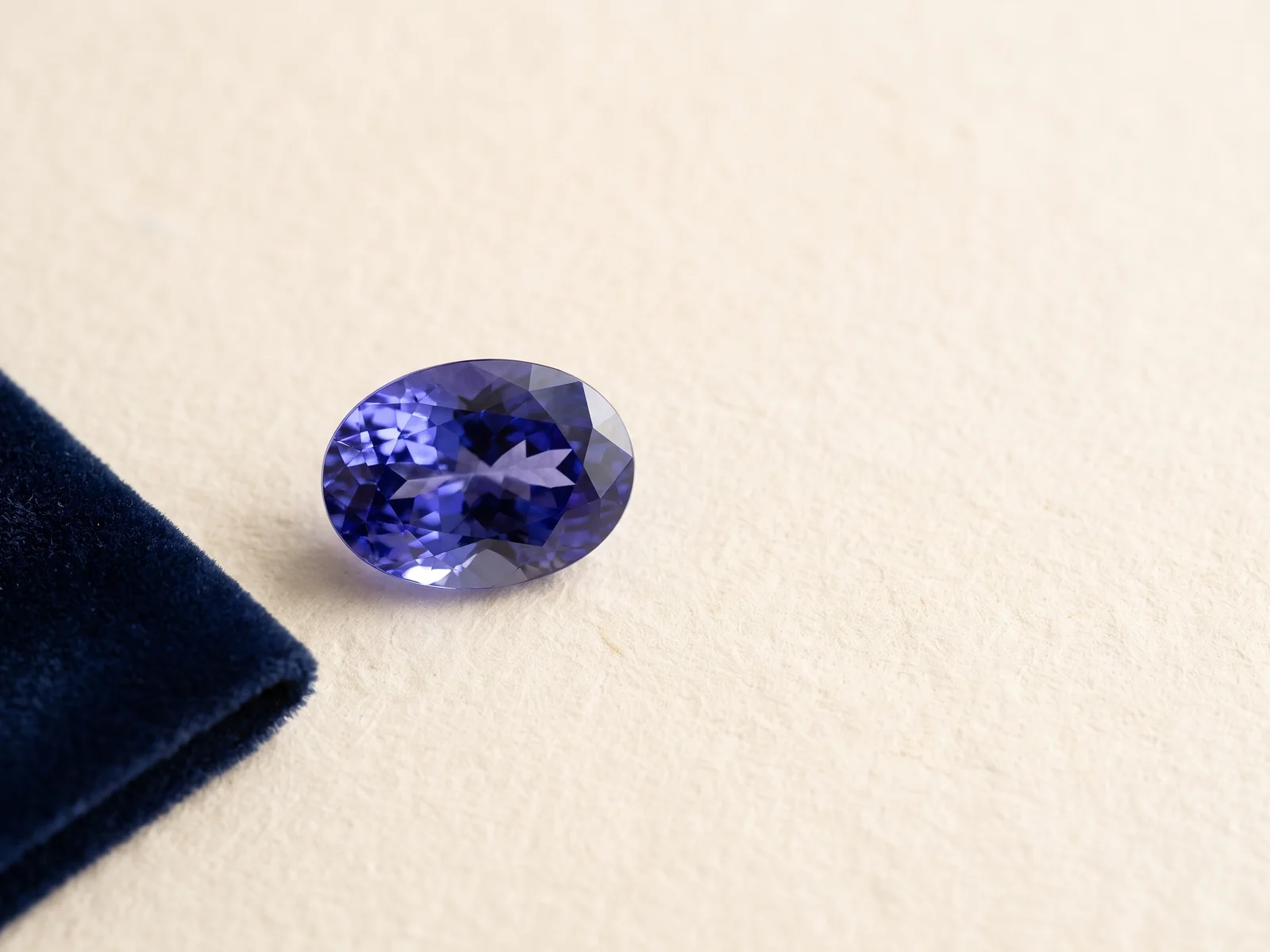
 Reviewed by Raj Sood, Graduate Gemologist (GIA), AJP (GIA)Master jeweller and Graduate Gemologist (GIA) · reviewed 4 November 2026
Quick answer
The December birthstone is actually three gems: tanzanite, a blue-violet zoisite mined only in Tanzania; zircon, a natural gem with fire close to diamond, best known in blue; and turquoise, an opaque sky-blue to green stone. All are softer than sapphire, so for everyday rings choose protective settings such as bezels or halos.
What is the December birthstone?
December has three birthstones on the modern list: tanzanite, zircon and turquoise. All three are known for blue, which is why December birthstone colour is usually described as blue, but they get there in completely different ways. Tanzanite is a transparent blue-violet crystal, zircon is a transparent gem with strong fire (flashes of spectral colour), and turquoise is an opaque stone you see as a smooth, waxy surface rather than a sparkle.
That variety is useful. It means a December birthday can be marked with anything from a faceted engagement ring to a pair of turquoise studs, at very different price points. If you are new to coloured stones, our overview of coloured gemstones and how they are graded is a good starting point, and our page on birthstone jewellery made in Melbourne shows how month stones are used in rings, pendants and family pieces.
A few terms come up often below. Mohs hardness is a 1–10 scale of scratch resistance, where diamond is 10. Toughness is resistance to chipping and breaking, which is a separate thing. Cleavage is a direction along which a crystal can split cleanly if it is knocked. Any other word you have not met is explained in our plain-English jewellery glossary.
Why does December have three birthstones?
Birthstone lists grew in layers. The list most jewellers use today began in 1912, when the American National Association of Jewelers (now Jewelers of America) published a standard list. December was given turquoise, with lapis lazuli as an alternative. In a 1952 revision, zircon was added. Then in 2002 the American Gem Trade Association added tanzanite, a gem that had only been discovered in 1967. Some lists, particularly retailers' own, also include blue topaz.
Turquoise has by far the longest history. Ancient Egyptians mined it in the Sinai Peninsula more than 5,000 years ago, and the Nishapur district of Iran has produced it for well over a thousand years. The name comes from the French for Turkish stone, because it reached Europe through Turkish trade routes. Zircon is also ancient: the name is usually traced to the Persian zargun, meaning gold-coloured, and colourless zircon was widely used as a diamond substitute before modern lab-grown diamonds and cubic zirconia existed.
December birthstone meaning varies by tradition. Turquoise has long been worn as a protective stone, zircon was associated with wisdom and prosperity in medieval writing, and tanzanite, being so new, has no folklore of its own. We mention these as history, not as properties of the stones.
What is tanzanite, and what colours does it come in?
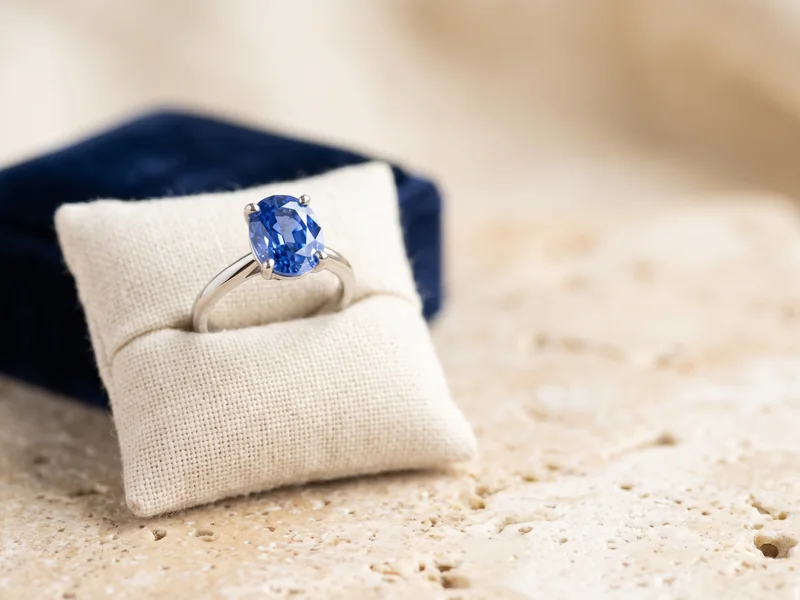
Tanzanite is the blue to violet variety of a mineral called zoisite, coloured by traces of vanadium. Every commercial deposit is in one small area: the Merelani Hills near Arusha in northern Tanzania, within sight of Mount Kilimanjaro. It was found in 1967 and given its trade name soon after. Our full guide to tanzanite's grades and sources goes deeper into the mining story.
The key to tanzanite is pleochroism: it shows different colours when you look through it in different directions. Tanzanite is strongly trichroic, meaning three colours, typically blue, violet and a reddish or bronze-brown. Almost all tanzanite is heat treated at a few hundred degrees Celsius, which removes the brownish colour and leaves the blue and violet. The treatment is stable and accepted across the trade, but it should still be disclosed.
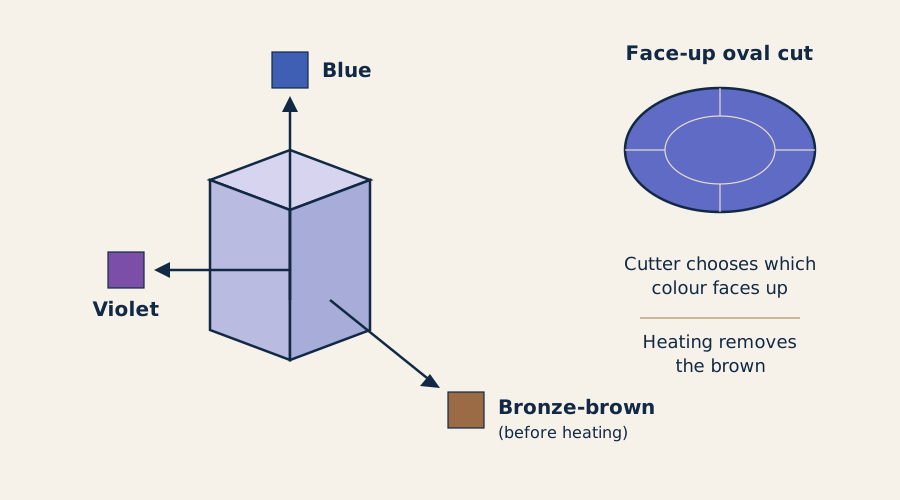
Because of this, the cutter decides the face-up colour. Orienting the stone so blue faces up usually wastes more rough, so a purer blue stone costs more than a more violet one of the same weight. Colour also deepens with size: stones under about 1 carat are often paler lavender-blue, while larger stones show richer, more saturated colour. Tanzanite looks bluer in daylight and more violet under warm indoor light, so view it both ways.
- Mohs hardness: about 6–7, softer than quartz dust in some directions.
- Refractive index: about 1.69–1.70, giving a soft, velvety brightness rather than strong sparkle.
- Cleavage: perfect in one direction, so a sharp knock can split it.
- Heat sensitivity: sudden temperature changes can crack it; never use a steam cleaner or ultrasonic.
Trade grades such as AAA or AA are set by individual sellers, not by an independent laboratory, so compare stones side by side rather than trusting the letters. Before choosing one for a ring, read our honest look at how tanzanite rings hold up to daily wear.
Is zircon the same as cubic zirconia?
No. Zircon is a natural mineral, zirconium silicate (ZrSiO4), that has been used in jewellery for centuries. Cubic zirconia is a synthetic material, zirconium oxide (ZrO2), first produced commercially in the 1970s as an inexpensive diamond simulant. The similar names cause endless confusion, but they are different substances with different properties.
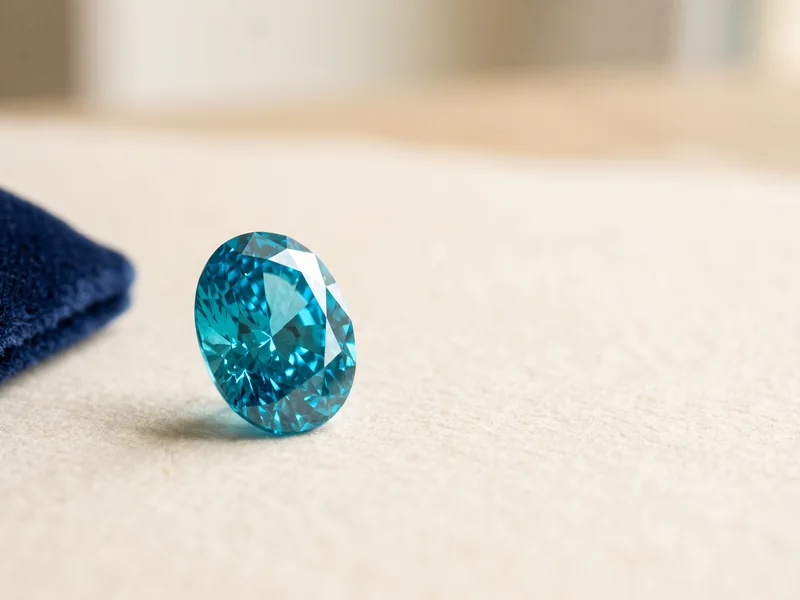
Zircon is one of the most optically lively gems. Its refractive index is high, about 1.92–1.99 for most gem zircon, and its dispersion (the ability to split white light into spectral colours, often called fire) is about 0.039, close to diamond's 0.044. It also has strong birefringence (double refraction): look through the table of a faceted zircon with a loupe and the back facet edges appear doubled, a quick way gemmologists tell it from diamond.
Zircon comes in brown, yellow, orange, red, green and colourless. Blue zircon, the classic December colour, is almost always produced by heating brownish zircon, mainly from Cambodia. Some heated blue zircon can fade a little after long exposure to strong sunlight; a jeweller can often restore it with gentle reheating. Zircon is also dense, with a specific gravity of about 4.6–4.7, so a 1 carat zircon looks smaller face-up than a 1 carat sapphire or diamond.
This is where Australia comes in. Zircon is common in the sapphire fields of central Queensland and the New England district of New South Wales, and the Harts Range in the Northern Territory produces gem zircon in golden, honey and pinkish tones. The tiny zircon grains from the Jack Hills in Western Australia, dated to about 4.4 billion years, are among the oldest known pieces of Earth; they are scientific treasures rather than gems, but they show how durable the mineral is chemically. Our zircon gem guide, including Australian sources covers the colours in detail.
Durability is the catch. Zircon rates about 6–7.5 on the Mohs scale but is brittle: facet edges chip and wear easily, and loose zircons rubbing together in a parcel show worn edges, sometimes called paper wear. Store zircon jewellery separately and choose settings that cover the edges.
Not sure which one is right?
Send us the stones you are looking at and our gemologist will tell you which to choose and why.
What is turquoise, and how can you tell if it is treated?
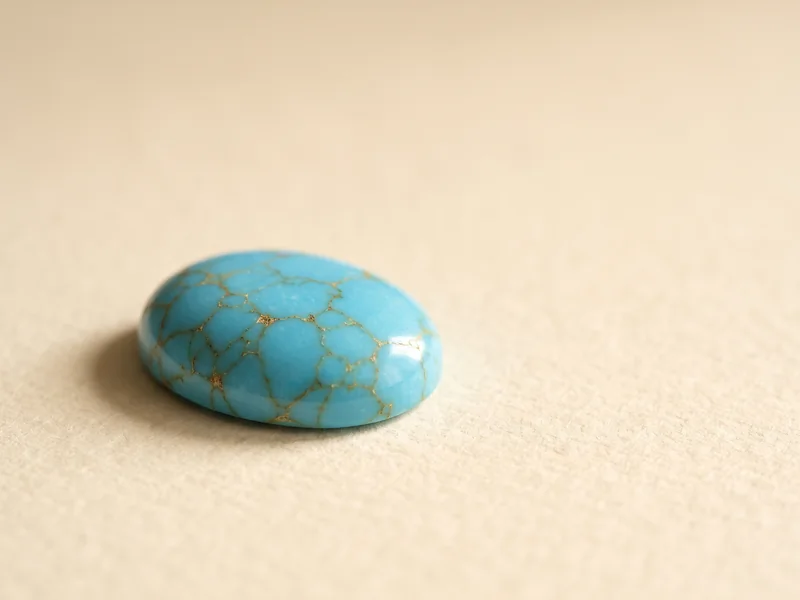
Turquoise is a hydrated copper aluminium phosphate. Copper gives the sky blue; iron pushes it towards green. It forms in veins and nodules inside host rock, and when that rock shows as dark lines through the stone it is called matrix; a fine network of lines is known as spiderweb. Turquoise is opaque and almost always cut as a cabochon (a smooth, domed stone without facets), or carved and inlaid. Our turquoise guide covering sources and grades explains the main mining regions, from Iran to the American Southwest and China.
At about 5–6 on the Mohs scale, turquoise is the softest of the three December stones, and much of it is porous. Porous turquoise absorbs skin oils, lotion, perfume and sunscreen, and can slowly turn greener or blotchy. That is why most turquoise sold today is treated. The common forms are:
- Stabilised: impregnated with a clear resin to harden it and fix the colour. Widely used and acceptable when disclosed.
- Dyed: colour added to pale material. Look for colour pooling in cracks or around the drill hole.
- Reconstituted: turquoise powder bonded with resin into a block. Much lower value.
- Imitations: dyed howlite or magnesite, glass and plastic, sold as turquoise but not turquoise at all.
- Synthetic: laboratory-made turquoise exists and must be described as synthetic or lab-created.
Natural, untreated turquoise with even, intense colour is rare and priced accordingly. If a piece is described as natural and is expensive, ask for written disclosure or a report from an independent gem laboratory.
Which December birthstone is most durable for an everyday ring?
For a ring worn every day, none of the three is as forgiving as sapphire or diamond. The reason is simple: ordinary dust contains quartz, which is 7 on the Mohs scale. Anything softer than 7 will slowly lose its polish and soften at the edges from everyday contact. Tanzanite and zircon sit right on that line, and turquoise sits below it.
| Tanzanite | Zircon | Turquoise | |
|---|---|---|---|
| Mohs hardness | 6–7 | 6–7.5 | 5–6 |
| Toughness | Fair; one perfect cleavage | Brittle; edges chip | Fair; porous and softer |
| Transparency | Transparent | Transparent | Opaque |
| Main risk | Knocks and heat shock | Edge wear and chips | Scratches, oils, chemicals |
| Everyday ring? | With care and a protective setting | With care; better in low-wear designs | Occasional wear, or protected cabochon |
| Ultrasonic or steam cleaning | No | No | No |
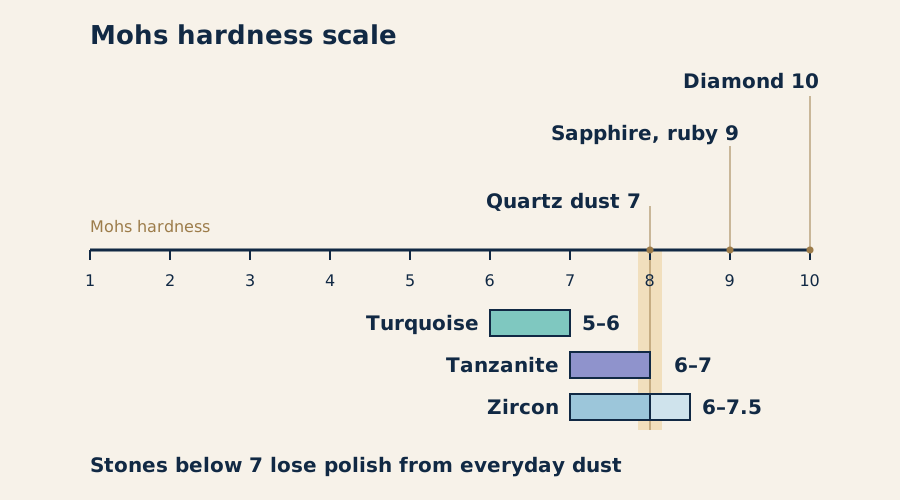
So, is tanzanite durable enough for an engagement ring? It can be, if you accept that it needs more care than a diamond. Many people wear tanzanite engagement rings for years in bezel or halo settings and remove them for gardening, the gym and cleaning. Zircon suits rings worn a few times a week, or pendants and earrings, where the edges are not bumped. Turquoise is at its most practical in a bezel-set cabochon, which is the traditional way to wear it.
If daily durability matters most, our guide to choosing a birthstone engagement ring that lasts compares every month's stones. Many December babies choose a violet-blue sapphire, natural or lab-created, for the colour of tanzanite with far more hardness; see the September sapphire guide. A white diamond centre with tanzanite or blue zircon accents is another common solution, covered in our April diamond birthstone page.
Related guideTanzanite Rings: Beauty vs Everyday DurabilityHow do December birthstones compare with other months?
Set against the other months, the December stones sit in the softer half of the list. The table puts the Mohs hardness of the main birthstones side by side; remember that toughness and cleavage also matter, which is why emerald can be more fragile than its hardness suggests.
| Month | Stone | Mohs hardness | Everyday ring |
|---|---|---|---|
| January | Garnet | 6.5–7.5 | Yes, with some care |
| February | Amethyst | 7 | Yes, with some care |
| March | Aquamarine | 7.5–8 | Yes |
| April | Diamond | 10 | Yes |
| May | Emerald | 7.5–8 | With care; often included |
| July | Ruby | 9 | Yes |
| August | Peridot / spinel | 6.5–7 / 8 | Peridot with care; spinel yes |
| September | Sapphire | 9 | Yes |
| December | Tanzanite / zircon / turquoise | 6–7 / 6–7.5 / 5–6 | With care and protective settings |
For family rings that combine several birthstones, this matters: the softest stone sets the care routine for the whole piece. Each month has its own guide: the January garnet colours and varieties, February amethyst and its purple shades, March aquamarine for pale-blue lovers, May emerald and its inclusions, July ruby and what drives its price and August's peridot and spinel pair.
What is the best setting for a December birthstone ring?
The aim with all three stones is to protect the edges and keep the stone from taking direct knocks. Settings that suit a December birthstone ring:
- Bezel: a rim of metal around the whole stone. The most protective choice for tanzanite and zircon, and the traditional setting for turquoise cabochons.
- Halo: a ring of small diamonds around the centre stone. It frames tanzanite well and takes knocks before the centre does.
- Six claws, set low: more claws spread the load, and a lower profile keeps the stone out of harm's way.
- Recessed or flush settings: zircon or tanzanite set into a band, with metal around the girdle (the outer edge).
- Pendants and earrings: the lowest-risk way to wear any December stone, including higher claw settings that show off zircon's fire.
Metal colour changes how the stones look. White gold and platinum emphasise the blue in tanzanite and blue zircon; yellow gold warms tanzanite towards violet and is the classic partner for turquoise, along with silver. Sterling silver is soft, so for a ring worn often, gold or platinum holds the setting more securely over time.
How much does a December birthstone cost in Australia?
The three stones span a wide price range. Tanzanite costs the most and climbs steeply with size and depth of colour. Zircon is good value for its brightness. Turquoise ranges from inexpensive stabilised stones to costly untreated material from famous mines. The figures below are broad, approximate retail ranges for loose stones only; settings add to the cost.
| Stone | Approximate price range (AUD) |
|---|---|
| Tanzanite, around 1 ct, medium blue-violet | about $300–$1,200 per carat |
| Tanzanite, 3 ct+, deep blue-violet | about $800–$2,000 per carat |
| Blue zircon, 1–5 ct | about $100–$600 per carat |
| Golden or colourless zircon | about $50–$300 per carat |
| Stabilised turquoise cabochon | about $20–$200 per stone |
| Natural untreated fine turquoise | from a few hundred to several thousand dollars per stone |
What moves the price most: for tanzanite, saturation and how blue rather than violet it faces up; for zircon, colour purity and clean, unworn facets; for turquoise, even colour, hardness, treatment status and origin. Imitations are common for all three, including synthetic forsterite and glass sold as tanzanite, and cubic zirconia confused with zircon, so ask for the stone's identity and any treatment in writing.
Browse natural gemstones
How do you choose and care for a December birthstone? Step by step
- Match the stone to your wear. Daily ring: tanzanite in a protective setting, or a sapphire alternative. Occasional ring, pendant or earrings: any of the three.
- Confirm identity and treatment. Ask whether tanzanite and zircon are heated and whether turquoise is stabilised, dyed or reconstituted.
- View colour in two lights. Check tanzanite and zircon in daylight and under warm indoor light before deciding.
- Check the edges. With a loupe, look for chips or worn facet junctions, especially on zircon.
- Choose a protective setting. Bezel, halo or low six-claw for rings; save high claws for pendants and earrings.
- Clean gently. Warm water, a drop of mild detergent and a soft brush for tanzanite and zircon; just a soft damp cloth for turquoise. No ultrasonic, steam or chemicals.
- Put it on last, take it off first. Apply perfume, sunscreen and lotion before wearing, and remove the ring for cleaning, sport and gardening.
- Store separately. Keep each piece in its own pouch so harder stones cannot scratch it.
Free consultation
Talk to a gemologist
Compare stones in person or online with Raj Sood, Graduate Gemologist (GIA), AJP (GIA).
Book a consultationShop this shape
FAQ
Common questions
What is the December birthstone?
December has three birthstones: tanzanite, zircon and turquoise. Some lists also include blue topaz.
What colour is the December birthstone?
Blue is the shared theme. Tanzanite is blue to violet, blue zircon is a bright pastel to vivid blue, and turquoise ranges from sky blue to greenish blue.
Is tanzanite durable enough for an engagement ring?
It can be worn as an engagement ring with care. At about 6–7 on the Mohs scale with one perfect cleavage, it needs a protective setting such as a bezel or halo, and should come off for heavy work and never go in an ultrasonic cleaner.
What is the difference between tanzanite and zircon?
Tanzanite is a blue-violet zoisite with a soft, velvety glow and strong pleochroism (different colours in different directions). Zircon is a different mineral with much higher refractive index and fire close to diamond, but its facet edges are brittle and chip more easily.
Is zircon a fake diamond?
No. Zircon is a natural gemstone in its own right. It is often confused with cubic zirconia, which is a synthetic material made as a diamond simulant.
How do you care for a turquoise ring?
Wipe it with a soft damp cloth and keep it away from perfume, sunscreen, oils and household chemicals, which can discolour it. Never use ultrasonic or steam cleaning, and store it apart from harder stones.

Ask a gemologist
Not sure which diamond to choose?
Raj Sood is a Graduate Gemologist (GIA) and master jeweller. Bring the stones you are considering, or send the reports, and he will tell you honestly which one is better and why.
Keep learning
Related guides
 GemstonesTanzanite
 GemstonesZircon
 GemstonesTurquoise
 GemstonesBirthstone Engagement Rings: Choosing for DurabilityGemstonesGemstones | Coloured Gemstones, Birthstones and Custom Jewellery
 GemstonesTanzanite Rings: Beauty vs Everyday Durability
 GemstonesBirthstone Jewellery Melbourne
 GemstonesApril Birthstone: Diamond
Explore more
More guides on this topic
Education