
- Education
- Diamond 4Cs & Grading
- Very Good vs Excellent Cut (and Good): Diamond Cut Grades Compared
Diamond 4Cs & grading
Very Good vs Excellent Cut (and Good): Diamond Cut Grades Compared
Cut decides how much a round diamond sparkles, and in the very good vs excellent cut decision the gap is smaller, and more variable, than most people expect. Here is what each grade means and when the lower one is a sensible choice.
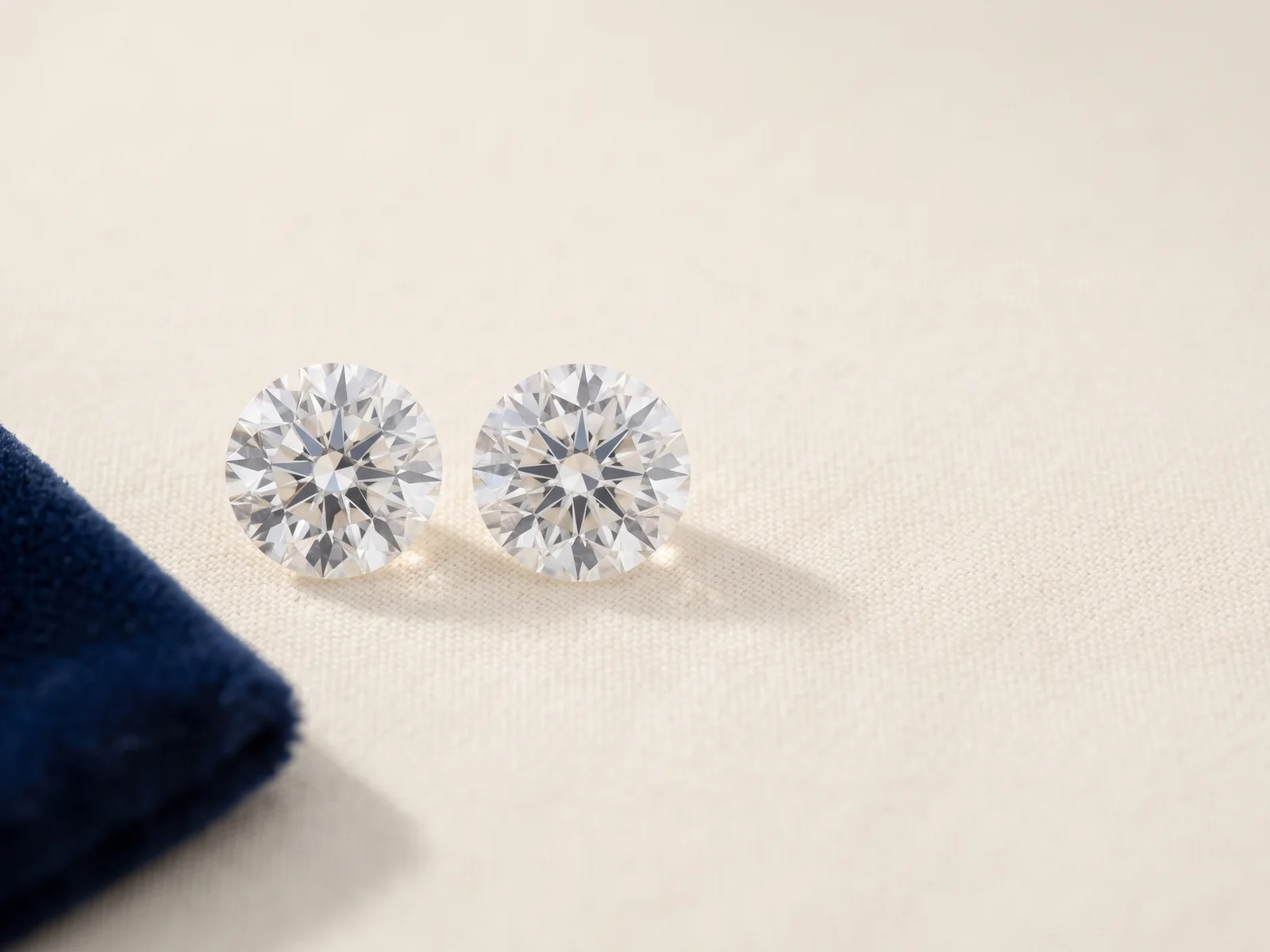
 Reviewed by Raj Sood, Graduate Gemologist (GIA), AJP (GIA)Master jeweller and Graduate Gemologist (GIA) · reviewed 4 November 2026
Quick answer
In the very good vs excellent cut choice, Excellent is GIA's top grade for round diamonds and returns the most brightness, fire and sparkle. A Very Good cut can look almost identical face-up and usually costs less; a Good cut is visibly less lively. Most buyers choose Excellent or a carefully checked Very Good.
What does a diamond's cut grade actually measure?
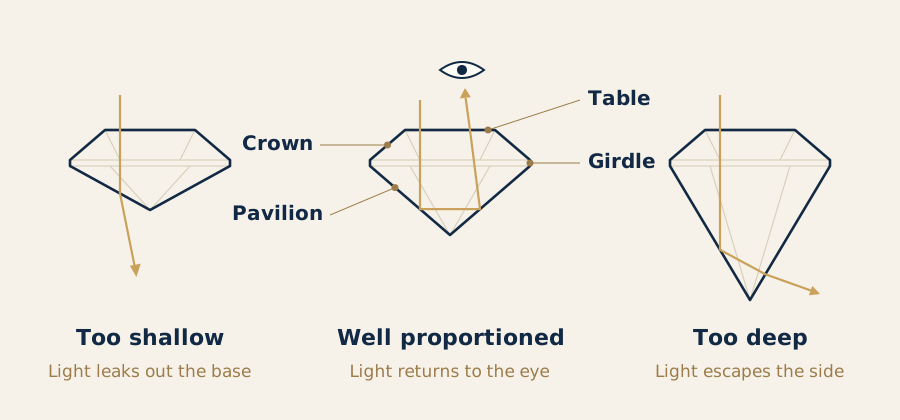
Cut is the one part of the 4Cs of diamond quality decided by people rather than nature. It describes how well a diamond's facets, angles and proportions handle light, not its shape. A round, an oval and a pear can each be cut well or badly.
For standard round brilliant diamonds in the D-to-Z colour range, GIA gives an overall cut grade on a five-step scale: Excellent, Very Good, Good, Fair and Poor. To set it, the lab measures the stone's proportions and assesses three things you can see face-up: brightness (white light returned to your eye), fire (flashes of spectral colour) and scintillation (the sparkle and pattern of light and dark as the stone moves).
The grade also takes in how the stone is built: whether it carries extra weight it doesn't need (a thick girdle or a deep pavilion), whether a very thin girdle makes it fragile, and the quality of its polish and symmetry. So a cut grade is part beauty, part craftsmanship. Our complete diamond cut grade guide goes through every factor, and the jewellery glossary defines terms such as crown, pavilion and girdle.
The scale was built around the modern 57- or 58-facet round brilliant. Older and alternative styles are judged differently; see how a rose cut differs from a brilliant for why a flat-based rose cut is never graded this way.
Excellent vs very good vs good cut: what each grade means
| GIA cut grade | What you see face-up | Where it fits |
|---|---|---|
| Excellent | Bright, even sparkle across the whole stone, crisp contrast and plenty of fire | The usual choice for a round centre stone |
| Very Good | Very close to Excellent; one or two factors sit just outside the top range | Often a sensible saving if you check the stone itself |
| Good | Noticeably less bright, with darker or washed-out areas in some lights | Budget-led choices, small stones, or stones bought for spread |
| Fair | Clearly dull or uneven; light leaks out of the base | Rarely suitable for a centre stone |
| Poor | Little life; may look glassy or dark | Not recommended where sparkle matters |
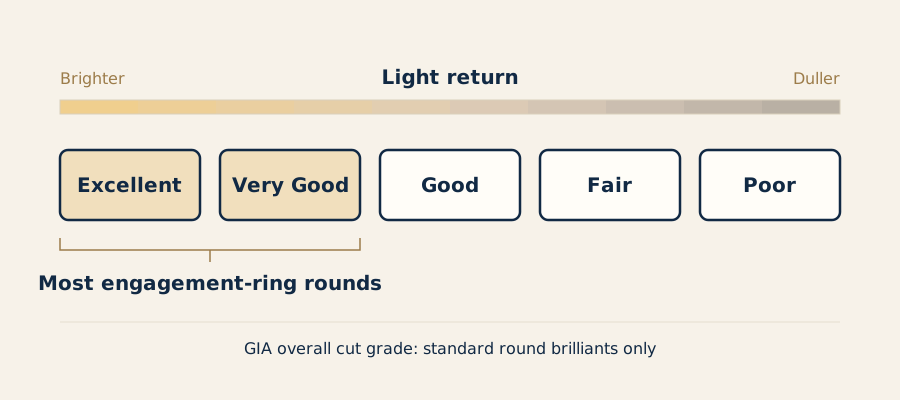
The grades are bands, not single points. Two Excellent stones can look slightly different, and the best Very Good stones overlap with the weakest Excellent ones. That is why the grade is a starting filter, not the final answer. How GIA sets each cut grade explains the overlap in more detail.
As a rough guide, Excellent rounds tend to sit within ranges like these. They are typical, not rules: GIA grades the combination, so one number outside the range does not automatically drop the grade.
| Proportion | Typical in Excellent rounds | What happens outside it |
|---|---|---|
| Total depth | about 59–62.5% | Deeper hides weight underneath; shallower can look glassy |
| Table | about 53–60% | Larger tables can reduce fire |
| Crown angle | about 33–36° | Too flat loses fire; too steep can darken the stone |
| Pavilion angle | about 40.6–41.8° | Light leaks out the base or the side |
| Girdle | thin to slightly thick | Very thin chips; very thick adds hidden weight |
Very good vs excellent cut: can you see the difference?
Sometimes not at all, sometimes clearly. A diamond drops from Excellent to Very Good if any one of the graded factors falls outside the Excellent range. That might be a crown angle a fraction too steep, a slightly thick girdle, a table a little large, or Good rather than Excellent or Very Good polish or symmetry. Some of those barely change the look; others take the edge off the sparkle.
So a Very Good round with a thicker girdle may look identical to an Excellent face-up, while a Very Good round with an awkward combination of crown and pavilion angles can look noticeably flatter. The only way to know is to read the proportions on the report and look at the stone itself, ideally on a 360° video beside an Excellent of similar size.
Many people also compare Excellent with the 'Ideal' label used by some labs and sellers; our guide to Ideal vs Excellent cut explains where those labels overlap and where they don't.
Is a Good cut diamond worth buying?
A Good cut returns noticeably less light than Excellent or Very Good. In bright daylight it can still look pleasant; under softer indoor light you are more likely to see dark or watery patches. For a round centre stone you will look at every day, most people find the drop in sparkle isn't worth the saving.
There are fair reasons to consider one. A slightly shallow Good cut, say around 57–58% depth, can look wider for its weight, and in very small stones (under about 0.30 carat) the difference is harder to see. A deep Good cut does the opposite: at 64% depth or more it hides weight underneath and looks smaller than its carat suggests.
Before choosing a Good cut, check the table and depth percentages on the report. If the depth is high, you are paying for weight you can't see. It also helps to think about balancing cut against colour, clarity and carat: dropping one colour grade often costs you less visible beauty than dropping a cut grade.
Not sure which one is right?
Send us the stones you are looking at and our gemologist will tell you which to choose and why.
What do polish and symmetry grades add, and what does triple excellent mean?
GIA reports also grade polish (the smoothness of the facet surfaces) and symmetry (how precisely the facets are shaped, placed and aligned) on the same Excellent-to-Poor scale. Unlike the overall cut grade, these appear on reports for every shape.
Triple Excellent, or 3EX, is a trade term for a round graded Excellent for cut, polish and symmetry. It's a tidy shorthand, but differences between Excellent and Very Good polish or symmetry are usually only visible under 10× magnification. Very Good polish or symmetry on an otherwise Excellent round is rarely something you will notice on the hand, and it doesn't stop a round reaching an Excellent cut grade; only Good or lower polish or symmetry does that.
Fluorescence is listed on the same report but is not part of the cut grade. It is a separate property, a glow under ultraviolet light, explained in fluorescence strengths from None to Very Strong.
Related guideIdeal Cut vs Excellent Cut DiamondsDoes GIA give fancy shapes like ovals and princess cuts a cut grade?
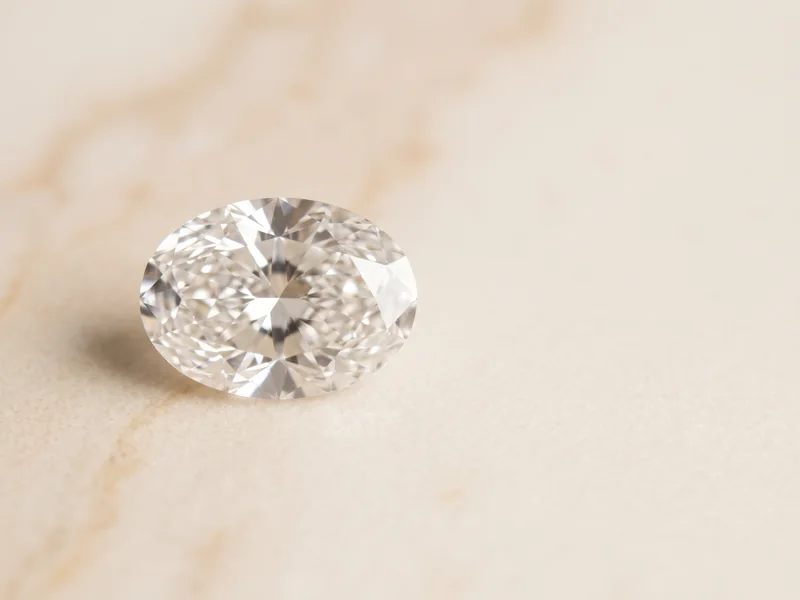
No. GIA's overall cut grade applies only to standard round brilliants. Ovals, pears, princess, emerald and other fancy shapes receive polish and symmetry grades but no overall cut grade, because there is no single agreed set of correct proportions for them. Some sellers and other labs apply their own cut terms to fancy shapes, so check what a label actually measures. Our guide to judging cut quality without a GIA cut grade walks through the approach.
For a fancy shape you judge cut by eye and by numbers: the length-to-width ratio, table and depth, how strong any bow-tie is, and the facet pattern. What to look for changes with the shape:
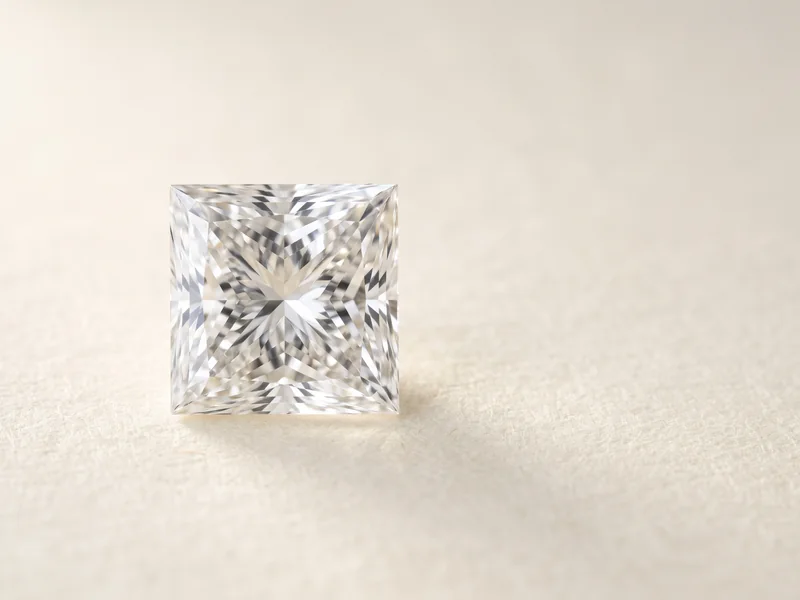
- Princess: the chevron pattern under the table shows how it was cut, and sharp corners need care; see keeping a princess cut's corners safe.
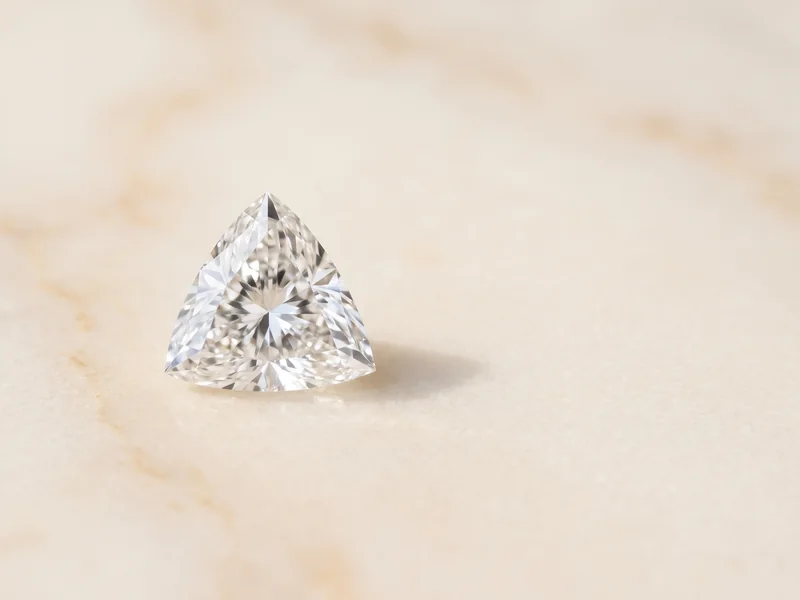
- Triangles and trillions: triangular cuts can look glassy in the centre if too shallow, and their points need protecting.
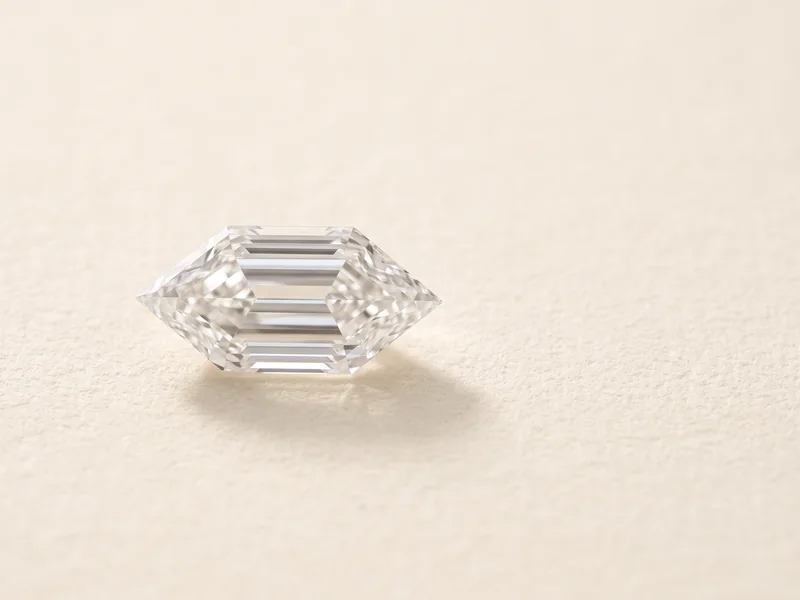
- Side-stone shapes: bullet-cut side stones and lozenge cuts are step cuts, so judge them by symmetry, clean corners and how well a pair matches.
- Geometric and drop shapes: hexagonal diamonds rely on even sides, while briolette drops are faceted all over and judged on facet evenness.
How much does cut grade change the price?
With colour, clarity and carat equal, an Excellent round costs more than a Very Good, which costs more than a Good. The size of each step varies with the stone's size, the market and whether it is natural or lab-grown, so compare real stones side by side rather than relying on a rule of thumb.
| Excellent | Very Good | Good | |
|---|---|---|---|
| Light return | Highest | Close to Excellent, varies stone to stone | Noticeably lower |
| Price (same colour, clarity, carat) | Highest | Lower | Lower again |
| Worth checking | Proportions still vary within the grade | Why it missed Excellent | Depth (hidden weight) and dark areas |
| Typical buyer | Wants maximum sparkle in a round | Wants near-Excellent looks with some saving | Prioritising carat or budget over sparkle |
Natural and laboratory-grown diamonds are graded on the same cut scale where a lab issues one. Lab-grown rounds cost much less than natural rounds of the same grades, so the saving from dropping to Very Good is smaller in dollar terms, and many lab-grown buyers simply stay with Excellent. Natural diamonds are rarer; lab-grown diamonds are real diamond with the same physical properties, made in a laboratory.
Browse Excellent, Very Good and Good cut diamonds in our stock
How to choose between very good vs excellent cut (or Good): step by step
- Start with the shape. If it's a round, use the GIA cut grade as your first filter. If it's a fancy shape, use the fancy-shape cut checks instead: ratio, depth and video.
- Default to Excellent for a round centre stone. It's the grade most likely to give you full sparkle without surprises.
- Consider Very Good, then find out why. Read the depth, table, crown and pavilion angles and girdle on the report and compare them with the typical ranges above.
- Look at the stone moving. A 360° video beside an Excellent stone shows whether a Very Good looks flatter or just as bright.
- Treat Good as a deliberate trade. Only choose it if you've seen the stone and you're happy to swap sparkle for carat or budget.
- Check what any extra label means. If a seller adds 'Ideal' or a brand name, see how Ideal labels compare with GIA Excellent and ask which measurements it is based on.
Free consultation
Talk to a gemologist
Compare stones in person or online with Raj Sood, Graduate Gemologist (GIA), AJP (GIA).
Book a consultationFAQ
Common questions
Is a Very Good cut diamond good enough for an engagement ring?
Often, yes. Many Very Good rounds look almost identical to Excellent face-up and cost less. Check why it missed Excellent: a slightly thick girdle matters less than poor crown and pavilion angles.
Can you see the difference between Excellent and Very Good cut?
Sometimes. Side by side, a trained eye can often pick the Excellent stone, but the gap depends on which factor pushed the Very Good below the top grade. On the hand, many people can't tell.
Is a Good cut diamond bad?
Not bad, but noticeably less bright than Excellent or Very Good. It can make sense for a tight budget or a stone bought for spread, but most people choose higher for a round centre stone.
What does triple excellent mean?
Triple Excellent (3EX) means a round diamond graded Excellent for cut, polish and symmetry on its report. It's a useful shorthand, but proportions within the Excellent range still vary.
Does GIA give a cut grade to oval or pear diamonds?
No. GIA's overall cut grade is only for standard round brilliants. Fancy shapes get polish and symmetry grades, so you judge their cut by ratio, depth, bow-tie and video.
Is Ideal better than Excellent?
GIA has no Ideal grade; Excellent is its top cut grade. Some other labs and retailers use 'Ideal', and it can mean different things, so compare the actual proportions rather than the label.
Terms in this guide

Ask a gemologist
Not sure which diamond to choose?
Raj Sood is a Graduate Gemologist (GIA) and master jeweller. Bring the stones you are considering, or send the reports, and he will tell you honestly which one is better and why.
Keep learning
Related guides
 Diamond 4Cs & GradingIdeal Cut vs Excellent Cut Diamonds
 Diamond 4Cs & GradingDiamond Cut Grade
 Diamond 4Cs & GradingCut Quality in Fancy Shapes (No GIA Cut Grade)Diamond 4Cs & GradingDiamond 4CsDiamond 4Cs & GradingDiamond Fluorescence Strengths: None to Very Strong
 Diamond ShapesPrincess-Cut Diamond Corner Protection
 Diamond ShapesTriangular Cut Diamonds
 Diamond ShapesLozenge Cut Diamonds
Explore more
More guides on this topic
Education