
Gemstones
Fire Opal Guide: Colour, Hardness, Origins, Value and Care
Fire opal glows like a coal rather than flashing like the opals Australia is known for. It is also softer and more sensitive than most ring stones, so it pays to understand it before you choose one.
 Reviewed by Raj Sood, Graduate Gemologist (GIA), AJP (GIA)Master jeweller and Graduate Gemologist (GIA) · reviewed 4 November 2026
Quick answer
Fire opal is a transparent to translucent opal in yellow, orange or red, coloured by traces of iron. Most comes from Mexico. It rates about 5.5–6.5 on the Mohs scale with fair to poor toughness, so it suits earrings and pendants best; in a ring, choose a protective bezel and avoid heat, knocks and ultrasonic cleaners.
What is fire opal?
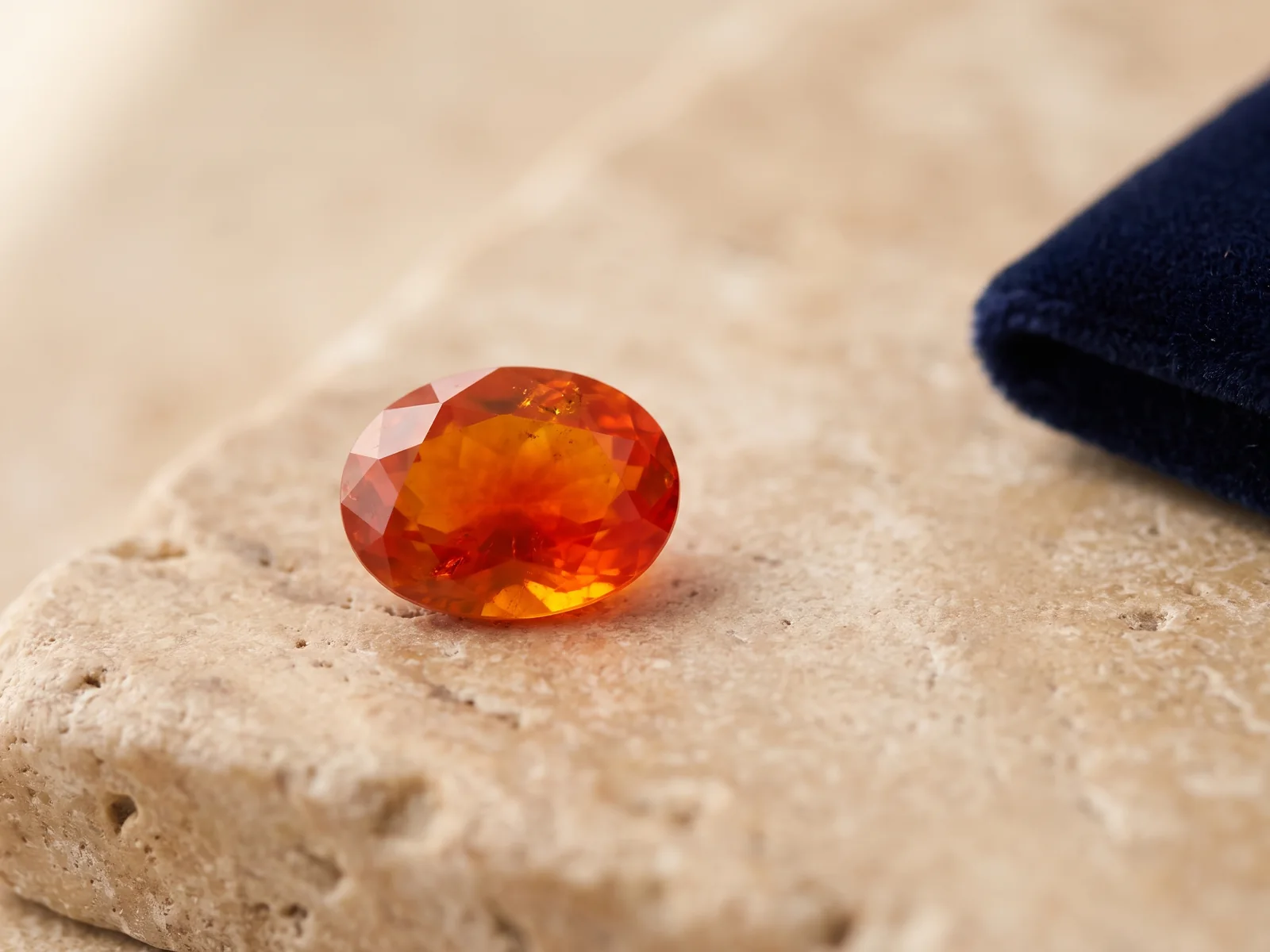
Fire opal is opal with a warm body colour: the colour of the stone itself, from pale yellow through orange to deep red. Unlike the precious opal mined in Australia, most fire opal shows little or no play-of-colour (the moving flashes of spectral colour that opal is famous for). Its appeal is the glow of the body colour, much like a red-orange garnet or a glass of Aperol held to the light. It sits within the wider family of coloured gemstones and birthstones we cover, and it is one of the few opals transparent enough to facet.
Chemically, opal is hydrated silica, written SiO2·nH2O. That means silicon dioxide (the same compound as quartz) with water locked inside, usually about 3–10% by weight. Opal is amorphous or only poorly crystalline: it has no regular crystal structure, which is why gemmologists sometimes call it a mineraloid. You can see how it compares with diamond, corundum and beryl in our page on the chemical make-up of diamonds, sapphires, opals and other gems.
Inside precious opal, tiny silica spheres, roughly 150–300 nanometres across, are stacked in neat rows that split white light into colours. In most fire opal the spheres are irregular in size and arrangement, so light passes through or scatters instead of being diffracted. The orange and red come from small amounts of iron oxide. When a fire opal does have orderly zones as well, it can show flashes of green or blue over the orange; the trade calls this precious fire opal.
One naming note. The word 'fire' means different things in different parts of the trade. With diamonds, fire is the rainbow flashes caused by dispersion, explained in our guide to how fire, brilliance and scintillation work in a diamond. In the Australian opal trade, 'fire' is often used loosely for play-of-colour. In gemmology, fire opal means the orange-to-red body colour. When you read a listing, check which meaning is intended. Any unfamiliar term here is also defined in our plain-English jewellery glossary.
What colours does fire opal come in?
Fire opal runs along a single warm scale. Pale yellow and honey tones are the most common and the most affordable. Saturated orange is the classic look. A clear, strong red-orange, sometimes sold as cherry opal, is the rarest and most sought after. Brown tones (sometimes called chocolate opal, mostly from Ethiopia) sit at the other end and are valued less.
| Colour | Typical trade description | How it is usually valued |
|---|---|---|
| Pale yellow to lemon | Yellow fire opal, honey opal | Most common, lowest price |
| Golden to orange | Classic Mexican fire opal | Mid-range, depends on clarity |
| Strong red-orange | Cherry opal, red fire opal | Highest for transparent stones |
| Brown to chocolate | Chocolate opal, brown opal | Lower, unless it shows play-of-colour |
| Any of the above with flashes | Precious fire opal | Priced individually, often much higher |
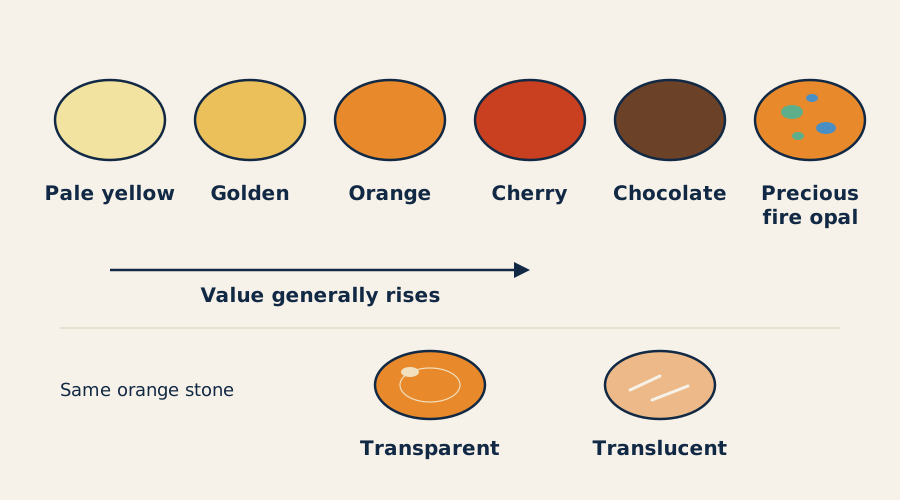
Transparency is the second half of the picture. Fire opal ranges from completely transparent, like coloured glass, to translucent and milky. Transparent stones are usually faceted to bring the colour alive. Translucent or milky stones, and stones with play-of-colour, are usually cut as a cabochon: a smooth, domed shape with no facets. You will also see Mexican cantera opal, where the fire opal is left in its pale host rock and cut as one piece.
Mexican cutters also use the term contra luz for rare opal whose play-of-colour only shows when light comes from behind the stone. It is a curiosity, prized by collectors, and is more often seen in clear 'jelly' opal than in strongly coloured fire opal.
How is fire opal different from Australian precious opal?
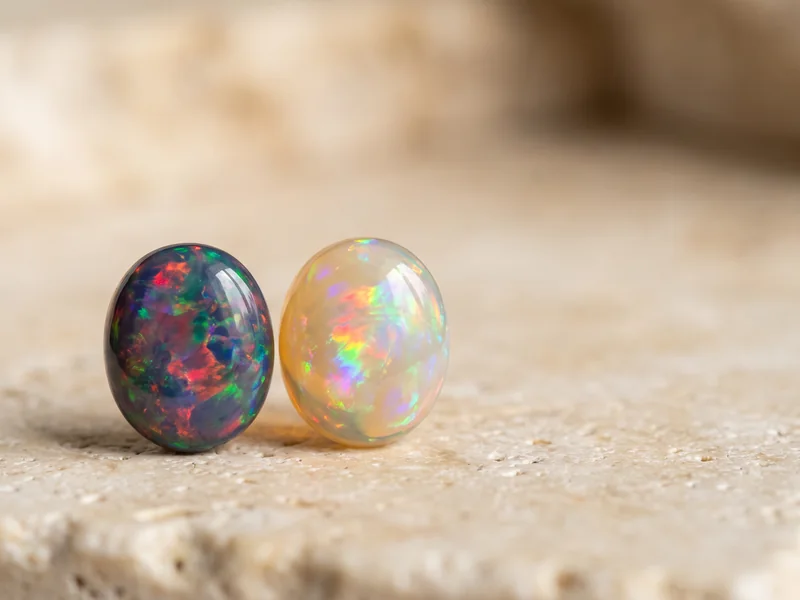
Australia produces most of the world's precious opal, and almost none of it is fire opal in the gemmological sense. Australian opal is valued for play-of-colour against a dark, light or clear background, while fire opal is valued for its warm body colour. The table sets out the main differences.
| Opal type | Body colour | Play-of-colour | Usual cut | Main sources |
|---|---|---|---|---|
| Fire opal | Yellow, orange, red | Usually none; some show flashes | Faceted or cabochon | Mexico, Ethiopia |
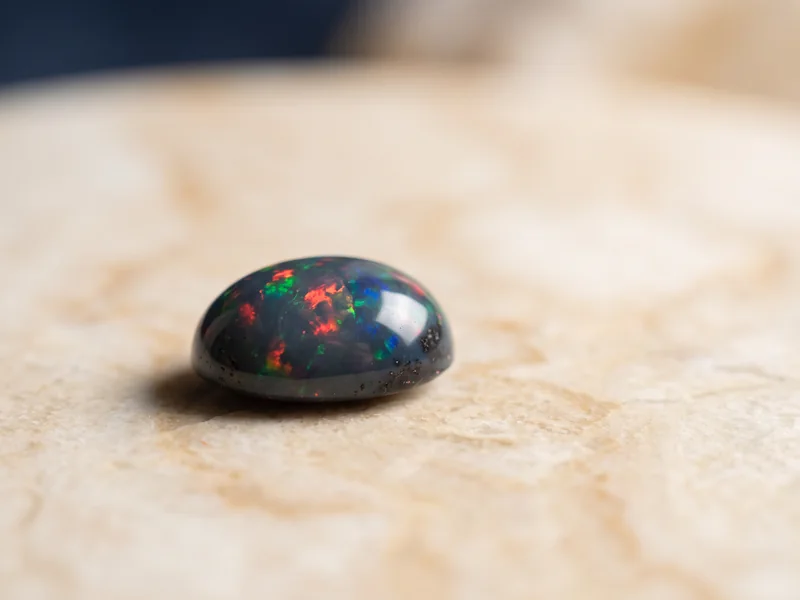
| Black opal | Dark grey to black | Strong, the defining feature | Cabochon | Lightning Ridge, NSW |
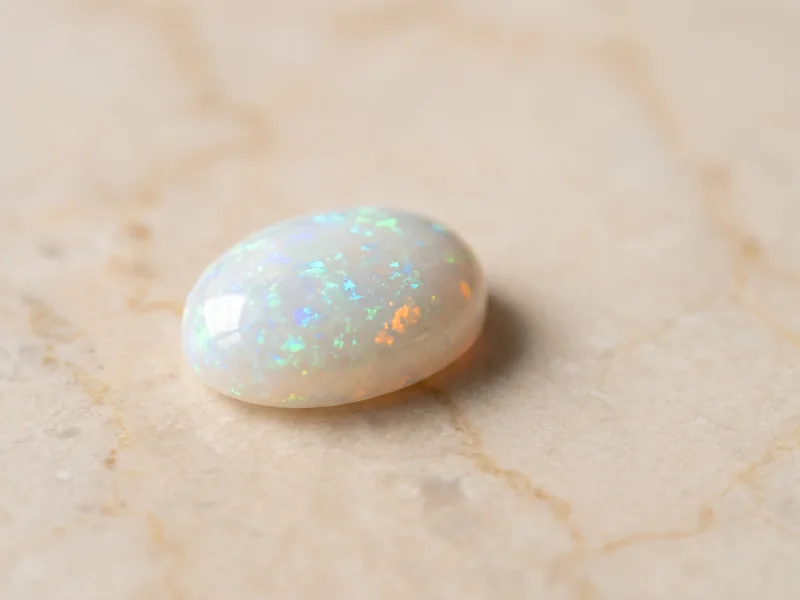
| White opal | Milky white to pale | Present, softer against light body | Cabochon | Coober Pedy, SA |
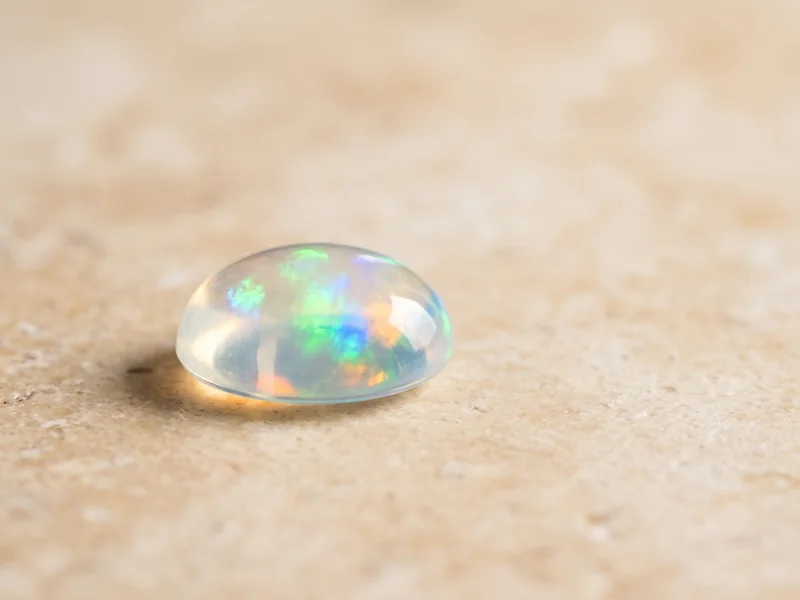
| Crystal opal | Clear to semi-clear | Present, seen through the stone | Cabochon | Several Australian fields |
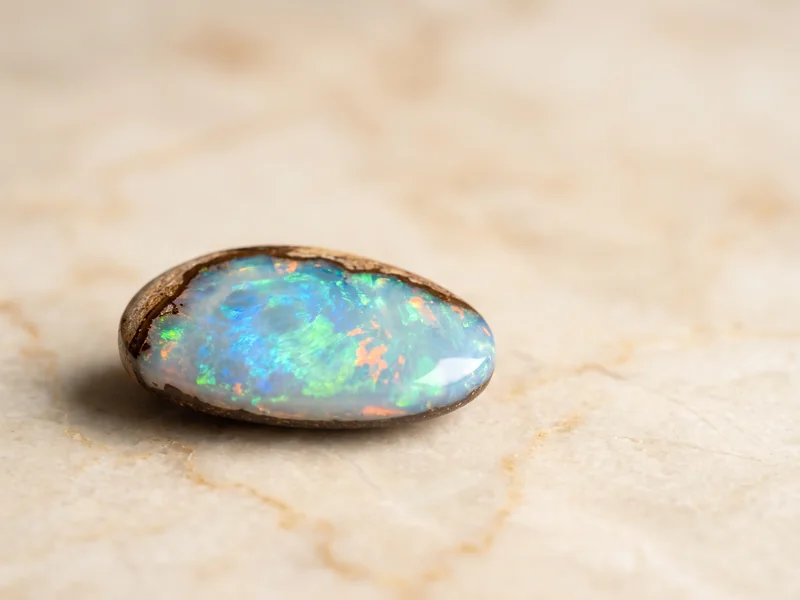
| Boulder opal | Dark ironstone backing | Present in thin seams | Cabochon with natural backing | Queensland |
| Ethiopian opal | White, clear, orange, brown | Often strong | Cabochon, some faceted | Wollo and Shewa, Ethiopia |
If play-of-colour is what draws you to opal, start with our guides to dark-bodied black opal from Lightning Ridge, light-bodied white opal and clear crystal opal. Queensland boulder opal is worth a look too, because its ironstone backing makes it tougher than solid opal. For a direct comparison of origins and stability, see how Australian opal types compare with Ethiopian opal.
Related guideAustralian Opal Types ComparedWhere does fire opal come from?
Fire opal forms in volcanic rock, usually rhyolite, where silica-rich water fills gas pockets and cracks and slowly sets into opal. That is a different setting from Australian precious opal, which formed in sedimentary rock in the Great Artesian Basin. The geology explains why each country produces its own kind of opal.
- Mexico: the classic source, especially Querétaro and Jalisco, where fire opal has been mined for well over a century. Most transparent orange and red faceted stones on the market are Mexican.
- Ethiopia: the Shewa region produced orange, red and brown opal from the 1990s. The Wollo region, which became important in the late 2000s, mainly yields white and crystal opal with play-of-colour, plus some orange material. Ethiopian fire opal can be hydrophane (see below).
- Smaller sources: Brazil, Turkey, Kazakhstan and the United States (Oregon and Nevada) have produced fire opal in modest amounts.
- Australia: not a significant commercial source of fire opal. Our fields are famous for precious opal instead.
To see what Australia does produce and where, read our guide to Lightning Ridge, Coober Pedy and the Queensland boulder fields. Origin rarely appears on a fire opal report, and it is often hard to prove, so treat origin claims as helpful background rather than proof of quality.
Not sure which one is right?
Send us the stones you are looking at and our gemologist will tell you which to choose and why.
Is fire opal hardness enough for an engagement ring?
Fire opal rates about 5.5–6.5 on the Mohs scale, which measures resistance to scratching. Everyday dust contains quartz at 7, so over time a fire opal's polish will dull and its facet edges will soften. Toughness (resistance to chipping and breaking) is fair at best and poor in stones with internal stress. A sharp knock on a benchtop can chip a faceted fire opal, especially at the corners.
| Gem | Mohs hardness | Toughness | Everyday ring wear |
|---|---|---|---|
| Diamond | 10 | Good (can cleave) | Very well suited |
| Sapphire | 9 | Excellent | Very well suited |
| Spinel | 8 | Good | Well suited |
| Citrine (quartz) | 7 | Good | Suited, with some care |
| Spessartite garnet | 6.5–7.5 | Fair to good | Suited, with care |
| Fire opal | 5.5–6.5 | Poor to fair | Occasional wear, protective setting |
| Australian precious opal | 5.5–6.5 | Poor to fair | Occasional wear, protective setting |
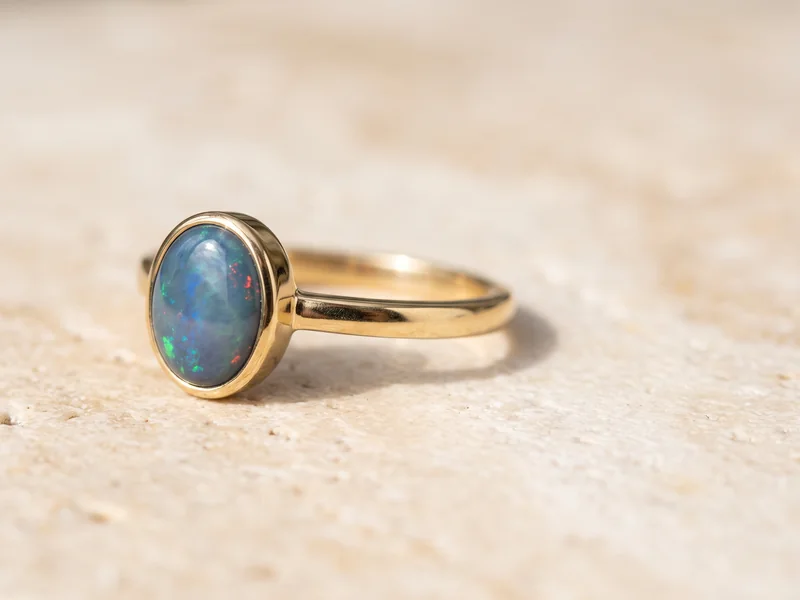
A fire opal engagement ring worn every day, through gardening, gym sessions and hand washing, will need repolishing and possibly replacement over the years. Many people who love the orange-red look choose a tougher stone for the ring itself: pink and padparadscha-toned sapphire at 9, or orange and red spinel at 8. Others keep fire opal for earrings and pendants, where it takes fewer knocks. Our guide to how opal engagement rings wear over time goes further into the trade-offs.
The other durability issue is crazing: a network of fine surface cracks that can appear as an opal loses water, often after rapid drying, heat or a sudden change in temperature. Some Mexican fire opal is prone to it, especially soon after mining. Crazing cannot be repaired, only polished away if it is shallow.
Is fire opal treated, and how is it identified?
Most Mexican fire opal is sold untreated. Treatments do exist, though, and should always be disclosed:
- Oiling or resin filling: used to hide crazing or surface-reaching cracks. It can wear off or yellow over time.
- Dyeing: some Ethiopian opal has been dyed orange or red to imitate fire opal. Colour concentrated in cracks is the giveaway.
- Smoke treatment: used to darken Ethiopian opal, more often to imitate black opal than fire opal.
- Lab-created opal: laboratory-made opal, including orange material, has been produced since the 1970s. It must be sold as lab-created or synthetic opal, never just as opal.
Imitations are more common than treatments. Orange glass and plastic are the usual suspects, along with naturally orange stones such as citrine, carnelian or spessartite garnet sold under a vague name. The same testing logic we use for spotting glass and other diamond simulants applies here.
At the bench, a gemmologist checks a few things with standard gemmological instruments such as the refractometer and polariscope:
- Refractive index (RI): how much the stone bends light. Fire opal reads very low, about 1.37–1.47 (Mexican stones often near 1.42–1.43). Most glass reads about 1.50 or higher, and citrine about 1.54–1.55.
- Specific gravity (SG): fire opal is light, about 1.98–2.20. Plastic is lighter again, around 1.2, and feels warm in the hand.
- Polariscope: opal is singly refractive, but strain often gives an irregular, patchy anomalous double refraction. Citrine shows true double refraction.
- Magnification: glass often shows round gas bubbles and swirl lines. Natural fire opal may show flow lines, host-rock inclusions or zones of colour.
- Lab-created opal: under magnification, play-of-colour patches in lab-created opal often show a regular 'chicken wire' or lizard-skin structure.
What affects fire opal price in Australia?
There is no universal grading system for fire opal, so value comes down to a few visible factors, roughly in this order:
- Colour: a strong, even red-orange is worth most; pale yellow least.
- Transparency: clear, lively stones command more than milky ones.
- Clarity: eye-clean stones, with no inclusions you can see without magnification, are preferred for faceting.
- Play-of-colour: any flashes over the orange body lift the price sharply.
- Cut and size: a well-proportioned faceted stone with a lively face-up appearance, and larger clean stones over about 3 carats, are harder to find.
- Stability: no crazing, and no oil or resin, adds confidence and value.
| Quality | Typical appearance | Approximate price range (AUD per carat) |
|---|---|---|
| Commercial | Pale yellow to orange, translucent, some inclusions | about $10–$60 |
| Good | Clear orange, transparent, eye-clean | about $50–$200 |
| Fine | Strong red-orange, transparent, eye-clean, well cut | about $150–$500 |
| Precious fire opal | Orange body with clear play-of-colour | priced individually, often above fine |
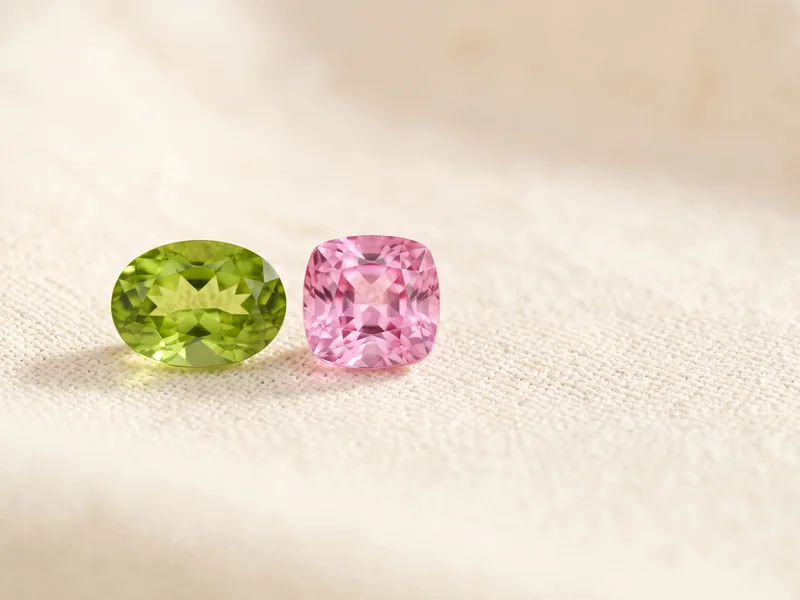
These are broad ranges only and vary with size, cut and the market. Because fire opal is light for its size, a 2 carat stone looks larger than a 2 carat sapphire. For a full guide to opal as the October stone, and the tourmaline that shares the month, see our October birthstone guide to opal and tourmaline.
Browse natural gemstones
What is the best setting for a fire opal ring?
The setting does most of the work in keeping a fire opal safe. Good choices for a fire opal ring, from most to least protective:
- Full bezel: a rim of metal around the whole edge. It shields the girdle (the outer edge of the stone) and the corners from knocks.
- Half-bezel or rub-over: protects the sides most likely to take a hit while letting more light in.
- Halo: a ring of small diamonds or tougher gems that stands slightly proud of the opal and takes impacts first.
- Six claws: fine for pendants and earrings; in a ring, keep the claws sturdy and the stone set low.
Set the stone low rather than high, and avoid sharp-cornered shapes in a ring; ovals and rounds have no exposed points. Yellow and rose gold flatter the warm colour, while white metals give a cooler, sharper contrast. Setting fire opal also takes care at the bench, because heat from a jeweller's torch or a sizing job can craze it, so the stone is usually removed before any soldering.
How do you care for fire opal jewellery?
Fire opal is easy to look after if you avoid the few things that damage it: heat, sudden temperature changes, chemicals and knocks. Some Ethiopian opal is hydrophane, meaning it absorbs water and can temporarily turn more transparent, lose its play-of-colour or change colour when wet; it usually returns to normal as it dries, but it can also take up oils and dirt, so keep it dry.
- Take it off first. Remove fire opal jewellery before gardening, the gym, cleaning, swimming or cooking near heat.
- Clean gently. Use lukewarm water with a drop of mild dish soap and a soft brush; for hydrophane opal, wipe with a barely damp cloth instead.
- Dry it straight away. Pat dry with a soft lint-free cloth and let it reach room temperature naturally.
- Skip the machines. Never use ultrasonic or steam cleaners, and keep it away from bleach, acetone and perfume.
- Store it separately. Keep it in a soft pouch away from harder gems such as diamond and sapphire, out of direct sun and away from heaters.
- Check the setting. Have claws or the bezel checked about once a year, and tell the jeweller it is opal before any repair or resizing.
Free consultation
Talk to a gemologist
Compare stones in person or online with Raj Sood, Graduate Gemologist (GIA), AJP (GIA).
Book a consultationShop this shape
FAQ
Common questions
Is fire opal a real opal?
Yes. Fire opal is natural hydrated silica, the same material as other opals, distinguished by its yellow, orange or red body colour. Lab-created opal also exists and must be sold as lab-created or synthetic.
Can you wear a fire opal engagement ring every day?
You can, but at about 5.5–6.5 on the Mohs scale it will scratch and can chip with daily wear. A full bezel, a low setting and taking it off for rough work help a great deal.
Why is Mexican fire opal so popular?
Mexico produces most of the transparent orange and red fire opal clear enough to facet. Its warm, glowing colour is what most people picture when they hear the name.
Does fire opal crack?
Some fire opal can develop crazing, a network of fine surface cracks, if it dries out quickly or meets heat or sudden temperature change. Stones that have been held for months without crazing are generally more stable.
What is the difference between fire opal and precious opal?
Fire opal is valued for its warm body colour and usually has little or no play-of-colour. Precious opal, such as Australian black and white opal, is valued for its flashes of spectral colour.
How can you tell fire opal from orange glass?
A gemmologist measures the refractive index: fire opal reads about 1.37–1.47, while most glass reads 1.50 or higher. Gas bubbles and swirl lines under magnification also point to glass.

Ask a gemologist
Not sure which diamond to choose?
Raj Sood is a Graduate Gemologist (GIA) and master jeweller. Bring the stones you are considering, or send the reports, and he will tell you honestly which one is better and why.
Keep learning
Related guides
 GemstonesAustralian Opal Types Compared
 GemstonesAustralian Opal Engagement Rings: Wearability and Care
 GemstonesBlack Opal
 GemstonesOctober Birthstone: Opal and TourmalineGemstonesGemstones | Coloured Gemstones, Birthstones and Custom Jewellery
 GemstonesBoulder Opal
 GemstonesCrystal Opal
 GemstonesWhite Opal
Explore more
More guides on this topic
Education