
Gemstones
Crystal Opal Guide: Colour, Origins, Value and Ring Wear
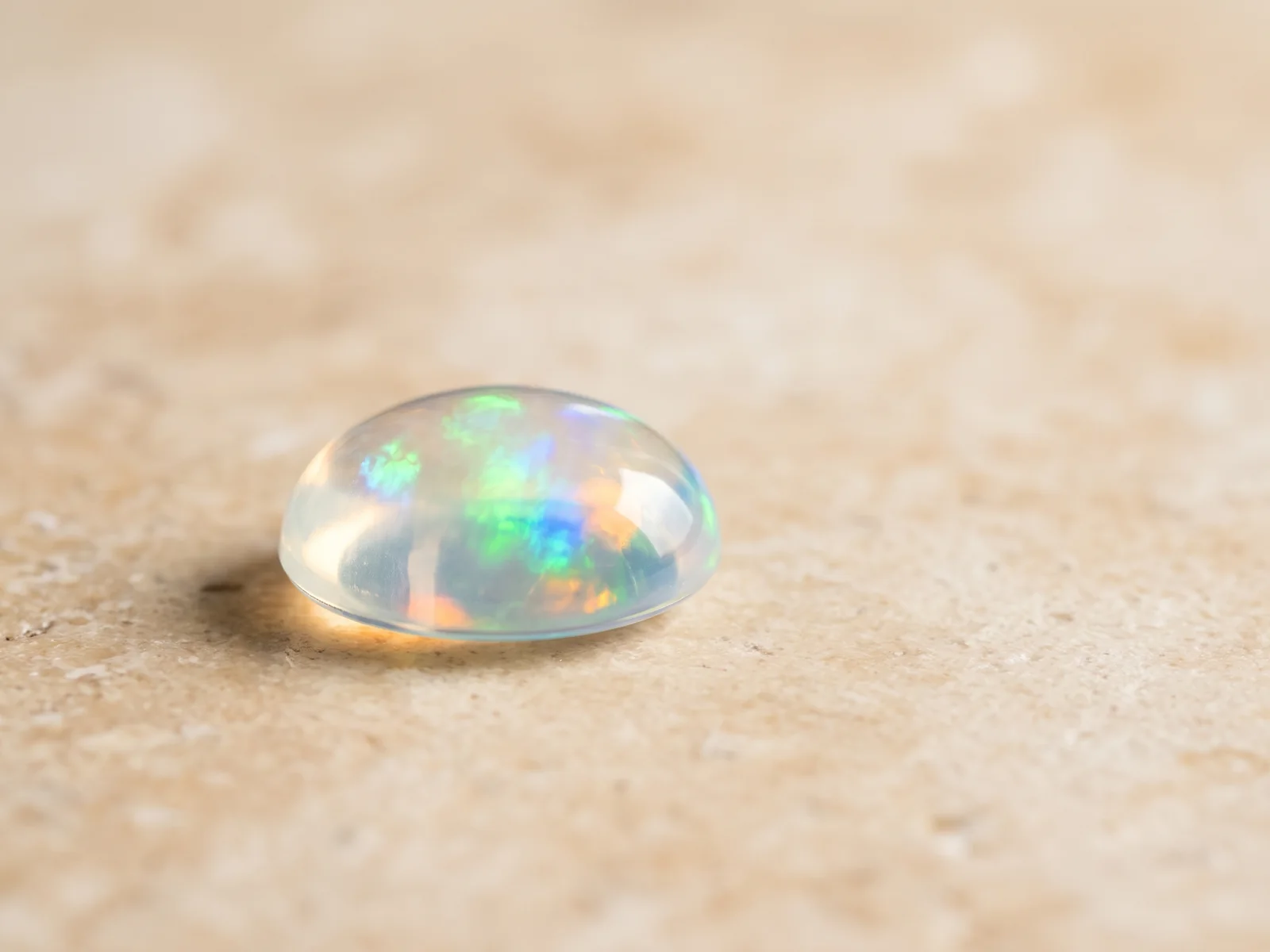
Crystal opal is the clearest form of precious opal, and that transparency changes how you judge its colour, value and durability. Here is what to look for, from body tone and treatments to the setting that keeps it safe.
 Reviewed by Raj Sood, Graduate Gemologist (GIA), AJP (GIA)Master jeweller and Graduate Gemologist (GIA) · reviewed 4 November 2026
Quick answer
Crystal opal is precious opal that is transparent to semi-transparent, so its play-of-colour seems to float inside the stone. It can have a light or dark body tone; dark versions are called black crystal opal. It is 5.5–6.5 on the Mohs scale, so it suits pendants and earrings, or a ring with a protective bezel worn with care.
What is crystal opal?
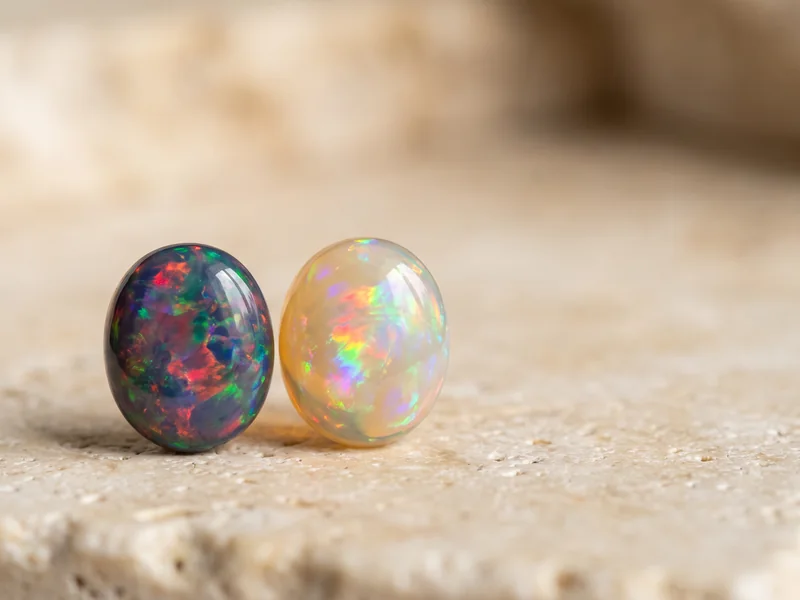
Crystal opal is precious opal that is transparent to semi-transparent. Light travels into the stone, so the flashes of colour seem to sit deep inside it rather than on the surface. The name describes clarity, not a different mineral: crystal opal is the same material as every other opal, a hydrated form of silica written SiO2·nH2O. Our page on what opals, sapphires and diamonds are made of puts that formula beside the other main gems.
Despite the name, opal is amorphous, meaning it has no true crystal structure. Precious opal is built from tiny silica spheres, roughly 150–350 nanometres across, stacked in an orderly grid with water and more silica filling the gaps. When light meets that grid it is diffracted (bent and split) into spectral colours. This is play-of-colour. Small spheres can only produce blue and violet; larger spheres are needed for orange and red, which is one reason red is the rarest and most valued colour in opal.
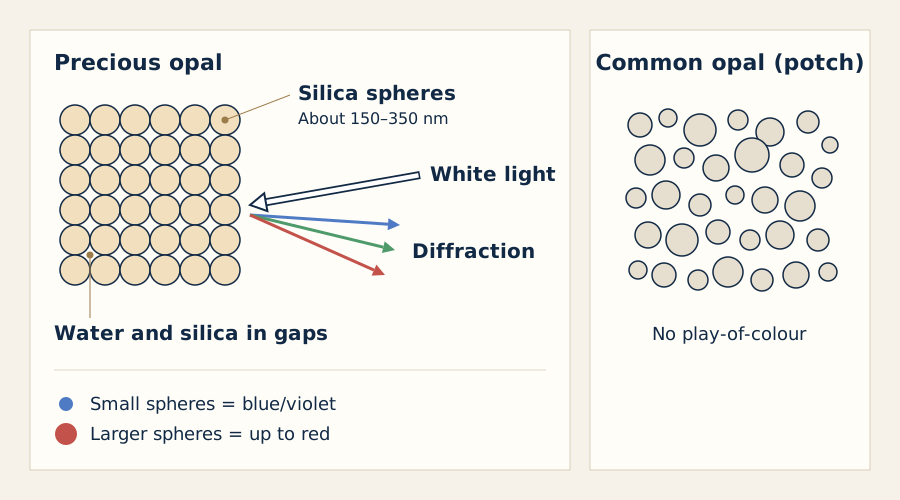
Common opal, which Australian miners call potch, has the same chemistry but its spheres are jumbled or uneven, so there is no play-of-colour. A crystal opal has little or no milky potch to block light, and that is what gives it a clear, glassy depth. Opal sits alongside many other coloured stones in our guide to coloured gemstones and birthstones, and any unfamiliar term on this page is defined in the GemTrove jewellery glossary.
What colours and body tones does crystal opal come in?
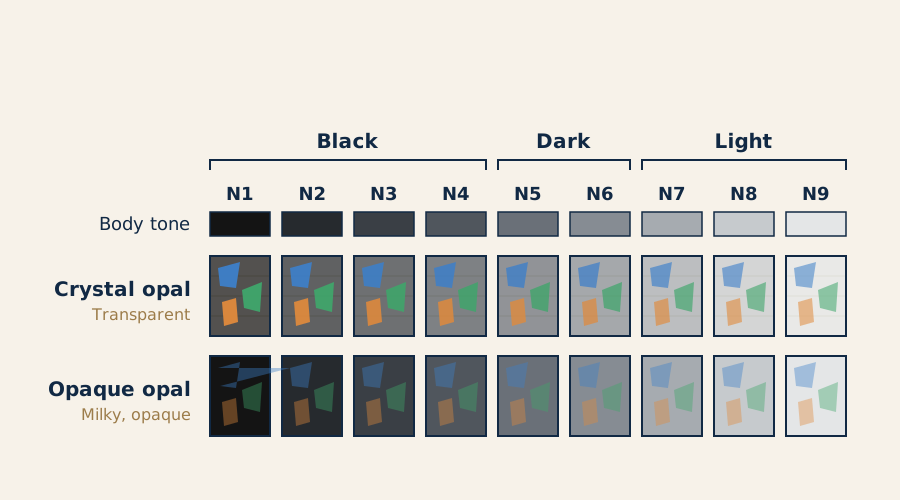
Two things decide how a crystal opal looks: its body tone (the background lightness or darkness of the stone, ignoring the play-of-colour) and how transparent it is. The Australian opal trade grades body tone on a scale from N1, jet black, to N9, very light. Crystal opal can sit anywhere on that scale.
| Body tone | Usual name when transparent | How it looks |
|---|---|---|
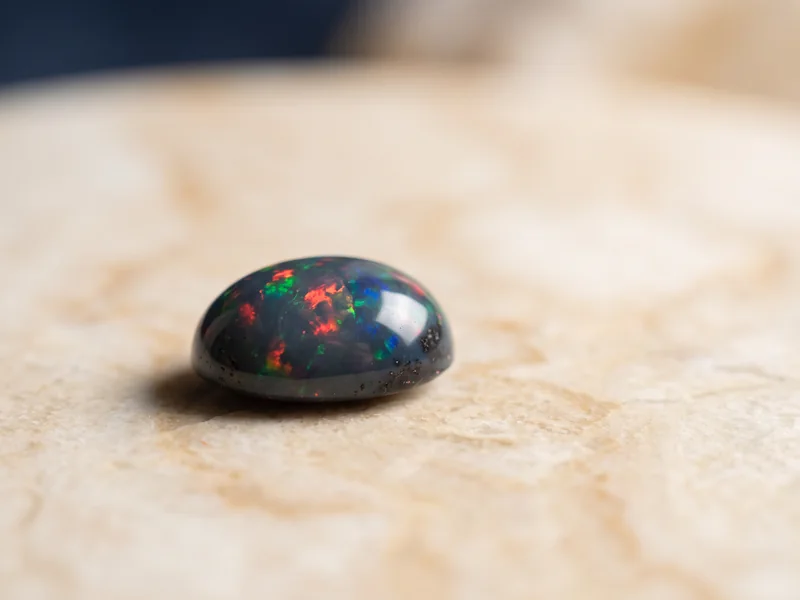
| N1–N4 | Black crystal opal | Colours glow against a dark but see-through body; mostly from Lightning Ridge |
| N5–N6 | Dark crystal opal | Smoky grey body with strong contrast, short of full black |
| N7–N9 | Light crystal opal | Water-clear to pale; colours seem to float in glass |
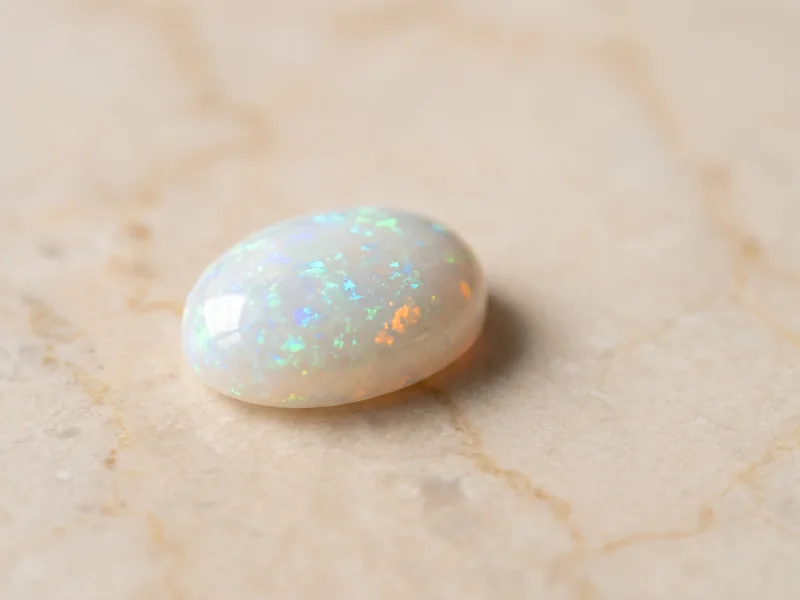
A dark body works like a black curtain behind a stage light, so colours look more saturated. That is why black opal from Lightning Ridge reaches the highest prices, and a black crystal opal combines that contrast with real depth. A light crystal opal is gentler: the colours are paler, but you see them in three dimensions as the stone moves. Compare that with opaque, milky white opal, where the colour sits on a pale, cloudy background and does not show the same depth.
Play-of-colour covers the whole spectrum. Blue and green are the most common, orange is less common, and red, especially red visible from every angle, is the rarest. The pattern matters as much as the hue:
- Pinfire: tiny specks of colour scattered across the stone.
- Broad flash: large sheets of colour that switch on and off as you tilt it.
- Rolling flash: colour that sweeps across the face like a wave.
- Ribbon or Chinese writing: lines and strokes of colour, a favourite with collectors.
- Harlequin: a rare mosaic of angular patches, highly prized.
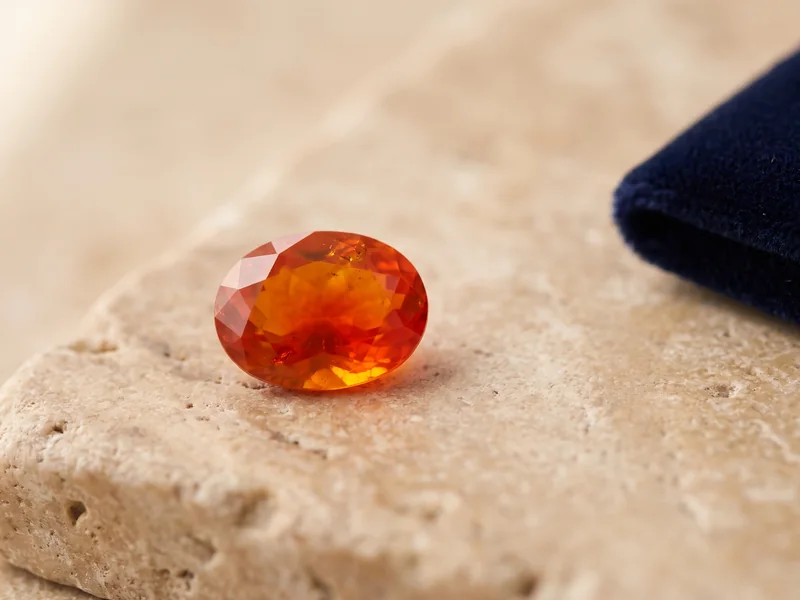
Some crystal opals have a yellow, orange or red body colour and are sold as crystal fire opal; in Mexico, colourless transparent opal with play-of-colour is called water opal. The classic orange-red Mexican material, with or without play-of-colour, has its own page: our fire opal guide.
Crystal opal vs white, black and boulder opal: what is the difference?
| Crystal | White (light) | Black | Boulder | Fire | |
|---|---|---|---|---|---|
| Transparency | Transparent to semi-transparent | Opaque to translucent, milky | Opaque to translucent | Opaque, with ironstone backing | Transparent to translucent |
| Body tone | Any, N1–N9 | Light, N7–N9 | Dark, N1–N4 | Usually dark from the ironstone | Yellow, orange or red body colour |
| Main sources | Lightning Ridge, Coober Pedy, Andamooka, Ethiopia | Coober Pedy, Andamooka, Ethiopia | Lightning Ridge | Queensland | Mexico |
| Play-of-colour | Deep, three-dimensional | Soft, on the surface | Vivid, high contrast | Vivid, often in thin veins | Sometimes; colour is the main appeal |
| Relative price | Wide; black crystal very high | Usually lowest of the Australian types | Highest | Mid to high | Low to mid |
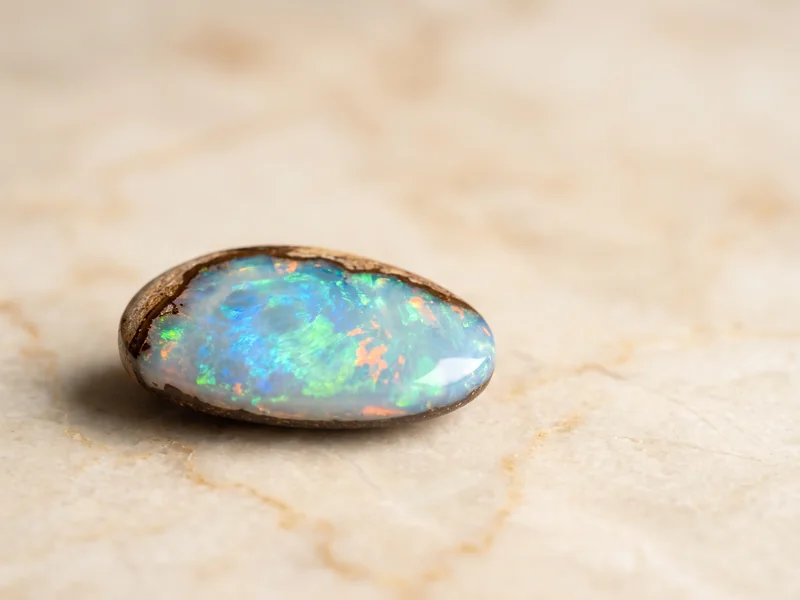
Boulder opal is a different structure again: thin seams of precious opal running through brown ironstone, cut with the host rock left on the back as a natural support. Our page on Queensland boulder opal and its ironstone backing explains why it can be cut into free-form shapes. For how every Australian type stacks up against the newer Ethiopian supply, see Australian opal types compared with Ethiopian opal.
Related guideAustralian Opal Types ComparedIs crystal opal hard enough for an engagement ring?
Crystal opal measures 5.5–6.5 on the Mohs scale, softer than quartz at 7. Ordinary household dust contains quartz, so over years the polish on an opal dulls and fine scratches build up, especially on the top of a ring. Toughness, meaning resistance to chipping and cracking, is poor to fair. Opal has no cleavage, but its water content and internal stress make it vulnerable to hard knocks and sudden temperature changes.
| Gem | Mohs hardness | Toughness | Ring wear |
|---|---|---|---|
| Diamond | 10 | Good, but can cleave | Everyday |
| Sapphire | 9 | Excellent | Everyday |
| Citrine and ametrine (quartz) | 7 | Good | Everyday with some care |
| Moonstone | 6–6.5 | Poor, has cleavage | Occasional, protective setting |
| Labradorite | 6–6.5 | Fair, has cleavage | Occasional, protective setting |
| Crystal opal (solid) | 5.5–6.5 | Poor to fair | Occasional or careful daily wear, bezel recommended |
| Opal triplet | About 7 with a quartz cap, lower (about 5.5) with glass | Layers can separate if soaked | Occasional; never soak |
So a crystal opal engagement ring is possible, but it is a ring you wear with awareness: take it off for the gym, gardening, cleaning and swimming. Our page on how opal engagement rings handle daily life goes into more detail. If you like a stone with an inner glow, moonstone and its soft adularescence and labradorite with its flash of colour sit at a similar hardness, while quartz gems such as warm golden citrine and two-tone ametrine cope better with everyday knocks.
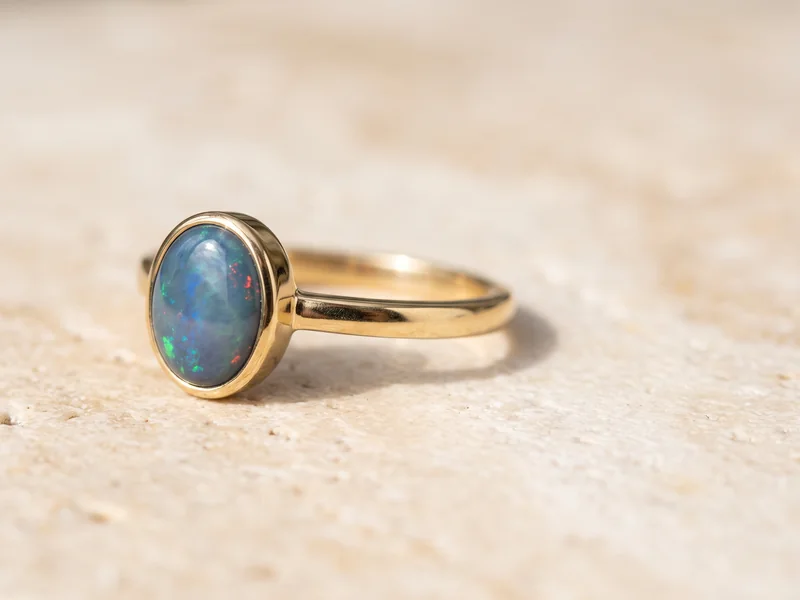
The setting does a lot of the work. A full bezel (a rim of metal around the edge) protects the girdle, the most chip-prone part of the stone. A design that holds the opal slightly below the shoulders of the band keeps the surface out of harm's way. Claws suit pendants and earrings, but in a ring four or six claws leave much of the edge exposed. Most crystal opal is cut as a cabochon (a smooth, polished dome with no facets); a high dome shows more colour but stands proud, while a lower dome sits safer on the hand.
Not sure which one is right?
Send us the stones you are looking at and our gemologist will tell you which to choose and why.
Where does Australian crystal opal come from?
Australia supplies the large majority of the world's precious opal, and opal is Australia's national gemstone. Australian opal is sedimentary: it formed when silica-rich water seeped into cracks and cavities in the rocks of the Great Artesian Basin and slowly set. Each field has its own character, which our guide to the Lightning Ridge, Coober Pedy and Queensland boulder fields covers in depth.
- Lightning Ridge, New South Wales: black and dark crystal opal, often found as small nodules called nobbies.
- Coober Pedy, South Australia: light crystal and white opal, the largest field by volume.
- Andamooka, South Australia: light crystal opal and the porous matrix opal that is often treated.
- Mintabie, South Australia: light to dark crystal opal from deeper sandstone.
- Ethiopia (Wollo province): volcanic opal, much of it crystal or semi-crystal, and often hydrophane.
- Mexico: transparent water opal and fire opal, including contraluz opal that shows colour against the light.
- USA (Virgin Valley, Nevada): striking crystal opal that is well known for crazing as it dries out.
The distinction between Australian and Ethiopian crystal opal matters for wear. Many Ethiopian opals are hydrophane, meaning they absorb water. Soak one and it can turn temporarily clear or cloudy and lose its play-of-colour until it dries, which may take days. Most Australian sedimentary crystal opal is non-hydrophane and stable once it has been properly cured after mining. Neither is better as such; they simply need different care.
Is crystal opal treated, synthetic or a doublet?
A solid natural crystal opal is a single piece of opal, top to bottom. Plenty of opal jewellery is something else, and every one of these must be disclosed:
- Doublet: a thin slice of precious opal glued to a dark backing, often ironstone, potch or black glass. A slice of light crystal opal on a black backing can look like black opal.
- Triplet: the same thin slice and backing, with a clear dome of quartz or glass on top to protect it and magnify the colour.
- Smoke treatment: porous Ethiopian opal heated in smoke to darken the body tone.
- Sugar-acid treatment: porous opal soaked in sugar solution, then acid, to deposit black carbon and darken it; common with Andamooka matrix opal.
- Dye and polymer impregnation: colour or plastic resin forced into porous opal to darken or stabilise it.
- Oil or wax: used to hide fine cracks; the cracks can reappear when the coating wears.
Lab-created opal (also called synthetic opal) has been made for decades, and some of it is very convincing crystal-type material. Under magnification it usually shows a columnar or snakeskin pattern inside each colour patch, and some types contain plastic resin that gives a lower specific gravity. Imitations made of glass or plastic also exist. Lab-created opal is a legitimate choice at a far lower price, provided it is sold as lab-created.
Identification is mostly about structure and testing rather than inclusions. With diamond, gemmologists map tiny mineral crystals trapped inside the stone; with opal we look at the pattern of the colour patches, the edge, and the readings. Natural opal gives a refractive index of about 1.45 (range 1.37–1.47) and a specific gravity of about 2.15 (range roughly 1.98–2.25), lower in hydrophane material. Many light crystal opals fluoresce white to pale blue under long-wave ultraviolet light.
What affects crystal opal value and price?
Opal has no single international grading system like the 4Cs for diamonds, so value is judged by eye against a set of agreed factors. In rough order of influence:
- Body tone: darker crystal opal, N1–N4, is worth much more than light crystal of the same brilliance.
- Brightness: how vividly the colours shine, often graded on a scale from dull to brilliant.
- Colour: red is most valued, then orange, green and blue. A stone showing all colours is rated higher.
- Pattern: harlequin and rolling flash are rare and prized; small pinfire is usually less valuable.
- Directionality: colour that shows from every angle is worth more than colour that only appears when you tilt the stone one way.
- Faults: crazing (fine surface cracks), sand spots, potch lines and dead windows (areas with no colour) all reduce value.
- Origin and type: solid Australian opal usually costs more than Ethiopian; doublets and triplets cost far less than solids.
- Size and cut: larger clean stones are rarer; a well-domed cabochon with a clean back sells better than an uneven one.
| Type of crystal opal | Approximate price range (AUD per carat) |
|---|---|
| Lab-created opal | about $5–$50 |
| Ethiopian crystal opal | about $20–$300 |
| Australian light crystal opal | about $100–$1,500 |
| Australian dark and black crystal opal | about $500–$10,000+ |
| Doublets and triplets | usually priced per piece, well below a comparable solid |
These ranges are broad because opal is priced stone by stone. Two black crystal opals of the same weight can differ in value many times over, depending on brightness and red in the pattern. Treat any per-carat figure as a starting point only.
Browse natural gemstones
How do you care for crystal opal jewellery?
Good care keeps crystal opal bright for generations. The rules are simple, but they matter more with opal than with harder gems:
- Clean gently: lukewarm water, a drop of mild detergent and a soft cloth or very soft brush, then dry straight away.
- No ultrasonic or steam cleaners: vibration and heat can crack solid opal and loosen the glue in doublets and triplets.
- Never soak doublets or triplets: water can creep under the join and cloud the layers.
- Keep hydrophane opal dry: take Ethiopian opal off before washing hands or swimming.
- Avoid sudden temperature changes: do not leave it on a sunny dashboard or move it from heat straight into cold water.
- Store it separately: in a soft pouch, away from harder gems that can scratch it.
- Repolish when needed: a jeweller can lightly repolish a dulled solid crystal opal every few years.
Opal is the traditional October birthstone, so it often turns up as a gift ring or pendant. Our page on the October birthstones, opal and tourmaline compares it with tourmaline, the tougher alternative for the same month.
How do you choose a crystal opal? Step by step
- Decide how it will be worn. Pendants and earrings suit any crystal opal; for a ring, plan a bezel or protective setting from the start.
- Ask whether it is solid, doublet, triplet or lab-created. Get the answer in writing, along with any treatment.
- Check the body tone. Look at the stone against a white surface and note where it sits from N1 to N9.
- Judge brightness and pattern. View it in daylight and under a single light, and rotate it fully to check directionality.
- Look for faults. Use a loupe to check for crazing, sand spots, potch lines and dead windows, especially near the edge.
- Confirm the origin. Australian or Ethiopian matters for care; ask whether the stone is hydrophane.
- Compare like with like. Price crystal opals of similar body tone, brightness and size together, not by weight alone.
Free consultation
Talk to a gemologist
Compare stones in person or online with Raj Sood, Graduate Gemologist (GIA), AJP (GIA).
Book a consultationShop this shape
FAQ
Common questions
What is the difference between crystal opal and white opal?
Crystal opal is transparent to semi-transparent, so its colours look deep and three-dimensional. White opal is opaque and milky, with colour that sits on the surface. Both are precious opal; the difference is transparency.
Is black crystal opal the same as black opal?
Not quite. Black opal has a dark body tone, usually N1–N4, and is opaque to translucent. Black crystal opal has the same dark tone but is more transparent, giving deeper colour.
Can you wear a crystal opal engagement ring every day?
You can, with care. At 5.5–6.5 on the Mohs scale it scratches and chips more easily than sapphire or diamond, so choose a bezel setting and remove it for sport, cleaning and swimming.
Is Ethiopian crystal opal real opal?
Yes. Ethiopian crystal opal is natural precious opal, but much of it is hydrophane, so it can absorb water and temporarily lose its colour. Keep it dry and it is a lovely, more affordable option.
How can you tell if a crystal opal is a doublet?
Look at the side of the stone. A doublet or triplet shows a straight dark join line between layers, while a solid opal shows colour through its thickness. A triplet also has a clear glassy cap on top.
Does crystal opal need to be kept in water?
No. Solid Australian crystal opal does not need to be stored in water, and doublets, triplets and hydrophane opal should not be soaked at all. Normal room conditions and a soft pouch are fine.
Terms in this guide

Ask a gemologist
Not sure which diamond to choose?
Raj Sood is a Graduate Gemologist (GIA) and master jeweller. Bring the stones you are considering, or send the reports, and he will tell you honestly which one is better and why.
Keep learning
Related guides
 GemstonesBlack Opal
 GemstonesWhite Opal
 GemstonesAustralian Opal Engagement Rings: Wearability and CareGemstonesAustralian Opal Fields: Lightning Ridge, Coober Pedy and Queensland BoulderGemstonesGemstones | Coloured Gemstones, Birthstones and Custom Jewellery
 GemstonesBoulder Opal
 GemstonesFire Opal
 GemstonesAustralian Opal Types Compared
Explore more
More guides on this topic
Education