
- Education
- Diamond Shapes
- Heart vs Pear Diamond: Which Shape Suits You?
Diamond shapes
Heart vs Pear Diamond: Which Shape Suits You?
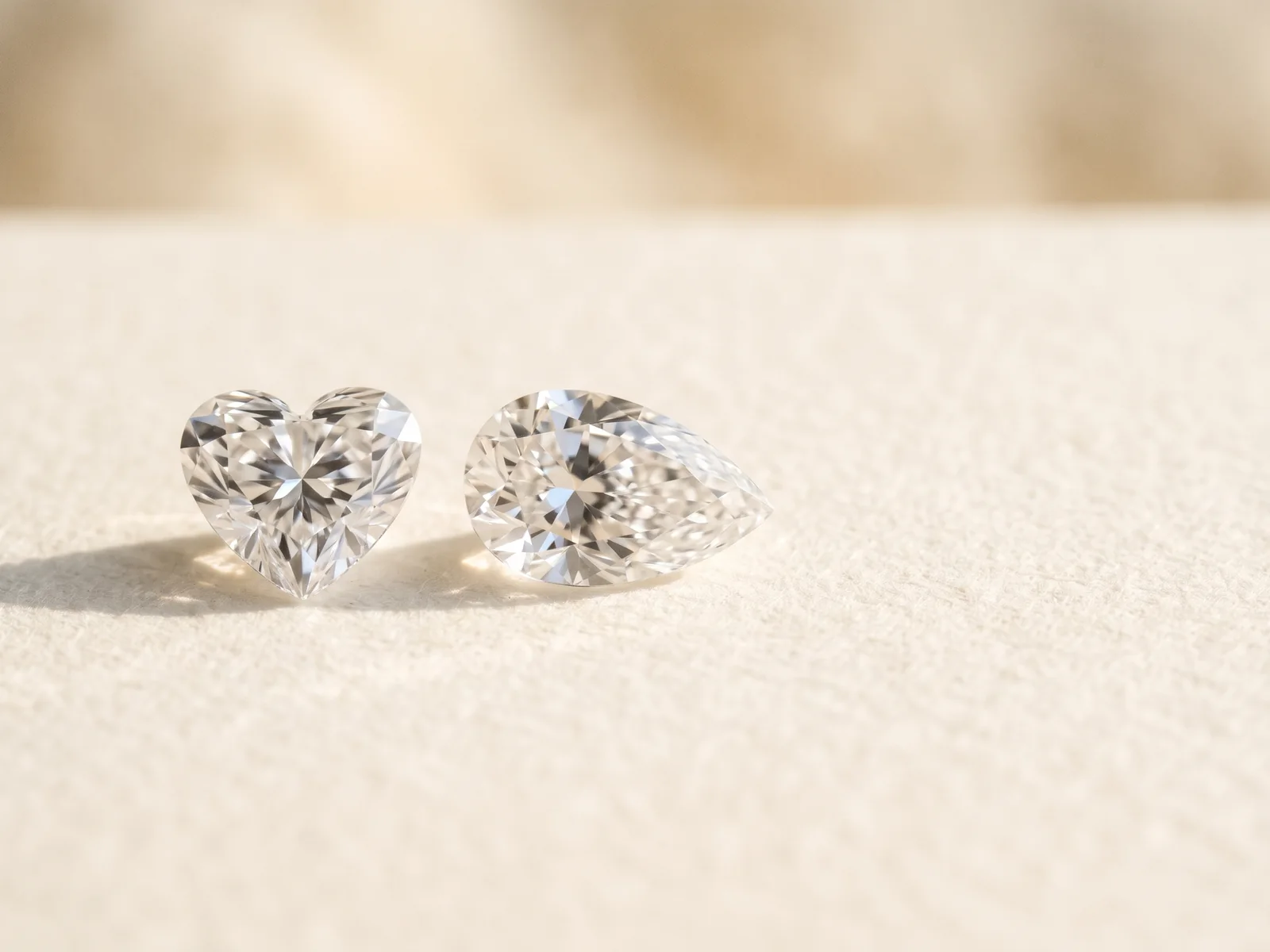
The heart and the pear are close cousins: both have a rounded top and a single point. Choosing between a heart vs pear diamond comes down to how each looks on your hand, how big it faces up and how you will protect its point.
 Reviewed by Raj Sood, Graduate Gemologist (GIA), AJP (GIA)Master jeweller and Graduate Gemologist (GIA) · reviewed 4 November 2026
Quick answer
A pear diamond is longer and slimmer (ratio about 1.45–1.75): a 1 carat pear measures about 8.5 × 5.5 mm and lengthens the finger. A heart is wider (ratio 0.90–1.10, about 6.8 × 6.3 mm at 1 carat) and reads as a symbol. Prices per carat are similar; the heart needs stricter symmetry and cleft protection.
What is the difference between a heart vs pear diamond?
Both shapes are modified brilliant cuts: they use the triangular and kite-shaped facets of a round brilliant, rearranged around a different outline. Most pears have about 56–58 facets and most hearts about 56–59. Under the loupe the faceting looks much the same. The difference is almost entirely in the outline.
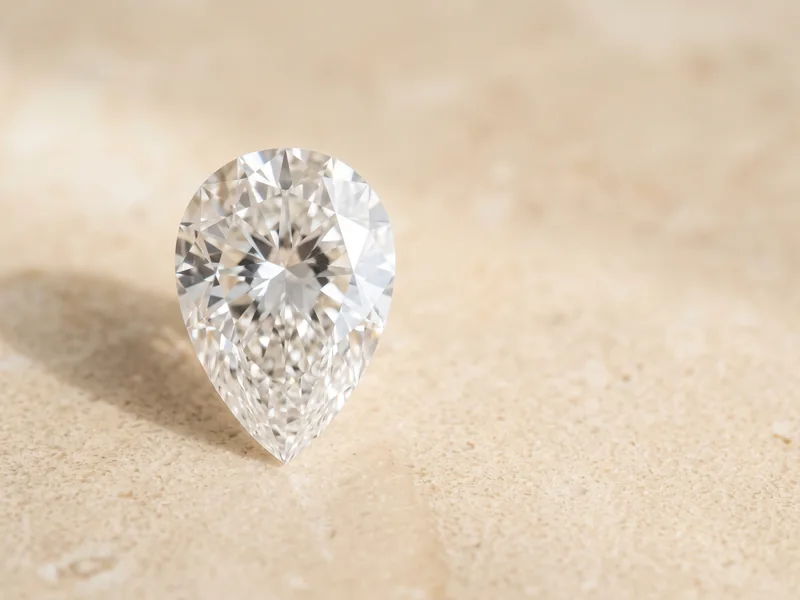
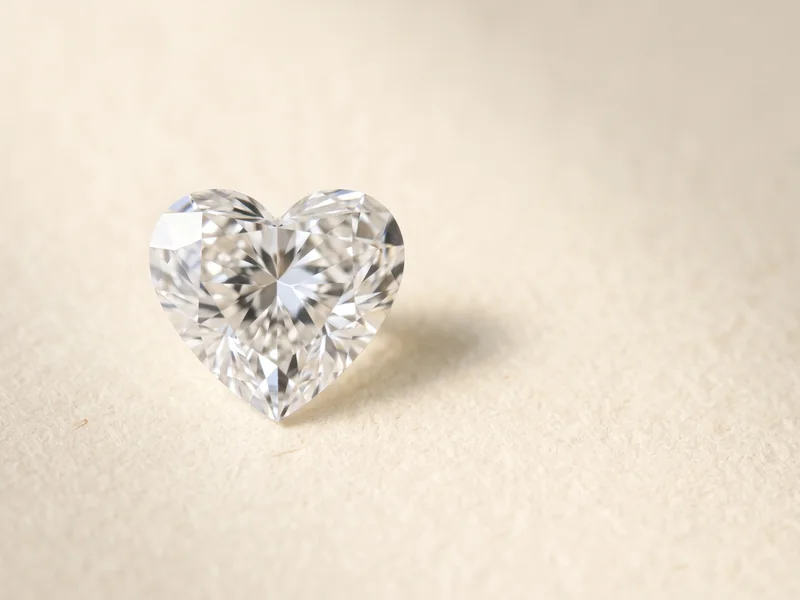
A pear (also called a teardrop) has one rounded end, called the head, which narrows through the shoulders and wings to a single point. A heart is, in effect, a pear with a notch cut into the head: two rounded lobes sit either side of a dip called the cleft, and the stone is far wider for its length. If you want the full detail on each shape on its own, start with our complete heart shaped diamond guide and our pear cut diamond guide.
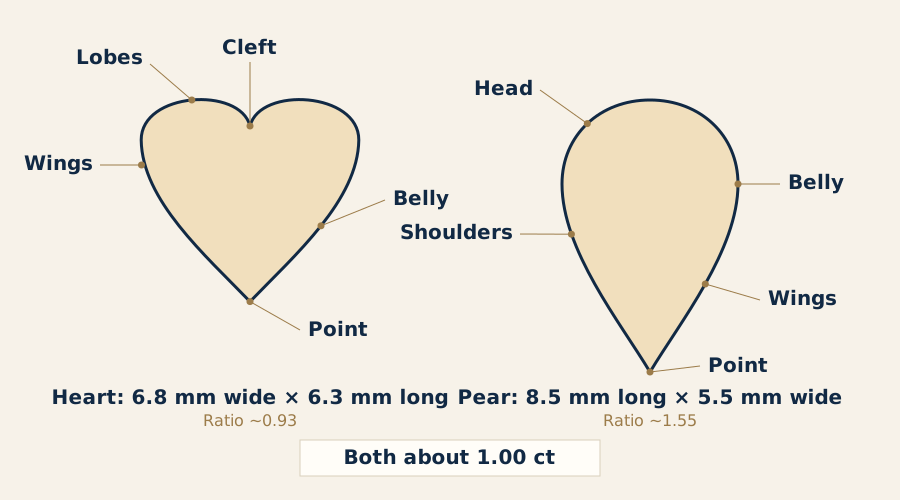
That one change in outline affects nearly everything else: how the stone sits on the finger, how big it looks, where it is fragile, how hard it is to cut well and which settings suit it. The sections below work through each point side by side. To see where both shapes sit among all the others, our overview of the main diamond shapes is a useful map, and any unfamiliar word is explained in the GemTrove jewellery glossary.
How do heart and pear diamonds look on the hand?
A pear is an elongated shape. Set north-south (point towards the fingertip), it draws the eye along the finger and makes the hand look longer and slimmer, much as an oval or marquise does. The rounded head gives it a softer feel than a marquise, and the point gives it more direction than an oval.
A heart is close to as wide as it is long, so it covers more of the width of the finger and less of its length. It reads less as a shape and more as a symbol: people recognise a heart from across the room in a way they rarely notice a pear. That is its appeal and, for some people, its drawback, because it is a strong statement to wear every day.
- Pear: lengthens the finger, suits slim and long fingers alike, and works north-south or set sideways (east-west) for a more unusual look.
- Heart: wider and rounder on the hand, suits wider fingers and shorter hands well, and is usually set with the point towards the fingertip, though some people prefer it pointing towards the wrist so it looks upright to them.
- Both: look natural as pendants, where gravity hangs them point-down.
The length-to-width ratio controls how strong each effect is. A pear at 1.45 is plump and close to an oval; at 1.75 or more it is slim and dramatic. Our pear ratio guide, from plump to slender shows the range on the hand.
Heart vs pear diamond: which looks bigger per carat?
Face-up size is how big the stone looks from above, which matters more to the eye than carat weight. Both shapes are relatively shallow for their weight compared with, say, a cushion, so both spread well. The pear's extra length makes it look bigger on the finger to most people, while the heart's face-up area is broadly similar but packed into a squarer outline.
| Carat weight | Heart (width × length) | Pear (length × width) |
|---|---|---|
| 0.50 ct | about 5.4 × 5.0 mm | about 7.0 × 4.5 mm |
| 0.75 ct | about 6.2 × 5.7 mm | about 7.7 × 5.0 mm |
| 1.00 ct | about 6.8 × 6.3 mm | about 8.5 × 5.5 mm |
| 1.50 ct | about 7.8 × 7.2 mm | about 9.7 × 6.3 mm |
| 2.00 ct | about 8.6 × 7.9 mm | about 10.5 × 7.0 mm |
These are typical figures for a heart at about 0.93 ratio and a pear at about 1.55. A deeper stone of either shape carries more weight underneath and faces up smaller; a shallower one spreads wider but can lose brightness. Always compare the millimetre measurements on the report rather than the carat weight alone.
Small size works differently for each shape. A pear still reads as a teardrop at 0.30 carat, which is why small pears are popular as earrings and side stones. A heart's cleft and lobes shrink quickly, and below about 0.50 carat, once claws cover part of the outline, it can read as a rounded triangle. Our guide to the minimum size for a heart to read clearly explains why.
Which sparkles more, a heart or a pear?
Diamond has a refractive index of about 2.42, and both shapes use brilliant faceting to return that light as sparkle, so a well-cut heart and a well-cut pear are similarly lively. The differences come from proportions, not from the shape being better or worse.
The main thing to watch in both is the bow-tie: a dark band across the middle of the stone where light leaks out of the pavilion (the lower half) instead of returning to your eye. Bow-ties are common in pears, because the long, narrowing body is hard to cut with even light return. Hearts can show one across the belly too, but the wider outline often makes it less obvious. A faint bow-tie that shifts as the stone moves is normal. One that stays dark in every position means the proportions are off.
- Pear: many well-cut pears sit at about 58–64% total depth with a table (the large top facet) of about 53–63%. See our pear proportions chart for the full ranges.
- Heart: many well-cut hearts sit at about 56–62% depth with a similar table range.
- Neither gets an overall GIA cut grade the way a round does, so you judge the cut from the proportions, the symmetry and a 360° video.
Not sure which one is right?
Send us the stones you are looking at and our gemologist will tell you which to choose and why.
Is symmetry harder to get right in a heart or a pear?
Both shapes are mirrored down a central line, so any imbalance shows. The heart is the harder of the two. A cutter has to match two lobes, centre the cleft, line up the point beneath it and keep both wings evenly curved. A pear has one head to round off and two shoulders to match, so there are fewer places for it to go wrong.
In a pear, look for a head that is a smooth, even curve rather than flattened, shoulders that are level and not high on one side, and a point sitting directly in line with the centre of the head. Our step-by-step on judging pear diamond symmetry by eye covers each check.
In a heart, check that the lobes are the same size and height, the cleft is crisp and centred, and the point does not lean. The heart symmetry checklist with examples walks through these with photos of good and poor stones.
The symmetry grade on a report mainly describes how precisely the facets line up. It is useful, but a stone can grade Excellent and still have one lobe or one shoulder slightly fuller than the other, so use your eye as well.
Which is more durable for everyday wear, a heart or a pear?
Diamond is 10 on the Mohs hardness scale, so neither shape scratches in normal wear. Hardness is not the same as toughness, though. Diamond can chip along its cleavage planes if a thin edge takes a sharp knock, and any point is a thin edge.
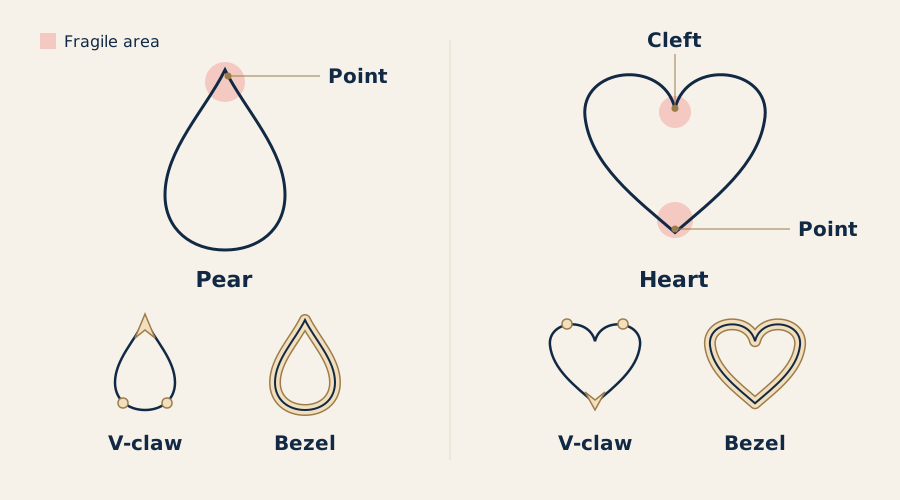
A pear has one weak spot: the point. A heart has the point plus the cleft, where the girdle (the narrow edge around the stone) dips inward and can be thin. In practice both are fine for everyday wear once the vulnerable areas are covered by metal, but the heart needs a little more thought.
- Check the report: a girdle described as very thin or extremely thin at the point is a risk in either shape.
- Check inclusions: a feather (small internal crack) at the point, or at the cleft in a heart, is easier to see and can weaken the thinnest area.
- Cover the point: a V-claw or bezel takes the knocks instead of the diamond. Our guide to keeping a pear's point safe applies equally to hearts.
What settings suit heart and pear diamonds?
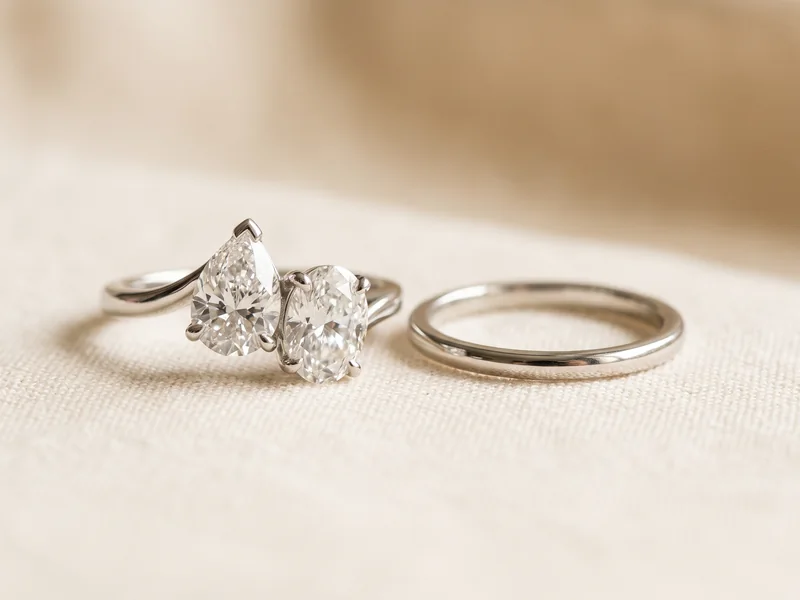
The setting's first job for both shapes is to protect the point. A pear is usually held with five claws: a V-claw (a V-shaped claw that wraps the tip) and two claws either side of the head. A heart is usually held with three claws (one at each lobe plus a V-claw) or five, adding one either side of the cleft. Bezels and halos suit both and shield the whole edge.
- Solitaire: shows the outline most clearly. A clean, slim band suits the pear; a heart looks balanced on a slightly wider band.
- Halo: makes either stone look larger and frames the shape, which helps smaller hearts read clearly.
- Side stones: small pears or trilliants either side of a centre stone are a classic three-stone look. Compare the two in trilliant vs pear side stones.
- East-west: a pear set sideways across the finger is a modern option; hearts are rarely set this way.
For worked examples of each shape, see pear diamond settings compared and setting styles that suit a heart. Both shapes are wider at one end than the other, so a straight wedding band can leave a gap or catch the point. Contoured bands are a common answer; our guide to wedding bands that sit flush beside a heart shows the options.
Related guideOval vs Pear DiamondsHeart vs pear diamond price: which costs more in Australia?
Per carat, hearts and pears cost broadly the same, and both usually cost less than a round of the same weight, colour and clarity. That is partly because more of the rough crystal is kept when cutting these shapes, and partly because demand is lower than for rounds. Pears are the more popular of the two, which can nudge their prices slightly up, while exceptionally well-matched hearts carry a premium because they are harder to cut. Within either shape, carat, colour, clarity and cut quality move the price far more than the outline does.
| 1 ct, G–H colour, VS clarity | Heart (approx. AUD) | Pear (approx. AUD) |
|---|---|---|
| Lab-grown | about $1,000–$3,500 | about $1,000–$3,500 |
| Natural | about $7,000–$16,000 | about $7,000–$16,000 |
These are broad ranges only, and prices move with the market. Lab-grown diamonds are real diamond, grown in a laboratory rather than mined; they look identical to natural diamonds and cost much less. Natural diamonds are rarer. Either way, ask for an independent grading report from a lab such as GIA or IGI that states whether the stone is natural or lab-grown.
Colour behaves a little differently in each shape. Body colour tends to gather at the point of a pear and in the lobes and point of a heart, so in white gold or platinum many people choose H colour or better for either. In yellow or rose gold, I or J can look just as white.
Shop heart and pear diamonds: natural and lab-grown
Who suits a heart, and who suits a pear?
| Heart | Pear | |
|---|---|---|
| Outline | Two lobes, cleft, point | Rounded head, one point |
| Typical ratio | 0.90–1.10 | 1.45–1.75 |
| 1 ct typical size | about 6.8 × 6.3 mm | about 8.5 × 5.5 mm |
| Effect on the hand | Wider, symbolic | Lengthens the finger |
| Smallest size that reads well | about 0.50 ct | about 0.30 ct |
| Bow-tie | Possible | Common |
| Fragile areas | Point and cleft | Point |
| Symmetry difficulty | Higher | Moderate |
| Price per carat | Similar, usually below a round | Similar, usually below a round |
Choose a heart if the symbolism matters to you, you like a wider, rounder look, or you have shorter or wider fingers and want a stone that sits balanced across them. Allow at least half a carat, and budget time to find well-matched lobes.
Choose a pear if you want the finger to look longer, like a softer alternative to the marquise, or want something that looks good at smaller sizes. If you are weighing the pear against other elongated shapes, our oval and pear comparison and the marquise vs pear guide cover the next most common choices.
How do you choose between a heart and a pear? Step by step
- Decide on the look. Try both outlines on your finger, or print the diagram to scale: longer and slimmer (pear) or wider and symbolic (heart).
- Set a minimum size. Aim for 0.50 carat or more for a heart; a pear reads well from about 0.30 carat.
- Read the report. Confirm shape, measurements, colour, clarity, polish, symmetry, girdle thickness and whether the stone is natural or lab-grown.
- Work out the ratio. Divide length by width: about 0.90–1.10 for a heart, 1.45–1.75 for a pear.
- Check symmetry and bow-tie by eye. Watch a 360° video for matched lobes or shoulders, and avoid a bow-tie that stays dark in every position.
- Compare face-up size. Use the millimetre measurements, not just the carat weight.
- Plan the setting. Make sure the point, and a heart's cleft, are protected by a V-claw, bezel or halo, and choose a band that sits flush.
Free consultation
Talk to a gemologist
Compare stones in person or online with Raj Sood, Graduate Gemologist (GIA), AJP (GIA).
Book a consultationFAQ
Common questions
Does a pear or heart diamond look bigger?
Most people find a pear looks bigger at the same carat weight, because it is about 2 mm longer at 1 carat and stretches along the finger. The total face-up area is broadly similar; the heart's size is spread across its width instead.
Is a heart or pear diamond more expensive?
Per carat they cost broadly the same, and both usually cost less than a round of the same grades. Carat, colour, clarity and cut quality affect the price far more than the choice of shape.
Which is more durable, a heart or a pear diamond?
The pear has one fragile area, the point, while the heart has the point and the cleft. Both are fine for everyday wear once a V-claw, bezel or halo protects those areas.
Is a pear diamond just a heart without the cleft?
In outline it is close, but a pear is much longer for its width, with a ratio of about 1.45–1.75 against a heart's 0.90–1.10. That changes how it looks on the hand, where light leaks and how small it can be cut while still reading clearly.
Which way should a pear or heart point on a ring?
Most people wear the point towards the fingertip, which lengthens the finger. Some prefer a heart pointing towards the wrist so it looks upright to them; either is fine as long as the point is protected.
Can you get lab-grown heart and pear diamonds?
Yes. Both shapes are widely available as lab-grown diamonds, which are real diamond grown in a laboratory, cost much less than natural and are graded by labs such as IGI and GIA.

Ask a gemologist
Not sure which diamond to choose?
Raj Sood is a Graduate Gemologist (GIA) and master jeweller. Bring the stones you are considering, or send the reports, and he will tell you honestly which one is better and why.
Keep learning
Related guides
 Diamond ShapesHeart-Shaped Diamonds
 Diamond ShapesPear Cut Diamonds
 Engagement Rings & SettingsBest Settings for Pear DiamondsEngagement Rings & SettingsBest Settings for Heart DiamondsDiamond ShapesUnderstanding Diamond Shapes
 Diamond ShapesHow Big Should a Heart-Shaped Diamond Be to Show Its Shape?Diamond ShapesHeart-Shaped Diamond Symmetry GuideDiamond ShapesProtecting the Point of a Pear Diamond
Explore more
More guides on this topic
Education