
- Education
- Diamond Shapes
- Marquise vs Pear Diamond: Which Shape Suits You?
Diamond shapes
Marquise vs Pear Diamond: Which Shape Suits You?
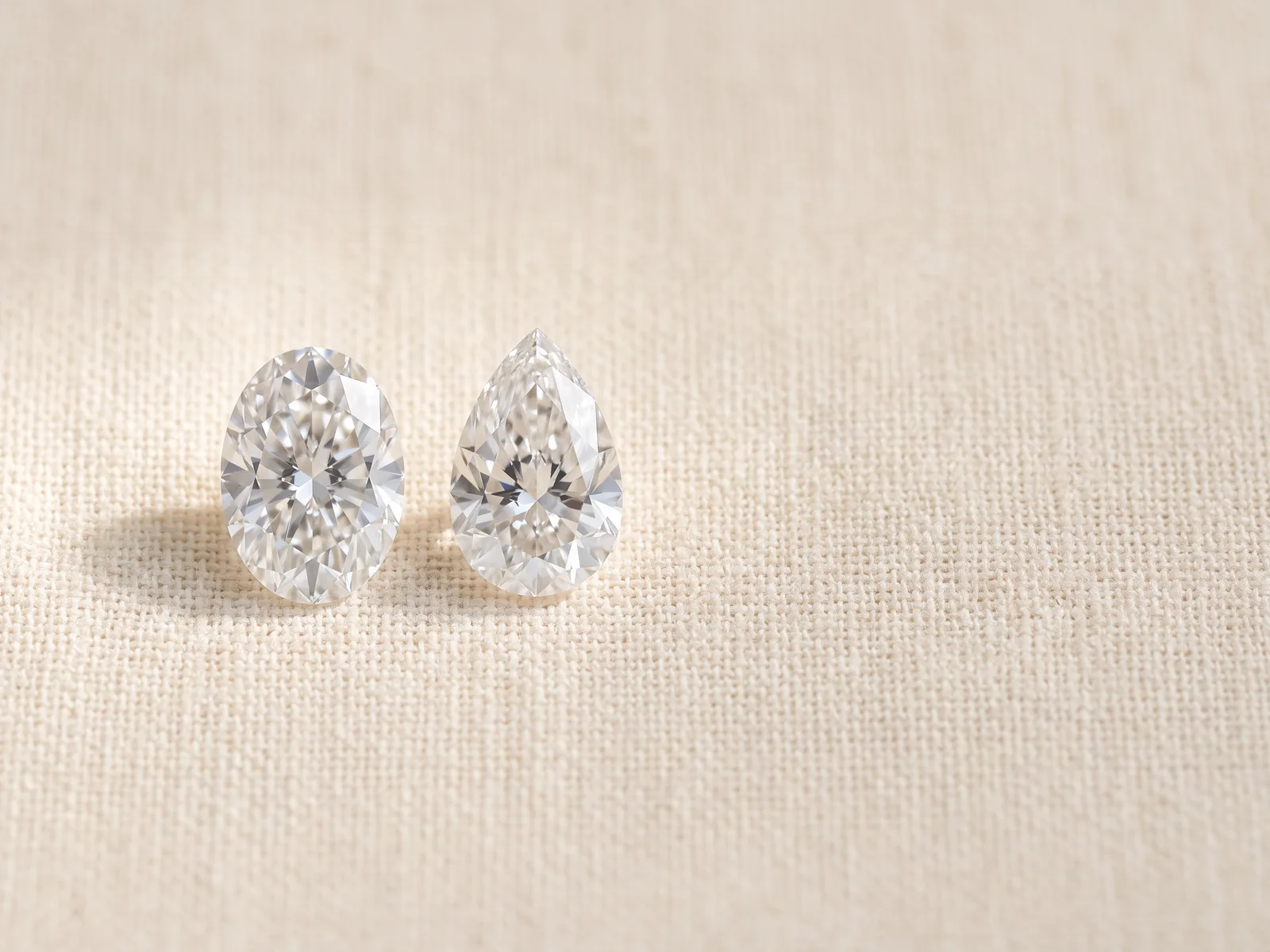
The marquise vs pear diamond choice comes up often, because both shapes look long, slim and larger than a round for their weight. They differ in how many points need protecting, how they sit on the finger and how forgiving they are to cut and wear.
 Reviewed by Raj Sood, Graduate Gemologist (GIA), AJP (GIA)Master jeweller and Graduate Gemologist (GIA) · reviewed 4 November 2026
Quick answer
In a marquise vs pear diamond comparison, the marquise has two points and a longer, slimmer outline that faces up larger per carat, while the pear has one rounded end and one point, so it is slightly easier to protect and set. Both show a bow-tie, cost less per carat than a round, and both lengthen the finger.
What is the difference between a marquise and a pear diamond?
Both shapes are modified brilliant cuts. That means they use the same triangular and kite-shaped facets as a round brilliant, arranged around an elongated outline instead of a circle, so both have strong, lively sparkle. Most marquise and pear diamonds carry about 56–58 facets, depending on the cutter and whether there is a culet (a tiny flat facet at the very bottom).
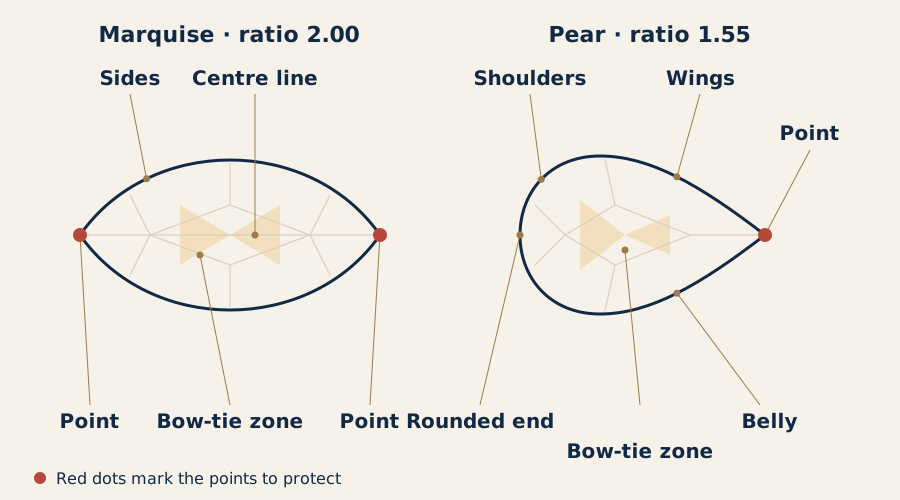
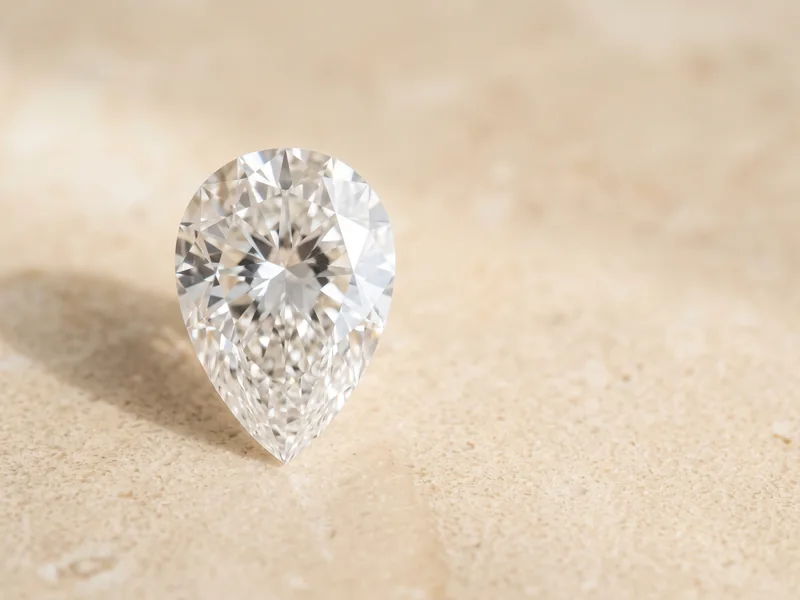
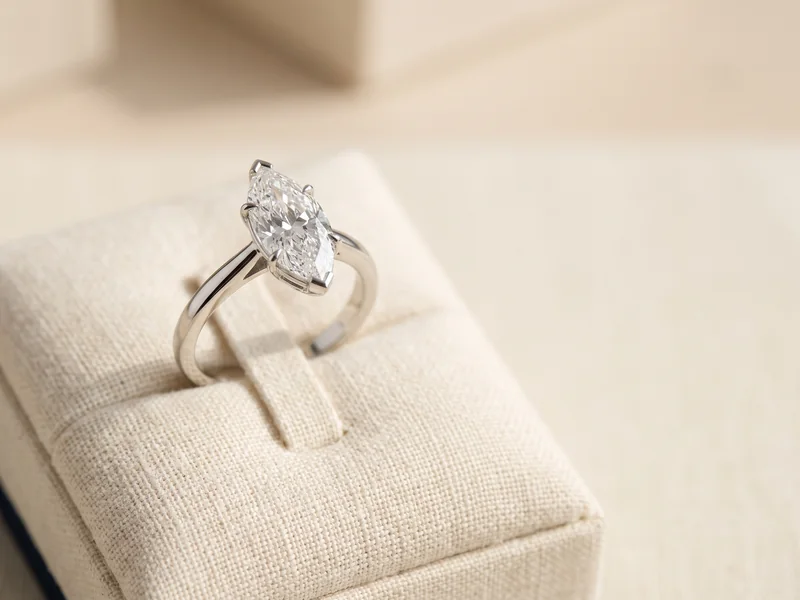
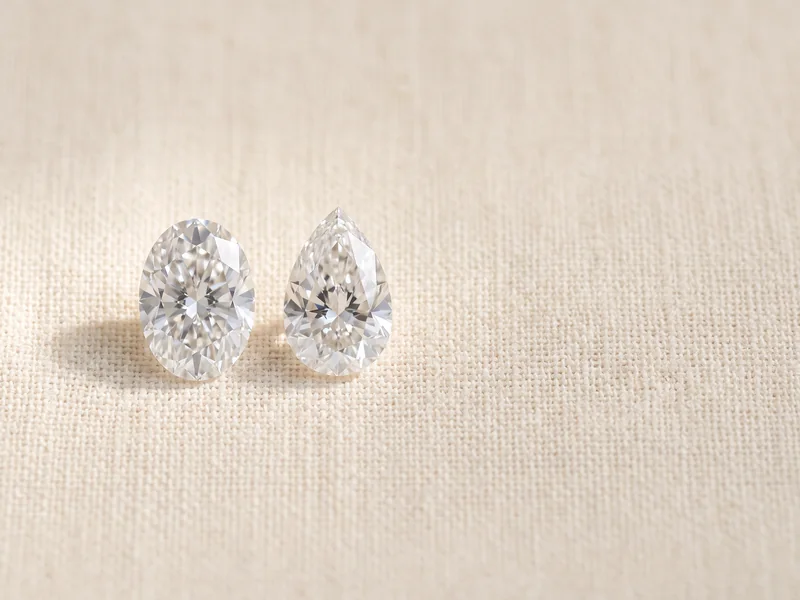
The difference is the outline. A marquise, also called a navette (French for 'little boat'), is pointed at both ends with gently curved sides, a bit like a rugby ball seen from above. A pear, or teardrop, has one rounded end and one point. In effect, a pear is half an oval joined to half a marquise, which is why it sits between the two in looks and in how easy it is to wear.
| Marquise | Pear | |
|---|---|---|
| Outline | Two points, curved sides | One rounded end, one point |
| Typical preferred ratio | 1.85–2.10 | 1.45–1.75 |
| Length of a 1 ct stone | about 10.8 mm | about 8.7 mm |
| Width of a 1 ct stone | about 5.4 mm | about 5.6 mm |
| Bow-tie | Common, often more noticeable | Common |
| Fragile points | Two | One |
| Symmetry | Mirrored lengthways and across | Mirrored lengthways only |
| Direction on the finger | Looks the same either way | Point usually towards the fingertip |
| Price per carat | Usually below a round | Usually below a round |
If you are still narrowing down shapes, our overview of how each diamond shape looks and wears is a good place to start. For the full detail on each shape on its own, see the complete marquise cut guide and the in-depth pear cut diamond guide. Any unfamiliar term on this page is explained in our A–Z jewellery glossary.
Marquise vs pear diamond: which looks better on the hand?
Both shapes make the finger look longer and slimmer, because they draw the eye along the length of the hand. The way they do it is quite different, and that is usually what decides it for people trying on a marquise or pear engagement ring.
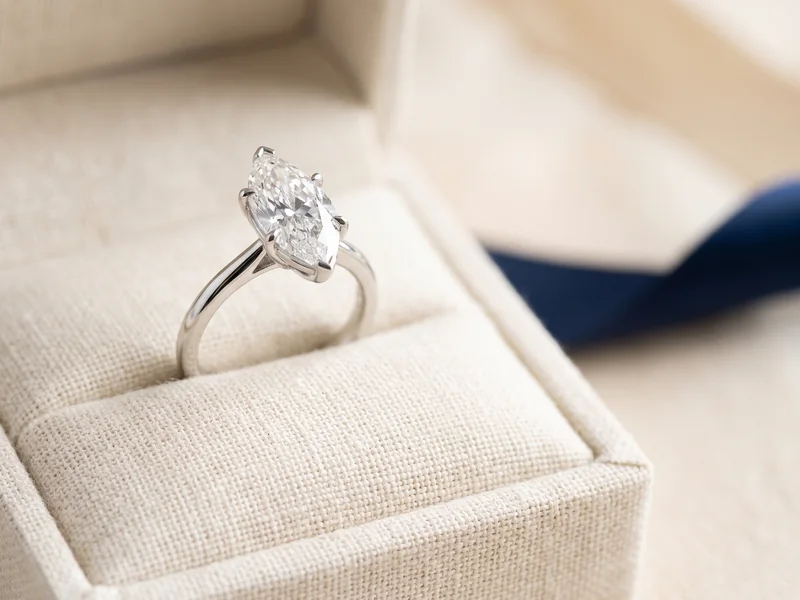
- Marquise: the longest outline per carat of the common shapes. It reads bold and graphic, and because it is mirrored end to end it looks the same whichever way it sits. It suits both vintage-style rings and very clean modern designs, and it can be set north–south (along the finger) or east–west (across it).
- Pear: softer, with a rounded end that sits at the base of the finger and a point that leads the eye towards the fingertip. That one-directional shape gives it a more relaxed, flowing look. Traditionally the point faces the fingertip, though some people wear it facing the wrist.
- Coverage: a 1 ct marquise covers more of the finger lengthways (about 10.8 mm against 8.7 mm), while a pear is a touch wider at its round end, so it fills the finger slightly more across.
On shorter fingers, a pear around 1.50–1.60 often looks balanced, while a long marquise can reach the knuckle once the claws are added. On long, slim fingers, a marquise at about 2.00 looks in proportion. On wider fingers, either shape works well if you choose a slightly longer ratio, because the extra length offsets the width.
If neither feels quite right, there are close relatives worth comparing. The moval softens the marquise's points, covered in our marquise vs moval comparison. If you like the pear but want no point at all, see the oval vs pear guide, side by side. And for a pear with a romantic twist, read how a heart compares with a pear.
Which looks bigger per carat, marquise or pear?
Of the two, the marquise usually looks bigger, mainly because it is longer. Both shapes spread more of their weight across the top than a round, so both face up larger (look larger from above) than a round of the same carat weight. The figures below are typical of well-proportioned stones at a marquise ratio of about 2.00 and a pear ratio of about 1.55.
| Carat weight | Marquise (length × width) | Pear (length × width) | Round (diameter) |
|---|---|---|---|
| 0.50 ct | about 8.6 × 4.3 mm | about 6.9 × 4.4 mm | about 5.1 mm |
| 0.75 ct | about 9.8 × 4.9 mm | about 7.9 × 5.1 mm | about 5.8 mm |
| 1.00 ct | about 10.8 × 5.4 mm | about 8.7 × 5.6 mm | about 6.4 mm |
| 1.50 ct | about 12.4 × 6.2 mm | about 10.0 × 6.4 mm | about 7.4 mm |
| 2.00 ct | about 13.6 × 6.8 mm | about 11.0 × 7.1 mm | about 8.1 mm |
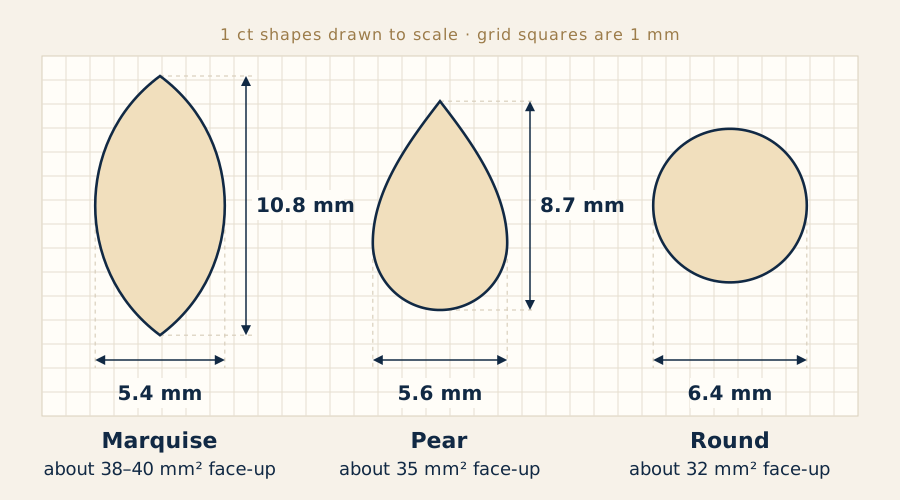
Length is not the whole story. Measured as the area you actually see from above, a 1 ct marquise covers roughly 38–40 mm² and a 1 ct pear roughly 35 mm², against about 32 mm² for a round. So the marquise looks bigger partly because it does cover a little more surface, and partly because the eye reads length as size. Depth matters too: a stone cut deep carries hidden weight underneath and looks smaller than its carat weight suggests, so always compare the millimetre measurements on the report, not just the carats.
Ratio changes the picture as well. A marquise at 2.10 looks longer and slimmer than one at 1.85 of the same weight, and a pear at 1.70 is very different from one at 1.45. Our guides to the marquise length-to-width ratio and the pear diamond ratio and how it changes the look show each range with examples.
Do marquise or pear diamonds sparkle more?
Well cut, both sparkle about as much as each other, because both use brilliant faceting. What differs is the bow-tie: a dark band across the middle of the stone where light leaks out instead of returning to your eye. Almost every elongated brilliant shows some bow-tie. A faint one that flickers as the stone moves adds contrast and is normal; a dark band that stays put in every position is a sign of poor proportions.
In a marquise the bow-tie runs across the narrow middle and is often more noticeable, because the stone is slim and the light has less room to return. In a pear it sits across the widest part, just below the rounded end. Photos rarely show it fairly, so watch a 360° video and keep your eye on the centre as the stone turns.
GIA does not give marquise or pear diamonds an overall cut grade the way it does for rounds, so you judge the cut from proportions and symmetry. As a rough guide, many well-cut stones sit at a total depth of about 58–62% for a marquise and 58–64% for a pear, with a table (the large flat top facet) of about 53–63% of the width. Treat these as starting points; how the stone looks matters more than any single number.
Symmetry matters more in these shapes than in rounds because any imbalance shows. In a marquise, both points should sit on one straight centre line and the two sides should curve evenly. In a pear, the shoulders (the curves either side of the rounded end) should match and the point should line up with the middle of the rounded end. Our step-by-step guides on checking marquise symmetry by eye and spotting uneven shoulders on a pear walk through each check.
Not sure which one is right?
Send us the stones you are looking at and our gemologist will tell you which to choose and why.
Is a marquise or pear diamond more likely to chip?
Diamond is the hardest natural material, 10 on the Mohs scale, with a refractive index of about 2.42. Hardness is resistance to scratching, though, not to knocks. Diamond can still chip along its cleavage planes if a thin edge takes a hard hit, and the thinnest parts of both shapes are their points.
On marquise vs pear durability, the pear has the edge simply because it has one point rather than two. Its rounded end is as tough as the edge of an oval or round. A marquise has two fine points, and when set north–south they sit at the most exposed ends of the ring, where they meet doorframes, bench tops and bag zips first. Inclusions (internal features) or a very thin girdle near a point add to the risk.
The fix for both is the setting. A V-claw (a V-shaped claw that wraps the point) or a bezel (a thin rim of metal around the edge) protects the tip. With that in place, both shapes are fine for everyday wear. See our guides on how to protect both marquise points and keeping a pear's point safe.
Which settings suit marquise and pear diamonds?
The setting's first job is to protect the points; its second is to show the outline. These are the usual choices:
- Marquise, six claws: a V-claw at each point plus two claws along each side, or four plain claws on the sides with the points covered by V-claws.
- Pear, five claws: one V-claw at the point and two claws on each side of the rounded end. Three claws is possible but leaves the shoulders more exposed.
- Bezel or half-bezel: very secure for both, and a good choice for active hands, though it hides a little of the outline.
- Halo: small diamonds around the centre stone make it look larger and shield the edge.
- East–west: setting the stone across the finger. It suits a marquise well and keeps the points away from the ends of the ring.
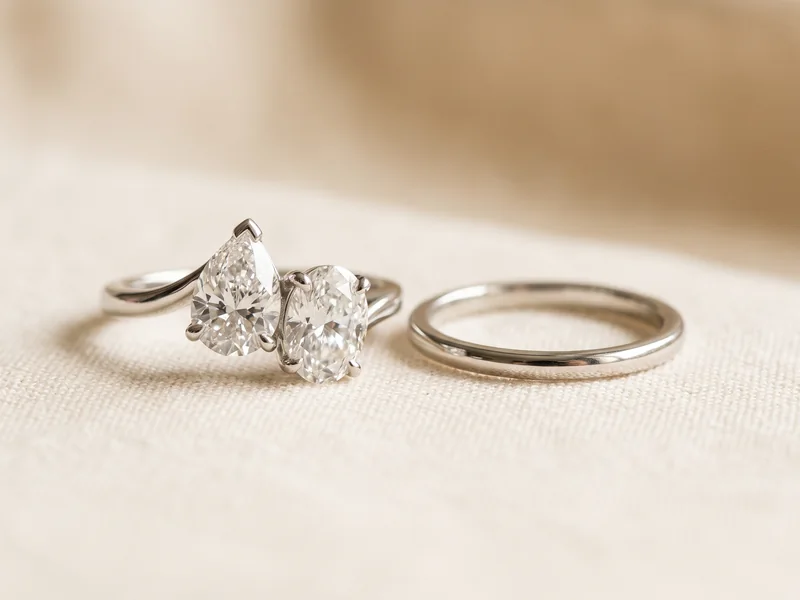
- Toi et moi: a two-stone ring. A marquise and a pear side by side is a popular pairing.
For side stones, pears can also be used as small accents either side of a centre diamond; our guide to trilliant vs pear side stones compares the two. For detailed examples, see setting styles that suit a marquise and claw, bezel and halo options for a pear. Both shapes often need a contoured or slightly curved wedding band, because the points can stop a straight band sitting flush.
Related guideHeart vs Pear Shaped DiamondsWhat colour and clarity should you choose for a marquise or pear?
Elongated shapes show body colour more than rounds, and the warmth tends to collect where the stone is thinnest: at the point of a pear and at both points of a marquise. Because a marquise has two ends, a faint tint can be a little easier to notice. In white gold or platinum, most people are happy from H colour or better, or G if you are sensitive to warmth. In yellow or rose gold, I or J can look just as white, because the metal warms everything around it.
For clarity, aim for an eye-clean stone, meaning no inclusions you can see without magnification at normal viewing distance. In both shapes that usually means VS2 or a carefully chosen SI1. Brilliant faceting hides small inclusions well, except near the points, where an inclusion is easier to see and, if it reaches the surface, can weaken the tip.
- White metal: G–H colour, VS2–SI1 eye-clean.
- Yellow or rose gold: I–J colour can look white, VS2–SI1 eye-clean.
- Avoid: feathers (small internal cracks) close to any point.
Marquise vs pear diamond price: which costs more in Australia?
Both shapes usually cost noticeably less per carat than a round of the same weight, colour and clarity, partly because demand is lower and partly because more of the rough crystal can be kept. Between the two, prices are close. What moves the price most within each shape is carat, colour, clarity and how well the outline and symmetry are cut, rather than the shape itself.
Both shapes are cut from natural and laboratory-grown diamond, and the two look identical to the eye. Lab-grown diamonds are real diamond, grown in a laboratory rather than mined; they cost much less and are easy to find in larger sizes. Natural diamonds are rarer. Either way, ask for an independent grading report from a lab such as GIA or IGI, which will state whether the stone is natural or lab-grown.
| 1 ct, G–H, VS | Marquise (approx. AUD) | Pear (approx. AUD) |
|---|---|---|
| Lab-grown | about $800–$2,500 | about $800–$2,500 |
| Natural | about $6,000–$14,000 | about $6,000–$14,000 |
These are broad ranges only; prices move with the market and with the exact grades. A well-matched, crisply cut stone with even symmetry will sit towards the top of its range, and a stone with a heavy bow-tie or uneven sides towards the bottom.
Browse marquise and pear diamonds: natural and lab-grown
Who suits a marquise, and who suits a pear?
- Choose a marquise if you want the most length and finger coverage for the weight, a bold outline, a vintage or east–west look, and you are happy to protect two points.
- Choose a pear if you want a softer look, a shape that is a little easier to protect, a stone that also suits pendants and drop earrings, or a slightly shorter outline for shorter fingers.
- Either works if you want a stone that looks larger than a round of the same weight and costs less per carat.
Hands that do a lot of physical work, such as gardening, nursing or the gym, often do better with a pear in a bezel or a marquise set east–west, because the points are less exposed. If you work mostly at a desk, either shape in a claw setting is practical.
How do you choose between a marquise and a pear? Step by step
- Try both shapes on. Same carat weight if possible, and look at them from arm's length, not just up close.
- Read the report. Confirm the shape, measurements, colour, clarity, girdle, polish and symmetry, and whether the diamond is natural or lab-grown.
- Work out the ratio. Divide length by width: about 1.85–2.10 for a marquise, 1.45–1.75 for a pear.
- Check symmetry by eye. Marquise points on one centre line; pear shoulders even and the point centred.
- Watch a 360° video. Look for a bow-tie that stays dark and for inclusions near the points.
- Compare face-up size. Use the millimetre measurements, not just the carat weight.
- Plan the setting. Make sure every point has a V-claw, bezel or halo before you commit to the stone.
Free consultation
Talk to a gemologist
Compare stones in person or online with Raj Sood, Graduate Gemologist (GIA), AJP (GIA).
Book a consultationFAQ
Common questions
Which looks bigger, a marquise or a pear diamond?
At the same carat weight, a marquise usually looks bigger because it is longer, about 10.8 mm against 8.7 mm at 1 ct. Its face-up area is also a little larger, and both look larger than a round of the same weight.
Is a marquise or a pear diamond more durable?
The pear, slightly, because it has one point instead of two. Both are durable for everyday wear once each point is protected by a V-claw, bezel or halo.
Which way should a pear diamond face on the finger?
Traditionally the point faces the fingertip, which lengthens the look of the finger. Some people prefer it facing the wrist; it is a personal choice.
Are marquise and pear diamonds cheaper than round diamonds?
Usually, yes. Both typically cost noticeably less per carat than a round of the same weight, colour and clarity, and prices between marquise and pear are close.
Do marquise and pear diamonds always have a bow-tie?
Most elongated brilliants show some bow-tie. A faint one that moves as the stone turns is normal; a dark band that stays in every position points to poor proportions.
Can you get lab-grown marquise and pear diamonds?
Yes. Lab-grown marquise and pear diamonds are widely available, cost much less than natural stones and are real diamond, graded by labs such as IGI on the same colour and clarity scales.

Ask a gemologist
Not sure which diamond to choose?
Raj Sood is a Graduate Gemologist (GIA) and master jeweller. Bring the stones you are considering, or send the reports, and he will tell you honestly which one is better and why.
Keep learning
Related guides
 Diamond ShapesMarquise Cut Diamonds Melbourne
 Diamond ShapesPear Cut Diamonds
 Engagement Rings & SettingsBest Settings for Marquise Diamonds
 Engagement Rings & SettingsBest Settings for Pear DiamondsDiamond ShapesUnderstanding Diamond Shapes
 Diamond ShapesMarquise Diamond Length-to-Width RatioDiamond ShapesProtecting Marquise Diamond PointsDiamond ShapesProtecting the Point of a Pear Diamond
Explore more
More guides on this topic
Education