
- Education
- Diamond Shapes
- Pear Diamond Ratio Guide: Finding the Right Length-to-Width
Diamond shapes
Pear Diamond Ratio Guide: Finding the Right Length-to-Width
The pear diamond ratio decides whether a teardrop looks short and full, classically balanced or long and slender. Getting it right for your taste and hand matters more in a pear than in almost any other shape.
 Reviewed by Raj Sood, Graduate Gemologist (GIA), AJP (GIA)Master jeweller and Graduate Gemologist (GIA) · reviewed 4 November 2026
Quick answer
The pear diamond ratio is the stone's length divided by its width, read from the grading report. Most people prefer about 1.45–1.75, with 1.50–1.65 the classic balanced teardrop. Below 1.40 a pear looks short and wide; above 1.75 it turns slim and marquise-like. Ratio is taste, so check symmetry, shoulders and bow-tie too.
What is the length-to-width ratio of a pear diamond?
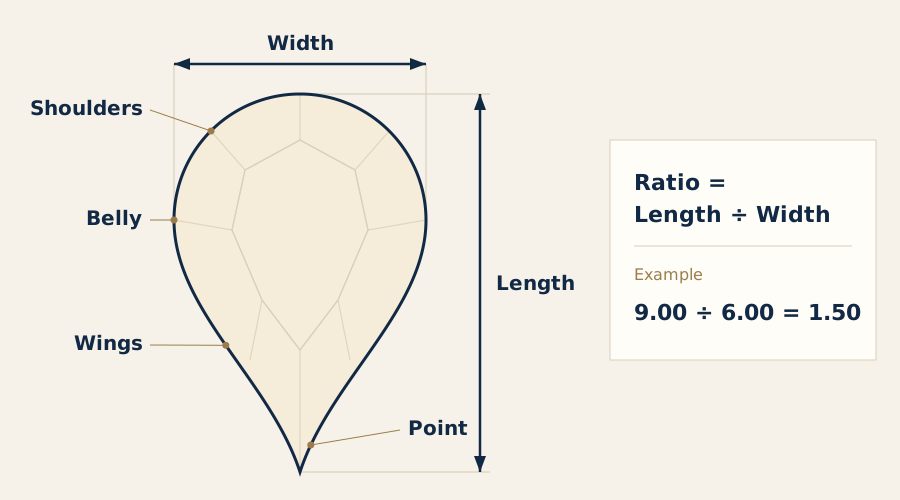
The length-to-width ratio tells you how elongated a diamond is. For a pear, the length runs from the tip of the point to the far edge of the rounded end, and the width is measured across the widest part of the rounded end, at right angles to the length. Grading reports from labs such as GIA and IGI list a fancy shape's measurements as length × width × depth in millimetres, so you can work the ratio out yourself: divide the first number by the second.
Take a pear measuring 9.00 × 6.00 × 3.70 mm. Divide 9.00 by 6.00 and you get a ratio of 1.50, meaning the stone is one and a half times as long as it is wide. A ratio of 1.00 would be as wide as it is long, which is impossible for a true teardrop. If you want the general idea behind ratios before going further, our explainer on how length-to-width ratio works across every shape covers rounds, fancies and step cuts.
A pear is a modified brilliant cut: it uses triangular and kite-shaped facets, usually around 56–58 of them, arranged in a teardrop outline. It belongs to the family of elongated diamond cuts, alongside the oval and marquise. Diamond's refractive index of about 2.42 and its hardness of 10 on the Mohs scale give the pear strong sparkle and scratch resistance, but the point is thin and can chip if knocked, which comes up again in the setting section. For the full picture on the shape itself, from history to colour and clarity, see our complete pear cut diamond guide. Any unfamiliar word on this page is explained among the diamond and jewellery terms in our glossary.
What is the ideal pear diamond ratio?
There is no single ideal pear diamond ratio, because GIA does not give pear shapes an overall cut grade the way it does for round brilliants. Ratio is a matter of taste. That said, most pears sold for engagement rings fall between about 1.45 and 1.75, and the outline changes in a predictable way across that range.
| Ratio | How the pear looks | Commonly chosen for |
|---|---|---|
| Below 1.40 | Short and wide, rounded end dominates | Rarely chosen; can look stubby or like a fat heart without a cleft |
| 1.40–1.50 | Full and soft, a generous teardrop | Wider fingers, halo settings, people who like a rounder look |
| 1.50–1.65 | Balanced classic teardrop | Most solitaire engagement rings |
| 1.65–1.75 | Slender and elegant, longer point | Longer fingers, a more elongating effect on the hand |
| Above 1.75 | Very slim, close to a marquise or a drop | Pendants and drop earrings; a personal preference in rings |
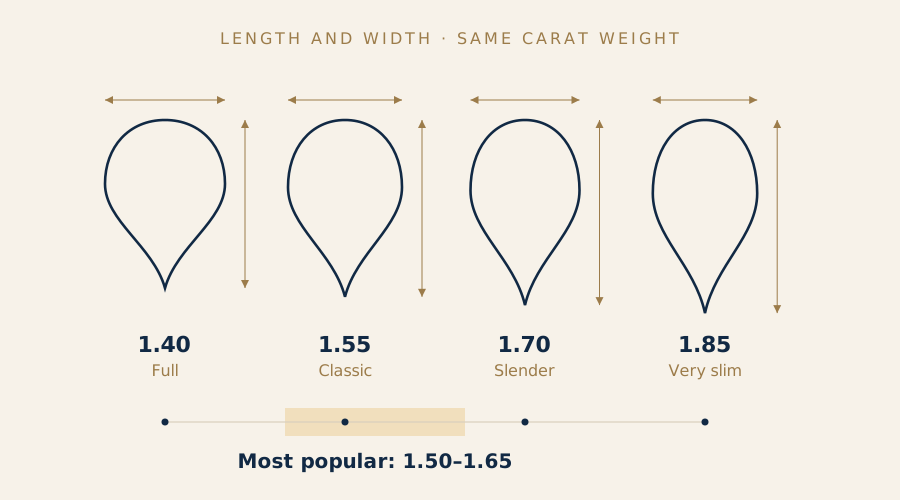
Once a pear passes about 1.80, the rounded end narrows so much that the stone starts to read as a marquise with one end softened. If you are drawn to that very long look, it is worth reading about when a slim pear starts to resemble a marquise so you know which shape you actually prefer.
How does the pear diamond ratio change face-up size?
Two pears of the same carat weight can look quite different on the hand. A higher ratio stretches the same weight into a longer outline, so the stone looks bigger from end to end, while the width across the finger shrinks slightly. The table shows rough figures for a 1 carat pear with similar depth at different ratios.
| 1 ct pear ratio | Approximate size (length × width) | Effect on the hand |
|---|---|---|
| 1.40 | about 8.0 × 5.7 mm | Wider across the finger, shorter |
| 1.50 | about 8.4 × 5.6 mm | Balanced |
| 1.60 | about 8.8 × 5.5 mm | Noticeably longer, a little narrower |
| 1.70 | about 9.2 × 5.4 mm | Long and slim |
| 1.80 | about 9.5 × 5.3 mm | Very elongated, close to a drop |
Depth changes the picture too. A pear with a total depth well above about 64% carries weight underneath, where you cannot see it, so it faces up smaller than its carat weight suggests. A very shallow pear spreads wider but can look glassy or watery in the centre. Many well-cut pears sit at a total depth of about 58–64% and a table (the large flat top facet) of about 53–63%.
Here is a pear diamond size chart by carat, using a typical ratio of about 1.55. For comparison, a 1 carat round brilliant measures about 6.4 mm across, so an elongated pear of the same weight looks considerably longer on the finger. Our comparison of which diamond shapes look largest for their weight puts the pear beside the other shapes.
| Carat weight | Typical size at about 1.55 ratio |
|---|---|
| 0.50 ct | about 6.9 × 4.5 mm |
| 0.75 ct | about 7.8 × 5.0 mm |
| 1.00 ct | about 8.6 × 5.5 mm |
| 1.50 ct | about 9.8 × 6.3 mm |
| 2.00 ct | about 10.8 × 7.0 mm |
| 3.00 ct | about 12.4 × 8.0 mm |
Which pear shaped diamond ratio suits your hand?
An elongated diamond pointing along the finger draws the eye lengthways, which is why pears are known for making fingers look longer and slimmer. How strongly that happens depends on the ratio. A few rules of thumb from the counter:
- Shorter or slimmer fingers: about 1.50–1.60 keeps the stone in proportion without the point reaching too far along the finger.
- Longer fingers: 1.60–1.75 carries well and makes the most of the elongating effect.
- Wider fingers: a fuller 1.45–1.55 pear covers more of the finger's width, so it does not look lost.
- Halo settings: a halo adds width all round, so many people choose a slightly slimmer stone, about 1.55–1.70, to keep the finished outline elegant.
- Pendants and drop earrings: slim pears of 1.65–1.80 hang naturally and look graceful in motion.
Try the outline before you choose. A printed paper template at the real millimetre size, held on the finger, tells you more than any photo. If you are leaning towards a slender stone, look at ring styles that suit a slender pear, because the setting changes how long the finished ring reads.
Not sure which one is right?
Send us the stones you are looking at and our gemologist will tell you which to choose and why.
What matters besides ratio: shoulders, wings and the pear diamond bow-tie?
Two pears with the same ratio can look completely different. The ratio only tells you the overall proportion; the shape of the curves decides whether the stone looks graceful or awkward. Look at these parts:
- Shoulders: the upper curves where the rounded end meets the sides. Too flat and the stone looks squared off; too high and it looks bulbous.
- Wings: the sides curving down to the point. Gentle, even curves are the aim. Wings that bulge make a fat pear; wings that are too straight make it look like a triangle with a round top.
- Belly: the wide middle of the stone. A pear with low, heavy shoulders and a pinched belly looks off balance.
- Point: sitting exactly in line with the centre of the rounded end, so the stone does not lean to one side.
Most pears also show a bow-tie: a darker band across the middle where light leaks out instead of returning to your eye. A soft bow-tie that comes and goes as the stone moves is normal and gives contrast. A heavy black band that stays dark in every position points to poor proportions. Ratio plays a part here: very slim and very wide pears are more prone to a strong bow-tie than stones in the middle of the range. Our page on cut quality and proportions in pear diamonds goes into the facet side of this.
Related guideHeart vs Pear Shaped DiamondsHow does the pear diamond ratio compare with oval, marquise and heart?
Every elongated shape has its own preferred ratio range, so a number that is right for one shape can look wrong for another. This comparison puts the main ranges side by side.
| Shape | Typical preferred ratio | Outline | Fragile points |
|---|---|---|---|
| Heart | 0.90–1.10 | Two lobes, cleft and a point | One, plus the cleft |
| Elongated radiant | 1.20–1.35 | Rectangle with cut corners | None |
| Oval | 1.30–1.50 | Smooth elongated curve | None |
| Pear | 1.45–1.75 | One rounded end, one point | One |
| Marquise | 1.85–2.10 | Two points | Two |
Pears and ovals overlap in ratio, which is why people often compare them; see oval vs pear compared side by side if you are torn between a soft outline and a point, and our oval diamond guide for the oval on its own. At the slim end, the pear borders on the marquise, and our marquise and pear differences page explains the trade-off of one point against two; the marquise cut explained covers that shape in full. At the other extreme, how a pear differs from a heart shows what happens when the rounded end splits into two lobes.
Step-cut and square-ish shapes work differently again: the ratio ranges for radiant cuts run from square to rectangular rather than from full to slender. To see all of these shapes together, start with our guide to every diamond shape.
Does ratio change the best setting for a pear diamond?
Yes, a little. The slimmer the pear, the sharper the angle at the point, and a sharper point is thinner and more exposed to knocks. A fuller pear has a broader, slightly sturdier tip. Whatever the ratio, the setting's first job is to protect that point.
- Five claws with a V-claw: one V-shaped claw wraps the point and four claws hold the rounded end. The most common pear solitaire setting.
- Bezel or half-bezel: a rim of metal around the edge. Very secure, especially for slim pears over about 1.70.
- Halo: small diamonds around the pear add width and shield the edge, which can balance a very slender stone.
- East-west: the pear set sideways across the finger. A fuller ratio around 1.45–1.55 usually suits this best, so it does not overhang the finger.
There is more on each style in our roundup of pear engagement ring setting options, and practical detail on claws, bezels and wear in how to protect the point of a pear diamond. Point direction is a personal choice: most people wear the point towards the fingertip, which lengthens the hand.
Does ratio affect pear diamond price in Australia, natural or lab-grown?
Ratio on its own has a fairly small effect on price. Carat, colour, clarity and the overall quality of the outline move the price far more. Pears in the popular 1.50–1.65 range with well-shaped shoulders and a mild bow-tie are the most sought after, so they can cost a little more than a stubby or very slim pear with the same grades. Pears generally cost less per carat than rounds of the same weight and grades, because demand is lower and cutters can keep more of the rough crystal.
Pears are cut from both natural and laboratory-grown diamond. A lab-grown pear diamond is real diamond, with the same hardness and refractive index, grown in a laboratory rather than mined. It costs much less than a natural stone and is easy to find in larger sizes. Natural pears are rarer. Both should come with an independent grading report that states clearly whether the diamond is natural or lab-grown.
| 1 ct pear, G–H, VS | Approximate price range (AUD) |
|---|---|
| Lab-grown | about $900–$2,500 |
| Natural | about $6,000–$14,000 |
These are broad ranges only; prices move with the market and with the exact grades. If you are weighing a pear against other shapes on budget, our page on how price per carat differs between diamond shapes sets out the general pattern.
Browse pear diamonds: natural and lab-grown
How do you check a pear diamond ratio before you buy? Step by step
- Read the report. Note the measurements (length × width × depth), colour, clarity, polish and symmetry, and whether the stone is natural or lab-grown.
- Work out the ratio. Divide the length by the width. Most people are happy between about 1.45 and 1.75.
- Check the face-up size. Compare millimetre measurements, not just carat weight, and make sure the total depth is not far above about 64%.
- Judge the outline by eye. Even shoulders, gently curved wings and a point centred on the rounded end.
- Watch a 360° video. Look for a bow-tie that stays dark in every position and for inclusions near the point.
- Try it on your hand. Use a paper template at the real size to see how the ratio suits your finger.
- Plan the setting. Choose a V-claw, bezel or halo for keeping the slender tip safe before committing to the stone.
Free consultation
Talk to a gemologist
Compare stones in person or online with Raj Sood, Graduate Gemologist (GIA), AJP (GIA).
Book a consultationFAQ
Common questions
What is the ideal pear diamond ratio?
Most people prefer a length-to-width ratio between about 1.45 and 1.75, with 1.50–1.65 seen as the classic balanced teardrop. The right figure depends on your taste and your hand.
How do you calculate a pear shaped diamond ratio?
Divide the length by the width from the grading report. A pear measuring 8.6 × 5.5 mm has a ratio of about 1.56.
Does a higher ratio make a pear diamond look bigger?
A higher ratio makes the same carat weight look longer from end to end, which many people read as larger, though the stone becomes slightly narrower across the finger. Depth matters too, because a very deep pear faces up smaller.
What size is a 1 carat pear diamond in mm?
At a typical ratio of about 1.55, a 1 carat pear measures roughly 8.6 × 5.5 mm. A slimmer 1.70 ratio stone is closer to 9.2 × 5.4 mm.
Do all pear diamonds have a bow-tie?
Most show some bow-tie, a darker band across the middle. A soft one that shifts as the stone moves is normal; a heavy band that stays dark suggests poor proportions.
Is a lab-grown pear diamond the same shape and ratio as a natural one?
Yes. Lab-grown pears are real diamond and are cut and measured the same way, so the same ratio guidance applies. They cost much less than natural pears, and the report will state that the stone is lab-grown.

Ask a gemologist
Not sure which diamond to choose?
Raj Sood is a Graduate Gemologist (GIA) and master jeweller. Bring the stones you are considering, or send the reports, and he will tell you honestly which one is better and why.
Keep learning
Related guides
 Diamond ShapesPear Cut Diamonds
 Diamond Anatomy & LightDiamond Length to Width Ratio Guide
 Diamond ShapesOval vs Pear DiamondsEngagement Rings & SettingsBest Settings for Pear DiamondsDiamond ShapesUnderstanding Diamond Shapes
 Diamond ShapesMarquise vs Pear DiamondsDiamond ShapesProtecting the Point of a Pear Diamond
 Diamond ShapesHeart vs Pear Shaped Diamonds
Explore more
More guides on this topic
Education