
- Education
- Diamond Shapes
- Oval vs Pear Diamond: How the Two Shapes Compare on the Hand
Diamond shapes
Oval vs Pear Diamond: How the Two Shapes Compare on the Hand
An oval vs pear diamond is one of the closest choices in the shape family. Both are long, both carry their weight well, and they differ at one end. That one end changes durability, setting and the look on your hand.
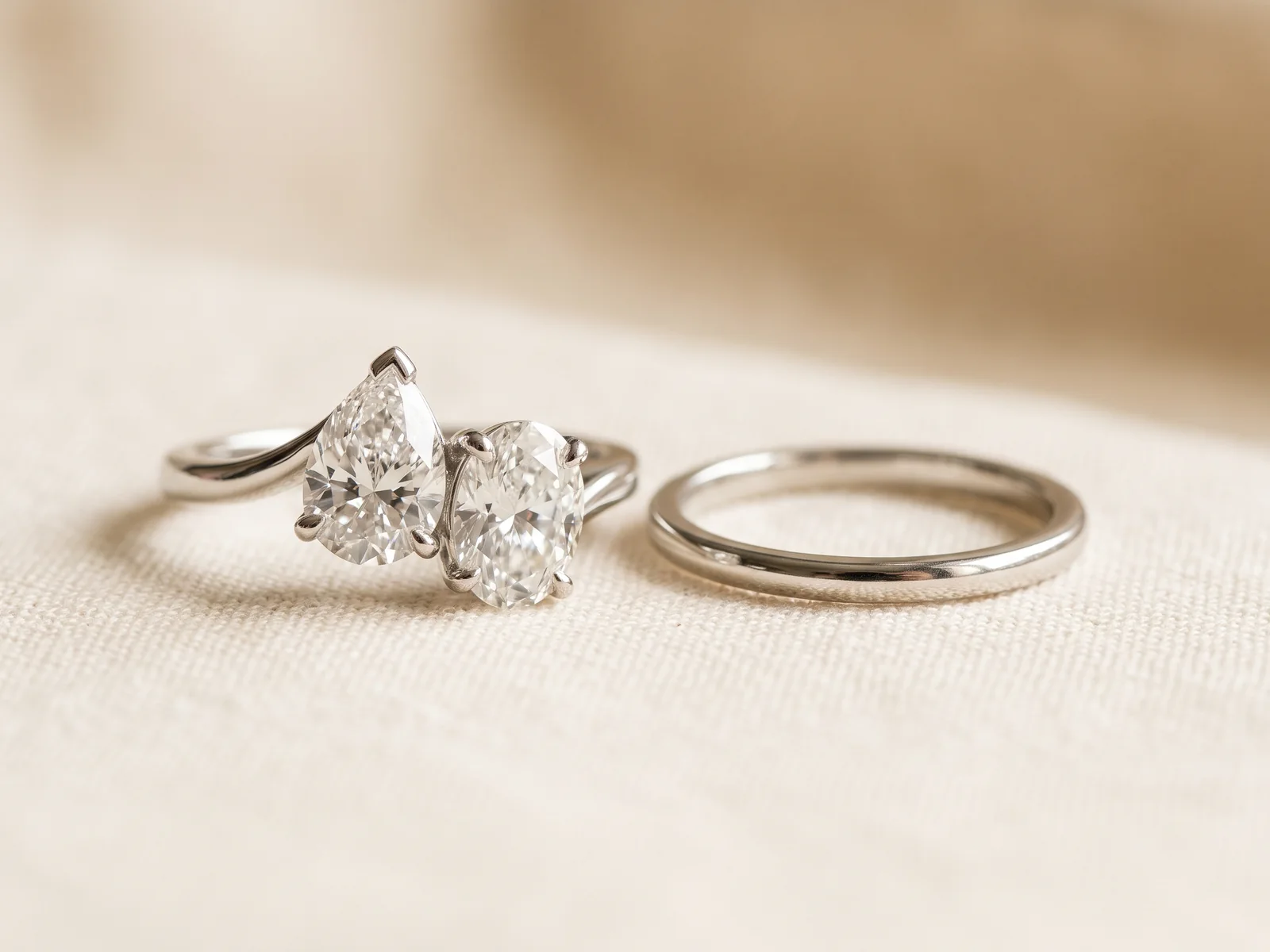
 Reviewed by Raj Sood, Graduate Gemologist (GIA), AJP (GIA)Master jeweller and Graduate Gemologist (GIA) · reviewed 4 November 2026
Quick answer
An oval and a pear face up at similar sizes for their weight, but differ at the ends. An oval is a smooth symmetrical ellipse with no point, so it is tougher and simpler to set. A pear has one rounded end and a point, adding direction, but needs a V-claw or bezel. Both cost less than a round.
What is the difference between an oval vs pear diamond?
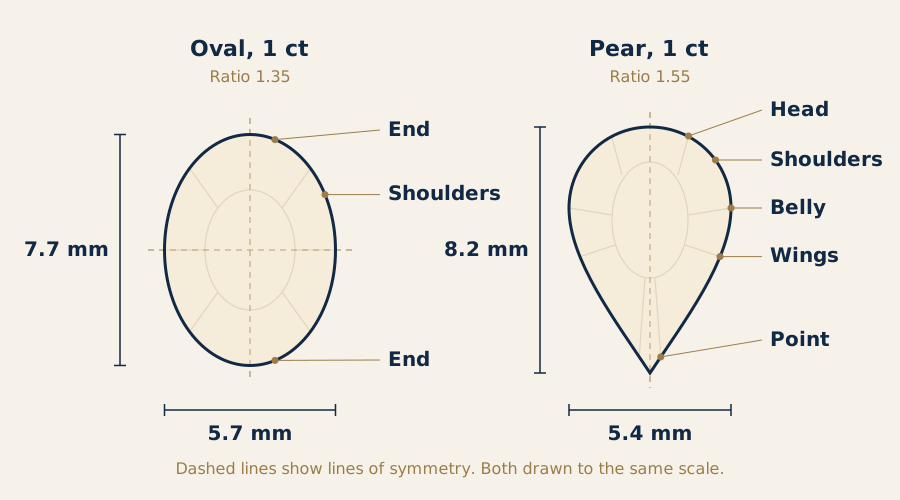
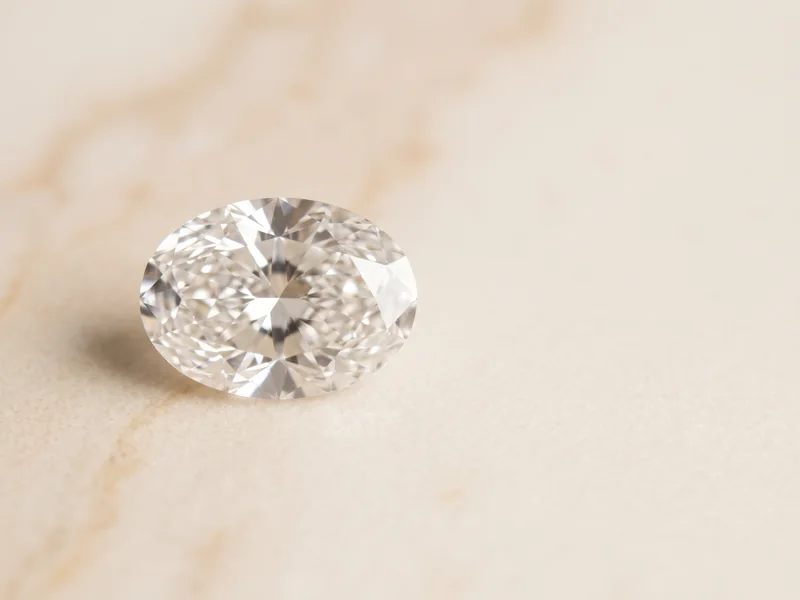
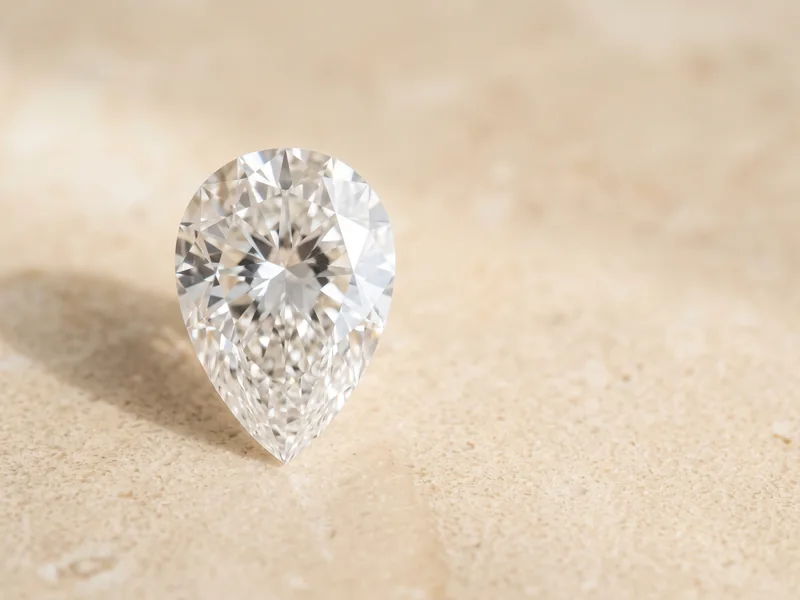
An oval and a pear are both modified brilliant cuts. That means they use the same triangular and kite-shaped facets as a round brilliant, rearranged around an elongated outline instead of a circle. Most of each have between 56 and 58 facets. The real difference is at the ends. An oval is an ellipse: rounded and identical at both ends, mirrored both lengthways and across. A pear (often called a teardrop) has one rounded end, called the head, and one end that tapers to a point, so it is mirrored lengthways only. For each shape on its own, see our complete guide to oval diamonds and the pear cut diamond guide.
Both are the same material. Diamond is 10 on the Mohs scale of hardness, with a refractive index of about 2.42, which is what gives brilliant cuts their strong sparkle. So scratch resistance and brightness potential are the same. What changes is where the light pattern sits in the outline, how exposed the edges are, and how the stone points on your finger. To see where both sit among all the cuts, start with our overview of every diamond shape, and any unfamiliar term is explained in the GemTrove jewellery glossary.
| Oval | Pear | |
|---|---|---|
| Outline | Smooth ellipse, both ends rounded | Rounded head, tapering point |
| Typical ratio | 1.30–1.50 | 1.45–1.75 |
| Fragile points | None | One (the point) |
| Lines of symmetry | Two (lengthways and across) | One (lengthways) |
| Bow-tie | Common, across the centre | Common, across the widest part |
| Usual setting | Four or six claws, bezel or halo | Five claws with a V-claw, bezel or halo |
| 1 ct face-up size | about 7.7 × 5.7 mm | about 8.2 × 5.4 mm |
| Wedding band | A straight band often sits close | Often needs a contoured band |
| Price per carat | Below a round | Below a round |
How do oval and pear diamonds look on the hand?
Both shapes are elongated, so both make fingers look longer and slimmer than a round of the same weight. The character is different, though. An oval reads calm and balanced: your eye travels evenly along it and there is no front or back. A pear has direction. The point draws the eye one way, which gives the ring movement and a slightly more romantic, vintage feel.
Most people wear both north-south, along the finger. An oval can also be set east-west, across the finger, for a modern look. A pear is usually worn with the point towards the fingertip, which lengthens the finger most; worn point towards the wrist it looks softer and less expected. Neither is wrong, and it is worth trying both ways on before you settle.
The length-to-width ratio (length divided by width, both taken from the grading report) changes the look of each shape more than anything else. The same ratio does not suit both: a 1.35 oval is classic, while a 1.35 pear looks short and wide.
| Ratio | Oval | Pear |
|---|---|---|
| Below 1.30 | Plump, close to round | Short and wide; the point looks stubby |
| 1.30–1.50 | Classic oval, the most chosen range | Full, soft pear |
| 1.50–1.70 | Long and slim, can look narrow | Classic teardrop, the most chosen range |
| Above 1.70 | Very slim, edging towards a marquise feel | Long and dramatic |
Our guides to the ideal oval ratio for your hand and the pear ratio guide with examples go into each shape in detail. With ovals, the curve near the ends matters as much as the ratio: compare rounded and boxy oval shoulders to see why two ovals of the same ratio can look quite different.
Which looks bigger per carat, an oval or a pear diamond?
Carat is weight, not size. What you see on the hand is the face-up size: the outline and area visible from above. Oval and pear diamonds of the same weight spread across a broadly similar area. The pear is usually about half a millimetre longer and a few tenths narrower, because it tapers to the point and is cut to a higher ratio.
| Carat weight | Oval (about 1.35 ratio) | Pear (about 1.55 ratio) |
|---|---|---|
| 0.50 ct | about 6.0 × 4.5 mm | about 6.6 × 4.3 mm |
| 0.75 ct | about 7.0 × 5.0 mm | about 7.6 × 4.9 mm |
| 1.00 ct | about 7.7 × 5.7 mm | about 8.2 × 5.4 mm |
| 1.50 ct | about 8.8 × 6.5 mm | about 9.4 × 6.1 mm |
| 2.00 ct | about 9.7 × 7.2 mm | about 10.4 × 6.8 mm |
These are typical figures, and real stones vary. A stone cut deep carries extra weight in its pavilion (the lower half), so it looks smaller face-up than its carat suggests; a shallow stone spreads wider but can lose brightness. Ovals are especially prone to this, and our page on how deep ovals hide their carat weight shows how to spot it from the report. Thick girdles (the outer edge where the top and bottom meet) hide weight in both shapes.
Both shapes face up larger than a round of the same weight. A 1 carat round is about 6.4 mm across, while a 1 carat oval or pear measures close to 8 mm in length. Our oval and round comparison sets that difference out in full. When you compare stones, always compare the millimetre measurements, not just the carat figure.
Do oval or pear diamonds sparkle more?
Cut well, the two sparkle in much the same way: both are brilliant cuts and both return plenty of white light (brilliance) and flashes of colour (fire). Neither has an overall GIA cut grade the way a round does, so you judge the cut from the proportions, the polish and symmetry grades, and above all from how the stone looks in a video or in person.
Both shapes can show a bow-tie: a dark band where light leaks out the bottom instead of returning to your eye. In an oval it runs across the centre; in a pear it sits across the widest part, just below the head. A faint bow-tie that shifts as the stone moves adds contrast and is normal. A solid dark band that stays in every position points to poor proportions. As a rough guide, many well-cut ovals and pears sit at a total depth of about 56–64% and a table (the large top facet) of about 53–63%, but appearance matters more than any one number.
Colour and clarity behave slightly differently. Elongated shapes show body colour at the ends, and a pear concentrates warmth in its point, where facets crowd together. In white gold or platinum, most people are happy from G–H colour; in yellow or rose gold, I–J can look just as white. For clarity, aim for eye-clean, meaning no inclusions you can see without magnification, which in both shapes usually means VS2 or a carefully chosen SI1.
- Oval checks: even ends, matching shoulders on both sides, a bow-tie that is light and mobile.
- Pear checks: a centred point, even shoulders and wings, a nicely rounded head that is not flat or pinched.
- Both: no feathers (small internal cracks) near the edge, and especially none at a pear's point.
Pear symmetry is harder to get right because there is only one line of symmetry to work with, and a point that drifts even slightly makes the whole stone look like it leans. Our guide on judging pear symmetry by eye walks through each check.
Not sure which one is right?
Send us the stones you are looking at and our gemologist will tell you which to choose and why.
Is a pear diamond more fragile than an oval?
Yes, a little, and only at one spot. Hardness is not the same as toughness. Diamond resists scratching better than anything, but it can still chip along its cleavage planes (directions in the crystal where it splits more easily) if a thin edge takes a hard knock. An oval has no thin edges to speak of: its girdle curves smoothly all the way round, which is why ovals suit people who work with their hands, play sport or garden.
A pear's point is the thinnest part of the stone. Left exposed, it is the part most likely to catch on a doorframe or a bench top and chip. The fix is simple: cover it with metal. A V-claw (a V-shaped claw that wraps the point), a bezel or a halo takes the knock instead of the diamond. Set this way, a pear is perfectly fine for everyday wear. Our guide to keeping a pear's point safe covers the options in detail.
Ovals are not knock-proof either. A very thin girdle on any diamond is more prone to chipping, so check the report: girdle descriptions from thin to slightly thick are what you want, and very thin or extremely thick are worth avoiding in both shapes.
What are the best settings for oval vs pear engagement rings?
The shape decides the setting more for a pear than for an oval. The usual options:
- Oval, four claws: one at each corner of the shoulders; open and simple, showing the most diamond.
- Oval, six claws: extra security, and the outline looks a little rounder.
- Pear, five claws: two at the head, two at the shoulders and a V-claw at the point; the standard for a pear solitaire.
- Pear, three claws: two at the head and a V-claw; lighter looking, best for careful wearers.
- Bezel or half-bezel: a thin rim of metal round the edge; very secure for either shape and especially good at protecting a pear's point.
- Halo: small diamonds framing the centre stone make both shapes look larger and shield the edge.
See our pear setting styles side by side and the gallery of oval engagement ring designs for examples of each.
Think about the wedding band early. A low-set oval often sits close to a straight band. A pear's wide head and pointed tip usually leave a gap against a straight band, so many people pair a pear with a contoured band that curves around it, or accept a small gap as part of the look.
Oval vs pear diamond price: which costs more?
Oval and pear diamonds usually cost less per carat than a round of the same weight, colour and clarity, partly because more of the rough crystal can be kept when cutting elongated shapes. Between the two, prices per carat are broadly similar. Ovals have been in strong demand in recent years, so a well-cut oval can sit a little higher than a comparable pear, but the grades and the quality of the outline move the price far more than the shape does.
Both shapes are cut from natural and laboratory-grown diamond, and the two look identical to the eye. Lab-grown diamonds are real diamond, grown in a laboratory rather than mined, with the same hardness and refractive index; they cost much less and are easier to find in larger sizes. Natural diamonds are rarer. Either way, ask for an independent grading report from a lab such as GIA or IGI, which states whether the stone is natural or lab-grown.
| 1 ct, G–H colour, VS clarity | Oval (approx. AUD) | Pear (approx. AUD) |
|---|---|---|
| Lab-grown | about $1,000–$3,000 | about $1,000–$3,000 |
| Natural | about $7,000–$16,000 | about $6,500–$15,000 |
These are broad ranges only. Prices move with the market, and a stone with a crisp outline, a light bow-tie and strong symmetry will sit at the upper end.
Shop oval and pear diamonds: natural and lab-grown
Should you choose an oval or a pear diamond?
There is no better shape, only the one that suits you. As a rough guide:
- Choose an oval if you want a classic, balanced look, an active lifestyle without worrying about a point, easy band pairing, and the option of an east-west setting.
- Choose a pear if you want something more distinctive, like the sense of direction a point gives, and are happy with a V-claw or bezel.
- For earrings and pendants, pears hang naturally point-down as drops, while ovals suit studs and halo pendants.
- For slender fingers, both lengthen the hand; a pear at about 1.60 or an oval at about 1.45 gives the slimmest look.
If you are close to deciding on a pear, compare it with its nearest relatives: our marquise and pear comparison covers the two-point alternative, and heart versus pear, point by point looks at the softer option. If you are leaning oval but want something slightly more angular, read how the moval differs from a classic oval.
Related guideMarquise vs Pear DiamondsHow to compare an oval vs pear diamond step by step
- Read both reports. Confirm shape, measurements, colour, clarity, polish, symmetry, girdle thickness, and whether each diamond is natural or lab-grown.
- Work out each ratio. Divide length by width; aim for about 1.30–1.50 for an oval and 1.45–1.75 for a pear.
- Compare millimetres, not carats. Put the length and width side by side so you are comparing face-up size fairly.
- Watch a 360° video of each. Look for a bow-tie that stays dark, and for inclusions near the edge or a pear's point.
- Check symmetry by eye. Even ends and shoulders on the oval; a centred point and rounded head on the pear.
- Try both on the hand. Look at them north-south and, for the oval, east-west; for the pear, point up and point down.
- Plan the setting and band. Decide on a V-claw or bezel for a pear, and check how your wedding band will sit before you commit.
Free consultation
Talk to a gemologist
Compare stones in person or online with Raj Sood, Graduate Gemologist (GIA), AJP (GIA).
Book a consultationFAQ
Common questions
Which looks bigger, an oval or a pear diamond?
At the same carat weight they cover a broadly similar area. A pear is usually about half a millimetre longer and a little narrower, so it can look slightly longer on the finger.
Is a pear diamond more fragile than an oval?
Only at the point, which is the thinnest part of the stone. A V-claw, bezel or halo protects it, and with a protective setting a pear is fine for everyday wear.
Are oval diamonds more expensive than pear diamonds?
Prices per carat are broadly similar, and both usually cost less than a round. A well-cut oval can sit slightly higher because demand is strong, but grades matter far more than shape.
Which way should a pear diamond face on an engagement ring?
Most people wear it with the point towards the fingertip, which lengthens the finger most. Point towards the wrist is less common but entirely a personal choice.
Do oval and pear diamonds both have a bow-tie?
Yes, both elongated shapes can show one. A faint bow-tie that moves as the stone turns is normal; a dark band that stays in every position suggests poor proportions.
Can you get lab-grown oval and pear diamonds?
Yes. Both shapes are widely available as lab-grown diamonds, which are real diamond, cost much less than natural and are usually graded on the same colour and clarity scales by labs such as IGI.

Ask a gemologist
Not sure which diamond to choose?
Raj Sood is a Graduate Gemologist (GIA) and master jeweller. Bring the stones you are considering, or send the reports, and he will tell you honestly which one is better and why.
Keep learning
Related guides
 Diamond ShapesOval Diamonds
 Diamond ShapesPear Cut Diamonds
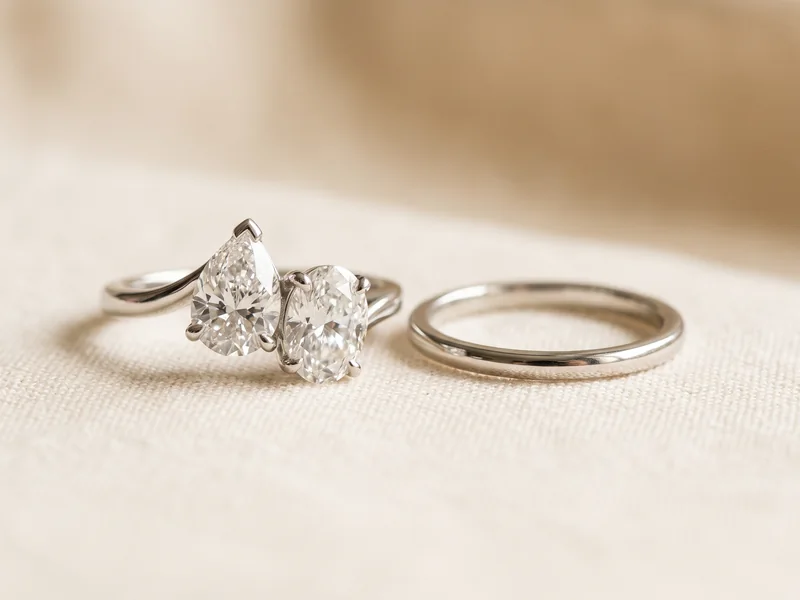 Engagement Rings & SettingsBest Settings for Pear DiamondsDiamond ShapesProtecting the Point of a Pear DiamondDiamond ShapesUnderstanding Diamond Shapes
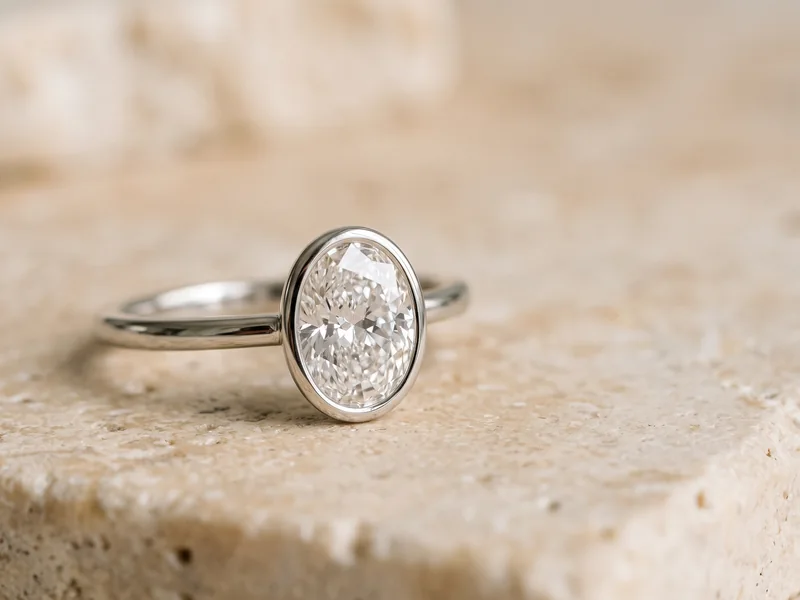 Engagement Rings & SettingsOval Engagement RingsDiamond ShapesPear Diamond Length-to-Width Ratio Guide
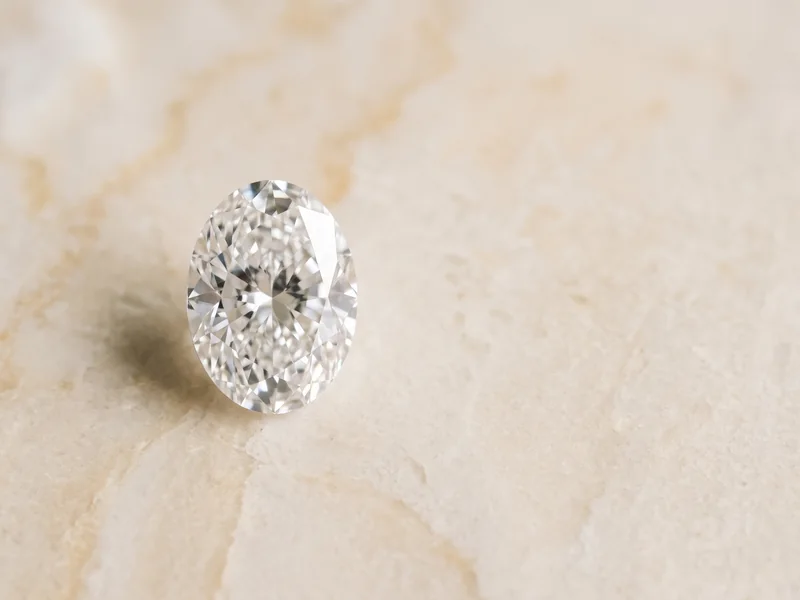 Diamond ShapesBest Length-to-Width Ratio for an Oval Diamond?
Explore more
More guides on this topic
Education