
- Education
- Diamond Shapes
- Trilliant vs Pear Side Stones: How They Compare on the Hand
Diamond shapes
Trilliant vs Pear Side Stones: How They Compare on the Hand
Side stones change the whole character of a three-stone ring. Choosing between trilliant vs pear side stones decides whether your ring reads crisp and wide or soft and flowing, so it is worth understanding exactly how the two differ before you match them to a centre.
 Reviewed by Raj Sood, Graduate Gemologist (GIA), AJP (GIA)Master jeweller and Graduate Gemologist (GIA) · reviewed 4 November 2026
Quick answer
Trilliant vs pear side stones comes down to line and softness. Trilliants are triangular, sit flat against the centre and give a crisp, geometric three-stone look with bright, broad flashes. Pears are teardrop-shaped, curve away from the centre and look softer and longer on the finger. Trilliants have three corners to protect; pears have one point.
What are trilliant and pear side stones?
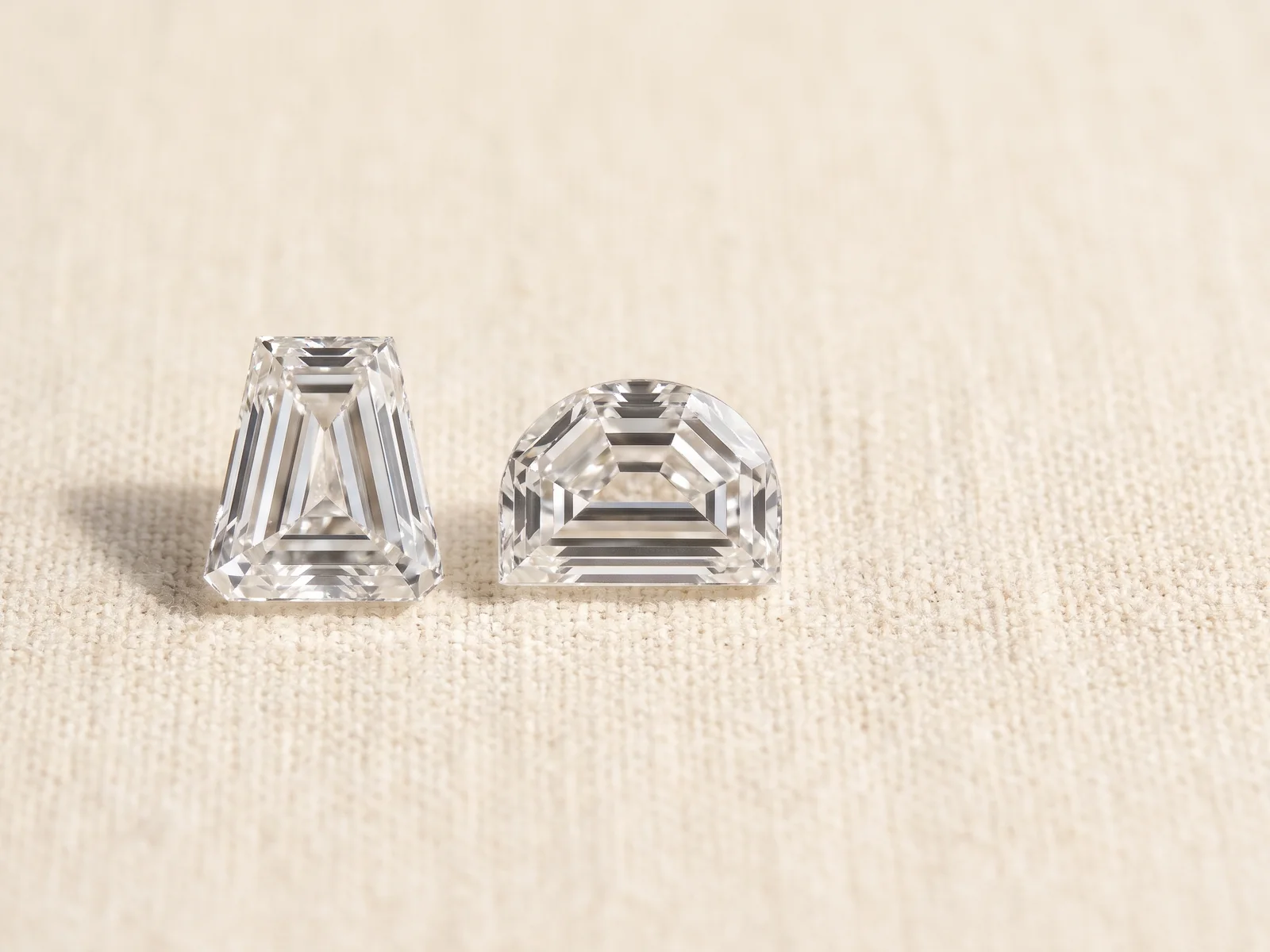
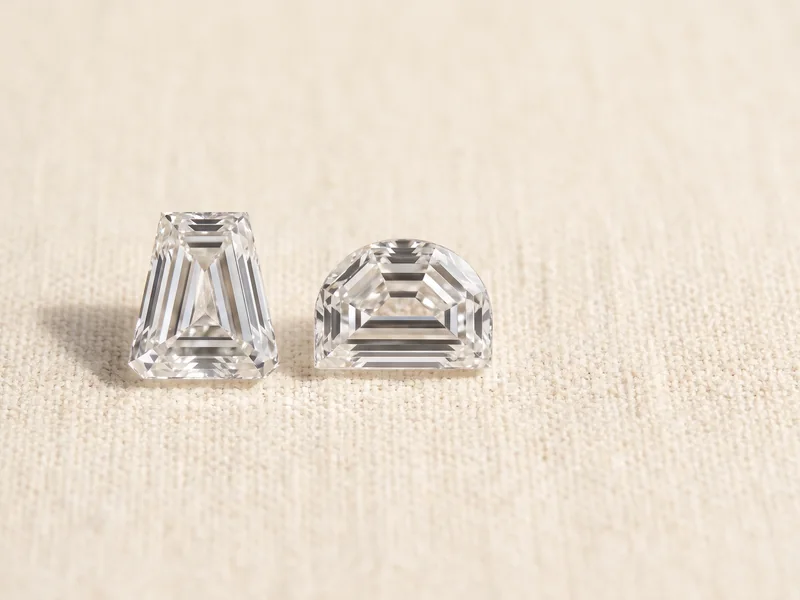
Side stones are the smaller diamonds set either side of a centre stone, most often in a three-stone ring. Trilliants and pears are two of the most popular shapes for the job, and they build very different rings. Our overview of trapezoid, half moon, bullet, baguette and trilliant side stones covers the whole family; this page puts these two head to head.
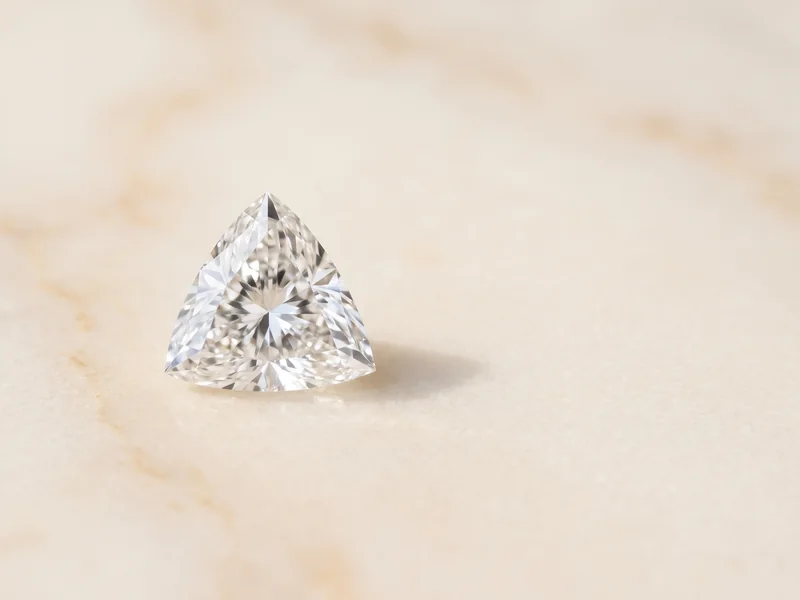
A trilliant (also spelled trillion or trillian) is a triangular diamond, usually cut as a brilliant with three equal sides and 60° corners. It comes in two versions. Curved trilliants have sides that bow gently outwards and are more often used as a centre stone. Uncurved or straight-sided trilliants are the version most often used beside a centre, because the flat inner edge sits neatly against the main diamond. Our full guide to trilliant cut diamonds goes deeper into its proportions and history.
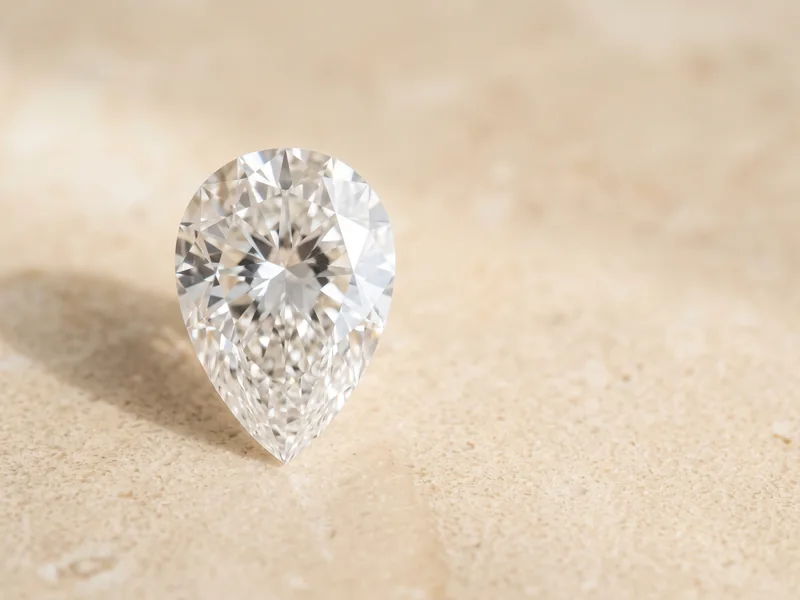
A pear is a teardrop: one rounded end and one point, cut as a modified brilliant with about 58 facets. A modified brilliant uses the same triangular and kite-shaped facets as a round, arranged around a different outline. As a side stone a pear is usually small, about 0.15 to 0.50 carat, and set with its rounded end tucked against the centre and its point running down towards the band. Choosing pears in larger sizes is covered in our pear cut diamond guide.
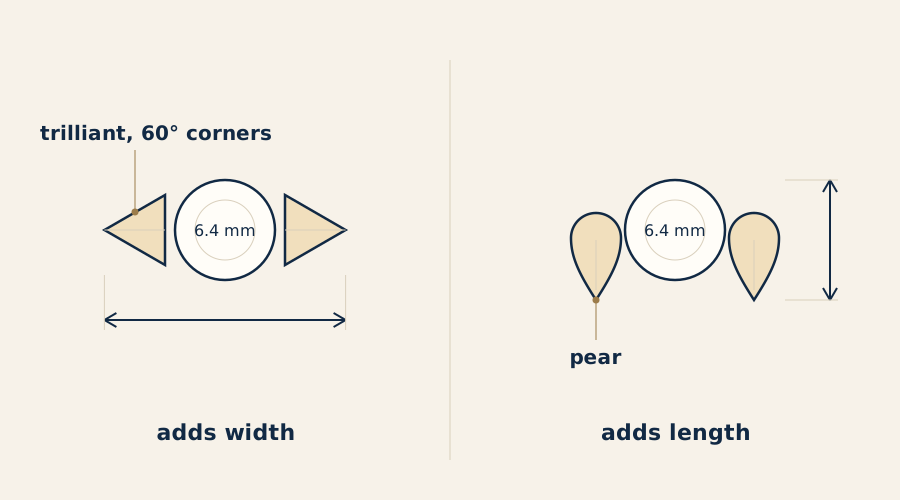
Both are fancy shapes, meaning any diamond shape other than round. Both are real diamond whether natural or lab-grown, at 10 on the Mohs hardness scale with a refractive index of about 2.42. If a word here is new, the plain-English jewellery glossary explains it, and our introduction to every diamond shape shows where these two sit in the wider family.
How do trilliant vs pear side stones look on the hand?
On the hand, the difference is line versus curve. The flat inner side of a trilliant butts right up against the centre, so the three stones read as one continuous, fan-like shape that is wider than it is tall. The look is crisp and architectural, a little modern. Because the trilliants add width across the finger, they suit a round or cushion centre that might otherwise look small on a broader hand.
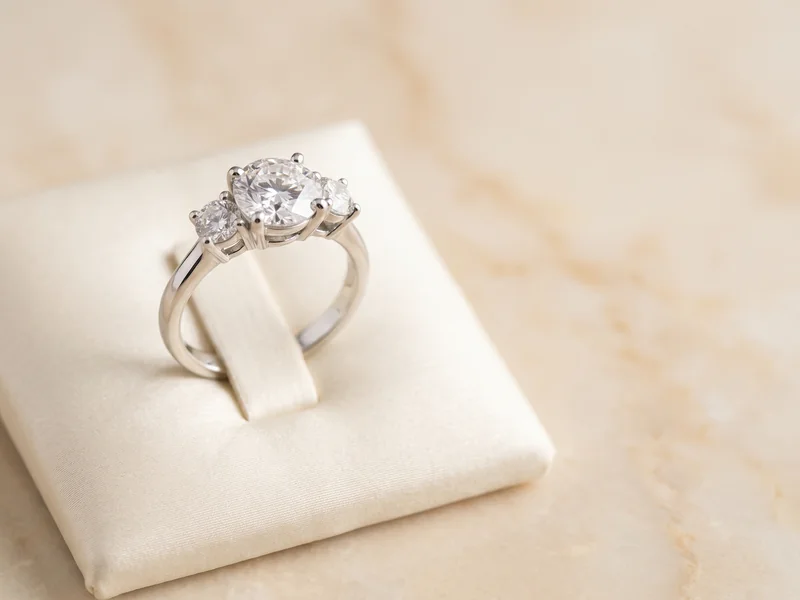
Pears flow. Their rounded ends cradle the centre and their points lead the eye down the band, so the ring looks longer and softer. A pear side stone engagement ring tends to read as romantic or vintage, and it lengthens the finger, especially around an oval or elongated cushion. The curve of each pear leaves a small, natural gap against the centre, which lets a little more light and metal show between the stones.
- Overall outline: trilliants make a wide, triangular trio; pears make a long, tapering trio.
- Contact with the centre: a trilliant meets the centre along a straight edge; a pear meets it at a curve.
- Mood: trilliants look geometric and bold; pears look soft and traditional.
- Finger coverage: trilliants spread across the finger; pears run along it.
Height matters too. Side stones can sit level with the centre or a little lower, and pears are sometimes tilted slightly so their points follow the curve of the finger. Our guide to how a ring looks from the side explains why that height affects snagging and wedding band fit. For other shape pairings, browse our overview of side-stone engagement ring styles.
Which looks bigger per carat, a trilliant or a pear side stone?
Face-up size is how big a diamond looks from above, measured in millimetres. Both shapes face up larger than a round of the same weight in their longest measurement, but they spend that size differently. A trilliant is cut relatively shallow and puts its weight into a broad triangle, so it looks wide. A pear puts its weight into length, so it looks long. Here are typical figures for well-cut stones:
| Carat (each stone) | Trilliant (side length) | Pear (length × width) | Round, for reference |
|---|---|---|---|
| 0.10 ct | about 3.3 mm | about 4.0 × 2.5 mm | about 3.0 mm |
| 0.15 ct | about 3.8 mm | about 4.5 × 3.0 mm | about 3.4 mm |
| 0.25 ct | about 4.5 mm | about 5.5 × 3.5 mm | about 4.1 mm |
| 0.33 ct | about 5.0 mm | about 6.0 × 4.0 mm | about 4.4 mm |
| 0.50 ct | about 5.8 mm | about 7.0 × 4.5 mm | about 5.1 mm |
These are approximate and vary with depth and outline. A trilliant's triangle covers less surface area than its side length suggests, so in total face-up area a pear of the same weight is usually similar or a little larger. What you notice on the hand is direction: trilliants add width to the ring, pears add length. Always compare the millimetre measurements of the actual pair, not just the carat weight.
For pears, the length-to-width ratio (length divided by width) shapes how slim the stone looks. Side stone pears usually sit around 1.40–1.70; slimmer pears point more sharply down the band, fuller pears hug the centre. The pear length-to-width ratio guide shows each ratio drawn out, and the ideal depth and table chart for pears lists the proportions that keep a pear bright without hiding weight underneath.
As a rough rule, each side stone is often about a quarter to a half of the centre's carat weight. A 1 carat round (about 6.4 mm) commonly pairs with trilliants or pears of 0.25 to 0.40 carat each.
Do trilliants or pears sparkle more?
Both are brilliant cuts, so both sparkle well, but the character differs. A brilliant-cut trilliant, often cut with somewhere between 31 and 50 facets, gives broad, bright flashes across its flat face. Because it is shallow, it can show windowing: a washed-out, see-through patch in the middle where light passes straight through instead of bouncing back. Good cutting avoids it; tilt the stone in a video and the centre should stay lively.
A pear gives finer, more scattered sparkle and can show a bow-tie, a dark band across the widest part where light leaks out. In side stones under about 0.30 carat, a bow-tie is usually too small to notice from normal viewing distance, and a faint one that moves as the ring turns simply adds contrast. The bigger the pear, the more it matters.
Colour shows differently too. Trilliants tend to collect a hint of body colour in their corners, and pears in their points, because those are the thinnest, most crowded areas. Match side stones to within about one colour grade of the centre, and choose an eye-clean clarity (no inclusions visible without magnification), usually VS2 to SI1 at these sizes.
The most important sparkle check is that the two side stones match each other. A matched pair should be within about 0.1 mm in size, the same colour and similar in brightness. Pears also need even shoulders and a point centred under the rounded end; our guide to checking a pear's shoulders and point for symmetry shows what to look for, and the same eye applies to whether a trilliant's three sides are truly equal.
Not sure which one is right?
Send us the stones you are looking at and our gemologist will tell you which to choose and why.
Are trilliant or pear side stones more durable?
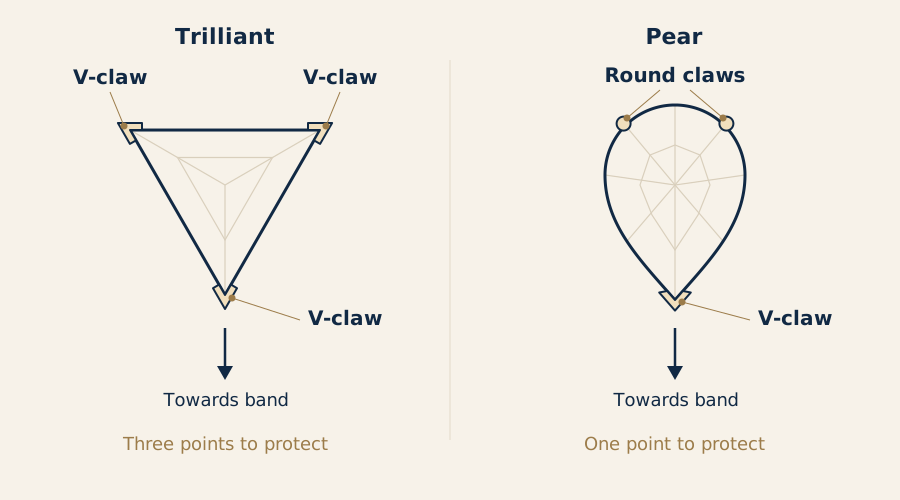
Diamond is the hardest natural material, but hardness is not toughness. Thin points can chip along a diamond's cleavage planes (natural planes of weakness in the crystal) if they take a sharp knock. A trilliant has three corners; a pear has one point. That makes the pear the simpler stone to protect, though both are perfectly wearable in the right setting.
- Trilliants: each corner is usually held by a V-claw (a V-shaped claw that wraps the point), or the stone is set in a half-bezel, a thin rim of metal around the outer edges. The inner edge is often shielded by the centre's own claws.
- Pears: the point faces outwards towards the band, where knocks happen, so it needs a V-claw or bezel tip. The rounded end needs only one or two ordinary claws.
- Everyday wear: side stones sit on the shoulders of the ring, which meet door frames and benchtops more often than the centre does. Protection matters more here, not less.
Our page on keeping a pear's point safe from chips compares the claw options in detail, and setting styles that suit pear diamonds shows how the same ideas carry across to three-stone designs.
Which centre stone suits trilliant or pear side stones?
The side stones should either echo the centre or complete its outline. Trilliants suit centres with straight edges or a strong outline, because their flat side lines up cleanly. Pears suit centres with curves, because their rounded ends follow the centre's edge.
| Centre shape | Trilliant side stones | Pear side stones |
|---|---|---|
| Round | Classic pairing; widens the ring | Soft, vintage-style trio |
| Oval | Works, but the straight edge meets a curve | Natural fit; flowing and long |
| Cushion | Strong pairing; balances the squarish outline | Softens a cushion's corners |
| Emerald or asscher | Sharp, geometric look | Contrasting; less common |
| Princess or radiant | Very neat; edges line up | Rare; can look mismatched |
| Pear | Bold contrast | Elegant, especially pointing the same way |
If you are still choosing the centre, our oval vs pear comparison helps if you love curves, and the marquise vs pear guide and heart vs pear breakdown cover the other pointed shapes. A pear centre with pear side stones is a striking option, though it means three points to protect.
Related guideSide Stone Diamond Cuts: Trapezoid, Half Moon, Bullet, Baguette, TrilliantHow do trilliant vs pear side stones compare side by side?
| Trilliant side stones | Pear side stones | |
|---|---|---|
| Outline | Triangle, 60° corners | Teardrop: one rounded end, one point |
| Typical facets | About 31–50 (brilliant) | About 58 (modified brilliant) |
| Look on the hand | Wide, crisp, geometric | Long, soft, flowing |
| Face-up size | Wide for its weight | Long for its weight |
| Sparkle | Broad, bright flashes | Finer scattered sparkle |
| Cut issue to watch | Windowing if too shallow | Bow-tie in larger sizes |
| Points to protect | Three | One |
| Suits | Round, cushion, princess, emerald | Round, oval, cushion, pear |
| Wedding band fit | Often needs a notched or contoured band | Often needs a curved band |
Neither shape is better; they solve different problems. Choose trilliants if you want width, a modern edge and a clean line from centre to side. Choose pears if you want length, softness and a ring that flows down the finger.
Plan the wedding band at the same time. Trilliants spread wide at the base and pears dip towards the band, so either can stop a straight band sitting flush. Our guide to wedding bands that sit neatly beside pear designs covers curved and contoured options that work for both.
How much do trilliant and pear side stones cost in Australia?
Both shapes are cut from natural and laboratory-grown diamond. Lab-grown diamonds are real diamond, grown in a laboratory rather than mined; they cost much less than natural, and matched pairs are easier to find. Side stones are usually sold as matched pairs, and stones under about 0.30 carat often come without individual grading reports, so ask what has been graded and by whom.
| Matched pair, G–H, VS (total weight) | Natural (AUD, approx.) | Lab-grown (AUD, approx.) |
|---|---|---|
| 0.30 ct total (0.15 ct each) | about $800–$2,000 | about $200–$600 |
| 0.50 ct total (0.25 ct each) | about $1,500–$3,500 | about $300–$900 |
| 1.00 ct total (0.50 ct each) | about $3,500–$8,000 | about $600–$1,800 |
These are broad ranges only and move with the market. Per carat, trilliants and pears generally cost less than rounds of the same grade, but a closely matched pair can carry a premium, because the cutter or supplier has to find two stones that agree in size, colour and brightness. Trilliants are cut in smaller numbers than pears, so a well-matched trilliant pair can take longer to source.
You can combine lab-grown side stones with a natural centre, or the reverse. That is a legitimate choice, but each stone's origin should be stated clearly in writing.
Shop trilliant and pear diamonds: natural and lab-grown
How do you choose between trilliant and pear side stones?
- Start with the centre. Note its shape and face-up width in millimetres; the side stones are sized to it.
- Pick the look. Trilliants for width and a crisp line; pears for length and softness.
- Set the size. Each side stone at roughly a quarter to a half of the centre's weight; compare millimetres, not just carats.
- Check the pair matches. Within about 0.1 mm of each other, the same colour, eye-clean, and within about one colour grade of the centre.
- Check the cut. No windowing in trilliants; no fixed dark bow-tie in larger pears; even outlines in both.
- Protect every point. V-claws or a half-bezel on trilliant corners; a V-claw on each pear point.
- Confirm origin and paperwork. Natural or lab-grown stated for each stone, and reports where they exist.
- Plan the band and profile. Make sure a wedding band can sit beside the side stones before you finalise the design.
Free consultation
Talk to a gemologist
Compare stones in person or online with Raj Sood, Graduate Gemologist (GIA), AJP (GIA).
Book a consultationFAQ
Common questions
Do trilliant or pear side stones look bigger?
At the same weight, both look larger than a round in their longest measurement. Trilliants make the ring look wider across the finger, while pears make it look longer along the finger.
Are trilliant side stones durable enough for everyday wear?
Yes, if every corner is protected. A trilliant has three thin corners, so V-claws or a half-bezel are important; with those in place, trilliant side stones are fine for daily wear.
Can you use pear side stones with an oval centre?
Yes, it is one of the most natural pairings. The rounded ends of the pears follow the oval's curve and the points carry the line down the band.
Should side stones match the centre's colour and clarity?
They should be within about one colour grade of the centre so they do not look warmer or whiter beside it. Clarity only needs to be eye-clean, which at side stone sizes is usually VS2 to SI1.
Can you mix lab-grown side stones with a natural centre?
Yes. Mixing natural and lab-grown diamonds is a common way to manage cost, as long as the origin of every stone is clearly disclosed in writing.
Which costs more, trilliant or pear side stones?
Per carat they are broadly similar and usually below rounds of the same grade. A closely matched trilliant pair can cost a little more or take longer to find, because fewer trilliants are cut.
Terms in this guide

Ask a gemologist
Not sure which diamond to choose?
Raj Sood is a Graduate Gemologist (GIA) and master jeweller. Bring the stones you are considering, or send the reports, and he will tell you honestly which one is better and why.
Keep learning
Related guides
 Diamond ShapesTrilliant Cut Diamonds
 Diamond ShapesPear Cut Diamonds
 Engagement Rings & SettingsSide-Stone Engagement Rings
 Diamond ShapesSide Stone Diamond Cuts: Trapezoid, Half Moon, Bullet, Baguette, TrilliantDiamond ShapesUnderstanding Diamond ShapesDiamond ShapesProtecting the Point of a Pear DiamondDiamond ShapesPear Diamond Length-to-Width Ratio Guide
 Diamond ShapesOval vs Pear Diamonds
Explore more
More guides on this topic
Education