
Gemstones
Iolite Gemstone Guide: Colour, Hardness, Value and Care
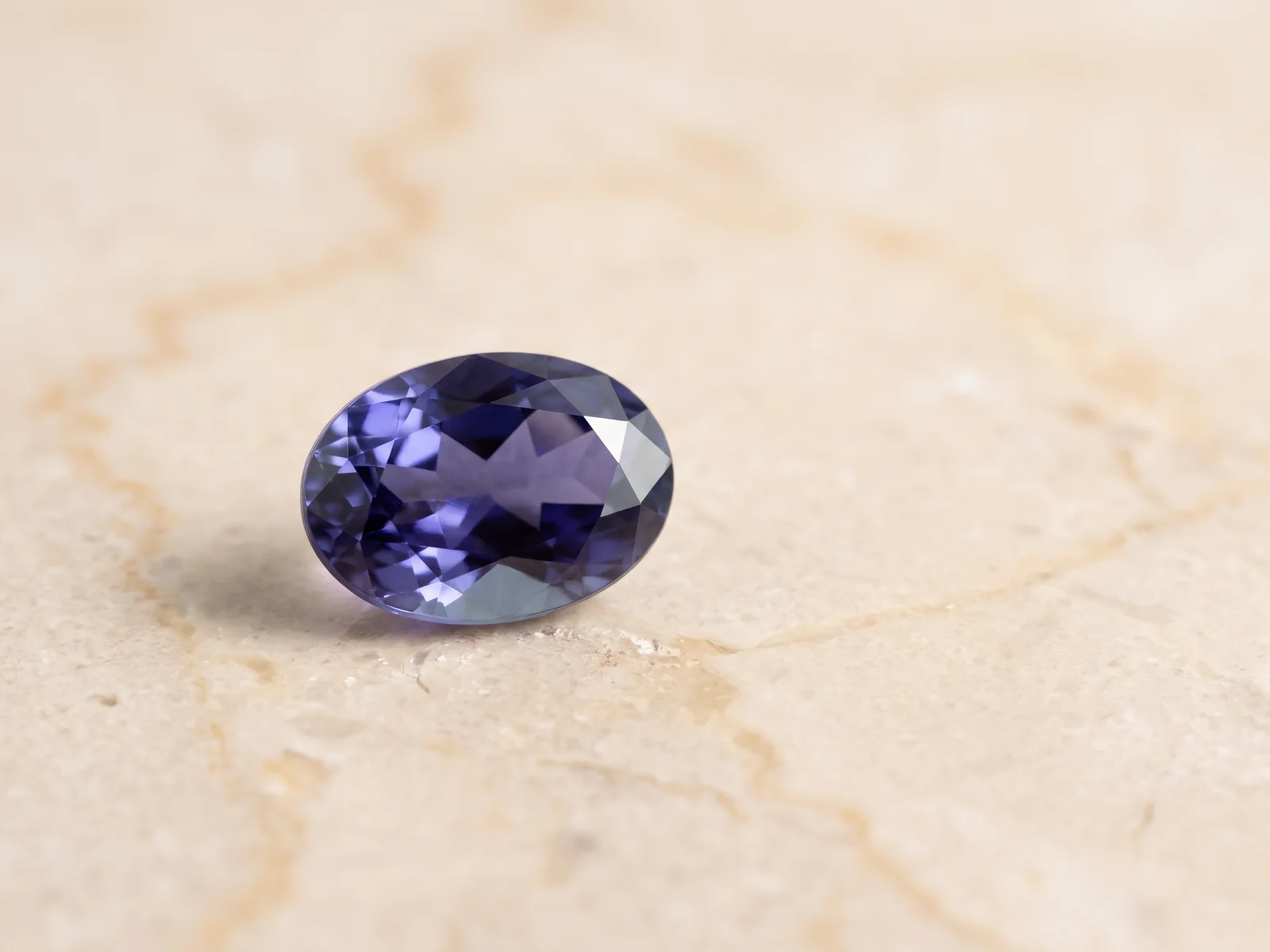
Iolite gives you a violet-blue colour close to sapphire or tanzanite for a fraction of the price, but it is not as forgiving to wear. Here is how iolite really behaves, how to judge its colour and where it works in jewellery.
 Reviewed by Raj Sood, Graduate Gemologist (GIA), AJP (GIA)Master jeweller and Graduate Gemologist (GIA) · reviewed 4 November 2026
Quick answer
Iolite is the gem variety of the mineral cordierite, a violet-blue stone known for strong pleochroism: it shows violet-blue, pale blue-grey and straw-yellow from different directions. It rates 7–7.5 on the Mohs scale but has one distinct cleavage, so it suits pendants, earrings and well-set dress rings. Most iolite is untreated and costs about AUD $30–$150 per carat.
What is iolite?
Iolite is the transparent, gem-quality form of a mineral called cordierite, a magnesium aluminium silicate (roughly Mg2Al4Si5O18) that forms in metamorphic rocks, where heat and pressure have changed clay-rich sediments over millions of years. The name comes from the Greek word ios, meaning violet, which describes the colour most people know it for. You may also see older trade names such as dichroite and water sapphire; the second is misleading, because iolite is not a sapphire at all.
Iolite sits in the affordable end of the coloured stone world. It gives a violet-blue that can look a lot like sapphire or tanzanite, but because it is fairly plentiful and rarely treated, prices stay modest. It is one of many stones covered in our wider guide to coloured gemstones, and any unfamiliar term on this page is explained in the GemTrove jewellery glossary.
The key physical facts: iolite has a hardness of 7–7.5 on the Mohs scale (the 1–10 scale of scratch resistance), a refractive index of about 1.54–1.55 and a specific gravity (density compared with water) of about 2.58–2.66. That refractive index is low, closer to quartz than to sapphire, so iolite has a softer, more glassy brightness rather than strong sparkle. What it lacks in brilliance it makes up for in colour play, which comes from its pleochroism.
What colour is iolite, and why does it change with angle?
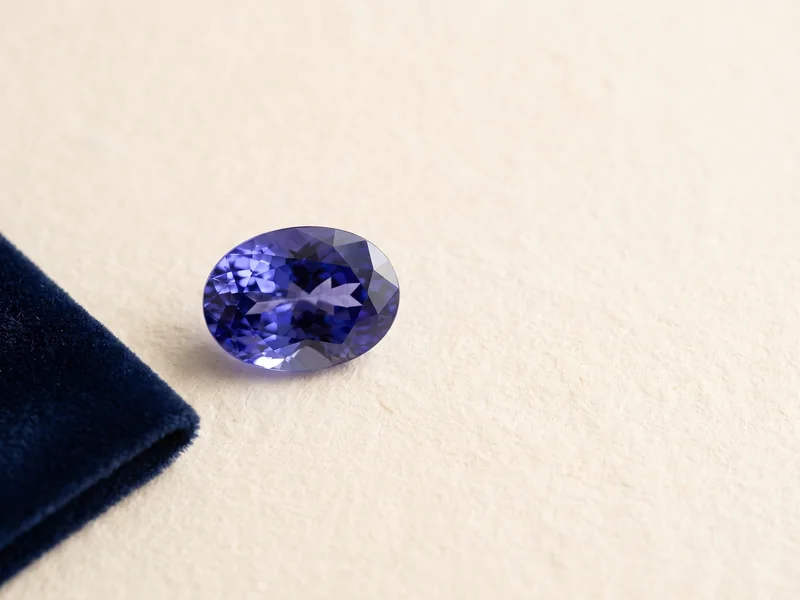
The finest iolite is a rich violet-blue, often described as somewhere between blue sapphire and tanzanite. Lighter stones read as lavender-blue or periwinkle, and poorer stones look grey-blue or steely. The colour comes mainly from iron in the crystal structure.
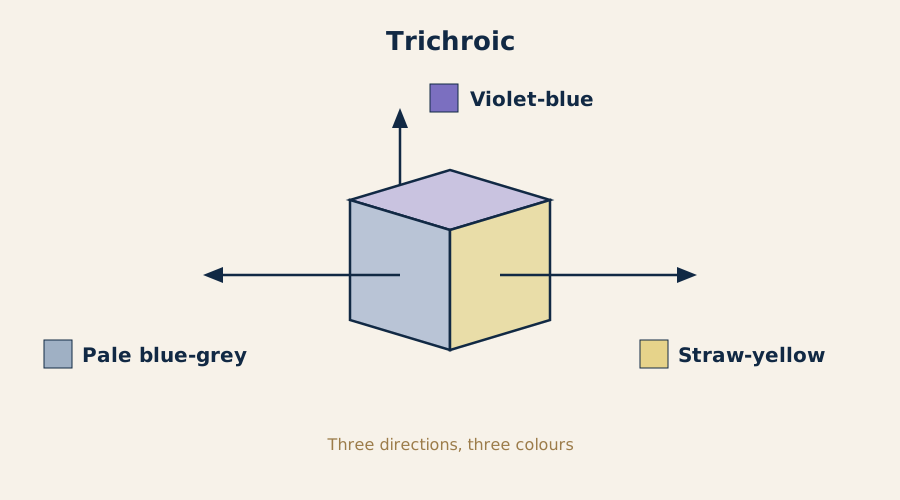
What makes iolite unusual is pleochroism: the stone shows different colours when you look at it along different directions in the crystal. Iolite is trichroic, meaning it has three directions with three distinct colours, and it is one of the most strongly pleochroic gems there is. You can often see the change with the naked eye just by turning a loose stone:
- Violet-blue: the deepest, most saturated colour, the one buyers want facing up.
- Pale blue to blue-grey: a lighter, cooler tone.
- Straw-yellow to near colourless: sometimes with a honey tint, seen side-on.
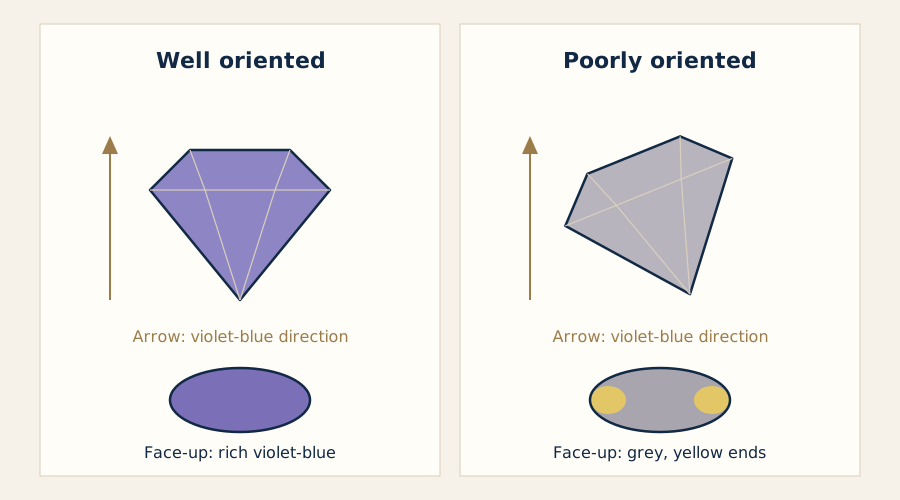
This is why cutting matters so much. A skilled cutter orients the rough so the table (the large top facet) faces the violet-blue direction. A badly oriented stone can look washed-out, greyish or show yellowish flashes at the ends. Tanzanite shares this trick, and if you are comparing the two, our guide to tanzanite, iolite's pricier violet-blue cousin explains how its colours differ. For a greener-blue alternative with strong colour change by direction, see blue indicolite tourmaline.
Legend says Viking navigators used thin slices of iolite (or a similar mineral) as a polarising filter to locate the sun through cloud. Researchers have tested the idea with crystals and it is physically possible, but there is no direct archaeological proof, so treat it as an attractive story rather than history.
How hard is iolite, and is it tough enough for a ring?
Hardness and toughness are different things. Hardness is resistance to scratching; toughness is resistance to chipping and breaking. At 7–7.5, iolite is at least as hard as quartz (7), the hardest common part of household dust, so it holds its polish reasonably well. Its weakness is toughness: iolite has a distinct cleavage in one direction, a plane along which the crystal can split cleanly if it takes a sharp knock. Its toughness is generally rated fair to poor.
| Gem | Mohs hardness | Toughness | Cleavage | Everyday ring? |
|---|---|---|---|---|
| Iolite | 7–7.5 | Fair to poor | Distinct, one direction | With care, in a protective setting |
| Tanzanite | 6–6.5 | Fair | Perfect, one direction | Occasional wear |
| Indicolite tourmaline | 7–7.5 | Fair | None (brittle) | With care |
| Aquamarine | 7.5–8 | Good | Indistinct | Yes, with care |
| Morganite | 7.5–8 | Good | Indistinct | Yes, with care |
| Spinel | 8 | Good | None | Yes |
| Alexandrite | 8.5 | Excellent | Weak | Yes |
| Sapphire and ruby | 9 | Excellent | None | Yes |
| Diamond | 10 | Good | Perfect, four directions | Yes |
For daily wear the harder, tougher stones are simply more forgiving. If you want violet-blue on a ring you wear every day, look at sapphire or spinel, a tougher alternative at 8 on the Mohs scale. For engagement rings in other colours, compare aquamarine engagement rings, ruby engagement rings and alexandrite engagement rings, or consider pink sapphire for a hard-wearing pink. Even peach-pink morganite, at 7.5–8, is a little more durable than iolite.
Is iolite treated?
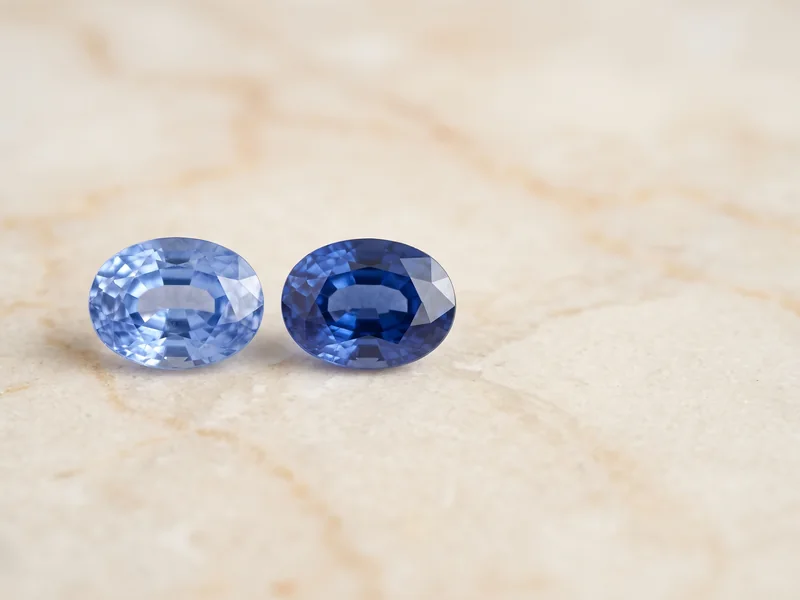
Usually not, which is one of iolite's real strengths. Unlike sapphire, ruby or tanzanite, iolite is not routinely heated to improve colour, and there is no common treatment that reliably changes it. If you want to understand why heating is so common in other stones, our page on how heat treatment changes a gem's colour covers it.
Occasionally lower-grade iolite with surface-reaching fractures may be filled with oil or resin to make cracks less visible. Any filling should be disclosed, because fillers can break down with heat, solvents or ultrasonic cleaning. Our guide to glass and fracture filling explains how to spot and ask about these.
Bloodshot iolite is a natural variety, not a treatment. It contains tiny reddish platelets of hematite or goethite (iron oxide minerals) that scatter a red-orange shimmer through the blue. Some stones with aligned needle inclusions can show a cat's-eye, and rarely a star, though the effect is softer than in star sapphires and star rubies.
Iolite is not grown commercially in laboratories for jewellery. Lab-created cordierite exists as an industrial ceramic, but if a stone is sold as lab-created iolite, ask for a test. The lookalikes you are more likely to meet are glass, lab-created blue spinel and lab-created sapphire.
Not sure which one is right?
Send us the stones you are looking at and our gemologist will tell you which to choose and why.
Where does iolite come from?
Cordierite is a common rock-forming mineral, but clean, well-coloured crystals large enough to cut are less common. Most gem iolite on the market comes from:
- India: especially Odisha (formerly Orissa), a long-running source of commercial material.
- Sri Lanka: often found in gem gravels alongside sapphire.
- Madagascar: a major modern source of clean violet-blue rough.
- Tanzania and other East African countries: including some good-colour material.
- Myanmar, Brazil and Namibia: smaller amounts.
In Australia, cordierite occurs in metamorphic rocks in several regions, and small finds of gemmy material have been reported by collectors. Australian iolite is not a significant commercial source, though, and the iolite you see in Australian jewellers is almost always imported. Origin has little effect on iolite's price; colour and clarity matter far more.
How do gemmologists identify iolite vs tanzanite and sapphire?
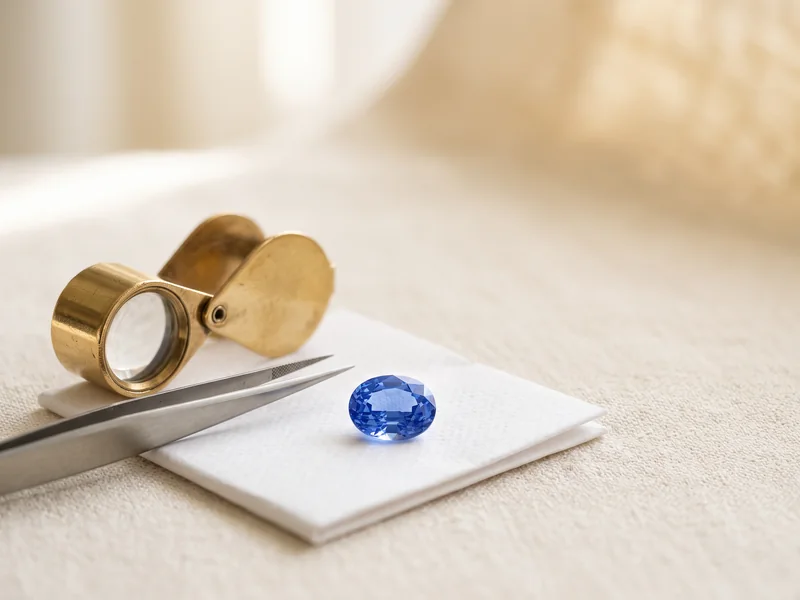
Iolite is often confused with tanzanite, sapphire and blue glass. A gemmologist separates them with a few simple measurements using a refractometer (measures how much light bends), a dichroscope (shows pleochroic colours side by side) and a hydrostatic balance or heavy liquids (for specific gravity). Our page on the refractometer, dichroscope and other gem-testing tools explains how each works.
| Stone | Refractive index | Specific gravity | Pleochroism | Quick clue |
|---|---|---|---|---|
| Iolite | 1.54–1.55 | 2.58–2.66 | Strong, trichroic: violet-blue, blue-grey, yellowish | Yellow flash side-on; light in the hand |
| Tanzanite | 1.69–1.70 | about 3.35 | Strong: blue, violet, sometimes brownish | Much heavier; higher RI |
| Blue sapphire | 1.76–1.77 | about 4.00 | Moderate: blue and greenish-blue | Very high RI and weight |
| Indicolite tourmaline | 1.62–1.64 | about 3.06 | Strong: darker along length | Often doubling of back facets |
| Lab-created blue spinel | about 1.73 | about 3.64 | None | Singly refractive |
| Blue glass | varies, often 1.50–1.70 | varies | None | Gas bubbles, swirl marks |
Inclusions help too. Iolite often contains fine needles, fluid inclusions or the reddish platelets of bloodshot material, and it is light in the hand: a 1 carat iolite is noticeably larger than a 1 carat sapphire, because it is about a third less dense.
Related guideTanzaniteWhat affects iolite value and price in Australia?
Iolite is valued mainly on colour, then clarity, cut and size. The most sought-after stones are a saturated, even violet-blue with no grey or yellow flashes face-up. Too dark and the stone looks inky in normal light; too light and it reads as lavender.
- Colour: medium to medium-dark violet-blue is the top grade.
- Clarity: iolite is usually expected to be eye-clean (no inclusions visible without magnification). Bloodshot iolite is the exception, where inclusions are the point.
- Cut and orientation: a well-oriented, well-proportioned stone shows more violet-blue and fewer windows (pale, see-through areas).
- Size: most clean faceted iolite is under about 5 carats; larger clean stones with good colour are less common and priced higher per carat.
| Quality | Approximate price per carat (AUD) |
|---|---|
| Commercial: greyish, light or visibly included | about $10–$40 |
| Good: medium violet-blue, eye-clean | about $40–$120 |
| Fine: rich even violet-blue, eye-clean, well cut | about $100–$250 |
| Bloodshot iolite | about $20–$100 |
These are broad ranges only and change with the market and the individual stone. Even fine iolite costs a small fraction of a tanzanite or blue sapphire of similar size. For a sense of how other collector stones are priced, compare demantoid garnet, a rare green collector's stone and hessonite garnet in cinnamon and orange tones.
Browse natural gemstones
Is iolite a good choice for an engagement ring?
It can be, if you go in with clear expectations. An iolite engagement ring worn every day will meet knocks against benches, car doors and gym equipment, and with a distinct cleavage, one hard blow in the wrong direction can chip or split the stone. For daily wear, these choices help:
- Bezel or half-bezel: a rim of metal around the edge, the most protective option.
- Halo: small diamonds around the iolite shield its girdle (outer edge) and add sparkle iolite lacks on its own.
- Low profile: a stone that sits closer to the finger is less likely to be hit.
- Rounded shapes: ovals, rounds and cushions have no sharp corners; avoid pointed marquise or pear shapes for daily wear.
- Six claws or more: if you prefer claws, more claws spread the load and protect more of the edge.
Iolite is very comfortable in earrings and pendants, which take few knocks, and in dress rings worn now and then. It also needs some care at the bench: iolite does not like sudden heat, so a jeweller resizing or repairing an iolite ring will usually protect or remove the stone first.
How do you clean and care for iolite jewellery?
Iolite is easy to keep bright with gentle cleaning:
- Clean: warm water, a drop of mild dish soap and a soft toothbrush, then rinse and pat dry.
- Avoid ultrasonic and steam cleaners: vibration and heat can open cleavage or fractures, and can damage any filler.
- Avoid temperature shocks: don't move it straight from hot water into cold, or leave it near strong heat.
- Store separately: sapphires, diamonds and even other quartz-hard stones can scratch iolite in a shared pouch.
- Take it off: for gardening, gym work, cleaning and sport.
Have claws or bezels checked about once a year. A loose claw is the usual way a stone gets knocked out or chipped, and it is a quick fix if caught early.
How to choose an iolite gemstone: step by step
- Decide how it will be worn. Earrings and pendants suit any iolite; a daily ring needs a protective setting and an eye-clean stone.
- Look at the face-up colour. Aim for an even violet-blue, not grey, inky or lavender.
- Turn it slowly. Check the stone is oriented well, with little yellow or grey showing face-up.
- Check clarity. Faceted iolite should be eye-clean, with no feathers (small cracks) near the edge or reaching the surface.
- Ask about treatment and identity. Confirm it is natural iolite and whether any filling has been used.
- Compare millimetres, not just carats. Iolite is light, so it looks bigger per carat than sapphire or tanzanite.
- Plan the setting. Choose a bezel, halo or low setting before you commit if it is for a ring.
Free consultation
Talk to a gemologist
Compare stones in person or online with Raj Sood, Graduate Gemologist (GIA), AJP (GIA).
Book a consultationShop this shape
FAQ
Common questions
What is iolite's meaning?
The name comes from the Greek word for violet, describing its colour. It is also linked to the Viking navigation legend, which is a story rather than proven history.
Is iolite a real gemstone?
Yes. Iolite is the natural gem variety of the mineral cordierite, mined mainly in India, Sri Lanka, Madagascar and East Africa.
What is the difference between iolite and tanzanite?
Both are violet-blue and strongly pleochroic, but tanzanite is heavier, has a higher refractive index and usually costs far more. Iolite is slightly harder at 7–7.5 against tanzanite's 6–6.5, though both need protective settings.
Can you wear iolite every day?
In earrings and pendants, yes. In a daily ring it can chip along its cleavage if knocked, so choose a bezel, halo or low setting and take it off for hard work.
How much is iolite worth in Australia?
Most iolite sells for roughly AUD $30–$150 per carat, with fine, eye-clean, rich violet-blue stones higher. Large clean stones over about 5 carats cost more per carat.
Is iolite heat treated?
Generally not. Most iolite is untreated, though some lower-grade stones may have fractures filled with oil or resin, which should be disclosed.

Ask a gemologist
Not sure which diamond to choose?
Raj Sood is a Graduate Gemologist (GIA) and master jeweller. Bring the stones you are considering, or send the reports, and he will tell you honestly which one is better and why.
Keep learning
Related guides
 GemstonesTanzaniteGemstonesGemstones | Coloured Gemstones, Birthstones and Custom Jewellery
 GemstonesGemological Instruments
 GemstonesHeated vs Unheated Gemstones
 GemstonesGlass Filling and Fracture Filling Explained
 GemstonesRuby Engagement Rings
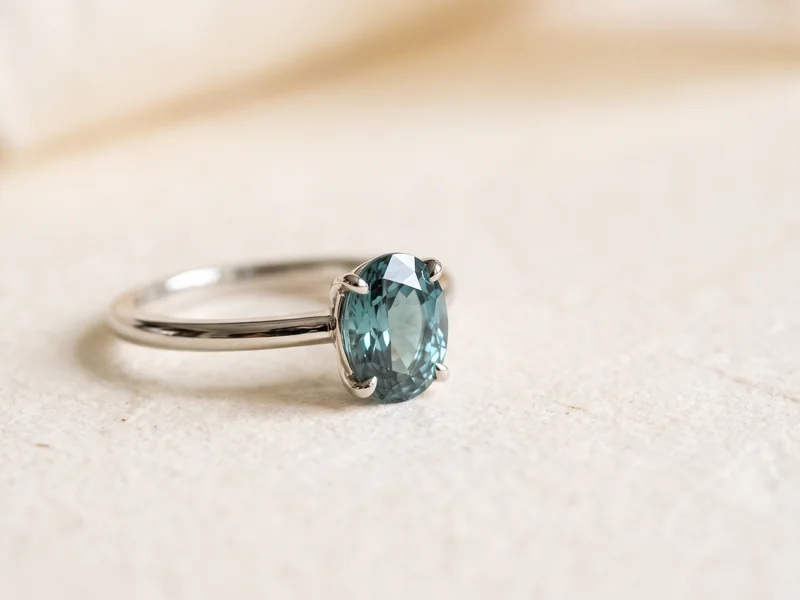 GemstonesAlexandrite Engagement Rings
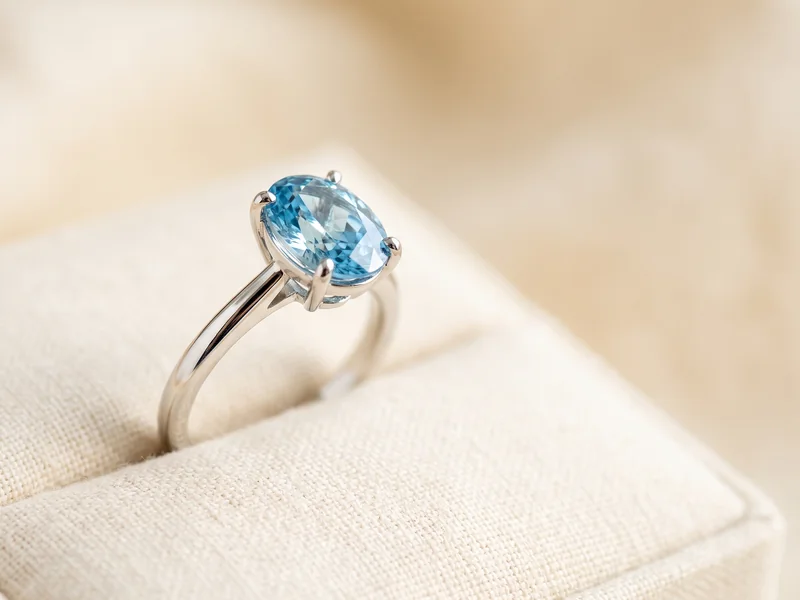 GemstonesAquamarine Engagement Rings
Explore more
More guides on this topic
Education