
- Education
- Engagement Rings & Settings
- Edwardian and Victorian Engagement Rings: History, Anatomy and How to Tell Them Apart
Engagement Rings & Settings
Edwardian and Victorian Engagement Rings: History, Anatomy and How to Tell Them Apart
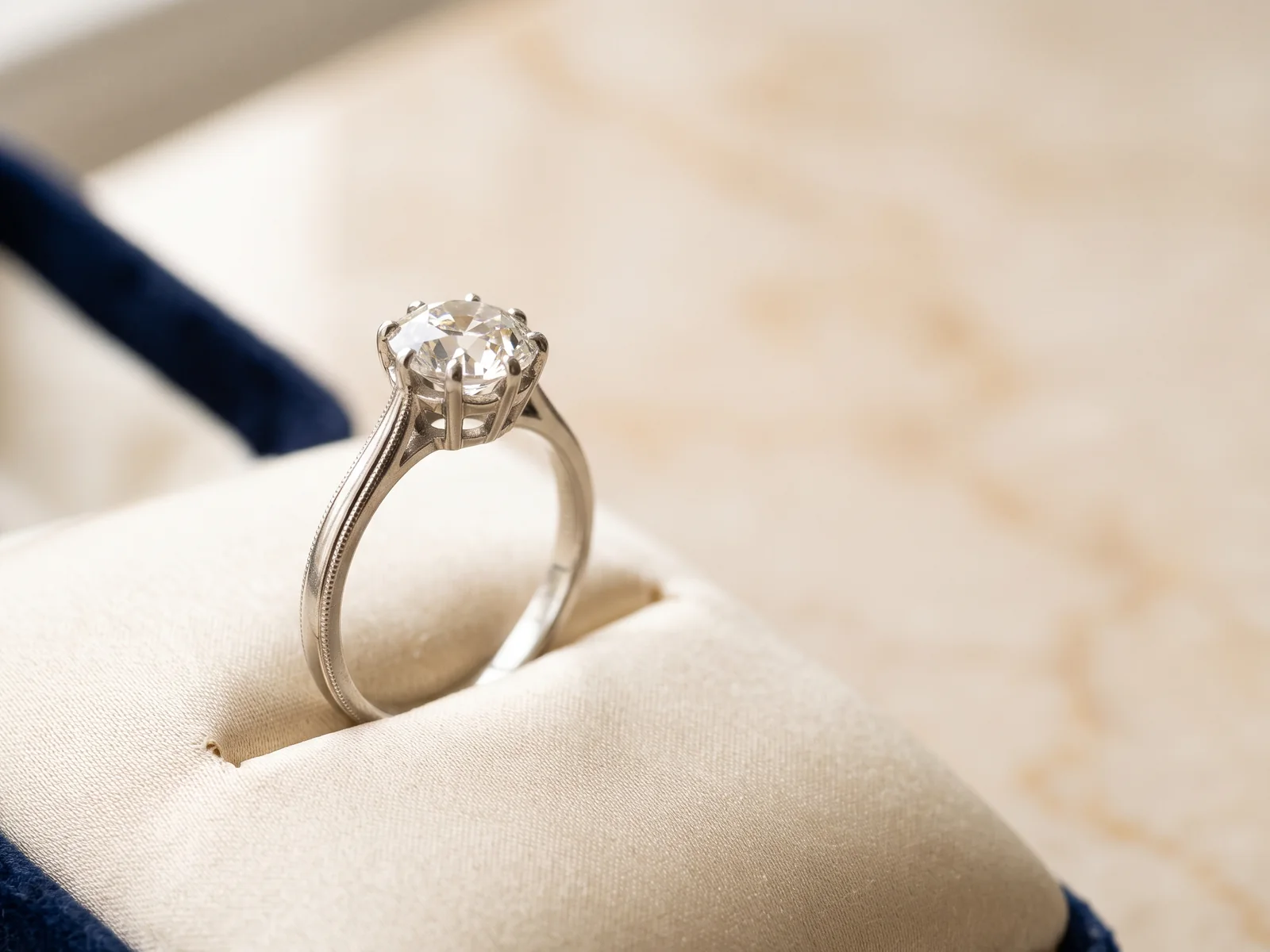
Edwardian and Victorian engagement rings are two of the most loved antique styles, and two of the most loosely copied. Here is what each era actually made, how the rings are built and what to check before you buy, repair or remake one.
 Reviewed by Raj Sood, Graduate Gemologist (GIA), AJP (GIA)Master jeweller and Graduate Gemologist (GIA) · reviewed 4 November 2026
Quick answer
Victorian engagement rings (1837–1901) are usually yellow or rose gold, set with old mine or rose cut diamonds, coloured gems and pearls, often as clusters, half hoops or snake designs. Edwardian rings (about 1901–1915) use platinum, hand-pierced openwork, milgrain edges and old European cut diamonds for a lacy, white-on-white look.
What are Edwardian and Victorian engagement rings?
The names come from British monarchs. The Victorian era covers Queen Victoria's reign, 1837 to 1901. The Edwardian era is named after Edward VII, who reigned from 1901 to 1910, but jewellers use it for the style that ran until about 1915, when the First World War cut off supplies of platinum and changed fashion. After that came the geometric Art Deco period of the 1920s and 30s.
A true antique ring was made in one of those periods, usually by hand. A vintage-inspired or reproduction ring is new, made with the look of the era. Both are covered here, because the details that make an original convincing are the same details a good remake has to get right. If you are earlier in your research, our engagement ring education hub sets out every style, and our page on vintage-inspired rings with old-world detail looks at the wider family, including Art Deco and retro designs.
Australia has its own share of these rings. Colonial jewellers in Melbourne, Sydney and Adelaide worked through the gold rush years of the 1850s onward, and many British rings came out with families. So an antique ring found here may be locally made, imported, or remade at some point in its life. Any unfamiliar term below is also explained in our plain-English jewellery glossary.
What does a Victorian engagement ring look like?
Victorian jewellery changed a lot over 63 years, so collectors usually split it into three periods. Each has its own mood, metals and stones.
| Period | Approx. dates | Typical ring details |
|---|---|---|
| Early (Romantic) | 1837–1860 | Yellow gold, engraved and chased shanks, snakes, hearts, hands and flowers, rose cut diamonds, seed pearls, turquoise, garnet |
| Mid (Grand) | 1860–1885 | Heavier gold, darker colours, mourning rings with black enamel, jet or woven hair after Prince Albert's death in 1861 |
| Late (Aesthetic) | 1885–1901 | Lighter designs, more diamonds after the South African finds, old mine cuts, half hoops, star-set gypsy rings, sapphires, opals |
Victoria herself set the tone. Prince Albert's engagement ring for her in 1839 was a gold snake with an emerald, her birthstone, set in its head. Snakes stood for eternal love and became one of the era's most popular ring designs. Sentimental messages were common too: a REGARD ring spells the word with the first letter of each gem (ruby, emerald, garnet, amethyst, ruby, diamond).
The diamonds in a Victorian ring are usually rose cuts (flat-backed with a domed, faceted top) or old mine cuts (a cushion-shaped brilliant with a high crown). To make diamonds look whiter against warm gold, many were set in silver-topped gold: a silver setting soldered onto a gold ring, so the white metal sits around the stone and the gold touches the skin. Early settings were often closed-back, with the back of the stone enclosed in metal and sometimes lined with coloured foil to boost its colour.
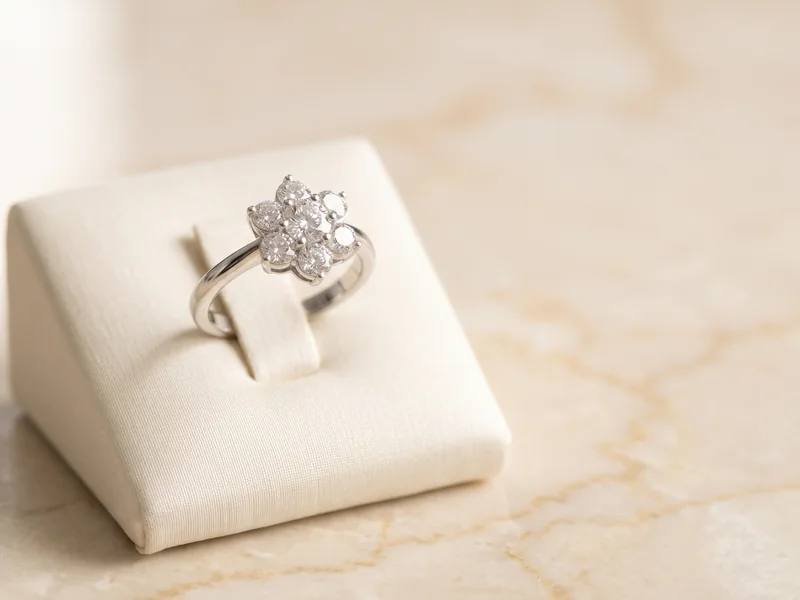
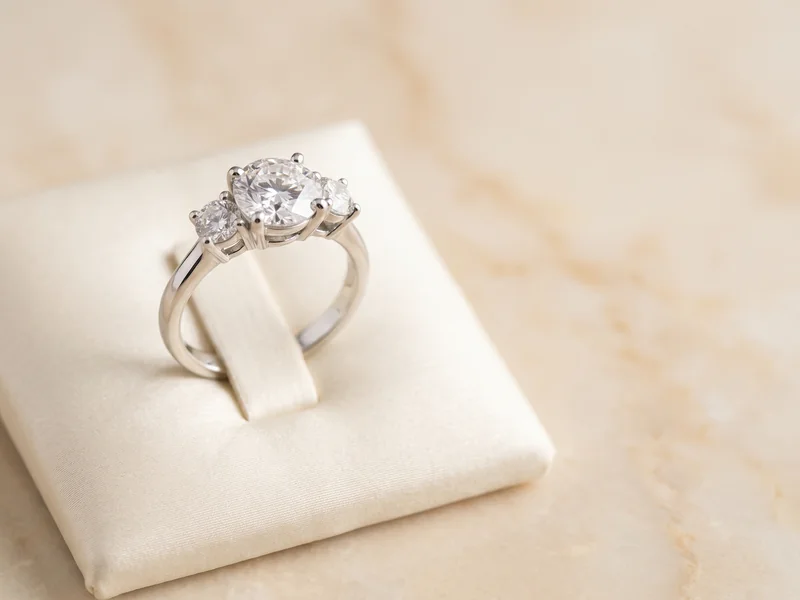
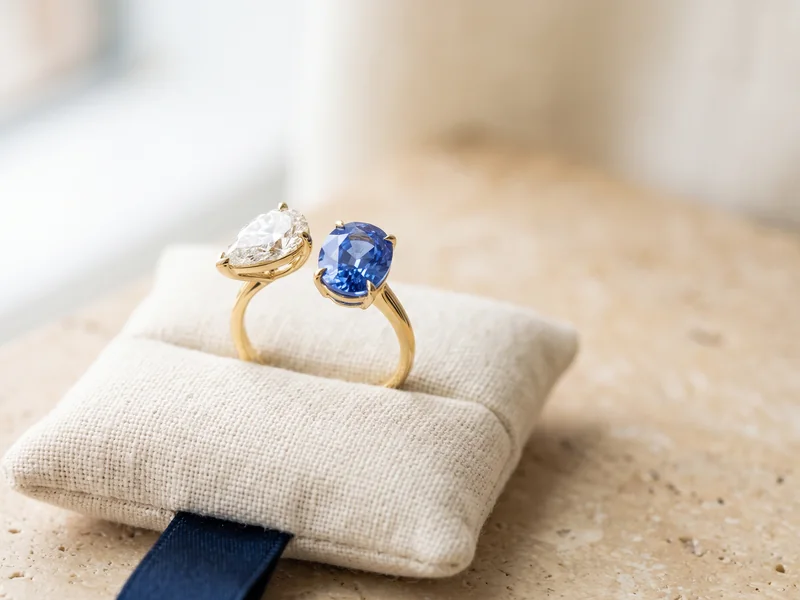
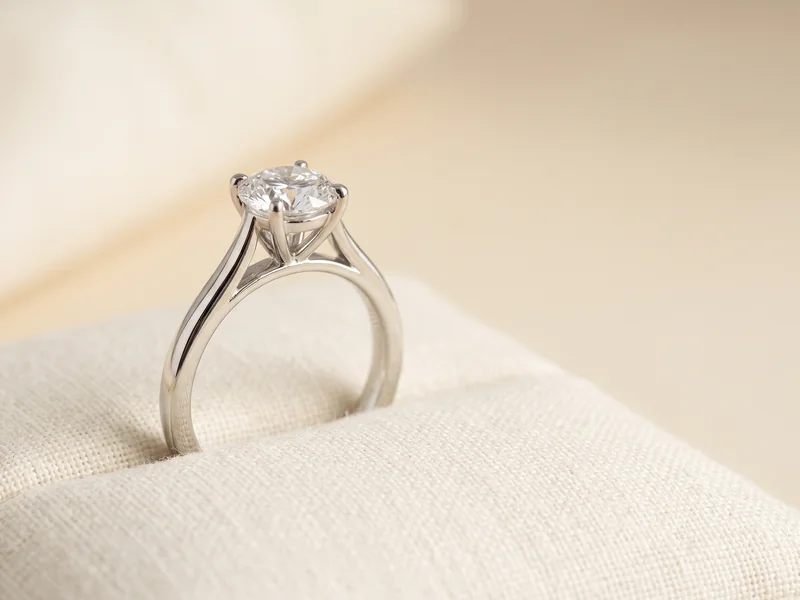
The most recognisable Victorian engagement shapes are the cluster (a centre stone ringed by smaller ones, often in a raised dome), the five-stone half hoop of graduated diamonds across the top of the band, and the two-stone crossover. Modern versions of each exist: see our guides to cluster engagement rings, three-stone ring designs, and bypass and toi et moi rings, the crossover style's direct descendant. Single stones were often held in a collet (a rim of metal around the stone), the ancestor of today's bezel and rubover settings.
What makes an Edwardian engagement ring different?
The big change was platinum. Platinum melts at about 1,768°C, far hotter than gold, and jewellers only had reliable tools to work it from the late nineteenth century, using oxy-hydrogen torches. Around 1900 it became the fashionable metal. Because platinum is strong and dense, a claw or a bar only a fraction of a millimetre thick will still hold a diamond, which let Edwardian jewellers make rings that look like lace.
Early Edwardian rings are often platinum-topped gold, the same idea as Victorian silver-topped gold: a platinum face over an 18 carat gold back. Later rings are usually solid platinum. Look for these Edwardian details:
- Hand-pierced openwork: patterns cut through the metal with a fine jeweller's saw, often bows, garlands, scrolls and lattices borrowed from eighteenth-century French design (the 'garland style').
- Milgrain: rows of tiny beads pressed along every edge with a knurling tool, softening the outline and catching light.
- Knife-edge shanks: a band that narrows to a sharp ridge on top, so it looks very fine from above while staying strong.
- Old European cut diamonds: round brilliants with a small table and a high crown, usually set in fine claws or millegrained collets.
- Navette and plaque shapes: long, pointed or rectangular heads paved with small diamonds, often with a centre stone.
- Calibré-cut sapphires: tiny stones cut to fit a channel exactly, used as blue lines framing the white diamonds.
Edwardian rings are mostly white on white: diamonds, platinum and natural pearls, with sapphire as the main colour accent. The openwork is the ancestor of modern filigree, explained in our filigree engagement ring guide. Not every Edwardian ring is busy, though. Many are simple single-diamond solitaire styles on a knife-edge shank, and many others add small diamonds down the sides, much like today's rings with diamonds down the shoulders.
What are the parts of an antique engagement ring?
Antique rings use the same basic parts as modern rings, but each part is built differently. Knowing the names helps when you read a listing or talk to a jeweller about a repair.
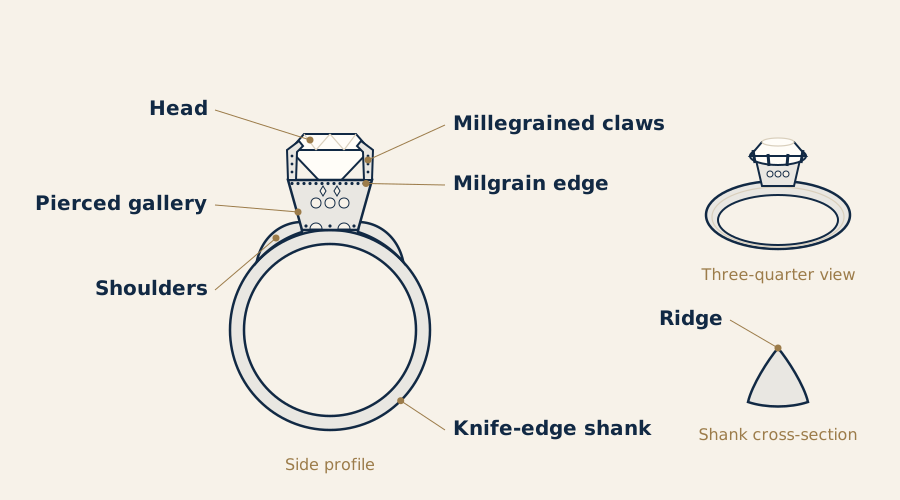
- Head: the top section that holds the stones. In a cluster or plaque it can be 10–15 mm across.
- Claws or collet: what grips the stone. Victorian claws are often short and thick; Edwardian claws are fine and frequently millegrained.
- Gallery: the side wall under the head, seen in profile. Edwardian galleries are usually pierced; Victorian ones are often solid or closed-back.
- Shoulders: where the band meets the head. Victorian shoulders are often carved or engraved; Edwardian shoulders may split or carry small diamonds.
- Shank: the band itself. Antique shanks are commonly 1.5–2.5 mm wide and, after a century of wear, can be thin at the base.
Many modern styles grew out of these parts. Raised Edwardian heads with supporting arches look like cathedral shoulders that arch up to the head, and shoulders that fork into two fine wires are early split shank designs. For how all these fit together today, see every engagement ring setting style explained. Because our workshop draws remakes in CAD (computer-aided design) first, we can show each of these parts on screen and adjust the proportions before any metal is cast.
Not sure which one is right?
Send us the stones you are looking at and our gemologist will tell you which to choose and why.
Which diamond cuts are found in antique rings?
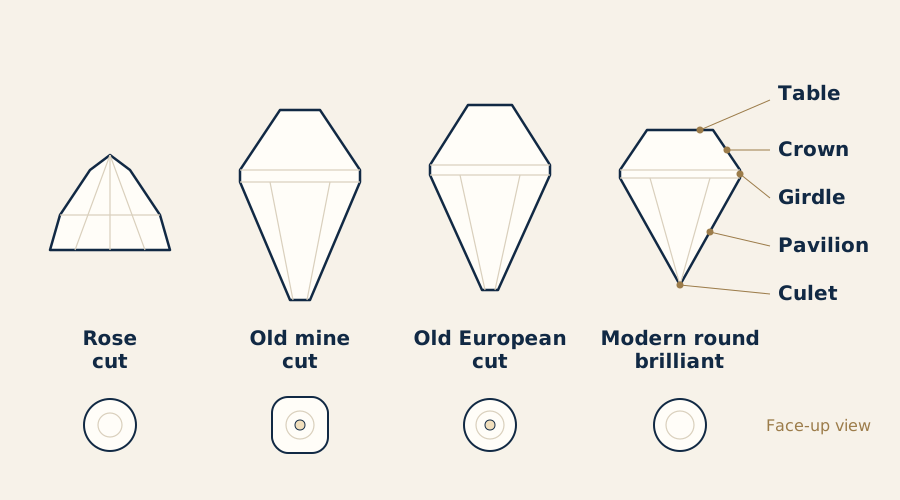
Before the modern round brilliant was standardised in the early twentieth century, diamonds were cut by hand and by eye. The aim was to keep as much weight from the rough as possible and to sparkle in candle and gas light, which is softer and more directional than electric light. The result is a bigger, chunkier flash of light rather than the fine 'crushed ice' sparkle of a modern round.
| Cut | Main era | Outline and profile | How it looks |
|---|---|---|---|
| Rose cut | Georgian to Victorian | Flat base, domed top of triangular facets, usually 12–24 facets | Soft, glassy shimmer; looks larger for its weight |
| Old mine cut | Georgian to late Victorian | Cushion-shaped outline, high crown, small table, deep pavilion, large open culet | Broad, blocky flashes; a small circle visible through the top |
| Old European cut | About 1870s–1930s | Round outline, high crown, small table, open culet, 58 facets | Bold, chunky sparkle; the main Edwardian diamond |
| Modern round brilliant | 1920s to today | Round, flatter crown, larger table, pointed or tiny culet, 57–58 facets | Bright, fine pinpoint sparkle |
The culet is a small flat facet at the very bottom of the stone. In old cuts it is large enough to see face-up as a little dark or bright circle in the centre, and that is normal, not a flaw. Old cuts also tend to show more body colour, as their proportions mask it less than a modern round does, so many antique diamonds grade around J to M colour. Set in yellow gold, that warmth is part of the charm.
Old cuts were not only round or cushion. Oval, pear and marquise (navette) diamonds appear in antique rings too, cut with the same high crowns. If you love that softer oval outline, our page on oval engagement rings shows how modern ovals compare. New old European and old mine cut diamonds are also cut today, in both natural and lab-grown diamond, for people who want the antique look with a new ring.
How do Edwardian and Victorian engagement rings differ?
The quickest test is colour: Victorian rings are warm gold with colour; Edwardian rings are white platinum with lace. The table below sets the two eras side by side, with Art Deco for context, because it is the style most often confused with Edwardian.
| Victorian (1837–1901) | Edwardian (c.1901–1915) | Art Deco (c.1920–1935) | |
|---|---|---|---|
| Main metal | Yellow and rose gold, silver-topped gold | Platinum, platinum-topped gold | Platinum, white gold |
| Diamond cuts | Rose cut, old mine cut | Old European cut, rose cut accents | Old European, early modern round, baguettes |
| Coloured stones | Garnet, turquoise, coral, pearl, emerald, ruby, opal | Sapphire, natural pearl, some ruby and emerald | Sapphire, emerald, onyx, ruby, often calibré-cut |
| Shapes | Clusters, half hoops, snakes, hearts, crossovers | Garlands, bows, navettes, plaques, solitaires | Geometric lines, steps, hexagons, sharp angles |
| Edges | Engraved, chased, carved | Milgrain, pierced openwork | Milgrain, crisp straight edges |
| Setting backs | Often closed, sometimes foil-backed | Open, pierced galleries | Open, pierced, often geometric |
| Overall feel | Sentimental, warm, symbolic | Light, lacy, delicate | Bold, graphic, symmetrical |
Some rings sit across the borders. Late Victorian rings of the 1890s can already have open claws and platinum-topped faces, and some rings made after 1915 still look fully Edwardian. Dealers often label these 'late Victorian / early Edwardian', which is honest when the evidence is mixed.
Some modern techniques simply did not exist then. You will never see an original antique in tension and suspended settings, which rely on modern spring-hardened alloys and precise machining. The offset two-stone crossovers of the Victorians, on the other hand, are very close to today's asymmetrical ring designs.
How can you tell if an antique ring is real or a reproduction?
Nothing replaces a jeweller handling the ring under magnification, but these signs help you judge a listing or a ring in the hand:
- Hand-cut diamonds: old mine and old European cuts have slightly uneven facets, an off-round outline and a visible culet. A perfectly symmetrical modern round in an 'antique' ring was probably added later, or the ring is new.
- Hand-pierced work: saw-pierced openings have tiny file marks and slight irregularities. Cast reproductions have softer, rounded edges and identical repeats.
- Wear in the right places: a century of wear rounds the milgrain, thins the base of the shank and smooths engraving on the outside, not the inside.
- Hallmarks: British gold is usually marked with a carat stamp such as 18 or 15, an assay office symbol and a date letter. Platinum was not hallmarked in Britain until 1975, so Edwardian platinum is often unmarked or stamped 'PLAT' or 'PT'. Australian colonial makers often used their own marks.
- Construction: silver-topped and platinum-topped gold, and closed foil backs, are hard to fake convincingly and point strongly to age.
Stones need checking too. Victorian jewellers used paste (high-lead glass) and garnet-topped doublets, where a thin slice of garnet is fused to coloured glass, to imitate rubies, sapphires and emeralds. And synthetic gems are older than many people think: lab-created ruby made by flame fusion was being sold by the early 1900s, so an Edwardian ruby may be lab-created. A gemmologist identifies these from curved growth lines and gas bubbles under magnification.
Lab-grown diamonds are a different story. Gem-quality laboratory-grown diamonds were not produced until the 1970s and only reached jewellery in volume this century, so a genuine antique's original diamonds are natural. If a lab-grown diamond appears in an old mount, it is a later replacement and should be disclosed.
Is an antique engagement ring worth it, or should you remake one?
An original antique gives you a piece of history and hand work that is hard to reproduce. The trade-off is fragility: thin shanks, worn claws, soft high-carat gold and organic stones such as pearl and turquoise that do not like daily knocks. A new ring in an Edwardian or Victorian style gives you era-correct details, sized and built for everyday wear, with either a natural or a lab-grown old cut diamond.
| Ring type | Approximate price range (AUD) |
|---|---|
| Antique Victorian gold ring with small diamonds or gems | about $1,500–$6,000 |
| Antique Edwardian platinum ring, centre under 0.50 ct | about $3,000–$10,000 |
| Antique Edwardian ring, 1 ct old European cut centre | about $10,000–$30,000 or more |
| New Edwardian-style platinum ring, 1 ct lab-grown old European cut | about $4,000–$9,000 |
| New Edwardian-style platinum ring, 1 ct natural old European cut | about $10,000–$20,000 |
These are broad ranges only. Antique prices depend heavily on condition, provenance, the quality of the centre diamond and whether it has been altered. Lab-grown diamonds are real diamond grown in a laboratory and cost much less than natural; natural old cut diamonds are prized for their genuine age. Neither should be thought of as a way to make money.
A third option is remodelling: keeping an inherited old mine or old European cut diamond and setting it in a new mount that suits it. Old cuts are deep, often 60–70% of their width, so the new head and gallery have to be drawn around the actual stone, not a standard size.
Related guideVintage-Inspired Engagement Rings with Old-World Detail and Custom CharacterCreate an Edwardian or Victorian style ring
How do you care for and repair a Victorian or Edwardian ring?
Antique rings have already survived a century, but they need gentler care than a new ring. When antique pieces come into the workshop for repair, the same issues come up again and again:
- Worn claws: get them checked every 6–12 months; worn tips can be rebuilt (re-tipped) before a stone works loose.
- Thin shanks: a shank worn below about 1 mm at the base can crack; a new section can be joined in.
- Closed or foil backs: keep them dry. Water trapped behind the stone can tarnish the foil and dull the colour permanently.
- Silver-topped settings: the silver tarnishes; polish gently with a soft cloth rather than dips.
- Ultrasonic cleaners: avoid them for pearls, opals, turquoise, emerald, doublets and any ring with loose stones or old fractures. Warm soapy water and a soft brush are safer.
- Resizing: pierced or engraved shanks and half hoops need careful resizing so the pattern is not distorted; some rings are better fitted with sizing beads or a new shank.
Platinum and gold behave differently under heat, and old diamonds can carry feathers (small internal cracks), so repairs on antique rings are often done with a laser welder, which heats a tiny spot without warming the whole stone.
How do you choose an Edwardian or Victorian style ring? Step by step
- Pick the era by colour. Warm gold with coloured stones points to Victorian; white platinum with lacy openwork points to Edwardian.
- Decide antique or new. An original has history; a new ring in the style is built for daily wear and can use a natural or lab-grown old cut diamond.
- Check the diamond cut. Look for a high crown, small table and visible culet, and confirm on the paperwork whether it is natural or lab-grown.
- Look at the side profile. Check the gallery for hand-piercing and the milgrain for crisp or naturally worn beads.
- Inspect wear and repairs. Ask about the shank thickness, claw condition, resizing history and any replaced stones.
- Plan for everyday life. If you work with your hands, consider a lower head, a collet setting or a reinforced shank.
Free consultation
Talk to a gemologist
Compare stones in person or online with Raj Sood, Graduate Gemologist (GIA), AJP (GIA).
Book a consultationShop this shape
FAQ
Common questions
What is the difference between a Victorian and an Edwardian engagement ring?
Victorian rings (1837–1901) are usually yellow or rose gold with rose or old mine cut diamonds and coloured gems. Edwardian rings (about 1901–1915) are usually platinum with pierced openwork, milgrain and old European cut diamonds.
Are antique engagement rings strong enough for everyday wear?
Many are, but they need checking first. Thin shanks, worn claws and soft stones such as pearl or turquoise may need repair or a protective setting before daily wear.
Why does the diamond in my antique ring have a dot in the middle?
That is the culet, a small flat facet at the bottom of old mine and old European cuts. It is a normal feature of the cut, not a flaw.
Can an old ring contain a lab-grown diamond?
Only as a later replacement. Gem-quality lab-grown diamonds were not produced until the 1970s, so a genuine Victorian or Edwardian ring's original diamonds are natural.
Can you make a new ring in Edwardian or Victorian style?
Yes. A new ring can copy era details such as milgrain, hand-pierced galleries and knife-edge shanks, and set either a natural or lab-grown old European or old mine cut diamond.
How do I know if my antique ring is platinum?
Look for a 'PLAT' or 'PT' stamp, though many Edwardian rings are unmarked because British platinum hallmarking only began in 1975. A jeweller can test the metal without damaging the ring.
Terms in this guide

Ask a gemologist
Not sure which diamond to choose?
Raj Sood is a Graduate Gemologist (GIA) and master jeweller. Bring the stones you are considering, or send the reports, and he will tell you honestly which one is better and why.
Keep learning
Related guides
 Engagement Rings & SettingsVintage-Inspired Engagement Rings with Old-World Detail and Custom Character
 Engagement Rings & SettingsFiligree Engagement Rings
 Engagement Rings & SettingsCluster Engagement Rings
 Engagement Rings & SettingsThree-Stone Engagement RingsEngagement Rings & SettingsEngagement Ring Setting Styles Guide
 Engagement Rings & SettingsAsymmetrical Engagement RingsEngagement Rings & SettingsSolitaire Engagement Rings
 Engagement Rings & SettingsCathedral Engagement Rings
Explore more
More guides on this topic
Education