
- Education
- Engagement Rings & Settings
- Filigree Engagement Ring Guide: History, Anatomy, Styles and Care
Engagement Rings & Settings
Filigree Engagement Ring Guide: History, Anatomy, Styles and Care
A filigree engagement ring looks like lace worked in metal, and its fine detail is both its charm and its weak point. Here is what filigree really is, how to tell handmade from cast, and what makes one last for decades.
 Reviewed by Raj Sood, Graduate Gemologist (GIA), AJP (GIA)Master jeweller and Graduate Gemologist (GIA) · reviewed 4 November 2026
Quick answer
A filigree engagement ring has a lace-like metalwork pattern of fine curls, scrolls and piercings in the gallery, shoulders or band. True filigree is twisted wire soldered into shapes; most modern and Art Deco rings imitate it by casting or die-striking. Choose platinum or 18ct gold, solid claws and openwork at least 1 mm thick for everyday wear.
What is a filigree engagement ring?
Filigree is a metalworking technique in which fine wires, often twisted in pairs and then flattened, are curled into scrolls, loops and leaves and soldered inside a heavier frame. The result is openwork: metal with holes in it, so light and skin show through the pattern. The word comes from the Latin filum (thread) and granum (grain), because early filigree was often paired with tiny gold beads.
A filigree engagement ring uses that lacy metalwork somewhere on the ring, most often in the gallery (the side wall of the head under the centre stone), across the shoulders (where the band meets the head) or around the whole band. The centre stone is still held by claws or a bezel in the usual way; the filigree is the decoration around it. It sits among the vintage-inspired options in our complete guide to engagement ring setting styles.
Strictly speaking, only wire work is true filigree. In the trade, though, the word is used loosely for any pierced, scrolled pattern, whether it was built from wire, stamped with a steel die or cast from a wax or CAD model. That difference matters for strength, price and how the ring can be repaired, so we cover it in detail below. Terms such as milgrain, gallery and die-struck are also defined in our jewellery glossary of ring and setting terms.
What are the parts of a filigree engagement ring?
Every ring has the same basic parts: the band (or shank), the shoulders, the head that holds the stone, and the gallery beneath it. Filigree can appear on any of them. Knowing the names helps you describe exactly what you want and spot where a ring is likely to wear. Our page on the parts of an engagement ring covers the basics; here is how they look in a filigree design.
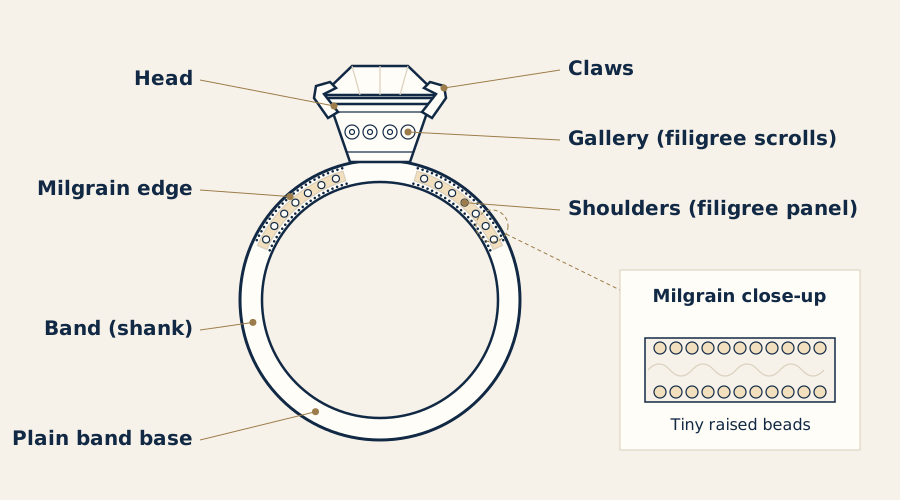
| Part | What it is | Typical filigree detail |
|---|---|---|
| Claws (prongs) | Metal tips that grip the stone | Usually solid; sometimes topped with tiny beads |
| Head and gallery | The basket under the stone and its side wall | Scrolls, hearts, arches or pierced circles seen from the side |
| Shoulders | Where the band rises to meet the head | Curling leaves, open triangles or a tapering lace panel |
| Band (shank) | The circle around the finger | Pierced panels on the sides; the base usually solid |
| Edges | The outer rims of each panel | Milgrain (rows of tiny raised beads) to outline the pattern |
Milgrain is the bead-like edging you see on most vintage-style rings. It is not filigree itself, but the two are almost always used together: filigree makes the pattern, milgrain outlines it. Hand engraving, cut into the surface with a graver, is a third separate technique often added to the band.
Where do filigree rings come from?
Filigree is one of the oldest jewellery techniques. Examples survive from ancient Mesopotamia, and Etruscan and Greek goldsmiths refined it more than 2,500 years ago, combining fine wire with granulation. Strong filigree traditions continue today in India, Portugal, Malta and much of the Middle East, usually in high-purity silver or gold that bends easily into fine wire.
In engagement rings, filigree belongs above all to the early twentieth century. The custom of a diamond engagement ring was spreading widely by then, as our history of the engagement ring explains. Around 1900, jewellers gained torches hot enough to work platinum reliably. Platinum is strong in thin sections, so Edwardian jewellers (roughly 1901–1915) could make ring heads as fine as lace, with pierced galleries, milgrain edges and garland motifs. You can compare them with earlier gold rings in our guide to Edwardian and Victorian ring styles.
In the 1920s and 1930s, demand rose faster than hand work could supply. Makers, especially in the United States, began producing die-struck filigree: a hardened steel die stamped the pattern into a sheet of platinum or white gold, and the shape was then pierced, bent into a ring and finished by hand. These mounts were crisp, consistent and surprisingly strong, and many still survive. Filigree wedding bands from the same decades were often made to match, a story told in our history of wedding bands.
Related guideArt Deco Engagement RingsIs it real filigree? Handmade, die-struck and cast compared
Most rings sold as filigree today are cast. That is not a fault, but it is worth knowing which method made the ring you are looking at, because each one wears and repairs differently.
| Handmade wire filigree | Die-struck (stamped) | Cast (wax or CAD model) | |
|---|---|---|---|
| How it is made | Twisted wire curled and soldered into a frame | Pattern pressed into sheet metal by a steel die | Molten metal poured into a mould of a carved or 3D-printed model |
| Era | Ancient to today; rare in rings | Mainly 1920s–1940s | Mainly 1950s to today |
| Detail | Very fine, slightly irregular | Very crisp, sharp edges | Good; softer edges unless hand-finished |
| Metal density | Many solder joints | Dense, work-hardened metal | Can have tiny porosity if poorly cast |
| Strength for daily wear | Lowest; best for occasional wear | Good | Good if openwork is at least about 1 mm |
| Repairs | Specialist work; joints can reopen | Laser welding and patching possible | Easiest to repair or recreate |
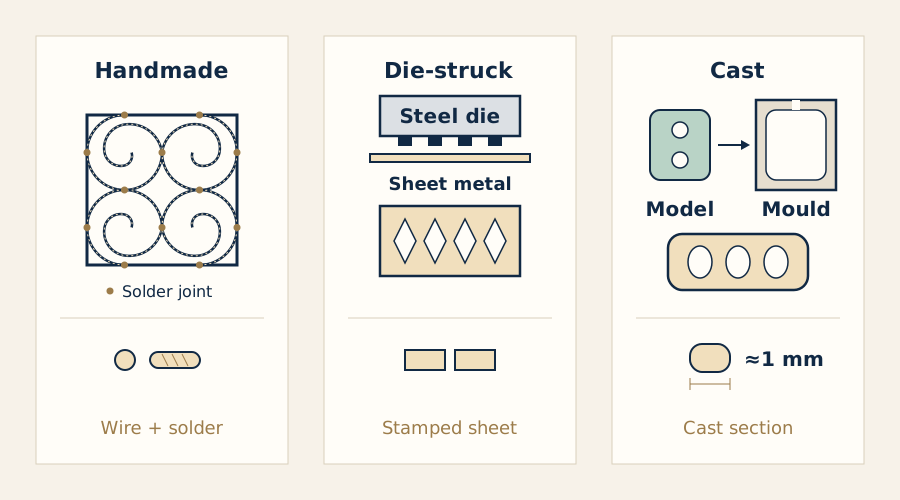
With a loupe (a 10× hand lens), handmade filigree shows tiny solder joints where each curl touches the frame, and the wires have a twisted, rope-like texture. Die-struck work has very sharp, uniform edges and often a maker's or metal stamp inside the band. Cast work shows smooth, rounded inner edges. Original die-struck mounts are a defining feature of the period covered in our guide to Art Deco rings and their geometric filigree.
Modern CAD (computer-aided design) has closed much of the gap. A designer can model a gallery pattern to a tenth of a millimetre, check that every bar is thick enough to be cast well, and print a resin model for casting. That is how most era-style rings are remade today, including copies of damaged antique mounts.
Not sure which one is right?
Send us the stones you are looking at and our gemologist will tell you which to choose and why.
Which filigree engagement ring styles are there?
Filigree is a technique, not a single look, so it combines with many ring styles:
- Edwardian garland: soft swags, bows and leaves in platinum, often with a round or old cushion diamond and milgrain everywhere.
- Art Deco geometric: arches, fans, hexagons and stepped shapes, often with calibré-cut sapphires or small diamonds along the shoulders.
- Floral: curling vines and petals in the gallery, a natural fit with flower-inspired ring settings.
- Halo with filigree gallery: a ring of small diamonds around the centre stone, with lace visible from the side; see our guide to halo engagement rings.
- Double halo: two rows of diamonds, which pairs well with a vintage gallery; read more on double halo rings and how they are built.
- Hidden halo: a row of diamonds under the stone, wrapped in filigree for a quieter look, explained in our hidden halo explainer.
- Asymmetrical: filigree climbing one shoulder only, one of the ideas in our page on asymmetrical engagement ring designs.
If you are torn between a visible halo and one tucked under the stone, our comparison of halo and hidden halo styles sets out the differences in look, height and upkeep. Filigree itself does not make a centre stone look much larger, but a pierced, bright gallery and a halo can; see setting choices that make a diamond look larger.
Filigree is not only for engagement rings. Its delicate look suits right-hand dress rings and lighter promise rings, where the ring takes fewer knocks than an everyday engagement ring.
What metal and stone work best in a filigree setting?
Thin metal has to be strong metal. That is why most original filigree rings are platinum, and why the choice of alloy matters more here than in a plain solitaire.
| Metal | Purity | How it handles filigree |
|---|---|---|
| Platinum (Pt950) | 95% platinum | Strong and dense; fine detail holds well and metal moves rather than snaps. Develops a soft grey patina. |
| 18ct white gold | 75% gold | Crisp detail; usually rhodium plated, which wears from raised edges and needs replating every 1–3 years. |
| 18ct yellow or rose gold | 75% gold | Warm, vintage look; good strength in sections of about 1 mm and above. |
| 9ct gold | 37.5% gold | Harder and cheaper, but more brittle in very thin openwork; better for chunkier patterns. |
Centre stones are less limited. Diamond (10 on the Mohs scale of hardness) and sapphire (9) are both well suited to everyday wear. Natural and lab-grown diamonds sit equally well in filigree; a lab-grown diamond is real diamond, grown in a laboratory rather than mined. Old European and old mine cut diamonds suit Edwardian designs, while round brilliants, Asscher and emerald cuts suit Art Deco patterns. Softer gems such as opal (about 5.5–6.5) or morganite (7.5–8) can be used, but they need a protective bezel or halo.
Are filigree engagement rings durable enough for everyday wear?
A well-made filigree engagement ring can be worn every day for decades; many 1920s mounts are still in use. Problems come from three places: openwork that is too thin, claws rising out of fine wire instead of solid metal, and patterns on the base of the band, which takes the most wear against tables, bags and other rings.
- Resizing: a pierced band usually resizes by only 1–2 sizes before the pattern distorts. Plain-based bands resize more easily.
- Cleaning: warm water, mild detergent and a soft toothbrush. Dirt and lotion build up in the holes, so clean more often than a plain ring.
- Ultrasonic cleaners: avoid them for antique, handmade or heavily repaired filigree, which can loosen solder joints and stones.
- Checks: have claws and milgrain checked about once a year; worn milgrain can be redone by hand.
- Stacking: a plain wedding band beside a filigree ring rubs the pattern. A matching or contoured band, or a slightly softer metal on the band, spreads the wear.
When antique filigree is worn through, it can sometimes be patched with a laser welder. If too much is gone, the usual approach is to measure and model the original pattern in CAD and recast it, keeping the original stones.
How much does a filigree engagement ring cost in Australia?
The setting adds to the price because filigree needs more design time, more finishing and, in platinum, more metal than a plain solitaire. The centre stone still makes up most of the total. These are broad ranges for the setting only, without the centre stone.
| Setting type | Approximate price range (AUD, setting only) |
|---|---|
| Cast 18ct gold filigree setting | about $1,800–$4,500 |
| Cast platinum filigree setting | about $2,500–$6,000 |
| Custom CAD filigree design, 18ct or platinum | about $3,000–$8,000 |
| Original Edwardian or Art Deco ring (with stones) | about $3,000–$30,000+, depending on stones and condition |
For antique rings, the condition of the filigree and claws matters as much as the diamonds. A ring that needs a new head or retipped claws may need several hundred dollars of repair work. Lab-grown centre stones cost much less than natural ones of the same size and grade, which leaves more room in the budget for detailed metalwork.
Explore ring settings and create your own ring
How do you choose or design a filigree engagement ring? Step by step
- Pick the era or look. Edwardian garlands, Art Deco geometry, floral curls or a modern pattern.
- Decide where the filigree goes. Gallery only, gallery and shoulders, or the full band; keep the base of the band plain for everyday wear.
- Choose the metal. Platinum or 18ct gold for fine detail; avoid very thin openwork in 9ct.
- Check the construction. Ask whether it is handmade, die-struck or cast, and confirm openwork of about 1 mm or more.
- Check the claws. They should rise from solid metal and suit the stone's shape and size.
- Plan the wedding band. Make sure a band can sit beside it without rubbing the pattern.
- Get your size right first. A pierced band is hard to resize later, so measure at a comfortable temperature.
Free consultation
Talk to a gemologist
Compare stones in person or online with Raj Sood, Graduate Gemologist (GIA), AJP (GIA).
Book a consultationShop this shape
FAQ
Common questions
What is the difference between filigree and milgrain?
Filigree is openwork pattern made of curled wire or pierced metal. Milgrain is a row of tiny raised beads along an edge. Vintage-style rings often use both.
Are filigree engagement rings durable?
Yes, if the openwork is at least about 1 mm thick, the claws rise from solid metal and the ring is made in platinum or 18ct gold. Very fine handmade wire filigree is better kept for occasional wear.
Can a filigree ring be resized?
Usually by 1–2 sizes. Beyond that the pierced pattern stretches or compresses, so larger changes may need a new section of band made to match.
Is a modern filigree ring real filigree?
Most modern filigree rings are cast from a wax or CAD model rather than built from wire. The jewellery trade calls both filigree, but only wire work is filigree in the strict sense.
How do you clean a filigree engagement ring?
Soak it in warm water with a little mild detergent and brush gently with a soft toothbrush, then rinse and dry. Avoid ultrasonic cleaners on antique or handmade pieces.
Can a damaged antique filigree ring be remade?
Often, yes. Small breaks can be laser welded, and badly worn mounts can be measured, modelled in CAD and recast in the original style, reusing the original stones.
Terms in this guide

Ask a gemologist
Not sure which diamond to choose?
Raj Sood is a Graduate Gemologist (GIA) and master jeweller. Bring the stones you are considering, or send the reports, and he will tell you honestly which one is better and why.
Keep learning
Related guides
 Engagement Rings & SettingsArt Deco Engagement Rings
 Engagement Rings & SettingsEdwardian and Victorian Engagement Rings
 Engagement Rings & SettingsEngagement Ring Anatomy
 Engagement Rings & SettingsFloral Engagement Ring SettingsEngagement Rings & SettingsEngagement Ring Setting Styles Guide
 Engagement Rings & SettingsHistory of Engagement Rings
 Engagement Rings & SettingsHistory of Wedding Rings
 Engagement Rings & SettingsPromise Rings Explained
Explore more
More guides on this topic
Education