
- Education
- Wedding Bands & Eternity
- Women's vs Men's Wedding Band Widths: A Millimetre Guide
Wedding Bands & Eternity
Women's vs Men's Wedding Band Widths: A Millimetre Guide
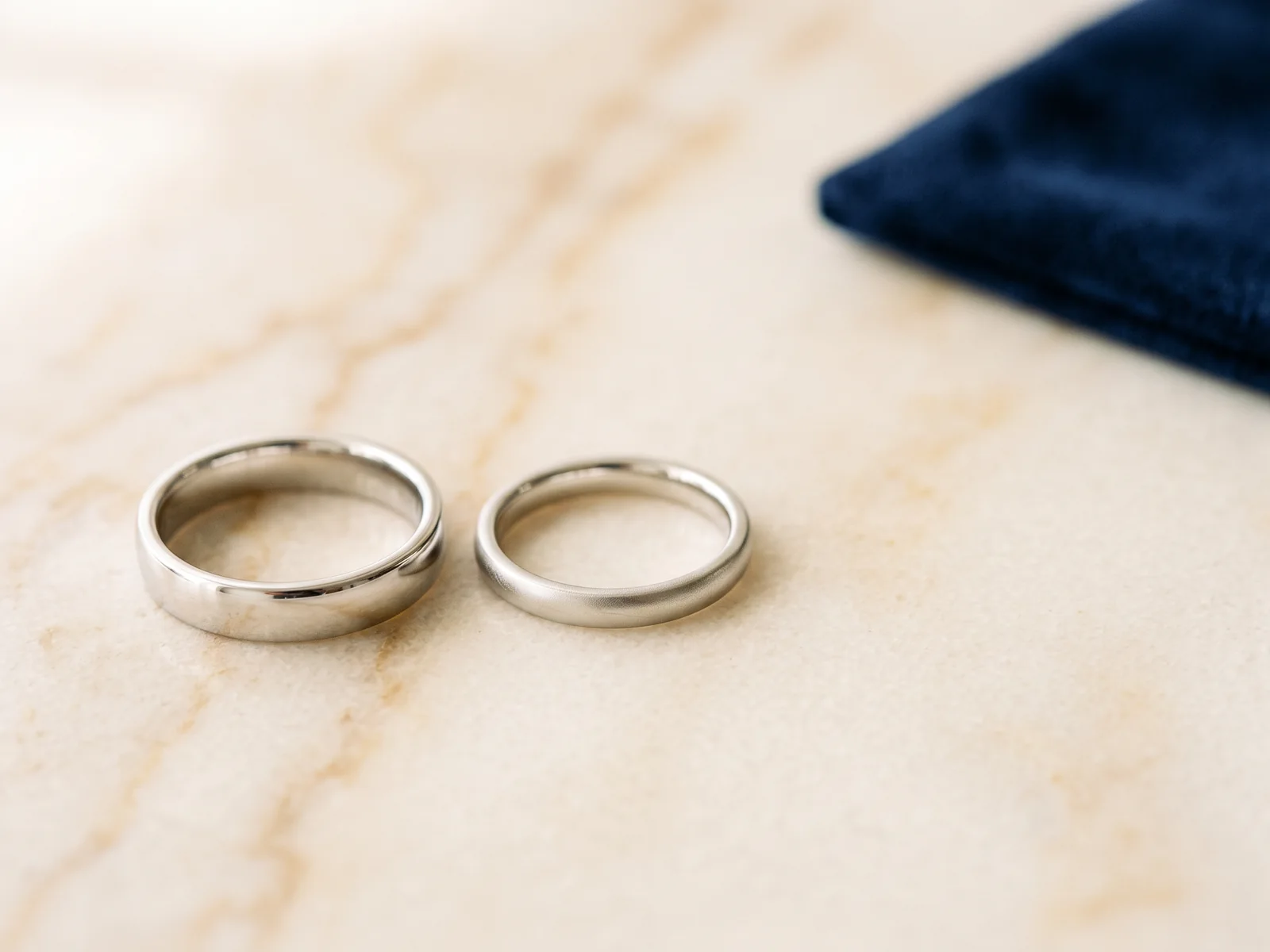
Women's vs men's wedding band widths differ more by habit than by any rule. Knowing the real millimetre numbers helps you choose a band that looks right on your hand and stays comfortable for decades.
 Reviewed by Raj Sood, Graduate Gemologist (GIA), AJP (GIA)Master jeweller and Graduate Gemologist (GIA) · reviewed 4 November 2026
Quick answer
Most women's wedding bands are 1.5–3 mm wide, often chosen to sit beside an engagement ring, while most men's bands are 4–8 mm, with 5–6 mm the most common. These are habits, not rules: pick by finger length, knuckle size, comfort and work. Wider bands feel tighter, so you may need a quarter to half size up.
How wide are women's vs men's wedding band widths on average?
Width is how far the band stretches along your finger, measured across the top in millimetres. It is the number you see on most listings: a "2 mm band" or a "6 mm band". Across Australian jewellery counters, the pattern is fairly consistent. Women's bands cluster between 1.5 and 3 mm, because most are worn beside an engagement ring. Men's bands cluster between 4 and 8 mm, because they are usually worn alone and on a larger hand.
| Width | Usually worn by | How it reads on the hand |
|---|---|---|
| 1.5–2 mm | Mostly women | Fine and delicate; disappears beside an engagement ring |
| 2–3 mm | Mostly women | The classic stacking width; balanced next to most solitaires |
| 3–4 mm | Both | A noticeable band on a slim hand, a slim band on a larger hand |
| 4–5 mm | Mostly men, some women | Understated men's band; a bold women's band worn alone |
| 5–6 mm | Mostly men | The most common men's width; reads as a definite ring |
| 6–8 mm | Mostly men | Wide and strong; suits longer fingers and larger hands |
| 8 mm+ | Some men | A statement band; can feel restrictive when you bend the finger |
These are habits, not rules. Plenty of women wear a 4 or 5 mm plain band on its own, and plenty of men with slim fingers are happier in 3–4 mm. If you are unsure of the difference between the terms, our guide to what separates a wedding ring from a wedding band clears it up, and the wider wedding ring buying guide covers metals, budgets and timing alongside width.
What does wedding band width actually measure?
Two measurements decide how a band looks and feels, and they are often confused:
- Width: the distance along the finger, seen from above. This is what makes a band look slim or wide.
- Thickness (also called depth or height): how far the metal stands up from the skin. This decides how strong the band is and how much it pushes neighbouring fingers apart.
- Profile: the shape of the band's cross-section, such as flat, domed (D-shape), court (rounded inside and out) or knife-edge. Profile changes how wide a given width appears.
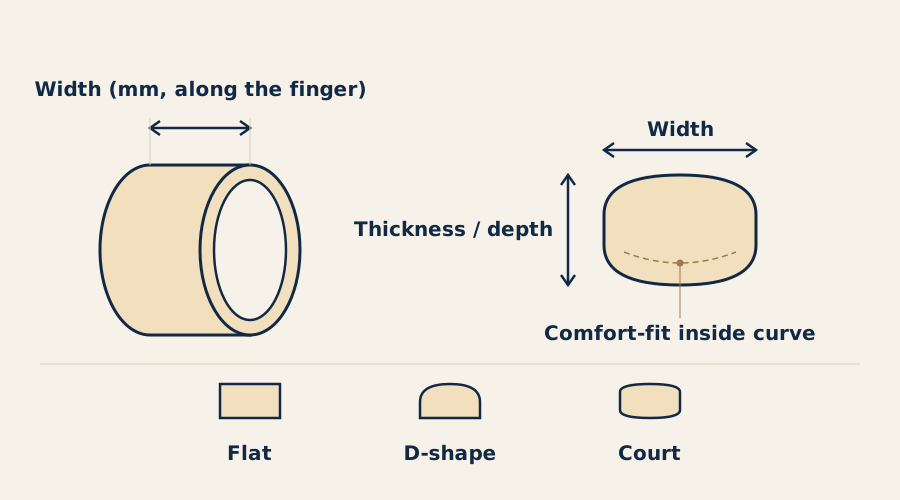
A domed band looks a touch narrower than a flat band of the same width, because the edges curve away from your eye. A flat band shows its full width edge to edge, so a 5 mm flat band can read like a 6 mm domed one. Our page on how flat, court and D-shape profiles change the look shows them side by side, and any unfamiliar term is in the GemTrove jewellery glossary.
For everyday wear, most bands are made around 1.5–2 mm thick. Very fine women's bands under about 1.3 mm thick can bend out of round over years of wear, especially in softer, higher-carat yellow gold such as 18ct. Men's bands for physical work are often 2 mm thick or more.
How do women's vs men's wedding band widths look on different hands?
Width is really about proportion. The same 4 mm band looks wide on a size J finger and slim on a size W. Australia uses letter sizes (A to Z, with half sizes), and finger length matters as much as circumference.
| Your hand | Widths that usually balance | Why |
|---|---|---|
| Short or slender fingers | 1.5–3 mm (women), 3–5 mm (men) | A narrow band leaves more visible finger, so the finger looks longer |
| Long, slim fingers | 2–4 mm (women), 4–6 mm (men) | Room for a little more width without crowding |
| Larger hands, broad fingers | 3–5 mm (women), 6–8 mm (men) | A fine band can look lost; more width keeps the proportion |
| Large knuckles | Comfort-fit profile at any width | The band must pass the knuckle but not spin at the base |
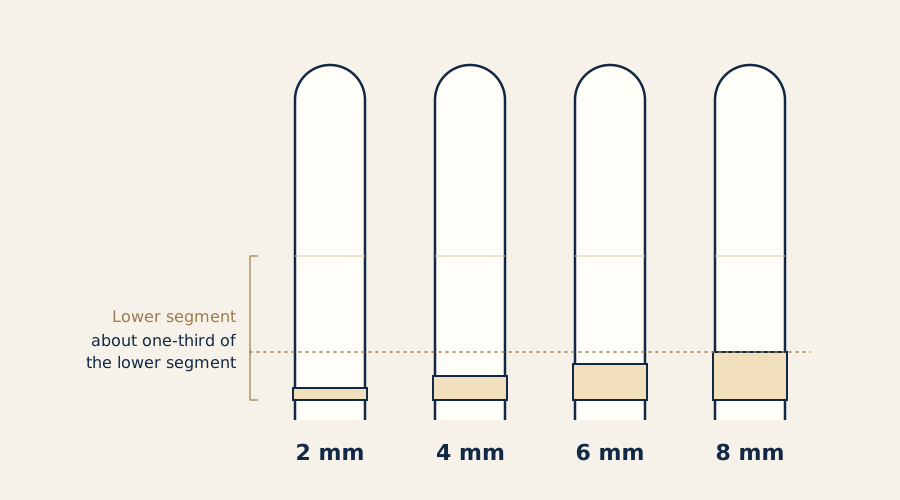
A useful rule of thumb: the band should cover no more than about a third of the lower segment of your finger, between the base and the first knuckle. Beyond that it starts to feel like it restricts bending. Men looking at styles and metals in more depth will find the complete men's wedding band guide useful, as it pairs widths with profiles and finishes.
Does wedding band width affect ring size and comfort?
Yes. A wider band has more metal in contact with your skin, so it grips the finger along a longer stretch and feels tighter than a narrow band of the same size. Fingers also swell in heat, after exercise and in the evening, which you notice more under a wide band.
| Band width | Typical sizing adjustment | Comfort notes |
|---|---|---|
| 1.5–4 mm | Usually your normal size | Easy to wear; little difference from sizer to ring |
| 5–6 mm | Often your normal size, sometimes a quarter size up | Try a sizer of the same width |
| 6–8 mm | Often a quarter to half size up | A comfort-fit inside helps a lot |
| 8 mm+ | Often half a size up | Try before deciding; can trap moisture and heat |
Comfort fit means the inside of the band is gently rounded rather than flat, so it slides over the knuckle more easily and sits without a hard edge. It adds a little metal, and therefore a little cost, but on bands of 5 mm and wider most people notice the difference straight away.
Not sure which one is right?
Send us the stones you are looking at and our gemologist will tell you which to choose and why.
What width wedding band suits an engagement ring?
For women's bands worn with an engagement ring, the usual starting point is to match the width of the engagement ring's shank (the band part of the ring), which is typically 1.8–2.5 mm. Matching widths make the two rings read as a set. A band slightly wider than the shank looks deliberate; a band only a fraction wider or narrower can look like a mismatch. Our guide on matching a wedding band to your engagement ring goes into metal colour and profile as well.
- Total stack width: the engagement ring plus the band. On short fingers, keeping the combined width around 5 mm or less stops the stack looking heavy.
- Low-set centre stones: if the setting sits low, a straight band may leave a gap or not sit flush; see bands designed for low-set engagement rings.
- Square and angular stones: straight, even widths suit a princess cut well; our page on wedding bands that pair with princess cuts covers the options.
- Halos and wide settings: a contoured band may be needed so the two rings touch along their length.
When a straight band cannot sit flat against the engagement ring, the answer is a band shaped to follow it. Read how custom fitted bands are shaped to an engagement ring for the process. Many couples find it simpler to plan both together from the start, which is the question we look at in designing the engagement ring and band as a pair.
Related guideCurved vs Straight Wedding BandsWhich wedding band width lasts best over time?
Durability depends more on thickness and metal than on width, but width still matters. A wider band spreads knocks across more metal, so it is less likely to dent or go out of round. It also shows its surface more, so scratches and scuffs are more visible on a wide polished band than on a fine one.
- Polished finish: bright and reflective; on a 6–8 mm band, fine scratches show within weeks and soften to a satin look over a year. It can be polished back up.
- Brushed or satin finish: fine parallel lines that hide small scratches well, which suits wider men's bands. It gradually polishes itself in high-contact spots and can be re-brushed.
- Hammered or textured finish: very forgiving of wear; the texture softens over years and can be re-cut if needed.
- White gold: usually rhodium plated (a thin coating of a bright white metal). The plating wears first on wide bands, often within one to two years, and can be replated.
Each refinish removes a tiny amount of metal. On a band made at 2 mm thick, that is no concern over a lifetime; on a very fine 1.2 mm band, repeated heavy polishing eventually thins it. For anyone who works with tools, weights or machinery, our guide to choosing a men's band for hands-on work covers thickness, metals and safety. Simple care habits are in the yearly wedding band maintenance checklist.
How does band width change with diamond wedding bands?
With diamond bands, width and stone size are linked. The band must be wider than the diamonds so there is metal to hold them. As a rough guide, a claw or shared-claw band is about 0.3–0.6 mm wider than the stones, and a channel or bezel band a little more again.
| Diamond size | Approximate carat each | Typical band width |
|---|---|---|
| 1.3 mm | about 0.01 ct | 1.6–2.0 mm |
| 1.8 mm | about 0.025 ct | 2.0–2.4 mm |
| 2.0 mm | about 0.03 ct | 2.2–2.6 mm |
| 2.5 mm | about 0.06 ct | 2.8–3.2 mm |
| 3.0 mm | about 0.10 ct | 3.3–3.8 mm |
Diamonds can be natural or lab-grown; a laboratory-grown diamond is real diamond grown in a lab rather than mined, and both look the same in a band. For more on scaling stones to the band, see how big diamonds should be in a wedding band. If you are still deciding whether to add stones at all, plain and diamond bands compared weighs up the look, wear and cost.
Should women's and men's wedding bands be the same width?
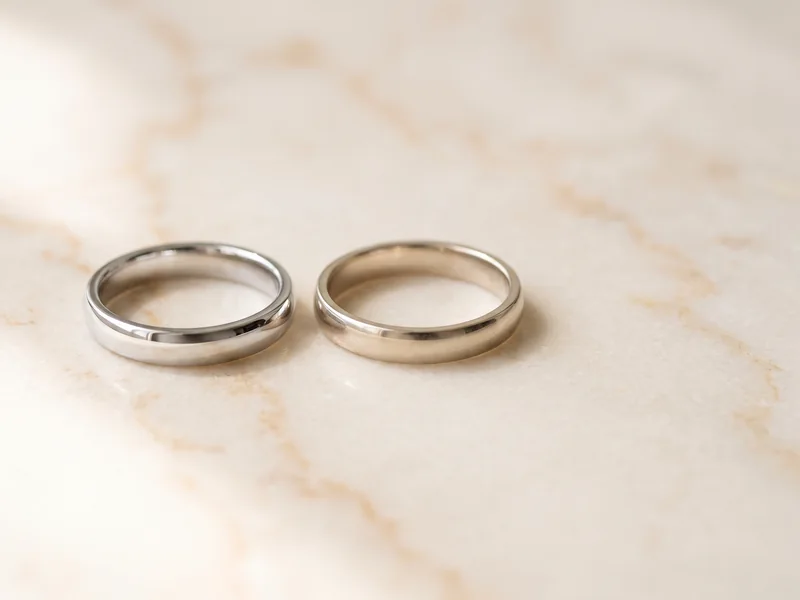
They do not need to be. Most couples choose different widths and link the two bands through metal, profile or finish instead. A common pairing is a 2 mm women's band with a 5 or 6 mm men's band in the same metal and profile, so they read as a set without forcing either person into a width that does not suit their hand.
| Women's band (typical) | Men's band (typical) | |
|---|---|---|
| Width | 1.5–3 mm | 4–8 mm |
| Thickness | 1.3–1.8 mm | 1.6–2.5 mm |
| Usually worn | Beside an engagement ring | On its own |
| Common profiles | Court, D-shape, flat | Court, flat, comfort-fit |
| Common finishes | Polished, diamond-set | Polished, brushed, hammered |
| Sizing change | Rarely needed | Often ¼–½ size up at 6 mm+ |
| Approx. 18ct gold weight | about 2–4 g | about 5–12 g |
Our piece on whether couples' bands should match has more ideas for linking two different widths, from matching finishes to a shared engraving inside.
How much does wedding band width change the price?
For plain bands, price follows metal weight, and weight rises roughly in step with width and thickness. Doubling the width of a band of the same thickness roughly doubles the metal in it. Platinum is denser than 18ct gold, about 20–21 g per cubic centimetre against about 15–16 g, so the same band weighs more in platinum and usually costs more.
| Plain band, comfort fit | Approximate price range (AUD) |
|---|---|
| 2 mm, 9ct gold | about $300–$700 |
| 2 mm, 18ct gold | about $600–$1,400 |
| 5 mm, 18ct gold | about $1,300–$2,800 |
| 6 mm, 18ct gold | about $1,600–$3,500 |
| 6 mm, platinum | about $2,000–$4,500 |
| 8 mm, 18ct gold | about $2,200–$4,800 |
These are broad ranges only. Gold and platinum prices move daily, and finish, profile and size all shift the figure. Diamond bands are priced mainly on the stones, so width matters less there than stone count, size and quality.
Create your wedding band: choose your width, metal and profile
How do you choose the right wedding band width? Step by step
- Start with the typical range. 1.5–3 mm for a band worn beside an engagement ring, 4–6 mm for most men's bands worn alone.
- Look at your finger length. Shorter fingers usually suit the lower end of each range; longer fingers can carry more width.
- Match the engagement ring. For a stack, aim for a width close to the engagement ring's shank and check the two sit flush.
- Decide on thickness and profile. About 1.5–2 mm thick for daily wear, more for physical work; choose a comfort fit at 5 mm and wider.
- Get sized at the real width. Use a sizer of the same width, morning and evening, and allow a quarter to half size up for wide bands.
- Think about the finish. Wider bands show scratches more; brushed or hammered finishes hide wear, polished bands can be refinished.
- Try two widths side by side. Wear, say, 4 mm and 6 mm for a few minutes each; the right one usually stops feeling noticeable.
Free consultation
Talk to a gemologist
Compare stones in person or online with Raj Sood, Graduate Gemologist (GIA), AJP (GIA).
Book a consultationShop this shape
FAQ
Common questions
What is the average women's wedding band width?
Most women's wedding bands are 1.5–3 mm wide, with about 2 mm the most common because it matches the shank of many engagement rings. Women who wear a band on its own often choose 3–5 mm.
What is the average men's wedding band width?
Most men's bands are 4–8 mm, and 5–6 mm is the most common choice. Men with slim or short fingers are often more comfortable at 4–5 mm.
Is a 2 mm wedding band too thin?
Not if it is made thick enough. A 2 mm wide band at around 1.5 mm or more in thickness is fine for everyday wear; very thin bands under about 1.3 mm can bend over time.
Do wider wedding bands need a bigger ring size?
Often, yes. Bands of 6 mm and wider usually feel tighter, so many people need a quarter to half size up; sizing with a sizer of the same width gives the clearest answer.
What width wedding band suits short fingers?
Narrower bands usually look better on short fingers because they leave more of the finger visible: about 1.5–3 mm for women and 3–5 mm for men. A domed profile also looks slimmer than a flat one.
Can a wedding band be made wider or narrower later?
A band can be resized for finger size, but changing its width generally means remaking it. It is worth trying a few widths before the band is made.

Ask a gemologist
Not sure which diamond to choose?
Raj Sood is a Graduate Gemologist (GIA) and master jeweller. Bring the stones you are considering, or send the reports, and he will tell you honestly which one is better and why.
Keep learning
Related guides
 Wedding Bands & EternityMen’s Wedding Band Guide
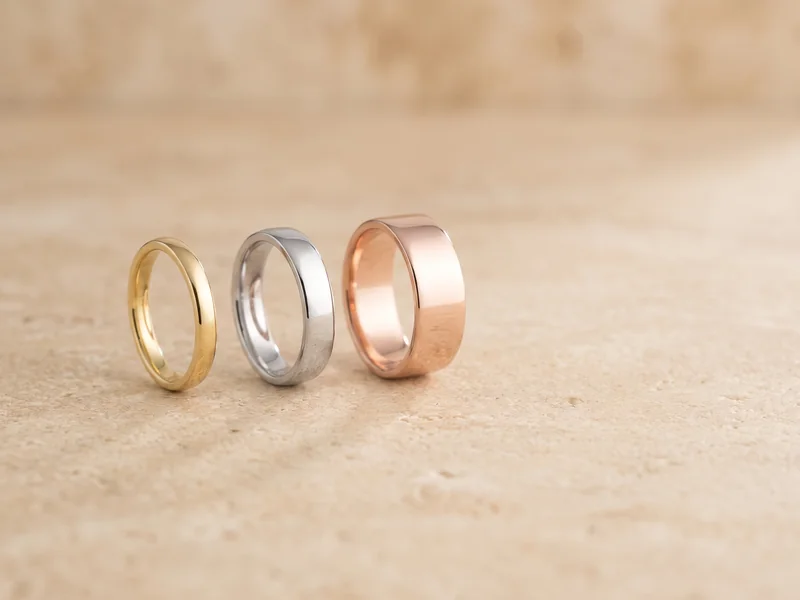 Wedding Bands & EternityWedding Band Profiles Explained
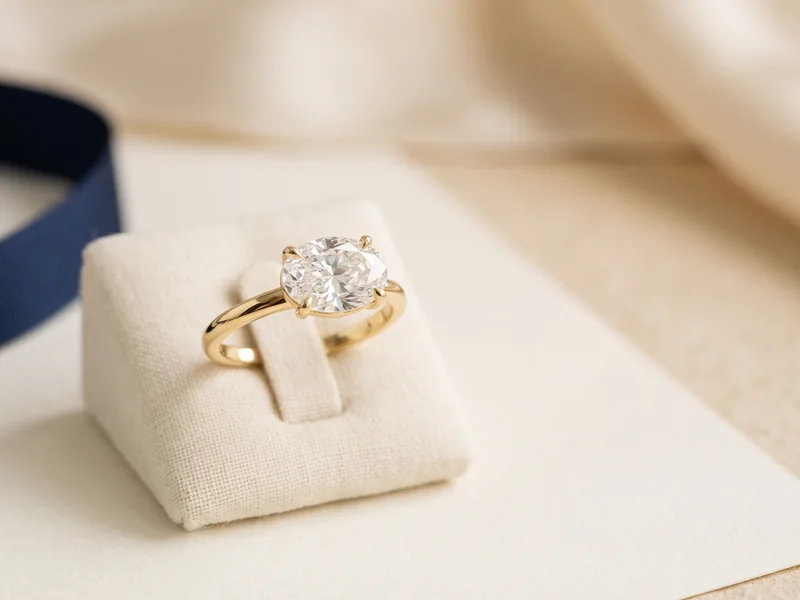 Wedding Bands & EternityHow to Match a Wedding Band to an Engagement Ring
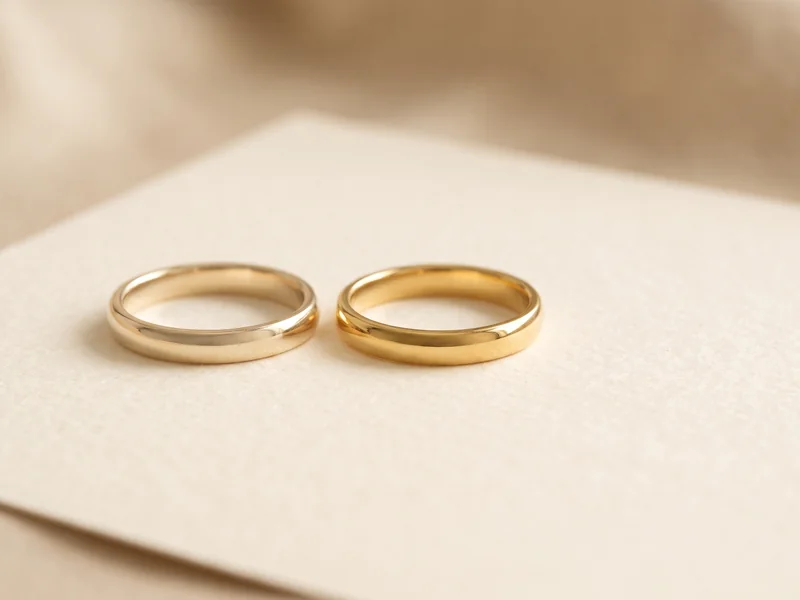 Wedding Bands & EternityShould Couples’ Wedding Bands Match?Wedding Bands & EternityWedding Ring Buying Guide
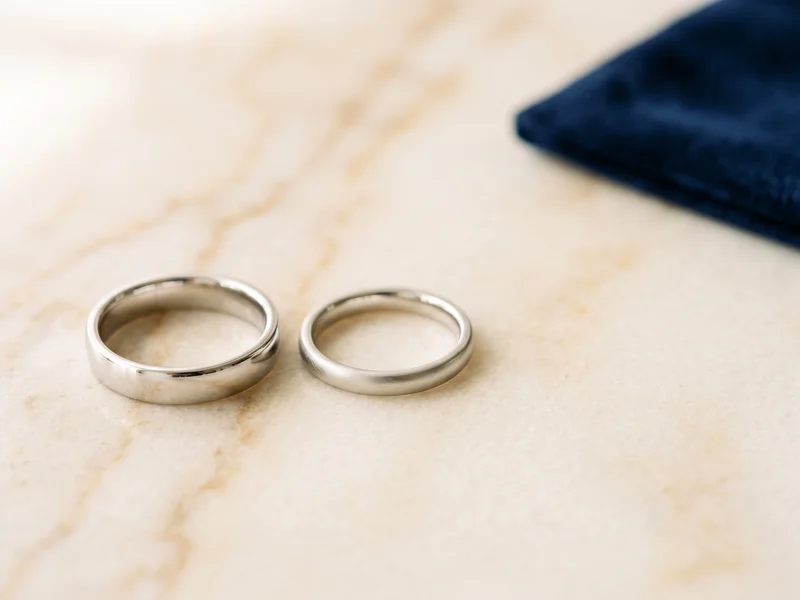 Wedding Bands & EternityHow to Choose a Men’s Wedding Band for Hands-On Work
 Wedding Bands & EternityWedding Ring vs Wedding Band
 Wedding Bands & EternityPlain vs Diamond Wedding Bands
Explore more
More guides on this topic
Education