
- Education
- Engagement Rings & Settings
- Vintage Engagement Rings: A Guide to Eras, Antique Cuts and Old-World Detail
Engagement Rings & Settings
Vintage Engagement Rings: A Guide to Eras, Antique Cuts and Old-World Detail
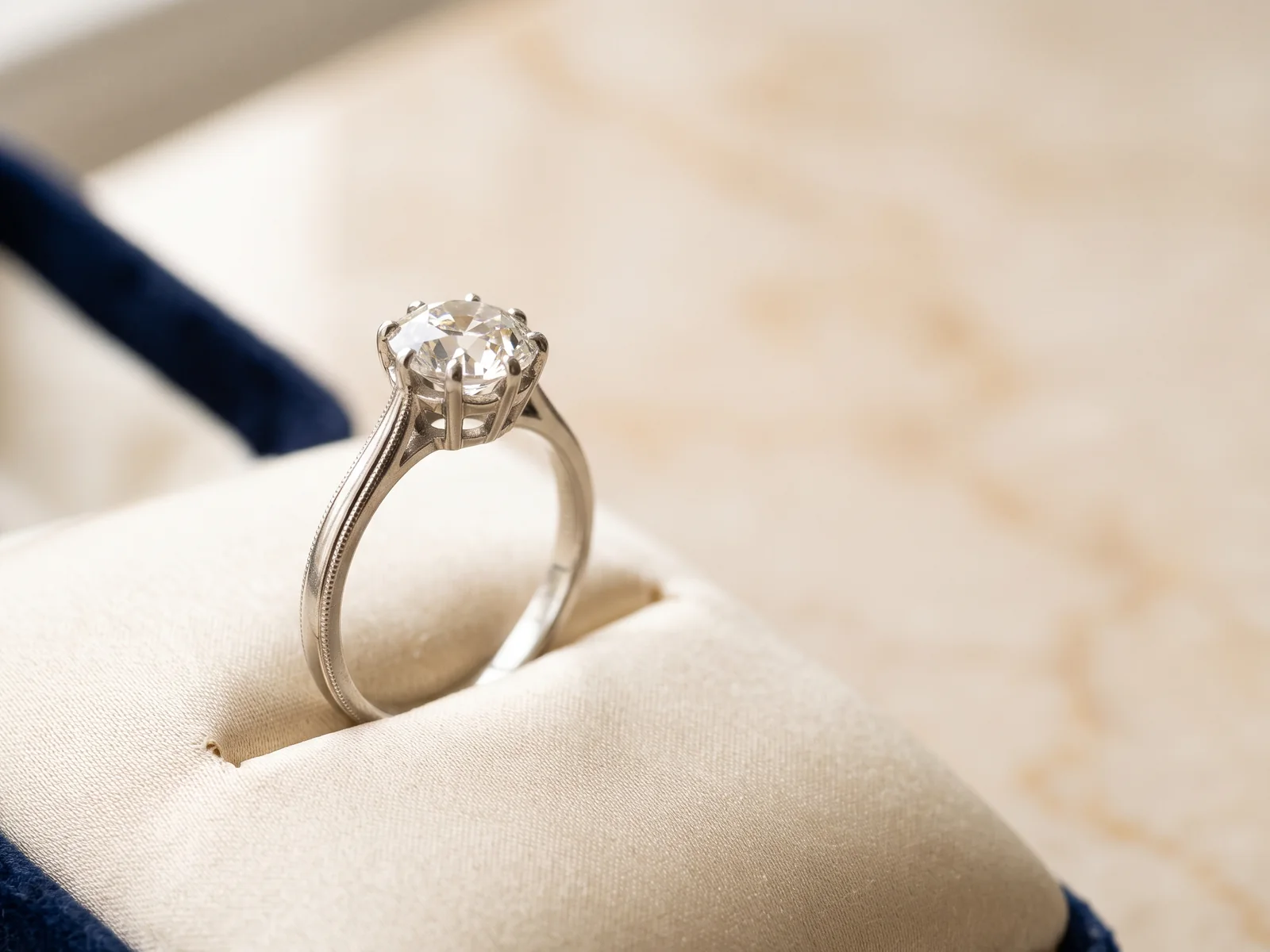
Vintage engagement rings carry more than a look: they bring older diamond cuts, hand-finished metalwork and, in a true antique, a hundred years of wear. Here is how to tell the eras apart, what to check, and how each style holds up over time.
 Reviewed by Raj Sood, Graduate Gemologist (GIA), AJP (GIA)Master jeweller and Graduate Gemologist (GIA) · reviewed 4 November 2026
Quick answer
Vintage engagement rings are either genuinely old rings (antique usually means 100+ years) or new rings made in an older style. Most draw on three eras: Victorian (1837–1901), Edwardian (about 1901–1915) and Art Deco (about 1920–1935). Look for old mine or Old European cut diamonds, milgrain, filigree and engraving, and check claws and shank thickness before buying.
What are vintage engagement rings?
Vintage engagement rings fall into two camps. A true antique is a ring that is genuinely old. In the jewellery trade, antique usually means 100 years or more, while vintage is used loosely for anything from about 20 to 100 years old. A vintage-inspired (or vintage-style) ring is newly made, but borrows the shapes, diamond cuts and hand-finished details of an earlier era. Both turn up under the same search, so it is worth asking which one you are looking at before you compare prices.
What makes a ring read as vintage is rarely one feature. It is a combination: an older diamond cut with broader, chunkier flashes of light, fine metal detail such as milgrain (a row of tiny beads along an edge), filigree or hand engraving, and a design that is decorated from the side and underneath, not just from the top. A modern solitaire tends to lift the stone high on thin claws. Older rings usually sit lower and treat the whole head of the ring as something to look at.
If you meet a term in this guide you haven't seen before, our plain-English jewellery glossary has a short definition. To see how vintage designs sit alongside solitaires, halos, bezels and the rest, start with the overview of engagement ring setting styles.
Which eras do vintage engagement rings come from?
Each period has its own metals, cuts and motifs, and once you know them you can usually date a ring, or brief a jeweller on a new one, quite precisely. The dates below are the usual style periods; real rings overlap at the edges.
| Era | Approx. dates | Typical metals | Typical stones and cuts | Signature look |
|---|---|---|---|---|
| Georgian | 1714–1837 | High-carat yellow gold, silver-topped gold | Rose cuts, early old mine cuts, foil-backed stones in closed settings | Clusters and closed backs; rare and often fragile |
| Victorian | 1837–1901 | Yellow and rose gold (15ct and 18ct common in Britain) | Old mine and rose cuts, coloured gems, pearls | Half-hoop rows, clusters, engraved shanks, sentimental motifs |
| Edwardian | about 1901–1915 | Platinum, or platinum-topped gold | Old European and old mine cuts, pearls | Lace-like milgrain, pierced galleries, bows and garlands |
| Art Deco | about 1920–1935 | Platinum, early white gold | Old European and transitional cuts, calibré coloured stones | Geometric lines, stepped shoulders, sharp colour contrast |
| Retro | about 1935–1950s | Rose and yellow gold | Transitional cuts, smaller diamonds, synthetic rubies | Bold, sculptural, curved metal |
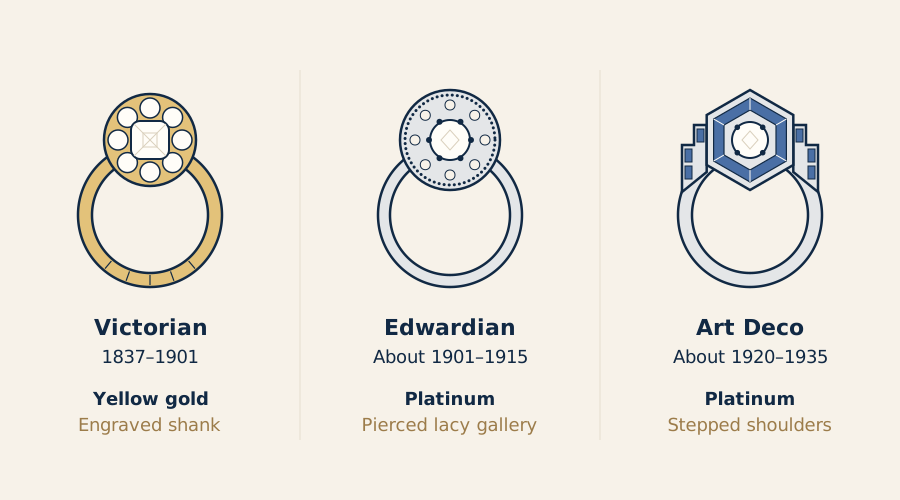
Platinum is the reason rings from about 1900 look so delicate. It is strong enough to hold a diamond in very fine claws and openwork, so Edwardian jewellers could make heads that look almost like lace. Our guide to Edwardian and Victorian ring styles covers both of these softer, more romantic periods in detail. Art Deco kept the platinum but swapped curves for straight lines, hexagons and stepped shapes, often framing a white diamond with blue sapphire or red ruby; see what defines an Art Deco engagement ring.
A gemmologist's note on older coloured stones: lab-created (synthetic) rubies and sapphires have been made by flame fusion since the early 1900s, and many Art Deco and Retro rings use them, especially in small calibré (cut-to-fit) strips. That does not make the ring any less genuinely old, but the stones should be described as synthetic. Georgian and Victorian pieces can also contain paste (glass) or foil-backed stones, which is why an independent check matters with any antique.
What diamond cuts suit a vintage style engagement ring?
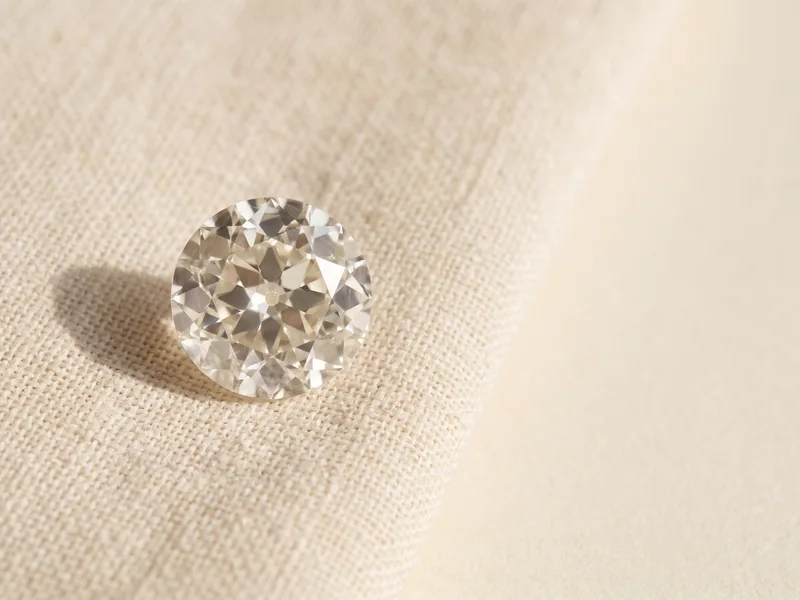
Before about the 1930s, diamonds were cut by eye and by hand, to keep as much weight from the rough crystal as possible. The result is a different kind of sparkle: larger, slower flashes of light rather than the fine, bright pinpoint sparkle of a modern round brilliant. Most vintage-style rings use one of the cuts below, or a modern cut made to look like one.
| Cut | Outline | Main era | Facets | How it looks |
|---|---|---|---|---|
| Old mine | Squarish with rounded corners | 1700s–early 1900s | Usually 58 | High crown, small table, large open culet; chunky, candle-lit flashes |
| Old European | Round | about 1870s–1930s | Usually 58 | High crown, small table, open culet; broad flashes, often a visible culet circle |
| Transitional | Round | about 1930s–1950s | Usually 58 | Halfway to modern: larger table, smaller culet |
| Rose cut | Round, oval or pear | 1500s onwards | Usually 12–24 | Flat base, domed top of triangular facets; soft glow, not much fire |
| Modern round brilliant | Round | 1919 design, refined since | 57–58 | Bright, crisp pinpoint sparkle; the standard today |
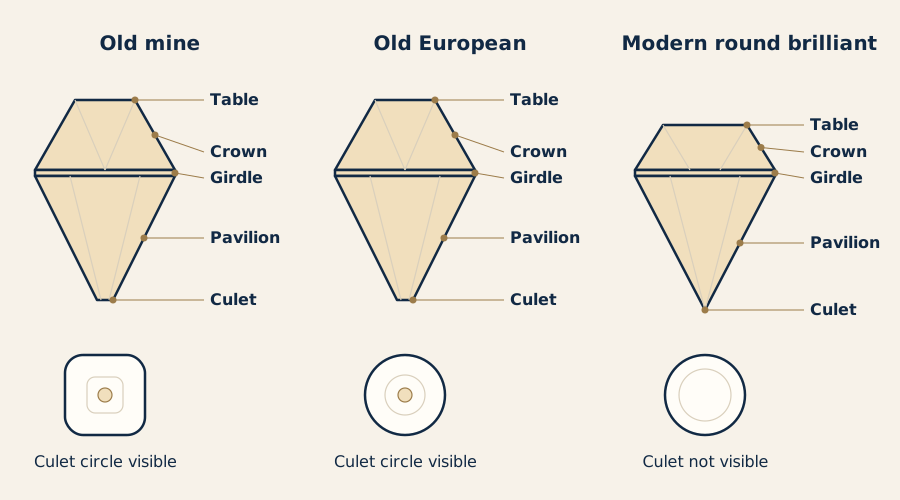
The culet is the bottom point of the diamond. On old cuts it was polished into a small flat facet, so face-up you may see a tiny circle in the centre. That is normal and part of the character, not a flaw. The cushion-like old mine is covered in our old mine cut diamond guide, and the round version in our guide to the Old European cut and its open culet. If you are weighing an old cut against a modern one, compare them in how an Old European differs from a modern round and old mine versus a modern cushion cut. For rose cuts as well, see the family of antique diamond cuts.
Old cuts were often chosen and cut with less attention to colour than today, so many sit in the warmer J–M range. In a yellow or rose gold ring that warmth looks right; in platinum some people prefer H–I. Labs such as GIA grade an old cut's colour and clarity in the usual way, but they do not give it the same overall cut grade as a modern round, so judge the stone by eye and on video. New diamonds cut in old mine and Old European styles are available in both natural and laboratory-grown diamond, and the report will always say which. For genuinely old stones recovered from earlier jewellery, read about where old-stock and antique diamonds come from.
What details make an engagement ring look vintage?
The metalwork is where vintage character really lives. These are the details to look for, or to ask for in a new ring:
- Milgrain: a line of tiny beads, often about 0.3–0.5 mm each, run along the edges of the band, bezel or halo with a small wheel tool. It softens the outline and catches light.
- Filigree: openwork patterns. True filigree is built from fine twisted wire; many Art Deco rings used die-struck (pressed) openwork that looks similar. Either way it lets light reach the stone from the side.
- Hand engraving: leaves, scrolls or geometric patterns cut into the shoulders and band with a graver.
- Pierced or open gallery: the gallery is the metal framework under the centre stone. Vintage galleries are often cut out in hearts, arches or scrolls.
- Clusters and halos: a centre stone ringed by smaller diamonds, common from Georgian times through to Art Deco.
- Collet and bezel settings: the stone sits in a metal cup or rim instead of claws, typical of earlier rings.
- Split or engraved shanks: a band that divides near the head, or carries pattern all the way round.
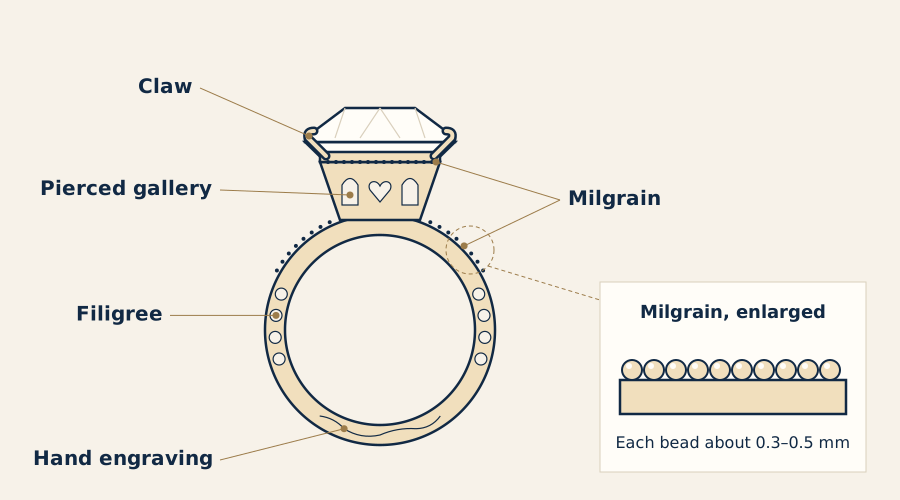
Filigree is a whole style in itself, and our page on filigree engagement ring designs shows the main patterns. Much of the beauty of a vintage ring is seen from the side, so the area under the stone deserves real thought; see these ideas for under-gallery detail. A new ring can also carry private touches that old rings rarely had, such as a hidden stone in the band or a message inside it. Our guide to the personal details hidden inside custom rings collects them, and you can even have a date laser-inscribed on the stone itself with girdle engraving for names and dates.
Not sure which one is right?
Send us the stones you are looking at and our gemologist will tell you which to choose and why.
Should you buy a true antique or a vintage-inspired ring?
Both are good choices for different reasons. The question is how much you value the history of a real antique against the practicality of a ring built for you now.
| Genuine antique | Vintage-inspired (new) | |
|---|---|---|
| History | Real age and story; one of a kind | Made now in an older style |
| Diamond | Original old cut, hand-cut | Your choice: old-style cut or modern, natural or lab-grown |
| Condition | Varies; may have worn claws, thin shank, old repairs | New metal at full thickness |
| Size | Fixed design; resizing may be limited | Made to your finger size |
| Wedding band fit | Often needs a shaped or custom band | Can be designed to sit flush with a band |
| Durability | Depends on how much metal is left | Built with today's thicknesses |
| Changes | Altering it can reduce its antique character | Every detail can be adjusted before it is made |
If you love a particular antique but it is badly worn, a common middle path is to keep the original old cut diamond and set it in a new vintage-style mount. You keep the stone's history and gain a ring that will wear well for decades.
Related guideOld-Stock and Antique DiamondsHow do vintage engagement rings wear over the years?
This is the part most guides skip, and it is where a repair bench sees the truth. Fine vintage detail is beautiful, but thin metal wears faster than thick metal. When an antique ring comes in for a check, these are the things a jeweller looks at first:
- Shank thinning: the bottom of the band takes decades of knocks and rubbing. A shank that started near 2 mm can wear below 1 mm, at which point it can crack or bend. The fix is a new section of shank (re-shanking).
- Worn claws: claw tips wear flat until the diamond is barely held. They can be re-tipped with new metal, usually by laser welding close to the stone.
- Flattened milgrain and engraving: beading and engraved lines soften with wear. Milgrain can be re-run and engraving recut, though each recut removes a little metal.
- Gallery and filigree cracks: fine openwork can crack or catch on fabric.
- Old soft-solder repairs: past repairs done with lead-based solder are common in antiques. That solder must be removed before any heat is used near it, or it can eat into gold and platinum.
- Chipped girdles: an old diamond may have small chips on its edge from earlier settings, often hidden under claws.
New vintage-inspired rings avoid most of this by starting heavier: a shank of about 1.8–2.2 mm, claws thick enough to re-tip later, and milgrain set slightly back from the very edge, where it wears more slowly. White gold rings are usually rhodium plated and may need re-plating every one to two years to stay bright white; platinum does not need plating and develops a soft grey patina instead. A check of claws and settings every year or so is sensible for any engagement ring, and especially for one with fine detail.
Resizing is the other practical limit. Plain bands resize easily. Rings engraved all the way round, set with stones along the band, or built with split shanks may only move a size or so without losing pattern, so get the size right before an antique is altered.
Which settings and metals suit a vintage engagement ring?
Match the metal to the era you love. Platinum (usually 950 platinum, meaning 95% pure) is right for Edwardian and Art Deco looks: it is dense, holds fine detail well and stays white. 18ct white gold gives a similar look at a lower cost, with rhodium plating for colour. 18ct yellow or rose gold suits Victorian and Retro styles, and flatters warmer old cut diamonds. 9ct gold is durable but has a paler colour that looks less like period gold.
For the head of the ring, the usual vintage choices are a milgrain-edged bezel, a halo or cluster, six or eight fine claws, or a square or hexagonal Art Deco frame. Old mine cuts in particular look right in some settings and awkward in others; our guide to settings that flatter an old mine diamond goes through each option with examples.
A vintage-style ring can be made fully custom or by adapting an existing design. Custom gives you every detail; semi-custom is quicker and usually costs less. See how custom and semi-custom rings compare. Because so much of a vintage ring's detail is fine and three-dimensional, a CAD render (a computer model of the ring) is the easiest way to check milgrain, gallery and shoulder detail before any metal is cast.
How much do vintage engagement rings cost in Australia?
Price depends far more on the centre diamond than on the vintage detail, though handwork such as engraving and filigree adds labour. These are broad ranges only.
| Ring type | Approximate price range (AUD) |
|---|---|
| Vintage-inspired setting only, 18ct gold or platinum | about $2,500–$7,000 |
| Vintage-inspired ring with a 1 ct lab-grown old-style centre | about $4,000–$9,000 |
| Vintage-inspired ring with a 1 ct natural old cut centre | about $10,000–$25,000 |
| Genuine antique ring, about 0.50 ct old cut centre | about $3,000–$10,000 |
| Genuine Edwardian or Art Deco ring, about 1 ct centre | about $10,000–$30,000 or more |
With genuine antiques, condition, maker, original parts and documented history all move the price, and so does the cost of any repairs it will need. Lab-grown diamonds are real diamond grown in a laboratory; they cost much less than natural stones of the same size and grade and are available in old mine and Old European styles. Natural old cuts are rarer, and true antique stones cannot be made again. Choose on what you value, not on resale.
Design a vintage-style ring: settings and custom work
Can you turn an heirloom into a vintage-style engagement ring?
Yes, and it is one of the most common ways people end up with an old cut diamond. A grandmother's ring might have a worn shank but a lovely Old European centre. That stone can be reset in a new mount that keeps the era's character but is built at modern thickness.
It is usually better to keep an old cut as it is than to recut it to a modern round. Recutting brightens the sparkle but removes a significant share of the weight and all of the stone's period character. Old gold can be reused too, though antique alloys vary, so it is often refined first. Our step-by-step guide on redesigning an inherited ring explains what can be kept and what has to be new.
How to choose a vintage engagement ring: step by step
- Decide antique or vintage-inspired. A real antique for history, a new ring for full control over size, durability and detail.
- Pick your era. Victorian warmth, Edwardian lace or Art Deco geometry; this sets the metal and motifs.
- Choose the cut and read the report. Old mine, Old European, transitional or rose cut; confirm whether the diamond is natural or lab-grown and check colour and clarity.
- Inspect the condition. On an antique, check shank thickness, claw tips, gallery cracks and signs of old solder repairs.
- Check sizing limits. Ask how far the ring can be resized without damaging engraving or stones.
- Plan the wedding band. Low vintage heads and wide shoulders often need a shaped or custom band to sit flush.
- See it before it is made. For a new ring, review a CAD render of the side, gallery and milgrain before casting.
- Book regular checks. Have claws and settings looked at about once a year to catch wear early.
Free consultation
Talk to a gemologist
Compare stones in person or online with Raj Sood, Graduate Gemologist (GIA), AJP (GIA).
Book a consultationShop this shape
FAQ
Common questions
What is the difference between vintage and antique engagement rings?
In the trade, antique usually means a ring 100 years old or more, while vintage loosely covers rings about 20 to 100 years old. Vintage-inspired rings are new rings made in an older style.
Are antique engagement rings durable enough for everyday wear?
Many are, but it depends on how much metal is left. A jeweller should check the shank, claws and gallery first; worn parts can usually be rebuilt so the ring is safe to wear daily.
Can a vintage engagement ring be resized?
Plain bands resize easily. Rings with engraving or stones all the way round, or split shanks, may only move about one size without losing pattern, so ask before any work is done.
Can I get a vintage style engagement ring with a lab-grown diamond?
Yes. Lab-grown diamonds are cut in old mine and Old European styles and suit any vintage-inspired mount. The grading report will state that the diamond is laboratory-grown.
What is an Art Deco engagement ring?
An Art Deco ring comes from, or copies, the period of roughly 1920 to 1935. It is usually platinum or white gold, with geometric shapes, stepped shoulders and often contrasting sapphires or rubies.
Why does my old diamond have a small circle in the middle?
Old mine and Old European cuts have an open culet, a small flat facet at the bottom point. Face-up it can show as a tiny circle, which is normal for these cuts.

Ask a gemologist
Not sure which diamond to choose?
Raj Sood is a Graduate Gemologist (GIA) and master jeweller. Bring the stones you are considering, or send the reports, and he will tell you honestly which one is better and why.
Keep learning
Related guides
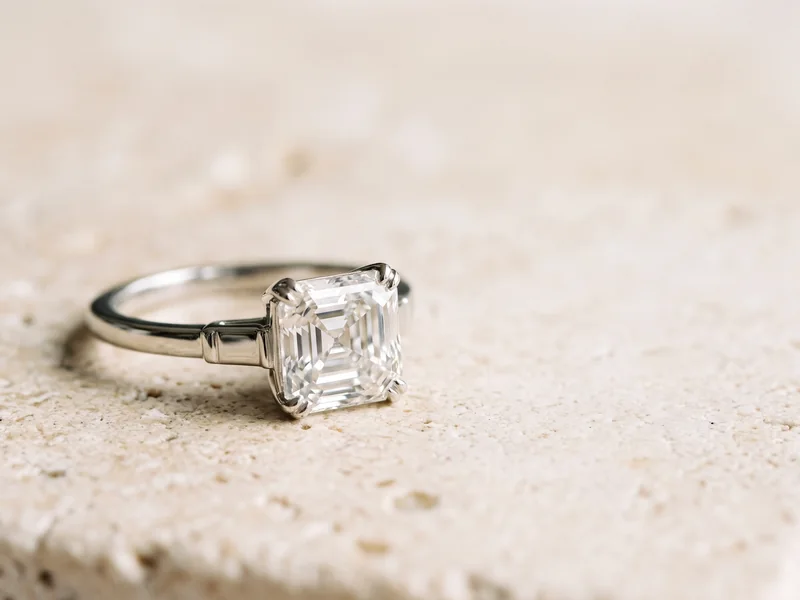 Engagement Rings & SettingsArt Deco Engagement Rings
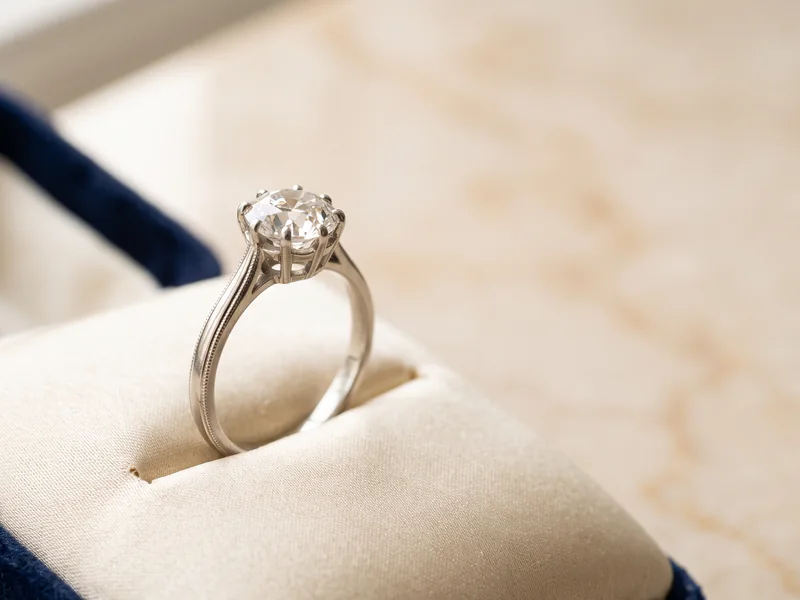 Engagement Rings & SettingsEdwardian and Victorian Engagement Rings
 Engagement Rings & SettingsFiligree Engagement Rings
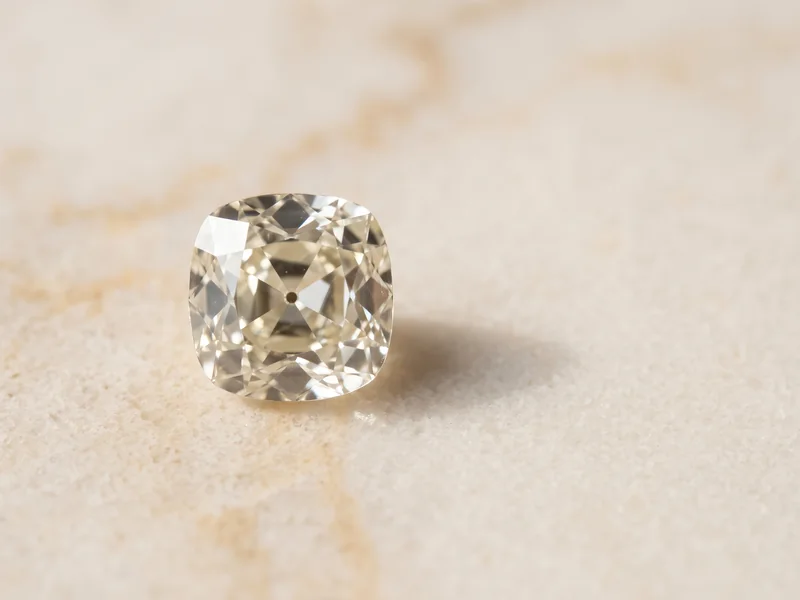 Engagement Rings & SettingsBest Settings for Old Mine DiamondsEngagement Rings & SettingsEngagement Ring Setting Styles GuideDiamond ShapesOld Mine Cut Diamonds
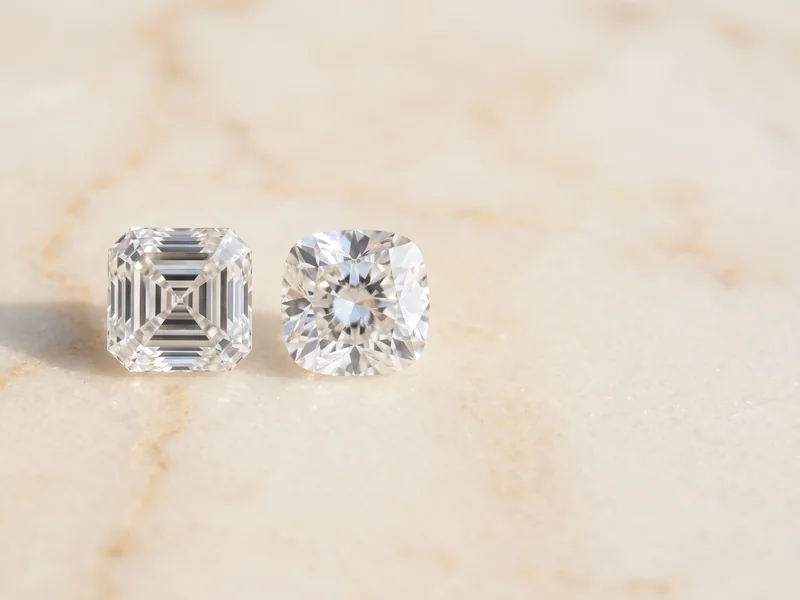 Diamond ShapesOld Mine vs Cushion Cut Diamonds
 Diamond ShapesOld European Cut Diamonds
Explore more
More guides on this topic
Education