
- Education
- Diamond Shapes
- Old Mine Cut Diamond Guide: Facets, Ratio, Colour and Settings
Diamond shapes
Old Mine Cut Diamond Guide: Facets, Ratio, Colour and Settings
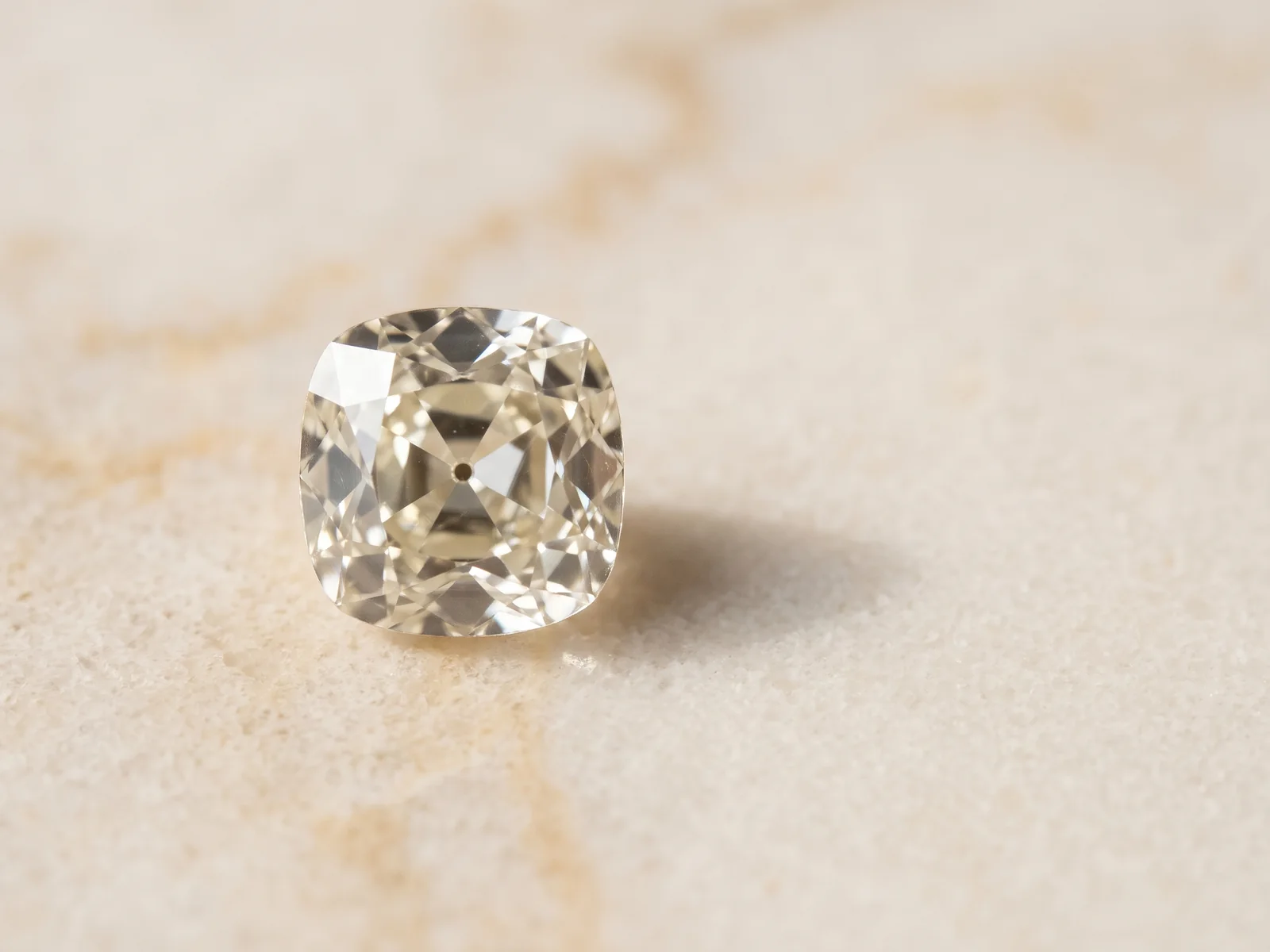
The old mine cut diamond is the stone in many great-great-grandmothers' rings: a soft square, cut deep and full of coloured fire. Here is how to read one, from its facet pattern and ratio to colour, settings and what it costs in AUD.
 Reviewed by Raj Sood, Graduate Gemologist (GIA), AJP (GIA)Master jeweller and Graduate Gemologist (GIA) · reviewed 4 November 2026
Quick answer
An old mine cut diamond is an antique brilliant with a squarish, cushion-like outline, 58 large facets, a small table, high crown and an open culet. Cut by hand mainly in the 1700s and 1800s, it gives broad, chunky flashes and strong fire. Look for a ratio near 1.00–1.10, eye-clean clarity and a protective claw or bezel setting.
What is an old mine cut diamond?
An old mine cut diamond is an antique form of the brilliant cut with a soft, squarish outline, a little like a pillow, and gently rounded corners. It has a small table (the flat top facet), a tall crown (the part above the girdle, the stone's outer edge), a deep pavilion (the part below the girdle) and a large, open culet, a small flat facet at the very bottom that you can often see face-up as a tiny circle or octagon in the centre. It is one of the three classic shapes in our guide to antique diamond cuts, from old mine to rose.
You will also see it called an old miner, an old mine brilliant or, loosely, an antique cushion. The name comes from the 'old mines' of India and Brazil, which supplied almost all of the world's diamonds before the South African discoveries of the late 1860s. Old mines were cut by hand and by eye, without the light-performance maths that later shaped the modern round, so no two look quite the same. Its round relative, the Old European cut that followed it, shares the same chunky faceting on a circular outline.
Diamond is 10 on the Mohs hardness scale, with a refractive index of about 2.42 and a dispersion of about 0.044. Dispersion is the ability to split white light into flashes of colour, which jewellers call fire. The old mine's tall crown makes the most of that dispersion, which is why these stones are known for big coloured flashes rather than the bright, busy sparkle of a modern brilliant. New to any of these words? Our plain-English jewellery glossary explains each one.
Where did the old mine cut come from?
Diamond cutting developed slowly over centuries. The earliest stones were simply polished points or flat table cuts. By the 1600s cutters were producing the flat-backed, domed rose cut, and drop-shaped stones were faceted all over as teardrop-shaped briolettes for earrings and pendants. Through the late 1600s and 1700s, cutters added more facets to the crown and pavilion of the older table and double cuts, and the result, a cushion-shaped brilliant with 58 facets, is what we now call the old mine cut.
Old mines were cut to save as much weight as possible from the rough crystal, which usually grows as an octahedron (two four-sided pyramids joined base to base). Following that squarish crystal gave a squarish stone with a deep pavilion and a high crown. They were also cut to look their best under candlelight and, later, gas light, where broad facets throw out large, slow flashes of colour. The style was most common from about the early 1700s to the late 1800s, when the Old European cut gradually replaced it. Georgian and Victorian jewellery is full of them.
Many old mines were later recut into modern round brilliants, losing weight and history in the process. That is one reason genuine antique old mines with their original faceting are now relatively scarce, and why many jewellers now avoid recutting them.
How many facets does an old mine cut have?
Most old mines have 58 facets: 33 on the crown (including the table) and 25 on the pavilion (including the culet). That is the same count as a modern round brilliant with a culet, but the facets are arranged and proportioned differently. They are larger and broader, so instead of pinpoint sparkle you see blocky flashes, often described as a chunky or chequerboard look. Because the culet is open, you will usually see a small spot in the centre when you look straight down. That is normal and part of the character, not a flaw.
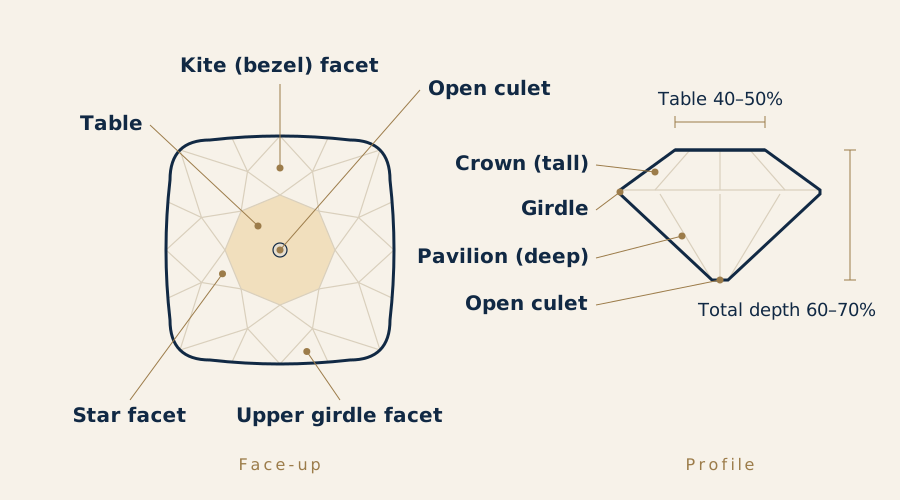
| Measurement | Typical old mine | Modern round brilliant |
|---|---|---|
| Table | about 40–50% of width | about 53–58% |
| Crown height | about 17–22% | about 14–16% |
| Total depth | about 60–70% | about 59–63% |
| Culet | Large, open, visible face-up | None or pointed |
| Girdle | Often thin, can be uneven; hand-polished | Thin to medium, even |
| Facet count | 58 | 57–58 |
Those figures are rough because every old mine was shaped by hand. GIA does not give antique cuts the overall cut grade it gives modern rounds, so you judge an old mine by eye: whether the flashes are bright and evenly spread, whether any area stays dark as the stone moves, and whether the culet sits in the centre. To see how chunky antique faceting differs from other styles, compare how rose and brilliant faceting differ and read our side-by-side of the modern round against the Old European.
On a grading report, an old mine may be described as an old mine brilliant, or as a cushion brilliant or cushion modified brilliant with a comment about its antique style. Ask what the report actually says before you assume a stone sold as a 'cushion' is a true old miner.
What is the ideal ratio for an old mine cut diamond?
The length-to-width ratio compares the longer side of the stone with the shorter side. Divide the length by the width from the report's measurements. A ratio of 1.00 is a perfect square. Most old mines sit close to square, and most people prefer about 1.00–1.10.
| Ratio | How it looks | Suits |
|---|---|---|
| 1.00–1.05 | Square cushion, the classic old miner | Solitaires and Georgian-style collets |
| 1.05–1.15 | Slightly rectangular, soft pillow shape | Most rings; lengthens the finger a little |
| 1.15–1.30 | Clearly elongated antique cushion | A personal choice; rarer in antiques |
| Above 1.30 | Long and rectangular | Uncommon; check it still has the old mine look |
The outline itself also varies. Some old mines are almost round with slightly flattened sides; others are close to square with tighter corners. All share curved sides and rounded corners, which sets them apart from the crisp-cornered princess cut and from eight-sided octagonal cuts with their straight edges.
Because old mines are cut deep, they carry more weight underneath and look smaller face-up (the size you see from above) than a modern round of the same carat. A 1.00 carat round measures about 6.4–6.5 mm across; a 1.00 carat old mine is often closer to 5.6–6.1 mm. Typical face-up widths:
- 0.50 ct: about 4.5–4.9 mm
- 1.00 ct: about 5.6–6.1 mm
- 1.50 ct: about 6.4–7.0 mm
- 2.00 ct: about 7.1–7.7 mm
Always compare millimetre measurements, not just carat weight, when you are choosing between an old mine and a modern shape.
Not sure which one is right?
Send us the stones you are looking at and our gemologist will tell you which to choose and why.
What colour and clarity suit an old mine cut?
Antique old mines commonly grade in the J–M range or warmer by today's standards. Colourless rough was harder to find, cutters put weight ahead of colour, and the tall crown and deep pavilion hold body colour more than a shallow modern cut. Many people choose that warmth on purpose. In yellow or rose gold, J–L looks soft and natural. In platinum or white gold, H–J reads whiter if that matters to you. Modern-cut and lab-grown old mines are readily available from D to H.
For clarity, the goal is an eye-clean stone, meaning no inclusions (internal features) you can see without magnification at normal viewing distance. Large facets and the open culet act like windows, so inclusions are easier to see in an old mine than in a modern brilliant, whose busy sparkle hides them. VS2 to SI1 is a common sweet spot; some SI2 stones are eye-clean too. Ask for the plotting diagram, which maps where each inclusion sits.
With antiques, also check for signs of long wear:
- Chips at the girdle: small nicks are normal after a century or two; a deep chip near a corner weakens the stone.
- Abraded facet edges: rounded or scratched facet junctions dull the flashes. A light repolish can help but removes a little weight.
- Fluorescence: many older diamonds glow blue under ultraviolet light. Medium blue can make a warm stone look a little whiter; very strong fluorescence occasionally looks hazy.
- Treatments: uncommon in antiques, but ask whether the stone has been laser-drilled or fracture-filled, because fillings affect cleaning and repairs.
Is an old mine cut antique, a reproduction or lab-grown?
Old mine cuts come from three sources today, and each has a clear place:
- Antique natural: cut by hand, usually before about 1900. Each is individual, with uneven facets, an off-round culet and some wear. The appeal is history and character.
- Modern-cut natural (antique-style): natural diamonds cut recently in the old mine pattern. Symmetry is more precise, colour is often whiter and the stone is free of old wear.
- Lab-grown old mine cut diamond: laboratory-grown diamond cut in the old mine style. It is real diamond, with the same hardness of 10 and refractive index of about 2.42, costs much less than natural and is easy to find in larger sizes and whiter colours. The report will state that it is laboratory-grown.
None of these is fake. The differences are origin, history and price. A natural antique is a piece of jewellery history, but treat it as something to wear and love rather than a financial investment; resale values for diamonds are usually well below retail. A lab-grown old mine suits anyone who wants the look in a bigger or whiter stone for less.
What is the best setting for an old mine cut diamond ring?
Old mines are deep and their girdles can be thin or already chipped, so the setting needs enough depth underneath and protection at the corners. The usual options for an old mine cut diamond ring:
- Four claws or eight claws: one claw, or a pair of double claws, at each corner. Double claws spread the load and suit antique girdles.
- Bezel or collet: a thin rim of metal around the edge. Georgian rings used closed-back collets; today an open-back bezel lets light in and gives very good protection.
- Halo: a frame of small diamonds, often with milgrain (a fine beaded metal edge), for a vintage look. It makes the stone face up larger.
- Three-stone: bullet cut side stones or shield cut shoulders add clean lines beside the soft centre.
- Cluster: a ring of small round diamonds around the centre, a classic Victorian design.
- Metal colour: yellow and rose gold flatter warm antique colours; platinum suits whiter modern-cut and lab-grown stones.
A square outline usually sits flush against a straight wedding band, which makes the old mine cut engagement ring one of the easier designs to pair. A low-set halo or a wide basket may need a gently contoured band. See setting styles that suit an old mine stone and our gallery of vintage-inspired engagement rings with old-world detail for ideas.
If you are resetting an inherited antique, have the stone checked under magnification before the old claws are opened, because chips often hide beneath them. Fracture-filled stones should not go into an ultrasonic cleaner or near a jeweller's torch.
How does an old mine cut compare with cushion, Old European and round diamonds?
| Old mine | Modern cushion | Old European | Round brilliant | |
|---|---|---|---|---|
| Outline | Soft square, curved sides | Square to rectangle, rounded corners | Round | Round |
| Facets | 58 | 58–64 or more | 58 | 57–58 |
| Table | Small, about 40–50% | Larger, about 55–70% | Small, about 40–50% | About 53–58% |
| Culet | Large, open | None or pointed | Large, open | None or pointed |
| Look | Broad flashes, strong fire | Brilliant or 'crushed ice' | Broad flashes, strong fire | Sharp, even sparkle |
| Era | About 1700s–1800s | 20th century to today | About 1890s–1930s | From about 1919 |
| Price per carat | Usually below a round | Usually below a round | Usually below a round | Highest |
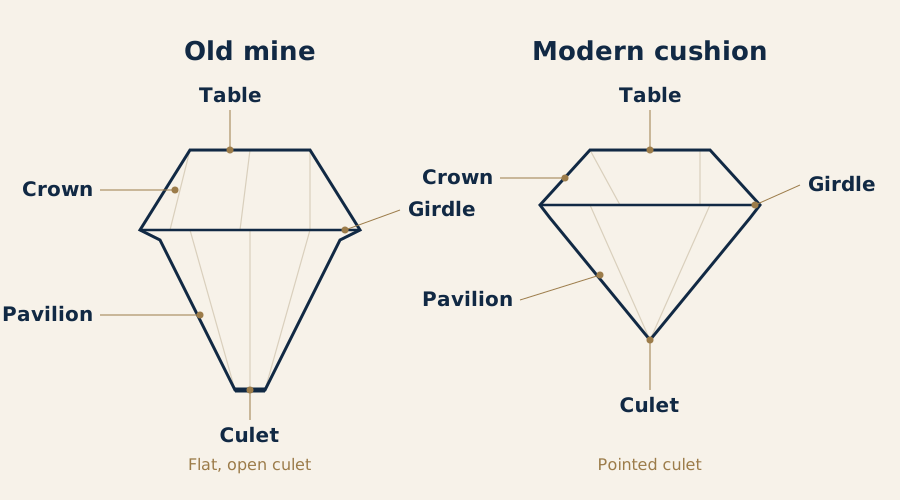
The modern cushion is the old mine's direct descendant, but it has a larger table, a flatter crown and often extra pavilion facets that create a 'crushed ice' look of tiny glitter. Our old mine against the modern cushion comparison sets out the differences point by point.
Related guideOld Mine vs Cushion Cut DiamondsIf you like geometric outlines from the same antique and Art Deco world, look at diamond-shaped lozenge cuts and six-sided hexagonal diamonds. To see every shape together, start with how every diamond shape compares or browse every one of the 34 diamond cuts.
How much does an old mine cut diamond cost in Australia?
Prices depend on whether the stone is antique natural, modern-cut natural or lab-grown, and then on carat, colour, clarity and how attractive the cutting is. Because each antique is individual, two stones with similar grades can be priced quite differently.
| 1 ct old mine cut | Approximate price range (AUD) |
|---|---|
| Lab-grown, G–H, VS | about $1,000–$3,000 |
| Antique natural, J–K, VS–SI | about $5,000–$12,000 |
| Modern-cut natural, G–H, VS | about $7,000–$15,000 |
These are broad ranges only; prices move with the market and the exact grades. As a pattern, an old mine usually costs less per carat than a modern round of the same weight, colour and clarity, partly because grading labs do not give it a cut grade and demand is smaller. A well-cut antique with good symmetry, little wear and an attractive colour can cost more than an average modern cushion, because suitable stones are scarce. Matched pairs of antique old mines for earrings are harder again to find.
Browse old mine cut diamonds: natural and lab-grown
How do you choose an old mine cut diamond? Step by step
- Read the report. Confirm the shape description, measurements, colour, clarity and whether the diamond is natural or lab-grown, plus any treatment.
- Work out the ratio. Divide length by width; about 1.00–1.10 gives the classic soft square.
- Check face-up size in mm. Old mines are deep, so compare millimetres, not just carat weight.
- Watch a 360° video. Look for broad, evenly spread flashes, a centred culet and no area that stays dark.
- Inspect for wear. On antiques, check the girdle and facet edges for chips and abrasion.
- View it in warm and cool light. Decide whether you enjoy the colour in everyday settings.
- Plan the setting. Choose claws, double claws or a bezel that protect the corners and allow for the stone's depth.
Free consultation
Talk to a gemologist
Compare stones in person or online with Raj Sood, Graduate Gemologist (GIA), AJP (GIA).
Book a consultationShop this shape
FAQ
Common questions
What is the difference between an old mine cut and a cushion cut?
An old mine cut is the hand-cut antique ancestor of the cushion, with a small table, high crown and open culet. A modern cushion has a larger table, a flatter crown and often extra facets that give finer, glittery sparkle.
Are old mine cut diamonds still made?
Yes. Cutters now produce old mine cuts from both natural and laboratory-grown diamond. They are more symmetrical than antiques but keep the chunky facets and open culet.
Why do old mine diamonds look yellowish?
Many antique old mines are J colour or warmer, and their deep proportions hold body colour. Set in yellow or rose gold, that warmth looks soft and natural; modern-cut and lab-grown versions are available in whiter grades.
Is the hole in the middle of an old mine diamond a flaw?
No. That small circle is the open culet, a flat facet at the bottom of the stone that old cutters left on purpose. It is a normal feature of the cut.
Do old mine cut diamonds look smaller than round diamonds?
Usually, yes. Because they are cut deep, a 1 carat old mine often measures about 5.6–6.1 mm across compared with about 6.4–6.5 mm for a modern round.
Can you get a lab-grown old mine cut diamond?
Yes. Lab-grown old mine cuts are real diamond, cost much less than natural and are easy to find in larger sizes. The grading report will state that the diamond is laboratory-grown.

Ask a gemologist
Not sure which diamond to choose?
Raj Sood is a Graduate Gemologist (GIA) and master jeweller. Bring the stones you are considering, or send the reports, and he will tell you honestly which one is better and why.
Keep learning
Related guides
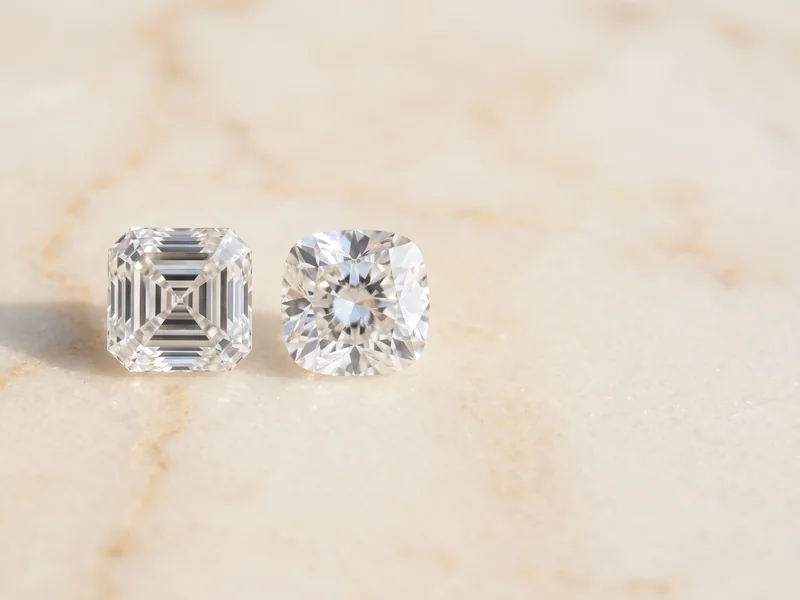 Diamond ShapesOld Mine vs Cushion Cut Diamonds
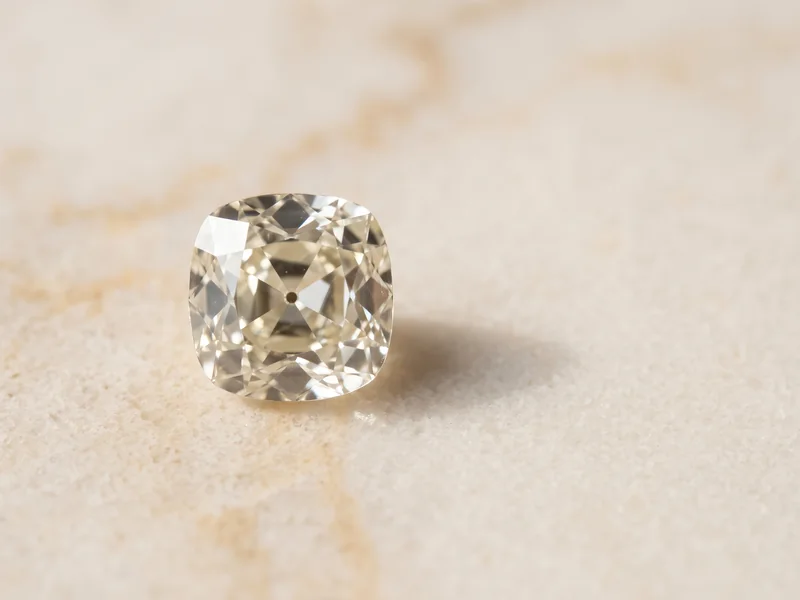 Engagement Rings & SettingsBest Settings for Old Mine Diamonds
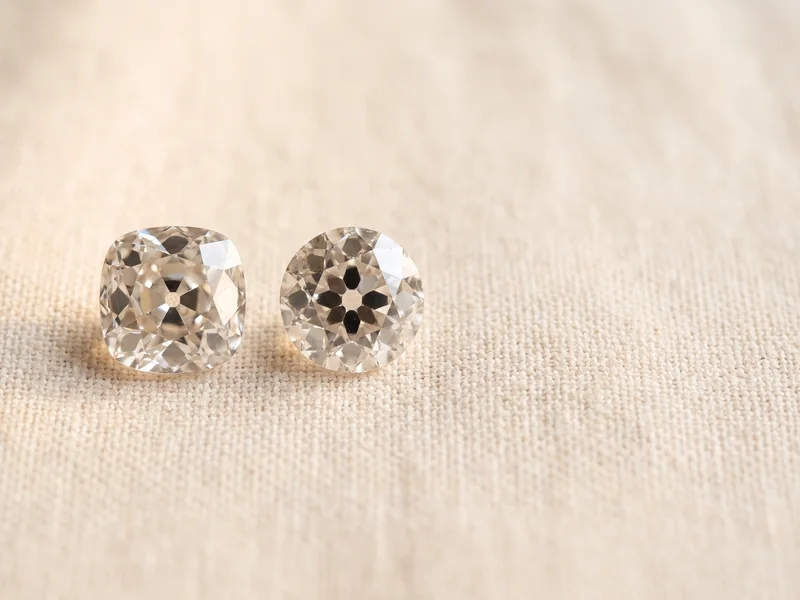 Diamond ShapesAntique Diamond Cuts: Old Mine, Old European and Rose
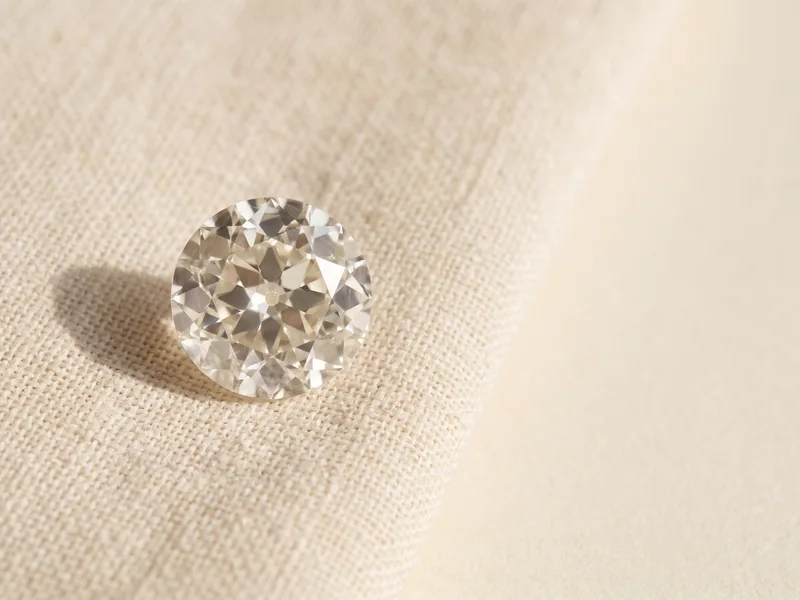 Diamond ShapesOld European Cut DiamondsDiamond ShapesUnderstanding Diamond Shapes
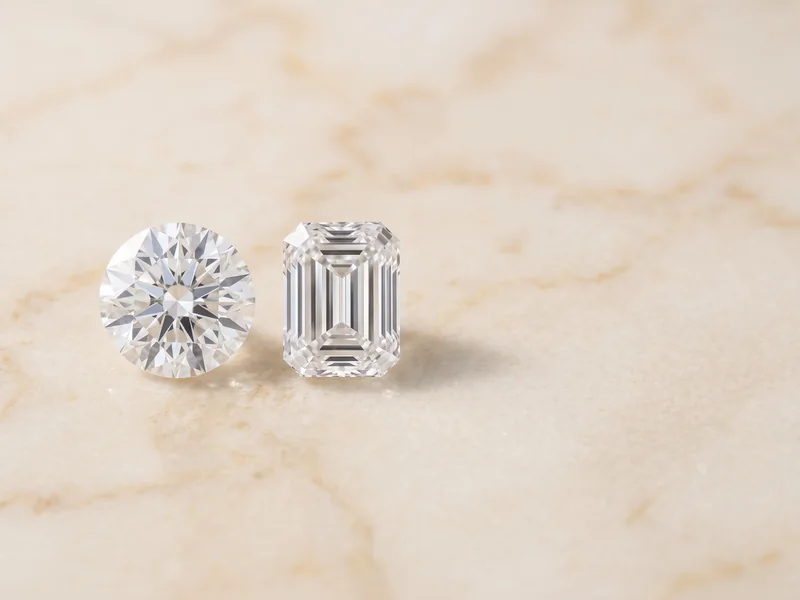 Diamond ShapesAll 34 Diamond Cuts: Every Shape Explained and Compared
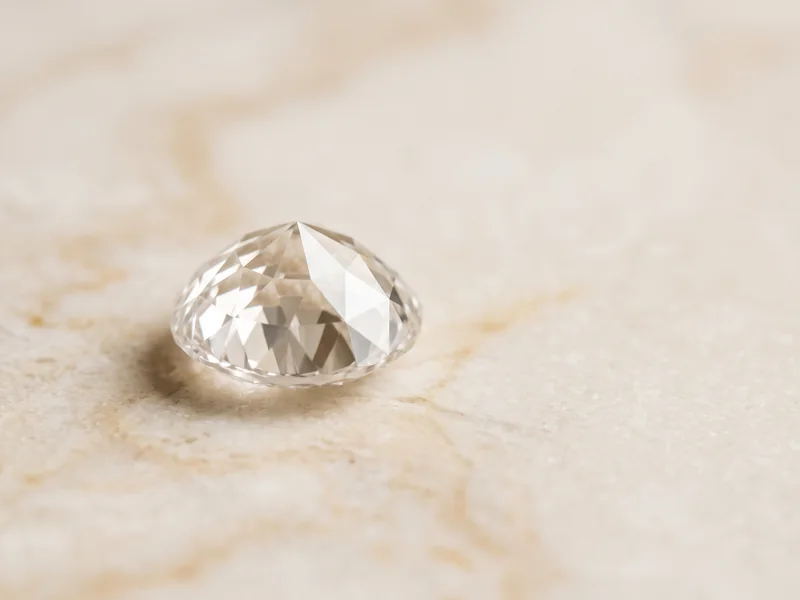 Diamond ShapesRose Cut Diamonds
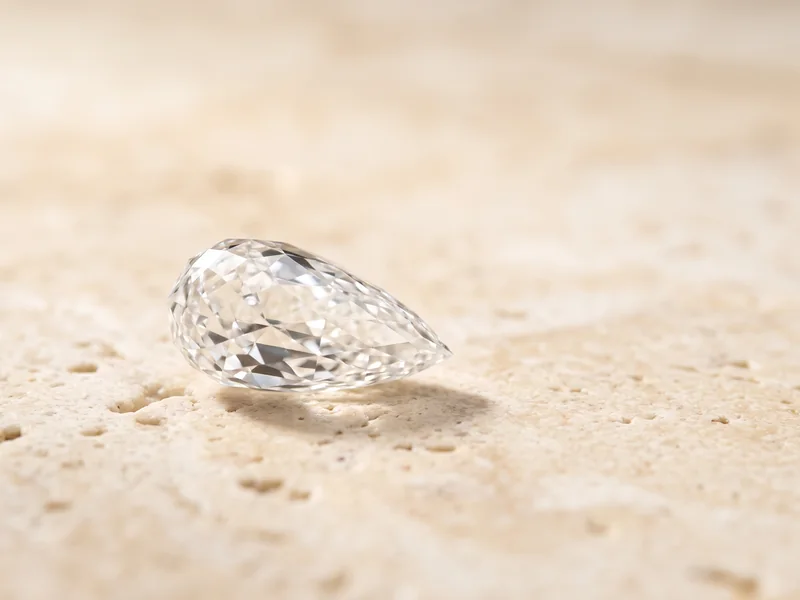 Diamond ShapesBriolette Cut Diamonds
Explore more
More guides on this topic
Education