
- Education
- Diamond Shapes
- Old Mine vs Cushion Cut Diamonds: Which Should You Choose?
Diamond shapes
Old Mine vs Cushion Cut Diamonds: Which Should You Choose?
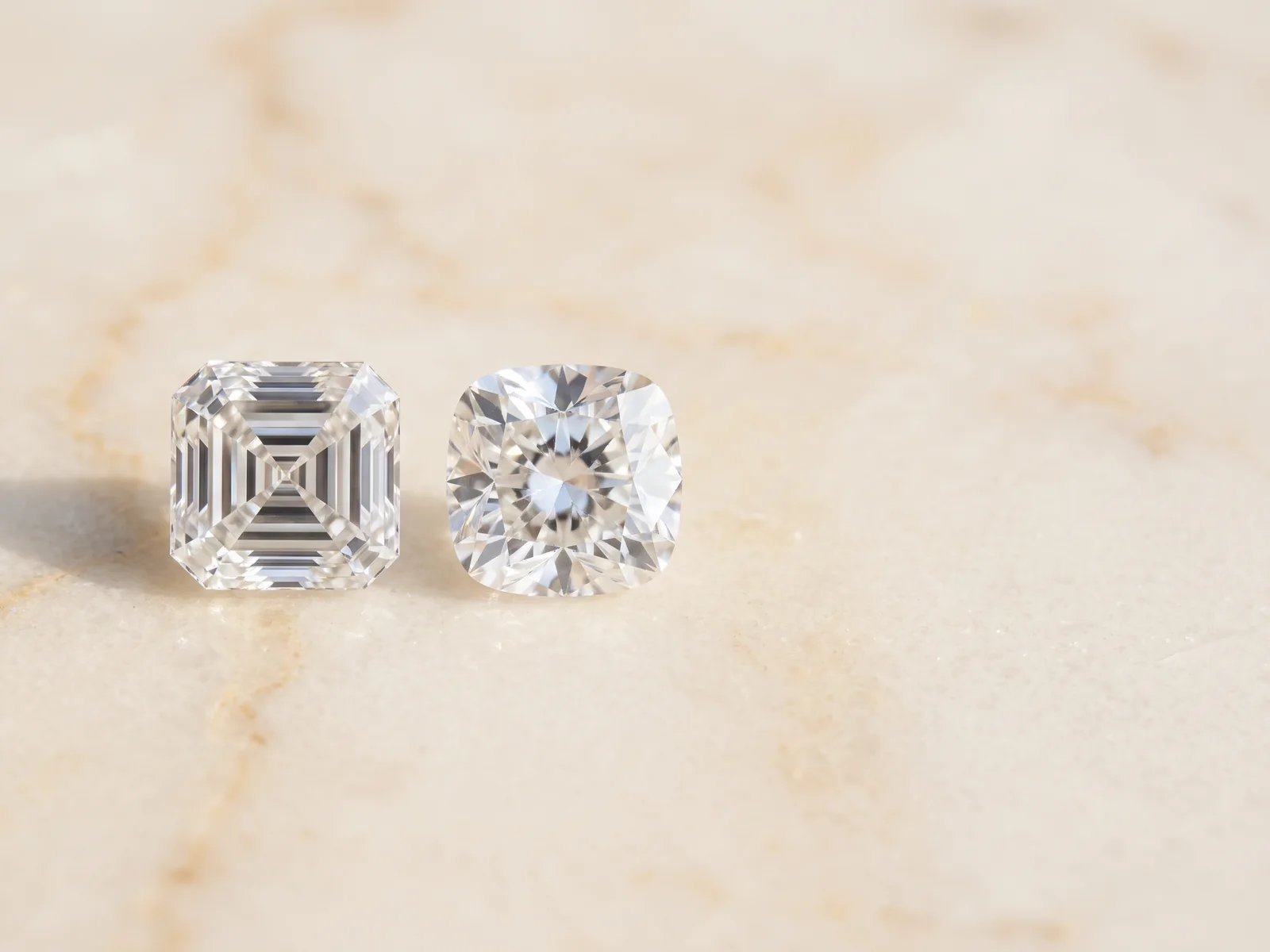
Old mine vs cushion cut is really hand-cut antique versus modern precision. The two share a rounded-square outline but handle light, colour and size very differently, and that changes how each one looks on your hand.
 Reviewed by Raj Sood, Graduate Gemologist (GIA), AJP (GIA)Master jeweller and Graduate Gemologist (GIA) · reviewed 4 November 2026
Quick answer
An old mine cut is a hand-cut antique cushion with a small table, high crown, deep pavilion and a large open culet, giving broad, fiery flashes and often a warmer tint. A modern cushion cut is precision-cut, brighter under shop lights, faces up about the same or slightly larger per carat, and is far easier to find, including lab-grown.
Old mine vs cushion cut diamonds: what is the difference?
Both shapes are rounded squares with gently curved sides and soft corners, which is why people mix them up. The old mine cut is the original: a diamond cut by hand, roughly between the 1700s and the early 1900s, with a small table (the large flat facet on top), a tall crown (the upper part of the stone), a deep pavilion (the lower part) and a large, flat open culet at the bottom. The modern cushion cut is its descendant, cut today with precise planning software and polishing machines to repeatable proportions.
Our full guides to the antique old mine cut and to modern cushion brilliant and modified cushions cover each shape on its own. This page puts them side by side, because the decision usually comes down to a handful of practical differences.
| Old mine cut | Modern cushion cut | |
|---|---|---|
| Era | Mostly 1700s to early 1900s; new-cut versions made today | Revived in the late 20th century; cut today |
| How it was cut | By hand and eye, to save weight from the rough | Planned by computer, polished to tight tolerances |
| Outline | Rounded square, often slightly uneven | Rounded square or rectangle, symmetrical |
| Table | Small, often about 40–55% of the width | Larger, often about 58–68% |
| Crown | High | Moderate |
| Culet | Large and open, visible face-up | Pointed or very small, not visible |
| Facets | Usually 58 | 58 (brilliant) or more (modified) |
| Sparkle | Broad, chunky flashes and strong fire | Brighter; chunky or crushed ice |
| Colour often found | Warmer, about J–M is common in antiques | Any grade, colourless to warm |
| Availability | Limited; each antique is one of a kind | Wide, in natural and lab-grown |
If you are still getting your bearings, our overview of every diamond shape shows where both sit in the wider family, and any term here you have not met before is explained in the GemTrove jewellery glossary.
Where did the old mine cut come from, and how did it become the cushion?
The old mine cut takes its name from the 'old mines' of India and Brazil, the main sources of diamonds before the South African finds of the late 1800s. Cutters worked each stone by eye on a polishing wheel. Their first goal was to keep as much weight as possible from the rough crystal, which is why old mines are deep, slightly uneven and often a little out of square. They were also cut for the light of the day: candles and oil lamps, which are small, warm point sources. A high crown and small table throw that kind of light back as big, coloured flashes.
From the late 1800s, mechanical bruting (grinding the outline round on a lathe) made round stones far easier to produce, and the round Old European cut took over. That cut, in turn, led to the modern round brilliant in the early 20th century; our page on how the round brilliant replaced the Old European tells that part of the story. All three antique styles, old mine, Old European and rose cut, are compared in our guide to antique diamond cuts and how to spot them.
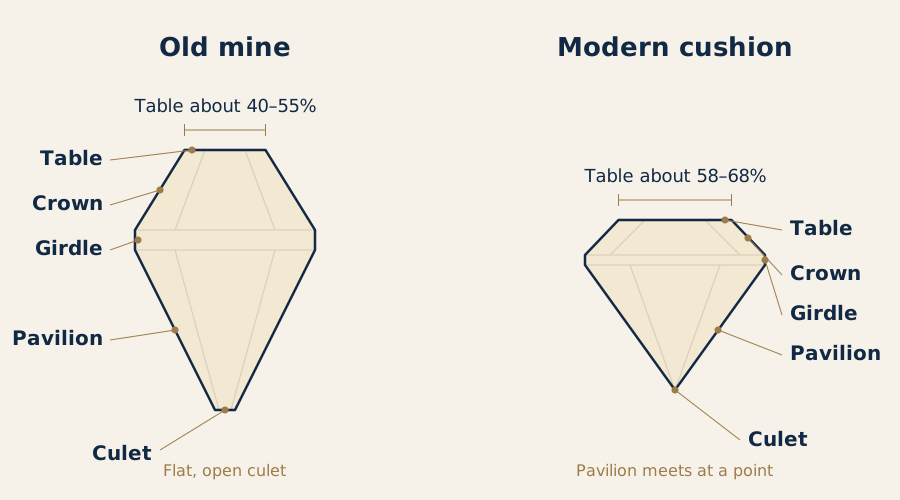
The cushion outline never really disappeared, but it came back strongly in the late 20th century once cutters could plan cushions by computer. GIA now describes most modern cushions as either a cushion brilliant, with a facet pattern close to the old mine's, or a cushion modified brilliant, with an extra row of pavilion facets. You can see how cushions sit beside the princess, radiant and Flanders in our guide to square and cushion cut families.
One point to keep clear: some cutters now make new old mine cuts, cut today in the antique style from new natural or laboratory-grown rough. They can look very close to an antique but are a modern stone. A genuine antique will often show signs of age, such as a hand-finished girdle, slightly uneven facets and small worn edges.
Which sparkles more: an old mine or a cushion cut?
Sparkle is really three things. Brightness is the white light coming back to your eye. Fire is the flashes of rainbow colour, caused by diamond splitting white light (diamond has a refractive index of about 2.42 and strong dispersion). Scintillation is the on-off flicker as you move. The two cuts balance these very differently.
- Old mine: fewer, larger flashes and strong fire, thanks to the high crown and small table. Brightness is lower, so under rows of bright shop LEDs an old mine can look softer than a modern cushion. In warm, single-source light, by a window or under a spotlight at dinner, it comes alive.
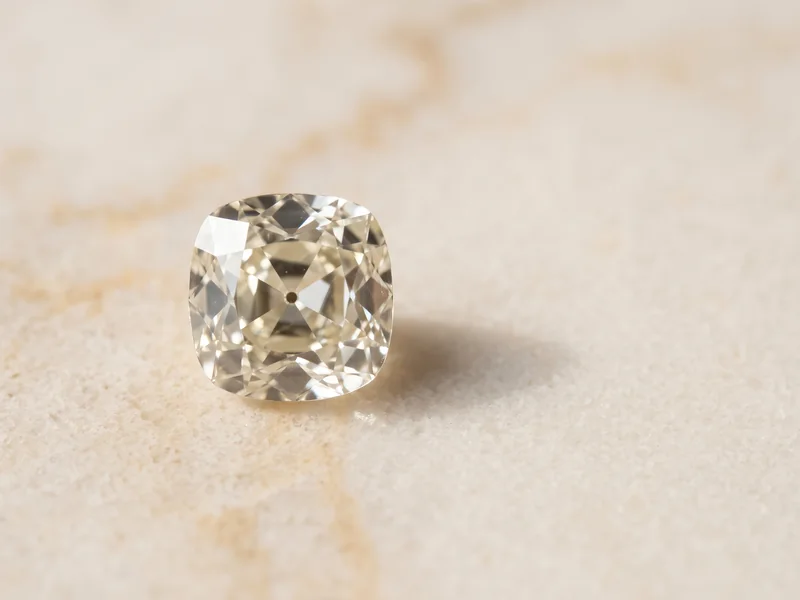
- Open culet: face-up, the flat culet shows as a small circle in the centre of the stone. Antique lovers see it as character; some people read it as a 'hole'. It is normal and not a flaw.
- Cushion brilliant: keeps the broad, chunky facet look of the old mine, but with a larger table and tighter angles it returns more white light.
- Cushion modified brilliant: the extra facets break light into many tiny pin-points, known as the crushed ice look. It is bright and lively but looks less like an antique.
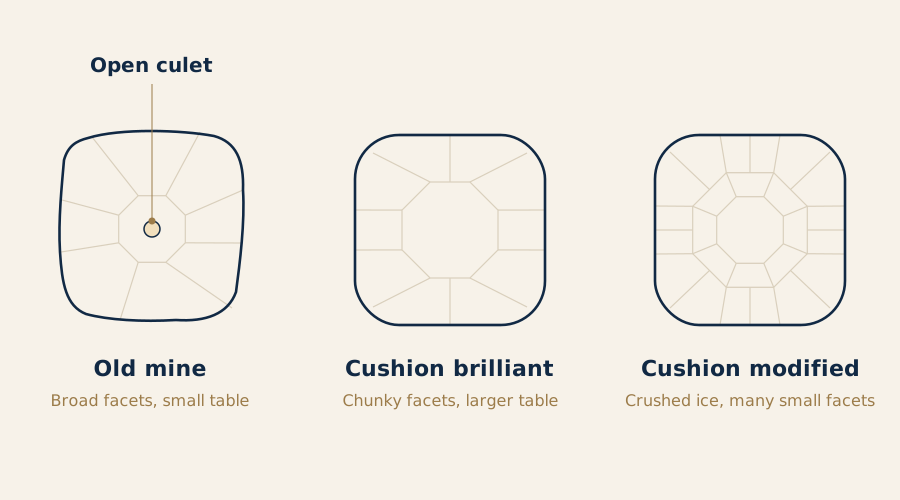
If you love the antique look but want a modern, certified stone, a chunky cushion brilliant is the closest match. Our guide to the crushed ice cushion modified cut explains that pattern, and chunky facets versus crushed ice compared shows how to tell them apart from a photo or video, since reports do not always make it obvious.
Old mine vs cushion cut: which looks bigger per carat?
Face-up size is the width you see from above, and it matters more on the hand than carat weight. Both cuts carry a lot of weight below the girdle (the outer edge), so both face up noticeably smaller than a round brilliant of the same carat. Between the two, a modern cushion is usually the same size or a little larger, because many old mines have very deep pavilions, high crowns and thick girdles that hide weight where you cannot see it.
| Carat weight | Modern cushion (square) | Old mine (typical) | Round brilliant, for reference |
|---|---|---|---|
| 0.50 ct | about 4.5–4.9 mm | about 4.3–4.8 mm | about 5.1 mm |
| 0.75 ct | about 5.0–5.4 mm | about 4.9–5.3 mm | about 5.8 mm |
| 1.00 ct | about 5.4–5.9 mm | about 5.3–5.8 mm | about 6.4 mm |
| 1.50 ct | about 6.2–6.7 mm | about 6.0–6.6 mm | about 7.3 mm |
| 2.00 ct | about 6.8–7.3 mm | about 6.6–7.2 mm | about 8.1 mm |
These are typical ranges only. The spread inside each cut is wide: a cushion cut at 70% depth faces up smaller than one at 63%, and an old mine at 75% depth can look a full size smaller than its weight suggests. Always compare the millimetre measurements on the report, not just the carats. Depth is total depth divided by average width; for a modern cushion, about 61–68% is common, while old mines often sit anywhere from about 60% to over 70%.
If face-up size is your main concern, an elongated shape spreads further along the finger. Our guide to longer, rectangular cushion cuts covers ratios of about 1.15–1.30, and our round vs cushion comparison shows how much extra width a round gives for the same weight.
Not sure which one is right?
Send us the stones you are looking at and our gemologist will tell you which to choose and why.
Do old mine and cushion cut diamonds show more colour?
Yes, both can. Cushion outlines concentrate body colour (the diamond's faint natural tint) in the corners, and deep stones show more of it, because light travels further through the diamond. We explain the optics in why cushion diamonds can show more body colour.
Old mines add a second factor: history. Much of the rough cut in the 1700s and 1800s was warmer in tone, and antique old mines in the J–M range are common. Many people choose them for exactly that soft, warm glow, especially in yellow gold. Colourless antiques (D–F) exist but are scarce. A modern cushion can be ordered in any grade, so if you want an icy white look, a cushion is the simpler path.
- White metal, modern cushion: G–H colour is a common choice; G or higher if you are sensitive to warmth.
- Yellow or rose gold, either cut: I–K can look pleasantly white or softly warm.
- Antique old mine: judge colour by eye in daylight as well as by grade; J–L can suit the antique style well.
- Clarity: aim for eye-clean (no inclusions visible without magnification at normal distance). For both cuts, VS2 or a carefully chosen SI1 usually works; the old mine's open culet makes inclusions directly below the table easier to see.
Many antique old mines change hands without a grading report, or with one issued decades ago. Before you commit, ask for a current independent report from a lab such as GIA, which grades colour and clarity on the same scales used for modern stones and records the shape and cutting style.
How durable are old mine and cushion cut diamonds?
Diamond is 10 on the Mohs hardness scale, but hardness is not toughness: a thin edge that takes a hard knock can still chip along a cleavage plane. The good news is that both cuts have rounded corners and no sharp points, so they are among the more forgiving shapes for everyday wear.
- Modern cushion: corners are softened and the girdle is usually medium to slightly thick, so the stone is well protected in four claws or a bezel.
- Old mine: girdles are often thick, which adds strength, and the open culet removes the fragile point at the bottom. The risk is age: antiques may already carry small chips, abrasions or nicks from a century of wear. Check the girdle under a loupe (a 10× magnifier) before setting.
- Recutting: an old mine can be recut to remove damage or brighten it, but it loses weight and its antique character. Most people only polish out small chips, if anything.
Settings that suit an old mine are often lower and softer than modern ones: four or eight claws, a fine millegrain bezel, or a halo that echoes period jewellery. Our guide to settings that suit old mine diamonds covers each option and how to protect an older stone that already shows wear.
If you are resetting an inherited old mine from a family ring, the stone should be checked and cleaned before any new design is drawn, so the setting can work around any existing chips.
Old mine vs cushion cut price: how much do they cost in Australia?
Price depends far more on carat, colour, clarity and condition than on the name of the cut, but there are some clear patterns. Modern cushions usually cost less per carat than rounds of the same grades. Genuine antique old mines are priced stone by stone: a well-preserved, high-colour antique can command a premium, while warmer or chipped antiques can cost less than a comparable modern cushion.
| 1 ct, around G–J, VS–SI | Approximate price range (AUD) |
|---|---|
| Lab-grown modern cushion | about $800–$2,500 |
| Lab-grown old mine style (new cut) | about $1,000–$3,000 |
| Natural modern cushion | about $5,000–$12,000 |
| Natural old mine, newly cut | about $5,000–$12,000 |
| Natural antique old mine | about $5,000–$15,000+, very dependent on colour and condition |
These are broad ranges only, and prices move with the market. Lab-grown diamonds are real diamond, grown in a laboratory rather than mined; they have the same hardness, refractive index and sparkle and cost much less than natural stones. A lab-grown old mine cut gives you the antique look in a new stone, and its report will state that it is laboratory-grown. A natural antique old mine carries a history no new stone can; that is a matter of personal meaning rather than a reason to treat it as an investment.
Shop old mine and cushion cut diamonds: natural and lab-grown
Which should you choose, an old mine or a cushion cut?
Neither is better; they suit different tastes. As a rough guide:
- Choose an old mine if you love antique and vintage jewellery, warm colour, broad candlelit flashes and a stone with a story. It suits yellow gold, rose gold, millegrain detail and engraved bands, and an old mine cut engagement ring will rarely look like anyone else's.
- Choose a modern cushion if you want the most white brightness under everyday light, a choice of colourless grades, a clean modern outline and an easy match in size and grade across many stones, natural or lab-grown.
- Choose a chunky cushion brilliant if you want a middle ground: a modern, symmetrical stone with an antique-style facet pattern.
- Consider other cushion relatives if you want more structure or sparkle: see radiant vs cushion, cut-corner versus rounded or the Art Deco Asscher against the cushion.
On the hand, the two look most different from a metre or so away. The modern cushion reads as a bright, even square of light; the old mine reads as a softer stone that throws occasional big flashes of colour. Up close, the open culet and hand-cut facets of the old mine are the giveaway.
How do you compare an old mine and a cushion cut? Step by step
- Read the report. Confirm shape, measurements, colour, clarity and whether the stone is natural or lab-grown. For an antique, ask for a current report.
- Compare millimetres, not carats. Line the face-up width and length up side by side; deep stones look smaller for their weight.
- Check depth and table. A modern cushion around 61–68% depth faces up well; an old mine over about 70% will look small.
- Look at the facet pattern. Decide whether you want an old mine's broad flashes and open culet, a chunky cushion brilliant or crushed ice.
- View in two kinds of light. Look under bright LEDs and under a single spotlight or daylight; the cuts swap places on sparkle.
- Inspect the girdle of an antique. Use a 10× loupe for chips and abrasions before planning the setting.
- Plan the setting with the stone. Match claws, bezel or halo, and the metal colour, to the cut's colour and style.
Free consultation
Talk to a gemologist
Compare stones in person or online with Raj Sood, Graduate Gemologist (GIA), AJP (GIA).
Book a consultationFAQ
Common questions
Is an old mine cut the same as a cushion cut?
Not quite. The old mine is the hand-cut antique ancestor of the cushion, with a smaller table, higher crown and open culet; the modern cushion is a precision-cut stone with a brighter, more even look.
Does an old mine diamond look smaller than a cushion cut?
Often a little, because many old mines are cut deep with thick girdles. A 1 ct old mine typically faces up about 5.3–5.8 mm, close to or slightly under a modern cushion of the same weight.
Can you get a lab-grown old mine cut diamond?
Yes. Cutters now make old mine style diamonds from laboratory-grown rough, and the grading report will state that the stone is lab-grown. They look like an antique but are new stones.
Why do old mine diamonds have a hole in the middle?
The 'hole' is the open culet, a flat facet at the bottom of the stone that shows through the table as a small circle. It is a normal feature of the cut, not a flaw, and it protects the base of the stone.
Are old mine diamonds more expensive than cushion cuts?
It depends on the stone. A high-colour, well-preserved antique can cost more than a comparable modern cushion, while warmer or worn antiques can cost less; lab-grown versions of both cost much less than natural.
Which sparkles more, an old mine or a cushion?
A modern cushion is brighter under shop lights. An old mine shows bigger, more colourful flashes in warm, single-source light such as candlelight or a spotlight.

Ask a gemologist
Not sure which diamond to choose?
Raj Sood is a Graduate Gemologist (GIA) and master jeweller. Bring the stones you are considering, or send the reports, and he will tell you honestly which one is better and why.
Keep learning
Related guides
 Diamond ShapesOld Mine Cut Diamonds
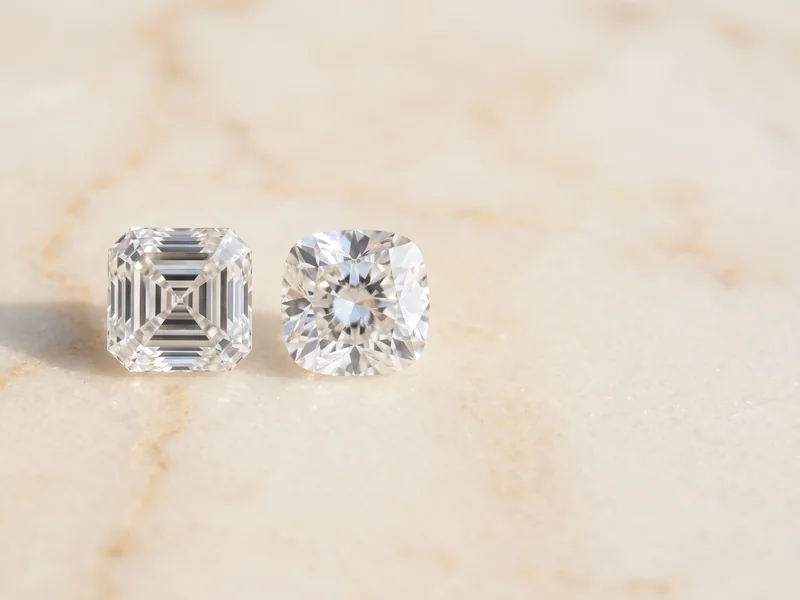 Diamond ShapesCushion Cut Diamonds: Brilliant, Modified & Buying GuideEngagement Rings & SettingsBest Settings for Old Mine DiamondsDiamond ShapesCushion Diamond Chunky Facets vs Crushed IceDiamond ShapesUnderstanding Diamond Shapes
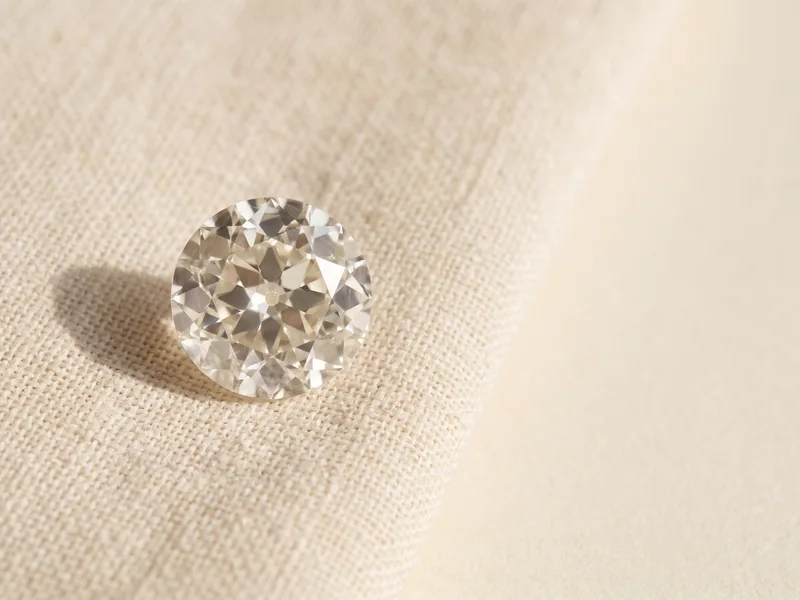 Diamond ShapesOld European Cut DiamondsDiamond ShapesRadiant vs Cushion Cut DiamondsDiamond ShapesRound vs Cushion Cut Diamonds
Explore more
More guides on this topic
Education