
- Education
- Engagement Rings & Settings
- Reverse Taper Band Guide: Look, Build, Security and Wedding Band Fit
Engagement Rings & Settings
Reverse Taper Band Guide: Look, Build, Security and Wedding Band Fit
A reverse taper band flips the usual design. Instead of thinning towards the diamond, it grows wider. Here is how it is built, what it suits, how it wears over the years and how to make a wedding band sit beside it.
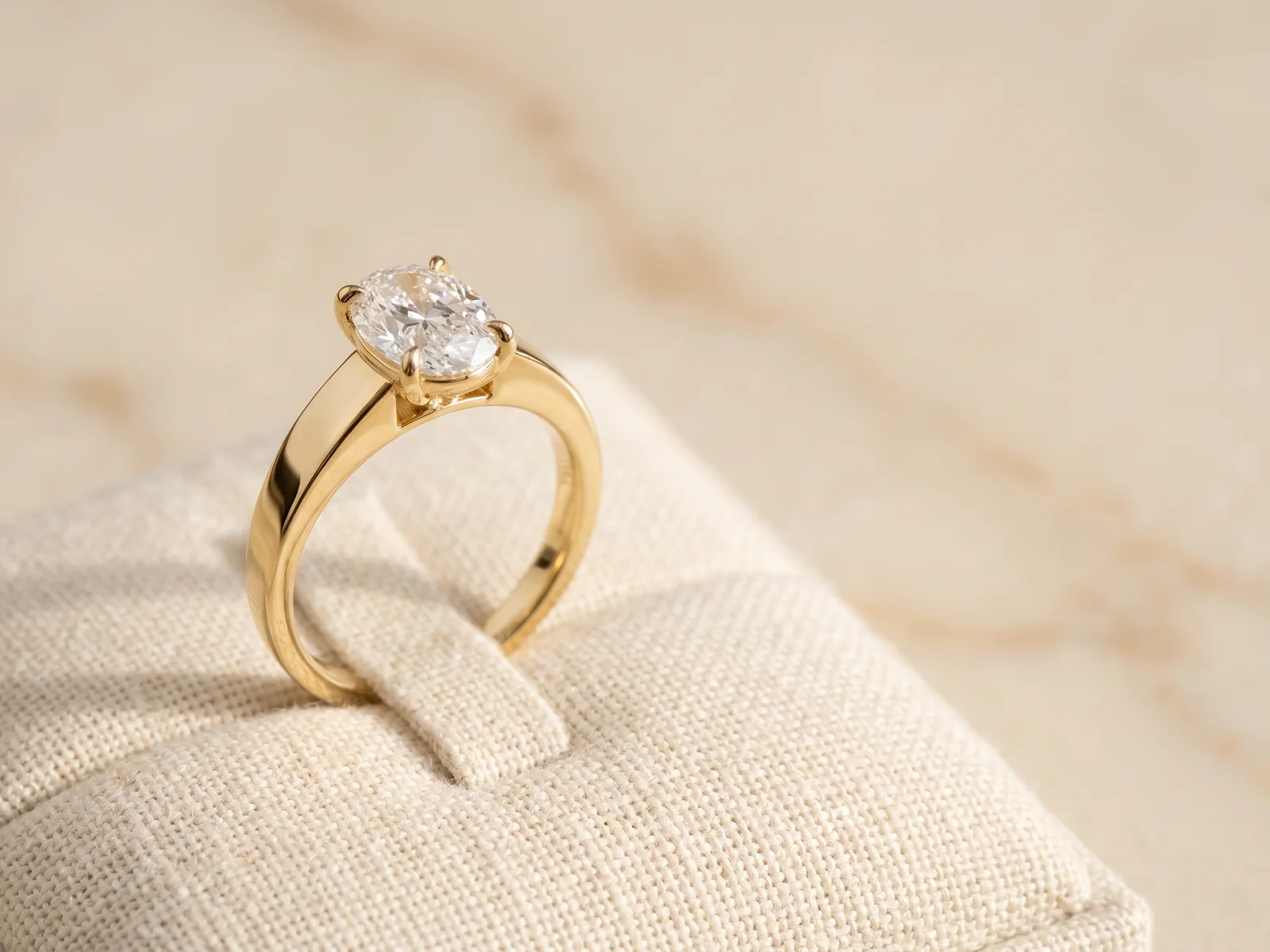
 Reviewed by Raj Sood, Graduate Gemologist (GIA), AJP (GIA)Master jeweller and Graduate Gemologist (GIA) · reviewed 4 November 2026
Quick answer
A reverse taper band is an engagement ring band that is narrow at the back of the finger and widens as it rises towards the centre stone, often from about 2 mm to 3–4 mm. It gives the setting a bold, sturdy frame, suits larger or elongated stones and bezels, but may need a fitted wedding band.
What is a reverse taper band?
A reverse taper band is an engagement ring band (the jeweller's word is shank) that is at its narrowest at the back of the finger, on the palm side, and gradually widens as it climbs towards the centre stone. The widest part is the shoulders, the sections of band either side of the head (the claws or bezel that hold the stone).
It is the opposite of the far more common classic tapered band that narrows towards the stone. A standard taper makes the band look fine and delicate at the top so the diamond seems larger by contrast. A reverse taper does the reverse: it builds up metal where the stone sits, so the ring looks solid, architectural and deliberate. Some people call it a reverse tapered band or a flared shank.
It is one of several shank styles you can pair with almost any head, from a simple four-claw solitaire to a bezel or halo. If you want to see where it sits among all the options, our guide to engagement ring setting styles lays out every main setting and band type. Any term on this page you have not met before is explained in our plain-English jewellery glossary.
How is a reverse taper band built?
A reverse taper can change in two directions, and it helps to know which one you are looking at, because they behave differently on the hand and against a wedding band.
- Width taper (seen from above): the band gets wider along the finger as it approaches the head. This is what most people mean by a reverse taper engagement ring.
- Depth taper (seen from the side): the band also gets thicker from the inside of the ring to the outside as it rises, so the shoulders stand taller and meet the head with more metal.
- Both together: many reverse taper solitaire designs widen and thicken at once, which gives the strongest support for the head and the boldest look.
| Part of the band | Typical width | Typical thickness (depth) |
|---|---|---|
| Back of shank (palm side) | about 1.8–2.2 mm | about 1.5–1.8 mm |
| Mid shank (sides of finger) | about 2.2–2.8 mm | about 1.6–2.0 mm |
| Shoulders (beside the head) | about 3.0–4.0 mm | about 1.8–2.5 mm |
These figures are a typical range, not a rule. A delicate reverse taper might run from 1.8 mm to 2.8 mm; a strong, chunky one might go from 2.2 mm to 4.5 mm. What matters is the change: a difference of at least about 1 mm between back and shoulder is usually needed before the eye reads it as a taper at all. For how each of those widths actually looks and wears, see our page on band widths from 1.8 to 4 mm compared.
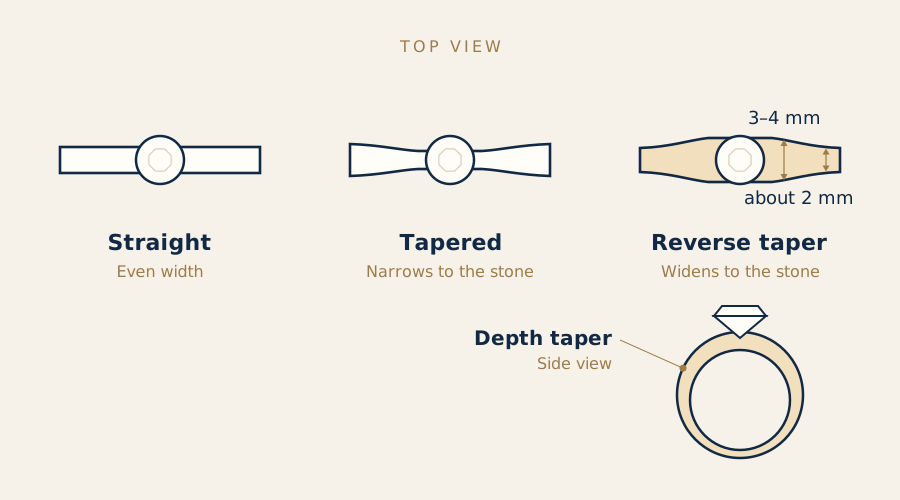
The top surface can be flat, softly domed or pavé-set. A reverse taper band with pavé (rows of small diamonds held by tiny beads of metal) uses the extra shoulder width to fit slightly larger accent stones near the head, graduating down as the band narrows. In a custom design the taper is drawn in CAD first, so the width at each point can be checked and adjusted before anything is cast.
Reverse taper vs tapered band: what's the difference?
The two styles use the same idea, a change in width, but send your eye in opposite directions. A standard taper leads the eye up to the stone and lets it dominate. A reverse taper frames the stone with metal, so the ring reads as one strong shape rather than a diamond perched on a thin wire.
| Reverse taper | Tapered | Straight | Knife-edge | Twisted | |
|---|---|---|---|---|---|
| Width at the stone | Widest | Narrowest | Same all round | Same, but peaked | Same, but woven |
| Visual effect on the centre | Framed, can look slightly smaller | Looks larger | Neutral | Looks larger, lighter | Adds texture |
| Support for the head | Strong | Lighter | Moderate | Moderate | Moderate |
| Flush wedding band | Often needs a fitted band | Usually easy | Usually easy | Usually easy | Can catch on a band |
| Typical feel | Bold, modern, sturdy | Delicate, classic | Simple | Fine, sharp lines | Romantic, detailed |
If you like a light, airy look, a knife-edge band with its peaked ridge gives a finer line from above while keeping strength in depth. If you want texture rather than shape, our page on twisted band designs covers rope, vine and crossover styles. The reverse taper sits at the opposite end of that range: it is the band for people who want the metal to be part of the design, not just the thing that holds the diamond.
Related guideTapered BandsWhat does a reverse taper engagement ring look like on the hand?
From the front, the shoulders flare out to meet the stone, a little like a column flaring out into its capital. That creates a clear horizontal line across the finger at the head, which can make the ring look wider and more substantial than its actual metal weight.
On the hand, a few patterns come up again and again:
- Longer or larger fingers: the extra shoulder width balances the hand well, and a reverse taper rarely looks heavy.
- Slender or short fingers: keep the shoulders at about 3 mm rather than 4 mm, or the ring can look wider than the finger at the head.
- Small centre stones: below about 0.50 carat, wide shoulders can visually crowd the stone and make it look smaller.
- Larger centre stones: from about 0.75 carat up, the shoulders read as a frame rather than competition.
Because the back of the band stays narrow, a reverse taper is usually comfortable between the fingers even when the top looks bold. That is one of its real strengths over a straight wide band. Our guide to choosing a band width for your hand explains how finger length, knuckle size and lifestyle affect the right width.
Not sure which one is right?
Send us the stones you are looking at and our gemologist will tell you which to choose and why.
Which diamond shapes and settings suit a reverse taper band?
A reverse taper works with natural and lab-grown diamonds alike, and with coloured gemstones such as sapphires (9 on the Mohs hardness scale). What matters is the shape and size of the centre and the style of head.
| Centre stone or head | How it works with a reverse taper |
|---|---|
| Round solitaire, 0.75 ct+ | Strong and clean; the shoulders give a simple ring real presence |
| Oval, pear or marquise | Shoulders balance the length; set east-west for a very modern look |
| Emerald or Asscher (step cuts) | Straight lines of the band echo the step facets; a natural match |
| Bezel setting | Ideal; the shoulders flow into the bezel rim as one continuous shape |
| Halo | Works, but halo plus wide shoulders can get chunky; keep shoulders near 3 mm |
| Three-stone | Works when the side stones sit within the shoulder width |
| Small round under 0.50 ct | Can look small; a standard taper is often more flattering |
The bezel is the most natural partner. A bezel is a rim of metal that wraps the stone's edge, and when the shoulders widen to meet it, the head and band look carved from one piece. Step cuts are a close second, because a reverse taper's straight, widening lines suit their flat facets better than they suit the softer sparkle of a brilliant.
Diamond is 10 on the Mohs scale but can still chip at thin edges. Wide shoulders sit higher on either side of the head and act a little like bumpers, giving some side protection to the girdle (the stone's outer edge), especially on pears and marquises with points.
Is a reverse taper band secure and durable over the years?
Yes. Seen from the repair bench, a reverse taper is one of the more robust shank styles. The metal is concentrated where the head joins the band, which is the junction that takes the most strain when a ring is knocked. More metal there means the head is less likely to bend or twist, and claws are anchored into a solid base.
The weak point is the other end: the back of the shank. On every ring this is where wear happens, because it rubs against desks, steering wheels and other rings, and it takes knocks when the hand is gripping. On a reverse taper the back is also the narrowest part by design, so it has the least metal to lose. Over 10 to 20 years of daily wear, a thin back can wear down noticeably and eventually needs a new section of metal, known as re-shanking.
Other things to know about how a reverse taper wears:
- Resizing: rings are cut and sized at the back, where a reverse taper is narrow and simple, so one or two sizes up or down is usually straightforward. Larger changes can alter the proportions of the taper slightly.
- Pavé shoulders: the beads holding small diamonds wear down over time; have them checked every 6–12 months so a loose stone is caught early.
- Flat-top edges: the sharp edges of a wide shoulder soften with wear, which is normal. A light polish restores them.
- Polishing: every polish removes a little metal, so keep polishing occasional rather than frequent, especially at the narrow back.
Our ring maintenance checklist lists what to check, and how often, for engagement rings and bands worn together.
Will a wedding band sit flush with a reverse taper band?
Often not with a standard straight band, and this is the main practical trade-off. The reason is geometry. Two rings sit side by side along your finger. If the engagement ring is wider at the shoulders than at the back, a straight wedding band touches it at the shoulders and then angles away, leaving a V-shaped gap underneath on the palm side. The ring can also tilt slightly as the two rings press together at the top.
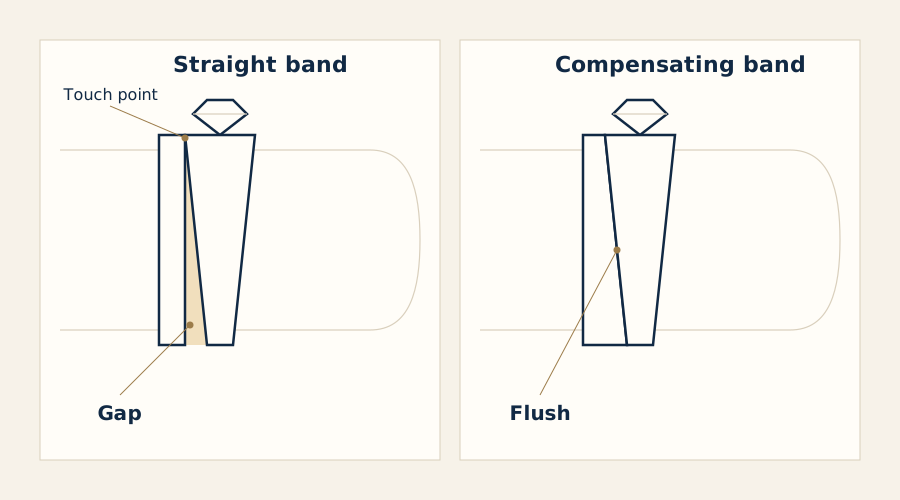
Whether that matters depends on the head too. A higher head may leave room for a band to slide partly underneath; a low bezel will not. Our pages on how setting height affects band fit and wedding bands for low-profile settings go into the detail. A small gap is not a fault, and many people are happy with it; see the normal gap between engagement ring and wedding band for what is typical.
If you want the two rings flush, the common options are:
- A compensating band: a wedding band that is wider at the back and narrower at the top, so together the two rings form an even, parallel stack.
- A fitted band: a band shaped to follow the outline of the shoulders and head. Our page on fitted and contoured wedding bands covers how these are made.
- A spacer: a thin plain band either side can even out the stack; read whether a spacer band helps before deciding.
- Worn on separate hands: some people simply wear the two rings apart.
What metal suits a reverse taper band?
Any of the usual ring metals work, but the extra shoulder metal makes the choice a little more noticeable than on a fine band. A reverse taper also uses somewhat more metal than a standard taper of the same size, often roughly 1–2 grams more, which nudges the cost up.
- Platinum (950): very dense (about 21 g/cm³), so a reverse taper feels weighty. When platinum wears, the metal tends to move rather than be lost, which suits the narrow back of the shank.
- 18ct white gold: usually rhodium-plated for a bright white finish; the plating wears and is renewed every year or two, more often on the high-contact shoulders.
- 18ct yellow or rose gold: no plating to wear off; the warm colour shows the flared shape well.
- 9ct or 14ct gold: harder alloys that resist scratching, with lower gold content and a paler colour.
For a full comparison of durability, colour and upkeep across metals, see our comparison of metals for everyday bands. It applies equally to the engagement ring shank, because the wear patterns are the same.
How do you choose a reverse taper band? Step by step
- Choose the centre first. Decide shape and size; from about 0.75 carat a reverse taper frames the stone rather than crowding it.
- Decide the taper direction. Width only, depth only, or both. Both gives the strongest head support and the boldest look.
- Set the numbers. Confirm the width at the back (about 1.8–2.2 mm) and shoulders (about 3–4 mm), and ask for at least about 1.6 mm thickness at the back.
- Pick the head. Bezels and step cuts suit it most naturally; keep shoulders nearer 3 mm with a halo.
- Plan the wedding band now. Decide whether you will accept a gap or want a compensating or fitted band.
- Check the CAD render. Look at the top view and side view, and ask to see it beside the planned wedding band.
- Book regular checks. Have claws, pavé and the back of the shank checked every 6–12 months.
Because the wedding band fit is so tied to the shape of a reverse taper, it is worth reading why designing both rings together helps. If you already have a band, the process runs the other way; see building an engagement ring around a band you already own.
Create your ring: browse ring settings
Free consultation
Talk to a gemologist
Compare stones in person or online with Raj Sood, Graduate Gemologist (GIA), AJP (GIA).
Book a consultationShop this shape
FAQ
Common questions
What is the difference between a tapered and a reverse taper band?
A tapered band narrows as it approaches the centre stone, which makes the stone look larger. A reverse taper band widens towards the stone, which frames it and gives a bolder, sturdier look.
Does a reverse taper band make the diamond look smaller?
It can with a small centre stone, roughly under 0.50 carat, because the wide shoulders compete with it. With larger stones the shoulders read as a frame instead.
Is a reverse taper band secure?
Yes. The extra metal at the shoulders gives the head a strong base. The part to watch is the narrow back of the shank, which wears over years and may eventually need re-shanking.
Can you wear a straight wedding band with a reverse taper engagement ring?
You can, but it usually touches at the shoulders and leaves a V-shaped gap at the back. A compensating or fitted band sits flush if you want no gap.
Can a reverse taper band be resized?
Usually yes. Rings are sized at the back, which is the narrow, plain part of a reverse taper, so one or two sizes is generally simple; pavé that runs all the way round makes resizing harder.
What width is a reverse taper band?
Most run from about 1.8–2.2 mm at the back to about 3–4 mm at the shoulders. The difference between the two, at least about 1 mm, is what makes the taper visible.
Terms in this guide

Ask a gemologist
Not sure which diamond to choose?
Raj Sood is a Graduate Gemologist (GIA) and master jeweller. Bring the stones you are considering, or send the reports, and he will tell you honestly which one is better and why.
Keep learning
Related guides
 Engagement Rings & SettingsTapered Bands
 Wedding Bands & EternityFitted Wedding Bands Explained | Custom Curved BandsEngagement Rings & SettingsSetting Height and Wedding Band FitEngagement Rings & SettingsEngagement Ring Setting Styles Guide
 Engagement Rings & SettingsTwisted BandsEngagement Rings & SettingsWhat Engagement Ring Band Width Should You Choose?Engagement Rings & SettingsKnife-Edge BandsEngagement Rings & SettingsEngagement Ring Band Widths: 1.8 to 4 mm
Explore more
More guides on this topic
Education