
- Education
- Engagement Rings & Settings
- Engagement Ring Setting Height and Wedding Band Fit: A Practical Guide
Engagement Rings & Settings
Engagement Ring Setting Height and Wedding Band Fit: A Practical Guide
Engagement ring setting height decides how your ring looks, how often it catches on jumpers, how it wears over the years and whether a plain wedding band will sit flush beside it. A millimetre or two changes all four.
 Reviewed by Raj Sood, Graduate Gemologist (GIA), AJP (GIA)Master jeweller and Graduate Gemologist (GIA) · reviewed 4 November 2026
Quick answer
Engagement ring setting height is the distance from your finger to the top of the centre stone, usually about 5–9 mm. Low settings feel secure and snag less but often leave a gap beside a straight band. Higher settings lift the stone clear of the shank so a straight wedding band can sit flush underneath.
What is engagement ring setting height?
Setting height (also called profile or head height) is how far the centre stone sits above your finger. Jewellers usually measure it from the inside of the shank (the band part of the ring that touches your skin) to the table, the large flat facet on top of the stone. Most engagement rings fall somewhere between about 5 mm and 9 mm.
Height is set by the head, the part of the ring that holds the stone. A head can be a ring of claws (prongs), a solid rim of metal called a bezel, a basket of wires, or a raised structure called a gallery that sits under the stone. How tall that head is, and how it joins the shank, controls everything else on this page. If you want the wider picture of how heads differ, our overview of engagement ring setting styles covers each one.
Setting height matters for four practical reasons: how the ring looks from the side, how secure the stone is day to day, how the ring wears over years, and whether a wedding band can sit beside it without a gap. That last point is the one most people only discover after the engagement ring is made. In Australia most people wear the two rings together on the left ring finger, and if you are unsure of the terms, our guide to the difference between a wedding ring and a wedding band sorts them out. The habit of pairing an engagement ring with a band is fairly recent; the story of how wedding rings developed explains why.
Any unfamiliar word here, from shank to culet, is also defined in our plain-English jewellery glossary.
How high should an engagement ring sit?
There is no single correct height, but there is a physical minimum. A diamond is shaped like a spinning top: the crown above the widest edge (the girdle) and a deeper pavilion below it, ending in a point or tiny facet called the culet. A well-cut round diamond's total depth is about 59–63% of its width, so a 1 carat round about 6.4 mm across is roughly 3.9 mm deep, and most of that depth (about 43% of the width) hangs below the girdle.
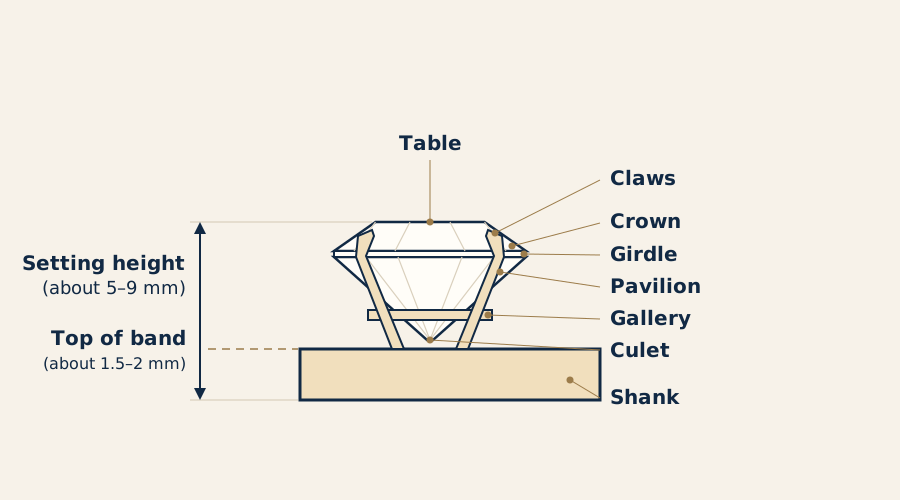
For a straight wedding band to sit flush, the culet and the metal holding it need to clear the top of the band, which is usually 1.5–2 mm tall. Add a little clearance for the gallery and you get a rough minimum height for each stone size.
| Round diamond | Approx. width | Approx. total depth | Approx. height needed for a flush straight band |
|---|---|---|---|
| 0.50 ct | 5.1 mm | 3.1 mm | about 5.0–5.5 mm |
| 1.00 ct | 6.4 mm | 3.9 mm | about 5.8–6.3 mm |
| 1.50 ct | 7.4 mm | 4.5 mm | about 6.4–6.9 mm |
| 2.00 ct | 8.1 mm | 4.9 mm | about 6.8–7.3 mm |
These are typical figures for a well-cut round and a band around 1.7 mm tall. Deeper stones, fancy shapes with tall pavilions such as cushions and radiants, and coloured gemstones (which are often cut deeper to hold colour) all need more height. A stone can be set lower than this table, but only by letting the pavilion sit down between the shoulders of the shank, which is exactly what creates a gap beside a straight band.
Height also changes how the ring feels. A taller head moves the weight of the ring away from the finger, so it can tip sideways if the shank is thin or the inside profile is flat. A rounded inner profile helps it sit steadily, as explained in what a comfort-fit shank changes on the finger.
Low setting vs high setting: which is more practical?
Jewellers loosely group settings into three heights. The exact boundaries vary from maker to maker, so treat these as working ranges rather than fixed rules.
| Low profile | Medium | High | |
|---|---|---|---|
| Typical height (finger to table) | about 4.5–6 mm | about 6–7.5 mm | about 7.5–9 mm+ |
| Look from the side | Sleek, stone close to the hand | Balanced | Stone lifted and prominent |
| Light entering the sides | Less, especially in a bezel | Good | Most open |
| Snagging on clothes and hair | Least | Some | Most |
| Knocks to the stone | Shielded by the shank | Moderate | Most exposed |
| Straight band sits flush? | Usually not | Often, for smaller stones | Usually yes |
| Common band solution | Curved, notched or fitted band | Straight or slightly curved | Straight band |
| Suits | Active hands, nurses, gym, gardening | Most people | Larger stones, occasional wear, stacking |
A low profile engagement ring is the practical choice if you work with your hands, wear gloves or simply hate catching your ring on knitwear. The trade-off is fit: because the stone sits down into the shank, there is often no room for a straight band to slide underneath. Our page on bands that suit low-set engagement rings shows the shapes that close that gap.
A high setting engagement ring lets more light into the sides of the stone and leaves space for any band underneath. It also puts the claws and stone where they meet door frames, car doors and bench tops first. In repairs, high-set claws are the ones we most often see bent, worn thin or pulled open by a snag.
How does engagement ring setting height affect wedding band fit?
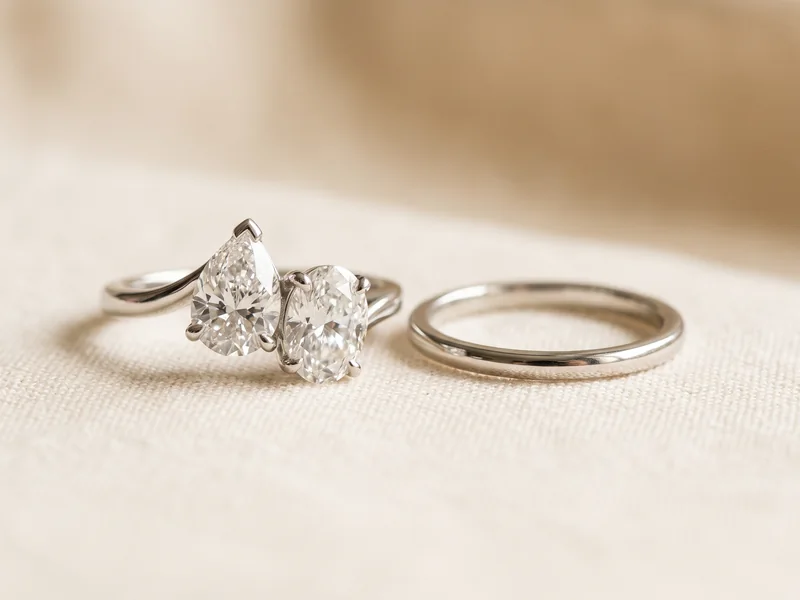
When two rings sit side by side, what matters is whether anything on the engagement ring dips below the top edge of the band. If the head, gallery, basket or culet does, a straight band will be pushed away and leave a gap, usually 1–3 mm, between the rings. Many people do not mind this gap; others find it looks unfinished or that the rings rattle against each other.
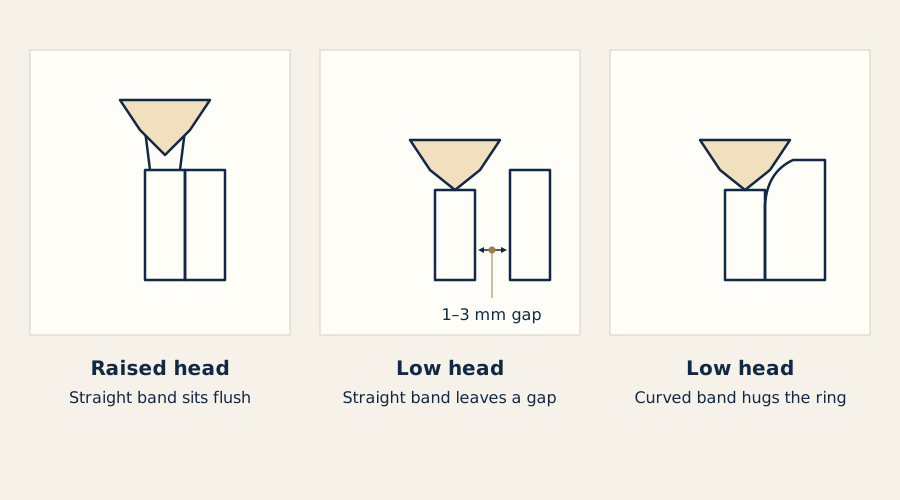
There are four main ways to make the pair work. The shape of the band's cross-section matters too: a flat band sits differently from a court or knife-edge band, which is explained in how wedding band profiles differ.
| Band type | How it works | Best with | Watch for |
|---|---|---|---|
| Straight band | Slides under a raised head | Medium and high settings | Needs the culet and gallery clear of the band |
| Curved or contoured band | Dips around the head | Low settings, halos, larger stones | Only looks right next to the engagement ring |
| Notched band | Small cut-out where the head sits | Low bezels and baskets | Notch must line up; can spin out of place |
| Fitted (shadow) band | Made to trace the exact outline of the ring | Unusual shapes, east-west stones, halos | Made for one ring only; costs more to make |
Curved bands are the most common fix for a low head, and our comparison of curved and straight wedding bands sets out the pros and cons. When a curve is not enough, a band can be shaped to follow the ring exactly; the page on custom fitted bands that mirror your ring shows how these are made. For the colour, width and finish side of the match, see our guide to pairing a band with your engagement ring.
Width matters as much as height. A 2.5 mm engagement shank next to a 2 mm band looks balanced; a 2 mm engagement shank beside a 4 mm band can make the centre stone look smaller and the stack top-heavy.
Not sure which one is right?
Send us the stones you are looking at and our gemologist will tell you which to choose and why.
Which setting styles sit low or high?
Some styles naturally sit low and some naturally sit high, though most can be adjusted in the design stage.
- Bezel: usually the lowest and most protective. A full bezel often blocks a straight band; a raised bezel on a narrow post can clear it.
- Four or six claws (peg head): very flexible. The claws can be made short for a low profile or tall enough for a band to pass under.
- Cathedral: the shoulders of the shank rise in arches up to the head, lifting the stone. Most cathedral rings take a straight band, although the arches can leave a small gap at the sides.
- Basket: wires join the claws in a ring below the stone. A low basket meets the band; a high basket can be designed with a gap above the shank.
- Halo: a frame of small diamonds around the centre stone. The halo's underside is wide, so it often needs a curved band unless it is raised.
- Hidden halo: a row of small diamonds under the girdle. It adds height, which helps a straight band fit, and adds sparkle from the side.
- Tension and semi-bezel styles: usually low and wide; they often need a fitted band.
If you would like your wedding band to carry diamonds too, the band's stone size affects height and width as well. A row of 1.5–2 mm diamonds needs a band roughly 2–2.5 mm wide; our guide to choosing diamond size in a band covers the proportions, and plain or diamond-set bands weighs up wear and upkeep.
Related guideFitted Wedding Bands Explained | Custom Curved BandsWhich stones and shapes suit a low or high setting?
Hardness and toughness should guide height as much as looks. Hardness is measured on the Mohs scale, from 1 (talc) to 10 (diamond). The softer or more brittle the stone, the more it benefits from a low, protective setting.
| Stone | Mohs hardness | Height that suits everyday wear |
|---|---|---|
| Diamond (natural or lab-grown) | 10 | Any height; low or medium for very active hands |
| Sapphire and ruby (natural or lab-created) | 9 | Any height |
| Moissanite | 9.25 | Any height |
| Morganite and aquamarine | 7.5–8 | Low to medium |
| Emerald | 7.5–8, but often included | Low, ideally with protected corners |
| Opal | 5.5–6.5 | Low, ideally a bezel |
Natural and lab-grown diamonds have the same hardness and are cut to the same proportions, so a stone of the same size and depth needs the same height. Shape changes the picture. Elongated shapes such as ovals, pears and marquise are relatively shallow for their face-up size, so they can sit fairly low while still clearing a band. Cushions and radiants are often cut deep, sometimes 65–70% of their width, so they sit higher for the same face-up size. Pointed shapes (pears, marquise, hearts and princess corners) need claws or a bezel protecting the points, which is easier to do well at a low or medium height.
Stones set east-west (turned sideways across the finger) are a special case: the long pavilion lies along the band, so they almost always need a curved or fitted band unless the head is raised well above the shank.
How do low and high settings wear over the years?
This is where a repair bench sees patterns that a showroom does not. Every ring wears, but height changes where it wears.
- High claws: the tips wear flat first because they take most knocks. Once a tip thins to under about 0.5 mm, the stone is at risk. Re-tipping (adding new metal to a worn claw) is routine and usually needed every few years on a daily-worn high setting.
- Low claws and bezels: wear more slowly, but bezels can dent and a bent bezel edge can lift away from the stone.
- Band rubbing: wherever two rings touch, metal wears against metal. The softer metal loses more. A platinum engagement ring beside a 9 carat gold band, or the reverse, will wear unevenly over the years.
- Gaps: rings with a gap between them tend to tap and twist, wearing the inside edges and the underside of the head.
- Thin shanks: a tall head on a shank under about 1.6 mm thick can bend out of round, loosening the claws.
Matching metals reduces uneven wear: platinum with platinum, or the same carat of gold side by side. Our guide to choosing a metal for your wedding band explains how platinum, 18 carat and 9 carat gold compare in hardness and wear. For the yearly routine of claw checks, cleaning and resizing, use the wedding band care checklist.
Should you plan setting height and the wedding band together?
If you can, yes. Choosing the setting height with the band in mind costs nothing at the design stage and avoids having to rebuild a head later. In CAD (computer-aided design), the engagement ring and band can be drawn side by side, so you can see from the side view whether the culet clears the band before any metal is cast. Our page on designing your engagement ring and band as a pair goes into the timing and options.
Height can also be changed after the fact. A head can be replaced with a taller or shorter one, a bezel can be raised on a post, or a fitted band can be made to suit the ring you already have. Each involves re-setting the stone, so it is worth getting right first time.
If both partners are choosing bands, height questions only apply to the engagement ring side, but proportion still matters. See the guide to men's wedding bands for widths and profiles, and whether couples' bands need to match for ways to tie two different rings together.
Create your ring: compare setting heights and ring settings
How to choose an engagement ring setting height, step by step
- Decide how you will wear it. Daily with active hands points to low or medium; occasional or stacked wear can go higher.
- Check the stone's depth. Read the total depth in millimetres on the grading report, not just the carat weight.
- Choose your band plan now. Straight band, curved band, fitted band or no band at all.
- Ask for the side view. In a CAD render or a sample ring, confirm whether the culet and gallery clear the top of the band.
- Match metals and widths. Pair the same metal where possible and keep the band within about 0.5 mm of the engagement shank width.
- Try both rings on together. Make a fist, run your hand over a jumper and check for gaps, rocking or catching.
- Book a yearly check. Have claws, the shank and the contact point between the rings inspected every 12 months.
Free consultation
Talk to a gemologist
Compare stones in person or online with Raj Sood, Graduate Gemologist (GIA), AJP (GIA).
Book a consultationShop this shape
FAQ
Common questions
What is a normal engagement ring setting height?
Most engagement rings sit about 5–9 mm from the finger to the top of the stone. Low profiles are around 4.5–6 mm, medium around 6–7.5 mm and high settings 7.5 mm or more.
Will a straight wedding band fit my engagement ring?
Only if the head, gallery and culet sit above the top of the band, which is usually 1.5–2 mm tall. Look at the ring from the side; if the stone dips down into the shank, a straight band will leave a gap.
Is a gap between an engagement ring and wedding band a problem?
Not structurally, and many people wear rings with a small gap. It can let the rings tap and twist, which adds wear over time, so a curved or fitted band is a common fix if the gap bothers you.
Are low profile engagement rings more secure?
Generally, yes. A low head keeps the stone and claws closer to the shank, so they take fewer direct knocks and catch less on clothing. The claws still need checking every year.
Can the height of an existing engagement ring be changed?
Yes. A jeweller can replace the head with a taller or lower one, or raise a bezel on a post, which means removing and re-setting the stone. A fitted wedding band is the alternative if you prefer not to alter the engagement ring.
Does a lab-grown diamond need a different setting height?
No. Lab-grown and natural diamonds have the same hardness and are cut to the same proportions, so a stone of the same size and depth needs the same height.
Terms in this guide

Ask a gemologist
Not sure which diamond to choose?
Raj Sood is a Graduate Gemologist (GIA) and master jeweller. Bring the stones you are considering, or send the reports, and he will tell you honestly which one is better and why.
Keep learning
Related guides
 Wedding Bands & EternityWedding Bands for Low-Profile Engagement Rings
 Wedding Bands & EternityFitted Wedding Bands Explained | Custom Curved Bands
 Wedding Bands & EternityHow to Match a Wedding Band to an Engagement RingWedding Bands & EternityCurved vs Straight Wedding BandsEngagement Rings & SettingsEngagement Ring Setting Styles Guide
 MetalsBest Metal for Wedding Bands
 Wedding Bands & EternityWedding Ring vs Wedding Band
 Wedding Bands & EternityHow Big Should Diamonds Be in a Wedding Band?
Explore more
More guides on this topic
Education