
- Education
- Engagement Rings & Settings
- History of Engagement Rings: From Roman Bands to Modern Solitaires
Engagement Rings & Settings
History of Engagement Rings: From Roman Bands to Modern Solitaires
Knowing the history of engagement rings helps you date an antique ring, choose an era-inspired design and understand why the diamond solitaire became the norm. Here is each era, what it looked like and how to recognise it today.
 Reviewed by Raj Sood, Graduate Gemologist (GIA), AJP (GIA)Master jeweller and Graduate Gemologist (GIA) · reviewed 4 November 2026
Quick answer
Engagement rings date back to ancient Rome, where betrothal rings of iron and later gold sealed a marriage agreement. The first well-documented diamond engagement ring was given in 1477. Georgian, Victorian, Edwardian and Art Deco rings each have distinct cuts, metals and settings, and the raised diamond solitaire became standard after 1886 and later diamond advertising.
What is the history of engagement rings in brief?
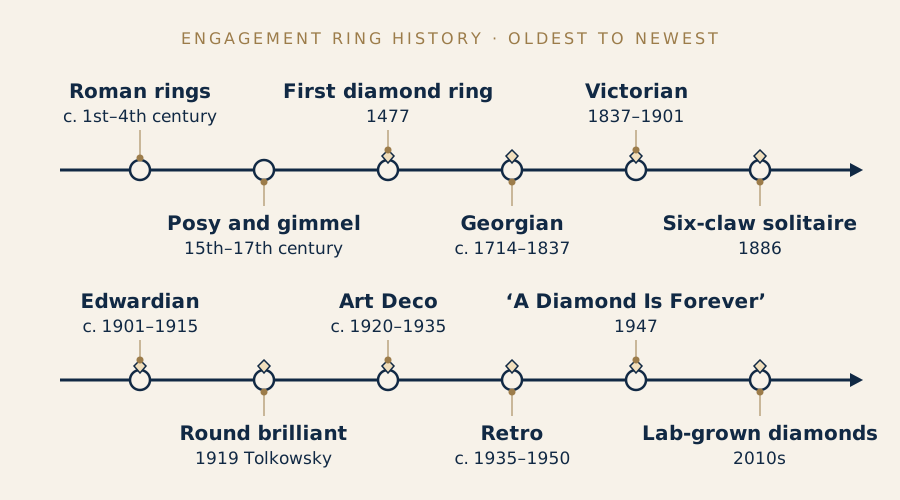
The history of engagement rings runs for about two thousand years, but the ring most Australians picture today, a diamond solitaire raised up on claws, is only a little over a century old. The idea began with Roman betrothal rings, which marked a contract between two families. Diamonds appeared in the late Middle Ages among royalty, spread to the wealthy in the Georgian and Victorian eras, and became the general standard in the 20th century as mining, cutting and advertising all changed.
Each period left fingerprints you can still read on an antique ring: the cut of the stone, the metal, the way the setting is built and even the hallmark stamped inside the band. If the parts of a ring are new to you, our labelled guide to the parts of an engagement ring names each one, and the glossary of jewellery terms covers the vocabulary used below. For everything else on choosing a ring, start at our engagement rings and education hub.
When did engagement rings start?
The clearest early evidence comes from ancient Rome. A Roman betrothal ring, sometimes called an anulus pronubus, was given when a marriage was agreed, and it was as much a sign of a legal and financial promise as of romance. Early examples were iron; by the later Roman period gold was common among those who could afford it. Some were made as tiny key rings, and many were fede rings, carved or cast with two clasped right hands, the Roman gesture for a sealed agreement.
The habit of wearing the ring on the fourth finger of the left hand is often traced to the belief in a vena amoris, a 'vein of love' thought to run from that finger straight to the heart. Anatomy says otherwise, but the custom stuck, and it is still the usual finger in Australia. Our guide to which finger an engagement ring goes on covers the countries that use the right hand instead. Rings given at the wedding itself have their own overlapping story, told in our history of wedding rings and wedding bands.
Through medieval and Renaissance Europe, betrothal rings took several forms:
- Posy rings: plain gold bands with a short verse engraved inside, popular in England from about the 15th to the 17th century.
- Gimmel rings: two or three hoops that slide together to form one ring. A couple could each keep a hoop during the engagement and join them at the wedding.
- Fede rings: the clasped-hands design carried on, and the Irish Claddagh ring (two hands holding a crowned heart) grew out of the same idea.
- Gem-set rings: rubies, sapphires and other coloured stones were prized in betrothal rings for centuries before diamonds took over.
What was the first diamond engagement ring?
The ring usually named as the first well-documented diamond engagement ring was given in 1477, when Archduke Maximilian of Austria became betrothed to Mary of Burgundy. Accounts describe a ring set with thin, flat diamonds arranged in the shape of the letter M. The story is famous partly because it was so unusual. At the time almost all diamonds came from India, cutting was basic, and only royalty and the very rich could own one.
Early diamonds were usually point cuts, which simply polished the faces of the natural eight-sided crystal, or table cuts, which ground the top point flat. Neither gave much sparkle by today's standards. Their appeal was diamond's hardness (10 on the Mohs scale, the hardest natural material), the symbolism of something that could not be scratched, and plain rarity.
A famous two-stone ring came later. In 1796 Napoleon Bonaparte gave Joséphine a ring with a pear-shaped diamond and a pear-shaped sapphire sitting side by side, a design called toi et moi, French for 'you and me'. The style has come back strongly, and our guide to two-stone toi et moi rings shows how that old idea is set today.
How did engagement ring styles change from Georgian to Art Deco?
Collectors and jewellers divide antique and vintage rings into eras. The dates are approximate and overlap, because jewellers kept making older styles long after new ones arrived, but each era has a recognisable combination of metal, cut and construction.
| Era | Approx. dates | Usual metals | Typical diamond cuts | Signature details |
|---|---|---|---|---|
| Georgian | c. 1714–1837 | Silver-topped yellow gold | Rose cut, old mine cut | Closed-back foiled settings, clusters, all hand-made |
| Victorian | 1837–1901 | Yellow and rose gold (9, 15, 18 ct) | Old mine, rose cut, early Old European | Serpent rings, half-hoop rows, flush (gypsy) settings |
| Edwardian | c. 1901–1915 | Platinum, platinum-topped gold | Old European, rose cut, single cut | Milgrain, filigree, lace-like piercework, knife-edge shanks |
| Art Deco | c. 1920–1935 | Platinum, white gold | Old European, early modern round, Asscher and step cuts | Geometric outlines, calibré-cut coloured stones, engraved shoulders |
| Retro | c. 1935–1950 | Yellow and rose gold | Old European, transitional round | Bold scrolled mounts, illusion plates to enlarge small diamonds |
| Mid-century | c. 1950–1970 | White and yellow gold, platinum | Modern round brilliant, marquise, baguette | Raised solitaires, cluster and cocktail styles |
Georgian engagement rings were made for candlelight. Diamonds were set in silver so they looked white, backed with gold so the metal did not mark the skin. Settings were often closed-back, meaning the metal covered the underside of the stone, sometimes with coloured foil behind it to boost brightness. Water trapped inside can damage that foil, which is why Georgian rings should never be soaked. Clusters of small rose-cut diamonds were common, the ancestor of today's cluster engagement rings built from many small stones.
Victorian engagement rings were sentimental. Prince Albert gave Queen Victoria a serpent ring set with an emerald, her birthstone, in 1839, and serpents became a symbol of eternal love. Acrostic rings spelled words with gem initials (Ruby, Emerald, Garnet, Amethyst, Ruby, Diamond for REGARD). After diamonds were found in South Africa in 1867, supply rose and diamond rings reached more of the middle class. Many Victorian rings found in Australia are stamped 15 ct, a gold standard used in Britain and its colonies until the 1930s.
Edwardian engagement rings are mostly white. Improved torches made platinum practical to work, and its strength allowed very fine filigree (openwork wire patterns) and milgrain (a border of tiny metal beads). Art Deco engagement rings swapped Edwardian lace for straight lines, stepped shoulders and calibré-cut sapphires, rubies or emeralds, which are small stones cut to fit a channel exactly. White gold arrived as a cheaper alternative to platinum around the same time.
Related guideVintage-Inspired Engagement Rings with Old-World Detail and Custom CharacterNot sure which one is right?
Send us the stones you are looking at and our gemologist will tell you which to choose and why.
How have diamond cuts in engagement rings changed through history?
The cut is often the quickest clue to a ring's age, because cutting technology changed in clear steps. Older cuts were shaped by hand and eye to save as much rough crystal as possible; modern cuts are planned by machine for light performance.
| Cut | Main period | Shape and facets | How to recognise it |
|---|---|---|---|
| Point cut | c. 14th–15th century | Natural octahedron, faces polished | Pyramid-like, very little sparkle |
| Table cut | c. 15th–17th century | Octahedron with a flat top | Dark, glassy look |
| Rose cut | c. 16th–19th century, revived today | Flat base, domed top, often 24 triangular facets | No pavilion, soft glow rather than sparkle |
| Old mine cut | c. 18th–late 19th century | Cushion outline, about 58 facets, high crown, small table | Chunky flashes, open culet seen as a dot |
| Old European cut | c. 1870s–1930s | Round, 58 facets, small table, high crown, large culet | Broad circular flashes, pinwheel pattern |
| Modern round brilliant | 1919 onwards, refined since | Round, 57 or 58 facets, larger table, tiny or no culet | Fine, even sparkle across the stone |
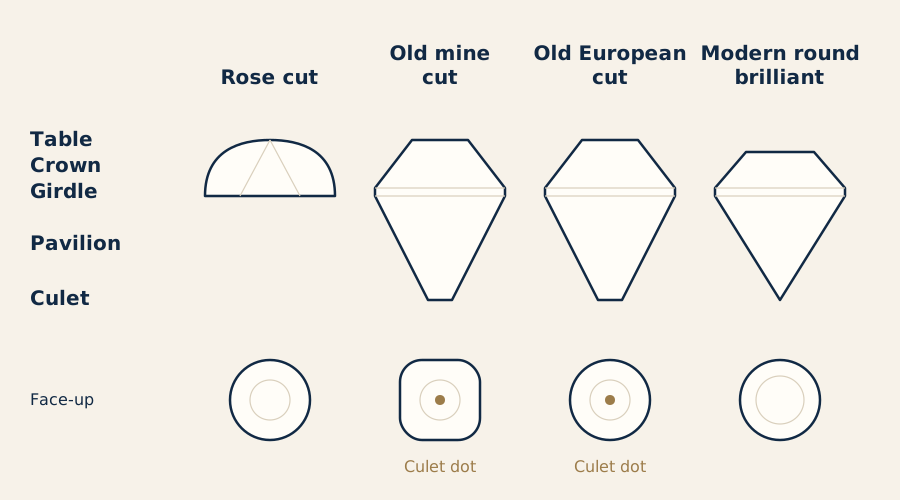
The culet is the small facet at the bottom point of a diamond. On old mine and Old European cuts it was polished large and flat, so you see it face-up as a small round or octagonal window. In 1919 Marcel Tolkowsky published round brilliant proportions, with a table about 53% of the diameter, a crown angle of about 34.5° and a pavilion angle of about 40.75°, that balanced brightness (white light) and fire (flashes of colour). Power-driven saws and bruting machines, which round the girdle, made that kind of precision practical.
Step cuts, with long parallel facets, suited Art Deco's straight lines; the Asscher cut was patented in 1902 and the emerald cut was widely used through the 1920s and 1930s. Later shapes followed: the modern oval brilliant from the late 1950s, the princess cut around 1980 and a steady stream of fancy shapes since. The oval engagement ring is a good example of a shape that feels classic but is a fairly recent design.
Why are engagement rings diamonds, and why did the solitaire win?
Before 1886, most single diamonds sat low in a collet (a metal cup) or among other stones. That year Tiffany & Co. introduced a setting with six slender claws that lifted one diamond high above the band, letting light enter from the sides. Combined with the larger supply of South African rough, the raised solitaire became the model for the engagement ring.
Advertising did the rest. From 1938 the diamond producer De Beers and its agency N.W. Ayer ran a long campaign in the United States linking diamonds with engagement, and in 1947 it introduced the line 'A Diamond Is Forever'. The campaign shaped expectations across much of the English-speaking world, including the idea that a diamond was the default stone. It is worth remembering that this is a fairly recent custom, not an ancient rule, and that a diamond ring is jewellery to wear rather than a financial asset.
During the Second World War, platinum was restricted for military use in the United States and elsewhere, so Retro rings of the late 1930s and 1940s used yellow and rose gold in bold, sculpted mounts. After the war the platinum or white gold solitaire returned, often with baguette side stones. The solitaire was never the only choice, though. Bypass rings, where the two ends of the band slide past each other, appear in Victorian and Retro jewellery, and the forked split shank band that opens towards the centre stone is common in mid-century and modern designs. To see how all these styles relate, read every engagement ring setting style compared.
What do engagement rings look like today?
Modern engagement rings borrow freely from every era. The halo, a ring of small diamonds around a centre stone, descends from Georgian and Victorian clusters and Art Deco target rings. Milgrain edges and engraved shoulders are Edwardian ideas made with modern tools. Placement has loosened up too: east-west rings that set an elongated stone sideways turn ovals, emeralds and marquises across the finger, a look seen in some Georgian and Victorian pieces.
The biggest change is lab-grown diamond. General Electric produced the first reproducible laboratory-grown diamonds in 1954 using high pressure and high temperature (HPHT), and gem-quality crystals followed decades later. Since the 2010s, lab-grown diamonds grown by HPHT or chemical vapour deposition (CVD) have been widely used in engagement rings. They are real diamond, with the same hardness, refractive index (about 2.42) and crystal structure as natural diamond, but they cost much less and must always be disclosed as lab-grown. Natural diamonds remain rarer, formed over a very long time underground.
Australia has its own chapter. The Argyle mine in Western Australia produced most of the world's pink diamonds from the 1980s until it closed in 2020, making Australian pinks a recognised part of modern ring history. Customs are also widening: men's engagement rings are now a common choice for couples where both partners want to wear one.
How is an antique engagement ring built compared with a modern one?
An antique ring and a modern ring can look alike from the top, but the construction underneath tells them apart. The gallery, the metal structure beneath the centre stone, is where the difference is clearest; our guide to under-gallery details such as piercework and hidden halos shows what to look for.
| Feature | Antique ring (before about 1940) | Modern ring |
|---|---|---|
| Metalwork | Hand-forged, hand-pierced, hand-engraved | Cast from a wax or 3D-printed CAD model, then hand-finished |
| Stone seats | Closed backs (Georgian) or hand-cut seats | Open seats cut precisely to the stone |
| Claws | Fine, often worn thin after decades | Thicker, uniform and easy to retip |
| Band | Often 1.5–2.5 mm, may be worn thinner at the base | Commonly 1.8–4 mm, chosen to suit the stone |
| Centre stone | Rose, old mine or Old European cut | Modern brilliant or any fancy cut, natural or lab-grown |
Bands wear thin at the base after 80 or 100 years of daily wear, and claws flatten until the stone is at risk. Restoring an antique ring usually means rebuilding claws, adding a new section of shank and sometimes re-seating a stone, while keeping the original metal and detail where possible. If you are planning a new ring in an old style, our guide to choosing a band width from 1.8 to 4 mm helps balance a delicate look with long-term strength.
How do you date an antique engagement ring? Step by step
You can narrow down a ring's age at home before having it assessed. Use these checks together, because rings are often altered over the years and one clue alone can mislead.
- Read the stamps. Look inside the band with a loupe for gold marks (9 ct, 15 ct, 18 ct, or numbers such as 375 and 750) or platinum marks (PLAT, PT). A 15 ct mark usually points to a British or Australian ring made before the 1930s.
- Check the metal colour. Silver on gold suggests Georgian or early Victorian; all-white platinum suggests Edwardian or Art Deco; yellow or rose gold in a bold mount suggests Retro.
- Look at the cut. A visible culet, high crown and small table point to an old mine or Old European cut. A flat-backed domed stone is a rose cut.
- Turn the ring over. A closed back over the stone suggests Georgian work. Hand-pierced galleries and filigree suggest Edwardian or Art Deco.
- Check the details. Milgrain, engraved shoulders, calibré coloured stones and geometric outlines each fit particular eras, as the era table shows.
- Look for changes. A newer section of band, fresh claws or a modern stone in an old mount are common and do not make a ring any less special, but they change how you describe it.
- Have it assessed. A gemmologist can test the stones, confirm natural or lab-grown, and check the setting is secure before you wear it daily.
If you would rather have a new ring with old-world character, our guide to vintage-inspired rings with era-accurate detail covers how milgrain, filigree and old-cut style stones are recreated today.
Design an era-inspired ring
Free consultation
Talk to a gemologist
Compare stones in person or online with Raj Sood, Graduate Gemologist (GIA), AJP (GIA).
Book a consultationShop this shape
FAQ
Common questions
When did engagement rings become popular?
Betrothal rings go back to ancient Rome, but diamond engagement rings became widespread only from the late 19th century, after South African diamond discoveries and the raised solitaire setting of 1886. Advertising from the late 1930s onwards made the diamond ring the general expectation.
Who gave the first diamond engagement ring?
The first well-documented example is usually credited to Archduke Maximilian of Austria, who gave Mary of Burgundy a diamond ring in 1477. Earlier diamond rings may have existed, but this is the one best recorded.
Why are engagement rings worn on the left hand?
The custom is often traced to the old belief in a vena amoris, a vein thought to run from the fourth finger of the left hand to the heart. It is not anatomically true, but the tradition continues in Australia, while some countries wear the ring on the right hand.
What is the difference between an antique and a vintage engagement ring?
By common trade convention, an antique ring is at least 100 years old and a vintage ring is usually at least 20 years old. 'Vintage-inspired' means a new ring made in an older style.
Are old cut diamonds worse than modern round brilliants?
Not worse, just different. Old mine and Old European cuts show broader, chunkier flashes and a softer glow, while modern round brilliants are cut for maximum brightness. Many people choose old cuts precisely for that look.
Did men wear engagement rings in the past?
Traditionally the betrothal ring was given to the woman, although gimmel rings could be split between a couple during the engagement. Men's engagement rings are a more recent and growing custom.

Ask a gemologist
Not sure which diamond to choose?
Raj Sood is a Graduate Gemologist (GIA) and master jeweller. Bring the stones you are considering, or send the reports, and he will tell you honestly which one is better and why.
Keep learning
Related guides
 Engagement Rings & SettingsEngagement Ring Anatomy
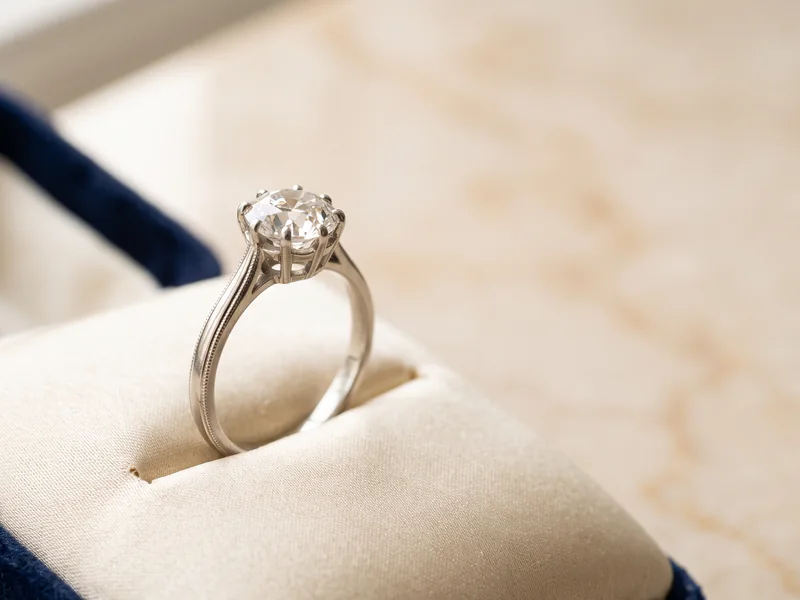 Engagement Rings & SettingsVintage-Inspired Engagement Rings with Old-World Detail and Custom Character
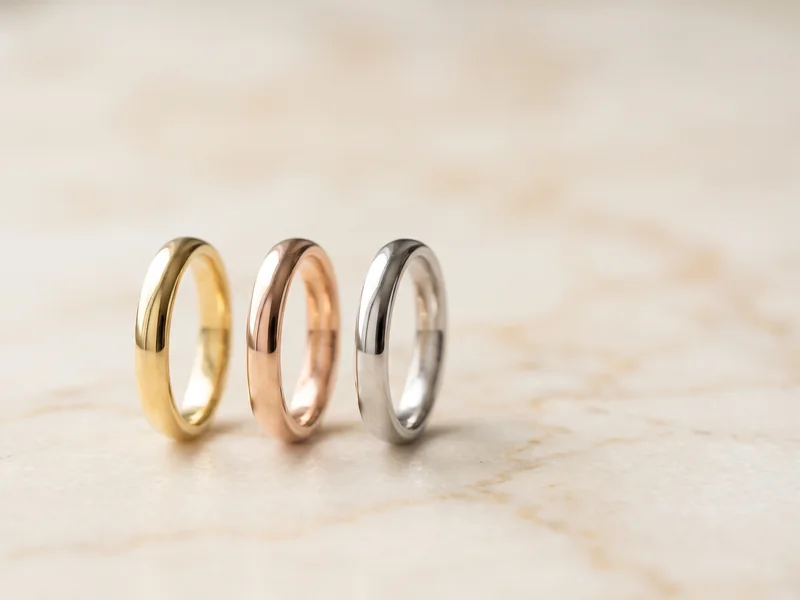 Engagement Rings & SettingsHistory of Wedding RingsEngagement Rings & SettingsEngagement Ring Setting Styles GuideEngagement Rings & SettingsEngagement Rings & Education
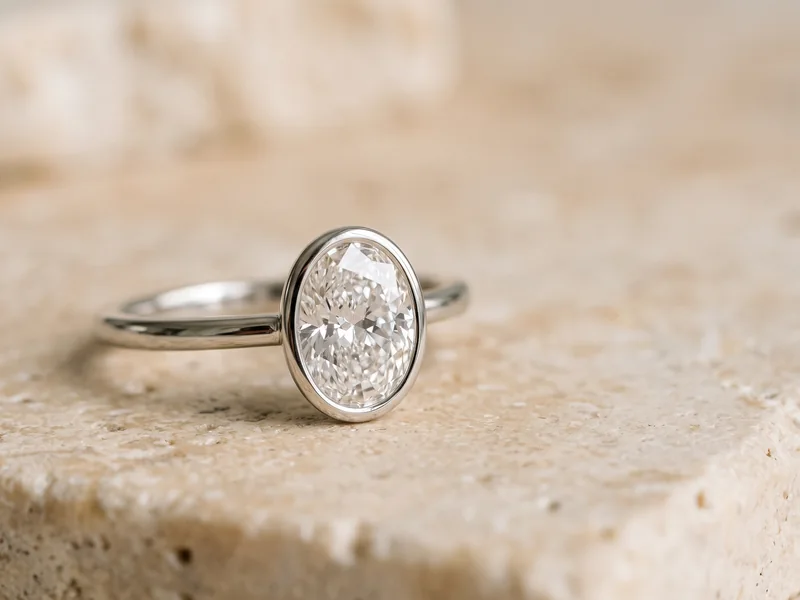 Engagement Rings & SettingsOval Engagement Rings
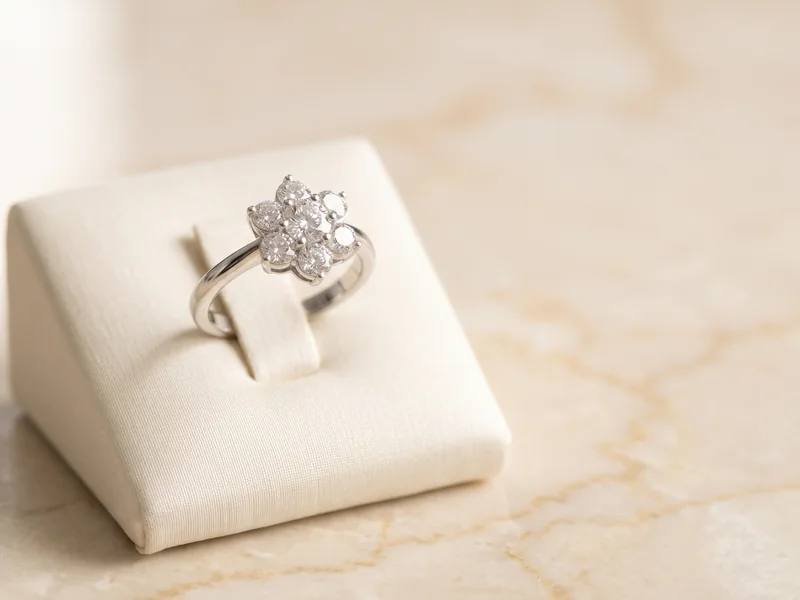 Engagement Rings & SettingsCluster Engagement RingsEngagement Rings & SettingsBypass Engagement Rings
Explore more
More guides on this topic
Education