
- Education
- Engagement Rings & Settings
- Halo vs Hidden Halo Engagement Rings: Which Setting Suits You?
Engagement Rings & Settings
Halo vs Hidden Halo Engagement Rings: Which Setting Suits You?
Halo vs hidden halo is one of the most common questions we hear about engagement ring settings. The two look similar in photos, but where the small diamonds sit changes the ring's size, its fit with a wedding band and how it wears for decades.
 Reviewed by Raj Sood, Graduate Gemologist (GIA), AJP (GIA)Master jeweller and Graduate Gemologist (GIA) · reviewed 4 November 2026
Quick answer
A halo is a ring of small diamonds around the centre stone, seen from above, that makes it look 2–3 mm wider and brighter. A hidden halo sits under the centre stone's girdle (edge), visible only from the side, so the diamond looks like a solitaire from above. Choose a halo for size, a hidden halo for subtlety.
Halo vs hidden halo: what is the difference?
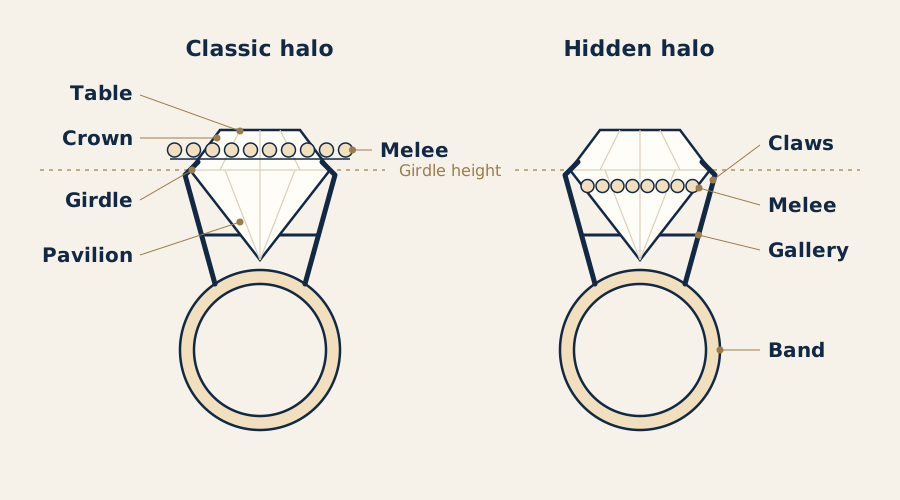
Both styles use a row of tiny diamonds called melee (pronounced MEL-ay: small diamonds, usually under about 0.20 carat) around a centre stone. The difference is where that row sits. A classic halo frames the centre stone at the top, so you see it face-up, looking straight down at the ring. A hidden halo sits lower, under the girdle (the thin outer edge of the centre diamond), so from above you see only the centre stone and the row of sparkle appears when you look at the ring from the side.
That one change in height affects almost everything else: how big the ring looks, how it pairs with a wedding band, how it wears over the years and what it costs. Both sit within the wider family of engagement ring setting styles, and any term on this page you have not met before is explained in our glossary of jewellery and setting terms.
| Classic halo | Hidden halo | |
|---|---|---|
| Where the melee sit | Around the top of the centre stone, just below its crown | Under the girdle, around the basket or gallery |
| Seen from above | Yes, a bright frame of small diamonds | No, it looks like a solitaire |
| Seen from the side | A line of diamonds near the top | A line of diamonds under the centre stone |
| Face-up size | About 2–3 mm wider overall | No change |
| Overall look | Bold, glamorous or vintage-leaning | Clean and classic, with a detail mostly the wearer sees |
| Protects the centre's edge | Yes, the halo takes knocks first | Partly, from the side |
| Wedding band fit | Often needs a curved or notched band | A straight band often sits close; check the profile |
| Upkeep | More exposed melee to check | Fewer exposed stones, but grime collects under the centre |
| Extra cost over a solitaire | Higher | Lower |
What is a halo engagement ring?
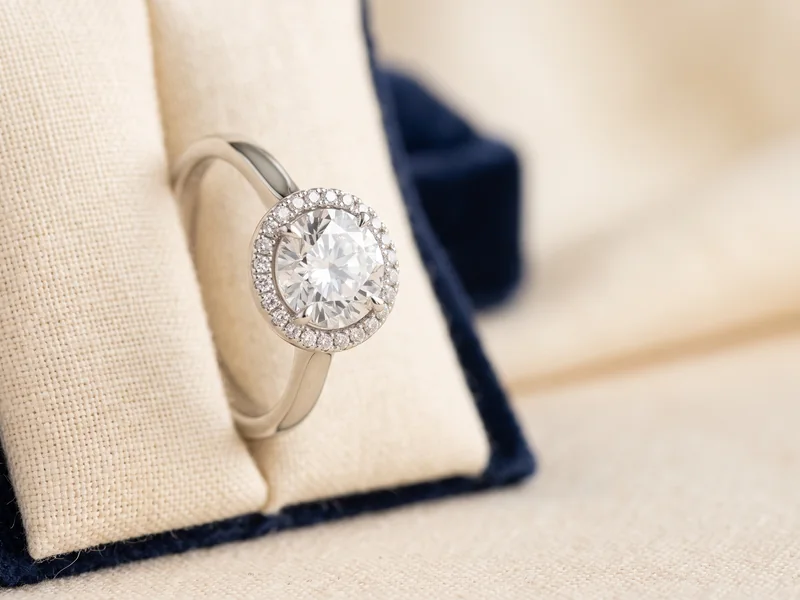
A halo engagement ring has a continuous frame of melee around the centre stone, sitting almost level with it. Around a 1 carat round, a single halo usually uses somewhere between 16 and 24 stones of about 0.9–1.3 mm each, held by tiny beads of metal raised from the setting (a technique called pavé or bead setting), by small micro-claws, or inside a thin rim with a milgrain edge (a fine beaded line of metal). Our full guide to halo engagement rings covers the styles in detail.
The halo does three jobs. It makes the centre stone look larger from a distance, it adds a lot of small, lively sparkle around the larger flashes of the centre, and it shields the centre's edge from knocks. That last point matters most for shapes with fragile points, such as pears, marquises and hearts.
- Matching halo: the halo follows the centre's outline, such as a round halo around a round or an oval halo around an oval.
- Contrasting halo: a different outline, such as a round halo around a cushion, which softens the corners. Our page on how halo shapes are drawn around each cut shows the common pairings.
- Floral or vintage halo: scalloped edges and milgrain that suit Art Deco and Edwardian-inspired designs.
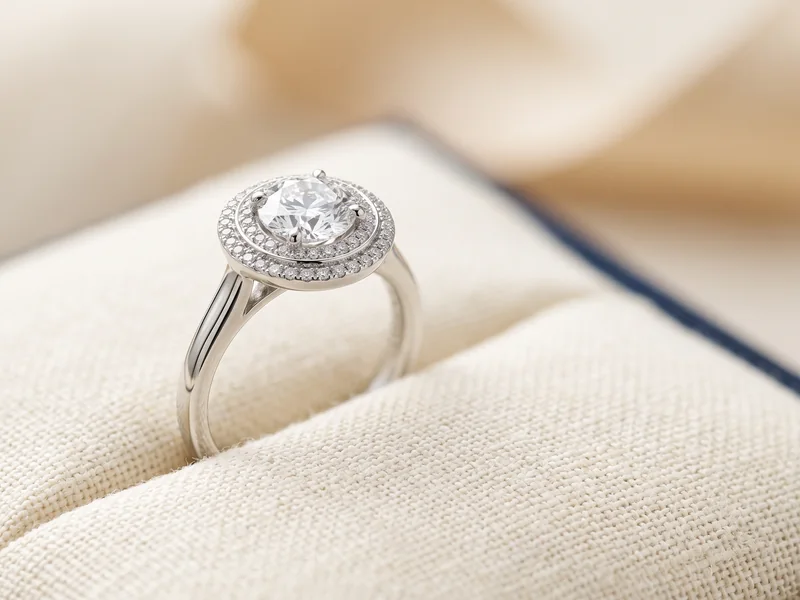
- Double halo: two rows of melee for even more spread; see our guide to double halo designs and how they wear.
- Coloured halo: small sapphires, natural or lab-created, around a white diamond, or white diamonds around a coloured centre.
What is a hidden halo engagement ring?
A hidden halo (also sold as a secret, surprise or under halo) places a row of melee, usually about 0.8–1.3 mm each, on a ring of metal just below the centre stone's girdle. It is built into the gallery, the metal structure that holds the stone up from underneath, so it is closely tied to the head design. If you are weighing up the basket underneath it, our comparison of basket, trellis and peg head settings explains how each one supports the stone.
From above, the ring reads as a solitaire. From the side, and especially when the hand moves, the hidden halo throws small flashes of light under the centre stone. Many people choose it because it is a detail that belongs to the wearer rather than the room, in the same spirit as engraving or a stone set inside the band. Our guides to everything about hidden halo rings, decorative under-gallery details and personal hidden details in a custom ring go further.
There is one trade-off. The hidden halo needs roughly 1–2 mm of room beneath the girdle, so the centre stone often sits a little higher than it would in a plain low basket. For an active job, or if you prefer a ring that sits close to the finger, read our page on how setting height changes comfort and wear before deciding. Seeing the ring from the side, ideally in a CAD render (a 3D computer drawing) before it is made, is the clearest way to judge this; our tips for reading a ring's side profile show what to look for.
Does a halo make a diamond look bigger than a hidden halo?
Yes. A classic halo adds the width of the melee plus a thin rim of metal on each side, which usually makes the overall face-up outline about 2–3 mm wider. From a metre or so away, the eye reads the centre and halo as one bright shape. Up close you can still see they are separate stones, so a halo makes a ring look bigger, not the diamond itself. A hidden halo adds nothing face-up.
| Centre stone (round) | Centre diameter | Overall width with a classic halo | Face-up width with a hidden halo |
|---|---|---|---|
| 0.50 ct | about 5.1 mm | about 7.4–8.0 mm | about 5.1 mm |
| 0.75 ct | about 5.8 mm | about 8.1–8.7 mm | about 5.8 mm |
| 1.00 ct | about 6.4 mm | about 8.7–9.4 mm | about 6.4 mm |
| 1.50 ct | about 7.4 mm | about 9.7–10.4 mm | about 7.4 mm |
| 2.00 ct | about 8.1 mm | about 10.4–11.1 mm | about 8.1 mm |
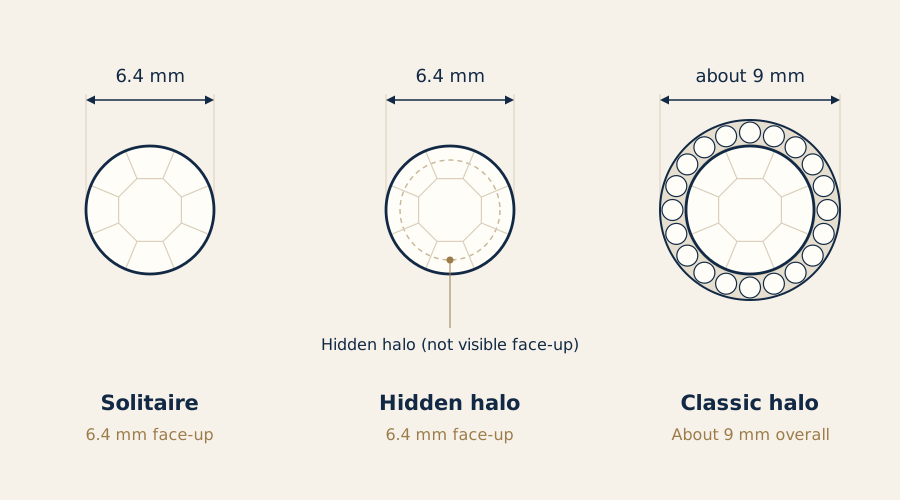
These figures assume melee of about 1.0–1.3 mm; bigger melee or a double halo widen the outline further. The same logic applies to fancy shapes: a 1 carat oval of about 8 × 6 mm in a halo measures roughly 10.5 × 8.5 mm overall.
So the honest way to think about it: a halo spends part of the budget on apparent size, while a hidden halo leaves the centre to speak for itself. If a solitaire look matters but you want a bigger stone, the money that would go into a classic halo can often move the centre up a size step instead.
Not sure which one is right?
Send us the stones you are looking at and our gemologist will tell you which to choose and why.
How do halo and hidden halo rings wear over the years?
This is where the repair bench tells you more than any photo. A classic halo is the widest, highest-exposed part of the ring, so it takes the knocks first: car doors, benchtops, gym weights and trolley handles. The metal beads holding each melee are only about 0.2–0.3 mm across, and over years of wear they flatten and thin. Once a bead wears down, a stone can work loose and fall out, often without the wearer noticing.
- Re-tightening and re-beading: the most common halo repair, raising fresh metal over worn beads.
- Replacing lost melee: a jeweller matches size and colour as closely as possible; well-matched stones are hard to tell apart.
- Rebuilding a worn rim: a thin outer edge or milgrain can wear smooth and may need rebuilding after many years.
- Re-plating white gold: rhodium plating on 18ct white gold wears fastest on the high points of a halo.
A hidden halo is better protected from face-up knocks, because the centre stone and its claws sit above and outside it. Its weak spots are different. It meets the wedding band side-on, so metal and diamond rub against the band every day, and the gallery underneath traps soap, hand cream and skin oils. That build-up coats the underside of the centre diamond and makes it look noticeably duller, so a hidden halo ring benefits from regular cleaning with warm water, a little mild dishwashing liquid and a soft toothbrush.
Halo and hidden halo melee each sit in their own seat, so one loose stone is usually a small fix. That is different from how channel-set stones are held and repaired, where a bent channel wall can loosen a whole row. For either halo style, have the stones checked every 6–12 months, and ask your jeweller before using an ultrasonic cleaner, which can loosen melee that already have worn beads.
Related guideEngagement Ring Side Profile GuideWill a wedding band sit flush with a halo or hidden halo?
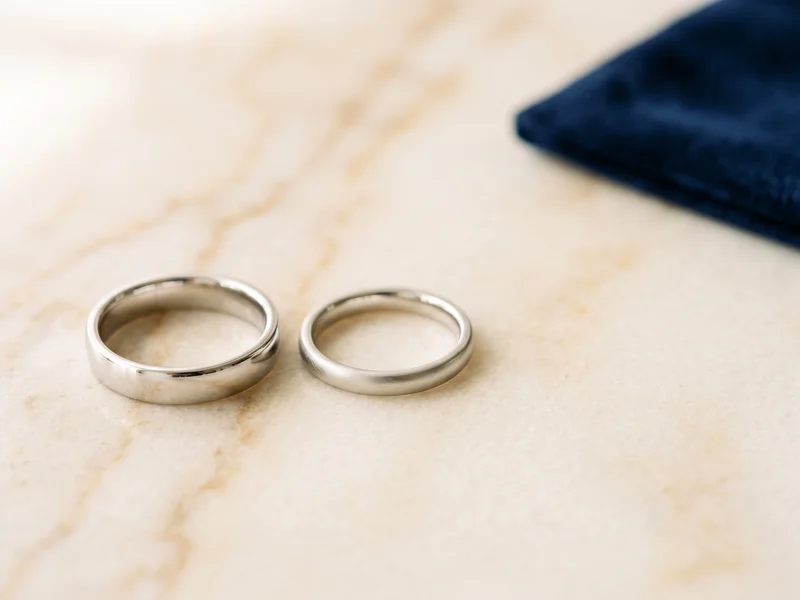
A classic halo is usually wider than the shoulders of the engagement ring, and on a low setting it sits right where a wedding band would go. A straight band then leaves a gap. The usual answers are a curved or contoured band, a notched band, or a halo set just high enough for a straight band to slide beneath it. Our guide to wedding bands that pair well with halo rings shows each option.
A hidden halo is narrower, sitting inside the outline of the centre stone, so a straight band can often sit close or touching. It depends on how low the hidden halo is built and on the shape: elongated stones such as ovals and pears overhang the band more, so a low-set one can leave a gap unless it sits high enough for the band to slide beneath. Ask to see the ring from the side with a band beside it before the design is finalised.
The engagement ring's own band affects this too. A slim band of about 1.8–2.2 mm makes a centre look larger and leaves room for a matching wedding band, while 2.5 mm and above is sturdier for daily wear; see band widths from 1.8 to 4 mm compared. Shapes such as reverse taper bands, which widen as they approach the head, and knife-edge bands, which rise to a fine ridge, change how a halo looks from the side. A comfort-fit inner shape makes a slightly top-heavy halo ring sit more evenly on the finger.
Which diamond shapes and metals suit each style?
- Round: suits both. A round halo is the classic size boost; a hidden halo keeps a timeless solitaire look.
- Oval, pear and marquise: a hidden halo adds side sparkle to elongated shapes without changing their outline; a classic halo protects pear and marquise points.
- Cushion and princess: a classic halo softens or frames the corners; a hidden halo needs careful work around square corners.
- Emerald and Asscher: a thin halo emphasises the step-cut outline; a hidden halo adds pinpoint sparkle that the broad flashes of a step cut do not give on their own.
- Heart: a classic halo protects the point and cleft; see our protective settings for heart diamonds.
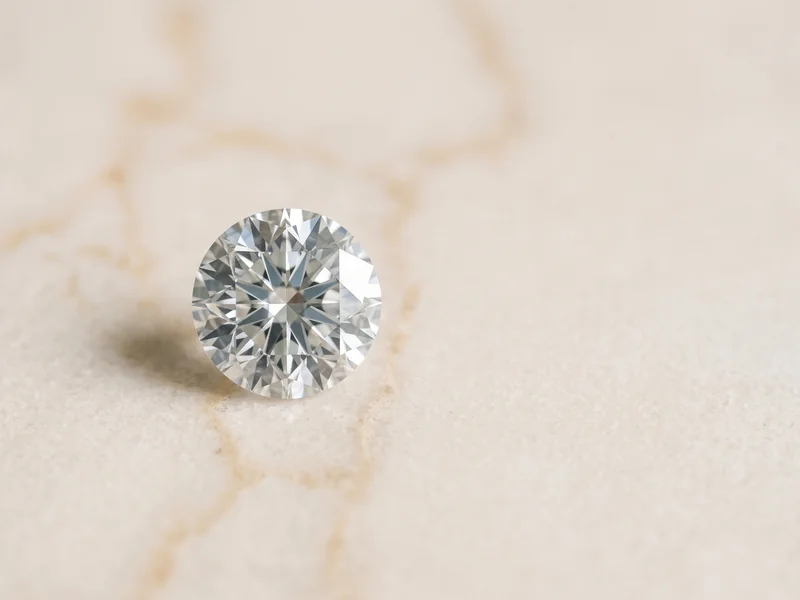
Melee colour should be close to the centre's colour, ideally within a grade or two. If the halo is much whiter than the centre, the centre can look warmer by comparison. Melee can be natural or lab-grown regardless of the centre stone, and the two should be described separately on paperwork; our page on lab-grown melee in pavé and halo work explains grades, sourcing and disclosure.
For metal, platinum is dense and wears by moving rather than losing metal, which suits fine beads and claws over many years. 18ct white gold is lighter and usually plated with rhodium, which needs renewing every one to three years depending on wear. Yellow and rose gold halos suit warmer centre stones and vintage designs; a common approach is a white metal head for the centre and halo on a yellow or rose gold band.
Halo vs hidden halo: how much does each cost in Australia?
The extra cost comes from two things: the melee themselves and the setting labour, because every small stone needs a seat cut and beads raised by hand. A classic halo uses more and slightly larger stones than a hidden halo, and its exposed position needs more careful finishing.
| Setting only, 18ct gold, 1 ct round centre | Approximate total melee weight | Approximate setting price (AUD) |
|---|---|---|
| Plain solitaire | none | about $1,200–$2,500 |
| Hidden halo | about 0.08–0.15 ct | about $1,800–$3,500 |
| Classic halo | about 0.15–0.30 ct | about $2,200–$4,500 |
| Double halo | about 0.30–0.50 ct | about $3,000–$6,000 |
These are broad ranges for the setting alone, without the centre stone. Platinum usually adds to the price, pavé down the band adds more again, and lab-grown melee costs less than natural melee of the same size and grade. Whichever you choose, the centre stone remains the largest part of the budget.
Design your halo or hidden halo setting
How do you choose between a halo and a hidden halo? Step by step
- Decide on the face-up look. If you want the ring to read as large and bright from across the room, lean towards a classic halo; if you want a solitaire look, a hidden halo.
- Check the size numbers. Compare the overall millimetre width with a halo against simply choosing a larger centre stone in a solitaire or hidden halo.
- Look at the side profile. Ask how high the centre sits with each style and whether that suits your work and daily life.
- Plan the wedding band now. Hold a straight band against each design, or view it in a CAD render, to see whether you need a curved or notched band.
- Match the melee. Confirm the melee colour and clarity, and whether they are natural or lab-grown.
- Choose the metal for the beads. Consider platinum or a white metal head for long-lasting claws and beads.
- Book the upkeep. Plan a check every 6–12 months and regular gentle cleaning, especially under a hidden halo.
Free consultation
Talk to a gemologist
Compare stones in person or online with Raj Sood, Graduate Gemologist (GIA), AJP (GIA).
Book a consultationShop this shape
FAQ
Common questions
Is a hidden halo worth it?
It is worth it if you like a clean solitaire look from above but want extra sparkle from the side. It costs less than a classic halo and adds no face-up size, so it suits people who would rather put more of the budget into the centre stone.
Does a halo make a diamond look bigger?
A classic halo makes the overall outline about 2–3 mm wider, so the ring looks bigger from a distance. Up close you can see the halo is separate small stones. A hidden halo does not change the face-up size.
Can you have both a halo and a hidden halo?
Yes. Many designs combine a classic halo on top with a hidden halo underneath, or use a double halo for more spread. Each extra row adds stones to maintain and adds to the cost.
Do halo engagement rings lose stones?
They can over many years, because the tiny metal beads holding each melee wear down with daily knocks. Having the stones checked every 6–12 months lets a jeweller tighten beads before a stone is lost.
Will a straight wedding band sit flush with a hidden halo?
Often it will sit close, because a hidden halo stays within the outline of the centre stone. It depends on how low the setting is and on the stone's shape, so check the side profile with a band before finalising the design.
Is a halo or a hidden halo more expensive?
A classic halo usually costs more, because it uses more and slightly larger melee and needs more setting work. As a rough guide, a hidden halo setting in 18ct gold sits several hundred dollars below a classic halo.
Terms in this guide

Ask a gemologist
Not sure which diamond to choose?
Raj Sood is a Graduate Gemologist (GIA) and master jeweller. Bring the stones you are considering, or send the reports, and he will tell you honestly which one is better and why.
Keep learning
Related guides
 Engagement Rings & SettingsHidden Halo Engagement Rings
 Engagement Rings & SettingsHalo Engagement Rings
 Wedding Bands & EternityBest Wedding Band for Halo Engagement Rings
 Engagement Rings & SettingsHalo Shapes ExplainedEngagement Rings & SettingsEngagement Ring Setting Styles Guide
 Engagement Rings & SettingsDouble Halo Engagement Rings
 Lab-Grown DiamondsLab-Grown Diamond Melee in Pavé and Halo Settings
 Engagement Rings & SettingsHidden Details That Make a Custom Engagement Ring Personal
Explore more
More guides on this topic
Education